The Home Of Noah
This is part 9 of the The History of the World Series
; Introduction is part 1.
Click here to read in series
So we’ve talked a lot about Noah’s sons, but what about Noah himself? He simply disappears from the Bible’s record, never mentioned alive again after that embarrassing wine incident. Yet he continued to live for 350 years after the flood.
Surely, had he been present at Babel, it would never have happened. Hence he was somewhere else, but where? But the Bible is utterly silent about his whereabouts, and offers no information about any of his descendants until, inexplicably, we find Abraham and his father Terah at Ur.
Fortunately, the Sumerians talked about him quite a bit – including where he went to live. In the Akkadian versions of the flood stories, the man who was saved from the flood – Noah – is called Utnapishtim, literally “he who found life.”
This probably isn’t meant to be a translation of the name Noah, but rather a description of him; there was often a superstition regarding using the names of powerful people, especially ones seen as divine or semi-divine, so it’s likely they consciously avoided using his name.
The Sumerian version of his name is Ziusudra – various transliterations of this exist, but we’ll stick to this one for consistency. The Greek historians, retelling Babylonian history, spelled the name as Xisuthros.
Using these three sources, we can provide quite a lot of information on what happened to Noah that is not found in the Bible. Some of it is wrong, of course, but we can generally tell what that is by context. For example, one version tells us…
After the flood had been upon the earth, and was in time abated, Xisuthrus … made an opening in the vessel, and upon looking out found that it was stranded upon the side of some mountain; upon which he immediately quitted it with his wife, his daughter, and the pilot. Xisuthrus then paid his adoration to the earth: and having constructed an altar, offered sacrifices to the gods, and, with those who had come out of the vessel with him, disappeared.
They, who remained within, finding that their companions did not return, quitted the vessel with many lamentations, and called continually on the name of Xisuthrus. Him they saw no more; but they could distinguish his voice in the air, and could hear him admonish them to pay due regard to religion; and likewise informed them that it was upon account of his piety that he was translated to live with the gods; that his wife and daughter, and the pilot, had obtained the same honour. … (Berossus, as quoted in Alexander Polyhistor)
So examining this for facts, we see immediately that it cannot be entirely true; Noah and his sons are seen interacting in Genesis 9 what must be at least a few years later, more likely decades. He cannot have been spirited away directly from Mt. Ararat.
Yet rather than utterly discard the information, let’s try and harmonize it. We know that by the time of Babel, Noah was absent; so it’s likely there was a point when Noah did leave, never to be seen again. This story, therefore, may have had the facts right, but the timing wrong.
More interestingly, this legend suggests that he did not go alone, but went with his wife (of course), and “his daughter, and the pilot.” There is no mention of a pilot in the Bible, but given that the only inhabitants of the ark were his sons, it must be one of them; given that his oldest – or at least his birthright son – was Shem, the pilot can only be Shem.
Telling us, therefore, that when Noah left, Shem and his wife went with him. As we would have expected anyway. This doesn’t mean they didn’t part ways later, but at the very least they probably went in the same direction away from Sumer when they did leave.
TO DILMUN
The passage above tells us that Noah (and the others) received “the reward of his piety in being taken up to dwell henceforth among the gods.” We argue that this was true, but that it happened perhaps a century or two after Ararat, not immediately. The Sumerians add:
The Epic of Ziusudra adds an element at lines 258–261 not found in other versions, that after the flood “king Ziusudra … they caused to dwell in the KUR Dilmun, the place where the sun rises.” The Sumerian word “KUR” is an ambiguous word. Samuel Noah Kramer states that “its primary meanings is ‘mountain’ is attested by the fact that the sign used for it is actually a pictograph representing a mountain. From the meaning ‘mountain’ developed that of ‘foreign land,’ since the mountainous countries bordering Sumer were a constant menace to its people. Kur also came to mean ‘land’ in general.’” The last sentence can be translated as “In the mountain of crossing, the mountain of Dilmun, the place where the sun rises.” (Wiki, Ziusudra)
Scholars mostly say Dilmun was modern day Bahrain in the Persian Gulf. This fits well with later descriptions of Dilmun from the time of the Assyrians ‑700, but it fits quite poorly with earlier descriptions from the time of Nimrod (-2100).
There are two other place names that seem to have “moved” from the time of ancient Sumer to the time of Assyria, named Magan and Meluhha; ancient texts seem to refer to somewhere near the Indus valley, but later Assyrian texts place these locations in Egypt, far to the west.
Scholars have no idea why this is, but I see no reason why Dilmun could not, likewise, have moved west somehow. Perhaps simply because a settler thought it would be fun to name a new colony after an even older, more honorable one – maybe where he himself had come from (New York, New Zealand, etc).
Regardless, you’ll notice in that above quote that Dilmun is called “the mountain of crossing, the mountain of Dilmun.” The article rushes to explain that KUR, mountain, also has the meanings of “land in general” in later texts.
But not in early texts – I mean, the cuneiform sign KUR, “mountain,” is literally a picture of a mountain. And Dilmun is old. Any reference to Dilmun’s mountainous state would predate those later corruptions and certainly preserve the original meaning of “mountain.”
Before the land of Dilmun yet existed, the E-ana of Unug Kulaba was well founded, and the holy jipar of Inana in brick-built Kulaba shone forth like the silver in the lode. Before …… carried ……, before ……, before …… carried ……, before the commerce was practiced; before gold, silver, copper, tin, blocks of lapis lazuli, and mountain stones were brought down together from their mountains, before …… bathed for the festival, ……, …… time passed. (ELA)
Proverbially placing the founding of Uruk before the existence of Dilmun demonstrates that Dilmun was seen as very ancient even then. So this story sets Uruk’s founding before the existence of mining of lapis (and therefore the settling of Aratta) and before the existence of commerce between them.
Nor do we disagree with this timeline; Nimrod no doubt moved on to start Uruk right away after Babel; even as the boats carrying Arphaxad were plying east to settle the Indus Valley. Meanwhile, Noah was heading towards Dilmun.
Because in spite of the Sumerian propaganda about Uruk’s primacy, they never lost the idea of Dilmun as a perfect paradise, superior even to Uruk. In fact, some Sumerian stories placed it as the site of the creation of the first man.
While we don’t believe that is true literally – Adam having been created before the flood – as the post-flood home of Noah, the father of mankind, it could easily be confused with Eden. It certainly possessed all the hallmarks of Eden in the Sumerian imagination…
In Sumerian mythology, Dilmun is depicted as a pristine paradise, a “land of the living” free from sickness, aging, or death, prominently featured in myths such as Enki and Ninhursag—where it is portrayed as a pure, virginal land created by the gods—and the Epic of Gilgamesh, where the hero seeks eternal life there. (Grokipedia, Dilmun)
This describes Dilmun as a land where no one dies; and if that is indeed where the patriarchs of Abraham’s line went – none of whom died for around 350 years after the flood – it would certainly have gained a reputation for eternal youth, earning it the synonym “the land of the living.”
WHERE IS IT?
Scholars today are reasonably convinced it is located in modern Bahrain; and while that does check some boxes, especially based on later sources from the Ur III period (-1600) onward, it completely fails on other grounds.
First of all, it is portrayed on the far side of the world, after many journeys through mountains and deserts in many stories; it’s so hard to reach Noah, that Utnapishtim has the epithet “the faraway.” Bahrain… isn’t that far away.
To maintain legendary and mythical status, a place must be remote; Shangri-la, Timbuktu, Cusco; not Cleveland. And Bahrain-Dilmun was just a short safe boat ride away from Sumer. Also, as has been mentioned, Bahrain is not mountainous, over mountains, or in any way associated with mountains.
Further, it’s portrayed as “where the sun rises,” and while Bahrain is faintly east from Uruk, it’s so slight that I doubt that ancient mariners could have even told for sure (longitude is hard to figure when sailing).
Take a look at “Dilmun,” marked over Bahrain, on the map below from Wikipedia. You can see that this location certainly doesn’t scream “so far east, it’s where the sun comes from!”
Particularly when we know that the Sumerians interacted with the Indus Valley from the earliest times (marked Meluhha, probably correctly) on the map below. That was much farther east, yet they were never identified with sunrise!
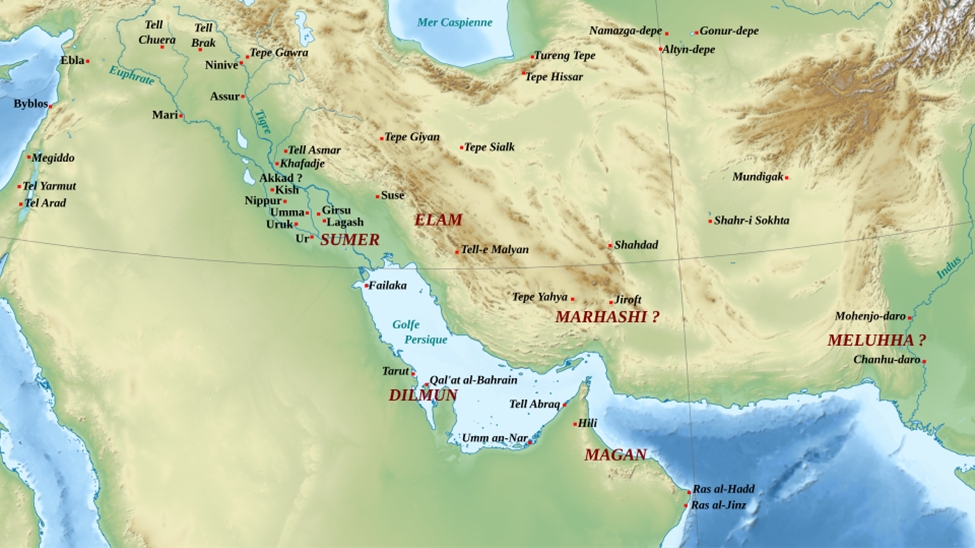
These, and other flaws with the consensus on Dilmun led one of the most eminent scholars on the subject to search for it farther east in the 1960’s, in a place familiar to us by now… the Indus Valley.
In another Sumerian text, Dilmun is described as a blessed, prosperous land dotted with “great dwellings,” to which the countries of the entire civilized world known to the Sumerians, brought their goods and wares. A number of cuneiform economic documents excavated by the late Leonard Woolley at Ur–Biblical Ur of the Chaldees–one of the most important cities of Sumer, speak of ivory, and objects made of ivory, as being imported from Dilmun to Ur. The only rich, important land east of Sumer which could be the source of ivory, was that of the ancient Indus civilization, hence it seems not unreasonable to infer that the latter must be identical with Dilmun. (The Indus Civilization and Dilmun, the Sumerian Paradise Land; Kramer)
Bahrain, while developed in antiquity, hardly seems to have had “great dwellings”; Harappa, on the other hand, or Mohenjo-Daro, would certainly have justified the term. Furthermore, Dilmun was a source of ivory; which only comes from Africa or India. Only one of which is east.
Historians tend to get around this by envisioning Bahrain-Dilmun as a trading post where everyone brought their wares, and the Sumerians bought them second hand. But the most ancient texts don’t really suggest that Dilmun was a trading post; they’re described as the source of these objects.
Besides, looking at the geography, why would you go to the trouble of sailing from the Indus up into the Persian Gulf, and not go on up to trade with Ur in person – which was a coastal port city in ancient times? You’re definitely going to lose a significant chunk of money to the middleman. But there are other connections between Dilmun and the Indus culture…
[given the amount of baths and wells] it is not unreasonable to assume therefore … that the Indus people had developed a water cult of deep religious import centering about a water god and featured by sundry rites concerned with lustration and purification. All of which seems to fit in rather surprisingly well with the Dilmun-Indus land equation. For the god most intimately related to Dilmun is Enki, the Sumerian Poseidon, the great Sumerian Dilmun-myth which tells the following story:
Dilmun, a land described as “pure,” “clean,” and “bright,” a land which knows neither sickness nor death, had been lacking originally in fresh, life-giving water. The tutelary goddess of Dilmun, Ninsikilla by name, therefore pleaded with Enki, who is both her husband and father, and the latter orders the sun-god Utu to fill Dilmun with sweet water brought up from the earth’s watersources; Dilmun is thus turned into a divine garden green with grain-yielding fields and acres. (Ibid)
In case you’re interested, I’ll tell the first part of the myth in the Sumerian’s own words; note how holy, clean, and pure Dilmun was in comparison with all other cities. Which can only be the result of Noah’s presence there – or at the very least, Noah-following cultures.
The holy cities–present them to him (Enkil?)[sic; probably meant to suggest Enlil],
The land Dilmun is holy,
Holy Sumer–present it to him,
The land Dilmun is holy.
The land Dilmun is holy, the land Dilmun is pure,
The land Dilmun is clean, the land Dilmun is holy;
…That place is clean, that place is most bright.
We already know that Aratta was ruled by “the lord of purification,” and that the Indus was full of baths and wells. This interest with cleanliness certainly fits what we know about them.
In Dilmun the raven utters no cry,
The wild hen utters not the cry of the wild hen,
The lion kills not,
The wolf snatches not the lamb,
Unknown is the kid-devouring wild dog,
Unknown is the grain-devouring boar,
The malt which the widow spreads on the roof–
The birds of heaven do not eat up that malt,
The dove droops not the head,
The sick-eyed says not “I am sick-eyed,”
The “sick-headed” says not “I am sick-headed,”
Its old woman says not “I am an old woman,”
Its old man says not “I am an old man,”
Unwashed is the maid, no water is poured in the city,
Who crosses the river (of the Nether World) utters no groan (?),
The wailing priest walks not round about him,
The singer utters no wail,
By the side of the city he utters no lament. (Ibid)
No one would have invented such a myth about a place as close as Bahrain, knowing it could easily be tested by any sailor. So either it was literally true of Bahrain, which no historian believes… or else it was a land so far away that no one knew anyone who had ever been there.
We also know that the patriarchs lived abnormally long lives, and many of them probably almost certainly lived in the Indus Valley – Arphaxad for near-certain. And the Indus is, indeed, due east of Sumer “where the sun rises.” The poem above continues
For Dilmun, the land of my lady’s heart, I will create long waterways, rivers and canals, whereby water will flow to quench the thirst of all beings and bring abundance to all that lives.
This describes a river valley, with “long waterways” and “canals.” There are not many places that could have described at the time; definitely not Bahrain. perhaps Egypt, far to the west; Sumer proper, which no one believes it was; or else the Indus Valley, which the Sumerians themselves said was filled with ditches and irrigated for grain growing when they besieged Aratta.
THE EPIC OF GILGAMESH
In the Epic of Gilgamesh, the hero sets out to find the secret of immortality from the man who had the secret, Utnapishtim; upon finally finding him, Utnapishtim relates the story of the flood in his own words, then says that after the flood and the sacrifice after it…
Then Enlil went up into the boat, he took me by the hand and my wife and made us enter the boat and kneel down on either side, he standing between us. He touched our foreheads to bless us saying, “In time past Utnapishtim was a mortal man; henceforth he and his wife shall live in the distance at the mouth of the rivers.” Thus it was that the gods took me and placed me here to live in the distance, at the mouth of the rivers. (Epic of Gilgamesh [EOG])
“Mouth of the rivers” is not here defined, but in Babylonian contexts this would generally be understood as the Tigris and Euphrates. It is not, however, strictly necessary that it be there – and a location at the river mouth of the Tigris/Euphrates would be quite impossible based on the rest of the description in the epic.
Still, most scholars leaning heavily on the “mouth of the rivers” idea and the belief that at the time of Gilgamesh world trade was in its infancy, concluded that Dilmun must be very close to the delta, leading them to Bahrain.
Besides that one point, Bahrain does not fit the narrative of Gilgamesh at all. Because the epic makes it clear, Gilgamesh had to travel an extreme distance to get to Utnapishtim, “whom they call the faraway.”
‘Because I am afraid of death I will go as best I can to find Utnapishtim whom they call the Faraway, for he has entered the assembly of the gods.’ So Gilgamesh travelled over the wilderness, he wandered over the grasslands, a long journey, in search of Utnapishtim, whom the gods took after the deluge; and they set him to live in the land of Dilmun, in the garden of the sun; and to him alone of men they gave everlasting life. (EOG)
And the fact is, even by 3rd millennium BC standards, Bahrain wasn’t that far away. A quick float down the river, a coast-hugging voyage, and you’re there. But Gilgamesh faced desert, grasslands, and even immense mountains – which do not exist in that part of the world. This alone completely excludes any possibility of Bahrain, which will not be mentioned again.
So at length Gilgamesh came to Mashu, the great mountains about which he had heard many things, which guard the rising and the setting sun. Its twin peaks are as high as the wall of heaven and its paps reach down to the underworld. At its gate the Scorpions stand guard, half man and half dragon; their glory is terrifying, their stare strikes death into men, their shimmering halo sweeps the mountains that guard the rising sun. (EOG)
These “great mountains” are a truly impressive mountain range which “guard the rising and the setting sun.” Since those events happen on the opposite sides of the sky, that must be a matter of perspective; for one group of people, these mountains are the eastern barrier; for another, they are the western barrier.
To Gilgamesh, coming from the west, he sees “a shimmering halo sweep the mountains that guard the rising sun.” Most scholars place these mountains far to the west, in Lebanon. But that’s simply wrong. Because these mountains, as he approached them, guard the rising sun. Which is… east.
But you may recall that the Lord of Aratta describes the mountain range to his west:
The mountain range is a warrior, …… high, like Utu going to his abode at twilight, like one from whose face blood drips; or like Nanna, who is majestic in the high heavens, like him whose countenance shines with radiance, who …… is like the woods in the mountains. (ELA)
Utu/Shamash goes to his abode at twilight when the sun sets; hence, these mountains were to the west of him at the time from the Indus Valley. These same mountains which Gilgamesh had to cross towards the rising of Shamash!
Mountains which Gilgamesh had heard of from his father/grandfather Lugalbanda (there’s some discussion here), because Lugalbanda had crossed them to invade Aratta! We will note, in passing, that these mountains are called “Mashu,” here. That will be useful at the conclusion of this article.
THROUGH THE MOUNTAIN
Meanwhile Gilgamesh talks to the scorpion men; certainly guards posted by the Arattans to control the passes. Their weapons and armor must have given the impression of a scorpion from a distance. He tells them…
‘… I have travelled here in search of Utnapishtim my father; for men say he has entered the assembly of the gods, and has found everlasting life: I have a desire to question him, concerning the living and the dead.’ The Man-Scorpion opened his mouth and said, speaking to Gilgamesh, ‘No man born of woman has done what you have asked, no mortal man has gone into the mountain; the length of it is twelve leagues of darkness; in it there is no light, but the heart is oppressed with darkness. From the rising of the sun to the setting of the sun there is no light.’
Gilgamesh said, ‘Although I should go in sorrow and in pain, with sighing and with weeping, still I must go. Open the gate of the mountain.’ And the Man-Scorpion said, Go, Gilgamesh, I permit you to pass through the mountain of Mashu and through the high ranges; may your feet carry you safely home. The gate of the mountain is open.’ When Gilgamesh heard this he did as the Man-Scorpion had said, he followed the sun’s road to his rising, through the mountain. (EOG)
Historians typically picture this as a magical tunnel; but I doubt that’s what the ancient writer meant. If I told you that you were permitted to “pass through the mountain,” you would not assume tunnel, you would assume… a pass through the mountains. Duh.
Thus, this is an unusually long, narrow, and difficult mountain pass where little light enters. A “gate of the mountain,” which was barred “as if with a great door” by Aratta. And this particular gate was a pass which runs east-west, for he is said to “follow the sun’s road to his rising, through the mountain” – thus Gilgamesh is traveling, as always, east.
Remember, he’s looking for Utnapishtim who dwells in Dilmun “where the sun rises.” It never ceases to amaze me that scholars, knowing this, insist on placing this in the far west in Lebanon or south in Bahrain. He describes the crossing…
When Gilgamesh heard this he did as the Man-Scorpion had said, he followed the sun’s road to his rising, through the mountain. When he had gone one league the darkness became thick around him, for there was no light, he could see nothing ahead and nothing behind him. After two leagues the darkness was thick and there was no light [you get the idea] ….
When he had gone eight leagues Gilgamesh gave a great cry, for the darkness was thick and he could see nothing ahead and nothing behind him. After nine leagues he felt the north-wind on his face … After ten leagues the end was near: After eleven leagues the dawn light appeared. At the end of twelve leagues the sun streamed out. (EOG)
“League” is a poor translation of a Sumerian word meaning “a double-hour distance.” So basically, twelve leagues is 24 hours. He clearly started at dawn, “following the sun’s road to his rising”; and 22 hours later “the dawn light appeared.”
16 hours into the journey, he “gave a great cry, for the darkness was thick.” So at this point, something must have somehow gotten worse; of course, because the sun set. Before he only thought it was dark, now it got truly dark. This confirms, as if we needed it, that this was a real mountain pass, not a tunnel.
But which one? The usual suspects, far to the west, have no pass through them that could even remotely fit the description we have here; but there is one such pass in the great mountains of the Hindu Kush, which from Uruk is found far to the east, across “wilderness” and “grassland.”
It’s called the Khyber pass, the gateway to Afghanistan and the northwesternmost pass in the Indus Valley. Listening to the following description by 19th century British soldiers, can we blame Gilgamesh for his exaggeration, if even the stolid Brits felt this way about it?
On May 2, 1879, eight hundred and four stalwart Royal Irishmen found themselves at the foot of the great wall of rock which forbids access to Afghanistan from the plains of India. This natural rampart is pierced by the Khyber Pass—a dark and gloomy gorge, winding its way between high mountains which so nearly approach each other that in places their rugged sides are only ten or twelve feet apart. Through this defile, one of the most difficult in the world, runs the track which for centuries has been the highway of commerce between Central Asia and Hindustan. (The Campaigns and History of the Royal Irish Regiment from 1684 to 1902; Gretton)
It is described as “a narrow defile winding between cliffs of shale and limestone 600 to 1000 ft. high, stretching up to more lofty mountains behind” (Encyclopedia Brittanica 1911); so we can easily imagine a valley-dweller from Uruk intimidated by the massive gorge, so much that even a mighty hero screamed in fear when the sun went down.
What’s more, the roughest part of the pass measures 25-30 miles (40–53 km), depending on exactly where you count from; given typical walking distances through such terrain, that would have taken just about one 24 hour period; precisely as Gilgamesh tells us.
I think we’ve found “mount Mashu.” But there’s more!
After eleven leagues the dawn light appeared. At the end of twelve leagues the sun streamed out. There was the garden of the gods; all round him stood bushes bearing gems. Seeing it he went down at once, for there was fruit of carnelian with the vine hanging from it, beautiful to look at; lapis lazuli leaves hung thick with fruit, sweet to see. For thorns and thistles there were hematite and rare stones, agate, and pearls from out of the sea. (EOG)
Beneath the hyperbole, we are told that in this land gems were so abundant they seem to grow on trees; not that far from the truth, considering how gem-wealthy the Indus Valley was particularly in the north, just to the east of the Khyber pass!
The fact that his mythical trees contained lapis and carnelian confirms that he was in the Indus Valley, the only ancient source of these gems. The Indus, then, was the “garden of the gods,” the land of the living, to which Gilgamesh came – the last place Noah had been seen, according to the Sumerian legends!
This cannot be Lebanon, nor an island in the Persian Gulf. It can only be a slightly exaggerated version of the Indus Valley. The only other option is to discard the story as an utterly fabricated fantasy – but if that were all it were… why does it match the route to Indus so well?
THE GOMAL PASS
There are three passes through these mountains; the Khyber, Bolan, and Gomal. Enmerkar and Lugalbanda almost certainly passed through either the Bolan or the Gomal to invade Aratta a few generations earlier, which are much easier to cross and closer to Uruk.
Which explains why, when Gilgamesh was crossing the Khyber, the scorpion guard said… “no mortal has done this…”; meaning he was first Urukian to ever pass through this particular pass in the mountains.
This part is actually really important, because it tells us that it was certainly Gilgamesh’s first time in this part of the mountains, but he himself tells us it was not his first time in the region; just before arriving in Mashu, the mountain pass, Gilgamesh said:
At night when he came to the mountain passes Gilgamesh prayed: ‘In these mountain passes long ago I saw lions, I was afraid and I lifted my eyes to the moon; I prayed and my prayers went up to the gods, so now, O moon god Sin, protect me.’ (EOG)
That is a reference to the first adventure he had with Enkidu, erstwhile wild man and best friend and co-hero, whose death he sought to reverse by finding Utnapishtim. And before we get to the end of the search for Utnapishtim, we need to back up and tell the story of Gilgamesh’s first adventure in the region, when he and Enkidu journeyed to a faraway cedar forest to kill the beast Humbaba.
His words above “in these mountain passes long ago,” mean that he was in these passes during that first journey as well, but clearly not in this pass. Thus, at the same mountain chain, but at one of the easier, lower passes like the Gomal or Bolan.
I stress this, because the first adventure (and therefore this second one as well) are almost unanimously believed to be a reference to Lebanon, the only place cedars grew in the ancient world.
…or was it?
THE CEDAR FOREST
In the earliest versions of Gilgamesh, the first adventure takes place in the “cedar mountain.” No place names are given, although there are directions to point where it was (which we’ll get to in a moment).
Later Assyrian copyists (circa ‑800) inserted the name of Lebanon in their copies, the identity of the only source of cedar trees they knew of by that time. But by doing so, they made the story incomprehensible; because nothing about this story matches Lebanon except the cedars.
It was then that the lord Gilgamesh turned his thoughts to the Country of the Living; on the Land of Cedars the lord Gilgamesh reflected. He said to his servant Enkidu, ‘I have not established my name stamped on bricks as my destiny decreed; therefore I will go to the country where the cedar is felled. I will set up my name in the place where the names of famous men are written, and where no man’s name is written yet I will raise a monument to the gods. Because o£ the evil that is in the land, we will go to the forest and destroy the evil; for in the forest lives Humbaba whose name is “Hugeness,”” a ferocious giant.’ (EOG)
Notice here, early in the book, that the “country of the living” is synonymous with “the land of cedars.” No such tradition exists for the region around Lebanon as far as I know; but we have shown repeatedly why the Indus Valley would deserve such a name, and it’s repeatedly associated with Dilmun as well.
But Gilgamesh makes it clear he is heading to the cedar forest, and everyone knows that the only cedar forests are in Lebanon… right? Well… guess where else they grow!
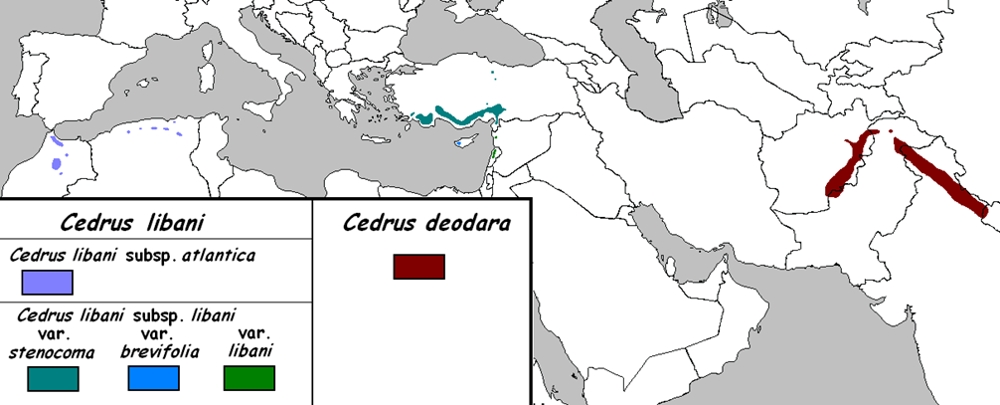
Aren’t we lucky! Precisely where we expected Gilgamesh to be based on other factors, we find him also in cedar mountains in the western Indus Valley! And while later cultures seemed to have looked farther west for their cedar, we know that Enmerkar was in contact with Aratta, also described as having cedars!
Now Aratta’s battlements are of green lapis lazuli, its walls and its towering brickwork are bright red, their brick clay is made of tinstone dug out in the mountains where the cypress grows. (LAB)
You don’t see cedars in that quote? Well, you should. Look at that word “cypress” there. The original Sumerian word, here rendered cypress, is in fact GIŠ.ERIN, where GIŠ means the following word is a type of wood, and ERIN is the species. Since I don’t speak Sumerian, I asked ChatGPT what this word means:
In Sumerian lexical lists and literary texts, GIŠ.ERIN refers to a coniferous timber tree. It is commonly glossed in Akkadian as erēnu …In Akkadian, erēnu is conventionally translated as “cedar.”
In fact, in most Akkadian contexts (especially royal inscriptions), erēnu clearly refers to the Lebanon cedar (Cedrus libani) or at least a prestigious mountain conifer used in monumental construction.
So translating this as “cypress” is a frankly dishonest translation, based on the belief by scholars that Aratta could not possibly be where the cedars were. But what Lugalbanda’s story actually said is that Aratta’s bricks were made of “tinstone dug out in the mountains where the Cedars grow.”
But translating this way, scholars faced an impossibility; they were convinced that the only cedars the Sumerians could have known about were in Lebanon; but they can’t place this story in Lebanon… because there are no tin sources in Lebanon!
Which means there must be a separate site in the ancient world with both mountains, tin, and cedars. We already saw that cedars have a very small range; where, then, do we find tin? It is no surprise, I’m sure, that there is tin in the Indus mountains.
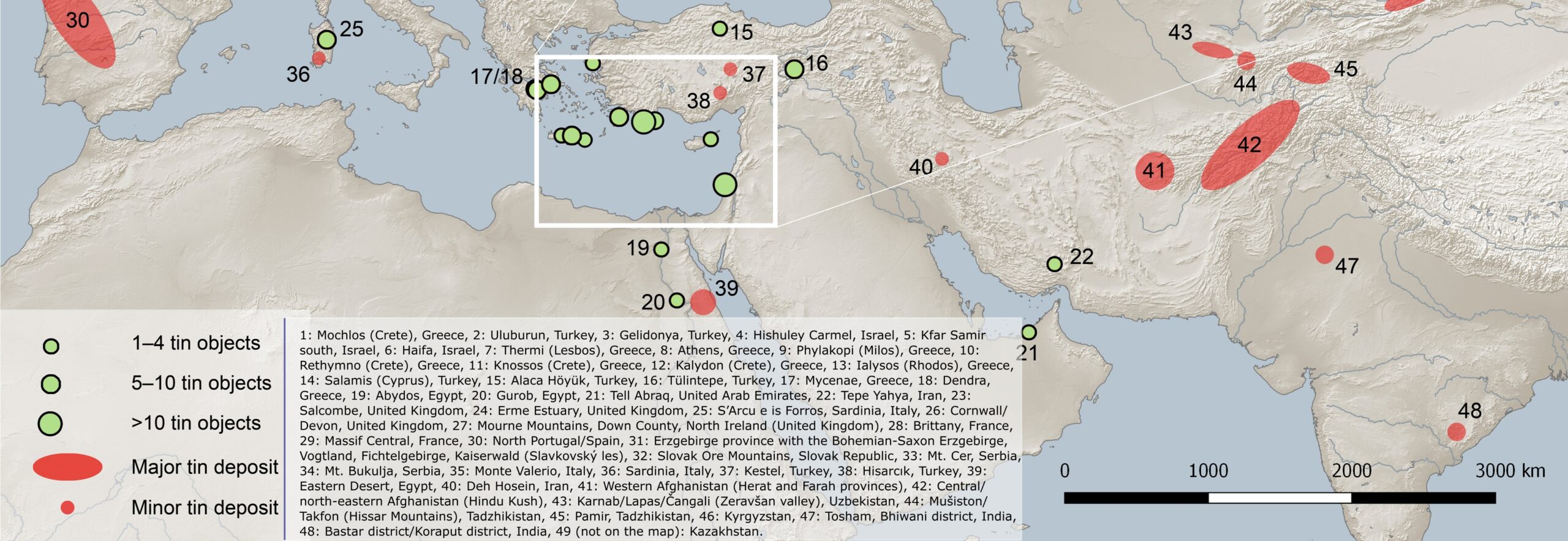
Looking at this map from Wikipedia of ancient tin sources, red represents deposits of tin and green represents the discovery of objects made from tin. I’m sure I don’t have to point out that deposit #42 perfectly overlays the range of the Cedrus Deodora or Himalayan cedar!
You see, if you listen to ancient sources, there is literally only one possibility; tin + cedar + mountains = the Hindu Kush, whose stones had been brought down to the Indus Valley to build their bricks by the sons of Arphaxad, known to Sumer as Aratta.
THE FIRST QUEST
Being freed from the requirement that cedars = Lebanon, Gilgamesh makes a lot more sense. Being blessed by his mother, a goddess, before leaving Uruk, Gilgamesh is told:
May he [Shamash] open the mountains for your crossing, and may the nighttime bring you the blessings of night, and Lugulbanda, your guardian god, stand beside you for victory. May you have victory in the battle as though you fought with a child. Wash your feet in the river of Humbaba to which you are journeying; in the evening dig a well, and let there always be pure water in your water-skin. Offer cold water to Shamash and do not forget Lugulbanda. (EOG)
This tells us their destination requires Shamash to “open the mountains”; remember, Shamash is the sun god. The sun melts snow to open mountain passes. Thus, this is not mere hyperbole or mysticism; Shamash really needed to open the mountain passes, after which they would “wash their feet in the river of Humbaba,” which can only mean the Indus.
Not to beat a dead horse, but Lebanon isn’t really across mountains, it is mountains – although not worthy of the word when compared to those in Pakistan. Also note that Humbaba has his own river – meaning not the Euphrates, the river of Uruk, nor the tiny rivers in Lebanon.
Note also the spiritual presence of Lugalbanda, whom we’ve met many times, always in the context of an invasion of Aratta – the Indus Valley. So besides being his ancestor, it makes sense his spiritual guidance would be important on this particular journey.
After twenty leagues they broke their fast; after another thirty leagues they stopped for the night. Fifty leagues they walked in one day; in three days they had walked as much as a journey of a month and two weeks. They crossed seven mountains before they came to the gate of the forest. (EOG)
Hero-speed notwithstanding, it’s a very long journey to get to their destination, across seven mountains. You may recall that’s the same number of mountains Lugalbanda had to cross to get to Aratta.
Together they went down into the forest and they came to the green mountain. There they stood still, they were struck dumb; they stood still and gazed at the forest.(EOG)
The “green mountain” is notable; from a Sumerian standpoint, mountains were not usually green, but brown. Compare to Lugalbanda’s description of Aratta as “Now Aratta’s battlements are of green lapis lazuli”; not literally, but poetically; for as blue lapis reflects light with gold specks, so might a cedar mountain reflect the sun and give the impression of lapis lazuli.
They saw the height of the cedar, they saw the way into the forest and the track where Humbaba was used to walk. The way was broad and the going was good. They gazed at the mountain of cedars, the dwelling-place of the gods and the throne of Ishtar. The hugeness of the cedar rose in front of the mountain, its shade was beautiful, full of comfort; mountain and glade were green with brushwood. (EOG)
This “throne of Ishtar” is almost certainly a reference to Aratta, where Ishtar/Inanna dwelt in the times of Enmerkar. Meaning that this is literally the same mountain as Enmerkar saw. And note the cedars growing on the banks of the mountain, called “dwelling-place of the gods.” Compare to the botanical name for the cedars that are found in Pakistan today…
The botanical name, which is also the English common name, is derived from the Sanskrit term devadāru, which means “wood of the gods,” a compound of deva “god” and dāru “wood and tree.” (Wiki, Cedrus Deodora)
Whaddaya know.
And now that we know that there were two known and acknowledged sources of cedar in the ancient world, we can understand what the sorcerer told the lord of Aratta in a whole new light.
“I will make Unug [Uruk] dig canals. I will make Unug submit to the shrine of Aratta. After the word of Unug ……, I will make the territories from below to above, from the sea to the cedar mountain, from above to the mountain of the aromatic cedars, submit to my great army. Let Unug bring its own goods by boat, let it tie up boats as a transport flotilla towards the E-zagin of Aratta.” (EE)
Notice that cedar mountain is mentioned twice, but not in exactly the same way. The “cedar mountain,” Lebanon, is mentioned separately from “the mountain of aromatic cedars.” Between the two species, the Himalayan cedar has a significantly stronger scent.
Which means that, as we would expect, the sorcerer is promising the lord of Aratta a territory mapped out by waypoints; “from the sea to the cedar mountain” is a common Sumerian phrase meaning “from the Persian Gulf to Lebanon.” Then “from above to the mountain of the aromatic cedars” would be from the upper Euphrates valley to the Khyber pass; and finally, the first one, fills in the gap in the triangle; “from below to above” – from the Indian Ocean to the Himalayas.
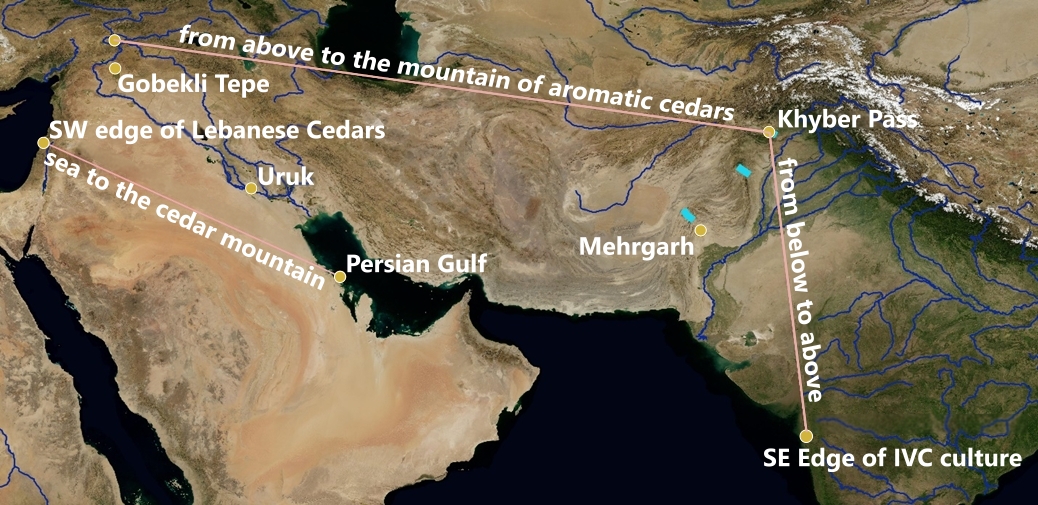
Most people don’t see this, because they think the sorcerer just stuttered, saying “cedar mountain” twice, for poetic effect. They know too much to learn the truth – we have literal, textual evidence that there are two sources of cedar precisely as science tells us.
HUMBABA
The goal of Gilgamesh and Enkidu was to kill the monster Humbaba, whose name is “hugeness.” People generally consider this entirely fictional, but knowing that we are now in Pakistan, and not in Lebanon, we are free to consider other real-world possibilities for the identity of the monster Humbaba… if we just listen to his description with an open mind.
Then Enkidu, the faithful companion, pleaded, answering him, “O my lord, you do not know this monster and that is the reason you are not afraid. I who know him, I am terrified. His teeth are dragon’s fangs, his countenance is like a lion, his charge is the rushing of the flood, with his look he crushes alike the trees of the forest and reeds in the swamp.” (EOG)
Think for a moment, about a creature one might encounter in Pakistan “whose name is huge” with “teeth as dragons’ fangs,” who “crushes alike the trees of the forest and reeds in the swamp,” whose path through the forest is “wide.”
…they saw the way into the forest and the track where Humbaba was used to walk. The way was broad and the going was good. (EOG)
Naturally it was a wide, easy path… Because it was an elephant’s path. Think about it; the Sumerians had never seen one before, to be sure. Giant tusks would certainly be equivalent to “dragon’s fangs.”
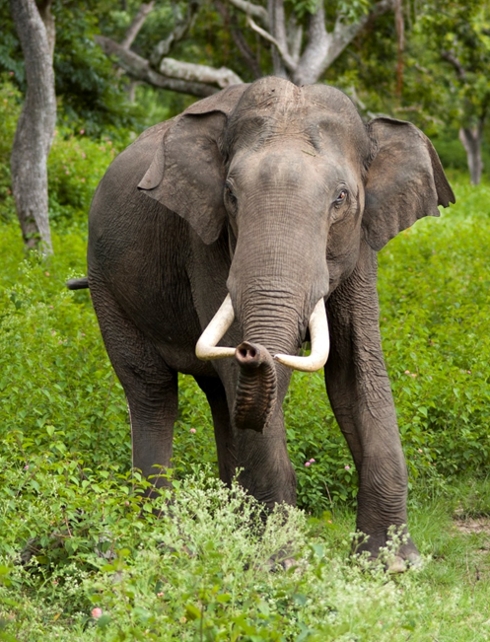
Crushing trees as if they were reeds is something only one animal on Earth does. They don’t even have to have a reason – sometimes elephants will level forests because they’re in a bad mood. Certainly to a Sumerian seeing them for the first time, it is a fitting description of a bull elephant. Gilgamesh proceeds to describe his attack:
Like a raging wild bull he snuffed the ground; the watchman of the woods turned full of threatenings, he cried out. Humbaba came from his strong house of cedar. He nodded his head and shook it, menacing Gilgamesh; and on him he fastened his eye, the eye of death. (EOG)
The text references seven magical defenses the beast supposedly had, and an urgency to attack him before he was able to put on (like weapons) the other six “splendors.” For now, he was only able to “blaze out,” almost certainly a reference to the trumpeting of an elephant.
So he felled the first cedar and they cut the branches and laid them at the foot of the mountain. At the first stroke Humbaba blazed out, but still they advanced. They felled seven cedars and cut and bound the branches and laid them at the foot of the mountain, and seven times Humbaba loosed his glory on them. As the seventh blaze died out they reached his lair. He slapped his thigh in scorn. He approached like a noble wild bull roped on the mountain, a warrior whose elbows are bound together. (EOG)
After this, Humbaba surrenders, and begins speaking as a human, begging for life. This anthropomorphized version may refer to the elephants’ keeper or rider. Regardless, Gilgamesh is inclined to spare him and put him to work, but Enkidu insists in killing it, which they do.
There are many versions of the story, and later copies from the first millennium BC certainly believed the cedar forest to have been in Lebanon, naming it in the text; but in the oldest versions, this is absent because it took place in the mountains of Pakistan, not of Lebanon.
The death of Humbaba, “whose name is hugeness,” was clearly a record of two men killing an elephant with hand weapons – a heroic feet indeed, killing the largest land animal in the world. One which only existed in the Indus Valley, precisely where all the other locational clues pointed us to!
THE LAND OF THE LIVING
It’s curious that, repeatedly, Gilgamesh referred to this place as the “country of the living,” i.e., the never-dying. This is consistent with how the Sumerians viewed Dilmun in general, from their earliest myths:
[a certain tablet] locates Paradise in Dilmun and apparently Tagtug the gardener [yet another name of Noah] dwelled here after the flood. Also the epical fragment of Creation and the Flood published by Dr. Poebel says that Ziudgiddu, the king who survived the deluge, received eternal life and lived in the mountain of Dilmun. (The Sumerian Epic of Paradise and the Fall of Man, Langdon)
Gilgamesh also considered this land a place unique in comparison with Sumer – better, more glorious, a place that a hero needs to have been to. This is one of the motivations for his first trip to kill Humbaba:
“Indeed I know it is so, for whoever is tallest among men cannot reach the heavens, and the greatest cannot encompass the earth. Therefore I would enter that country: because I have not established my name stamped on brick as my destiny decreed, I will go to the country where the cedar is cut. I will set up my name where the names of famous men are written; and where no man’s name is written I will raise a monument to the gods.” (EOG)
What famous men was he referring to? The people famous to Sumer had mostly dwelt in Uruk or Kish, and certainly did not require an adventure to a far-away land. There was no one of particular fame in Lebanon, then or ever. Clearly, Gilgamesh set his sights on another land – which we have proven in a myriad ways must be the Indus Valley, or someplace even beyond it.
That, then, is “where the names of famous men are written.” It’s worth noting, in passing, that the name “Shem,” whom we are confident went to “the land of the living,” literally means fame in Hebrew. So it was to his homeland that Gilgamesh wanted to go.
And he went twice, actually; the first time with Enkidu, it seems like they took a southerly route, as no “twelve leagues of darkness” was required to get to Humbaba. When Gilgamesh returned, he said he had been to these passes before, not necessarily to this particular pass.
And yet when Gilgamesh did finally pass through the mountains for what was apparently the first time any man [from Uruk] had ever done it, and encountered the land where gems grew on trees, he still did not find Noah.
We are quite certain that the second time he entered from the Khyber pass; what is strange about the story is that immediately after he finds the gems growing on trees, we find him on the sea coast, a minimum of hundreds of miles away, and he seems vastly more weary that he had been when he entered the mountain pass:
There was the garden of the gods; all round him stood bushes bearing gems. Seeing it he went down at once, for there was fruit of carnelian with the vine hanging from it, beautiful to look at; lapis lazuli leaves hung thick with fruit, sweet to see. For thorns and thistles there were hematite and rare stones, agate, and pearls from out of the sea.
Gilgamesh walked in the garden by the edge of the sea Shamash saw him, and he saw that he was dressed in the skins of animals and ate their flesh. He was distressed, and he spoke and said, “No mortal man has gone this way before, nor will, as long as the winds drive over the sea.” And to Gilgamesh he said, “You will never find the life for which you are searching.” (EOG)
Since this is quite impossible – mountain passes and seashores are never adjacent – and yet in both cases, Gilgamesh was “in the garden of the gods,” we must assume that to the storyteller, the entire Indus region qualified as “the garden of the gods,” “land of the [ever-]living.”
We must therefore conclude that part of the story was skipped over; since he began at one end of the Indus territory, and we find him at the sea, he must be on the opposite end of the Indus territory. Thus, he searched for Noah from one end to the other, “from the mountain of the aromatic cedars to the sea.” But which sea? Where?
NO TURNING BACK
Shamash’s attempt to discourage him was doomed to failure, obviously, and Gilgamesh naturally responded to Shamash with words to the effect of “I’ve come too far to go back now.” The story continues…
Beside the sea she lives, the woman of the vine, the maker, of wine; Siduri sits in the garden at the edge of the sea, with the golden bowl and the golden vats that the gods gave her. She is covered with a veil; and where she sits she sees Gilgamesh coming towards her, wearing skins, the flesh of the gods in his body, but despair in his heart, and his face like the face of one who has made a long journey. (EOG)
The woman at first fears him, asks who he is and what he wants, then – like everybody else – tells him he’s wasting his time and should give up:
But Gilgamesh said to Siduri, the young woman, ‘How can I be silent, how can I rest, when Enkidu whom I love is dust, and I too shall die and be laid in the earth. You live by the sea-shore and look into the heart of it; young woman, tell me now, which is the way to Utnapishtim, the son of Ubara-Tutu? What directions are there for the passage; give me, oh, give me directions. I will cross the Ocean if it is possible; if it is not I will wander still farther in the wilderness.’
The wine-maker said to him, ‘Gilgamesh, there is no crossing the Ocean; whoever has come, since the days of old, has not been able to pass that sea. The Sun in his glory crosses the Ocean, but who beside Shamash has ever crossed it? The place and the passage are difficult, and the waters of death are deep which flow between. Gilgamesh, how will you cross the Ocean? When you come to the waters of death what will you do? But Gilgamesh, down in the woods you will find Urshanabi, the ferryman of Utnapishtim; with him are the holy things, the things of stone. He is fashioning the serpent prow of the boat. Look at him well, and if it is possible, perhaps you will cross the waters with him; but if it is not possible, then you must go back.’ (EOG)
This cannot be a reference to the island which I promised not to mention again in the Persian Gulf, which was well known and in shallow, calm seas. It is also a poor fit to the coast of Pakistan, which has no major islands, none of them mountainous as Dilmun is said to be.
Given that Gilgamesh clearly was going from one end to the other of the “land of the living,” i.e., land of Shem/Arphaxad, and that he started in the extreme NW we would expect him to be somewhere in the extreme SE.
This means that he was probably, but not necessarily, at the SE of the IVC lands; though since the IVC was Aratta, Arphaxad in particular, it’s possible that he passed through all the settled lands divided among Arphaxad’s descendants in the east – i.e., all along the west coast of India.
So if we expand our search farther than the IVC, we would be looking for an island, relatively close to land, with a direct east-west passage between them; remember, Shamash – the sun – crosses this passage daily, so it must be east-west.
And remember, Dilmun is repeatedly said to be the place where the sun rises, so the island must be directly east from the nearest vantage point.
So from wherever Gilgamesh was standing at that very moment in the story, Dilmun must be due east from him! But this excludes any location in Pakistan or on the west coast of India, for they all would travel west from the coast to find any island!
But as it happens… there is a place that checks every single box.
SERENDIP (ITY)
Remember, this island was remote. It was at the literal edge of the world to the Sumerians. They traded with the Indus Valley, so it had to be even more remote than the Indus from Uruk, otherwise the story makes no sense; Gilgamesh would be heroically trekking to a land sailors went to every year!
If our understanding of Gilgamesh is correct, then to find Utnapishtim, he traveled farther than any man from Sumer had ever gone before, to where Noah was dwelling. This means it was beyond Aratta, where both Enmerkar and Lugalbanda had gone, in a place still connected to the IVC but far beyond the realm of Sumer.
So the real Dilmun where Noah settled must be some other island, even farther east from Uruk. One with mountains, one with rivers, not too far from the mainland and due east of it, with a dangerous crossing. One that is a source of ivory and copper, both of which the Sumerians said came from there.
And guess what – we just described Sri Lanka.
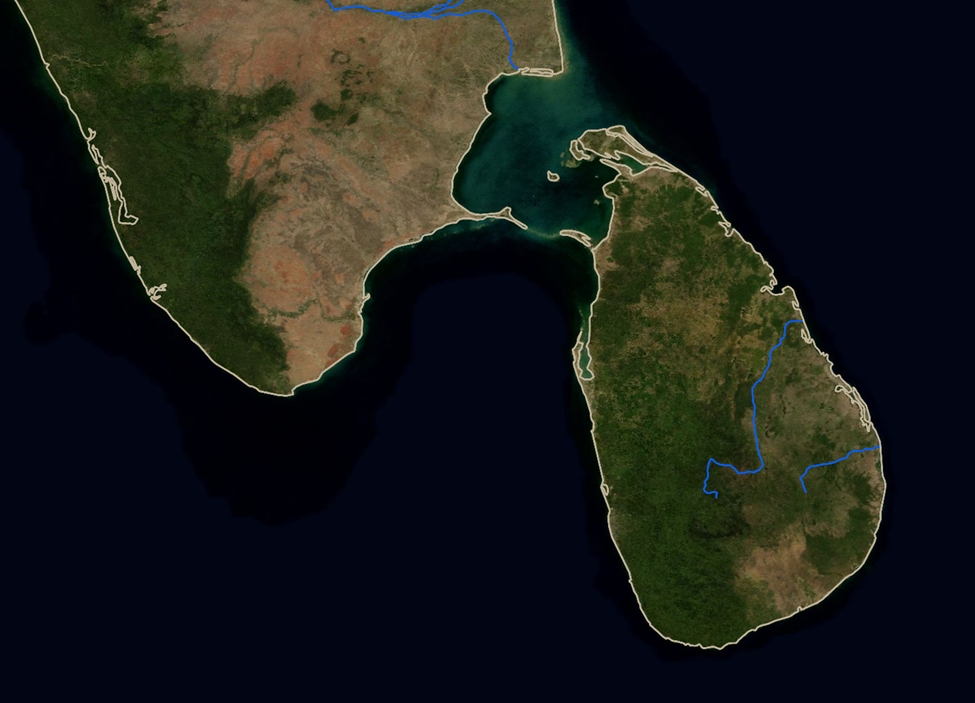
Unlike all the other candidates, Sri Lanka is quite dangerous to reach due to currents, shallows, reefs, and large swells. In the photo above you’ll see a narrow reef, almost a bridge, connecting it to the mainland; it runs almost due east-west, precisely as we would expect. This, then, would be the route Gilgamesh traveled.
Unlike other candidates, Sri Lanka has respectable mountains reaching 2,524 metres (8,281 ft) above sea level. Sri Lanka is also a source of copper which was mined in prehistoric times. And of course, elephants.
It has fresh water, irrigated valleys, and other things we saw that Dilmun must have. And while Sri Lanka is far beyond the cultural horizon of the Harappan civilization… it was nonetheless connected to it:
Megalithic markings, Megalithic graffiti marks, Megalithic symbols or Non-Brahmi symbols are terms used to describe markings found on mostly potsherds found in Central India, South India and Sri Lanka during the Megalithic Iron Age period. They are usually found in burial sites but are also found in habitation sites as well. They are tentatively dated from 1000 BCE to 300 CE marking the transition of the proto-historic period into the historic period of the Indian subcontinent…
In 1960, archaeologist B. B. Lal found that 89% of the surveyed megalithic symbols had their counterparts amongst the Indus script. He concluded that there was a commonness of culture between the Indus Valley Civilisation and the later megalithic period. In 2019, archaeologists in Tamil Nadu excavated further potsherds at Keeladi with graffiti closely resembling symbols of the Indus script. (Wiki, Megalithic Graffiti Symbols)
It’s as if the IVC stopped half-way down the west coast of India, but here was an outpost in the farthest-flung corner of the world that still retained IVC symbols. Which is precisely where we would expect to find Dilmun – at the end of the world.
So in pretty much every way, Sri Lanka is a perfect fit. And for what it’s worth, remember how the Sumerians considered Dilmun the site of creation of man? And we explained that was because Noah lived there?
Well, the Arabs considered Sri Lanka to be the place Adam landed upon his expulsion from paradise. Speaking of that near-land-bridge you saw in the photo above, Wikipedia has this to say…
Ibn Khordadbeh’s Kitāb al-Masālik wa-l-Mamālik (c. 850) refers to the structure as Set Bandhai (lit. Bridge of the Sea). The name Adam’s Bridge appeared probably around the time of Al-Biruni (c. 1030). This appears to have been premised on the Islamic belief that Adam’s Peak — where the biblical Adam fell to earth — is located in Sri Lanka, and that Adam crossed over to peninsular India via the bridge after his expulsion from the Garden of Eden. (Wiki, Adam’s Bridge)
A legend from 3,000 years later is hardly convincing, but the fact that Dilmun is described as paradise, as is Sri Lanka, is an interesting connection. Of all the places to pick, why did the Muslims pick the very one that Gilgamesh also led us to, calling it “the garden of the gods?”
ARRIVING IN PARADISE
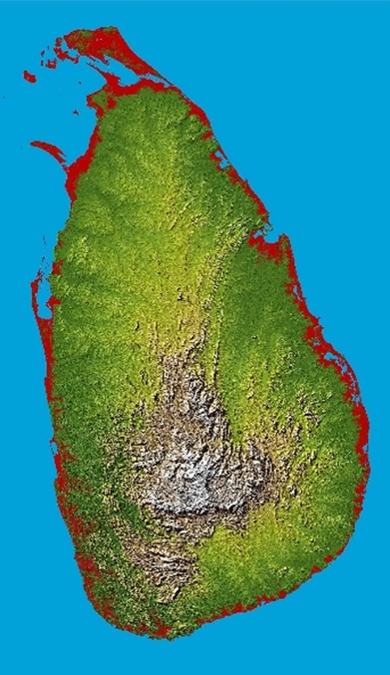
Gilgamesh leaves the wine-making woman and heads to the boatman; apparently he was hangry, for he set about breaking all the tackle on the boat he needed to ferry him to the island. Finally he calms down, the boatman asks him his story, and on the conclusion tells him that he would have taken him to the island… if he hadn’t just wrecked their boat! But after some thought, the boatman comes up with another idea.
When Gilgamesh heard this he went into the forest, he cut poles one hundred and twenty; he cut them sixty cubits long, he painted them with bitumen, he set on them ferrules, and he brought them to Urshanabi. Then they boarded the boat, Gilgamesh and Urshanabi together, launching it out on the waves of Ocean. For three days they ran on as it were a journey of a month and fifteen days, and at last Urshanabi brought the boat to the waters of death: Then Urshanabi said to Gilgamesh, Press on, take a pole and thrust it in, but do not let your hands touch the waters. Gilgamesh, take a second pole, take a third… [etc]… After one hundred and twenty thrusts Gilgamesh had used the last pole. Then he stripped himself, he held up his arms for a mast and his covering for a sail. So Urshanabi the ferryman brought Gilgamesh to Utnapishtim, whom they call the Faraway, who lives in Dilmun at the place of the sun’s transit, eastward of the mountain. To him alone of men the gods had given everlasting life. (EOG)
We see that this was a distance over clean waters, then a distance of swampy or marshy terrain requiring poling. Some danger was in the water – arguably chemical, or possibly animal. Either way, for the poles to work the water must be relatively shallow.
And we see, as always, Dilmun placed at the extremity of the world, “at the place of the sun’s transit,” specifically to a site “eastward of the mountain.” In context, that might mean eastward of the mountain on the island of Sri Lanka, which would direct us towards the large irrigated river valley on the east.
MEETING NOAH
Utnapishtim recognizes from far away that Gilgamesh is not from around there, and when he arrives asks the same old question:
So Utnapishtim looked at him and said, “What is your name, you who come here wearing the skins of beasts, with your cheeks starved and your face drawn? Where are you hurrying to now? For what reason have you made this great journey, crossing “the seas whose passage is difficult?” Tell me the reason for your coming.” (EOG)
Gilgamesh recaps his adventures, then concludes…
It is to see Utnapishtim whom we call the Faraway that I have come this journey. For this I have wandered over the world, I have crossed many difficult ranges, I have crossed the seas, I have wearied myself with travelling; my joints are aching, and I have lost acquaintance with sleep which is sweet. My clothes were worn out before I came to the house of Siduri. I have killed the bear and hyena, the lion and panther, the tiger, the stag and the ibex, all sorts of wild game and the small creatures of the pastures. (EOG)
He proceeds to ask Noah to tell him the secret of how he obtained eternal life, and Noah tells him the story of the flood, concluding with…
Then Enlil went up into the boat, he took me by the hand and my wife and made us enter the boat and kneel down on either side, he standing between us. He touched our foreheads to bless us saying, “In time past Utnapishtim was a mortal man; henceforth he and his wife shall live in the distance at the mouth of the rivers.” Thus it was that the gods took me and placed me here to live in the distance, at the mouth of the rivers. (EOG)
Most people interpret “the mouth of the rivers” as a reference to the Euphrates, which is understandable but contradictory; you don’t need to cross “many difficult mountain ranges” to find a place that’s at the mouth of the rivers in the Persian Gulf. So that conclusion is as impossible as it is easy.
Others try to argue that he meant the source of the rivers, not their mouth; the evidence for that seems weak to me. Given our location at the end of the world, we must look for some such place near Sri Lanka; referring to the image above, there are two large rivers on Sri Lanka, on the east side just as we would expect.
Anyway, Utnapishtim tells Gilgamesh, in effect, that if he can stay awake for a week, the gods might grant him eternal life; he of course falls asleep immediately and sleeps for the week instead.
To provide proof that he was asleep, Utnapishtim instructs his wife to bake a loaf of bread and lay it beside him each day, before finally waking him the seventh day and showing him the moldy, stale loaves.
Then Utnapishtim spoke to Urshanabi the ferryman: “Woe to you Urshanabi, now and for ever more you have become hateful to this harbourage; it is not for you, nor for you are the crossings of this sea. Go now, banished from the shore. But this man before whom you walked, bringing him here, whose body is covered with foulness and the grace of whose limbs has been spoiled by wild skins, take him to the washing-place. There he shall wash his long hair clean as snow in the water, he shall throve off his skins and let the sea carry them away, and the beauty of his body shall be shown, the fillet on his forehead shall be renewed, and he shall be given clothes to cover his nakedness. Till he reaches his own city and his journey is accomplished, these clothes will show no sign of age, they will wear like a new garment.” (EOG)
So the ferryman who brought Gilgamesh is exiled, who returns to Uruk with Gilgamesh. It should be noted, in passing, that the last part is strikingly reminiscent of something Moses said…
Deuteronomy 29:5 I have led you forty years in the wilderness: your clothes have not grown old on you, and your shoes have not grown old on your feet.
So after dressing him and sending him on his way, Utnapishtim’s wife prevails upon him to give Gilgamesh something so he doesn’t go home empty. So he tells him of a secret plant that restores youth…
Gilgamesh, you came here a man wearied out, you have worn yourself out; what shall I give you to carry you back to your own country? Gilgamesh, I shall reveal a secret thing, it is a mystery of the gods that I am telling you. There is a plant that grows under the water, it has a prickle like a thorn, like a rose; it will wound your hands, but if you succeed in taking it, then your hands will hold that which restores his lost youth to a man. (EOG)
Gilgamesh free-dives, finds it, brings it up, and then happily sails home to Uruk intending to gift it to all the old men of the city to make them young again, giving the plant the imaginative name “The Old Men Are Young Again.” But on the way back he went for a swim in a deep pool and a serpent saw the plant, ate it, shed its skin, and ran away.
And that, boys and girls, is why snakes shed their skin.
SOOOOO….
As I said at the beginning, the Bible says nothing of Noah after the incident with the wine, which probably took place in the region around Gobelki Tepe. But knowing all that we now know, we can tell a story that makes sense of a lot of things.
Because in a way, the Bible does mention Noah again. See we have inferred that Noah stayed behind in Gobekli Tepe while the rest of the family was sent south to scatter abroad and replenish the Earth. Well, they got sidetracked in Sumer and built the tower of Babel instead.
Communication would have been possible, certainly, but may not have been regular. It’s likely that Noah was consulted before Etana became king of Kish, for instance – who would, as Samuel did, have consulted God in turn.
But then time passed, the people bickered, and Nimrod started a second city in opposition to Kish; so at this point, someone must have tattled to Noah about the tower of Babel, and then Noah came down to see for himself.
Genesis 10:5-6 Yahweh came down to see the city and the tower, which the children of men built. Yahweh said, “Behold, they are one people, and they have all one language, and this is what they begin to do. Now nothing will be withheld from them, which they intend to do.”
This has always been read as if the Lord suddenly heard about Babel and decided to come check it out. But in many, if not most, examples, the Lord did so with a human present. Compare Abraham looking out over Sodom and Gomorrah, for example, with the Lord (Genesis 18:16-22).
Or consider Moses up on the mountain while the people made the golden calf (Exodus 32), who, coming down, got angry and whereupon God cursed the people. God knew about it the whole time, but it wasn’t until Moses came down that people started dying (verses 27-29).
So then, what Genesis may have left out, since it is so hyper-condensed, is the fact that Noah came down to see the city and the tower, and the Lord, working with and through Noah, cursed the people who built it!
If he started in the north and wound up far in the east, he had to have passed by Babel sooner or later. It makes sense that the righteous sons of Noah would have complained to him, and that he would have come down, knocked some heads together, and forced people to dispersed like they were supposed to in the first place.
It was Noah, then, who oversaw the assignment of land – just as Moses and Joshua did much later. Noah said “Elam, go that way, Cush – get a boat and go where it takes you, Lud, you’re up there…” etc.
It also makes sense that Noah, who certainly knew how to build an ocean-worthy boat, would have personally escorted the tribes destined for the far east with him, dropping Arphaxad’s line off at the Indus and various other places along the upper west coast of India with instructions on where to go.
And finally, that he got off himself at Sri Lanka, leaving Japheth’s family with instructions to go east and don’t look back – remember Lot’s wife. Sri Lanka forms a natural divide between east and west, it always has.
No evidence of cuneiform or the IVC script has ever been found east of there, and no evidence of Chinese writing or culture has ever crossed west of there. It’s as if a wall were built. Ethnically, linguistically, and culturally India represents the barrier between east and west.
FROM MESHA
And interestingly, the Bible did tell us this – although we can be forgiven for not understanding it the first time. Though it lists the sons of Shem down many generations, it only lists one per generation down to the time of Peleg and Joktan, the last generation before Babel. Joktan’s 13 sons are listed – these would be the tribes of Arphaxad, the tribes of Aratta – excepting the one tribe of Peleg which has Abraham’s ancestry. The Bible concludes that the other thirteen tribes…
Genesis 10:30 Their dwelling was from Mesha, as you go toward Sephar, the mountain of the east.
Most Bible maps will tell you that these tribes all settled in Arabia, and they offer some linguistic connections to place names there, not bad connections, but nothing ironclad. But first, in the Bible, “to the east” never meant Arabia.
Second, the Bible clearly felt the need to explain where “Sephar” was, clarifying it was “the mountain of the east,” as if their audience wouldn’t understand it. Odd, since it was written by Moses… in Arabia!
Third, Shem was the birthright son, entitled to the very best; the line of Abraham was the firstborn of firstborns of firstborns. Which means these 13 sons of Joktan deserved, by right, the best of the best, a land flowing with milk and honey where gems grew on trees. Not the rock and sand of Arabia.
Fourth, we’ve observed before that Shem’s lands were a group to the north and east, one continuous group divided more or less by the Mesopotamian rivers. To the south and west of there across Africa and so on was all Ham. So it would be very weird, in the middle of Ham’s territory, to have the bulk of Shem’s birthright line all by themselves!
Fifth, it’s a very small and poor region for any thirteen sons. For comparison, the eleven tribes of Canaan inherited a vast land on the eastern Mediterranean stretching from Turkey to the border of Arabia. And they were a cursed lineage!
But enough about where they weren’t. We have established already that they must be in the Iran-Pakistan-western Indian region. And fortunately, when we look there, we find that these place names… actually make sense!
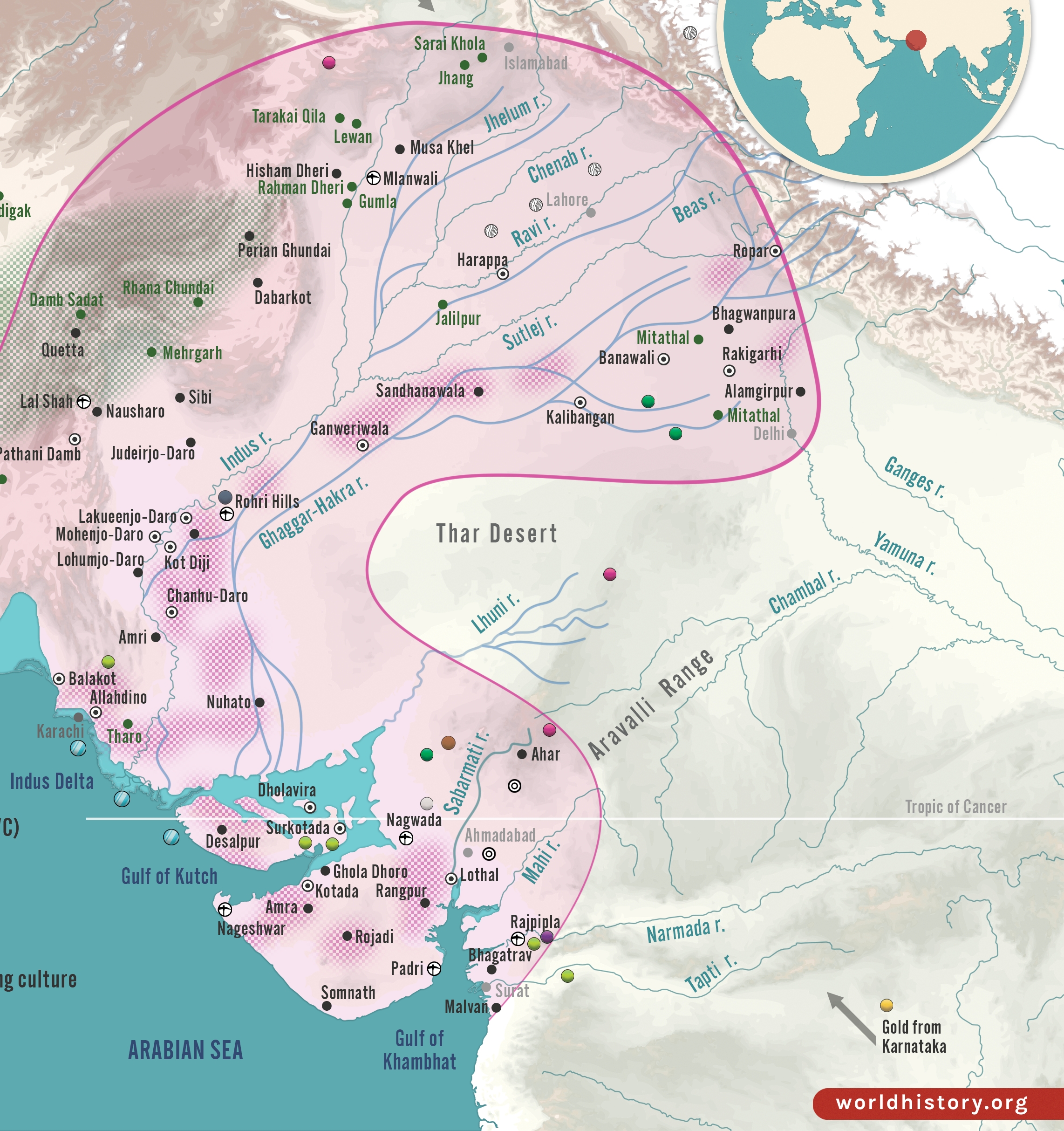 Remember earlier, that when Gilgamesh entered the upper Indus Valley, he did so through a mountain he called “Mashu?” Well, Hebrew doesn’t record vowels. So Mashu = Mesha. And this fits exceptionally well, since we know it was the extreme NW end of the Indus Valley Civilization Territory!
So then, we would read this as “from the Khyber pass to Sephar, a mountain of the east.” Since we know we’re looking for the SE border of the IVC culture and/or the SE border of the Aryan language/ethnic culture in history, let’s narrow our location with this map.
You see that the SE extremity of the IVC falls around the Gulf of Khambhat, although it’s known that they traded for gold from Karnataka, quite a bit farther south. The Aravalli range falls perfectly in the right location; and although we have no strong reason to believe the name is connected to Sephar, we could still stop our work right here and call it a job well done.
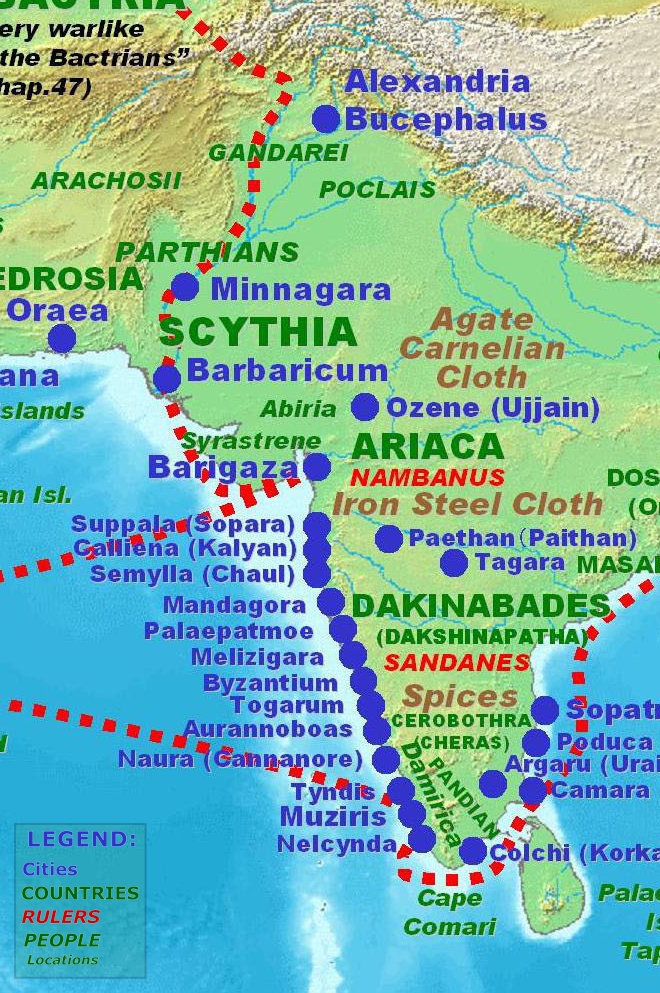
However, if we want to insist on a recognizable ancient name connected to Sephar, look at this map constructed based on detailed descriptions in a book called the “Periplus of the Eastern Sea.” And notice just where that bay is at the extreme edge of the IVC culture, you’ll find a city known by the name Sopara or Suppala in Roman times.
Linguistically, this is effectively identical with the Hebrew Sephar. Now one of the sons of Joktan was named “Ophir.” This Hebrew name is rendered into Greek in various ways:
In the Septuagint, other variants of the name are mentioned: Ōpheír, Sōphír, Sōpheír and Souphír. (Wiki, Ophir)
Thus it stands to reason that the name Sephar was actually a variant of the name of the son of Joktan who settled there, Ophir. When translated into other languages, particularly Greek as in the Periplus, that name becomes souphir or some other variant. Hence, Ophir = Sephar = Sopara.
Sopara (by some identified with the Ophir mentioned in the Hebrew texts) was an ancient port town and the capital of the ancient Aparanta. The ancient port of Sopara was the most important port in western India after the celebrated port of Cambay. The site of this ancient town is located near the present-day Nala Sopara. In ancient times, it was the largest township on India’s west coast, trading with Mesopotamia, Egypt, Cochin, Arabia and Eastern Africa. (Wiki, Nallasopara)
So this large, well-known city, with contacts to Mesopotamia and Egypt in particular, would have been an excellent reference point for the highly educated Moses to use; the Sumerians called the Khyber pass as Mt. Mashu, and the ancient Egyptians must have also known of the trading post Sopara; So Moses told us “from Mt. Mashu, as you go towards Sephar, the sons of Arphaxad settled.”
And what about the “mountain of the east” part? Well, as you go south down the west cost of India, this city is at the site of the first mountain range visible from the sea! Sephar, at the first mountain range east of the Indus!
And with that we consider the matter settled.
(Yes, I am aware we have just located king Solomon’s gold-rich region of Ophir, and we will talk much more about that in the proper place.)

This is part 9 of The History of the World Series
 Sargon to Hammurabi
  Descendants of Abraham
  Mesopotamian Empire and Sargon
  Lifespans
  Sumerian King List
  What Is The LOVE Of God?
  Everything You Believe About God Is WRONG!
  Make Up Your Mind!
  What Is Faith?
  How DARE you FEAR the judgment of God!
  Firstripe Figs
  The Bride Of The Father
  Exodus 40 – The Plan Of God
  The Temple Of God
  Pillars Of The Temple And The Brass Sea
  GEHENNA WITH ‘EM
  When Did God Forbid Polygamy?
  When You Shouldn’t Pray For Someone
  The Sins of the Father
  The First Paul