Sumerian King List
This is part 13 of the The History of the World Series
; Introduction is part 1.
Click here to read in series
The original author of the SKL must have had access to king lists and histories from various cities in Mesopotamia such as Uruk, Kish, Ur, and so on which he copied down and arranged in a way that made them seem as if only one king had ever ruled over Sumer at a time.
This had been done before, probably under Sargon (approximately ‑1896), but this version was much more extensive and included more cities, and since it was done centuries later, several more centuries of dynasties were added.
This was, as has been said, certainly motivated by politics, the scribe presenting his own king as the heir to an immensely long line of divinely-sanctioned rulers. This, in turn, explains the fact that significant cities such as Lagash and Larsa are not present on the list at all – they were enemies of the culture who wrote it, and were thus “illegitimate.”
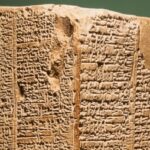
Unfortunately, we don’t have the original list, only later copies from at least a few hundred years later, written on clay tablets or cylinders that are to a greater or lesser degree cracked and damaged, so we must reconstruct the list from several different versions, eliminating errors that have crept in by copyists over the centuries, in order to approximate the original form of a list which is, itself, a copy of a copy.
Despite its flaws the SKL is still an invaluable source of data, and while traditional historians are skeptical of many of the claims, a lot of the kings mentioned on it have been proven to exist by other artifacts; obviously, fewer of the older kings are attested from archeological finds, as would be expected from a less beaurocratic, less developed society. But this doesn’t imply they didn’t exist.
On the contrary, the accuracy from the parts of the list we can verify externally argues for the accuracy of those parts we cannot verify. Thus, it deserves serious study, not to be dismissed. It’s not gospel, don’t get me wrong – but it’s not meaningless either.
The list begins with pre-flood kings, listing between 8 and 10 depending on which copy you use, and goes on to describe dozens upon dozens of kings, along with the length of time that they reigned, and the dynasty they belonged to, and sometimes a few brief notes about what the king did or who his father was.
Sounds good, right? Let’s just add up the dates and see what happened! Well, unfortunately it’s not quite that easy. Because taken at face value, it makes several ridiculous claims that no historian believes – such as reigns of individual kings that lasted for 3,600 years or more. In the preflood world, it’s even more extreme with reigns up to 43,200 years long.
But these are solvable problems, and when studied carefully and taken seriously, as several respected mainstream archeologists have done, it proves itself to be a very accurate record of the Mesopotamian world, and when interpreted correctly actually proves the Biblical timeline!
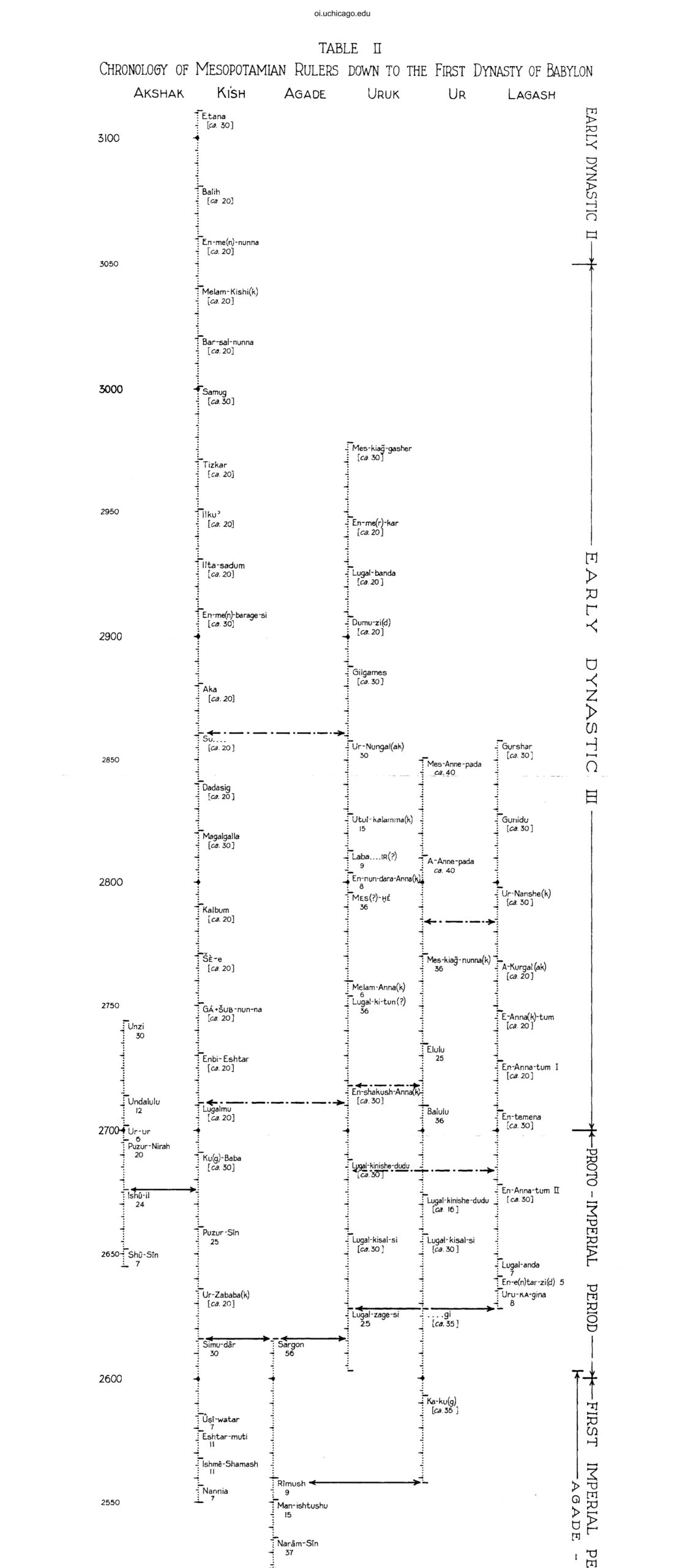
The foundational work on the SKL was done by Thorkild Jacobson in 1939 and little has come to light to change most of his conclusions since then, which makes this respected work a good place to begin our study. At the end of his book, he made the accompanying (large) chart.
The vertical lines represent the rulers of individual cities, and the horizontal lines represent places where they are believed to have interacted, thus placing them contemporary with one another. The era begins at 3100 BC and this page ends at 2500 BC, although it does in fact continue over another page.
To establish these dates, Jacobson began with the final king on the list, Damiq-Ilushi, last king of Isin and who was contemporary with Hammurabi. Hammurabi was believed in Jacobson’s time to have reigned around ‑2050, so he worked backwards from there.
Today, most researchers believe Hammurabi lived around ‑1850, although they disagree by up to 100 years or so. This moves the earliest king, Etana, from ‑3100 to ‑2900. However, I will show later that Hammurabi did in fact live far later, just after the time of Moses around ‑1350. The difference is simply that the later Kassite third dynasty of Babylon was contemporary, not consecutive, with the succeeding 4th-9th dynasties of Babylon. This effectively removes almost 500 years of kings out of the list, lowering the age of everyone before it by the same amount.
Adjusting for that one change – for which we have abundant reasons, as you will see in the proper place – the SKL no longer shows the first kings living in ‑2900, but rather in ‑2400. Already, you can see we are getting very close to the flood, and very close to agreeing with the Bible’s numbers.
So we are very gratified that with only a single major change – removal of the Kassites, or rather making them parallel with existing dynasties – secular history drops very nearly into Biblical time frames without any effort whatsoever.
LONG AGES
Later kings from the time of Sargon or Hammurabi have perfectly reasonable reign lengths of 7, 25, or 10 years; and where it’s possible to check, these have been demonstrated to be pretty accurate.
Earlier kings however, like Etana and Gilgamesh, have implausibly long reigns of 1,500 years, 126 years, 324 years, etc. And the earliest kings, before the flood, have even more absurd reign lengths of 36,000 years, 43,200 years, etc. Obviously, this presents a problem, and can be approached in one of three ways.
The first, and easiest, is to simply reject the early parts of the list as pure fantasy. This is what most modern researchers do. However, that’s difficult because some of these people with absurd reigns did really exist; we’ve found artifacts from that time with their names on them.
Aga for instance is said in the SKL to have reigned for 625 years; it would be tempting to reject his historicity since his age his obviously impossible, yet almost all historians believe he did in fact exist because among other things, he is known to have lost to Gilgamesh.
This prompts many of them to choose a second method of approaching the large ages, which is to simply adjust their reigns to a random, reasonable figure like 30 years. This is what Thorkild Jacobson did in his book.
It yields reasonable results, but it is a guess, and hence by definition arbitrary. It’s also rather on the large side for average reigns throughout history, which trend towards the 15-20 range on average.
The third way is what we will be doing; try to find an actual element of truth within these huge numbers. At the very least, a relative truth. Which is to say Etana did not reign 1,500 years, nor did Aga reign 625. But Etana may have reigned more than twice as long as Aga.
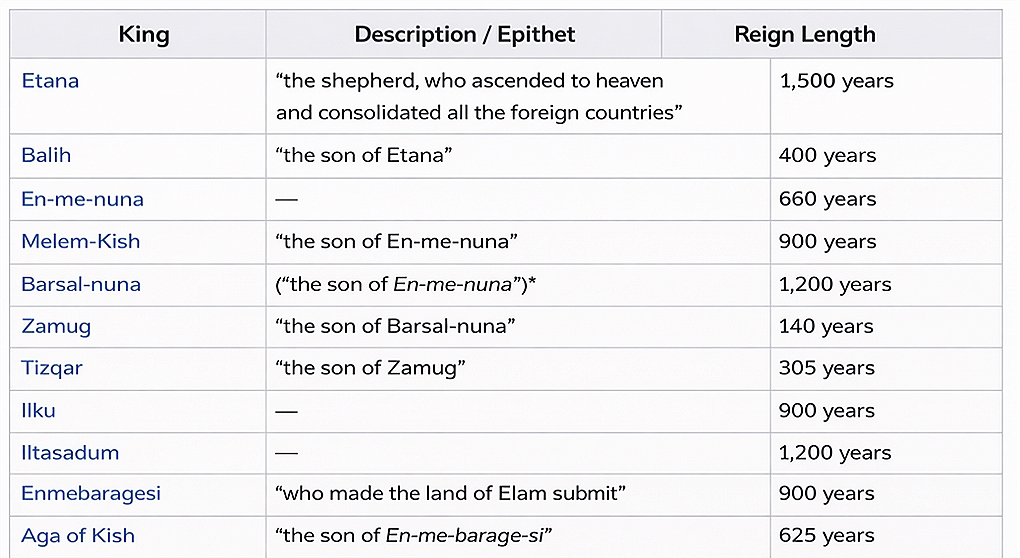
If you look at the list above as cited on Wikipedia for the first dynasty of Kish, one thing you’ll immediately notice is the reigns are in round numbers; 360, 900, 840 and so on, with a few that end in 5. Of the 11 names here, not a single one ends in a number other than 0 or 5. This is odd.
The other thing you’ll notice is that many of the dates are in round numbers of multiples of sixty. Etana, for example, at 1,500 years – if we divide that by 60, we get a clean 25 years. A very plausible reign length.
Enmenuna, at 660, divides clearly into 11 years. And so on. This happens far too often in the early king list to be random – even though it does not work all the time, as with Balih, 400, which divides into 6 and some change.
Still, there has to be some truth at work here; what could that be? This correlation of the extremely high SKL reign lengths with the numbers 6, 60, or 600 has not gone unnoticed by scholars, and Kenneth Kitchen, widely respected mainstream researcher, offers a plausible solution.
In short, these [the extremely long reigns of the preflood kings] look like “real” (or realistic) reigns that have been drastically bumped up through multiplying them by 600, to give heroically long reigns for the period betweeen creation and flood. … That process can perhaps be reversed. Our scribes in 2000 B.C., faced with few kings and long periods, may have bumped up the numbers by using sexagesimal multipliers. So, at Hamazi and Uruk, reversing the process, we might take the 36,000 years of Alalgar or of Dumuzi and divide it by the factor 10 x 60 (600), which would give them each a reign of 60 years. … The more modest Ubartutu at 18,600 years comes out at 31 years, eminently reasonable. The principal works for all the preflood rulers, and no awkward fractions, etc., are left over. After the flood, reigns are still high, until suddenly Gilgamesh’s son Ur-nungal (no longer heroic) reigns only 30 years, and all his successors are modest too, except in Kish (a special center of Sumerian kingship). Most of the “heroic” post flood kings may thus have been upped by only 60 years (not by 60 x 10). Thus Lugal-banda’s 1,200 years would then have been 20 years, and Enmebaragisi’s 900 years would have been 15 years. Those with 200 years down to 100 years may have had a factor of only 10x years; but that is a baseless guess for now. (On the Reliability of the Old Testament, Kitchen)
This author has the right answer, but the wrong explanation. His premise assumes intentional deception on the part of the ancients. I prefer a solution that is more generous to our predecessors where possible, and one is readily at hand.
SEXAGESIMAL
The Sumerians did not think of numbers in base-10 decimal system, as we do, they used a base-60 or sexagesimal system.
In the decimal system, we have ten unique numbers (decimals, from the Latin word for “ten”). We write these in the first column, called the “ones,” as 0-9; when that column is filled we write “0” there, put a “1” in the column next to it.
This action expresses that the “box” of 10 numbers is full, it has been emptied and a zero placed there for refilling and we place a “one” in the next column which represents “one” [box of] “ten,” so a “1” there means our total number is 10.
Base-60 is the same, only you write the numbers 0-59 in the first column, then when filled with 60, you write “1” in the column next to it and you start over again at 0 in the first column. Thus, “one” in the “sixties” column (where we put our tens) is actually meant to represent 60, not 1!
It’s a little bit more complicated than that, but that’s the basic idea. A box full of 60’s would be 60×60 and therefore where we would have our hundreds column, they would place their 3600’s column.
… The main units were at what we would designate 1, 10, 60, 360 (60 × 6), 3,600 (60 × 60), and 36,000 (60 × 60 × 10). A separate numerical sign existed for each of these numbers. This sounds confusing, but we still use it, in a way. There are 360 degrees in a circle, 60 seconds in a minute, and 60 minutes in an hour, because the Mesopotamians came up with this system and, in a long and convoluted way, we inherited it. …
The weird thing is that, in proto-cuneiform, the sexagesimal system was used for keeping track of some things—but not for everything. Some other items were counted using a bisexagesimal system, with the units at 1, 10, 60, 120 (60 × 2), 1,200 (60 × 2 × 10), and 7,200 (60 × 2 × 60), again with separate signs for each. It got even more complicated, because different signs were used depending on what type of countable object was being counted, so that thirteen different systems of counting goods and people were in use at the same time. (Weavers, scribes, and kings; Podany)
With thirteen systems of counting, working off of ancient and possibly damaged tablets, from different eras and using numbers that might be read as 1, 10, 60, 120, 360, 1,200, 3,600 or 7,200, you can readily see how a slight mistake in reading, due to a change in how things were counted over a century or two, would suddenly make perfectly normal ages become fantastic and godlike ages.
And so the reason the numbers of these reigns are so fantastic is because the earliest version of this list – which we don’t have today – recorded the numbers of real reigns, of reasonable length. But it did so in what would become an archaic script! Because it was, after all, the very first writing in human history!
A later scribe, assigned to copy this list centuries after the people involved were all dead, misunderstood the ancient character for “1” and assumed it was the character he knew as “60!” Given the complexity of the system (and the fact there were 13 different systems for counting different things), this was not only plausible, but inevitable.
Different lists, composed at different times in different cities, would be copied differently by the ancient scribes. Hence the preflood period shows huge numbers in the tens of thousands, which were confused with some large number like 36 or 60 or 600;
Meanwhile early post-flood lists like Kish I are in the hundreds or low thousands, and divide well by 60; later lists like Uruk I divide better by 6. This works about 75% of the time and generates a whole number which is realistic, with no fraction left over.
THE EXCEPTIONS
Of course, sometimes there are fractions left over; it’s not a perfect system, but it’s better than guessing “30” every time, since it preserves at least the relative length of reigns, since it is certain they didn’t all reign an equal amount of time.
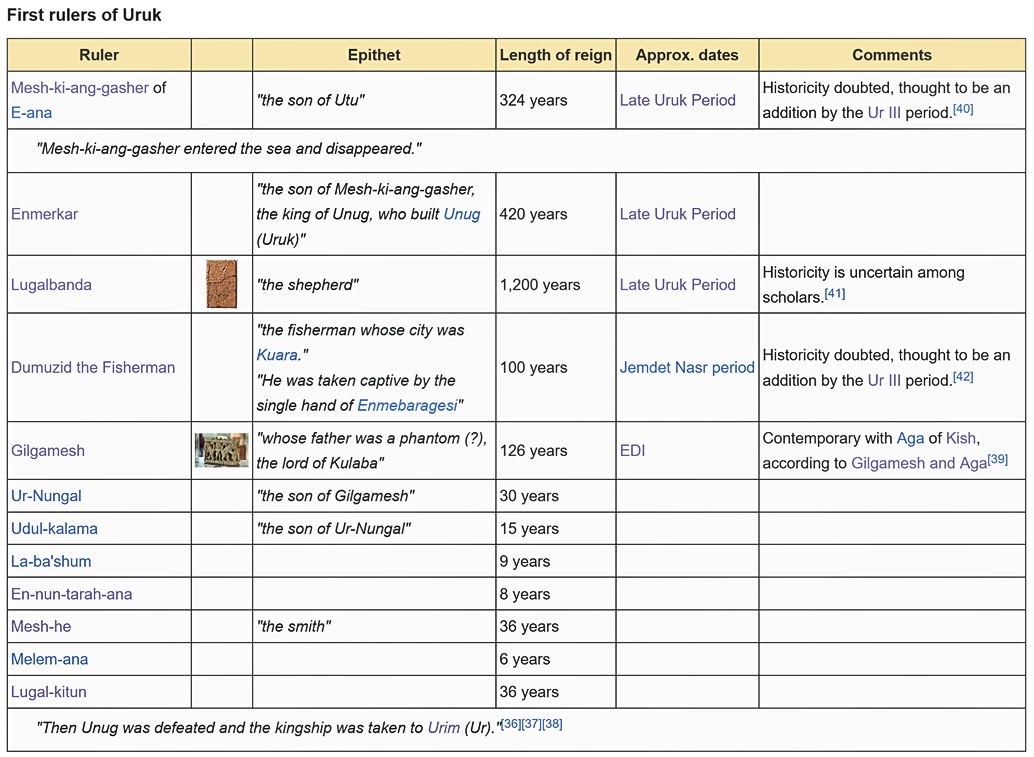
Dividing the early kings of Uruk by 6, Meshkiangasher gets 54 years and Enmerkar gets 70; this last is important because we know he was king for at least 50 years when the Amorites invaded, and 70 is a good fit for the Arattan war. Gilgamesh gets 21, which is also reasonable.
However Lugalbanda’s 1,200 years are anomalous, triple the length of any other Uruk I ruler. Dividing by 6 still yields 200, far too much; so this is probably actually a scribal error. Hence, we divide instead by 60 which gives us 20, which is more reasonable. For the later kings, many are naturally divisible by 6 and yield short reigns of 1-6 years.
But then there are the non-6/60 exceptions; Dumuzi has 100 years, which isn’t divisible; many historians don’t think he actually existed, although I myself do; I favor the idea that he was leading Uruk as vizier while Enmerkar and Lugalbanda were off campaigning.
But what about 15, 9, 8 and so on? These non-divisors are so rare as to make us believe the theory; but their existence means we must modify the theory somehow to make sense of them. So here is my hypothesis:
Babylonian numbers are written somewhat like Roman numerals, using I for 1, II for 2, III for three, and so on. Then they use < for 10, << for 20, << I for 21, etc. Remembering that they use base sixty, I<< I would be 60+20+1, or 81.
In the current copies of the list, we have, in most cases, clear versions of these numbers, so modern “translations” are accurate representations of the numbers as they were understood by ancient scribes who copied our most recent copies.
However, it would be relatively easy, in this case, for the number 31, written <<< I, to be mistaken for I<< I by an ancient scribe, yielding 81 instead. Or for 126, written II IIIIII (the space meaning a line placement, hence, two sixties and six ones) to be mistaken for << IIIIII, 26.
Who knows how degraded the copies the ancient scribes used as sources were? Who knows how many times they were copied? Or the relative skill, literacy, and indeed, eyesight, of the various scribes? Indeed, we would be stunned if something like this didn’t happen. And scholars are very willing to use this argument when convenient:
Most copies of the King List give Ur-Zababa an unrealistic reign of 400 years, but one copy reading “six years” is held to be more plausible. (Wiki, Ur-Zababa)
This mention about a much later king on the SKL helps to confirm that dividing by sixty solves a lot of chronological problems; rather than the implausible 400 recorded on one list, 6 is recorded on another version.
But what’s interesting is that 6 is not random; if you divided 400 by 60, it would yield 6, with 40 left over. Since Babylonians counted by 60’s and also had a sign for 10’s and 1’s, then we could surmise the original text said “Ur-Zababa reigned 6 years, 4 months.”
This was misunderstood by the scribe as 60 years + 40 years, the months being misinterpreted as 10’s. While this cannot be proven, it gives us a plausible way to deal with the few numbers that aren’t divisible – the excess was simply months. And there is reason to believe this.
One post-flood but pre-Etana king (more likely the head of one of the twelve tribes) was called En-tarah-ana, and the SKL records his reign as “420 years, 3 months, and 3 and a half days.” Wikipedia comments “Why the reign length is so specific is unknown.”
This is unique in that it is the only reign given in months and days as well as years. But that alone makes us suspicious; this data clearly existed at one point, probably for all the kings. It was edited out or lost on other entries for some reason. Where did it go?
Most likely, it was absorbed into the year itself, with the months mistaken for years as in the case of Ur-Zababa. Perhaps the full entry once said “6 years, 4 months, 10 days,” which was lumped together as 6×60+4×10, or 400.
Teasing the full truth out of the SKL is basically impossible at this point, but if we can get close with the divide-by-6 treatment, we’re happy enough to let the months and days be part of the remainder.
This is what I meant when I said at the beginning we will make sense of the sources without dismissing them, but reading them as they, themselves, were meant to be understood. If we do this, Lugalbanda reigned, not 1,200, but a quite reasonable 20 years; Etana ruled, not 1,500, but a quite plausible 25 years. And so on.
Thus, when the ancient scribe copied down the list, he was, in effect, accidentally multiplying all reigns by the number 60, producing absurdly long reigns that are obviously not true. And yet, they do record a truth – if you trust your source enough to look for it!
These things cannot, by their nature, be proven unless the original tablets are found which is highly unlikely to ever happen. I am simply seeking to find a plausible explanation that allows us to believe in the fundamental integrity of the SKL, a way to reduce the reigns to reasonable numbers that would be expected to fall in the 5-30 year mark in most cases, based on historical precedent; and to do so without simply guessing or arbitrarily assigning dates.
This way assumes the intelligence and good intentions of all involved, and postulates one simple error, easily explainable by the evolution of writing over a few centuries which we know happened in that timeframe.
This one assumption easily makes sense of all the excessively large reigns, reducing them, without exception, into the sorts of reigns normal humans would have.
And that, together with the removal of the Kassites from the chronology, makes Sumerian history as understood by historians completely compatible with the chronology of the Bible!
How cool is that?

This is part 13 of The History of the World Series
 Abraham and Chedorlaomer
  Abraham in Egypt
  Ur of the Chaldees
  The Home Of Noah
  What Is The LOVE Of God?
  Everything You Believe About God Is WRONG!
  Make Up Your Mind!
  What Is Faith?
  How DARE you FEAR the judgment of God!
  Firstripe Figs
  The Bride Of The Father
  Exodus 40 – The Plan Of God
  The Temple Of God
  Pillars Of The Temple And The Brass Sea
  GEHENNA WITH ‘EM
  When Did God Forbid Polygamy?
  When You Shouldn’t Pray For Someone
  The Sins of the Father
  The First Paul