Sargon to Hammurabi
This is part 17 of the The History of the World Series
; The History of the World is part 1.
Click here to read in series
While Abraham and the patriarchs were going down into Egypt, Sumer was far from uneventful. Indeed, the absence of Abraham wasn’t noticed. As has been said, Abraham’s departure roughly coincided with the arrival of Kudur-Laḫgumal the Elamite.
There followed around 75 years of the original Game Of Thrones between Eannatum, Enshakushanna, Entemena, Lugal-Anne-Mundu, Lugal-Zagesi and finally Sargon of Akkad who arguably managed to form the largest and most stable version of the Empire.
His rule also heralds the history of Semitic empires in the Ancient Near East, which, following the Neo-Sumerian interruption (21st/20th centuries BC), [-17th-16th centuries] lasted for close to fifteen centuries until the Achaemenid conquest following the 539 BC Battle of Opis. (Wiki, Sargon)
Sargon shifted the power center north and into Semitic-speaking hands, and out of the hands of the ethnic Sumerians who went into sharp decline at this point and ultimately disappeared after the Ur III period, also called the “Neo-Sumerian period” because it was the last time Enmerkar’s descendants held power in Sumer.
Speaking of Enmerkar the priest-king of Uruk, aka Nimrod, who was actually the first person to hold something like an empire in Mesopotamia, Sargon continued his legacy in other ways; in the Chronicle of Early Kings, a Babylonian text dating roughly to the time of Nebuchadnezzar, it says of Sargon…
He dug up the dirt of the pit of Babylon and made a counterpart of Babylon next to Agade. Because of the wrong he had done the great lord Marduk became angry and wiped out his people by famine. They (his subjects) rebelled against him from east to west and he (Marduk) afflicted [him] with insomnia . (Chronicle of Early Kings, a Babylonian text as cited in Wiki)
This reference to the city of Babylon is confusing to scholars, making them tend to reject this story completely as a later fabrication; which, you may be sensing by now, is a go-to move for the community of historians.
Despite their scepticism, they generally believe the Chronicle of Early Kings was probably based on the Weidner chronicle from the Kassite period, around the 12th century BC; there is no reason not to believe that was likewise based on older stories which contained some truth to them. Scholars say of the above quote…
This seemingly anachronous reference to Babylon reproduces text from the Weidner Chronicle. Little is known of the city of Babylon in the third-millennium with the earliest reference to it coming from a year-name of Šar-kali-šarri, Sargon’s grandson. (Wiki, Chronicle of Early Kings)
But again, we have a perspective they don’t. We know that Babylon was partially built by Nimrod, but “they left off building the city” (Genesis 11:8). Knowing human nature as we do, we can be certain that following the events of Babel, they would certainly have believed the city cursed; as it no doubt was.
Jeremiah 51:24-26 I will render to Babylon and to all the inhabitants of Chaldea all their evil that they have done in Zion in your sight, says Yahweh. Behold, I am against you, destroying mountain, says Yahweh, which destroys all the earth; and I will stretch out my hand on you, and roll you down from the rocks, and will make you a burnt mountain. They shall not take of you a stone for a corner, nor a stone for foundations; but you shall be desolate for ever, says Yahweh.
Two interesting points here; God calls Babylon a “destroying mountain.” Yet Babylon is in one of the flattest places on Earth. The reference then is to the ziggurats¸ artificial mountains at the heart of all Sumerian cities. God promises to make it a “burnt mountain.”
Second, God directly curses the city saying it will never be rebuilt – and other verses in the Bible paraphrase this in a variety of ways. Granting that this was written around 1400 years after the time of Sargon, it still shows that the idea of Babylon as a cursed city was long-enduring.
So what would it mean that Sargon built the city that Nimrod abandoned? And why would he even want to do so?
Afterward in his [Sargon’s] old age all the lands revolted against him, and they besieged him in Akkad; and Sargon went onward to battle and defeated them; he accomplished their overthrow, and their widespreading host he destroyed. Afterward he attacked the land of Subartu in his might, and they submitted to his arms, and Sargon settled that revolt, and defeated them; he accomplished their overthrow, and their widespreading host he destroyed, and he brought their possessions into Akkad. The soil from the trenches of Babylon he removed, and the boundaries of Akkad he made like those of Babylon. But because of the evil which he had committed, the great lord Marduk was angry, and he destroyed his people by famine. From the rising of the sun unto the setting of the sun they opposed him and gave him no rest. (Wiki, Sargon)
The translations of that passage vary a little bit between implying the actual rebuilding Babel itself, or building a “new Babel,” a kind of model, on the other side of the river from the city of Akkad, which has never been found. Then again, both may be true.
Regardless, he clearly was involved in Babel in some way; and these passages, if true, record the first historical record of the city outside of the Bible. And they are associated, by the Babylonians themselves, with sin!
I bring this up because Sargon had, initially, had great success. But the fact that Sargon is remembered as being “cursed with insomnia” in his later years is very reminiscent of Saul who was likewise afflicted (1 Samuel 16:14-23), or Nebuchadnezzar (Daniel 2:1).
Sargon rising from cupbearer to emperor is a big jump, consistent with the blessing of God (see Saul, David, Jeroboam, etc.). Then again, getting cocky and angering God by building a cursed city is also consistent with the patterns (see Saul and Agag, David and Uriah, Jeroboam and the golden calves, etc.).
So the fact that later generations remembered Sargon’s later years as cursed directly because of the rebuilding of Babel goes a long ways towards confirming the Bible’s version of what happened with the city of Babel in the first place.
As for why he would want to – what better way for a cocky emperor to show his power, than to rebuild a city Nimrod himself couldn’t finish.
HEIRS OF SARGON
After Sargon died (‑1841), his son Rimush took over. Rimush was plagued by revolts and adopted an extremely brutal approach to the Sumerians who rebelled.
Rimush introduced mass slaughter and large scale destruction of the Sumerian city-states, and maintained meticulous records of his destructions. Most of the major Sumerian cities were destroyed, and Sumerian human losses were enormous: It appears that the city of Shuruppak was spared. (Wiki, Rimush)
His rule was not well liked, and it seems to have ended in his assassination after 9 years (‑1841‑1832). His brother Manishtushu became king, ruling for a somewhat more successful 15 years (‑1832‑1817), who likewise is claimed to be assassinated (although there is some general confusion between these two brothers in later histories, including reversing their reign order in some lists).
Regardless, Rimush’s brutal suppression of revolts brought stability at home, and Manishtushu was able to extend the empire farther abroad, including a naval battle in the Persian Gulf.
“Man-istusu, king of the world: when he conquered Ansan and Sirihum, had … ships cross the Lower Sea. The cities across the Sea, thirty-two (in number), assembled for battle, but he was victorious (over them). Further, he conquered their cities, [st]ru[c]k down their rulers and aft[er] he [roused them (his troops)], plundered as far as the Silver Mines. He quarried the black stone of the mountains across the Lower Sea, loaded (it) on ships, and moored (the ships) at the quay of Agade. …” (Wiki, Manishtushu)
The “black stone” is generally believed to be diorite from Oman, on the east of the Arabian peninsula. However, the silver presents a problem; this is presented as a naval campaign “across the lower sea,” that “plundered as far as the silver mines.” So this was not merely the capture of silver metal, but of the mines themselves.
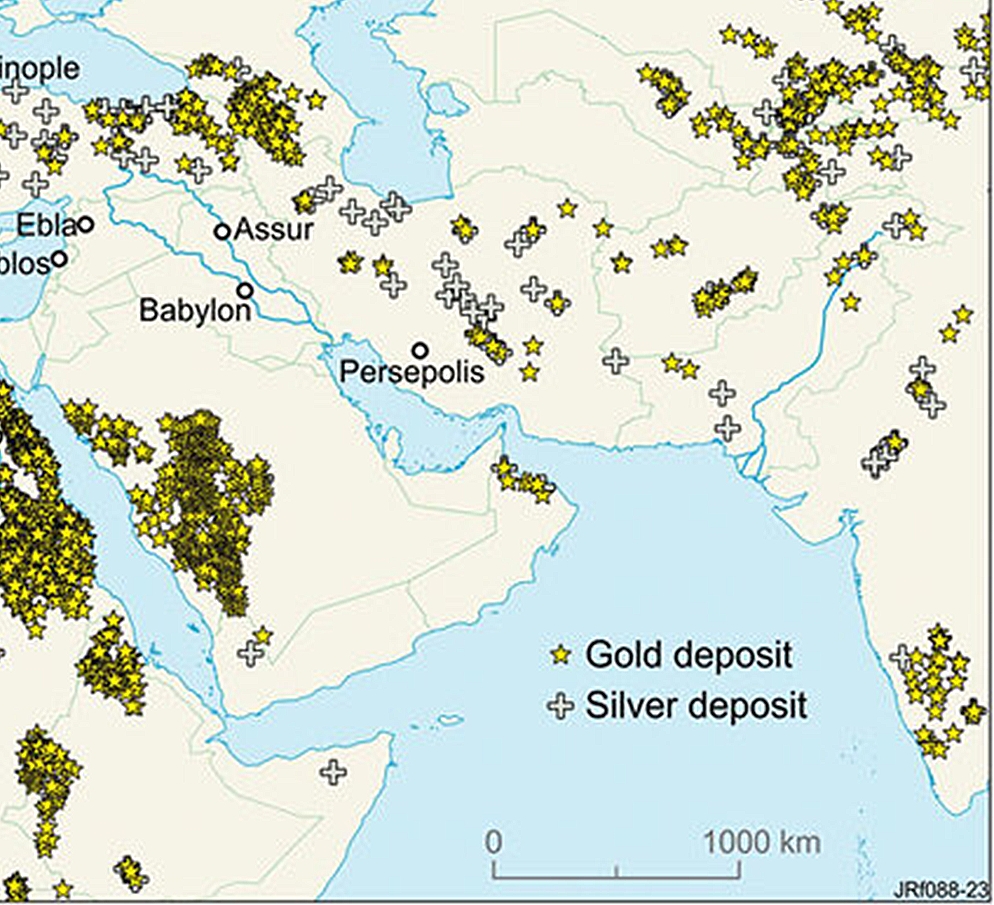 The problem is, there are no silver mines on that part of the Arabian peninsula; and the one on the west side is not particularly good. In the picture to the rightabove [Gold and Silver: Relative Values in the Ancient Past, Ross and Bettenay], which I have cropped to focus on our area of interest, you see that the only silver mines in the area near the sea are almost to the mouth of the Indus River.
There are, of course, many inland silver mines which scholars overwhelmingly favor as the furthest boundary of his conquests; but those don’t fit the text at all; read it for yourself, Manishtushu is very clear that these things are taking place “across the lower sea,” which requires either an Arabian or Iranian coastal location.
The obvious reading of the narrative is that Manishtushu moved south, attacked Anshan (near Persepolis on the map above) and then attacked Sirihum – no one knows for sure where the latter is, though some scholars propose the Makran coast in SE Iran, not far from those same silver mines.
Following these successes over land, he then built a fleet and moved down along the coast conquering as he went; along the way, he quarried stone in Oman and reached as far as the silver deposits at the mouth of the Indus River.
If this version of events is correct, then he stopped short of invading the Indus proper, hence no reference to typical Indus goods (lapis, carnelian, etc.). But he did break their naval power, at least for a generation or two, and strangled their trade to the west beginning their decline as a civilization.
Historians would never connect events this way since their timeline is so far off, but we know that at this point the Indus Valley merchants controlled the waves; the “32 cities across the sea” are not named, but it’s difficult to imagine the Persian Gulf alone could boast 32 cities worthy of Akkad’s wrath.
So in our context, this refers to the Akkadian navy taking back the Persian Gulf from the IVC sailors; this would mean that Mesopotamian and Indus trade would cease, except under Akkadian terms. It would also mean that, had the Indus been trading directly with Egypt, it would likely no longer be possible.
That, along with his boast of conquering their cities, might suggest a reason that the IVC began to decline in roughly this time frame (‑1820’s). The last surviving patriarch, Eber, died in ‑1783 at 464 years old and was likely no longer particularly spry in the time of Manishtushu.
THE GUTIANS
Naram-sin was the next king of Akkad, and grandson of Sargon. He would see the empire reach its greatest extent during his 37 years (‑1817‑1780). But his reign was increasingly plagued by restive barbarians to the east known as Gutians.
We know this from year names of his such as “Year Naram-Sin defeated Satuni, king of the Gutium.” Though always phrased as victories, the fact they kept happening suggests the victories were less than conclusive.
No one knows who they were, although their language seems unrelated to any languages in the region – perhaps they were farther flung sons of Asshur or Elam of whom we know nothing in the Bible. Regardless, they were the next big player in the Sumerian scene. After the Sargonic dynasty of Akkad, the SKL says…
“In the army of Gutium, at first no king was famous; they were their own kings and ruled thus for 3 years.”
These people came down from the Zagros mountains of northern Iran, a nomadic barbarian race who, the SKL tells us, had a sort of rotating three-year leadership at first; in later years, they seemed to have “civilized” and settled into a more respectable lifestyle.
The current scholarly consensus is that these people had been filtering in for decades or longer. Thanks to the events surrounding Kudur-Laḫgumal and Enshakushanna, we now know that the first Gutians were probably invited in as peacekeepers by the Elamite overlords.
After a lengthy Elamite dominance, many of the Gutians were probably established and settled, and the rise of Sargon did not chase them out completely. If it did, they certainly missed the comforts and wealth of civilization, and determined to have these things for themselves as soon as a weakness was felt.
This is why Sargon’s sons Rimush and Manishtushu, in their year-names, reported regular engagements (always reported as “victories”) over the Gutians. But these victories can hardly have been decisive, for the problem always grew worse, as territories to the north and east were slowly lost to the Akkadian empire.
The best guesses of scholars at this point is that the Gutian period breaks up into two parts; a part where they were tribal chieftains, followed by a later period where they had conquered some actual cities – Adab in particular – and were more properly “kings.”
Remembering that the SKL often shows lineages before a city or tribe was dominant in Sumer, my own belief is that the first half of the Gutian list, give or take, was still as mercenaries as they had been in the times of Awan I; who were at times working for, at times working against Akkad.
 There are many examples for this in history, such as the Russian Cossacks, various tribes of Native Americans working for and against the settlers, or the Romans using any number of semi-independent fringe tribes – Arabs, Germans, Gauls – to do their dirty work through threats or bribery.
But as the strength of Akkad weakened roles reversed; compare Rome against the Germanic tribes… at first they dominated the tribes through force, but then they hired them as mercenaries and then when Rome weakened those barbarians came calling and conquered Rome itself.
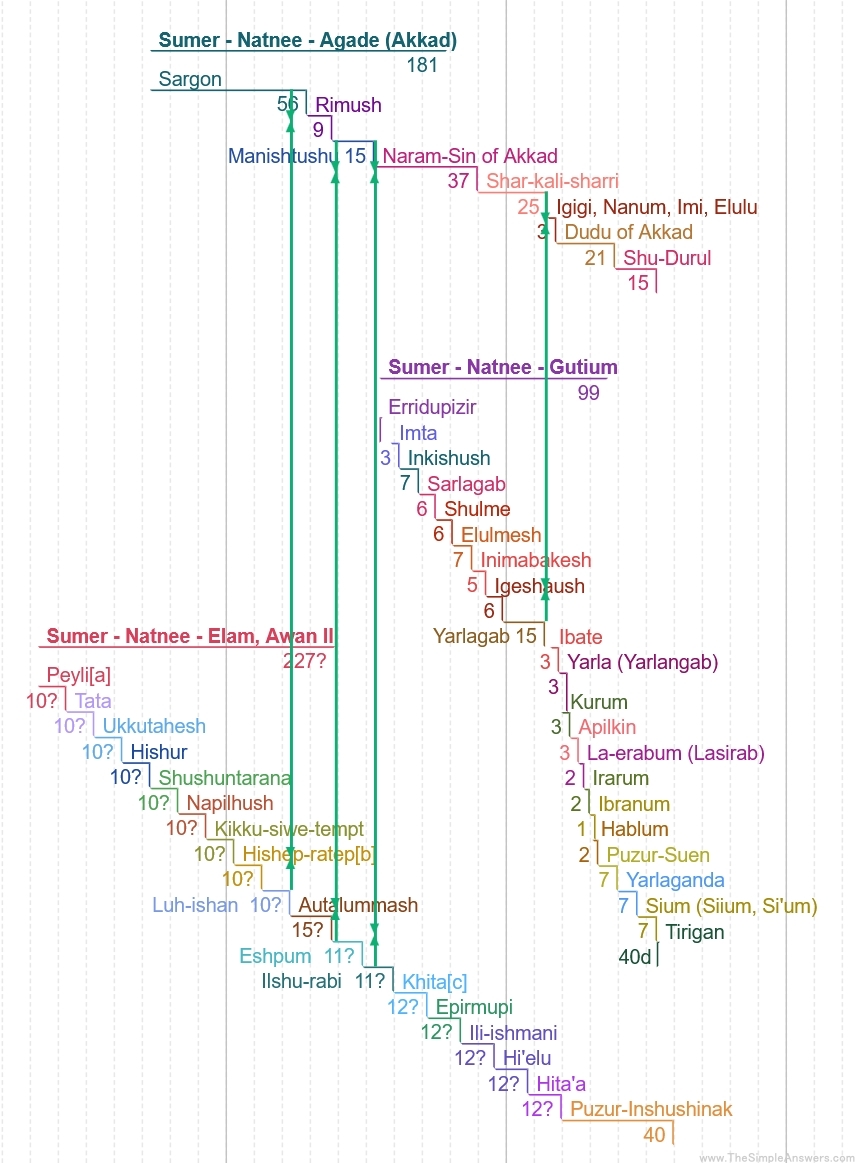
Likewise Akkad used some of the Gutians, and force held them at bay; but after Shar-kali-sharri died they took over the leadership role, in roughly the time of Yarlagab as you see represented by the green line in the chart. And even if they did not dominate Akkad directly, they certainly controlled most of the cities that had been subject to it, and they seemed to have been kings in Adab, no later than year 1 of Shu-durul.
Until a new threat came from the east and conquered or absorbed them once and for all.
ELAMITES
Another major player during the entire time of the Akkadian dynasty was the Elamites; we’re familiar with them from the exploits of Kudur-Laḫgumal during the Awan I dynasty, but after the Elamites were defeated in the ‑1930’s they retreated, rebuilt, and founded a new dynasty called Awan II by scholars.
The Awan II dynasty recovered from their loss of Sumer and challenged, and were defeated, by Sargon and his two sons on several occasions, allowing us to place them roughly in the proper place in time. The green arrows above show roughly when they interacted. We have no regnal length for the Awan II kings, so I have chosen an average to fit the time available for their dynasty.
Despite the growing power of the Gutians and Elamites, Akkad was strong enough to last for two more generations, through Naram-sin and his weak successor Shar-kali-sharri. But after the death of Shar-kali-sharri, the SKL describes a time of chaos; it rhetorically asks “Who was king? Who was not king?” indicating a time of anarchy which lasted three years.
A much weaker king named Dudu (if you laughed, how old are you?) was followed by Shu-durul, whose “empire” was probably confined to the walls of Akkad. These were the final kings of the Akkadian empire before it perished under uncertain circumstances.
This much historians pretty much all agree on, along with the regnal lengths of each of these kings, who after Sargon totalled about 100 years. The next great empire is the 3rd dynasty of Ur, henceforth Ur III, whose first king was Ur-Nammu.
In between, the transition between the Akkadian and Ur III period is highly debated. This period, called the “Gutian period” since Gutians were ruling much if not all of Sumer during this time, is estimated by historians to be anywhere from 40 to 100 years long, counted from the death of Shar-kali-sharri.
We have taken the shorter view, partly because it fits the overall timeline the best; but also because it requires the fewest assumptions. Here’s what we do know about this period; some time after Sargon, but before Ur III, a new dynasty known as Uruk IV appeared, lasting 30 years.
After this, another dynasty called Uruk V appeared with a lone king known as Utu-hegal. He is known to have killed Tirigan, the last king of the Gutian dynasty according to SKL, probably in his third year. So this puts a decisive end to the Gutian period.
After Utu-Hegal had ruled 7 years he seems to have died somehow, and his younger brother Ur-Nammu of Ur founded the Ur III dynasty just after the end of the Gutian period. This would go on to become a mighty power in Sumer, but let’s not get ahead of ourselves.
The only part of this story that is unclear is when Uruk IV began; some place it at the end of Shu-durul’s reign, others at some point earlier. But the best scholarship seems to indicate that after the death of Shar-kali-sharri many territories declared independence, among them Uruk.
Which means the founding of Uruk IV is likely to date shortly after that event, which is how we have placed it on the chart, six years after his death, three years after the anarchic period, in the reign of Dudu. I mean who would want to serve a king named Dudu?
During this period, there continued to be rulers of Akkad but the empire was as good as over. The Gutians rebelled in the north and eventually settled in Adab, meanwhile the Elamites were building power in the east, and a one-time governor of Elam named Puzur-inshushinak declared independence and started conquering the territory of his one-time masters.
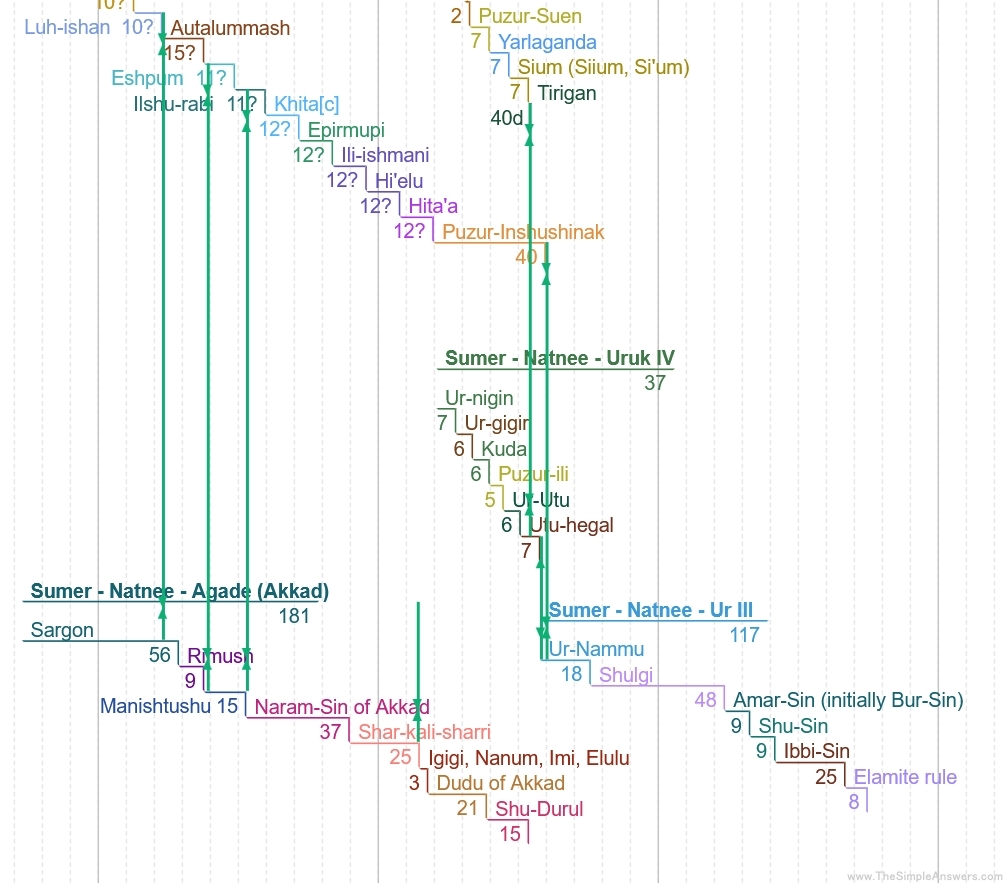
To help make sense of this, here is the chart. Green lines represent events which connect two kings with confidence, and which are datable reasonably securely to at least one of the kings. The reigns of Igigi, Nanum, Imi, and Elulu are the three years of chaos which began the rebellion of the city-states like Uruk and Ur.
PUZUR-INSHUSHINAK
According to one of Ur-Namma’s inscriptions, which describes his conflict with Puzur-Inshushinak, the latter occupied the cities of Awal, Kismar, and Mashkan-sharrum, and the lands of Eshnuna, Tutub, Zimudar, and Akkade. (Puzur-Inshushinak at Susa … Piotr Steinkeller)
As one of his first acts, Ur-Nammu of Ur III recaptured many important towns, specifically mentioning that he had captured back the towns that Puzur-Inshushinak, 12th and last king of the Awan II dynasty, had taken from Sumer – notably including Akkad. Which means that by this time, the Akkadian dynasty was over, and Puzur-Inshushinak was on the throne.
It is quite certain that the foreign conquests of Puzur-Inshushinak coincided broadly with the reign of Utu-hegal of Uruk. We do not know when precisely did Puzur-Inshushinak occupy northern Babylonia, of course. But it is a good guess that, throughout Utu-hegal’s reign (of eight years), northern Babylonia remained under Puzur-Inshushinak’s control. It is equally clear that the occupation of northern Babylonia by Puzur-Inshushinak must have weakened the position of the Gutians, who at that time resided at Adab, and who may actually have ruled over northern Babylonia before its conquest by Puzur-Inshushinak. (Puzur-Inshushinak at Susa … Piotr Steinkeller)
We don’t know anything about Puzur-Inshushinak’s reign length, but it must have been decent to have done as much conquering as he evidently did.
He was a Susian who made his career by rising in the ranks of the Old Akkadian political administration (presumably of Susa). This is supported, in particular, by the use of titles conveying continuity with designations used by Akkadian regents of Susa (eg. Ešpum, Epirmu); namely: (1a). Governor (ENSI) of Susa; (1b). Governor (ENSI) of Susa and general (KIŠ.NITA/ šakanakku) of the land of Elam; and (1c). General (KIŠ.NITA/šakanakku) of Elam (Puzur-Inshushinak, Last King of Akkad? Javier Álvarez-Mon)
But what’s interesting about him is that over the course of his career, his titles evolved from being a governor of Susa, to a king of Elam, Awan, Anshan, and most telling of all, he finally adopted the very Sumerian title “king of the four quarters”; which was effectively like saying “king of the known world.”
He never really achieved this, but he apparently liked to pretend to be emperor. We’ve all been there. After an extensive review and comparison of Akkadian and Susian art, culture, and so on from the Puzur-inshushinak period, that same historian concludes…
Considered together, these political and artistic features convey a kaleidoscopic profile so heavily dominated by continuity with the Akkadian past that one might be justified to think of Puzur-Inshushinak as “the last king of Akkad.” (Ibid)
Knowing that in the Akkadian period Susa was a vassal of Akkad, it stands to reason that Puzur-Inshushinak began his career as puppet ruler of Akkad; one who gradually began to cut his own strings as his master grew weaker.
Puzur-Mama also appears in a letter about territorial disputes between two Governors, apparently sent to Shar-Kali-Sharri:
(Say to my Lord): This is what Puzur-Mama, Governor of Lagash, said: Sulum and e-apin since the time of Sargon belonged to the territory of Lagash. Ur-Utu, when he served as Governor of Ur for Naram-Sin, paid 2 minas of gold for them. Ur-e, Governor of Lagash, took them back. The consequence is that Puzur-Mama should (.…). (Wiki, Puzur-Mama)
This letter is dated to after the reign of Naram Sin; the assumption is that it dates to the reign of Shar-kali-sharri; and during that time Puzur-Mama was an obedient governor of Lagash. Puzur-Mama, in turn, is synchronized with Puzur-Inshushinak:
Puzer-Mama also appears as “King of Lagash” in a document also naming the Elamite ruler Puzur-Inshushinak, suggesting the synchronicity of the two rulers. (Ibid)
Thus, the two Puzur’s were contemporary, and one of them was contemporary with Shar-kali-sharri, last king before the anarchic period which would be a perfect time for a governor of Susa to rebel, and strike off on his own. After all, there wasn’t any clear ruler for three years.
In addition, Ur-Utu is said to have been the governor of Ur for Naram-sin (died ‑1780); it’s natural to assume this is the same person as the last king of Uruk IV, who ruled Uruk independently from ‑1725‑1719.
But this letter refers to an earlier time when he was merely a governor of Ur, 55 years earlier, subject to Akkad. While this is a long time, it’s not unprecedented for ancient kings to be in politics that long – consider Sargon, for instance. Of course, it could just be a relative or someone else with the same name.
In any case, this gives us a quadruple connection, where the lives of Puzur-Inshushinak of Elam, Puzur-Mama of Lagash, Ur-Utu of Ur and later Uruk, and Naram-sin and Shar-kali-Shari all interacted with each other in a single lifespan. If we had gone with the longer period of a century or so for the Gutians, Ur-Utu and Puzur-Inshushinak cannot fit into this picture, hence we chose the shorter period of 40 years.
To further secure these connections, Puzur-Mama’s successor was Ur-Baba (what does it say about me that I want so badly for there to have been a queen named Ur-Mama?). Anyway, Ur-Baba was followed by Gudea, a famous king of Lagash about whom we know quite a bit. Importantly, we know that he was part of a coalition with Ur-Nammu that reconquered Sumer and killed Puzur-inshushinak:
Various data indicate very persuasively that Gudea of Lagash too was part of the war on Puzur-Inshushinak. The most likely assumption is that Gudea and Ur-Namma had formed a military alliance against Puzur-Inshushinak. (Puzur-Inshushinak at Susa … Piotr Steinkeller)
Thus three generations of Lagash (Puzur-Mama, Ur-Baba, Gudea) fits well with one very long reign of Ur-Utu followed by Ur-Namma, and three generations in Akkad (Naram-Sin, Shar-kali-Shari, Puzur-Inshushinak).
THE STORY
This allows us to tell the story like this; Shar-kali-sharri was sovereign of governors in Lagash, Susa, Ur, and Uruk, among other places. Puzur-Inshushinak, who originally titled himself as the governor of Susa, was a vassal of Akkad as were the others.
But then Shar-kali-sharri died, and the unclear succession in an already weak dynasty led to three years of infighting in Akkad, while their provincial governors asked themselves “why are we serving these fools?” which led vassals everywhere to rebel. Thus, Puzur-inshushinak’s reign begins here, during the period of anarchy.
At more or less the same time Uruk rebelled and founded Uruk IV under Ur-Nigin, who had probably been the governor of Uruk under Akkad. Lagash likely also picked this time to break off the yoke in the later years of Puzur-Mama.
Meanwhile the Gutians, no longer fearing the power of Akkad, pushed further and conquered Adab, which they would use as their home base until Puzur-Inshushinak chased them out. So when the dust settled in Akkad, the new king Dudu found his empire reduced to a single city.
But Puzur-Inshushinak wasn’t content with independence. He had a taste of civilization and imperial power in the courts of Akkad, and he wanted that for himself. So he consolidated the Elamite states and pushed west, creating an empire of his own:
In view of the huge geographical scale of Puzur-Inshushinak’s conquests, it will not be unjustified to call his state an “empire.” Although this empire was short-lived, its historical importance cannot be overstated, since the act of putting of much of the Iranian plateau under a single rule, and of incorporating the Susiana into Elam, was a watershed event of the early Elamite history. (Puzur-Inshushinak at Susa … Piotr Steinkeller)
It will not be an exaggeration to conclude that Puzur-Inshushinak was not only the first native ruler to unite most of Iran but also creator of the first Iranian empire. It was as a result of these achievements, no doubt, that Puzur-Inshushinak claimed that the god Inshushinak gave him “four quarters to rule,” in which he obviously imitated the earlier achievements of Naram-Suen. At that point he also abandoned his earlier titles, replacing them with those of “the mighty one” (dannum) and the “king of Awan.” (Birth of Elam, Potts)
It’s not quite as big of a deal as Steinkeller thinks, for unbeknownst to him Kudur-Laḫgumal the Elamite had already done exactly this a century or more earlier. Nonetheless, it was significant. But really, it was a conscious imitation and briefly, continuation, of the Akkadian Empire; not unlike the Franks under Charlemagne who tried to emulate the Roman Empire that had once conquered their people.
Based on all of this, and the web of synchronisms between these people, I’ve assigned about 40 years to Puzur-Inshushinak, stretching from the anarchy after Shar-kali-shari until his defeat by Ur-nammu and Gudea – approximately ‑1750‑1710.
SHIMASHKI
The next kings of Elam are listed on the Shimashki king list, and play an important part in the next chapter of history. The first of these kings was mentioned in an inscription by Puzur-Inshushinak recounting his victories…
Toward the very end of Puzur-Inshushinak’s victory inscription, there is a passage describing how, following Puzur-Inshushinak’s victories in the Zagros, a king of Shimashki, being apparently impressed by that event, came to Puzur-Inshushinak to pay obeisance to him. Significantly, this is not only the earliest attestation of a Shimashkian ruler on record, but also of Shimashki’s name itself. The fact that Puzur-Inshushinak attaches so much importance to his encounter with the unnamed ruler of Shimashki, and that he recognizes him as a “king,” must be interpreted that this individual was a political figure in his own right, whose power, while inferior to that of Puzur – Inshushinak, was something to be reckoned with. … It will not be unreasonable to consider, therefore, that the unnamed Shimashkian partner of Puzur-Inshushinak was none other than Kirname, the first ruler of the Shimashkian dynasty. (Puzur-Inshushinak at Susa … Piotr Steinkeller)
Presumably the Shimashkians were coming on the scene from farther afield, and after the downfall of Puzur-inshushinak – which they may or may not have contributed to – they took over the reins of the Iranian territories.
Kirname [first king of the dynasty] would have been a contemporary of Ur-Namma. In turn, this would make him two generations removed from Ebarat I, the third ruler of Shimashki, whose rule seems to have begun in or shortly before the year Shulgi 44 [second king of Ur III]. (Ibid)
The twelve kings of the Shimaski king list – and probably a few others not included – would interact regularly with the kings of the later dominant states in Sumer – Ur, Isin, and Larsa – until the final king Siwe-Palar-Khuppak would be conquered by Hammurabi of Babylon.
The most important king to the story of Sumer is Kindattu, the 6th Shimashki king, who destroyed Ur III and occupied the city for some years. But we’ll come back to that.
UR III
The details of the earlier part of Ur III aren’t clear, but it seems that Ur-nammu, the first king of the dynasty, conquered Puzur-inshushinak early in his reign:
Following Utu-hegal’s brief reign, the crown of Uruk was assumed by Ur-Namma of Ur, who probably was Utu-hegal’s younger brother. The chronology of Ur-Namma’s reign, which lasted eighteen years, is known very poorly. Even more to the truth, we know nothing certain about it. However, since the majority of his inscriptions name him a king of Sumer and Akkad, it is clear that Ur-Namma became the master of northern Babylonia relatively early in his reign. Accordingly, his conflict with Puzur-Inshushinak should probably be dated to the very beginning of his reign. (Puzur-Inshushinak at Susa … Piotr Steinkeller)
After Utu-hegal killed the last of the Gutians, and Ur-Namma expelled the Elamites from northern Sumer, the land enjoyed a golden age for about a century known as the Ur III Empire. This was a strong Ur state with long-lived and relatively benevolent rulers who were mostly unchallenged, which led to a time of peace. Well, peace-ish.
Best of all for chronologers, who in this case I agree with, the Ur III period and its successor states, the Isin/Larsa dynasties and the 1st (Amorite) dynasty of Babylon are all attached very tightly with a web of strong synchronisms.
“From a chronological perspective, the long period from Urnamma down to the end of the First Dynasty of Babylon … represents a firm block of 515 years. Two independent recent reconstructions have come to almost the same conclusions; only a difference of +/- 1 year seems possible for the Isin period.” (ARCANE)
They of course disagree on the absolute dates, but that is to be expected. Meanwhile, the early kings of Ur, once they had established dominance, pursued a policy of diplomatic marriages between Mari and the various rulers of Elam under the Shimaski kings. A great deal of correspondence between the contemporary states in the upper Euphrates and northern Mediterranean area has survived.
They also embarked on massive building projects, most notably the ziggurat of Ur started under Ur-Nammu and finished under Shulgi, which is still standing to this day. Kings of Ur interacted with several Shimashki kings, whether with warring or marriages – sometimes both.
But like all dynasties, later kings grew weaker as new threats came up that were harder and harder to manage. In this case, it was the arrival of the Amorites, hunger, and the general weakness of the final Ur III king, Ibbi-sin, who reigned ‑1628‑1603.
Some years after the accession of the last ruler of Ur, Ibbisuen … the disintegration of the empire started. There are several potential reasons. The presence of nomadic Amorites must have changed the socioeconomic system, probably involving various conflicts. More seriously, Ibbisuen lacked grain in the central provinces of Southern Mesopotamia and hunger must have dramatically affected the inhabitants. Hunger was less severe in Northern Babylonia, so the general Ishbierra of Isin claimed independence from Ur and declared himself king of Isin … and, as such, successor of the kingship of Ur. By that time a series of provinces had already left the state: in Ibbisuen year 3… provinces in the east and north, including Eshnuna and Susa, in Ibbisuen years 4 and 5 … Umma and Girsu, and in Ibbisuen 6, Nippur … For his final 16 years, Ibbisuen only controlled the region of the city of Ur, before the city was devastated by an army from Elam, led by Kindattu of Shimashki. (ARCANE)
Despite his weakness, he later recorded several military successes in his year names, suggesting that he formed alliances with his former subjects to defend Sumer against Elam and the Amorites:
Year 17: of Ibbisin: “The Amorites, the powerful south wind who from the remote past have not known cities, submitted to Ibbi-Suen, the king of Ur.”
Year 14: “Ibbi-Suen, the king of Ur, overwhelmed Susa, Adamdun and Awan like a storm, subdued them in a single day and seized the lords of their people.”
That’s how he tells it, at least. Given the strength the Elamites showed 10 years later, he may have been exaggerating his successes a bit. Also, his defeat of the Amorites seems to have been overblown since many later rulers of nearby Larsa were Amorites.
Regardless of what he claimed in his year names, his empire was hemorrhaging vassals in his early years; Ibbi-sin’s onetime general Ishbi-Erra had effectively extorted the kingdom of Isin from Ibbisin, with the idea of “Either make me king of Isin… or else I’ll do it myself.” Scholars generally think this was in Ibbisin’s 8th year.
Ibbi-Sin bitterly lambasted Ishbi-Erra as “not of Sumerian seed” in his letter to Puzur-Šulgi and opined that: “Enlil has stirred up the Amorites out of their land, and they will strike the Elamites and capture Ishbi-Erra.” (Wiki, Ibbisin)
This coincides with a period of Semitic invasions and decline of ethnic Sumerians, who would soon completely disappear as an identity. Amorites, Elamites, Mitanni, Assyrians, and later Hittites and Chaldeans all invaded and settled until at some point there was no such thing as an ethnic “Sumerian” left.
Curiously, Puzur-Šulgi seems to have originally been one of Ishbi-Erra’s own messengers and indicates the extent to which loyalties were in flux during the waning years of the Ur III regime. While there was no outright conflict, Ishbi-Erra continued to extend his influence as Ibbi-Sin’s steadily declined over the next 12 years or so, until Ur was finally conquered by Kindattu of Elam. (Ibid)
The next Elamite ruler to conquer Babylonia following Puzur-Inshushinak’s feat was Kindattu, the sixth ruler of Shimashki. By sacking Ur, and by controlling it for some twenty years, this political heir of Puzur-Inshushinak’s made Babylonia pay for the annihilation of the latter’s realm by Ur-Namma and Gudea. This pattern of invasions countered by retaliations, which had began with the Sargonic conquests in Elam, was to characterize the Elamite-Babylonian relations down to the very end of these two great civilizations. (Puzur-Inshushinak at Susa, Piotr Steinkeller)
That author believes the Elamite occupation of Ur lasted 20 years, but I can’t find any substantiation for that and most scholars put it at around 8 years; what we do know for sure is from the year names of Ishbi-Erra…
Year 26, Ishbi-Erra the king brought down by his mighty weapon the Elamite who was dwelling in the midst of Ur.
Year 31, Year Ur was made safe in its dwelling place.
So he defeated them in year 26, which would be after 8 years of occupation if he began to be independent in year 8 of Ibbi-sin as most people believe. But the second year name suggests that he might not have been able to completely expel them until 5 years later.
The sack of Ur was a mighty blow to the culture of the time; it was an ancient and proud city at the peak of its glory. In response, a very emotional “Lament for Ur” was written, in the vein of Jeremiah’s lament for Jerusalem, which says things like…
The good house of the lofty untouchable mountain, E-kiš-nu-ĝal, was entirely devoured by large axes. The people of Šimaški and Elam, the destroyers, counted its worth as only thirty shekels. They broke up the good house with pickaxes. They reduced the city to ruin mounds. (Wiki, Lament for Ur)
“Mountain” in Sumer always refers to the ziggurat, the false mountains which are the closest thing you’ll find in Sumer to a “high place.” It’s curious that this temple was said to be valued by the Elamites at thirty shekels, just as Jesus was.
It’s also interesting that the city that was valued at thirty shekels was Ur, site of Abraham’s childhood and probable priesthood at that very temple. Perhaps it’s a coincidence, or perhaps more was revealed to them about the true God at times than we realize today.
Regardless, Ur was so thoroughly destroyed that the houses themselves were broken up with pickaxes, and it was occupied by Elam for around a decade before they were chased out by the founder of the Isin Dynasty.
ISIN-LARSA
As I said above, Ibbi-sin, final king of Ur III, was losing vassals fast as the Ur III empire collapsed due to famine and barbarians. The two vassals who are most important to our history are Ishbi-Erra, whom we’ve already met, and Naplanum.

Earlier inscriptions about this Naplanum suggest he may have been a wealthy merchant from Ur, who was appointed as governor of the city of Larsa. By comparing the dates when their descendants interacted, we can prove that Naplanum declared his independence from Ur just three years after Ishbi-Erra.
Naplanum would become the ancestor of the kings of Larsa, while Ishbi-Erra would become the ancestor of the kings of Isin, together forming the contemporary dynasties historians call the Isin-Larsa period which lasted from ‑1621‑1386.
For centuries theses two dynasties competed for dominance. At first Isin had the upper hand, then Larsa started pulling ahead, taking Ur away from Larsa in the reign of Gungunum and killing Lipit-Eshtar. There are many synchronisms we can use to tie these kingdoms together, but for once no one really disagrees so there’s no point in spelling them out.
Isin never really recovered after Lipit-Eshtar, and after 235 years the dynasty of Isin ended when Damiq-Ilishu was conquered by Rim-sin in the latter’s 30th year. The joy of this victory was short-lived, however, as it was the high point of Rim-sin’s career – every year name after that just repeated the event and said “the year after the year he conquered Isin,” and so on.
Finally, after a reign of 60 years he was conquered by a king named Hammurabi, whom I’m sure you’ve heard of, in the year ‑1354.
AMORITES
Hammurabi was the 6th king of the 1st dynasty of Babylon, but you may be surprised to know he was not Babylonian. At least, not in the Sumerian sense of the word; he, and his ancestors, were Amorites.
By the time of the last days of the Third Dynasty of Ur, the immigrating Amorites had become such a force that kings such as Shu-Sin were obliged to construct a 270-kilometre (170 mi) wall from the Tigris to the Euphrates to hold them off. The Amorites are depicted in contemporary records as nomadic tribes under chiefs, who forced themselves into lands they needed to graze their herds. Some of the Akkadian literature of this era speaks disparagingly of the Amorites and implies that the Akkadian – and Sumerian-speakers of Mesopotamia viewed their nomadic and primitive way of life with disgust and contempt. In the Sumerian myth “Marriage of Martu,” written early in the 2nd millennium BC, a goddess considering marriage to the god of the Amorites is warned:
Now listen, their hands are destructive and their features are those of monkeys; (An Amorite) is one who eats what (the Moon-god) Nanna forbids and does not show reverence. They never stop roaming about …, they are an abomination to the gods’ dwellings. Their ideas are confused; they cause only disturbance. (The Amorite) is clothed in sack-leather … , lives in a tent, exposed to wind and rain, and cannot properly recite prayers. He lives in the mountains and ignores the places of gods, digs up truffles in the foothills, does not know how to bend the knee (in prayer), and eats raw flesh. He has no house during his life, and when he dies he will not be carried to a burial-place. My girlfriend, why would you marry Martu? (Wiki, Amorites)
The past several centuries before Hammurabi had been a period of rising Amorite influence, as seen by various mentions of them in the Ur III and especially the Isin period. Indeed, many of the later kings of Larsa were themselves Amorites…
Seventy years later [after Ibbi-Sin] the king of Larsa said “Zaba’ia, Amorite chief, son of Samium, built the Ebabbar.” Two generations later, Abisare … called himself “heedful [shepherd, belo]ved of the god Sîn, mighty [ma]n, [ki]ng of Ur, Amorite chief….” (Wiki, Ibbisin)
Like many barbarians before them, what were once marauding tribes got a hankering for the very civilization they were plundering and domesticated themselves. By the time of Hammurabi, Amorites spread across nearly the entire fertile crescent, from Egypt to the Persian Gulf.
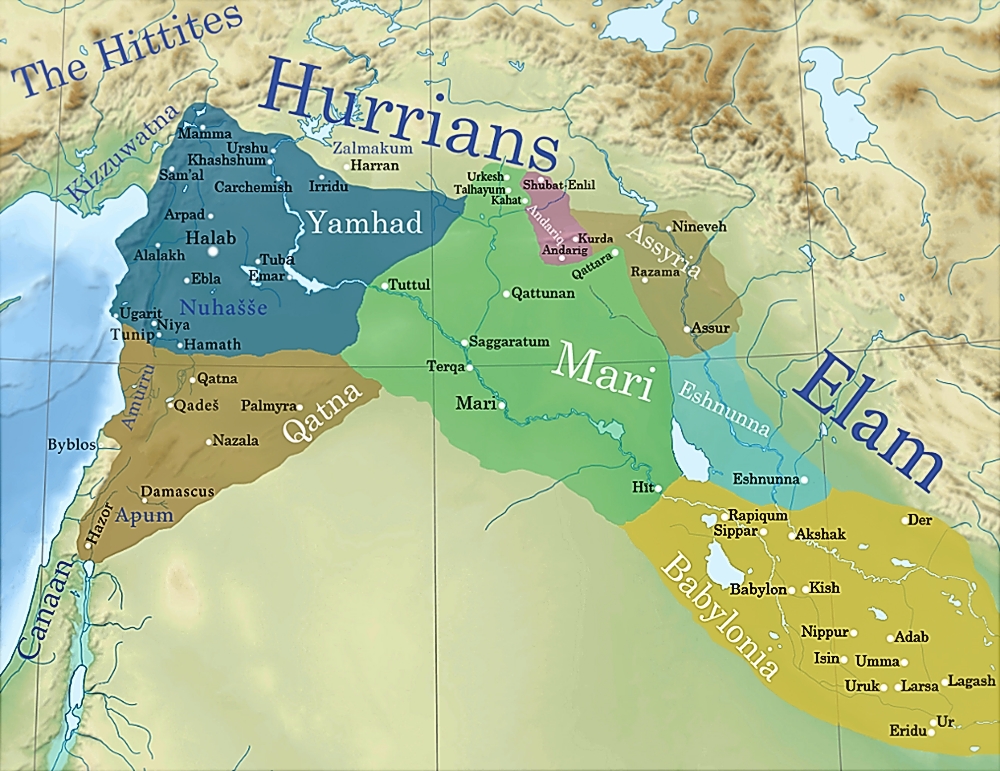 This map is set during the time of Hammurabi, so in the ‑14th century; you will notice that the land of Canaan itself is not colored on this map; this reflects historians’ belief that the Bible is not an accurate record of history; but in fact, that region was controlled by Joshua of Israel and his successors the judges.
These are the same basic peoples who would shortly become, in a manner unknown to historians, the Mitanni. You will note the Amurru to the west of the Qatna region, that is the word “Amorites” when not spelled in English.
Yet all of the colored regions were ruled by Amorites at this time, according to historians; but while this is a specific ethnicity, especially as used in the Bible to refer to certain descendants from Canaan, ancient cultures used the term far looser.
…In Sumerian they were known as the Martu or the Tidnum (in the Ur III Period), in Akkadian by the name of Amurru, and in Egypt as Amar, all of which mean ‘westerners’ or ‘those of the west,’ as does the Hebrew name Amorite. … the Akkadians also referred to them as ‘the people of Amurru’ and to the region of Syria as ‘Amurru.’ There is no record of what the Amorites called themselves.
…Van de Mieroop and others point out that ‘Amorite’ may not have originally referred to a specific ethnic group but to any nomadic people who threatened the stability of established communities. Even if this is so, at some point, ‘Amorite’ came to designate a certain tribe of people with a specific culture based on a nomadic lifestyle of living off the land and taking what was needed from the communities they encountered. They grew more powerful as they acquired more land until finally they directly threatened the stability of those in the established cities of the region. (Worldhistory.org, Amorite)
I stress this point because while there is certainly some affinity between these tribes – similar languages, similar customs – they are not necessarily all ethnically Amorite in the strict sense. That in turn is important because it opens up the possibility that some or all of these Amorites might not be Canaanites at all… but sons of Abraham.
There is, after all, “no record of what the Amorites called themselves.”
MISSING SUMERIANS
We mentioned before how the Sumerians simply disappeared without a trace; by the time of Hammurabi, it was effectively extinct as a spoken language, being replaced by Akkadian, a Semitic language related to Hebrew and Assyrian – and Amorite.
Akkadian had risen to prominence as the language of Sargon’s empire, and became widely popular as the Akkadians conquered much of the known world. After the empire fell and Sumerian-speaking Ur III replaced it, Akkadian declined somewhat and Sumerian came back to the forefront.
After the collapse of the Ur III dynasty, the troubled Isin-Larsa period saw its decline and replacement by Akkadian and Amorite. But why?
Sumerian continued to be used as a written language in religion and science for nearly 2,000 years – almost exactly how Latin is used today – but eventually even that died out around the 1st century AD. This tells us that the language was culturally very highly respected; so why did people stop speaking it?
A change in spoken language almost always means a population change; either by the conquerors (French into English via the Normans) or by the conquered (the Vikings learning pidgin English to communicate with the conquered population), or else by intermarriage or wholesale population replacement.
The retention of the captive’s language by the captors as a religious language and poetic language suggests that the culture of the conquered people was far more respected; think Greek to the Romans, Latin to the Germanic tribes, etc.
We know that ethnic Sumerians began to disappear or were absorbed at the same time that the spoken Sumerian language disappears. The language and the rulers, at the very least, were replaced by Amorites – it stands to reason a lot of the people were as well.
Whether these Sumerians were killed off completely, or whether they were absorbed by the incoming populations – which is the dominant theory – or whether they fled en masse to a new home is unknown.
I personally like the idea that they may have fled and ended up in Southern India; the people there are ethnically quite different from northern India, yet not like the east Asians; there are many genetic links with east African populations, whom we know would be related to Sumerians since both were descendants of Cush.
And there’s something poetic about the last Sumerians fleeing to Dilmun for salvation, only to find that Noah the ever-living was dead. This is rank speculation; makes a good story though.
MISSING AMORITES
One of the primary things that was meant to happen with the invasion of Canaan was the destruction of the Amorites. God was blunt:
Deuteronomy 20:16-17 But of the cities of these peoples, that Yahweh your God gives you for an inheritance, you shall save alive nothing that breathes; but you shall utterly destroy them: the Hittite, and the Amorite, the Canaanite, and the Perizzite, the Hivite, and the Jebusite; as Yahweh your God has commanded you;
Yet it is clear that the Hittites survived, far to the north in Turkey in their ancestral homeland, since they were a significant force much later. So we should be careful not to read this “utter destruction” language too literally.
Still, the Amorites had already taken a beating at the hand of the Hittites a few centuries earlier in the time of Kudur-Laḫgumal, to the point that most of their former land was inhabited by Hittites later in Abraham’s life.
Still, Abraham couldn’t inherit the promised land in ‑1936 when God made the promises to him because the “sins of the Amorites were not yet full” (Genesis 15:16). By the time of Joshua, they were apparently filled up.
We also know that they were the prime target of the invasion of Canaan; more than any other “-ites,” it was the Amorites whose land was given to Abraham. Given that, we would not expect much to be left of the Amorites, just a few scattered cities who negotiated peace with Israel (Judges 1:34-36, 1 Kings 9:20-21).
Amos 2:9-10 Yet I destroyed the Amorite before them, whose height was like the height of the cedars, and he was strong as the oaks; yet I destroyed his fruit from above, and his roots from beneath. Also I brought you up out of the land of Egypt, and led you forty years in the wilderness, to possess the land of the Amorite.
This metaphor speaks of complete destruction – no roots and no offspring of the Amorites. Yet if all that is true, then we are very surprised to see that the Amorites not only existed, but conquered the entire Middle East as far as the Persian Gulf within a century; holding an empire rivalling that of Sargon, albeit with a less centralized power base.
So how could a defeated people chased from their homeland by Moses and Joshua mount an invasion to conquer the oldest cities in the world?
Well… maybe they didn’t.
THE SONS OF ABRAHAM
You will remember that Medan and/or Midian became the Mitanni, whom history finds in roughly the location of Mari in the map above or a century or two later; you will also remember that it says that Dedan, a grandson of Abraham, was the ancestor of the Assyrians.
We already provided evidence for this by connecting Dedan to Dedanu, one of the “kings who dwelt in tents” in the early AKL. But we are now ready to provide a second argument; the fact that the Assyrians are not native to Assur.
Like most of you, I had always assumed that the Assyrians were ethnically linked to ancient Asshur, and at least to the Akkadians who had dwelt in the region before; but in the course of this research I learned that the Assyrians of the ‑15th century were in fact Amorites.
As trade declined, perhaps due to increased warfare and conflict between the growing states of the Near East, Assur was frequently threatened by larger foreign states and kingdoms. The original Assur city-state, and the Puzur-Ashur dynasty, came to an end c. 1808 BC [-1358] when the city was conquered by the Amorite ruler of Ekallatum, Shamshi-Adad I. Shamshi-Adad’s extensive conquests in northern Mesopotamia eventually made him the ruler of the entire region, founding what some scholars have termed the “Kingdom of Upper Mesopotamia.” The survival of this realm relied chiefly on Shamshi-Adad’s own strength and charisma and thus collapsed shortly after his death c. 1776 BC [-1326]. (Wiki, Assyria)
To be clear, this is not believed to be a wholesale population replacement, just a conquest by Amorites; but still, it makes us much more inclined to believe the Bible when it says “And the sons of Dedan were Asshurim” (Genesis 25:2).
Because to the Sumerians, Amorites did not necessarily mean “Amorites, sons of Canaan.” But “people from what had once been the Amorite lands, i.e., Westerners.” And Abraham’s children certainly qualified.
They were westerners, from the region of Syria; precisely where Abraham’s sons were sent “east, to the east country.” So when they conquered Assyria, they became the Assyrians. We are, as always, extremely gratified to learn that the Bible knew this all along.
Shamsi-Adad’s son ruled Mari to the west; precisely the region of Job and Balaam, although a few centuries later. Meanwhile, to the south, Hammurabi the Amorite was conquering southern Babylonia; the peak of his power came a few decades after Shamsi-Adad, but suffice it to say it was a good century for Amorites.
To my knowledge no one has ever proposed that these Amorites might be anything but the Amorites of the Bible; but given the attested fact that the Sumerians used the word too generically, to mean “westerner,” it need not be the Amorites whom Joshua fought.
Indeed, it would be very odd if the Amorites, who dwelt in southern Canaan at the time of Abraham, were ethnically the same people who spread over the entire fertile crescent by the time of Joshua in ‑1467. How did they manage this? They were unable to defend a tiny amount of territory in Canaan, yet at basically the same time conquered as far as Iran?
On the other hand, 400 years is plenty of time for the sons of Abraham, “westerners” who left Canaan for the east around ‑1850 to multiply, probably in the headwaters of the Euphrates and Tigris where we find Mari on the above map.
From there it was easy to launch attacks into the aging city-states of Sumer and dominate the entire region – something we know for a fact happened, since Ibbi-Sin was constantly complaining about Amorite raids, and many of the Isin-Larsa kings either were raided by Amorites, or were Amorites.
But now we know, these were not Canaanite Amorites; these were the sons of Abraham. And the simple fact that science confirms that the population of “the east” was dominated by “westerners” is an impressive confirmation of the Bible’s accuracy; for where Abraham sent his children, we find Amorites prospering.
THE LAW CODE OF HAMMURABI
Since the discovery of the law code of Hammurabi, which scholars date to the ‑1700’s, it has been noted how many strikingly similar principles it shares with the law of Moses. “An eye for an eye,” is found there, along with some strikingly similar examples; for example:
250. If while an ox is passing on the street (market) some one push it, and kill it, the owner can set up no claim in the suit (against the hirer).
251. If an ox be a goring ox, and it shown that he is a gorer, and he do not bind his horns, or fasten the ox up, and the ox gore a free-born man and kill him, the owner shall pay one-half a mina in money. (Code of Hammurabi, Yale Avalon project)
Exodus 21:28-29 If a bull gores a man or a woman to death, the bull shall surely be stoned, and its flesh shall not be eaten; but the owner of the bull shall not be held responsible. But if the bull had a habit of goring in the past, and it has been testified to its owner, and he has not kept it in, but it has killed a man or a woman, the bull shall be stoned, and its owner shall also be put to death.
This is a reasonably common sense law, but still striking in its similarities. This, of course, causes Bible critics and skeptics to say that Moses (~1500 BC) plagiarized the code of Hammurabi (~1850 BC, they believe) for his law.
Only as you can see now, Hammurabi in ‑1354 actually post-dates Moses! So if there was plagiarism, it was the other way around – Hammurabi would have acquired it, somehow, through the writings of Moses.
Then again, the law code of Hammurabi is very similar, but hardly a copy-and-pasting of the Torah. Hence, it does not need a direct influence from Moses to exist; it suggests only a common ancestry, with similar concepts of right and wrong.
And if, as we have shown, the entire northern Mesopotamian region was populated by Abraham’s descendants, then we can see how both Moses and Hammurabi were heir to the same traditions. After all, Job and Balaam both lived quite close to Mari; Shamsi-Adad, one of the first kings of Assyria, was from Mari or nearby Terqa. Hammurabi’s ancestry almost certainly came from this region as well.
So like Job and Balaam, to whom his ancestors had certainly been exposed, he was heir to the beliefs of Abraham; albeit watered down with idolatry and beliefs of the tribes who inhabited the lands in which the sons of Abraham settled.
SUMMARY
Abraham’s descendants left Canaan for the east around ‑1850, before Abraham died (Genesis 25:6). They settled in northern Mesopotamia, mingled with the Aramites and Asshurites already there, outbred and outfought them, and ultimately became the Amorites, among others.
As for their being inaccurately called Amorites, large cultures like Sumer and Egypt tended to be snobbish, and tended not to differentiate rigorously between outlanders; the Egyptians, for example, called everyone from the Canaan-Syria area “A’amu,” which was probably derived from Amurru, regardless of their actual heritage.
Even the Bible called Abraham an Aramean; so if Abraham’s sons settled in the northern part of the fertile crescent in ancestral Amorite territories, as we know they did, then naturally they would be called Amorites by the equally uninterested Sumerians, to whom one barbarian tent-dweller was the same as any other.
So in the end there is closure in the realization that Abraham’s descendants wound up conquering the very lands he had to flee; that Chaldea, from whom Abraham was called out, would one day bow the knee to his own seed.
That the descendants of Nimrod were chased out, wiped out, or otherwise absorbed into an Abrahamic culture; God reversed the exile of Abraham from Sumer, took the land away from the original inhabitants and gave it to the those whom they persecuted.
Surely there must be some symbolism in that if you look for it.

This is part 17 of The History of the World Series
 Hammurabi and the Dynasties of Babylon
  Moses’ Return
  The Exodus
  The Birth And Youth of Moses
  Joseph In Egypt
  What Is The LOVE Of God?
  Everything You Believe About God Is WRONG!
  Make Up Your Mind!
  What Is Faith?
  How DARE you FEAR the judgment of God!
  Firstripe Figs
  The Bride Of The Father
  Exodus 40 – The Plan Of God
  The Temple Of God
  Pillars Of The Temple And The Brass Sea
  GEHENNA WITH ‘EM
  When Did God Forbid Polygamy?
  When You Shouldn’t Pray For Someone
  The Sins of the Father
  The First Paul