Descendants of Abraham

This is part 16 of the The History of the World Series
; Introduction is part 1.
Click here to read in series
Abraham settled in Canaan, and life seems – at least, from the Bible’s version of it – to have been relatively uneventful. When God promised him an heir “from his own body” at 85, in ‑1937, he knew his wife at 75 was too old to bear – as did she – so they decided to help God fulfil His promise by giving Abraham an heir by Sarah’s Egyptian handmaiden Hagar (Genesis 16:1-3).
This worked about as well as you’d expect, for as soon as she was pregnant Hagar hated Sarah, who hated her right back. Abraham, caught in the middle of this, told Sarah to do whatever she wanted; so she kicked the pregnant Hagar out of the house, who fled towards Egypt, along the way of Shur which led to her former home – exactly as you would expect her to do (verses 4-6).
There an angel met her and instructed her to humble herself and go back to Abraham’s house, for her son would become a great nation, and said to name her son “Ishmael,” prophesying that he would become a great nation who was at odds with every nation around him (verses 7-16).
Time passed, and when Ishmael was 13 and Abraham was 99 (‑1923), God appeared to him and made a covenant – a contract – with Abraham that if he would “walk before him and be perfect,” God would bless him and he would become a father of many nations.
The symbol of this agreement was the circumcision of every male in Abraham’s house, starting with him and Ishmael (Genesis 17:1-14, 23-27). At the same time, He changed his name from Abram (“exalted father”) to Abraham (“father of a multitude”), and changed Sarai’s name (“princess”), to Sarah (“noblewoman”).
Along with this came a promise that Sarah, 89 years old, would bear Abraham’s child. They both laughed at this idea (Genesis 17:15-17), but God was serious. On another day, but not too far in the future, God appeared to Abraham again and reiterated His promise that Sarah would bear a son, and they again laughed at the idea, which irked God a bit (Genesis 18:9-15).
Genesis 18:14 (BBE) Is there any wonder which the Lord is not able to do? At the time I said, in the spring, I will come back to you, and Sarah will have a child.
This is a very useful fact for much later chronology, because as we’ll see soon Isaac was a type of Christ, who was also known as the lamb of God; and like Isaac, Christ must have been born in the spring when lambs are always born. Contrary to what literally every Christian believes.
It’s worth noting that, when the angels went to see Lot in the next chapter, a few days later at most, he served them unleavened bread (Genesis 19:3). Which suggests that these promises were made at the time of the festival of unleavened bread which is celebrated in the spring.
SODOM AND GOMORRAH
After this God decided to visit Sodom to see if it was really as evil as He’d been told, going there with two angels – no doubt the tattletales who had told Him about how bad it was. Jude told us that this was a type of the final judgment – that God turns a blind eye to the sins of the mankind until one day He comes and sees for Himself (Jude 1:7). Because God won’t judge on hearsay, not even that of an angel.
But here we can tie back into secular history and archaeology in a very interesting way. Everyone knows the story of Sodom being evil, Lot and his daughters being saved, and the fire and brimstone falling. What people don’t know is that this miracle was far less magical than you might think.
Genesis 14: 3, 10 All these joined together in the valley of Siddim (the same is the Salt Sea). Now the valley of Siddim was full of tar pits; and the kings of Sodom and Gomorrah fled, and they fell there, and those who remained fled to the hills.
This tells us that the salt sea – what we call the Dead Sea – is now what was, at that time, a valley called Siddim full of tar pits. In Josephus, the sea is known as the asphalt sea – asphalt being an ancient word for oil tar, which is why we call our road coverings “asphalt” to this day.
Whether found in natural deposits or refined from petroleum, the substance is classed as a pitch. Prior to the 20th century, the term asphaltum was in general use. The word derives from the Ancient Greek word ἄσφαλτος (ásphaltos), which referred to natural bitumen or pitch. (Wikipedia, “bitumen”)
Interestingly, the very first picture on that Wikipedia page is natural bitumen from that very same Dead Sea where Sodom and Gomorrah once were!
Knowing that what is now a lake was once a valley full of petroleum-based slime, we can immediately understand the nature of the “fire and brimstone” which fell from heaven. The valley was obviously a source of highly explosive natural gas; a proper sized pocket underground, under pressure, and all that would be required was an angel lighting a cigarette for it to literally rain flaming “hailstones.”
I don’t wish to imply this was not a miracle; it absolutely was. But the miracle was in the timing, in the fact that it happened when God said so, not that it happened outside of the bounds of the physical laws of the universe. The miracle was that Lot was led out of the city by an angel who knew it was about to explode because he was going to set it off.
Genesis 19:22-25 [the angel said to Lot] “Hurry, escape there [to Zoar], for I can’t do anything until you get there.” Therefore the name of the city was called Zoar. The sun had risen on the earth when Lot came to Zoar. Then Yahweh rained on Sodom and on Gomorrah sulphur and fire from Yahweh out of the sky. He overthrew those cities, all the plain, all the inhabitants of the cities, and that which grew on the ground.
See, this is true; the sulphur and fire did rain out of the sky. It just didn’t start there, it was blown there by a massive petroleum explosion that buried the city in burning tar and pitch.
After this, Lot escaped to a city, and his daughters – thinking the world had come to an end, no doubt, considering what they had just seen – decided if they were going to have children, they’d have to use the only man handy. So they got him drunk and each got pregnant; giving birth to Ammon and Moab, second cousins of Israel, and inhabitants of the neighbouring countries for millennia after.
SARAH THE BABE
After this, but before Isaac was born – so still in ‑1923 – Abraham went south to Gerar (Genesis 20:1). No reason is given, but since it follows the massive ecological disaster that was the valley of Siddim exploding, it’s likely that every place in the area became an unpleasant place to be; sulphur fumes, tar everywhere, acid rain killing grass, that sort of thing.
There, for the second time, someone found Sarah so beautiful that they just had to have her in their harem. Abraham, for the second time, told a half-truth and said that she was his (half) sister, and so Abimelech took her for his wife (Genesis 12:11-14).
At that point Sarah was 89; how many 89 year old women today are so beautiful that their husbands must fear being murdered to have them as their wives? For this to happen, Sarah cannot have appeared over 40, and more likely 30. She must have begun aging at a more-or-less modern rate after this to die at 127. Which means not only did the patriarchs have long life, they had long youth.
Probably about nine months after the events in Gerar, when Abraham was 100 (‑1922), Sarah bore Isaac, whose name means “laughter” (Genesis 21:1-2). This, because Sarah said everyone would laugh with her; but interestingly, Ishmael laughed cruelly (verses 6-9) – just as Jesus, a type of Isaac, was a “stone of stumbling” to His enemies, but “the chief cornerstone” to His friends (1 Peter 2:6-8).
As a result of his mockery, the 14-year-old Ishmael and his mother were cast out of the house by Sarah, which grieved Abraham but God said it was meant to be (verses 9-13). So Hagar found an Egyptian wife for Ishmael, and he dwelt in Paran, in Arabia.
Interestingly, this is one of only three places in the Middle East where circumcision was practiced in antiquity; all of them places Abraham went. Israel, Egypt, and Arabia. The enmity between Ishmael and Isaac would color the history of the region for 4,000 years, up to our day.
SACRIFICE OF ISAAC
After this, God tested Abraham by asking him to sacrifice Isaac; long story short, God never intended for Abraham to follow through, but He wanted to know that he would give up that which was most cherished for God.
Hebrews 11:17-19 By faith, Abraham, being tested, offered up Isaac. Yes, he who had gladly received the promises was offering up his one and only son; even he to whom it was said, “In Isaac will your seed be called”; concluding that God is able to raise up even from the dead. Figuratively speaking, he also did receive him back from the dead.
Abraham knew that God could not lie, and that God had made a promise that Abraham’s descendants would be as the grains of the sea or the stars of the sky; and specifically that they would be children of Isaac.
That obviously could not happen if Isaac died, ergo, Abraham could obey God’s instruction knowing that whatever happened, God could not let anything happen to Isaac even if he died. Because unless God were a liar, Isaac could not remain dead.
This is of course also a metaphor for the Father sacrificing Jesus, His “only begotten son,” and His returning from the dead because “it was impossible that death could hold him” (Acts 2:24).
This happened on the same spot, Mt. Moriah, where the temple of Jerusalem would one day be built, and almost certainly happened on the day of the Passover, and most likely when he was 34, the same age as Jesus was (although the Bible allows it to be anywhere from about 12 to 37 years of age).
NEWS FROM HOME
Genesis 22:20 And it came to pass after these things, that it was told Abraham, saying, Behold, Milcah, she hath also born children unto thy brother Nahor;
This is actually a key event for chronology, although you wouldn’t think it. Remember, Nahor and the rest of the family dwelt in Haran; about 600 miles north. Back then, one wasn’t just told things out of the blue, especially not after decades.
There must have been a significant event to justify sending a messenger so far afield to track down Abraham. To learn what that was, consider that it is after the sacrifice of Isaac, which most likely happened in ‑1888, when Abraham would have been 134.
And yet this messenger came before the death of Sarah when Abraham was 137 (Genesis 23:1-2), ‑1885; that leaves us a very narrow window of time between ‑1888 and ‑1885, or Abraham’s 134th and 137th year. What might have happened in that time?
Well, remember that Terah had Abraham when he was 70, and died when he was 205. That tells us that Terah would have died when Abraham was 135, in ‑1887 – precisely in the window we find “news from home.” And surely the death of his father would be sufficient reason to send a messenger to find Abraham!
This fact solves a very thorny chronological problem. Because Acts 7 seems to imply that Abraham was born when Terah was 130; see for yourself:
Acts 7:4 (Rotherham) Then, coming forth out of the land of the Chaldeans, he dwelt in Haran; and, from thence, when his father was dead, he removed him into this land, in which, ye, now dwell;
At first glance, this seems to say that Abraham didn’t leave Haran until after his father was dead; since that happened when Terah was 205 and Abraham was 75, ergo, Abraham must have been born at 130! But this directly contradicts the Bible’s statement that Abraham was born to Terah at 70.
And lest someone try to reason “well, Abraham’s brothers were born when Terah was 70, but Abraham was born at 130,” let them try to explain why Abraham was stunned at the idea of a man who was 99 having children while he, himself, had been born to a man 130 years of age! So shocked was he at the idea a man could have children that old, he laughed at God!
Genesis 17:17 Then Abraham fell on his face, and laughed, and said in his heart, “Will a child be born to him who is one hundred years old? Will Sarah, who is ninety years old, give birth?”
Abraham literally ROFLed at the idea. Hence, this is not possible; he must have been born at 70, as Genesis tells us. What then are we to do with Stephen’s statement? Well, read it carefully. It’s really not that clear what it says – because it uses too many pronouns. Who are the “he” and the “him” being spoken of?
Further, think about the phrase “he removed him.” That is a very odd and awkward way to say “departed,” isn’t it? And even if it does mean “departed,” what do the pronouns mean? “God moved Abraham?” “Abraham moved himself?”
Or does it mean, which makes the most sense given the immediate context… that Abraham removed his dead father’s body and brought it to Canaan! (Compare to Joseph’s bones in Exodus 13:19).
The bones of ancestors were important to people, and remember: Terah said he was going to move to Canaan (Genesis 11:31). So what better tribute could Abraham give to his father, than to fulfill his long-postponed wish of going to Canaan than to send for his body and finish the journey he started a century earlier in Ur!
So it’s no accident that “it was told Abraham…” news from home at precisely the time Terah must have died (‑1887); the Bible simply doesn’t tell us the main event that caused it – the death of Terah – because that information was already provided in Genesis 11:32. And so Abraham must have sent back servants to Haran to bring his father’s bones into the promised land.
Genesis 23:3-4 And Abraham stood up from before his dead, and spake unto the sons of Heth, saying, I am a stranger and a sojourner with you: give me a possession of a buryingplace with you, that I may bury my dead out of my sight.
Which is why, when Abraham begged a cave to bury Sarah in, he didn’t say he needed it to “bury my wife”; he said he needed it to bury his plural “dead.” Because he had more than one dead member of his family to bury.
ISAAC AND REBEKAH
After this Abraham sent a servant to get Isaac a wife of his relatives near Haran;
Genesis 24:10 And the servant took ten camels of the camels of his master, and departed; for all the goods of his master were in his hand: and he arose, and went to Mesopotamia, unto the city of Nahor.
This is a city named after Abraham’s other brother, Nahor, in “Mesopotamia.” Literally this is the Hebrew words aram naharaim, which means “Aram of the two rivers.” Aram, you will recall, was the son of Shem who first dwelt in upper Mesopotamia.
So this wasn’t Mesopotamia in the sense we usually mean it, referring to ancient Sumer/Akkad in southern Iraq, but the far northern portion of the rivers, in eastern Syria, near where Terah originally settled in Haran.
Long story short, the servant went, met Rebekah, and proposed marriage. Interestingly, her family didn’t sell her to Isaac, despite the servant bringing many gifts; they agreed to the union, but still gave her the choice.
Genesis 24:50-58 Then Laban and Bethuel answered, “The thing proceeds from Yahweh. We can’t speak to you bad or good. Behold, Rebekah is before you. Take her, and go, and let her be your master’s son’s wife, as Yahweh has spoken.” … They said, “We will call the young lady, and ask her.” They called Rebekah, and said to her, “Will you go with this man?” She said, “I will go.”
In the times of the patriarchs, at least in the Hebrew countries, women had many more rights than historians give them credit for. Regardless, she became Isaac’s wife in ‑1882, and Jacob and Esau were born 20 years later in ‑1862.
ESAU AND JACOB
Before they were born, Esau and Jacob wrestled in the womb, and Esau came out first, but Jacob had a grip on his heel as he was born. Esau was, by all measures, a better man; stronger, tougher, more honorable. But for some reason, God loved Jacob before they were even born and hated Esau.
Romans 9:13 Even as it is written, “Jacob I loved, but Esau I hated.”
Jacob was a liar, deceiver, and thief. His name actually means “supplanter,” which was something he lived up to according to Esau after Jacob had tricked Isaac into blessing him instead of Esau…
Genesis 27:36 He said, “Isn’t he rightly named Jacob? For he has supplanted me these two times. He took away my birthright. See, now he has taken away my blessing.” He said, “Haven’t you reserved a blessing for me?”
Unfortunately Isaac had already given Jacob every blessing he could think of, believing he was blessing his favorite son Esau. So he told Esau he would have a lot of good things too, but he would serve his brother. This of course did not sit well.
Genesis 27:41 Esau hated Jacob because of the blessing with which his father blessed him. Esau said in his heart, “The days of mourning for my father are at hand. Then I will kill my brother Jacob.”
Meanwhile, Esau married Hittite women whom, like a typical mother in law, Rebekah despised (verses 46). Using this, and fearful for Jacob’s safety around Esau, Rebekah schemed to convince Isaac to send Jacob to her homeland.
So he sent him to “Paddan-aram,” literally “the fields of Aram,” which is another term for the lands north of the Euphrates where Haran and Nahor were (verses 42-45). Note that by this point, the inhabitants of this particular area of Aram were no longer solely Arameans, sons of Shem; they had been heavily mixed with the Terahites who were now the inhabitants of Aram.
Esau, seeing that his parents weren’t happy with his taste in women, went to Ishmael, who now lived in Arabia, and married his daughter Mahalath – this would be Esau’s cousin. This further cemented a bond that would last for millennia between Ishmael and Esau, who were already bonded over their shared hatred of the “golden boys” Isaac and Jacob.
Which is behind the conflict in the Middle East to this very day.
JACOB IN HARAN
Jacob fled to his uncle Laban in ‑1801, who was probably jealous of his brother-in-law Isaac’s prosperity and took advantage of Jacob at least 10 times (Genesis 31:47). Jacob loved Rachel, and agreed to seven years of bondage to have her.
Laban agreed, but on the fateful night played a dirty trick and gave him Leah instead. He then demanded another 7 years of service for his second daughter (Genesis 29:16-28), and seems to have fulfilled the contract immediately, meaning Jacob married them both at roughly the same time.
The sisters, jealous as always, played lots of mind games and manipulations to try and get the better of each other, resulting in Jacob having six children by Leah, two by Rachel’s handmaiden, two by Leah’s handmaiden, and finally two by Rachel.
In the end, Jacob wound up working for 20 years for Rachel, Leah, and his inheritance in the house of Laban; and another 20 years afterwards as a junior partner with him. That there were two periods of 20 years mentioned in Genesis 31:38-39 is suggested by the language.
In the Hebrew, each “twenty” is prefaced by the word “zeh.” When repeated, this word is used to separate two distinct things, as we say “This and that, the one or the other.” Examples of this usage in scripture are Exodus 14:20, Ecclesiastes 6:5, Job 21:23-23.
It is also required by the chronology, for without getting into the details there is no way to have the kids in the order specified, with the generations given by the time they enter Egypt, and do all that in a single set of 20 years (of which he wasn’t even married for the first seven).
We know for certain that Joseph, child #11 was born when Jacob was 91, in ‑1771. We know this because Jacob stood before Egypt when he was 130 years old (Genesis 47:9), and that was the second year of the famine (Genesis 45:6), in the year ‑1732.
We also know that Joseph had become vizier of Pharaoh at 30 years old, after which came seven years of plenty and 2 years of famine to this point (Genesis 41:46); hence, Joseph was 39 in Genesis 47 and was born when Jacob was 91. Shortly after the birth of Joseph, Jacob wanted to leave Laban, who begged him to stay, which he agreed to do (Genesis 30:25).
They made agreements that Jacob could have all of the animals that came out looking a certain way; and all the animals started bearing offspring like that. Laban, seeing this, said “no, no, I want all the ones that look like that next year” so Jacob agreed and next year, none of those were born. (Genesis 30:31-43).
This happened 10 times, according to Jacob, and therefore took ten years after the birth of Joseph (since he was there a total of 40 years, this is how I conclude that Jacob came to Laban 30 years before the birth of Joseph, hence when he was 61).
When Jacob was 101 he decided it was time to leave before Laban tried to kill him (Genesis 31:1-18). It’s worth noting that, at this age, he must have been relatively youthful and vigorous to be tending the flocks.
He then journeyed into Canaan, settled there for a while; made a fragile peace with Esau, had various adventures, his children got into trouble, God reaffirmed and added to the promises He had made to Abraham and Isaac, Benjamin was born and Rachel died, and then Isaac died at 180 years old (‑1742).
Esau moved out of Canaan to the southeast, to a land which became known by his nickname “Edom,” meaning “red” (Genesis 36:6). Joseph was sold by his brothers to Midianite traders heading to Egypt where he went first as a slave, then as a prisoner, then as, effectively king.
We’ll come back to Joseph’s adventures in the next chapter, but first we need to back up to talk about a far lesser known, but historically much more important, set of Abraham’s sons – Midian and Dedan.
ASSYRIANS
After Sarah died, Abraham married another wife named Keturah and had quite a few more children who were to have a profound impact on later history; Genesis 25:1-6 tells us she bore him “Zimran, and Jokshan, and Medan, and Midian, and Ishbak, and Shuah; And Jokshan begat Sheba, and Dedan. And the sons of Dedan were Asshurim, and Letushim, and Leummim.”
To these sons and grandsons “Abraham gave gifts, and sent them away from Isaac his son, while he yet lived, eastward, unto the east country.” If you’re paying attention, you might notice that Dedan’s sons were the Asshurim. This is literally the Hebrew word for “Assyrians.”
What?
Before this point in history, there is no mention of Assyrians in Sumer. The northern Sumerians were called Akkadians. The name Assyrian comes from their capital city, Assur. This city existed from the earliest times, according to historians, and from the Bible we know it was built by Asshur, son of Shem.
But after that, the first textual reference to the city is from ‑1600, in the Ur III dynasty, where it appears as a client state of Ur. It was clearly occupied in the meanwhile, but not by any famous or important dynasties, at least, not in the SKL or under the name of Asshur.
But here Moses tells us that these sons of Abraham, some time before his death in ‑1847, had been sent “eastward, unto the east country.” Historians universally believe they went to southern Arabia, which would be “south, to the south country.” In no universe is Arabia east of Abraham’s home, or any Biblical reference point.
“The east” refers to where Balaam’s home was, on the Euphrates (Numbers 23:7); “the east country” in 1 Kings 4:30 certainly refers to Babylonian wisdom as opposed to Egyptian; Abraham came “from the east” in Isaiah 41:2; and so on.
All arguments that you will read to the contrary are circular, in the format “Arabia is where these people lived; therefore Arabia must mean “east” in the Bible”; therefore “when they went ‘east’, they went to Arabia.”
But the fact is, from Israel, there is nothing due east but desert; what little habitable land there is near the Jordan was already occupied by Ammon and Moab, and Esau a generation later. So where did the sons of Abraham by Keturah go?
They certainly didn’t go south, as most people believe they did, to settle in Arabia where Ishmael already was. Because Abraham wanted these later sons of his to be far away from his favorite son Isaac, and Arabia was too close.
He wouldn’t send them back to Laban and his family, because then it would have said they were sent to aram naharaim, which, besides, is to the north. Which means these sons were sent back towards his original homeland, Sumer, where they became the Asshurim – literally, the Assyrians! Which means they must have settled in or near the city of Ashur. (Is it Ashur or Asshur? Or was it both at different times?)
INHABITANTS OF, NOT DESCENDANTS OF
It’s worth noting that none of these sons of Dedan was named “Asshur, of whom were the Assyrians.” It says that the sons of Dedan were the Asshurim who were known in Moses’ time. Which means that Dedan and his family invaded or colonized the land of Asshur, son of Shem, and conquered or replaced the former inhabitants, becoming the civilization known to later generations as “Asshurim,” literally Assyrians.
Thus these Abrahamic Dedanites were called Assyrians, not after their ancestry, but after their land. In the same way Abraham himself was called an Aramean, even in the Bible, although genetically he certainly was not:
Deuteronomy 26:5 You shall answer and say before Yahweh your God, “A Syrian [Aramean] ready to perish was my father;…”
Abraham and his ancestors had settled in the land of Aram, founded a city called Haran, and were later known as Arameans after the land, even though they were not descended from Aram, but Eber. Likewise Jesus, though from Bethlehem and of the tribe of Judah, was called Jesus of Nazareth and a Nazarene after His adopted city in Galilee, which was of the tribe of Zebulun (Matthew 2:23).
And so when Dedan and family settled in the land of Asshur, and were later known as Asshurim even though they were not descended from Asshur. Which means the culture which would later dominate the entire Middle East from Iran to Egypt were ethnically Abrahamites.
The original “real” Assyrians, those who dwelt in the city of Asshur, may even have already left the area under pressure from the ethnic Sumerians or Akkadians; or they may have welcomed the Abrahamites and mixed with them. We may never know. But we do know that it was Abrahamites who replaced them.
Scholars, even Biblical ones, reject this without a second thought. But as it happens, the Assyrian king list (AKL) actually confirms this; for in the oldest kings of the people known to as Assyrians are “17 kings who dwelt in tents.”
To us, that doesn’t mean much, but you have to put yourself in the prejudicial mindset of Sumerians; to them, only savages dwelt in tents. Good, law-abiding, gods-fearing people lived in cities, in houses of bricks. The only people who dwelt in tents were the Gutians and other savages who dwelt in the mountains. But absolutely not anyone from Mesopotamia!
Which means, the earliest reference to the ancestors of those we know as Assyrians clearly tells us that they were not from around there! For surely the descendants of Asshur, himself, would have traced their ancestry back to the flood and the city he built in Sumer… not to barbarian tent-dwellers.
Also, it is generally agreed by scholars that these earliest kings lived sometime around time of the Sargonic-Ur III period, or around ‑1900‑1600; precisely when we would expect these earliest Assyrians to be sent east by Abraham (‑1860).
Scholars generally believe this list was commissioned by a later king, perhaps Shamsi-Adad I. But no real Mesopotamian would have faked this origin story mythological or prestige reasons, since tent-dwellers were universally hated.
Why do I stress this? Because in the AKL, one of these 17 tent-dwelling ancestors is called Didanu! Precisely the same as Dedan, whom the Bible says is ancestor of the Assyrians! Who dwelt in tents, because that is how his father, Abraham, dwelt! So when he migrated east, of course he would have come in a tent!
But he and his brothers – there are 16 total names mentioned in Genesis 25:1-6 – were sent with enough gifts from Abraham to be powerful, enough servants and tents to establish a strong presence in the “land to the east” where they became the first “kings” of Assyria!
MITANNI
Two of Abraham’s other sons were also sent east – not south, this is important. One was called Medan and the other was Midian. And in the east, precisely where Abraham said he sent these men, we find a powerful civilization called the Mitanni.
These very similar names share the consonantal structure M-D-N or M-T-N. It is well attested that the change from D to T or vise versa is very common in ancient scripts and in languages in general – for example, the English word hearT is derived from the same source as the English word carDio and corDial.
At their peak, the Mitanna controlled most of the upper Euphrates as far as Turkey and Assyria. A great deal is unknown about them, and some of their key cities have never been found, but the map below shows their highest extent as understood by Wikipedia circa ‑1100 (‑1500 in conventional dating). While it was certainly somewhat smaller in Joshua’s time, we can see that the Mitanni controlled a great deal of the land to the east.
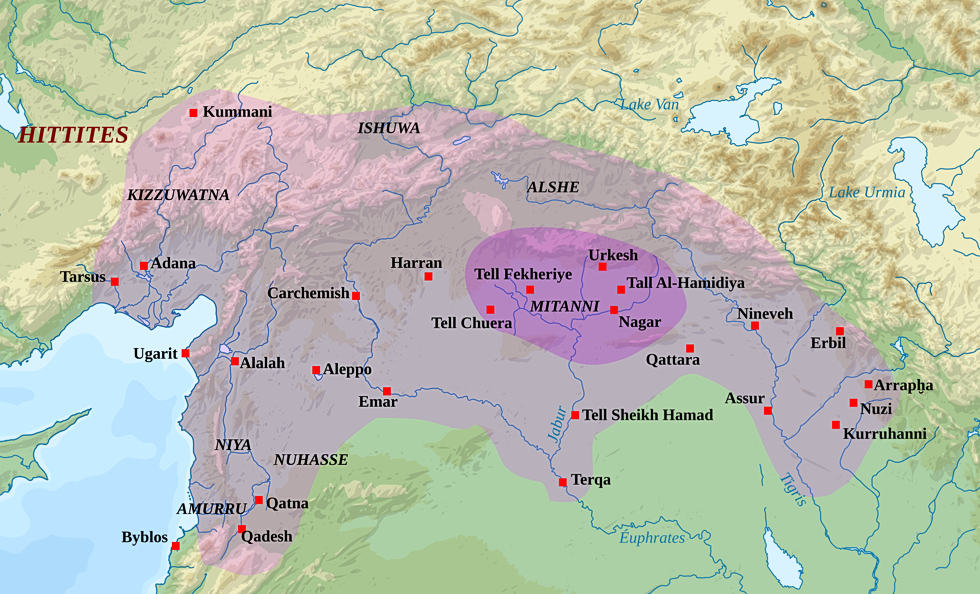
Much later, in the ‑900s, they were known to the Egyptians as the Naharina, which you may recognize from the Hebrew word naharaim “between the rivers.” Which means by that time, they had expanded west to the region around Haran – as you see in the picture above.
The Bible tells us that Abraham’s sons Medan or Midian were sent east “with gifts,” and either of them could have given birth to the Mitanni. While they and the Assyrians made a name for themselves, the rest of the sons of Abraham seem to have been lumped together under the term “children of the east,” a term which otherwise makes little sense.
Judges 6:33 Then all the Midianites and the Amalekites and the children of the east were gathered together, and went over, and pitched in the valley of Jezreel.
Unfortunately, there is another unrelated ethnic group which shares the M-D-N structure also called Midianites who inhabited Arabia in the time of Moses (Exodus 2:15), and most scholars confuse the two, even though this was a very common name structure.
But these Arabian Midianites cannot be descended from Abraham, because Abraham sent his grandson Midian “east, to the east country,” and there is nothing “east” about SW Arabia where Moses found them when fleeing from Pharaoh.
But there were Midianites in Arabia; just not Abrahamites. When Ishmael moved to Arabia (Genesis 25:16-18), he became close with a group of Midianites there to the point where “Ishmaelites” and “Midianites” was synonymous in Genesis 37, just 150 years later.
These Midianites could not be descended from Medan or Midian, son of Abraham, who wouldn’t even be born until long after Ishmael left for Arabia, because Abraham married their mother Keturah only after Sarah died when Ishmael was around 50.
Unfortunately most scholars never think to connect Abraham’s son to the Mitanni, assuming that there was only the one group of Midianites in Arabia; but Arabia is, I must stress, south of Israel. They cannot be one and the same.
The Mitanni were an immensely powerful civilization in Bible times, and a fairly close northern neighbor to Israel at its peak. It would be extremely strange to have them be completely ignored, as the Bible seems to do; but that’s just because all mentions of them are reassigned to the Midianites of Arabia!
CUSHAN OF MIDIAN
Habakkuk 3:7-8 I saw the tents of Cushan in affliction: and the curtains of the land of Midian did tremble. Was the LORD displeased against the rivers? was thine anger against the rivers? was thy wrath against the sea, that thou didst ride upon thine horses and thy chariots of salvation?
This tells us that the land of Midian has rivers in it. You know what Arabia doesn’t have? Rivers! It doesn’t even have river, singular! But the Mitanni do! They were literally called “the two rivers” by the Egyptians.
This passage uses the same Hebrew word naharaim; it’s translated as generic “rivers,” which is correct but it may also have been a direct reference to the region of Aram Naharaim where the Mitanni dwelt. It’s just obscured by the translation.
This passage also connects Midian to Cushan; no one is certain what or where this is, and most people believe they must be in Arabia since Midian “must be” there as well; but if Midian wasn’t there, then neither was Cushan.
The passage itself is very strange; by the time of Habakkuk, in the late ‑500’s, there were no people called Midian in Arabia nor were there Mitanni in Mesopotamia. Both people had long since disappeared or been conquered by the various empires that had taken over the Middle East.
So from the start, this reference is anachronistic – it doesn’t belong here. Which means God is being poetic, either in a prophetic sense or in a past sense. Which gives us the freedom to look into the past for a “Cushan” to identify the location. And the only the only example of this name in the Bible is found in…
Judges 3:8 (YLT) And the anger of Jehovah burneth against Israel, and He selleth them into the hand of Chushan-Rishathaim king of Aram-Naharaim, and the sons of Israel serve Chushan-Rishathaim eight years;
Cushan in Habakkuk does not need to be interpreted as a place name, then; but as the people of a deceased king, or descended from a patriarch. Compare frequent examples of this such as Genesis 9:27, Psalms 78:51, Zechariah 12:7, etc.
We know that Chushan-Rishathaim was king of Aram-Naharaim, king of the two-rivers area, in the early judges period in ‑1418‑1410. We also know that Abraham’s son Midian went east, to precisely that area.
And so when in Habakkuk, God references this region and its two rivers, he address them as the tents of [king] Cushan, and references the curtains of Midian/Mitanni, because Chushan was king of the Midianites in Mesopotamia!
Which makes perfect sense; the last nation Moses attacked before the entry to the promised land was the Midianites (Numbers 31), as reprisal for the curse of Balaam which we’ll read about in a moment. After the war which ended with decisive victory for the Hebrews, they settled in Canaan. And the very first nation to attack them in Canaan 50 years later was the Mesopotamians.
Why? They still held a grudge.
THE CURSE OF BALAAM
Something that no one bothers to explain is why would the Midianites, who were literally Moses’ family¸ have fought with Moabites against him. Moses’ father-in-law Jethro was a priest and clearly a powerful man in the region. Moses even offered the Midianites them a share in the promised land (Numbers 10:29, Judges 1:16).Yet the Moabites appealed to the Midianites for help against Israel – why would they ask Moses’ in-laws for help against Moses?
Numbers 22:3-4 Moab was very afraid of the people, because they were many: and Moab was distressed because of the children of Israel. Moab said to the elders of Midian, “Now this multitude will lick up all that is around us, as the ox licks up the grass of the field.”
And another thing; why would the Moabites have to tell the Midianites and Balaam that Israel had come to their borders; certainly if these were the Midianites of Arabia, they would already known since that’s where Israel had just come from!
While we’re on the subject, why were the Midianites even involved in this conversation? The Moabites played up the threat Israel supposedly represented to the Midianites, but if the Midianites dwelt far to the south in Arabia… then Isreal’s migration had already passed their borders hundreds of miles ago. How could the Moabites convince them that Isreal posed a threat to them?
But clearly, they did pose a threat to these Midianites, which means they cannot be the same ones. At this point, Israel was camping to the north of Moab, having skirted the eastern borders of Edom and Moab to the east and cut back from the north through Amorite territory. Which means at that time they were near to these Midianites, who can only be the Mitanni!
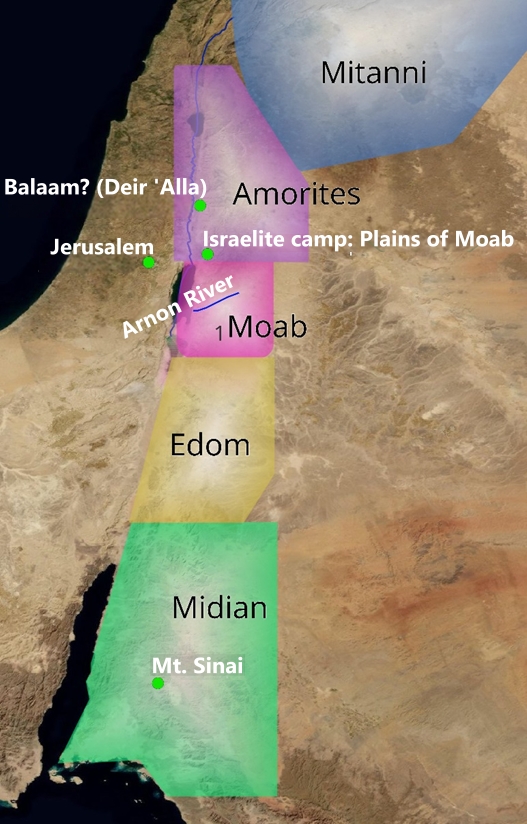
Numbers 22:5-6 … He sent messengers to Balaam the son of Beor, to Pethor, which is by the River, to the land of the children of his people, to call him, saying, “Behold, there is a people who came out from Egypt. Behold, they cover the surface of the earth, and they are staying opposite me. Please come now therefore curse me this people; for they are too mighty for me: perhaps I shall prevail, that we may strike them, and that I may drive them out of the land; for I know that he whom you bless is blessed, and he whom you curse is cursed.”
Deuteronomy 23:4 … and because they hired against thee Balaam the son of Beor of Pethor of Mesopotamia, to curse thee.
Deuteronomy uses the term Aram Naharaim, here translated Mesopotamia as usual, to specify that Balaam dwelt far to the north, near the Euphrates. That is always used to refer to the region around Haran, in the upper Euphrates. And the narrative makes it clear that Balaam came from the north:
Numbers 22:36 When Balak heard that Balaam had come, he went out to meet him to the City of Moab, which is on the border of the Arnon, which is in the utmost part of the border.
The river Arnon formed the northern border of Moab (Numbers 21:13); so once again, why were the Midianites involved in the conversation? Because these are the Mitanni, and Balaam dwelt in their land! Moab needed their permission to send “to Pethor, which is by the River, to the land of the children of his [Balaam’s] people.”
BALAAM’S HOMETOWN
Most people would tell you that Balaam came from one of two places; the more skeptical, critical point of view says he came from Deir Allah, just a few miles north of the Arnon River and the northern border of Moab; this is because they have found some texts there that mention Balaam and his prophesies. But while Balaam did prophesy there, that doesn’t prove he was from there.
We’ve already established he came from “the river,” from “Aram naharaim,” which can only refer to the Euphrates. So Balaam certainly did not live in Deir Allah. Since the Bible also locates his hometown as Pethor, more conservative scholars (those guided more by the Bible, in this case), place him on the west side of the Euphrates in Ancient Pitru.
Pethor or Petor (פְּתוֹר) in the Hebrew Bible is the home of the prophet Balaam. In the Book of Numbers, Pethor is described as being located “by the river of the land of the children of his people.” The Bible usually uses the name “the River” to [refer to] the Euphrates; … In Deuteronomy, Balaam is from “Pethor of Aram-Naharaim” in Upper Mesopotamia. It is widely accepted that Pethor is the town Pitru, which is mentioned in ancient Assyrian records. (Wiki, Pethor)
I like the agreement of the Pitru/Pethor here, but it’s hardly conclusive given Hebrew’s lack of vowels. And the problem is, this description is missing two key factors: Balaam said he was from the east, and from a mountain.
Numbers 23:7 He took up his parable, and said, “From Aram has Balak brought me, the king of Moab from the mountains of the East. Come, curse Jacob for me. Come, defy Israel.”
Pitru doesn’t fit this description; there are no mountains, and only in the most generous sense could we call it “east.” The Bible has the word “north” and knows how to use it. With all of these factors, the only possible candidate I see is Jebel Bishri, a mountain range which is indeed near the Euphrates in the east. In the heart of Mitanni territory.
Placing Balaam on the east coast of the Dead Sea requires us to dismiss every single description about where he came from; the east, Aram Naharaim, on the river, and in the mountains. If we actually listen to those descriptors, this is the only possibility.
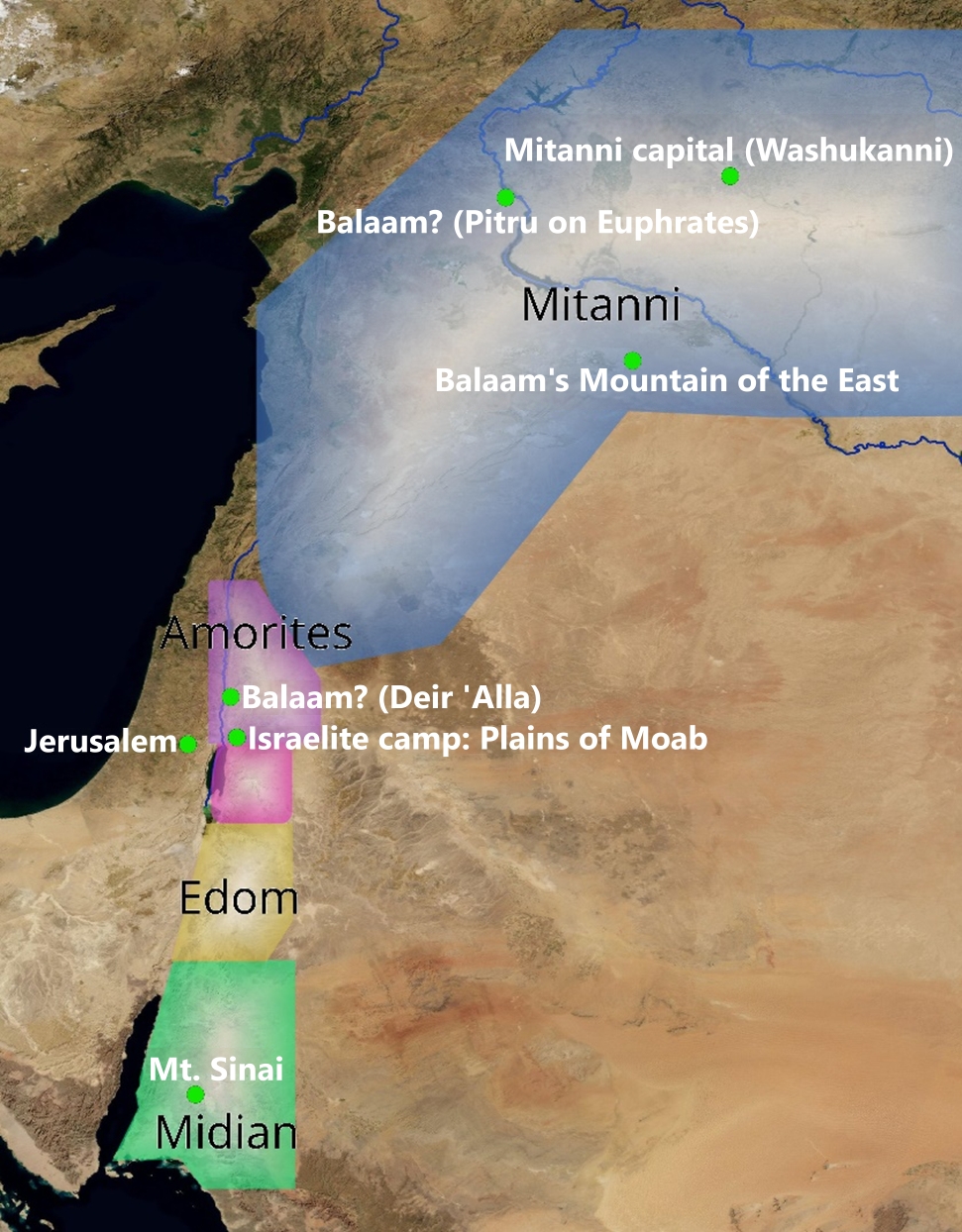 And the following map shows that, at least in later centuries, the Mitanni controlled a vast swath of the upper Euphrates, nearly reaching as far as the northern borders of Moab. At the time of Numbers, they would have almost certainly controlled Balaam’s mountain, which was in their core territory.
This makes sense of all the facts; why the Bible seems to make fetching him seem like such a big deal, far away from the local area; why they had to get the Midianites’ permission to cross their borders and extract one of their prophets; why Israel, moving due north, would have plausibly seemed like at threat to the northern-eastern-dwelling Mitanni.
And why the king of Moab talked to the elders of the Midianites to request Balaam, and both went together to talk to him (Numbers 22:7).Yet later there is no mention of those elders back in Moab when Balaam arrives, only the Moabite elders. Because the Midianite elders stayed in Midian!
Josephus, writing much later when knowledge of the Mitanni was likely lost, nonetheless tells the same story – that the Moabites sent ambassadors to the Midianites, who in turn sent ambassadors to Balaam.
…but [Balak king of Moab] he thought to hinder them, if he could, from growing greater, and so he resolved to send ambassadors to the Midianites about them. Now these Midianites knowing there was one Balaam, who lived by Euphrates, and was the greatest of the prophets at that time, and one that was in friendship with them, sent some of their honorable princes along with the ambassadors of Balak, to entreat the prophet to come to them, that he might imprecate curses to the destruction of the Israelite. … (Josephus)
How could Arabians know about, and be better friends with, a prophet on the Euphrates than the Moabites? This makes sense only if the ambassadors were sent, as I said, to the north – farther from Moabite territory, in Midianite territory. Balaam of course refused, so they tried again.
…Now the Midianites, at the earnest request and fervent entreaties of Balak, sent other ambassadors to Balaam, who, desiring to gratify the men, inquired again of God; (Ibid)
Note that Balak sent to the Midianites who in turn sent ambassadors to Balaam. At the risk of repeating myself, this can only make sense if the Midianites were north, and Balaam dwelt in their land – or at least, far closer to them than to Moab. That, in turn, is confirmed by the following two examples where Balaam showed a duty to the Midianites:
…but now, because it is my desire to oblige thee thyself [Balak], as well as the Midianites, whose entreaties it is not decent for me to reject, go to, let us again rear other altars … [which didn’t help] … But Balak being very angry that the Israelites were not cursed, sent away Balaam without thinking him worthy of any honor. Whereupon, when he was just upon his journey, in order to pass the Euphrates, he sent for Balak, and for the princes of the Midianites, and spake thus to them: – “O Balak, and you Midianites that are here present, (for I am obliged even without the will of God to gratify you,) it is true no entire destruction can seize upon the nation of the Hebrews, neither by war, nor by plague, nor by scarcity of the fruits of the earth, nor can any other unexpected accident be their entire ruin; …” (Ibid)
What’s key here is that Balaam twice says that he is obligated to gratify the Midianites, and “in order to pass the Euphrates,” he tries to offer an olive branch to the Mitanni whose requests “it is not decent for me to reject.” Because he lives in their land. Their land, therefore, is on the Euphrates.
Interestingly, though he inadvertently helps us prove this by being faithful to his sources, Josephus himself did not believe this, placing the Midianites in Arabia; as I said, he could not have known of the Mitanni, so was obliged to find some location in Arabia to try and make sense of this.
THE KINGDOM OF MIDIAN
Scholars are not ignorant of these problems, although they don’t talk about them much. Their solution is to propose a “diffuse network of Arabian trading groups,” of which these northern Midianites formed a part. But if that were true these would be small groups of traveling merchants, not whole cities of Midianites… but the Bible places them in cities.
Balaam, in an attempt to provide something of value to his hosts and earn their favor before leaving, finally suggests that the Moabites send the daughters of the chiefs of Midian to seduce the Hebrews and convince them to serve their pagan gods, and thereby get God Himself to curse Israel. This works wonderfully, as expected.
After the daughters of Midian do their work, at God’s command Moses sent an expedition to punish the Midianites, presumably to prevent this from happening again, with 12,000 chosen men (Numbers 31).The slaughter was immense, with probably one or two hundred thousand Midianites killed.
This, therefore, cannot be a small camp of Midianites; indeed, the Bible mentions that several cities were captured with their kings. This is a real, developed, and most importantly sedentary civilization. Not a “diffuse network of traders.”
And let me stress one last time that if these cities had been located in Arabia, Moses would have had to go back south, skirting east around the Moabites and Edomites, back where they had just left to capture cities in Arabia they didn’t need. Ridiculous!
The Bible makes no mention of such a journey because it could not have happened; these Midianite cities were close at hand, and can only have been to the north since Canaan was west and Moab was south, and they had already come from the east. Of these northern cities, Josephus says…
Now when the enemies were discomfited, the Hebrews spoiled their country, and took a great prey, and destroyed the men that were its inhabitants, together with the women; only they let the virgins alone, as Moses had commanded Phineas to do, who indeed came back, bringing with him an army that had received no harm, and a great deal of prey [675,000 sheep, according to Numbers 31:32]; fifty-two thousand beeves, seventy-five thousand six hundred sheep, sixty thousand asses, with an immense quantity of gold and silver furniture, which the Midianites made use of in their houses; for they were so wealthy, that they were very luxurious. There were also led captive about thirty-two thousand virgins. (Josephus)
What’s interesting here is the “immense quantity of gold and silver furniture,” and the references to “houses” and “cities.” This is incompatible with the known nomadic lifestyle of the Arabians, but quite in keeping with an immensely powerful state like Mitanni.
They had kings, something that the Arabians of that time probably did not have; Arabians had elders and chieftains, but kings require cities, as a rule. Something nomadic people by definition did not have. But something the Mitanni had in abundance.
Ergo, the Mitanni were the Midianites, who descended from a son of Abraham.
THE BOOK OF JOB
Job 1:1-3 There was a man in the land of Uz, whose name was Job; and that man was perfect and upright, and one that feared God, and eschewed evil … His substance also was seven thousand sheep, and three thousand camels, and five hundred yoke of oxen, and five hundred she asses, and a very great household; so that this man was the greatest of all the men of the east.
The book of Job stands unique in scripture; it has no reference to the Exodus or to Moses, at least one of which is alluded to in nearly every other book of the Bible. There are no clear quotes to any of Moses’ laws either, for that matter.
God brags extensively in the later part of the book, but confines his great works to the creation of the Earth – suggesting these other great works either hadn’t happened yet, or at least were not relevant to the audience of the book.
The flood is mentioned (Job 22:16), and the creation and sin of Adam (Job 31:33), showing that Job was heir to the same historical knowledge as Moses, but most likely was around before him, which would mean Job is the oldest book in the Hebrew Bible.
Precise dating isn’t possible, but we can get it to within a generation or so based on the names of Job’s friends. Eliphaz was a Temanite; Temanites were probably descended from Teman, son of Eliphaz, son of Esau; so Eliphaz was clearly a family name, and was most likely reused after Teman, and thus Job’s friend probably lived 3-5 generations after Esau.
We don’t know Esau’s lifespan exactly, but he was Jacob’s twin who lived ‑1862‑1715. So if we allow three generations from Esau’s time, figuring thirty years apiece, to having a mature Eliphaz, our first estimate would be that the events in Job took place not earlier than ‑1740, probably much later – but not after the time of Moses, meaning they preceded the Exodus in ‑1507.
THE LAND OF UZ
Job’s ancestry is never given, but his location was; he is said to have lived in “the land of Uz”; now Uz was a son of Aram (Genesis 10:23), which combined with him being one of the “men of the east” means he probably dwelt in the general upper Euphrates region, in some proximity to Balaam (though probably not at quite the same time).
In addition, another friend of Job’s was Bildad the Shuhite, whom most commentators agree was descended from Shuah, one of the sons of Abraham by Keturah; who was, as you’ll remember, sent far to the east.
Shuah is identified with Suhu, mentioned by Tiglath-pileser I as lying one day’s journey from Carchemish; and a “land of Uzza” is named by Shalmaneser II as being in the same neighborhood. Buz is a brother of Uz (“Huz,” Ge 22:21) and son of Nahor. Esar-haddon, in an expedition toward the West, passed through Bazu and Hazu, no doubt the same tribes. Abraham sent his children, other than Isaac (so including Shuah), “eastward to the land of Qedhem” (Ge 25:6). These factors point to the land of Uz as lying somewhere to the Northeast of Palestine. (ISBE online, “Shuhite”)
Another key is that when Job’s calamities were starting, his camels were stolen by three bands of “the Chaldeans.” The Bible seems to always treat Chaldea as synonymous with Babylon, although scholars place it somewhat farther to the south. So now we have “east from Israel, NE of Palestine, and close enough to be raided from Babylon.” And all of these things agree well with the region of Suhu.
Suhu was a region located on the Middle Euphrates that extended from Hindanu (perhaps located at modern Anqa or Tell al-Gabriya) in the north to Rapiqu (near modern Falluja) on the border with Babylonia. Suhu is attested from the early second millennium to the mid-first millennium BCE. … According to Assyrian records, Suhu was an important region of commerce. … (Wiley-Blackwell encyclopedia, “Suhu”)
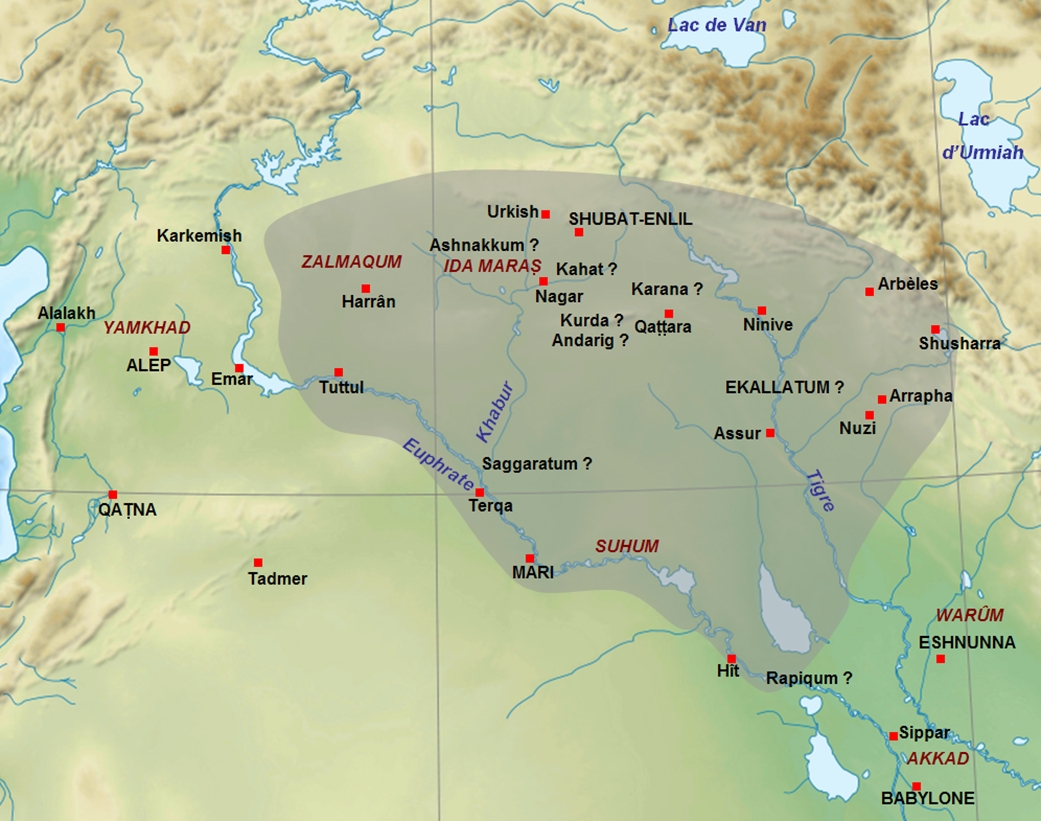
In this map showing the territories of Shamsi-Adad from Wikipedia, dating to approximately ‑1400 (my dating), you can see Suhu (Suhum) just to the east of Mari. Now that’s the home of Bildad, not necessarily of Job.
Still, Shalmaneser told us that Suhu was in the same vicinity as Uzza, and as the map shows us it is northeast of Palestine, close to Chaldea, and in the same area that Abraham’s children by Keturah were sent.
That last part answers the thorny question “how did Job know the God of Abraham?” Now the answer is easy – he learned it the same way Balaam did, from his ancestors the Abrahamites!
JOB’S ANCESTRY
The specifics of Job’s own ancestry is a puzzle we may never solve; but he almost certainly was a 4th-7th generation descendant of Abraham. This is suggested by his longevity – he lived 140 years after his trial, even longer than Abraham himself.
Since everything else he lost was rewarded double (Job 42:10-12), and since Job was older than the fathers of adult men at the time of the trial (Job 30:1), thus at least 50-60, it stands to reason Job was 70 at the time of his trial, for a total lifespan of 210 years.
If his trial did indeed take place after the ‑1700s, say around ‑1650, it means he would have died only a few decades before the Exodus, which means men such as Balaam who lived 40 years later would certainly have known the story and communicated it to Moses in some fashion; probably not via Balaam himself, but there were plenty of ways it could have reached the Hebrews.
Remember, writing was well developed in this region – done in cuneiform, of course. Job himself is almost certainly not the author of the book as we have received it, since it records how long Job lived (something Job himself could not have done).
The best guess is that Elihu wrote it down more or less contemporary with the events in cuneiform (proto-Hebrew wouldn’t be invented until the time of Moses), and that it was updated when it was transmitted into the Hebrew canon to include Job’s age at death and other details.
It’s also worthy of note that with one exception (Job 12:9), the name of Yahweh does not appear in the body of the book, only in the prologue and epilogue (chapters 1-2 and 38-42). God is referred to as “the Almighty,” Hebrew Shaddai, the only name by which Abraham and the patriarchs knew Him until the time of Moses (Exodus 6:3).
MORE CLUES
Job 1:19 And behold, there came a great wind from the wilderness, and struck the four corners of the house, and it fell on the young men, and they are dead. I alone have escaped to tell you.
This locates Job’s dwelling as close to “the wilderness,” i.e., close to the desert but not in it, since the wind came from it. So he lived in a well watered area – which would be necessary to support a wealth of “seven thousand sheep, three thousand camels, five hundred yoke of oxen, five hundred female donkeys, and a very great household” (Job 1:3).
Since Job counted his wealth in livestock, he was clearly from a pastoral culture; but not a nomadic one, for his sons were killed when their houses were smitten (Job 1:19). Thus he did not dwell in tents.
And these houses were made of clay, not stone, for they could be “dug through” (Job 24:16). This adds more evidence that Job didn’t live in the rocky mountains east of Israel, where some place him, but rather in the Euphrates area where building out of clay was more normal.
Job 29:7-10 when I went forth to the city gate, when I prepared my seat in the street. The young men saw me and hid themselves. The aged rose up and stood. The princes refrained from talking, and laid their hand on their mouth. The voice of the nobles was hushed, and their tongue stuck to the roof of their mouth.
Further, he mentions having spent time in cities; he mentions sitting in the street, which was a common practice where elders would sit in or near the city gates judging causes. Nor was this a small village, for it had nobles and princes/kings who all deferred to Job.
Another of Job’s friends – the righteous one, Elihu, was said to be “the son of Barachel, the Buzite, of the family of Ram” (Job 32:2). Buzites were descended from Nahor, brother of Abraham (Genesis 22:21); of Ram, JFB commentary says “Ram–Aram, nephew of Buz.”
We would infer that the whole household was called Buzites, including his nephew Aram, of whom Barachel and Elihu were descended. Which means here, including Nahor, we have five generations; Nahor, Buz, Aram, Barachel, and Elihu.
This was not intended to be a complete family tree, and generations are probably skipped here; but if we take a minimalistic view of this, Nahor-Buz-Aram-Barachel-Elihu would roughly correspond to Abraham-Isaac-Jacob-Joseph-Manasseh, the last of whom was probably born around ‑1740.
It could be off significantly, of course, but it agrees well with the generation of Eliphaz the Temanite whom we likewise placed not earlier than ‑1740. And these events are more likely later than earlier – since Elihu probably skipped generations in his genealogy – so I’d guess at the events of Job taking place more likely around ‑1650.
Regardless, this last clue tells us that a Nahorite was present; Nahor settled initially in Haran, and his family spread out from there, most likely to the city that bears his name (Genesis 24:10), which we know as the ancient city Nagar/Nahar. And with this, we’re finally ready to make our own map.
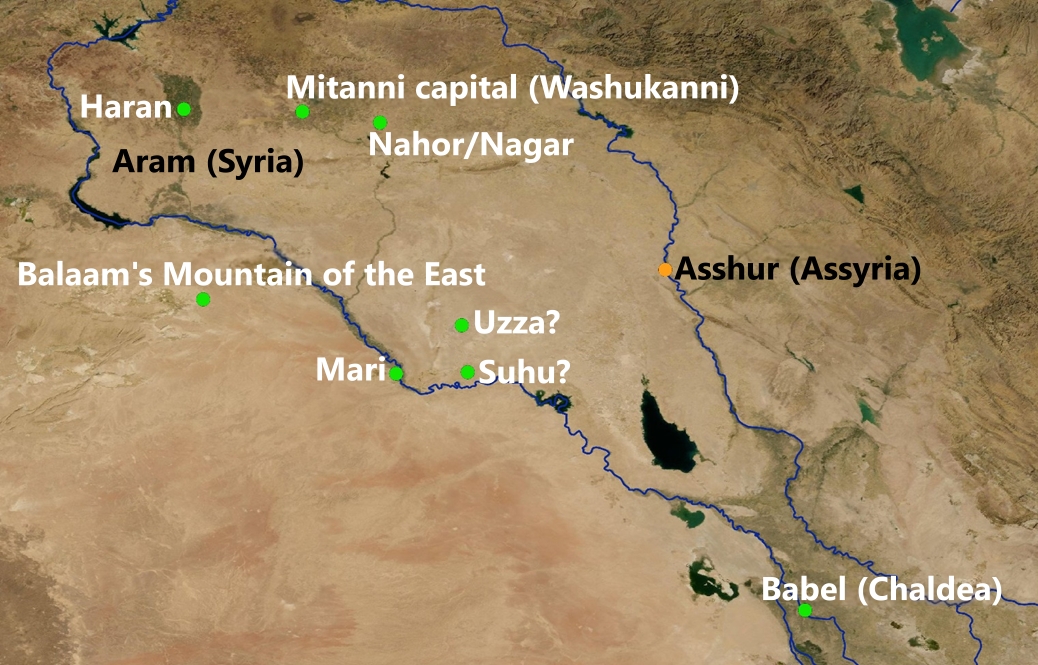
You’ll notice this is the same exact lands where all of Abraham’s children went; Dedan became the Asshurim/Assyrians, Medan became the Mitanni, and so on. He knew they would be taken care of, because by this point Nahor had spread east and taken over much of Aram’s land.
If Elihu came from Nahor, and Bildad came from Suhu, and Job lived nearby in Uzza, the only oddity is Eliphaz the Temanite who came from the far SW in Esau’s territory (just off the map). Easily explicable by trade routes and so on, though it’s also possible there was a Tema who lived in the region we don’t know about.
Jeremiah 25:23 Dedan, and Tema, and Buz, and all who have the corners of their beard cut off;
You may recall that Dedan was the ancestor of the Assyrians, Buz you’ve just met as the ancestor of Elihu, and Tema may have been the father of the Temanites not related to Esau’s lineage, meaning the Eliphaz-Teman link is a coincidence.
This scripture puts all three in close proximity, as we would expect them to be based on Job. And it was clearly intended to be a far-reaching passage, since two verses later it mentions the Medes and Elamites, much farther to the east.
Whatever we do with Eliphaz, everything else fits; Chaldeans, desert nearby, mud-brick houses, abundant pasturage, cities, and the general proximity of Balaam’s mountain helps to show that the worship of the true God, in a way acceptable to Moses, was present in this region at approximately this time.
Of course it was – because nearly everyone here was descended from Abraham.
THE LANDS OF ABRAHAM
So in the end we see that, thanks to the blessing of God, the entire northern half of Mesopotamia became populated by Abraham’s family, from Assyria, through lands of the Mitanni, through Haran which was already populated by his cousins, down the eastern side of the Mediterranean, for Ammon and Moab were his great-nephews, all the way down to the tip of Arabia which belonged to Ishmael.
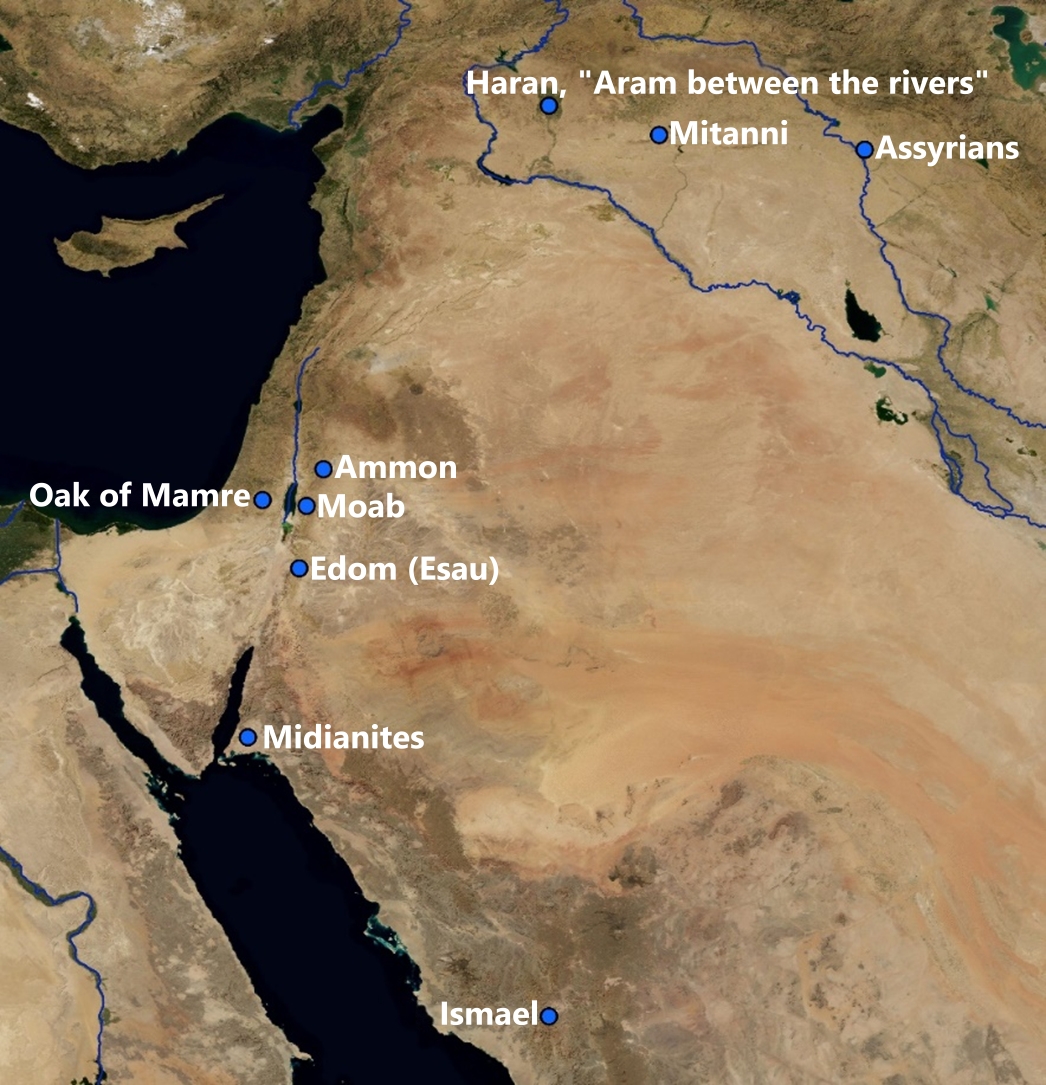
As I said at the beginning, the Mitanni were close to Israel during most of the judges and early kingdom period of Israel. As close as the Hittites, who were mentioned many times, and much closer than the Assyrians or Babylonians. So why is the Bible so utterly silent about them? We see now that it wasn’t.
Among David’s mighty men were many foreign warriors; Uriah the Hittite being the most famous, but also including Zelek the Ammonite and Ithmah the Moabite. For our purposes, the most interesting is Joshaphat the Mithnite (1 Chronicles 11:43).
While it can hardly be proven, the trend in these names is a very diverse coalition of fighters from many nations, not just Israelites. And Mithnite is plausibly derived from Mitanni. By this time – 400 years later – the name may have been written differently in Hebrew.
What cannot be argued is that the Mitanni were real, and present, in Biblical times. They should be in the Bible. And they are – as Midianites, descended from Abraham, dwelling to the east precisely as it said they would; and now, finally, we are ready to answer a question no one has ever answered before:
Why was Balaam able to curse Israel?
Moses acknowledged that Balaam was a prophet to fear, one to whom his own God spoke, whom Moses’ God gave the power to bless and curse. Isn’t that odd? Why was a prophet of Abraham’s God dwelling in Mesopotamia “by the river of the land of the children of his people?”
Because he, and his Midianite/Mitanni brethren, were descendants of Abraham!
He learned about the God of Abraham the old-fashioned way: from Abraham’s descendants, his own ancestors – like Job.

This is part 16 of The History of the World Series
 Mesopotamian Empire and Sargon
  Lifespans
  Sumerian King List
  Abraham and Chedorlaomer
  What Is The LOVE Of God?
  Everything You Believe About God Is WRONG!
  Make Up Your Mind!
  What Is Faith?
  How DARE you FEAR the judgment of God!
  Firstripe Figs
  The Bride Of The Father
  Exodus 40 – The Plan Of God
  The Temple Of God
  Pillars Of The Temple And The Brass Sea
  GEHENNA WITH ‘EM
  When Did God Forbid Polygamy?
  When You Shouldn’t Pray For Someone
  The Sins of the Father
  The First Paul