Lifespans

This is part 14 of the The History of the World Series
; Introduction is part 1.
Click here to read in series
We have so far taken the long age of Noah and others in the Bible at face value; but it’s worth pausing to see if we can establish real reasons to take these ages seriously. After all, we radically reduced the ages of the SKL as a scribal error; why not do the same to the “impossibly” long 900+ year ages in the Bible?
One difference is that the Bible’s pre-flood ages are consistently just over 900 years with a few exceptions probably explained by murder, accidents, etc. While extreme, this is relatively reasonable and internally consistent as compared to the Sumerians who had pre-flood reigns as low as 18,600 and as high as 43,200, with no real consistent pattern.
The haphazard numbers in the early SKL suggests there’s a big problem with how we interpret them, as we have already demonstrated. But people try to project this same uncertainty back on the Bible’s tradition, which is understandable, but which doesn’t really follow.
The very consistency of the Bible’s numbers suggests a real lifespan limit at just under 1,000 years. Today, that’s not even close to a dream; super-agers are lucky to reach 125 years, and we have every reason to believe this has been the norm throughout history. The Bible itself treats 70 as a “normal” age at death in the time of David:
Psalms 90:10 The days of our years are seventy, or even by reason of strength eighty years; yet their pride is but labour and sorrow, for it passes quickly, and we fly away.
So was the Bible really serious about these extreme ages of the patriarchs, or are they some sort of a scribal error or metaphor? Well, one thing that separates them from Sumerian writings is that the Bible makes several later references to a thousand year lifespan, confirming that this was understood by later generations as divine intent.
Ecclesiastes 6:6 Yes, though he live a thousand years twice told, and yet fails to enjoy good, don’t all go to one place?
This indirectly confirms the length of the pre-flood kings by saying that even if you live a thousand years [like they did], even if you did it twice, it would not be worthwhile if you didn’t “enjoy good.”
2 Peter 3:8 But don’t forget this one thing, beloved, that one day is with the Lord as a thousand years, and a thousand years as one day.
Psalms 90:4 For a thousand years in your sight are just like yesterday when it is past, like a watch in the night.
Job 14:5-6 Seeing his days are determined, the number of his months is with you, and you have appointed his bounds that he can’t pass; Look away from him, that he may rest, until he shall accomplish, as a hireling, his day.
Together, these verses show that metaphorically a millennium and a day are interchangeable to God. They also show that God has appointed an upper limit to the lifespan of man, “bounds that he can’t pass,” being allowed only to “accomplish, as a hireling, his day.”
That, combined with the fact that no one ever lived longer than 1,000 years, shows strongly that this is the upper limit God gave man after Eden. Which explains, in passing, how God’s words in that same garden came true…
Genesis 2:17 but of the tree of the knowledge of good and evil, you shall not eat of it; for in the day that you eat of it you will surely die.
This did not happen; they ate the fruit and went on to live productive and fertile lives for 930 years afterwards. God lied? God relented? Or God did exactly what He said He would do – set an upper bound on their lifespan of one millennial day, and they died in the same thousand years in which they first sinned.
BUT HOW?
So we have established that the Bible meant for the ages to be understood as we understand them. But is an age of 1,000 years even biologically possible?
It is increasingly well known today that the process of aging is unnatural. Cells are meant to replicate when they grow old. Some have been made, in a lab, to replicate indefinitely. Other scientists have taken old cells and rejuvenated them a lab.
So there is no such thing as “death by natural causes,” because death itself is not natural. Our cells are meant to age and be replaced naturally over time, without aging the organism itself. If a cell was replaced at senescence with an exact copy, we would have eternal youth.
The body makes new cells from the DNA code of the old one; and most of the time, they are copied correctly. But occasionally, mistakes creep in; the body has ways of correcting this and replacing the damaged cell, but sometimes it doesn’t “get around to it” because it is putting out fires elsewhere.
Over time, these slightly damaged cells are themselves copied and mistakes are made in those new cells. And it gets worse over time, like making a xerox of a xerox of a xerox. Turns out they can divide about 40-60 times at their current quality of transmission before they make copies so bad as to be unusable – which is when the human body starts to fail. This is called the Hayflick limit.
The safeguard against these errors are called telomeres, a sort of safety margin on the end of DNA string; generally compared to the little plastic parts that protect the end of shoelaces. Over time, these shorten and eventually they no longer protect the code behind it.
But here’s the thing: they shorten at different speeds, and in some cases can even be lengthened, which directly lengthens the life of the organism. And what controls this process is universally agreed to be stress, in its broadest definition.
…in vitro studies have shown that telomeres accumulate damage due to oxidative stress and that oxidative stress-mediated DNA damage has a major influence on telomere shortening in vivo. There is a multitude of ways in which oxidative stress, mediated by reactive oxygen species (ROS), can lead to DNA damage… (Wiki, Telomeres)
Oxidative stress is caused by a wide variety of things like smoking, drugs, excess sugar, all the usual things you know are bad for you; but biological aging is also caused by psychological stress:
In the past decade, the growing field of telomere science has opened exciting new avenues for understanding the cellular and molecular substrates of stress and stress-related aging processes over the lifespan. Shorter telomere length is associated with advancing chronological age and also increased disease morbidity and mortality. Emerging studies suggest that stress accelerates the erosion of telomeres from very early in life and possibly even influences the initial (newborn) setting of telomere length. In this review, we highlight recent empirical evidence linking stress and mental illnesses at various times across the lifespan with telomere erosion. (Stress and telomere biology: A lifespan perspective)
Bottom line; under ideal conditions your cells could, theoretically, divide perfectly, keeping you young forever. Which means that theoretically there is no reason a person could not live to be at least 1,000 years old.
The fact that there is zero modern (or even classical) evidence of it does not disprove this, since ideal conditions have never existed since the garden of Eden. In fact, that itself is an interesting point. God said that in the garden as long as he could eat of the tree of life, Adam was functionally immortal:
Genesis 3:22 Yahweh God said, “Behold, the man has become like one of us, knowing good and evil. Now, lest he reach out his hand, and also take of the tree of life, and eat, and live forever…”
But what’s interesting is that God never said “you will no longer live for ever.” Adam himself was never cursed. The ground was cursed because of Adam! If you read God’s words closely, the real curse was that Adam would have to be a farmer.
Genesis 3:17-19 (GWV) Then he said to the man, “You listened to your wife and ate fruit from the tree, although I commanded you, ‘You must never eat its fruit.’ The ground is cursed because of you. Through hard work you will eat food that comes from it every day of your life. The ground will grow thorns and thistles for you, and you will eat wild plants. By the sweat of your brow, you will produce food to eat until you return to the ground, because you were taken from it. You are dust, and you will return to dust.”
Notice the direct connection between Adam’s hard work, the stress of providing his own food, and his eventual death. Conditions were no longer ideal, and death was inevitable within the same 1,000 year period of his first sin.
If for some reason after the flood conditions became even less ideal, then this life span would be reduced even further, as we will explain in a moment. For now, the takeaway from this is that the Bible’s millennial lifespans could be true.
It would only be necessary that Noah’s telomeres did not shorten and his cells were copied perfectly – or at least, a lot less imperfectly than today. And while we can’t repeat this today, we can grant its theoretical possibility.
LONG LIFE
We do not rely on the Bible nor scientific speculation alone for this, but contemporary evidence from the Sumerians themselves. They had very specific, yet realistic memories of longevity in their recent past.
When in ancient days heaven was separated from earth, when in ancient days that which was fitting ……, when after the ancient harvests …… barley was eaten (?), when boundaries were laid out and borders were fixed, when boundary-stones were placed and inscribed with names, when dykes and canals were purified, when …… wells were dug straight down; when the bed of the Euphrates, the plenteous river of Unug, was opened up, when ……, when ……, when holy An removed ……, when the offices of en and king were famously exercised at Unug [the priest-king of Uruk], when the sceptre and staff of Kulaba were held high in battle – in battle, Inana’s game; when the black-headed were blessed with long life, in their settled ways and in their ……, when they presented the mountain goats with pounding hooves and the mountain stags beautiful with their antlers to Enmerkar son of Utu – (Lugalbanda and the Mountain Cave)
This story of the time of Enmerkar, the priest-king of Uruk, at the time of the division of the Earth among the nations – i.e., just after Babel – specifically mentions that at that time “the black headed,” the Sumerians, were blessed with “long life.”
Now “long life” is relative; to us, that might mean 100 years. But to Noah that wouldn’t be “long” at all. But another quote clears up what they meant; they had 100 years of youth, followed by 100 years of adulthood.
After the flood had swept over and brought about the destruction of the countries; when mankind was made to endure, and the seed of mankind was preserved and the black-headed people all rose; when An and Enlil called the name of mankind and established rulership, but kingship and the crown of the city had not yet come out from heaven [~2250 BC], and Ninĝirsu had not yet established for the multitude of well-guarded (?) people the pickaxe, the spade, the earth basket and the plough, which mean life for the Land – in those days, the carefree youth of man lasted for 100 years and, following his upbringing, he lasted for another 100 years. (Rulers of Lagash)
This specifically dates it to before the kingship of Kish, before the building of Babel or Uruk. At that time, everyone had a century of youth, followed by a century of “normal aging.” Which is not to say they spent a century as a biological teenager; the Bible records the average birth after the flood at around 30 years, meaning they were biologically adults for most of that first century.
The Bible also confirms that when people lived to be longer than a century, those added years were not spent shriveled and weak. Remember, when Sarah was in her late 60’s she was taken into Pharaoh’s harem as irresistibly beautiful, potentially worth murdering Abraham for (Genesis 12:11-14). And again when she was 89 she was taken by the king of the Philistines for the same reason. She would go on to live to be 137 years old.
Deuteronomy 34:7 Moses was one hundred twenty years old when he died: his eye was not dim, nor his natural force abated.
We can also see the youth of the super-aging patriarchs in the health of Moses; remember, Moses did not die of old age; he died because God forbade him to enter the promised land for his sin (Deuteronomy 31:14, 34:4-5). But compare the vibrant health of Moses at 120 – in particular, his eyesight – to that of Job when he was 70:
Job 17:7 My eye also is dim by reason of sorrow. All my members are as a shadow.
Job was righteous, but lacked faith and lived in fear (Job 3:25, Job 1:5, etc.). This made his eye dim, as compared to Moses. What does it say about us, today, that many people need glasses before they hit puberty?
PSYCHOLOGICAL STRESS
The reason we cannot, in practice, reach those lifespans today is that stress of every type makes the copying of DNA an imperfect process; these imperfect cells accumulate, are copied with their own errors, until at some point the cells are so bad they stop functioning altogether.
Some of this stress is dietary, like smoking or McDonald’s or lead goblets; some is environmental like volcanic eruptions or microplastics or microwave emissions; some is disease or famine or the fear of war; some is simply from a lack of exercise, which ironically causes stress on the body by denying blood flow to important organs and muscles.
Still, since no one has plausibly lived to be over 200 years in the past 4,000 years, it strongly argues that the drop in life span was not caused by fast food or wi-fi signals; which points us instead to a psychological cause, one which affected the entire world simultaneously. The Bible itself strongly suggests that the psychological stress is the most important one:
Genesis 47:9 Jacob said to Pharaoh, “The days of the years of my pilgrimage are one hundred thirty years. Few and evil have been the days of the years of my life, and they have not attained to the days of the years of the life of my fathers in the days of their pilgrimage.”
Jacob directly connected his stressful life to his “relatively” short lifespan as compared to his long-lived ancestors.
But reading his answer, we are shocked at his modesty. At 130, Jacob would have already set a new world record for longevity if he were alive today, and his total life of 147 years were double what Pharaoh could hope to achieve.
Yet he considered his days far fewer than they should have been. And he told us why: because his life had been hard. His brother wanted to kill him several times, not without reason; his uncle took advantage of him with hard work, his wives fought a lot, his favorite son he believed was murdered, the famine that led them to move to Egypt, etc.
So Jacob knew his lifespan was nothing compared to what it would have been if he hadn’t been a liar, deceiver, and thief who insisted on learning everything the hard way. And he plainly said that it was his sorrow – his stress – that caused him to age:
Genesis 42:38 He said, “My son shall not go down with you; for his brother is dead, and he only is left. If harm happens to him along the way in which you go, then you will bring down my gray hairs with sorrow to Sheol.”
A concept which doctors understand today – that stress is the cause of all aging and death – but they underestimate the potential for human lifespan if a certain kind of stress in particular were eliminated.
UTOPIA
The above quote told us that “kingship and the crown of the city had not yet come out from heaven,” and at that time “the carefree youth of man lasted for 100 years and, following his upbringing, he lasted for another 100 years.”
Since this is explicitly connected to the pre-kingship years, it is also by definition pre-Babel, and pre-Nimrod. After that time, the Sumerians believed it was only possible to live that long in Dilmun, the “land of the living:”
Pure is Dilmun land. Pure is Dilmun land. Virginal is Dilmun land. Virginal is Dilmun land. Pristine is Dilmun land … In Dilmun the raven was not yet cawing, the partridge not cackling. The lion did not slay, the wolf was not carrying off lambs, the dog had not been taught to make kids curl up, the pig had not learned that grain was to be eaten. … no eye-diseases said there: “I am the eye disease.” No headache said there: “I am the headache.” No old woman belonging to it said there: “I am an old woman.” No old man belonging to it said there: “I am an old man.” No maiden in her unwashed state …… in the city. No man dredging a river said there: “It is getting dark.” No herald made the rounds in his border district. No singer sang an elulam there. No wailings were wailed in the city’s outskirts there. (Enki and Ninhursanga).
It cannot be an accident that the place Noah and his righteous descendants dwelt was seen as a place where there was no death, no predators, no disease. In fact, it is precisely what we expected based on our knowledge of Noah from the Bible. And it must be noted that this is exactly how the Bible describes paradise over a thousand years later, down to the very same metaphors.
Isaiah 11:6-9 The wolf will live with the lamb, and the leopard will lie down with the young goat; The calf, the young lion, and the fattened calf together; and a little child will lead them. The cow and the bear will graze. Their young ones will lie down together. The lion will eat straw like the ox. The nursing child will play near a cobra’s hole, and the weaned child will put his hand on the viper’s den. They will not hurt nor destroy in all my holy mountain; for the earth will be full of the knowledge of Yahweh, as the waters cover the sea.
The cause of this non-violent utopia is given as “the Earth being full of the knowledge of the Lord.” Note also that, like the Sumerians, Isaiah said this place as being “in the holy mountain,” just as the Sumerians saw the mountain of Dilmun as paradise on Earth.
And as has been shown, the archeological record supports this, since a remarkable lack of weapons are found in IVC cities. The Sumerians noted this oddity of their pacifistic neighbors, and called it “the land of the [ever-]living” for a reason.
They also knew precisely why Dilmun was like this; the presence of Noah. Which makes sense – how else did Noah keep the animals from killing each other on the Ark, if not because “the lion did not slay?” Because “they shall not hurt nor destroy in all my holy mountain.”
As has been abundantly shown, it was this peculiarity of Noah, his longevity and that of those around him that led Gilgamesh to seek him out. Nor is it a surprise; for his name was Noah, meaning “rest, comfort”; his father named him this, saying…
Genesis 5:29 and he named him Noah, saying, “This same will comfort us in our work and in the toil of our hands, because of the ground which Yahweh has cursed.”
Apparently, this comfort extended also to the lions and wolves in the place that Noah, “a preacher of righteousness,” went to live (2 Peter 2:5). The righteousness he taught, the judgments he made, brought a safety and peace to his family which is what gave them peace, and that peace gave them long life.
THE PROTECTION OF NOAH
The flood happened in ‑2314. Babel took place less than 200 years after the flood; most people hadn’t been alive more than 100 years at that time. Which means that everyone lived in “eternal” youth until then, well on their way to living a “normal” 1,000 year pre-flood life span! Because Noah was around, and was obeyed!
During that time, all of the family was blessed with the youth of Noah. When they began to follow Nimrod instead, their normal aging processes kicked in and they lived out another 75 or 100 years after – give or take.
Which is exactly what the Sumerian legends tell us – that “in those days, the carefree youth of man lasted for 100 years and, following his upbringing, he lasted for another 100 years.” Following his upbringing… by Noah, in Gobekli Tepe.
But then men built the tower of Babel and everything changed. Which means that it was Babel itself which started their “normal” aging process, causing them to live our their lives with the normal modern lifespan of an additional 70-100 years starting from the tower of Babel.
Which allows us to explain why Shem lived to be 600, while the “black-headed” lost their youth after around 100 years; because Noah left Mesopotamia at precisely that time, taking with him his most righteous offspring!
THE STRESS OF FALSE RELIGION
This created several immediate and serious stressors; first, Nimrod had introduced an alternative religion; now we had to decide which God to serve, and how, and why; Noah was no longer around to cut through the nonsense for us.
The leaders were no longer kept in check by a righteous patriarch, but free to become more and more corrupt; this caused stress for them, their subjects, and those who wished to take their power for themselves.
It also caused a lack of fairness, and fear of death, theft, and all the other problems in a corrupt society. Which meant more weapons, more locks, more fear – and more stress.
And finally, and no less importantly, the absence of Noah’s righteous spirit meant that the animals became more of a threat; only in Dilmun would the wolf not take the lamb, meaning a great deal more stress in Sumer. Hence the need for Nimrod to be “a mighty hunter” and protect the people that way.
As a result, after the tower of Babel anyone not in the immediate proximity of Noah’s government, unless they were exceptionally righteous themselves like Abraham or Moses, died within a hundred years of Noah’s departure, and future generations didn’t enjoy a long youth, but began to age at 30 just like we do today.
The natural strength of our soul carries most of us through to our twenties in reasonable health – and when we can’t handle the stress of adulthood we immediately, and rapidly, begin to age. For it is, ironically, these fears – specifically the fear of death – which cause that same death:
Hebrews 2:15 and might deliver all of them who through fear of death were all their lifetime subject to bondage.
Logically, if we did not fear death, we would not be in bondage to death. But to do that, we would have to know we did not deserve death for our sins, which is to say we must be confident in our righteousness, which means we would have to consistently show love for our fellow man; only then can we cast out fear – and with it, death.
1 John 4:18 There is no fear in love; but perfect love casts out fear, because fear has punishment. He who fears is not made perfect in love.
The only other way is to avoid fear is the way small children do; by looking up with awe to a perfect immortal authority figure who protects you, whom you trust to provide for you and take care of your sins without reservation. And when they lost Noah, mankind lost that.
THE SHORTENING OF LIFESPANS
Contrary to popular belief, life spans were not shortened by the flood at all. Nor did they slowly change; no descendant of Noah in Abraham’s lineage died for nine generations until within a decade of his own death 350 years after the flood. Then within 78 years of his death five of those generation died, including all of the youngest ones.
Within another century, the four oldest – Shem, Arphaxad, Salah and Eber – joined them. They survived, no doubt, because they knew Noah best and were most acquainted with his righteous ways.
So this is not a slow decline of lifespans; this is a sudden decline caused by some significant event. Oddly enough, it wasn’t even the tower of Babel, which precedes the first Arphaxadite death by 200 years. Instead the defining event is clearly the absence of the patriarch who held that line of the family together and kept them connected to God.
While Noah lived, for 350 years after the flood, until just a decade before his own death, not one of his ten generations of descendants died. Yet within 182 years after his death, every member of his family for 11 generations would die!
Shem we know was righteous (Genesis 9:26), and so his own strength carried him beyond his father for a few centuries, which probably helped his descendants live as long as they did beyond Noah’s death. But Shem was not Noah.
Stress caught up with Shem at about the same time as his 11th generation descendant Ishmael. So the flood didn’t shorten lifespans; Babel shortened lifespans. Noah’s presence counteracted the effects of Babel for those who followed him, and with his death millennial ages disappeared from the world ever since.

This is part 14 of The History of the World Series
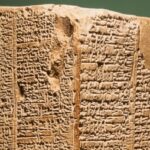 Sumerian King List
  Abraham and Chedorlaomer
  Abraham in Egypt
  Ur of the Chaldees
  What Is The LOVE Of God?
  Everything You Believe About God Is WRONG!
  Make Up Your Mind!
  What Is Faith?
  How DARE you FEAR the judgment of God!
  Firstripe Figs
  The Bride Of The Father
  Exodus 40 – The Plan Of God
  The Temple Of God
  Pillars Of The Temple And The Brass Sea
  GEHENNA WITH ‘EM
  When Did God Forbid Polygamy?
  When You Shouldn’t Pray For Someone
  The Sins of the Father
  The First Paul