Aftermath of the Exodus

This is part 31 of the The History of the World Series
; The History of the World is part 1.
Click here to read in series
The ten plagues in Egypt were the archetypal example of God’s wrath. I’d like you to imagine a country that relies on farming and agriculture going through these plagues, and think about what would be left of that country:
- Water turning to blood: The Nile River, the source of life in Egypt, turned into blood, killing the fish and making the water unusable.
- Frogs: Swarms of frogs emerged from the Nile and invaded Egypt, entering homes and bothering the Egyptians.
- Lice (Gnats): The ground became infested with gnats, tormenting the Egyptians.
- Flies: Swarms of flies plagued the land, affecting Egyptians and their livestock.
- Pestilence on livestock: A fatal disease killed most of the Egyptian livestock.
- Boils: Painful, pus-filled boils erupted on the bodies of Egyptians and their livestock.
- Hail: A severe hailstorm destroyed crops and trees and livestock, causing immense damage.
- Locusts: A massive locust swarm consumed all the remaining crops and vegetation, leaving Egypt bare.
- Darkness: Three days of complete darkness enveloped Egypt, making it impossible to see or move. This was a sandstorm so extreme that it would have blanketed Egypt with inches of sand, if not feet.
- Death of the firstborn: The firstborn of Egyptians, along with their firstborn livestock, were killed. “There was not a house where there was not one dead” (Exodus 12:30).
The Egyptian economy, based as it was on Israelite slave labor, would utterly collapse. And if that weren’t enough, most of Pharaoh’s army – which would have included a lot of the nobility, since they often were high-ranking soldiers – was killed at once, along with Pharaoh himself.
This means no government, no bureaucracy, no police; anarchy. Combined with an already existing state of destruction, death, and hunger. Plus after all this, we have reasons to believe that the Nile didn’t flood for a second year, deepening the famine.
In reality, the plagues are probably exaggerated a bit – at least, as they’re translated into English – because in plague #5, “all the cattle died” (Exodus 9:6) but then plague #7 has the cattle “fleeing into the houses” (Exodus 9:20). So “all” is clearly a figure of speech there.
Even so, after this succession of plagues there would be practically, if not literally, no food in Egypt. (Most of) the fish were dead. (Most of) the animals had been killed in plagues 4, 5, 6, 7 and 10 – and there was (almost) no grass for them to eat anyway, and what little there might be would be buried under sand from plague #9. So there was no food, nor anyone to plant the food for the coming years.
There would be disease from the dead and starving everywhere – not to mention whatever the flies and lice carried. Depending on the size of the family, the death of every firstborn alone would mean the death of anywhere between 10-50% of the total population.
To put it mildly, Egypt was in shambles, nor under the most ideal of circumstances would it be possible to recover quickly from this catastrophe. The plagues could easily have meant the death of half of the population before Moses even left, plus lingering aftereffects from hunger and disease.
So those few who survived the plagues and diseases were left with no food or hope of growing any. We can now better understand the full import of the Egyptians’ statement…
Exodus 12:33 The Egyptians were urgent with the people, to send them out of the land in haste, for they said, “We are all dead men.”
Those few who survived would be vulnerable to invasion, which promptly happened.
We would not expect the Egyptians experiencing these calamities to write about it on their monuments, for they certainly had no time or labor to make any monuments. But it is impossible that such a series of catastrophes did not leave a lasting impression in the cultural memory, and indeed it did.
SECOND INTERMEDIATE PERIOD
In fact, archaeologists have a name for the period – they call it the Second Intermediate Period. The Admonitions of Ipuwer were written about it, which we have already quoted extensively; but he has more to say.
How comes it that every man kills his brother? The troops whom we marshaled for ourselves have turned into foreigners and have taken to ravaging. What has come to pass through it is informing the Asiatics of the state of the land; all the desert folk are possessed with the fear of it. What the plebs have tasted […] without giving Egypt over [to] the sand. (Admonitions of Ipuwer)
As we can see in the king list of the 13th Dynasty, after the death of Merhotepre Ini various generals declared themselves king and fought for power; the remaining armies, Ipuwer tells us, went rogue and plundered what little was left for themselves.
Then – and this is key – the Asiatics were “informed” of the state of the land. And they smelled blood in the water. Here is one of the world’s ripest fruits for the plucking, defenseless and ready to be occupied by barbarians. And just like the Gutians before them in Sumer, and the Visigoths after them in Rome, the Hyksos invaded.
[Pharaoh] Tutimaeus. In his reign, for what cause I know not, a blast of God smote us; and unexpectedly, from the regions of the East, invaders of obscure race marched in confidence of victory against our land. By main force they easily seized it without striking a blow; and having overpowered the rulers of the land, they then burned our cities ruthlessly, razed to the ground the temples of the gods, and treated all the natives with a cruel hostility, massacring some and leading into slavery the wives and children of others. (Josephus, quoting Manetho)
These were the Hyksos, nomads from the areas between Egypt and southern Canaan. Note that they came “from the east” – southern Palestine – and then made slaves of the inhabitants of Egypt without striking a blow.
Try to imagine that happening; at any time in history, no matter how internally divided, Egypt could have mustered enough of an army for at least a token resistance to foreign invasion and occupation. How bad must Egypt have been, in order for it to fall so easily to such bitter oppression?
Life under their rule is described in detail in another ancient document, the Prophesies of Neferti. This is presented as a prophecy given in the time of the 4th Dynasty king Sneferu, but is generally agreed to have been written much later as a history-presented-as-prophecy.
He [the prophet] gathered his thoughts on the events in the land, he recalled the turmoil of the East, the rampage of Asiatics with their forces, disrupting the hearts of those at harvest, seizing those yoked in ploughing. He said ‘stir yourself, my heart, as you weep for this land where you started, silence would be refreshment’ …. This land is destroyed without any to care for it, any to speak up, any to make lament, what will become of this land?
…All happiness has departed, flung down in the land of hardship, from those (weights) of supplies of the Asiatics who are throughout the land. Men of violence have emerged in the East, Asiatics are coming down into Egypt. The confines are lost, another is beside, who will not be heard…. The herds of foreign lands will drink from the rivers of Egypt. They will be refreshed on their shores, for want of any to drive them back. This land is to be taken and carried off, unaware of the onset of what will happen, hidden in the saying: ‘Look out, the hearer is going deaf, the silent one is before (us).’ I give you the land in the passing of evil – what should not happen, happens. Weapons of war will be taken up, as the land lives in turmoil. (Neferti)
Note that this describes the exact same circumstances as the Admonitions of Ipuwer and Manetho; the invasion by Asiatics without anyone available to drive them out. In fact, the description of the situation in Egypt in the time of Neferti mirrors Ipuwer, almost word-for-word.
The river of Egypt is dry, the water is crossed on foot. Water is sought for boats for its sailings. Its course is turned into its shore, its sand back into flood, The place of water into what should be the place of the shore. The south wind does battle with the north wind, there will be not one wind for the sky. (Neferti)
You may recall in the chapter on the Exodus (chapter 20), I quoted the Admonitions of Ipuwer saying “The river is blood, yet men drink of it … Indeed, men cross the river on foot. The flood is none; the fields are bare of crops.” Note the identical phrasing – because it’s talking about the exact same time, just as Isaiah 11:15 said that the Israelites walked across the river in sandals because God waved “his scorching hand” over the river.
So what are the odds of a series of such specific events – famine, Asiatic incursions, a river “crossed on foot”… all happening twice? Or is it more likely that these two narratives are describing the same event?
I stress this, because everyone on Earth believes that Neferti refers to the first intermediate period, the time of the 7th-10th Dynasties. They say this because they misunderstand the reference to the “messiah” who will, eventually, save them from their oppression:
There is a king who will come from the south, Ameny true of voice is his name. He is the son of a woman of the Land of the Bow, he is a child of the Heartland of Nekhen…. Rejoice O people of his time. The son of a man will make his name for eternity and everlasting time. Those who fall into evil, or plan treason, they will be overthrown on themselves for fear of him, the Asiatics will fall at his slaughter, the Libyans will fall at his fire, the rebels at his force, the evil-hearted at his majesty. The rising cobra who is in the palace will overpower the evil-hearted for him. They will build the Walls of the Ruler may he live, prosper, and be well, to prevent the Asiatics from coming down into Egypt if they request water in the proper manner, to let their flocks drink. Right is returned to its place, and evil is expelled. (Neferti)
“Ameny” is a shortened abbreviation of, most scholars believe, Amenemhet I, first king of the 1st Dynasty. Thing is… that king didn’t have to chase Asiatics out of Egypt. There is no record of that in his many exploits.
He fought against the Egyptian kings of Heracleopolis of the 10th Dynasty; nothing is said of having to drive out Asiatics who were oppressing Egyptians “throughout the land.” Because Egypt in the first intermediate period was not invaded by barbarians from the east. Scholars know this! So the prophecy makes no sense!
…However, there is another name which could also be abbreviated as Ameny – Amenhotep I, of the 18th Dynasty. He was the second king of the dynasty, after his father Ahmose I (who also could, possibly, bear the nickname Ameny), and they probably shared a joint-rule for a few years.
It was during the reign of these kings that the last of the Asiatics and Nubians were chased out of Egypt. Precisely as Neferti prophesied. Note that Neferti said “The south wind does battle with the north wind, there will be not one wind for the sky.”
The south wind would be the Nubians and the north wind would be the Asiatics; “there was not one wind” that governed Egypt. Compare to the lament of Kamose, elder brother and predecessor of Ahmose:
To what effect do I perceive it, my might, while a ruler is in Avaris and another in Kush, I sitting joined with an Asiatic and a Nubian, each man having his (own) portion of this Egypt, sharing the land with me. There is no passing him as far as Memphis, the water of Egypt. (Carnarvon tablet, as quoted in Wiki “Hyksos”).
Avaris was in the north delta, stronghold of the Hyksos 15th Dynasty; while Kush was the Egyptian name for Nubia. Ahmose ruled a small slice of upper Egypt around Thebes, and at that period the Theban kings of Egypt were, or until very recently had been, vassals of the Hyksos.
Neferti goes on to describe Ameny as “Son of a woman of Ta-Seti, child of Upper Egypt.” Ta-Seti is the region of modern Aswan or Elephantine. This odd focus on his mother deserves more attention than Egyptologists give it.
They’re happy to hypothesize that Amenemhet I of the 12th Dynasty had Nubian ancestry, despite no corroborating evidence. Because unless you use Neferti to “prove” it, we have no reason to believe he had an Nubian mother, nor that she was in any way remarkable.
However, we know independently that Amenhotep I of the 18th Dynasty did indeed have a mother from Ta-Seti, and an immensely important mother at that!
Ahmose-Nefertari was the first Great Royal Wife of the 18th Dynasty of Ancient Egypt. She was a daughter of Seqenenre Tao and Ahhotep I, and royal sister and wife to Ahmose I. Her son Amenhotep I became pharaoh and she may have served as his regent when he was young. Ahmose-Nefertari was deified after her death.
The queen was revered as “Goddess of Resurrection” and was arguably the most venerated woman in Egyptian history…. Along with other queens of the period, it has been suggested that the matriarchal quality of Ahmose-Nefertari’s rule and line originated from Nubia.
Her death is recorded on the stela of a wab-priest called Nefer. The text mentions that “the divine consort Ahmose-Nefertari, justified with the great god lord of the West, flew to heaven” … When Ahmose-Nefertari died, she was deified and became “Mistress of the Sky” and “Lady of the West.” (Wiki, Ahmose-nefetari)
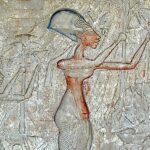
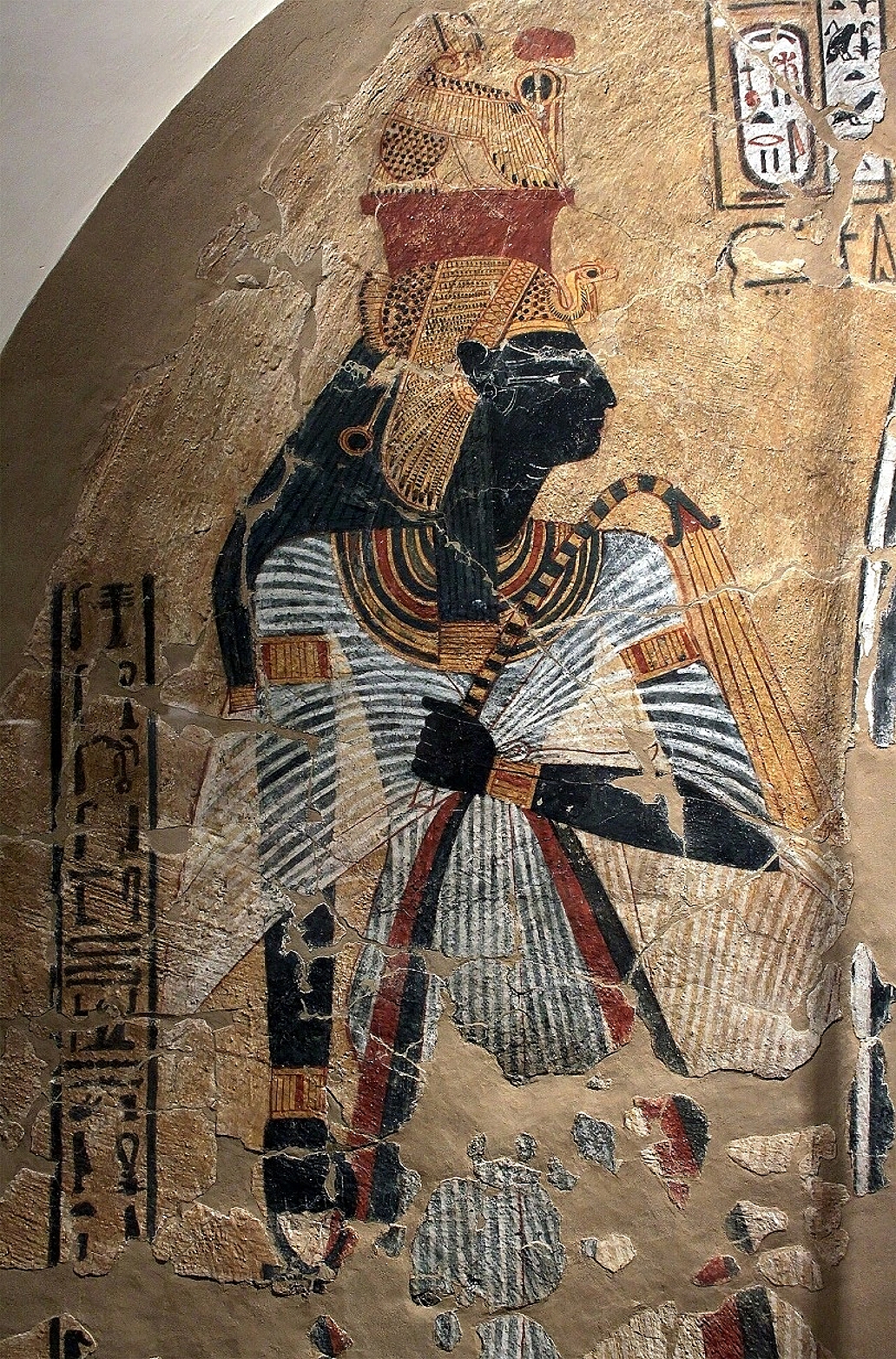 She is often depicted with jet-black skin, as in the picture at right; characteristics of Nubians to this day, as opposed to the much lighter copper-skinned Egyptians. So the fact that this “messiah” was the son of “the mistress of the sky,” the “woman from Ta-Seti,” would be significant if the prophecy of Neferti were about Amenhotep I; it is utterly bizarre to apply it to Amenemhet I, of whose mother we know little more than her name.
Because they have made such errant assumptions, scholars are very confused about why and when the Prophecies of Neferti was written, because it makes no sense; having firmly (to them) identified it with the wrong dynasty, Amenemhet of the 12th, it seems like a silly fable.
There were no Asiatics; no Nubian invasion; no widespread famine or invasion; nothing of that kind during the time of the 10th-11th Dynasties.
But if you apply the prophecy correctly, to a different Ameny, Amenhotep I of the 18th Dynasty, suddenly it all makes sense; for every Egyptologist knows that there were Asiatic, Nubian, and Libyan invasions that were chased out by Amenhotep and his father and grandfather. As always in Egypt, if you’re looking in the wrong dynasty, nothing makes sense.
All of this is to say, that the Prophecies of Neferti and the Admonitions of Ipuwer and several other apocalyptic Egyptian works are all describing the period between the Exodus in ‑1507 and the rise of the 18th Dynasty in approximately ‑1100; a period of chaos, foreign domination, slavery, and – well, basically everything they did to the Israelites.
WHY DID EGYPT OPPRESS THE HEBREWS?
This is an important question I’ve been saving for now; because thinking about it carefully will tell us an awful lot about the geopolitical situation in the time of the Middle Kingdom, before the Exodus.
Exodus 1:10 Come, let us deal wisely with them [the Hebrews], lest they multiply, and it happen that when any war breaks out, they also join themselves to our enemies, and fight against us, and escape out of the land.”
Egypt was not at war at this point. But this Pharaoh, probably Amenemhet IV, feared one might break out and that the Israelites would join their enemies. Why? Remember, at this point in history (‑1590), Israelites were, if not honored guests, at least regular citizens of Egypt. And it was explicitly because of this fear that they were subjected to hard labor.
So until this point, Israel would have had no reason to join an attacking force against their friends the Egyptians. So what justified this paranoia? Clearly, Amenemhet had foreign enemies, and was weak enough to fear them. This was not a common event for Egypt, as it was rarely invaded due to its geographical isolation – forbidding deserts to the east and west, the sea to the north.
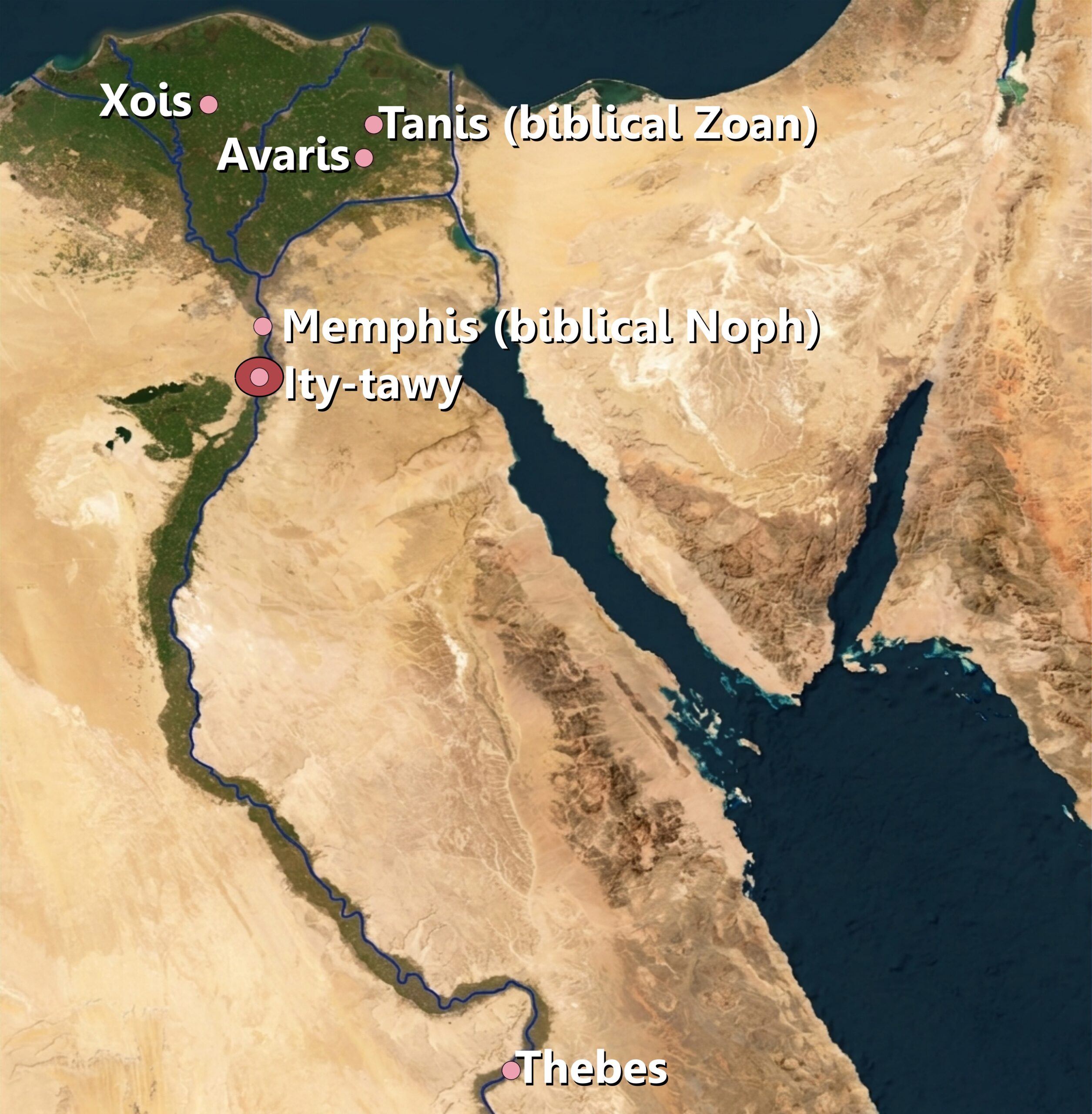
We can get a clue as to who these invaders were, because the succeeding dynasty retreated from their capital at Ity-tawy south to Thebes. If the threat of invasion were from the south – Nubia – this is hardly likely. Thus, these invaders were from the north.
Clearly then, Amenemhet IV was fearing the Hyksos, or related tribes, whose power was growing and whose proximity was alarming. So a century before the Exodus, these Asiatic tribes were close enough to be a real threat but not actually at war.
But why would that lead to oppression of the Israelites? How were these thoughts connected in Pharaoh’s mind? Easy; Egyptians were proudly racist; to the condescending Egyptians, everyone who lived on the other side of the NE border of Egypt, as far as Turkey and Mesopotamia were lumped together as “Asiatics,” aamu to the Egyptians.
They didn’t bother to distinguish Amorites and Hebrews, Philistines or Amalekites; they were all lumped together as Aamu which historians translate “Asiatics,” although it probably came from the word Amurru, or Amorites; because that was, in the time of Abraham, the primary ethnic group in the south of Canaan.
And in all fairness, from a distance all the Semitic tribes are quite similar. They spoke languages that were more-or-less mutually intelligible, dressed similarly, had similar haircuts, had similar gods, and mostly were nomadic shepherds by trade.
So it makes sense why the new Pharaoh was concerned; because his potential enemies were (he believed) relatives of the Israelites. Thus it would be expected that, choosing between their (supposed) kinsmen and the Egyptians, they would certainly join the Hyksos.
If he only knew who they really were, he would have not feared their forming an alliance, because the only people the Hyksos hated more than the Egyptians were the Israelites! But I’m getting ahead of the story.
For now, the point is that it was, ironically, Pharaoh’s fear of the Hyksos which caused their invasion. Because it was explicitly stated that it was Pharaoh’s fear of a Semite invasion which led him to oppress the Hebrews.
Which in turn, led God to punish Egypt with ruinous plagues and free the Hebrews… which, as a consequence, made Egypt so weak that the Semitic Hyksos were able to invade without firing a shot! Thus creating the very situation Pharaoh sought to avoid!
Job 3:25 (KJV) For the thing which I greatly feared is come upon me, and that which I was afraid of is come unto me.
And as an example of God’s love of poetic justice, after oppressing the “Asiatic” Hebrews cruelly for a hundred years or so, it was the Hyksos Asiatics who would then cruelly oppress the Egyptians themselves for centuries after.
THE COMING OF THE ASIATICS
At first, the Canaanite immigration in the delta was evidently gradual and peaceful, not unlike the Hispanic immigrants in the USA or the African and Syrian immigrants in Europe. Herdsman, driven by famine or population pressure, filtered into the delta.
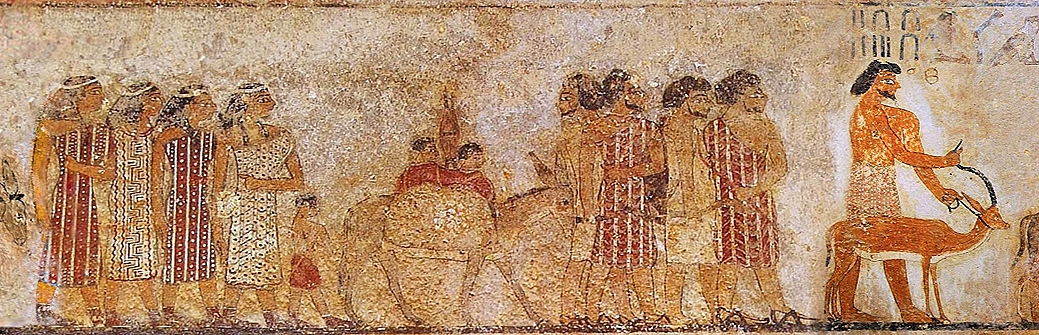
It had probably been going on since the time of Joseph, since in the time of Senusret III the tomb of an official named Khnumhotep II had a large mural depicting Canaanite tribes labeled as Aamu, including the leading man labeled as Abisha the Hyksos (above right).
Abisha is a recognizably Canaanite name; consider Abishai, David’s general (1 Samuel 26:6), among many others with similar names. Also, the dress is consistent with Canaanite styles; this is how Jacob and family would have dressed as well.
By the time of Amenemhet IV there was a substantial Asiatic population in the northern delta, even many of the ruling 14th Dynasty had Asiatic names by that point; and by the time of Moses, it was much worse.
Merneferre Ay [last major ruler of the 13th Dynasty, last pharaoh before the Exodus] governed Egypt during a time of political fragmentation. The 13th Dynasty rulers, including Ay, controlled Middle and Upper Egypt, but they coexisted with the 14th Dynasty, which ruled over the eastern Nile Delta. This division of power created a complex political landscape.
During Ay’s reign, foreign pressure on Egypt increased significantly. The 14th Dynasty, likely composed of Canaanite rulers, controlled parts of the eastern Nile Delta. Eventually, this region fell to the [15th Dynasty] Hyksos, a group of West Asian rulers who established their capital at Avaris. (Worldhistory.edu, “Pharaoh Merneferre Ay”)
As has been said, the 13th Dynasty rulers were the primary persecutors of the Israelites for about 75 years. And it was more or less contemporary with this dynasty that the 14th Dynasty began to control the northern delta.
There are enough gaps in the knowledge of the 14th Dynasty that its absolute chronological position is debated, and can vary by as much as 75 years between authorities. Egyptologist Kim Ryholt proposes that the 14th Dynasty emerged during the late 12th Dynasty, ca. 1805 BC, during or shortly after Sobekneferu’s rule.
He contends that the local Canaanite population residing in the eastern Delta declared their independence and staved off possible attempts from the 13th Dynasty Memphite kings to recover the Delta. According to Ryholt, the 14th Dynasty lasted from 1805 BC until its demise under the Hyksos 15th Dynasty ca. 1650 BC, lasting a total of 155 years.
This hypothesis is not shared by some Egyptologists… who argue that the 14th Dynasty could not have emerged before the mid 13th Dynasty, ca. 1720 BC, after the reign of Sobekhotep IV. In particular, they argue that the evidence from the strata levels where 14th Dynasty seals have been discovered conclusively establishes that the 14th Dynasty was only contemporary with the 13th Dynasty in the last half century of the latter’s existence, i.e., after ca. 1700 BC. (Wiki, 14th dynasty)
The test of a theory is how well it absorbs prior theories. And where these two eminent experts disagree, we can agree with both; because one says the 14th Dynasty emerged during the late 12th Dynasty, while another says it emerged during the mid-13th Dynasty. We agree with both, oddly enough!
Because the end of the 12th Dynasty and the time of Sobekneferu, and the middle 13th Dynasty around Sobekhotep IV, are, in our chronology, exactly the same date since Sobekneferu married Sobekhotep IV! Thus, all of the evidence which supports the contradicting theories supports our unified theory!
THE 14th DYNASTY
Manetho has the 14th Dynasty as 76 kings ruling for a total of 184 years. Doing the math, that’s a little over two years per king, on average – which agrees very nicely with the appointed rulers of the 13th Dynasty who likewise had very short reigns. The Turin Canon likewise credits most rulers with very short reigns – at least where reign lengths have survived.
This strongly suggests that the 14th Dynasty was at first just like the 13th Dynasty; a series of powerful governors who served short terms at the whims of the 12th Dynasty kings of Ity-tawy, who only later developed their independence during the independence of the 13th Dynasty.
The obvious conclusion then is that both dynasties began in the 25th year of Senusret III (‑1633) as an attempt to delegate control over upper and lower Egypt to powerful viziers know as the “pharaohs” of the 13th and 14th Dynasties, respectively.
But neither was independently ruled until the time of Sobekneferu when control of upper and lower Egypt was lost; thus, it seems like they emerged in the mid-13th Dynasty (Sobekhotep IV) or in late 12th Dynasty (Sobekneferu). Because those periods were synchronous, meaning both authorities’ competing theories are correct!
Thus, just as the 13th Dynasty wasn’t a proper dynasty but rather a list of leaders of the city of Thebes – even though many of them were subordinate to the real Pharaoh elsewhere – so likewise we should think of the 14th Dynasty as a list of rulers of Xois, whether or not they were independent.
This explains the relatively peaceful relationship between these dynasties; because at the beginning at least, they were working on the same side, both appointed by the kings of the 12th Dynasty.
Seals attributable to the 14th Dynasty have been found in Middle and Upper Egypt – then entirely the territory of the 13th Dynasty – and as far south as Dongola, beyond the Nile’s Third Cataract. To the north, seals have been found in the southern Levant, principally along the Mediterranean coast, even as far north as Tel Kabri (in modern-day northern Israel, near the border with Lebanon). This indicates the existence of important trade conducted between the 13th Dynasty, the Canaanite city-states, and Nubia. (Wiki, 14th dynasty)
And contrary to what you might read, these rulers of Xois – a city in the central delta, north of modern Cairo – were not all, or even mostly, Canaanites. In fact the first ruler was Nehesy, whose name literally means “the Nubian” in Egyptian. Because at first, these were Egyptian-appointed vassals.
It is only later in the king list that we start seeing Semitic names like Anati, Yaqub-har (Jacob), etc. This tells us that after the collapse of the 12th Dynasty – or, more properly, its absorption by the 13th Dynasty – the 14th Dynasty more or less gradually slipped out of the grasp of upper Egypt.
This is why Amenemhet IV was fearing a war with the delta Canaanites and their desert-dwelling relatives to the east. Because he could tell that the delta was a simmering pot of ethnic tension that was going to explode sooner or later. And when it did… he thought the Israelites would join the Canaanites against the Egyptians.
Experts believe the 13th and 14th Dynasties lasted between 75-155 years. Manetho tells us it was 184 years. This range fits well into the time between the Exodus (‑1507) and Sesostris III (‑1633), when the administration of Egypt was first divided into the rulers of the 13th and 14th “Dynasties.” Which we can actually confirm from the admonitions of Ipuwer!
Behold, things have been done which have not happened for a long time past; the king has been deposed by the rabble. Behold, he who was buried as a falcon [is devoid] of biers, and what the pyramid concealed has become empty. Behold, it has befallen that the land has been deprived of the kingship by a few lawless men…. Behold, the Serpent is taken from its hole, and the secrets of the Kings of Upper and Lower Egypt are divulged. (Ipuwer)
…and unexpectedly, from the regions of the East, invaders of obscure race marched in confidence of victory against our land. By main force they easily seized it without striking a blow; and having over-powered the rulers of the land, they then burned our cities ruthlessly. (Josephus, quoting Manetho)
Notice there is a plurality of kings, one of Upper and one of Lower Egypt, during this period; because, as has been explained, the 14th Dynasty kings of Lower Egypt and the 13th Dynasty kings of Upper Egypt were both overcome; first by rebellion by the starving population, then by military-turned-warlords, and then finished off by Asiatic invaders.
After an event in which their palace was burned, the Fourteenth Dynasty would be replaced by the Hyksos Fifteenth Dynasty, which would establish “loose control over northern Egypt by intimidation or force,” thus greatly expanding the area under Avaris’s control. (Wiki, Hyksos)
THE HYKSOS
 Despite the increased presence of Canaanite rulers in the 14th Dynasty, these were still naturalized Egyptian citizens, who had immigrated and settled into Egypt and built a future there. Though ethnically different, they were not “outsiders” in the true sense anymore, any more than Mexican-Americans are – even if the Egyptians may have seen them as such.
So the Exodus took a toll on them, just like every other inhabitant of Egypt excepting the Hebrews. And so the 14th Dynasty would have endured the famine, the plagues, the death of their firstborn, and so on – just as the 13th Dynasty ruling from Thebes. In fact, the Bible specifically mentions miracles being performed in the delta region:
Psalms 78:43-44 how he set his signs in Egypt, his wonders in the field of Zoan, he turned their rivers into blood, and their streams, so that they could not drink.
Zoan is almost certainly the Egyptian city of Djanet, which the Greeks called Tanis, which is very close to Avaris. But note that it did not refer to a city, only to “fields of Zoan.” Because Avaris wouldn’t be a significant city until the Hyksos arrived in Egypt!
One key to Bible study is that God does not stutter; so if something is mentioned twice, it isn’t merely for poetic effect. It means, rather, that to the author these were different things; Egypt as separate from Zoan. Why?
Because when Moses left, as Ipuwer told us, Egypt was ruled by two kings – the kings of Upper and of Lower Egypt – and as Josephus told us, the Hyksos “having over-powered the rulers of the land.” Thus Egypt in the 13th Dynasty did not include the “fields of Zoan” which were ruled by the 14th Dynasty! And God’s wonders happened in both regions.
And it was this very weakness caused by the plagues that opened the door to the 14th Dynasty’s relatives, the actual barbarians, known as the Hyksos. There are many analogs for this in history – the Gutians in Sumer, the Franks after the fall of Rome, the Mongols in China; and so on.
Each of them were warlike, often nomadic, tribes sensing the weakness of a corrupt empire who, upon invading, discovered they liked the trappings of civilization better than living in tents – provided they had slaves to do the actual work of civilization for them. So they settled down and became barbarian kings – and in time, became somewhat civilized themselves.
The remarkable fact about this invasion which I’ve already quoted several times, and which leaves Egyptologists scratching their heads, is that the Hyksos moved into Egypt unopposed, without so much as a single battle. Because most of the Egyptians were dead or starving in the aftermath of the plagues of Moses!
THE HYKSOS UNVEILED
But who were the Hyksos? No modern historian can give an answer except that “They spoke a Western Semitic language” and “may be called for convenience sake Canaanites” (Wiki, Hyksos). The consensus today is the convenient fall-back explanation that it was a vague assemblage of tribes, or perhaps a label meant to apply only to the leaders but not an ethnic term:
“It is now commonly accepted in academic publications that the term [Hyksos] refers only to the individual foreign rulers of the late Second Intermediate Period,” especially of the Fifteenth Dynasty, rather than a people. However, Josephus used it as an ethnic term. Its use to refer to the population persists in some academic papers. (Wiki, Hyksos)
Despite noting that it was used in antiquity as an ethnic term, modern historians in their infinite wisdom reject that usage and apply it strictly to the leaders. We, of course, will do no such thing. Because we do know who the Hyksos were – and all we have to do to prove it is listen to our sources.
Josephus gives us the etymology that Hyksos means “shepherd-kings,” but he (like Manetho before him) was trying very hard to connect the Hyksos with the Israelite slaves, which is simply wrong. Modern Egyptologists derive Hyksos from hekau khasut, “rulers of foreign (literally ‘mountainous’) countries.”
Egyptologists don’t take this description literally, but consider what we know; these were Semitic tribes who dwelt to the east of Egypt; they were rulers of “the mountainous countries.” They were nearby, or else they would have had to get in line to invade Egypt, or fight through other tribes to get there.
So where would the Hyksos homeland have been? If we exclude the Sinai Peninsula, which Egypt controlled directly under the middle kingdom, the only possibility nearby would be the hill country of southern Canaan and the Negev. There aren’t any other mountains nearby. So who dwelt in that region, according to the Bible, at that time?
According to the Hebrew Bible, the Amalekites inhabited the Negev and Sinai Peninsula. They appear to have lived a nomadic or seminomadic lifestyle along the fringes of southern Canaan’s agricultural zone. This is probably based on the association of this tribal group with the steppe region of ancient Israel and the area of Kadesh (Genesis 14:7). (Wiki, Amalek)
Numbers 14:45 Then the Amalekite came down, and the Canaanite who lived in that mountain, and struck them and beat them down, even to Hormah.
As you can see in the following map, this is precisely the zone we would expect Egypt’s invaders to have come from – at precisely the right time. The colored zone is the Negev, and along with the Sinai it forms the entire eastern border of Egypt. Right where Manetho’s Hyksos came from.
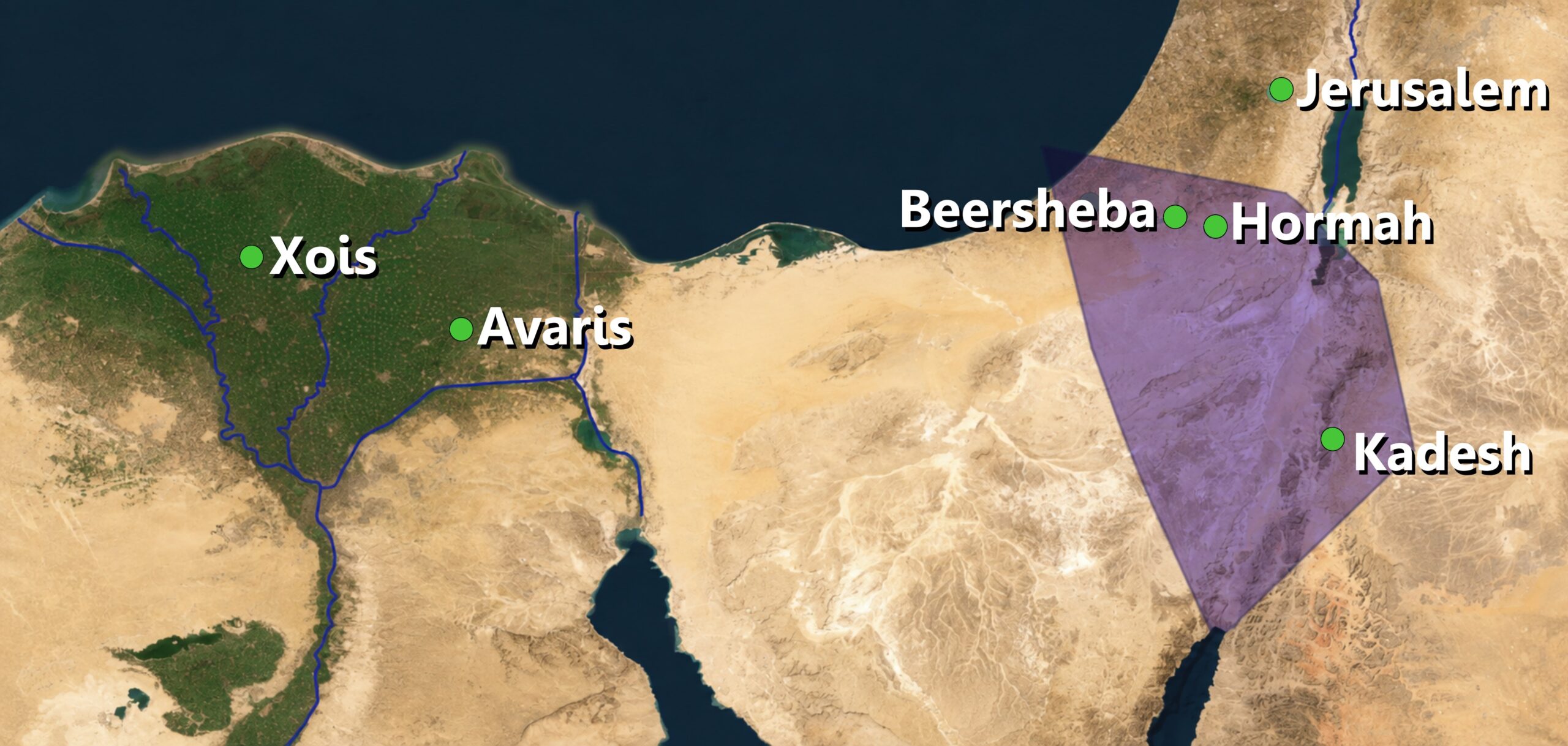
And the Bible explicitly tells us that the Amalekites “came down” from the mountain where they, and other Canaanite tribes, lived – the eastern border of the Negev has the largest mountains in the region, thus, calling them “kings of the mountain” is supported by the Bible.
1 Samuel 27:8 (NASB) Now David and his men went up and attacked the Geshurites, the Girzites, and the Amalekites; for they were the inhabitants of the land from ancient times, as you come to Shur even as far as the land of Egypt.
And in the time of David, it says that they had lived here “since ancient times” – as far as the land of Egypt. Which means they were the Egyptians’ immediate neighbors to the east – precisely as we would expect. And that allows us to answer a curious question – why did God make Israel go through the Red Sea when there was a much easier way to get to Sinai?
Exodus 13:17 It happened, when Pharaoh had let the people go, that God didn’t lead them by the way of the land of the Philistines, although that was near; for God said, “Lest perhaps the people change their minds when they see war, and they return to Egypt”;
Now that’s odd because they did, in fact, see war – with the Amalekites, as it happened – on the way to Mt. Sinai (Exodus 17:8). So it wasn’t a single battle that God was concerned with, but a pitched fight through the strongholds of a powerful enemy.
Because just think… if Israel struggled with that one battle what would it have been like to fight their way through the homeland of these same people? Crossing the Red Sea allowed them to avoid the homeland, skirt around to the east of their territory, and come to Israel from the east. The only reason to do that is to avoid “war” with the occupants of that land – i.e., the Hyksos.
So we know that the Hyksos lived on the border of Egypt; we know that they lived in mountains; we know that they were shepherds (since we see them with herds in the Aamu fresco); and we know all of the same things were true of the Amalekites.
We know for a fact that the Amalekites were shepherds (1 Samuel 15:3). And we know for a fact they had kings (verse 8). And the Bible places the land of the Amalekites immediately south of the land of Canaan.
Which means the ancestral enemies of Israel, the Amalekites, and the hated oppressors of Egypt, the Hyksos, were the exact same people. And as I said… if Amenemhet IV had bothered to get to know his enemy, he’d have realized that the only people the Amalekites hated more than the Egyptians… was the Israelites.
For the Amalekites were descended from Amalek, grandson of Esau; so the Egyptians were right, they were relatives of the Hebrews… but Esau hated Israel! The cousins of the Amalekites, also descended from Esau, were the Edomites who forbade the Israelites from crossing their territory (Numbers 20:14-21).
Thus there was absolutely no chance Israel would have ever joined forces with them in case of an Egypto-Amalekite war.
Which means, again, that the only reason the Egyptians succumbed to Semitic invasion… was because their fear of that invasion led them to oppress the Semitic peoples of God, who would otherwise have been their staunch allies against the Amalekites.

This is part 31 of The History of the World Series
 After Amarna
  Akhenaten the Heretic
  The Richest Man in History
  Thutmose III and Shishak
  Solomon and the Queen of Sheba
  What Is The LOVE Of God?
  Everything You Believe About God Is WRONG!
  Make Up Your Mind!
  What Is Faith?
  How DARE you FEAR the judgment of God!
  Firstripe Figs
  The Bride Of The Father
  Exodus 40 – The Plan Of God
  The Temple Of God
  Pillars Of The Temple And The Brass Sea
  GEHENNA WITH ‘EM
  When Did God Forbid Polygamy?
  When You Shouldn’t Pray For Someone
  The Sins of the Father
  The First Paul