The Exodus

This is part 20 of the The History of the World Series
; The History of the World is part 1.
Click here to read in series
Everyone knows the story of the Exodus, the ten plagues, the parting of the Red Sea, and so on. But did it really happen? Let’s ask Wikipedia…
There is no direct evidence for any of the people or events of Exodus in non-biblical ancient texts or in archaeological remains, and this has led most scholars to omit the Exodus events from comprehensive histories of Israel. (Wikipedia, Exodus)
When this chapter is done, you will know that statement to be what it is – the reasoned, sober consensus of the most respected historians and archaeologists in the world.
And one of the dumbest things historians have ever said.
Let’s start with the ten plagues. Historians would say there is no evidence they happened. But the thing is… the ten plagues (at least, the first nine) are a normal part of the lived experience of Egypt; a mild version of them happened almost every year. What was miraculous was the severity and the fact that Moses predicted the coming and going of them (Exodus 8:9-10).
The order of the plagues followed the natural sequence of seasonal troubles commonly experienced in Egypt, as has long been observed. The river turning to blood, accompanied by the death of fish, reflects the condition of the Nile at its lowest point before the annual inundation. During this time, typically in early June, the river becomes stagnant, red, and filled with microorganisms. As a result, the Egyptians often had to rely on wells and cisterns for water. (Egypt and Israel, Petrie)
This is the first plague, and so you can understand why, when Moses said “the Lord shall turn the water to blood” the Egyptians were all like “uh, yeah dude, he does that every year… so what?” And Moses was like “no, it’s gonna be, like, really bad this year” and they were like “whatever dude.”
Still, the miracle wasn’t that unusual. It was bad, but it wasn’t unheard of. And so when Moses said “I told you so!” Pharaoh was able to say to himself “nah, it was a coincidence, he got lucky is all.” And so God sent Moses to try again. And again.
Following the inundation in July, frogs proliferated, aligning with the second plague. The subsequent plagues—insects, murrain, and boils—are characteristic of the hot summer and the damp, unhealthy conditions of the autumn. (Ibid.)
The boils were probably a form of anthrax. This is, and always has been, endemic to Egypt. Anthrax is primarily a disease of livestock that become infected by ingesting spores found in soil. Thus it’s interesting that the boils are caused by Moses tossing ashes from a furnace into the air which “shall become small dust over all the land of Egypt, and shall be a boil breaking out with boils on man and on animal.”
Hail and rain, unusual for Egypt but plausible, occurred in January. This timing is confirmed by the impact on the crops: barley would have already sprouted, while the wheat was still hidden or barely emerging. This suggests that barley was sown in early November, in ear by mid-January, and ready for harvest in early March. Flax follows a similar growth pattern, with wheat being about a month behind. (Ibid.)
Lightning was so rare in Egypt that it was considered practically apocalyptic to have a thunderstorm, much less hail. It was associated with Seth, the god of chaos – basically as close to a proper devil as ancient Egypt had.
The locusts appeared in the spring, attacking the green crops around February. Around March, sandstorms would bring a dense, tangible darkness, coinciding with the onset of the hot winds. The final plague—the death of the firstborn—occurred during the Exodus in April. (Ibid.)
So you can see… each of these plagues, except the last one, was a perfectly normal event that might have happened purely by chance. So for modern historians to say there is no evidence of the plagues is absurd, since the evidence has been experienced every year since the dawn of time (up until the damming of the Nile about 125 years ago).
And again, I’m not saying this wasn’t a miracle; it absolutely was. But not in the Harry Potter sense, in the much more down-to-earth way that it almost always is in the Bible: the miracle was that the prophet said it would happen, and it was as severe as the prophet said, and it left when he asked for it to leave.
Obviously, statistically, Moses calling it nine times out of nine would have made a non-hardened heart realize that Moses was a prophet of a powerful God. And yet you can see how, to a hardened Pharaoh, it was just possible that they had a hailstorm.
So when the Bible said “Pharaoh hardened his heart,” what was happening was Pharaoh was thinking “Yeah, but it was possible that the frogs just happened to leave when Moses said they would. It was just possible that Moses guessed there would be a worse-than-usual plague of locusts this year. We can’t be certain he’s a prophet.”
The fact is, when someone is determined not to change their mind, even raising the dead isn’t really iron-clad proof of his sainthood (Luke 16:30-31). I mean, even today, sometimes people are pronounced dead when they are really in a deep coma; who can say it was because of the prayer, or just luck? After all, it might have happened even if Jesus hadn’t said “Lazarus, come forth!” (John 11:43).
God works this way so that the stubbornly rebellious, hard-hearted skeptics would have a way to say “nah, I’ll concede you tell a good story, but I’m still not convinced there is any evidence of the Exodus, nor that Joseph and Moses lived in the time of the 12th and 13th dynasties.”
But remember what happened to Pharaoh.
THE ROUTE OF THE EXODUS
The Bible provides considerable detail on the Exodus, which makes it surprising how much disagreement there is about the actual route taken. I mostly follow Steven Rudd’s excellent work on the Exodus route, with one major change – that Goshen is not in the northern delta, but the Fayoum.
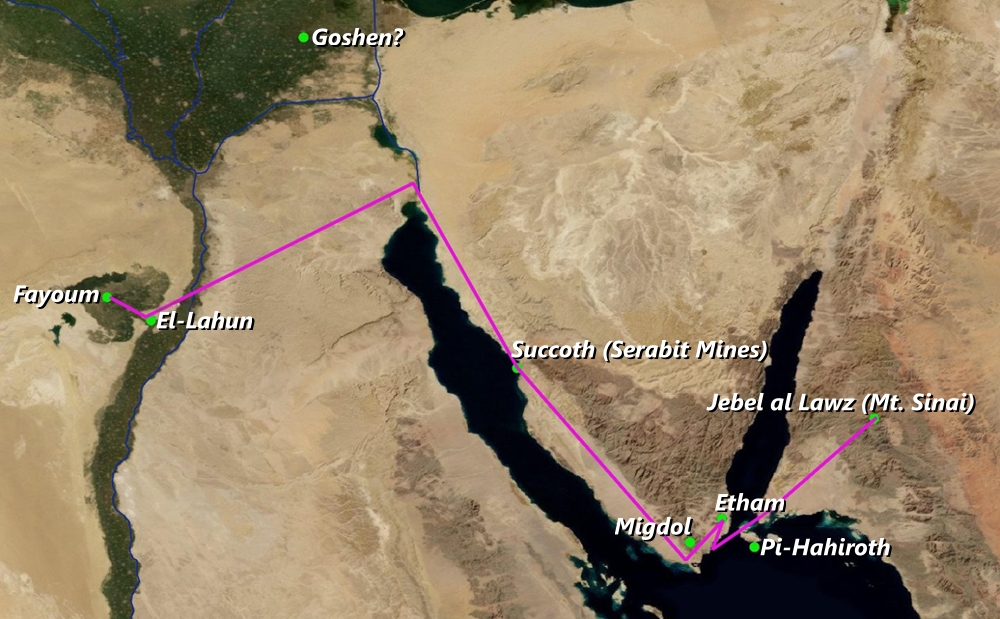
Surprisingly enough this changes little, since either way they have to cross the top of the Red Sea before turning south towards the south end of the Sinai Peninsula and crossing at the Straits of Tiran into Arabia, finally finding themselves at Mt. Sinai – today known as Jebel al-Lawz.
Departing from the Fayoum would not be any farther than departing from the central delta region – since surely 2 million Israelites would have spread across the entire delta, if that were indeed Goshen.
The only difficulty in leaving from the Fayoum is crossing the main stream of the Nile river. The idea of moving 2 million people across one or more river crossings in a single day, with livestock besides, boggles the mind (there has never been a bridge over the Nile in antiquity).
Fortunately, the Israelites didn’t have to cross it on a boat. They just… walked. In Isaiah, God prophesied that in the future there would be a “highway” created in Egypt, and that men would walk across the riverbed in sandals just as they did in the days of Moses!
Isaiah 11:15 Yahweh will utterly destroy the tongue of the Egyptian sea; and with his scorching wind he will wave his hand over the River, and will split it into seven streams, and cause men to march over in sandals. There will be a highway for the remnant that is left of his people from Assyria, like there was for Israel in the day that he came up out of the land of Egypt.
Which explains why “crossing the Nile” was never mentioned as part of the Exodus narrative; it was unnecessary as God had dried it up. And although this hasn’t gotten much attention, this is a key part of the events of the Exodus.
And remember how historians claim “There is no direct evidence for any of the people or events of Exodus in non-biblical ancient texts?” Well, the Egyptians did remember this exact event, one so rare that it has not happened in the last 2,000 years – and they remembered it turning to blood!
The river is blood, yet men drink of it. Men shrink from human beings and thirst after water. Indeed, gates, columns, and walls are consumed by fire. Indeed, men cross the river on foot. The flood is none; the fields are bare of crops. (The admonitions of Ipuwer)
Remember, the river turning to “blood” was a relatively common occurrence, though not to the extreme it did with Moses; but crossing the river on foot is, as far as I can tell, an utterly unique occurrence in recorded history. And “non-biblical ancient texts” specifically mention it!
Note that Ipuwer also complains that “the fields are bare of crops.” Because locusts, hail, and dust storms had destroyed them, of course! No historian doubts the authenticity of this document, yet they roundly reject it as proof of precisely the events the Bible describes around the Exodus!
Then they arrogantly claim that there is no evidence of the Exodus.
Objective science, indeed.
Oh, but there’s tons more where that came from.
ADMONITIONS OF IPUWER
The Ipuwer Papyrus has been dated no earlier than the Nineteenth Dynasty, around 1250 BCE. but the text itself is much older, and dated back no earlier than the late Twelfth Dynasty of the Egyptian Middle Kingdom. … It is a textual lamentation, close to Sumerian City Laments and to Egyptian laments for the dead… (Wikipedia, Ipuwer Papyrus)
This text dates sometime after the late 12th dynasty, using a name common from the 13th through 17th dynasties. Since we have shown that Moses was born in the late 12th dynasty, this is precisely where we would expect the Exodus to have happened.
Historians reject this as proof of the Exodus because it happens far too early in their timeline to be aligned with the events of Moses. They created a classic straw man fallacy; they made assumptions about the point in history where they think the Exodus might have happened (which is not when the Bible says it did).
Having made that assumption (the New Kingdom must have been the time of the Exodus), they looked only in that window for evidence; and after finding none they confidently claim they have disproved the historicity of the Exodus.
But Thutmose III and Ramses II, the conventional candidates for the Pharaoh of the Exodus if it even happened, lived 500 and 700 years, respectively, after Moses. And it’s quite hard to find proof for the Exodus when you’re looking for the evidence in pharaohs who lived half a millennium after Moses.
But before saying “there is no direct evidence for any of the people or events of Exodus in non-biblical ancient texts,” an actual scientist – at least an honest and objective one – would first scan all of the non-biblical ancient texts for direct evidence.
If they had done so, they would find an abundance of it in the 12th and 13th dynasties. I did. The 13th dynasty is full of descriptions of exactly what we would expect from a country visited by the “great judgments of God” (Exodus 7:2-5).
The date and authenticity of the admonitions of Ipuwer are not disputed, but if you read the Wikipedia article you’ll see that historians try very hard to move this into the “literary” (read: fictional) realm. Why do they try so hard? Because if they are forced to take the “water turning to blood” literally, it counts as evidence for the Exodus, which they do not want.
Indeed, [hearts] are violent, pestilence is throughout the land, blood is everywhere, death is not lacking, and the mummy-cloth speaks even before one comes near it. Indeed, many dead are buried in the river; the stream is a sepulcher and the place of embalmment has become a stream.
Indeed, noblemen are in distress, while the poor man is full of joy. Every town says: “Let us suppress the powerful among us.” Indeed, men are like ibises. Squalor is throughout the land, and there are none indeed whose clothes are white in these times… the poor man [complains]: “How terrible! What am I to do?” Indeed, the river is blood, yet men drink of it. Men shrink from human beings and thirst after water. Indeed, gates, columns and walls are burnt up, while the hall of the palace stands firm and endures. (The admonitions of Ipuwer)
So when historians say “there is no evidence,” that is either stupidity or fraud. This might not be proof, but to say it is not even worthy of consideration as evidence is foolish. It literally mentions the river being blood, one of the most famous plagues.
Indeed, the ship of [the southerners] has broken up; towns are destroyed and Upper Egypt has become an empty waste. Indeed, crocodiles [are glutted] with the fish they have taken, for men go to them of their own accord; it is the destruction of the land. Men say: “Do not walk here; behold, it is a net.” Behold, men tread [the water] like fishes, and the frightened man cannot distinguish it because of terror. Indeed, men are few, and he who places his brother in the ground is everywhere. When the wise man speaks, [he flees without delay]. (Ibid.)
Some Christian historians, based largely on the phrase “the river is blood,” tie this tale to the Exodus proper. But they’re wrong, and hurt their own cause among Egyptologists by their desperation in reaching for any thread they can find to prove their viewpoints.
No, most of this does not describe the Exodus at all. It was probably written between a month and a year after the Israelites had left. And seen in that light, these conditions are precisely what we would expect the plagues to have done to Egypt – making death so common that people were dumped unceremoniously in the river.
To us, that sounds bad enough; but you cannot imagine the impact such circumstances would have had on the death-obsessed Egyptians, who literally spent their lives preparing for their death. To them, this would have been the worst thing imaginable – an unceremonious burial in the river would mean their ka and ba would never be able to find rest, nor join with the gods in the afterlife.
I have separated him and his household slaves, and men will say when they hear it: “Cakes are lacking for most children; there is no food […]. What is the taste of it like today?” Indeed, magnates are hungry and perishing, followers are followed […] because of complaints. Indeed, the hot-tempered man says: “If I knew where God is, then I would serve Him.” (Ibid.)
Amid this lengthy lament of the state of Egypt, a very interesting fact comes out; “If I knew where God is, then I would serve Him.” This is not a normal Egyptian attitude towards the Gods, plural. Gods were generally mentioned by name, or in the plural; worshipping God, singular, without a named God in the context, is odd.
Furthermore, finding “God” was not hard. Gods were in every town, their temples and idols scattered throughout Egypt in easy-to-reach locations. They knew where Horus lived. They knew where Osiris was buried. But this Egyptian states that he doesn’t know where God is, so he cannot serve Him. So who is this God whom they didn’t know how to find?
Clearly, the implication is that this was a singular “God” whose name Ipuwer didn’t know and whose dwelling place he couldn’t find. So He cannot have been an Egyptian God… but the Hebrew God!
Exodus 7:5 The Egyptians shall know that I am Yahweh, when I stretch out my hand on Egypt, and bring out the children of Israel from among them.
If the Egyptians didn’t learn this lesson, God failed His stated goal; and here we have proof positive that some Egyptians had learned it! Knowing that, and knowing the situation of Egypt as it was, and hearing Ipuwer’s clear regret that he didn’t know where this God was to serve Him, help to explain an otherwise inexplicable fact about the Exodus:
Exodus 12:37 The children of Israel travelled from Rameses to Succoth, about six hundred thousand on foot who were men, besides children. A mixed multitude went up also with them, with flocks, herds, and even very much livestock.
Why would a group of Hebrew slaves have groupies who followed them out of their homeland of Egypt? Reading Ipuwer’s description of the place they left behind, you can see that they had very little to lose, and much to gain, by following this new God of Israel out of Egypt. How much worse could life get? Better than suicide-by-crocodile.
Would that there were an end of men, without conception, without birth! Then would the land be quiet from noise and tumult be no more. Indeed, [men eat] herbage and wash [it] down with water; neither fruit nor herbage can be found [for] the birds, and […] is taken away from the mouth of the pig. No face is bright which you have […] for me through hunger. Indeed, everywhere barley has perished and men are stripped of clothes, spice, and oil; everyone says: “There is none.”The storehouse is empty and its keeper is stretched on the ground; a happy state of affairs! …Would that I had raised my voice at that moment, that it might have saved me from the pain in which I am. (Ibid.)
This is very strange, because Ipuwer seems to think that if he had spoken up at some point, he would have saved himself – not the country, but himself – from the state he finds himself in. He doesn’t say what the moment to speak would have been, but there is clearly a regret for not speaking “at that moment,” which would have saved him from the pain of his current life.
Assuming the normal kinds of crisis – war, famine, plague – no one could save himself by speaking up. Which means this was no normal crisis. This was a crisis he could have personally avoided had he spoken up.
Which means Ipuwer must be lamenting the fact that he did not raise his voice “at that moment” when Moses left Egypt! He could have been part of the “mixed multitude,” but he hesitated too long. What else could it be?
BUT IT GETS WORSE
Over and above all the aforementioned calamities in Egypt, there is one more which is obvious in hindsight, even though the Bible didn’t mention it; for a devastated, depopulated Egypt would have been a ripe target for a barbarian invasion. And Ipuwer tells us this is exactly what happened…
Indeed, the desert is throughout the land, the nomes are laid waste, and barbarians from abroad have come to Egypt. Indeed, men arrive […] and indeed, there are no Egyptians anywhere…. A man regards his son as his enemy. Confusion […] another. Come and conquer; …The virtuous man goes in mourning because of what has happened in the land […] goes […] the tribes of the desert have become Egyptians everywhere. (Ibid.)
Egypt, as a civilization, was nearly wiped out. But Egypt, as a piece of land, would recover rapidly; a few Nile floods and it would again be one of the richest pieces of real estate on the planet. A target far too tempting for its neighbors to pass up.
Indeed, the Delta in its entirety will not be hidden, and Lower Egypt puts trust in trodden roads. What can one do? No […] [Egyptians?] exist anywhere, and men say: “Perdition to the secret place!” Behold, it [the delta] is in the hands of those who do not know it like those who know it. The desert dwellers are skilled in the crafts of the Delta. (Ibid.)
In other words, Egyptians have been completely expelled from the delta regions, in favor of barbarian tribes – desert-dwellers who don’t know the arts of farming. And these invaders put the few remaining Egyptians into bondage:
…Indeed, the builders [of pyramids have become] cultivators, and those who were in the sacred bark are now yoked [to it]. … The […] of the palace is despoiled…. Indeed, gold and lapis lazuli, silver and turquoise, carnelian and amethyst, Ibhet-stone and […] are strung on the necks of maidservants. Good things are throughout the land, (yet) housewives say: “Oh that we had something to eat!”
To what purpose is a treasury without its revenues? Happy indeed is the heart of the king when truth comes to him! And every foreign land [comes]! That is our fate and that is our happiness! What can we do about it? All is ruin! (Ibid.)
The invasion of Asiatic tribes from the desert is particularly important here, because Manetho, a 3rd century BC Egyptian priest and historian, whose writings certainly qualifies as a “non-biblical ancient text,” corroborates the events of Ipuwer, in particular the Canaanite invasion.
[Pharaoh] Tutimaeus. In his reign, for what cause I know not, a blast of God smote us; and unexpectedly, from the regions of the East, invaders of obscure race marched in confidence of victory against our land. By main force they easily seized it without striking a blow; and having overpowered the rulers of the land, they then burned our cities ruthlessly, razed to the ground the temples of the gods, and treated all the natives with a cruel hostility, massacring some and leading into slavery the wives and children of others. (Manetho, as quoted in Josephus)
So when historians tell you there is no evidence for the Exodus outside the Bible, they are simply refusing to believe what they read. Manetho knew that “a blast of God smote Egypt” during the reign of Tutimaeus, though he didn’t know why.
Him not knowing why isn’t surprising – the Egyptians were hardly likely to write “we oppressed God’s chosen people, and the God of the Hebrews punished us for our sins.” Following this “blast of God,” Manetho describes the invasion and brutal oppression of Egypt by Canaanite tribes whom he called the Hyksos, known to history as the 15th dynasty (and possibly some parts of 14th through 17th dynasties as well).
This invasion was not, as Manetho and Josephus believed, the arrival of the Hebrews, but rather the opportunistic invasion of Egypt by Canaanite tribes in the power vacuum caused by the Hebrews’ departure, which happened to leave the best of Egypt’s army at the bottom of the Red Sea.
Remember, Manetho said the invasion happened “without striking a blow,” something hard to imagine; even the weakest nations manage to put up some resistance to invasion; how could they have been utterly enslaved without a single battle?
Unless the invaders found a starving, depopulated Egypt fresh off the ten plagues.
FINDINGTHE PHARAOH OF MOSES
As you saw above, Manetho identified this Pharaoh as Tutimaeus; so all we have to do is find a king by that name, and we’ll know precisely when the Exodus happened, right? Actually, yes. But before we get into that, I want to go over what we will expect from our Pharaoh when we find him.
First, he cannot be a firstborn – since all of them died in Egypt, specifically including Pharaoh’s house. Since Pharaoh survived, he himself was not a firstborn. Second, we will not find his mummy since he drowned in the Red Sea.
Third, he will have had a short reign of only a few years, following an oppressive Pharaoh who had a long reign. We infer this from the following verse…
Exodus 2:23-24 It happened in the course of those many days, that the king of Egypt died, and the children of Israel sighed because of the bondage, and they cried, and their cry came up to God because of the bondage. God heard their groaning, and God remembered his covenant with Abraham, with Isaac, and with Jacob.
This passage tells us that after “those many days” a Pharaoh died – indicating a long reign for this Pharaoh – and it was at that point when God remembered His covenant and called Moses. Since the entire chain of events involving Moses’ call and return can’t have taken more than a few years, probably less, we conclude that the final Pharaoh had a short reign – 2-3 years at most.
As further evidence of the long reign of his predecessor, when God appeared to Moses, He said “Go, return into Egypt; for all the men who sought your life are dead” (Exodus 4:19). God had, apparently, been waiting nearly 40 years for this event – the death of the last Pharaoh who remembered Moses – to happen.
Fourth, we would not expect to know very much about this Pharaoh – a short reign, dominated by natural disaster, followed by a period of utter chaos, is unlikely to lend itself to monument-building or inscriptions or writing histories of the recently perished Pharaoh.
These qualifications solidly exclude every single candidate ever seriously proposed in mainstream research; the world’s favorite, Ramses II, reigned for 66 years, and we have his mummy. Conservative Christian favorite Thutmose III with his 54-year reign and a mummy in evidence also fails. And so on with all the lesser candidates proposed.
Oddly enough, I don’t think anyone has ever followed the evidence objectively enough to arrive at the obvious, and I mean obvious, answer.
THE ACTUAL PHARAOH OF MOSES
Since the Hyksos invaded after the reign of Tutimaeus, then he must have been the final king of his dynasty. And Tutimaeus is a Hellenized (Greek-ized) version of the name Dedumose, and as it happens the end of the 13th dynasty did have a king by that name.
The rulers Dedumose I, Dedumose II, Mentuemsaf, Mentuhotep (VI) Mer’ankhre’ and Senwosret IV Seneferibre’, who are documented epigraphically at Thebes but had not been positioned chronologically. However, the Dedumose kings certainly belong in Dyn. 13. (Ancient Egyptian History, Hornung)
Williams and others place Dedumose as the last king of Egypt’s 13th Dynasty. (Wikipedia, Dedumose II)
So not one, but two Dedumoses are known to history. We expect to find little information about the final king of the Exodus, given what he went through in his short reign, and we are not disappointed – little is known of these kings.
The placement of kings in the 13th dynasty is complicated, but some believe Dedumose to be the final king – as, of course, do we. Given this much clear evidence, I am shocked that no one has put forth Dedumose as a possible candidate for the Pharaoh of the Exodus; at least, not to my knowledge.
I mean, we’re literally just listening to all the ancient sources. But as I’ve said so many times, that’s not something historians do well.
THE PHARAOH OF THE EXODUS
We know that Dedumose I and II existed, but they appear on no king lists. Given that, it’s possible they are on those lists by other names; Egyptians had five, remember. So leaving the name behind for a moment, we will look for other Pharaohs that presided over conditions like the Exodus in the spiraling state of affairs at the end of the 13th dynasty. Not surprisingly, we immediately find a perfect fit.
Merneferre Ay is the last pharaoh of the 13th Dynasty to be attested outside Upper Egypt. In spite of his long reign, the number of artefacts attributable to him is comparatively small. This may point to problems in Egypt at the time and indeed, by the end of his reign, “the administration [of the Egyptian state] seems to have completely collapsed.” It is possible that the capital of Egypt since the early Middle Kingdom, Itjtawy was abandoned during or shortly after Ay’s reign. For this reason, some scholars consider Merneferre Ay to be the last pharaoh of the Middle Kingdom of Egypt. (Wikipedia, Merneferre Ay)
Merneferre Ay was one of the final kings of the 13th dynasty, and his reign sounds very similar to that of Manetho’s Tutimaeus, including the “complete collapse” of the administration after his reign. Yet he couldn’t have been the Pharaoh of the Exodus because he fails to meet many of our requirements.
For one thing, he reigned a long time – 23 or possibly 33 years. This means he certainly would have remembered Moses from 40 years earlier, and probably still wouldn’t have liked him. So Merneferre Ay was probably the king for whose death God was waiting before calling Moses back to Egypt.
Second, he built a pyramid – we found the capstone, although not the pyramid itself or his body. This isn’t conclusive – no body, no proof – but it makes him an unlikely candidate.
Third, despite the quote above, we have no real evidence that there were problems during his reign – but we know for sure there were after it.
All this suggests that Tutimaeus must have been the next king after Merneferre Ay. According to the king lists, that was Merhotepre Ini, who therefore would have been the Pharaoh who died in the Red Sea.
This pharaoh is positively attested only by a single seal found near the Fayoum, with a few other possible attributions that may or may not refer to this Merhotepre. The Turin Canon gives him just over two years of reign – and as you’ll see later, most of that was probably spent learning to hate Moses.
All of this is precisely what we expect from our Exodus pharaoh – an utter lack of evidence due to a brief reign at the end of a collapsing dynasty followed by the collapse of the Egyptian state altogether.
DJED-MER
If we are right, then one of the Pharaohs named Dedumose was the Pharaoh of the Exodus; but if we’re right, Merhotepre Ini was also the Pharaoh of the Exodus.
Is there any way these were the same person? Perhaps. We can make a case for it at least; for starters, no one has ever seen them both at a party at the same time, and they appear on none of the same lists. So there is no conclusive proof they aren’t the same person.
The full prenomens and nomens of the two Dedumoses were Djedhotepre Dedumose I and Djedneferre Dedumose II. For reasons I’ll show in a minute, I believe Egyptologists arbitrarily assigned the numbers backwards – II preceded I, so the Pharaoh who died in the Red Sea would be Djedhotepre Dedumose I.
Djedhotepre Dedumose does not appear in the Turin Canon, but he does appear (as Tutimaeus) in the histories of Manetho while Merhotepre Ini is in the Turin Canon but does not appear in Manetho (to be fair, neither does anyone else in the 13th dynasty).
Tutimaeus’ position in Manetho’s narrative requires him to be the final king of the dynasty, the exact same position some historians give to Merhotepre Ini – whose name is exceptionally similar: both formed their names with hotepre, only changing the first glyph from Djed to Mer.
That may be chalked up to a coincidence; but remember, we said the pharaoh who died before Moses came back was called Merneferre Ay; compare that to Djedneferre Dedumose II; again, the identical name element neferre, substituting only the exact same djed for a mer.
I can offer no mechanism or precedent to explain this substitution at this time; but consider what we have in these two pairs of kings; both pairs ruled at the very end of the 13th dynasty; both pairs formed their names with identical elements.
Dedumose was certainly the last king, according to Manetho; and after the reign of Merhotepre Ini, Egypt descended into utter chaos; there may or may not have been a handful of kings with brief reigns who held on against the barbarians for a dozen years or so.
But this, too, is what you’d expect after the Exodus; not necessarily an end to the dynasty as such, but its rapid demise. And what you’d expect from barbarian invasion – a continuous retreat in the face of overwhelming odds as people argued over who was in charge of the sinking ship.
Further, we know that around the time of Merhotepre Ini the capital was moved from Ity-tawy to Thebes, much farther south. No one else can offer a good reason why they would abandon an established capital, but we can.
Because if he was the Pharaoh of the Exodus, it stands to reason that the worst of the destruction would have been where he was – since the demonstration was chiefly for his benefit. His capital city, therefore, is likely to have been hit much harder than, say, Thebes. Why else would they abandon such an established and well-situated city?
And of course, this dovetails perfectly with the known situation after the reign of Dedumose; the country was overrun from the northeast by Canaanites – which would certainly have forced the surviving Egyptians to retreat south to Thebes. So if these were different kings, their lives mirrored each other very closely.
Admittedly, without evidence of the Mer-Djed transformation this cannot be considered proof; but it is very strong circumstantial evidence. And since it’s better than anyone else can offer, we’re going to go with this as a fact for now. In the end, it doesn’t really matter that much – what we are certain of is that whichever king it was, it was the final king of the 13th dynasty who ruled from Ity-tawy who faced Moses.
For now, our conclusion is that Dedumose “II” Djedneferre is Merneferre Ay, and ruled for 23 years just before Moses’ return from Midian. And Dedumose “I” Djedhotepre is Merhotepre Ini, and ruled for a little over two years and presided over the utter destruction of Egypt and the liberation of the Hebrews.

This is part 20 of The History of the World Series
 Rehoboam to Ramesses
  After Amarna
  Akhenaten the Heretic
  The Richest Man in History
  Thutmose III and Shishak
  What Is The LOVE Of God?
  Everything You Believe About God Is WRONG!
  Make Up Your Mind!
  What Is Faith?
  How DARE you FEAR the judgment of God!
  Firstripe Figs
  The Bride Of The Father
  Exodus 40 – The Plan Of God
  The Temple Of God
  Pillars Of The Temple And The Brass Sea
  GEHENNA WITH ‘EM
  When Did God Forbid Polygamy?
  When You Shouldn’t Pray For Someone
  The Sins of the Father
  The First Paul