Akhenaten the Heretic
This is part 38 of the The History of the World Series
; The History of the World is part 1.
Click here to read in series
Amenhotep III’s reign was, as has been noted, the absolute high point of Egyptian history; but if there is one thing history has taught us, it’s that golden ages never last. And so it was with the 18th Dynasty.
Amenhotep’s late reign began the Amarna period, called after the correspondence that was found at the modern site of el-Amarna which documented the interaction of Amenhotep III, Akhenaten, Tutankhamun, and a few others.
Already in Amenhotep III’s late reign religious shifts were underway which exalted the god Aten, the visible sun-disk, to primacy over the other gods. His son Amenhotep IV – whom you know as Akhenaten – would take this to a whole new level, banning the worship of other gods and forcibly reforming the Egyptian religion.
The change of state religion was deeply unpopular, and his policies began to be reversed no later than the reign of his son Tutankhamun (who was not the next king precisely, there being some little-known family members who ruled in between).
Later kings after Tutankhamun considered Akhenaten and his family illegitimate and tried to wipe them from memory, making king lists that excluded them and cannibalizing their monuments for stones, doing their best to pretend that this embarrassing episode never happened.
So beginning with Akhenaten until the end of the 18th Dynasty the history is highly debatable. Because reconstructing Egyptian history is hard enough even when the Egyptians weren’t actually making it hard on purpose!
No one knows exactly who ruled after him, for how long, or why. The history around Tutankhamun and his regents and successors is extremely murky, a gloom which doesn’t really clear up until the start of the 19th Dynasty with Ramesses I.
Everything about Akhenaten is mysterious; no one knows why he made such radical reforms to nearly every aspect of Egyptian life, where he got the idea of a monotheistic religion, why he democratized the afterlife and opened it to common people, why he made the monumental art realistic instead of idealized.
But if you’re following along with the story I’ve been telling, I bet you can guess why he did all these things.
And you’d be right.
AMARNA PERIOD
The period is, in every sense, a contradiction. On the one hand, because of the deliberate erasure by later kings, we don’t know much about the period. On the other, thanks to a treasure trove of documents called the Amarna letters, we know more about international diplomacy in this period than any other.
When Akhenaten officially converted to his monotheistic religion he moved the capital and founded a new one called Akhetaten, meaning “the horizon of the Aten,” which was built on a hill that resembled the rising sun.
Immediately after his death, it seems, the capital was moved back to Thebes by his successors, who likewise – at least after the reign of Tutankhamun – reversed his religious reforms. But those reforms are, themselves, incomprehensible.
Amenhotep IV was heir to a religion which had survived with only gradual changes for over a thousand years; ruling over a land whose people considered tradition to be the same as righteousness, whose earliest gods were still worshiped all over Egypt – albeit with some changes and with some younger divine company.
So we have to wonder why such a king would decide to unilaterally force a new religion – a deeply unpopular one at that – on his people?
He has been described as “enigmatic,” “mysterious,” “revolutionary,” “the greatest idealist of the world,” and “the first individual in history,” but also as a “heretic,” “fanatic,” “possibly insane,” and “mad.” (Wiki, Akhenaten)
As you can see, scholars are… confused, to say the least. We, however, know something they don’t: that he began to rule in ‑928, around 60 years after Shishak sacked Jerusalem in ‑986. This suggests an obvious source for his religious reforms: contact with the God of Israel.
THE HYMN TO THE ATEN
By now you know I wouldn’t make a statement like that if I didn’t intend to back it up. And as always, other people would know this if they didn’t place him 450 years too early in the history books. Because one of the most famous works of the Amarna period, probably authored by Akhenaten himself, was “The Hymn to the Aten.”
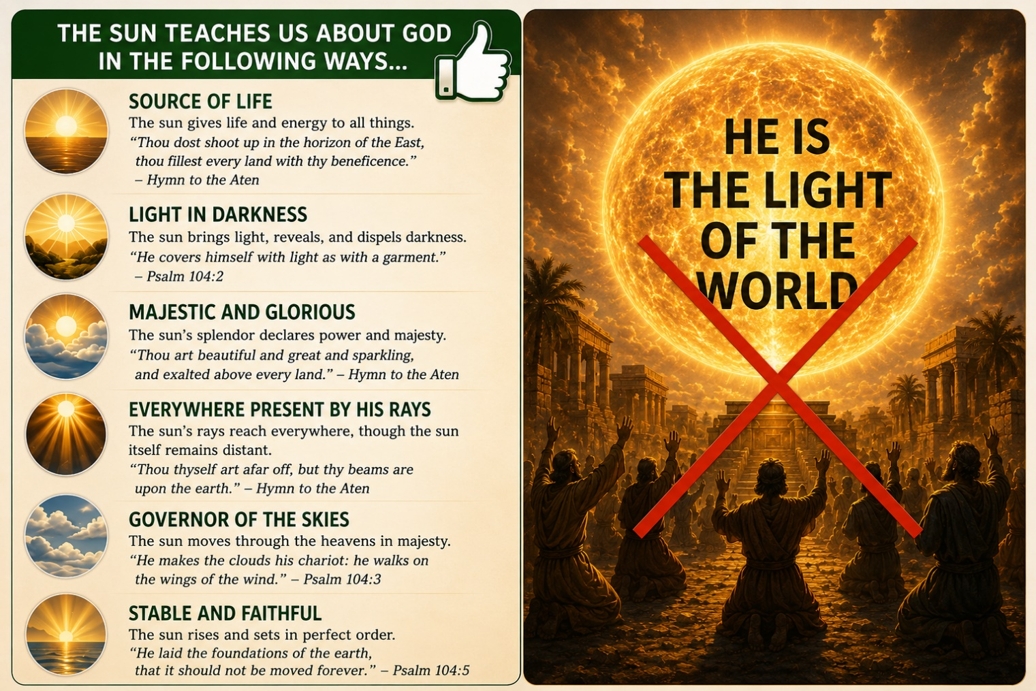
…Thy rising [is] beautiful in the horizon of heaven, O Aten, ordainer of life. Thou dost shoot up in the horizon of the East, thou fillest every land with thy beneficence. Thou art beautiful and great and sparkling, and exalted above every land… Thy arrows (i.e., rays) envelop (i.e., penetrate) everywhere all the lands which thou hast made… Thou thyself art afar off, but thy beams are upon the earth; thou art in their faces, they [admire] thy goings. (Great Hymn of the Aten, The Ancient Near East, Pritchard, henceforth GHA)
Compare to…
Psalms 104:1-5 Bless Yahweh, my soul. Yahweh, my God, you are very great. You are clothed with honour and majesty. He covers himself with light as with a garment. He stretches out the heavens like a curtain. He lays the beams of his rooms in the waters. He makes the clouds his chariot. He walks on the wings of the wind. He makes his messengers winds; his servants flames of fire. He laid the foundations of the earth, that it should not be moved forever.
Clearly, David compares Yahweh to the sun, “covered with light,” moving through the clouds as if they were a chariot, being carried by the wind as if they were wings; with his messengers – rays – flames of fire. It takes a lot of effort for Christians to deny that this is clearly solar imagery.
And why do they need to deny it? Jesus Himself said “I am the light of the world” (John 8:12). What else could He possibly have meant, but that He was like the sun? And He then went on to say that His disciples were also the light of the world, like flames… or rays (Matthew 5:14-16).
So using solar imagery to describe God is not unscriptural; I could cite many examples, such as “the sun of Righteousness” of Malachi 4:2 or God “dwelling in light to which no man can approach” in 1 Timothy 6:16.
Thus learning about God by contemplating the sun is Biblically-sanctioned. But making an idol of the sun is a completely different thing – and that’s where everyone has gone wrong on this idea. The sun shares some similarities with God, and thinking about the sun can help us better understand God; but God is not the sun (Romans 1:20).
And this is something that Akhenaten understood, in exactly the same way that David did.
Thou settest in the horizon of the west, the earth is in darkness, in the form of death… Every lion emergeth from his lair, all the creeping things bite, darkness [is] a warm retreat (?). The land is in silence. He who made them hath set in his horizon. The earth becometh light, thou shootest up in the horizon, shining in the Aten in the day, thou scatterest the darkness. Thou sendest out thine arrows (i.e., rays), the Two Lands make festival, [men] wake up, stand upon their feet, it is thou who raisest them up… throughout the land they do their works. (GHA)
Psalms 104:20-23 You make darkness, and it is night, in which all the animals of the forest prowl. The young lions roar after their prey, and seek their food from God. The sun rises, and they steal away, and lay down in their dens. Man goes forth to his work, to his labour until the evening.
This pair is nearly identical, even down to the use of lions as nighttime imagery. In both cases it is clearly the setting of the sun – or “Yahweh causing darkness” that activates night predators and his rising which starts the daily work of mankind.
O how many are the things which thou hast made! They are hidden from the face, O thou One God, like whom there is no other. (GHA)
Psalms 104:24 Yahweh, how many are your works! In wisdom have you made them all. The earth is full of your riches.
Any religious person praising his god’s creation might use similar words, but these are almost quoted from one another; right down to the very unEgyptian term “O you ONE God.” The Egyptian gods were many, not one.
Not even the greatest gods like Osiris and Ra were given such absolute domination in Egyptian religion; to do so would offend every other god in the pantheon. Nor was such a concept to be found in any other ancient religion.
Thy being is one, thou shinest (or, shootest up) among thy creatures as the LIVING ATEN, rising, shining, departing afar off, returning. Thou hast made millions of creations (or, evolutions) from thy one self… (GHA)
Only in Deuteronomy 6:4 “Hear, O Israel: The LORD our God is one LORD,” or in related scriptures like Psalm 18:31 “For who is God, except Yahweh? Who is a rock, besides our God?” and Psalm 86:10 “For you are great, and do wondrous things. You are God alone,” might Akhenaten have run across such a concept.
It maketh a flood on the mountains like the Great Green Sea [Mediterranean], it maketh to be watered their fields in their villages. How beneficent are thy plans, O Lord of Eternity! (GHA)
Psalms 104:8-11 The mountains rose, the valleys sank down, to the place which you had assigned to them. You have set a boundary that they may not pass over; that they don’t turn again to cover the earth. He sends forth springs into the valleys. They run among the mountains. They give drink to every animal of the field…
What’s odd about this – and what argues for a composition in Israel and not in Egypt… is that Egypt doesn’t have mountains or valleys! And certainly not mountains with watered villages in them!
The Nile Valley is one long strip of fertile land with little around it that could be called more than a “hill.” But even if we accept what little hillocks Egypt does have as “mountains”… they are dry desert!
But whoever originally composed this psalm was very familiar with mountains and well-watered valleys; neither of which exist anywhere in Egypt, but both of which David would have been intimately familiar with in the hill country of Judea!
At thy departure thine eye… thou didst create their faces so that thou mightest not see… ONE thou didst make… Thou art in my heart… The earth came into being by thy hand, even as thou hast created them (i.e., men). Thou risest, they live; thou settest, they die. As for thee, there is duration of life in thy members, life is in thee. [All] eyes [gaze upon]. (GHA)
Psalms 104:28-30 You open your hand; they are satisfied with good. You hide your face: they are troubled; you take away their breath: they die, and return to the dust. You send forth your Spirit: they are created. You renew the face of the ground.
There were many creator gods in Egypt, each of whom had his own part. This attempt to unite them all under a single God was unique in Egyptian history – but very much in line with Israelite religious thinking.
Thou didst create the earth by thy heart (or will), thou alone existing, men and women, cattle, beasts of every kind that are upon the earth… the fish in the river swim towards thy face, thy beams are in the depths of the Great Green (i.e., the Mediterranean and Red Seas). (GHA)
Psalms 104:25-26 There is the sea, great and wide, in which are innumerable living things, both small and large animals. There the ships go, and leviathan, whom you formed to play there. These all wait for you, that you may give them their food in due season.
Thou settest every person in his place… Thou providest their daily food, every man having the portion allotted to him, [thou] dost compute the duration of his life… Thou makest the Seasons to develop everything that thou hast made. (GHA)
Psalms 104:19 He appointed the moon for seasons. The sun knows when to set.
There’s a lot more, both in the Psalm and in the Hymn, on this theme. Feel free to read both for yourself. For now, we’ll just compare one last quote…
Thou hast made the heaven which is remote that thou mayest shine therein and look upon everything that thou hast made. (GHA)
Psalms 102:25 Of old, you laid the foundation of the earth. The heavens are the work of your hands.
That last is from a different Psalm, it should be noted, but if Akhenaten did indeed plagiarize this from David, it’s hardly likely that he only had a single psalm to work from. He would certainly have had the entire scroll, if not more of the Bible. And if he had read the rest of the Psalms, then he had this verse…
Psalms 84:11 For Yahweh God is a sun and a shield. Yahweh will give grace and glory. He withholds no good thing from those who walk blamelessly.
I think the point has been made: Psalms 104 and the Great Hymn to the Aten are almost certainly connected; many historians agree with that much; how can they not? The only question is – who learned it from whom?
Historians would confidently say that if plagiarism did take place, it was David borrowing from Akhenaten; that’s their only choice, since they believe he lived 400 years before David’s time – if David existed at all.
But if that’s how it went down, we have to ask how a simple shepherd from Judea somehow found a dusty scroll from four centuries earlier… hundreds of miles away in an abandoned Egyptian temple?
A scroll that, despite being deeply unpopular when it was written, somehow survived the deliberate erasure of the legacy of Akhenaten in particular the religious legacy; not to mention a number of dynastic upheavals, the invasion of the Sea Peoples and the chaotic Third Intermediate Period?
And having found this scroll that miraculously survived, David for some reason decided to adapt it to his own local God Yahweh and pass it off as his own work; despite severe Hebrew prohibitions against idolatry and foreign gods, particularly those of Egypt.
Really?
Or is it more plausible that Amenhotep III stumbled across the writings of David among the booty which his grandfather took from Jerusalem – and, finding it, recognized in it some ultimate truth which led him and his son to totally upend the religion of Egypt?
Which seems more likely to you?
THE TRUE (ISH) RELIGION
Egyptologists universally choose the first option anyway, which closes off any possibility of interpreting Akhenaten’s religious reforms in light of the Bible’s beliefs and leaves them completely confused as to his motivation.
But the fact is, there is quite a bit of the Bible’s ideology in his reforms. First of all, of course, the idea that “the Lord our God is one Lord.” This is an extremely rare sentiment in the ancient world – outside of the Bible and Amarna, it may well be unique at this point in history which strongly argues for a connection.
Second, the key element of most ancient religions was the aspect of a mystery, that only the initiated could be told; to support this, religious documents were carefully guarded, often in a dead language. Think Catholics and Latin, Akkadians writing religious texts in Sumerian, Muslims reading the Quran in 7th century Arabic.
Traditionally, Egyptian religious texts were written in an archaic language, far removed from the language of the people; so even those who could read, wouldn’t be able to read the sacred texts for themselves.
Which makes it all the more interesting that Akhenaten’s religion shed most of the mystery aspects, for it was a proselytizing religion made for the common people and written in their language – a concept that persisted long after the religion itself died.
This hymn and all other texts at Amarna were written in a newly created official language that was much closer to everyday speech than the classical Egyptian that had so far been used for official and religious texts. The boundary between official and vernacular language did not disappear completely, but the use of the latter for literary compositions was greatly stimulated by this development and gave rise to a whole new literature in the centuries after the Amarna Period. (Oxford)
The Amarna period broke many barriers that would remain broken long after his death; the afterlife, which had for long been the sole property of the rich and powerful, became greatly democratized after his death:
Although the Amarna episode lasted barely twenty years, its impact was enormous. It is perhaps the single most important event in Egypt’s religious and cultural history and it left deep scars on the collective consciousness of its inhabitants. Superficially, the country returned to the traditional religion of the time before Akhenaten, but in reality nothing would ever be the same again… The king lost for good the central position he had occupied in the lives of his subjects; instead, the god now acquired many traditional aspects of kingship… The representative theocracy had become a direct theocracy: no longer was the king the god’s divine representative upon earth who carried out his will; rather, the god revealed his will directly to every human being and intervened directly in the events of everyday life and in the course of history… This new form of religious experience, usually called ‘personal piety,’ was wholly characteristic of the Ramesside Period, although its beginnings, suppressed by Akhenaten, went back to the mid-18th Dynasty. (Oxford)
Third, Akhenaten banned the cult of Osiris, who, as I’ve shown in other writings, was an intentional counterfeit of the idea of a savior as taught in the Bible. Indeed, the entire belief system of life after death changed from the Egyptian norm to one much closer to what one might find in the Bible:
Osiris, the most important god of the dead, appears to have been proscribed from the very beginning of Akhenaten’s reign. Even the doctrine that viewed Osiris as the nocturnal manifestation of the sun-god, well established in funerary religion long before Amarna, was rejected by Akhenaten. The Aten was a god of life-giving light; during the night he was absent, but it is unclear where he was thought to go. Darkness and death were completely ignored instead of being regarded as a positive, necessary state of regeneration. At night the dead were simply asleep like every other living being and like the Aten himself. They were not in the ‘Beautiful West,’ the underworld, and their tombs were not even physically located in the west but in the east, where the sun rises. The ‘resurrection’ of the dead took place in the morning, when the Aten arose. (Oxford)
Compare to verses like Job 19:25-27, Psalms 13:3, and for a better (albeit New Testament) summary, very similar ideas are expressed in…
Ephesians 5:13-14 But all things, when they are reproved, are revealed by the light, for everything that reveals is light. Therefore he says, “Awake, you who sleep, and arise from the dead, and Christ will shine on you.”
If Christ shines on you when you wake, and you wake in the morning, when the sun shines on you… then this is just saying, in words Akhenaten would have understood, that Christ is the light of the world.
Finally – and most importantly from an Egyptian and a Biblical point of view… Akhenaten did not worship his God with idols!
The most conspicuous difference between, on the one hand, the Aten temples both at Amarna and earlier on at Karnak, and, on the other hand, the traditional temples is that the former are open to the skies. A typical temple of the traditional type began with a pylon and an open peristyle court followed by a succession of further courts and rooms, which gradually became smaller and darker as the worshipper penetrated further into the building. In the innermost sanctuary the cult image of the god was kept in a shrine that for most of the time was in total darkness. Akhenaten’s god was there for all to see, however, and no man-made cult image was, therefore, needed. The only statues to be found in Atenist temples are representations of Akhenaten and other members of the royal family. (Oxford)
Compare that to the Psalms, which Akhenaten apparently owned, read, and believed:
Psalms 115:1-8 Not to us, Yahweh, not to us, but to your name give glory, for your loving kindness, and for your truth’s sake. Why should the nations say, “Where is their God, now?” But our God is in the heavens. He does whatever he pleases. Their idols are silver and gold, the work of men’s hands. They have mouths, [and eyes, ears, noses, hands, and feet and a throat] but they don’t speak [or see… you get the idea]. Those who make them will be like them; yes, everyone who trusts in them.
I cannot overemphasize the idea that a god intentionally worshiped without an idol is unbelievably rare in the ancient world. I might almost say unique to the Hebrew religion. And Akhenaten’s reasoning seems to have been the same as Yahweh’s – that no idol could do justice to his image:
Acts 17:24-25 God that made the world and all things therein, seeing that he is Lord of heaven and earth, dwelleth not in temples made with hands; Neither is worshipped with men’s hands, as though he needed any thing, seeing he giveth to all life, and breath, and all things… Being then the offspring of God, we ought not to think that the Divine Nature is like gold, or silver, or stone, engraved by art and design of man.
This is something which Akhenaten, apparently, agreed with fully, yet which no Egyptian before him would have even imagined.
He ordered the defacing of Amun’s temples throughout Egypt and, in a number of instances, inscriptions of the plural ‘gods’ were also removed. This emphasized the changes encouraged by the new regime, which included a ban on images, with the exception of a rayed solar disc, in which the rays appear to represent the unseen spirit of Aten, who by then was evidently considered not merely a sun god, but rather a universal deity. (Wiki, Akhenaten)
Where then, did this completely foreign (in every sense of the word) concept come from… if not from the Psalms, which we have proven he would have had access to?
GOD IS A SPIRIT
But if you’re not completely sold yet, there is one more reason to believe; a reason that, to me, is the clincher… Akhenaten didn’t actually believe the Aten disc, the Sun, was really God!
Praise of Re Har-akhti, Rejoicing on the Horizon, in His Name as Shu Who Is in the Aton-disc, living forever and ever; the living great Aton who is in jubilee, lord of all that the Aton encircles, lord of heaven, lord of earth, lord of the House of Aton in Akhet-Aton… (GHA)
Being a normal person who hasn’t wasted their life studying Egyptian mythology, you won’t have noticed the significance of that statement; but it clearly says that the God’s name was Shu, who was IN the Aten disc! Therefore, the Aten – the visible sun – was not actually God. Who then, was Shu?
Shu (Egyptian šw, “emptiness” or “he who rises up”) was one of the primordial Egyptian gods, spouse and brother to the goddess Tefnut… He was the god of light, peace, lions, air, and wind. (Wiki, Shu)
John 4:24 God is spirit, and those who worship him must worship in spirit and truth.
In old English, the word “spirit” simply meant air or wind. Likewise in Greek and Hebrew; so when Jesus said that the true God “is a spirit,” He meant that the true God is a God of air, and wind (compare also to John 3:6-8).
Shu was also a God of peace; which of course reminds us of “For to us a child is born… His name will be called Wonderful, Counsellor, Mighty God, Everlasting Father, Prince of Peace” (Isaiah 9:6).
He was also a God of lions; and Jesus, of course, is called “the Lion of the tribe of Juda” (Revelation 5:5). Thus, everything that Akhenaten believed about Shu, who lay beyond the symbol of the sun-disc, is Biblically applied to Jesus. And more!
Shu and Tefnut, the first pair of cosmic elements, created the sky goddess, Nut, and the Earth god, Geb. Shu separated Nut from Geb as they were in the act of love, creating duality in the manifest world: above and below, light and dark, good and evil… The Egyptians believed that if Shu did not hold Nut (sky) and Geb (Earth) apart there would be no way for physically-manifest life to exist. (Wiki, Shu)
Shu was thus seen as the invisible ether which forced the stars and Earth to be separate; it could thus be fairly said that the Egyptians believed we were surrounded by Shu, inhaling Shu, with every breath. So likewise, Paul confirmed, the Greeks – much of whose philosophy was learned in Egypt – were right:
Acts 17:28 ‘For in him we live, and move, and have our being.’ As some of your own poets have said, ‘For we are also his offspring.’
We live, move, and have our being in the spirit, in the air. Which, Jesus said, represented all those who are “born of the spirit” (John 3:6-8). And all the other statements about Shu could likewise be legitimately applied to the Christian God; for He frequently said things like…
Isaiah 45:7 I form the light, and create darkness: I make peace, and create evil: I the LORD do all these things.
Hebrews 1:3 His Son is the radiance of his glory, the very image of his substance, and upholding all things by the word of his power…
Notice the “radiance of His glory,” and the fact that he “forms the light,” both sun metaphors. Yet God is not the sun, rather He is a spirit who can be understood in some way by thinking about the sun. Likewise, according to Akhenaten, Shu was the power behind this radiance, visible only through the power he gave to the Aten disc.
Representations of the Aten were always accompanied with a sort of hieroglyphic footnote, stating that the representation of the sun as all-encompassing creator was to be taken as just that: a representation of something that, by its very nature as something transcending creation, cannot be fully or adequately represented by any one part of that creation. (Wiki, Akhenaten)
Something Paul might have told us:
Romans 1:23-25 and traded the glory of the incorruptible God for the likeness of an image of corruptible man, and of birds, and four-footed animals, and creeping things… who exchanged the truth of God for a lie, and worshipped and served the creature rather than the Creator, who is blessed forever. Amen.
Whatever you might say about Akhenaten, he knew better than to do this. For he knew not even the visible sun was the true creator.
I’M NOT TRYING TO MAKE YOU A SUN WORSHIPER
No, really I’m not. But Christians are willfully blind to the immense amount of solar metaphors used to describe God in both the Old and New Testaments. And this is a piece of the truth – but the whole truth is vastly bigger truth than anyone realizes.
James 1:17 Every good gift and every perfect gift is from above, coming down from the Father of lights, with whom can be no variation, nor turning shadow.
James calls God “the Father of lights,” from which all good things come – just as Akhenaten did. Yet this did not mean James nor Jesus were sun-worshipers; indeed, the Bible explicitly condemns the worship of the sun:
Deuteronomy 17:3 And hath gone and served other gods, and worshipped them, either the sun, or moon, or any of the host of heaven, which I have not commanded;
Because the Bible also compares the Godhead to water, sheep, stones, trees, fire, mountains, bread, wine, and countless other things. Each of these is meant to teach us a basic truth about the Godhead that we are not capable of grasping without these metaphors.
God is like the sun; but the sun is not God. God is like sheep; but a lamb is not God. God is like the ocean; but the ocean is not God. And we are expressly forbidden from making an image to worship any of these things which were legitimately meant to teach us about God.
Deuteronomy 4:15-19 Take therefore good heed to yourselves; for you saw no kind of form on the day that Yahweh spoke to you in Horeb out of the midst of the fire. Lest you corrupt yourselves, and make yourself an engraved image in the form of any figure, the likeness of male or female, the likeness of any animal that is on the earth, the likeness of any winged bird that flies in the sky, the likeness of anything that creeps on the ground, the likeness of any fish that is in the water under the earth; and lest you lift up your eyes to the sky, and when you see the sun and the moon and the stars, even all the army of the sky, you are drawn away and worship them, and serve them, which Yahweh your God has allotted to all the peoples under the whole sky.
The mistake was made when men took one small metaphor and thought they understood God, and made an idol of what they thought was His whole essence. Take the evergreen tree, for example, which never “died” in winter, and therefore represented immortality. And you can actually learn about God, and the afterlife, from that tree.
…But that doesn’t mean you should cut it down, bring it into your house, deck it with silver and gold, and pray to it saying “O Christmas tree, O Christmas Tree, forever true your colour. Your boughs so green in summertime, stay bravely green in wintertime” (a carol which would not have been out of place in Jeremiah 10:1-4).
And a worse mistake was made when the limited understanding about one of these symbols – the sun, for example – caused people to murder other people who partially understood God through a different symbol, say, a crescent moon.
And an even worse mistake was when people, on the authority of God, declared idols to be a sin while they exempted their own idol. For it is extremely hypocritical for, say, a Muslim to kill a Catholic for being an idolater, when there is a crescent moon atop his own mosque – a symbol which has been worshiped as a god by his ancestors for over two thousand years before Muhammad.
Just as it is hypocritical for a Protestant to declare a Catholic an idolater, while he wears around his neck a cross, an ancient symbol of the sun that predates Jesus by thousands of years. But that is another story.
Since I’m offending people, I might as well say that it is also hypocritical for a Jew to wear a star of David, a symbol which can be traced directly back to idols from the Canaanite countries of Tyre and Sidon half a millennium before David lived, and ultimately back to Shamash, the sun-god of Sumer.
We were meant to learn about God by contemplating the sun, the mountains, the sea, the stars; to think about the grass growing in the fields and how it becomes grain which we turn into bread through fermentation and eat with butter and wine… all this, and many more things, were meant to teach us about God.
But we are forbidden from limiting God by saying He is more like one of these things than any other; and strictly forbidden from making images of these things to remind us of Him or His nature. Because the most perfect idol ever constructed fell short of the truth.
And contemplating the imperfect replica will inevitably give us the wrong idea of the nature of the God whom it supposedly represents.
If a pagan pharaoh of Egypt from 3,000 years ago knew this, why do Christians struggle so with it?
ATEN RISING
I have demonstrated that Akhenaten understood a great deal of the truth of the Bible; how much is debatable, but he absolutely knew many key concepts of Christianity; that there is one God, that He cannot be worshiped with idols, that He is like the sun yet is not the sun, that He is an unseen spirit like air; that He alone created the heavens and the Earth; that the dead are asleep, and that He intends to resurrect them when He returns.
In these things alone, Akhenaten has demonstrated a level of understanding unparalleled outside of Israel – and rarely found even there. I don’t go so far as to say he was a true Christian, but he definitely had been profoundly impacted by the Hebrew religion. The question is… how?
The worship of the Aten, though Akhenaten got all the credit for it, had already begun under the reign of his predecessor, Amenhotep III, who called his own palace “the Palace of the Dazzling Aten.”
“Construction began around Regnal Year 11 [‑948] and continued until the king moved to the palace permanently around Regnal Year 29.” (Wiki, Amenhotep III)
Thus, already by the year ‑948, only 38 years after Shishak looted Jerusalem, Amenhotep was shifting his worship to the Aten from Amun, despite naming his son and himself after Amun (Amun-hotep – vowels aren’t always clear in Egyptian writing). This suggests that sometime in the first ten years of his reign something happened to “open his eyes” to the glory of the sun.
During the reign of Amenhotep III this aspect of the sun-god [the Aten disc] had become increasingly important, especially in the later years of his reign. During the king’s sed-festivals, his deified self had been identified with the sun-disc and in several inscriptions, most clearly in one on the back pillar of a recently discovered statue, the king calls himself ‘the dazzling Aten.’ (Oxford)
Towards the end of the reign of Amenhotep III the cult of many gods as well as that of his own deified self were increasingly solarized, but at the same time the king appears to have tried to counterbalance this development by commissioning an enormous number of statues of a multitude of deities and by developing the cult of their earthly manifestations as sacred animals. However, in hymns from the very end of the reign, the sun-god is clearly set apart from the other gods – he is the supreme god who is alone, far away in the sky, whereas the other deities are part of his creation, alongside men and animals. Amenhotep III’s successor was soon to find a radically different solution to the problem of unity and plurality. (Oxford)
So clearly, Amenhotep III was already drifting in a solar direction early in his reign, which clearly accelerated near the end of his reign when he celebrated his sed-jubilee festivals. Generally, these celebrated all the main gods but Amenhotep made it all about the Aten.
This would coincide, very closely, to the association of Amenhotep IV on the throne if there was a 6 year co-reign as we believe. There is considerable debate on whether Amenhotep IV meant to make the worship of the Aten the worship of his own deified father, but there is no consensus on his intent.
Regardless, all of this suggests that it was not Amenhotep IV/Akhenaten, but his father who was the initiator of the changes to the religion – although Akhenaten went much farther, making it the only legal religion and suppressing, or at least strongly discouraging, all others.
It remains to be explained precisely why Amenhotep III did this.
THE ROAD TO DAMASCUS
Manetho speaks about the 18th Dynasty, and in that list, roughly where Amenhotep III should be, he mentions a king called “Orus,” and gives him a bit less than 37 years of reign; we agree with historians that this probably refers to Amenhotep III.
What’s interesting is what Manetho, through Josephus, later says about this Orus…
Amenôphis. This king, he states, conceived a desire to behold the gods, as Ôr, one of his predecessors on the throne, had done; and he communicated his desire to his namesake Amenôphis, Paapis’ son, who, in virtue of his wisdom and knowledge of the future, was reputed to be a partaker in the divine nature. This namesake, then, replied that he would be able to see the gods if he cleansed the whole land of lepers and other polluted persons. (Josephus)
Manetho attempted to connect this event with the Exodus, an identification which Josephus furiously rejects; given the story and characters which follows, it almost certainly takes place a century later in the time of Merenptah (‑800‑780), just after Ramesses II.
But for our purposes what is important is what he said about what happened to Or (Orus, Amenhotep III); he beheld the gods. It’s also interesting that his wise seer “was reputed to be a partaker in the divine nature,” language which is oddly close to 2 Peter 1:4.
Our point for now is that this later king, who was also named Amenophis, “desired to behold the gods, like Amenhotep III, one of his predecessors, had done.” This tells us that there was some sort of a special event that had inspired Amenhotep III and/or Akhenaten’s conversion!
Something that survived in the popular memory even though it had been erased from history, something which a later king envied – though he feared to follow the same religion, having seen how it worked out for his predecessor.
We will probably never know what happened exactly since it was deliberately erased. But what we can say is that the holy vessels of the house of the Lord had been taken by Shishak to Egypt, where Amenhotep III and/or IV must have found them.
God, for reasons of His own, decided to give him a vision, a dream, or send an angel to actually talk to him; these things are not unprecedented, even with foreign kings, and particularly when the vessels of the temple are involved; think Daniel’s writing on the wall (Daniel 5), Pharaoh’s dreams in the time of Joseph and Abraham, Abimelech’s dreams, etc.
And if God did appear, or send an angel, to Amenhotep III as he walked among the treasures of Jerusalem, what would Pharaoh have seen?
Daniel 12:5-6 I lifted up my eyes, and looked, and behold, a man clothed in linen, whose thighs were adorned with pure gold of Uphaz: his body also was like the beryl, and his face as the appearance of lightning, and his eyes as flaming torches, and his arms and his feet like burnished brass, and the voice of his words like the voice of a multitude.
Matthew 17:1-2 And after six days Jesus taketh Peter, James, and John his brother, and bringeth them up into an high mountain apart, And was transfigured before them: and his face did shine as the sun, and his raiment was white as the light.
So if Amenhotep did indeed “see the gods,” this is how they would have appeared. And he would almost certainly have been convinced that the “dazzling sun-disc” was the manifestation of the being whom he saw in the vision. And THAT would have been a powerful enough motivation to completely upend the established religion of Egypt!
Because God appearing as a dazzling sun in order to change an official religion is not without precedent…
Acts 9:1-9 But Saul, still breathing threats and slaughter against the disciples of the Lord… As he travelled, it happened that he got close to Damascus, and suddenly a light from the sky shone around him. He fell on the earth, and heard a voice saying to him, “Saul, Saul, why do you persecute me?” He said, “Who are you, Lord?” The Lord said, “I am Jesus, whom you are persecuting.
But rise up, and enter into the city, and you will be told what you must do.” The men who travelled with him stood speechless, hearing the sound, but seeing no one. Saul arose from the ground, and when his eyes were opened, he saw no one. They led him by the hand, and brought him into Damascus. He was without sight for three days, and neither ate nor drank.
This, the famous conversion story of Paul, would easily convince someone that “a light from the sky” which left them “without sight for three days,” was the sun-God speaking. Paul, being a Hebrew, knew better; but if something like this had happened to Amenhotep…
What would he have believed?
What would you have believed?

This is part 38 of The History of the World Series
 The Richest Man in History
  Thutmose III and Shishak
  Solomon and the Queen of Sheba
  Judges to Kings
  What Is The LOVE Of God?
  Everything You Believe About God Is WRONG!
  Make Up Your Mind!
  What Is Faith?
  How DARE you FEAR the judgment of God!
  Firstripe Figs
  The Bride Of The Father
  Exodus 40 – The Plan Of God
  The Temple Of God
  Pillars Of The Temple And The Brass Sea
  GEHENNA WITH ‘EM
  When Did God Forbid Polygamy?
  When You Shouldn’t Pray For Someone
  The Sins of the Father
  The First Paul