Neo-Assyrian Chronology

This is part 42 of the The History of the World Series
; The History of the World is part 1.
Click here to read in series
It’s finally time to address the Assyrian elephant in the room; for many chapters now I have begged your indulgence as I gave you Assyrian dates that differ by decades from what you’ll read on Wikipedia, and I’ve offered no explanation. Well, it’s time for the explanation.
Starting in ‑747, we have multiple independent sources for historical dating. This is because in ‑747 a Babylonian king named Nabonassar began a series of astronomical observations that would become an unbroken chain of history leading up to modern times; records which are independently checked by other Babylonian, Assyrian, Israelite, Persian, Greek, and Roman records.
But before ‑747, we only have two independent king lists that are remotely usable; Babylon was in a kingless period for most of the previous half century, Elam was in the midst of their “dark age” (which we don’t believe in, but still hurts their chronological credibility), the Hittites and Mitanni were long gone, and Egypt was (supposedly) in the Third Intermediate Period which is incredibly difficult for historians to date.
Only two kingdoms with a continuous chronological record remain: Assyria and Israel.
Fortunately, these kingdoms mentioned each other frequently in the 8th century BC, and after ‑745 when Tiglath-pileser III became king of Assyria, all but one of the Assyrian dates agree perfectly with the Bible; providing independent confirmation that both the Bible and the Assyrians kept accurate time after that date.
Unfortunately, all interactions between the two before ‑745 are, without exception, off by 30, 40, or even 50 years. Which means either the Assyrian dates are wrong or the Bible is. I don’t need to tell you which choice two centuries of historians have made.
The fact that before ‑745 Biblical dates disagree with Assyrian dates could mean the Bible is wrong; it could mean the Assyrians are wrong. When the only two witnesses to an event disagree, it’s impossible to know what really happened.
Assyriologists will tell you that the Bur-sagale event was an eclipse, and thus confirms the chronology; even if it were, it would only confirm another 18 years, back to ‑763. But since it wasn’t an eclipse, it actually proves a completely different chronological scheme, which you will read about in future chapters.
To a truly objective observer, this means that Assyrian history from ‑911‑745 (or ‑911‑763, if I’m being generous) cannot be confirmed by any independent source and must therefore be accepted entirely on faith. And rather than accepting this as the black mark against Assyrian chronology that it is, the traditional response is to grossly rewrite the Bible’s chronology.
Is that science?
BEYOND THIELE
Nearly all conventional dates for Biblical kings are based on the work of Edwin Thiele, a noted scholar who rewrote Biblical history about 80 years ago to bring it into line with Assyrian chronology in the 1940’s and 1950’s.
To accomplish this, he posited several different calendar systems which changed from time to time, and most egregiously he invented numerous co-regencies on the slimmest of evidence; usually with no evidence at all except the need to make the dates fit.
Thiele’s first lengthy coregency is that of Jeroboam with his father, Joash-I, where a remarkable 75% of the reign (12 out of 16 years) is devoted to co-rule … This left Joash-I with a sole reign of only four years. As if this approach were not radical enough, Thiele then adjusts the years for Joash-I’s contemporary, Amaziah, in order to swallow up 83% of his tenure—24 of 29 years—with coregency. In the end, Thiele leaves only 17 of Azariah’s 52 years to sole rule in the process of doing unwarranted “violence to the Dtr [Deuteronomistic] editing” of the biblical narrative. (Barnes 1991, p. 137)
Had the serial reigns of Amaziah, Azariah, and Jotham been found on a Mesopotamian cuneiform tablet, they would have been accorded 97 years, yet because they are part of the biblical text, scholarship does not hesitate to reduce this amount by 35 years. (Assyrian Chronology and Ideology of Kingship… Derstine)
Thiele’s 24-year co-regency between Amaziah and Uzziah would be one of the longest coregencies in any kingdom in history; and yet ironically, a straightforward reading of the Bible’s synchronisms actually predict a 12-year gap between these kings!
Derstine is correct; regnal lengths on an Egyptian scroll or Mesopotamian tablet would have been respected far more, and a co-reign would only have been accepted if there was strong evidence such as double-dating.
No issue of historiography is more dependent on contemporaneous documentation than coregency. If it is assumed that a king was coregent, “the assumption must be justified. It is not enough justification that coregencies enable chronological problems to be solved” (Laato 1986, p. 212). Obviously, any problem of chronology can be resolved dozens of ways by arbitrarily positing, and then adjusting the termini of, undocumented coregencies (cf. Laato 1986, p. 211). Even Albright (1952, p. 102) states: “It is risky assuming them when the biblical text offers no warrant for the assumption.” (Ibid.)
And yet for most of his coregencies Thiele offers no evidence besides the force of his own chronological framework based on Assyrian dating. And the vast majority of the academic community has followed him for nearly a century.
Derstine’s doctoral thesis “Beyond Thiele…” is largely devoted to discrediting Thiele’s premise, his method, and especially his conclusions; work I won’t repeat here. I will just point out the hypocritical elephant in the room:
The academic community would never accept a co-regency in, say, Egypt’s 12th or 18th dynasties without extensive documentation. Certainly not merely to solve a chronological problem. Only the Bible is treated this way.
And only because it is convenient for an utterly unsubstantiated, and unsubstantiable, Assyrian chronology.
Is that science? Or prejudice?
GOLD STANDARD
Whether or not you consider the Bible to be inspired, it is an incredibly well documented king list with above 25 double-synchronisms (“in the Xth year of king Y of Israel, king Z of Judah began to reign”) between Israel and Judah throughout a nearly 300-year period. As king lists go, it sets the gold standard.
The only ancient chronology that approaches it, as far as I’m aware, is the dynasties of Isin-Larsa; but their synchronisms are often one sided, and there are far fewer than the books of Kings and Chronicles contain; yet no historian would dare to mess with their relative chronology by more than a year or two.
So for historians to butcher the Bible’s record as they do to make Assyrian dates fit is unscientific no matter what culture it was done to. I would be defending the Elamite or Hittite king lists just as vigorously as I am defending the Bible here.
All evidence should be heard, whether you like it or not. And in the absence of independent confirmation, what justifies such confidence in an Assyrian document?
A document that was politically motivated, which may have contained gaps during periods of unrest, may have been copied wrong, may have kings erased from the record when they were later deemed illegitimate – at least one of which has happened in literally every other chronology in the Middle East?
Believing in such a document anyway is the definition of blind faith.
In all fairness, my critics may levy the same arguments against the veracity of the Bible. And that’s fair, but there’s a difference; I believe in God. That means I’m allowed to accept that a document was inspired, and was copied with such reverence that its text survived intact to the present day.
I thought the whole point of scientists was that they weren’t allowed to accept such things on faith?
Think about that.
EXTRAORDINARY EVIDENCE
Since the only source against which we can check the list before ‑745 disagrees with it significantly (the Bible), the unanimous claim that the years between ‑911 and ‑745 are complete and accurate is an extraordinary claim which requires extraordinary evidence.
The backbone of chronology should be able to pass, at a minimum, the following basic tests:
- It must be confirmed from external evidence such as contemporary independent king lists of other countries;
- All versions of the list must agree as to the order and number of years;
- It must be without internal disagreement or contradiction;
- There should be no inexplicable lines, dates, or kings not found on the list. Every question raised must be answerable.
But Assyrian history does not pass any of these tests. The only contemporary civilization with an internal chronology stretching back before ‑745 that isn’t based on Assyria itself is Israel; and as has been noted, it disagrees in every single case:
- Adad-nirari III (‑810‑783) boasts of taking tribute from Jehoash the Samarian (‑855‑839) in the Tell al-Rimah Stela, carved in his 5th year, an error of 34–50 years.
- The “eclipse” in Ashur-dan III’s year of Bur-sagale (‑763) we mentioned in the introduction, and will spend the next several chapters proving beyond a reasonable doubt, had to coincide with a major event called the Ra’ash which the Bible dates to ‑797, an error of precisely 34 years.
Since pushing back Ashur-dan III’s 10th year to ‑797 would also move his second predecessor Adad-nirari III by the same amount, these two problems can be solved with one adjustment – suggesting that a gap exists between Ashur-dan III and Tiglath-pileser III totaling 34 years.
- Ahab of Israel (‑933‑911) is (arguably) placed at the Battle of Qarqar (‑853), an error of 58–80 years.
- Jehu, based on the Bible’s own dating in the Masoretic Text, reigned from ‑899‑871; Shalmaneser III claims to have taken tribute from him in his 18th year; ‑841, according to Assyrian dates derived from the eponym lists; this is an error of 30–58 years;
- The death of Hadad-ezer of Syria and the accession of his general Hazael occurred in ‑899, based on the Bible. The same event is almost certainly recorded by Shalmaneser III between his 14th-18th years – traditionally ‑845‑841. This error is 54–58 years.
Resolving these conflicts with a minimum amount of errors suggests that Shalmaneser III needs to be pushed back 54-58 years compared to traditional dates, meaning there must be gaps totaling an additional 20-24 years between Shalmaneser III and Adad-nirari III.
- Pul, generally thought to be a nickname of Tiglath-pileser III (‑745‑727), took tribute from Menahem (‑772‑762) according to both his monuments and the Bible, an error of 24–34 years.
- Sennacherib besieged Jerusalem in his 3rd year, which the Bible has as Hezekiah’s 14th year. The Bible places this at ‑713, while historians place it as ‑701, an error of 10 years.
These two errors have a different cause, and will be handled separately. But what’s really interesting is not that these dates are off; it’s that all Assyrian-Hebrew dates after the accession of Tiglath-pileser III (‑745‑727) are perfect with the sole exception of #7.
Aside from that, agreement is very tight; Tiglath-pileser III is connected with Pekah of Israel, against whom he campaigned; Hoshea of Israel, whom he claimed to install after Pekah’s removal; Ahaz of Judah, who paid tribute and sought his help against Israel and Damascus; and Rezin of Damascus, whom Tiglath-pileser defeated and killed.
After Tiglath-pileser III died, Hoshea of Israel paid tribute to Shalmaneser V and later rebelled, prompting the siege of Samaria; Sargon II claimed the subsequent conquest and deportation of Samaria’s population. Manasseh of Judah is named as a vassal of both Esarhaddon and Ashurbanipal.
Finally, Josiah’s death in ‑610 occurred while Pharaoh Necho was marching north to aid the last Assyrian forces against Babylon, tying Judah indirectly to Assyria’s final collapse. In each of these cases, the appropriate Hebrew king is ruling opposite the Assyrian king with whom he interacted.
So what happened before ‑745 to so badly mess up the synchronisms between the two countries to the tune of a half-century? Not one, but at least two gaps in Assyrian record keeping are required to explain the discrepancy.
Why do I insist on Assyrian gaps, and reject the possibility that this is a Biblical problem? Believe it or not, it’s not because of faith. We put the burden on the Assyrians here for a very simple logical reason:
If the Hebrew books of Kings and Chronicles were so badly written, edited, and transmitted that roughly a dozen errors or omissions added up to a half-century discrepancy in the period between around ‑900 and ‑745… (a 33% failure rate!)
…then how did they manage to record the next 150 years so that they perfectly align with Assyrian interactions in ‑610 to the year?
Is it more probable there is a systemic error in the Hebrew record-keeping system that only affected the former 150 years, but left the later 150 years perfectly in agreement with Assyrian history…
…or that there were periods of civil war, gaps in record keeping, or reigns of unpopular rulers in Assyria that later generations preferred to forget? During a period of known civil war, poor documentation, and unpopular rulers in Assyria?
LIMMU LISTS
Our primary sources of evidence for the kings of Assyria against whom the Bible’s kings are compared are the Assyrian King List (AKL) and more importantly, a continual year-by-year accounting of rulers and major events in the Assyrian Eponym lists and chronicles (AEL), which are lists of years named after government officials, the way the Assyrians tracked time.
Each year was named after a high officer of state, termed limmu in Akkadian… a new king acted as eponym in his second year of reign… then followed four ministers of state: the turtanu, or commander-in-chief, the rabshake, “chief cupbearer,” nagir ekalli, “Palace herald” and the massenu, the chamberlain. (Eponyms of the Assyrian Empire 910-612 BC, Millard)
(Off-topic: for an interesting connection to the Bible, compare the titles there above and see them mistranslated as proper names in the Bible, as Tartan and Rabshakeh (2 Kings 18:17). It should be the Tartan and the Rabshakeh; KJV translators didn’t know they were Assyrian titles.)
Governors of major cities came after them, some taking precedence over others as the empire grew. The sequence was not rigid except for the tartanu following the king. A chance discovery seems to reveal the reason for that: lots were cast to determine the order. (Ibid.)
The primary purpose of these lists was to provide a dating system for bureaucracy; so that you could say something like “in the reign of Sargon, in the year of Zeru-ibni, I rented this land.” Counting how many people have been limmus since that man was allowed you to know how much rent was owed. That sort of thing.
The AKL is a separate document, the earlier parts of which are generally regarded as fictional (though not by me), and the later parts of which are considered mostly accurate beginning with Assuruballit I and extremely accurate after Ashur-dan II.
The AKL’s editorial history has long been debated, but there is a consensus that its textual tradition became fixed prior to the Neo-Assyrian period, and that scribes subsequently updated it periodically to include each new reign until at least the late eighth century BCE. (e.g., Yamada 1994, 35)
This has prompted a deference to the AKL as a chronological source for the Neo-Assyrian period that has only seldom been criticized… [continuing in footnote] For example, Pruzsinszky (2009, 52) states that since its publication “historians have based their chronologies of Assyria directly on the AKL.… Despite some gaps, omissions and conflicting numbers, the AKL is generally considered the ‘backbone’ of Assyrian chronology.”
…Note, however, Brinkman’s (1973, 314) caution: “One does not wish to be overly sceptical about the data of the Assyrian Kinglist tradition. But there is a tendency when dealing with such a unique and—at least in its later portions—seemingly scientific document to forget that all of its data may not be equally reliable.”
…Certainly, both the Khorsabad and SDAS lists are luxuriously crafted in a Henkeltafel format, and bear detailed colophons attesting to the care and accuracy with which they had been copied. Moreover, it has long been supposed that the AKL was compiled from the Assyrian Eponym Lists (e.g., Rowton 1946, 98–101), as the AKL’s reign lengths tally roughly to a count of entries from one royal eponymate to the next in such lists. (Three new kings of Assyria, Edmonds, Frahm; henceforth TNK)
As noted there, it is widely believed that the AEL was the source for the data in the AKL; that first the limmus were compiled, then a later scribe collated that data into the AKL to display a list of ancient kings.
Since at present these two lists generally agree, it means if either of them can be demonstrated to have omissions or errors, we must seriously question whether or not the other list likewise suffers from the same omissions in the same place.
What this means in practice is that, say, Shalmaneser III’s 35 limmu officials in the AEL do not stand as an independent witness alongside the 35 years given to him in the AKL, since the AKL may well have been compiled by a scribe who simply read the AEL.
In reality we only have one witness, and many reasons to distrust it.
CONSISTENCY IN THE KING LIST
Our next criterion is that all versions of the AEL must agree; here, too, the Assyrian lists fail. There are in fact well-known disagreements between different copies of the eponym lists, both in the number of limmus and in some cases their order as well:
Two recensions [versions] of the Neo-Assyrian Eponym List have been recognized for a long time. The difference between them is the number of eponyms given for the reign of Adad-nirari III. What we might call the short recension is represented by three textual witnesses (Ca6, Cb2, and Ce); it lists one less eponym for this king’s reign than does the long recension which is represented by only one textual witness (Ca3)…
Adjusted years
Long Recension
Short Recension
822
Sil-Ishtar
821
Balatu
Sil-Ishtar
820
Adad-uballit
Nabu-shar-usur
819
Marduk-shar-usur
Adad-uballit
818
Nabu-shar-usur
Marduk-shar-usur
817
Ninurta-nasir
Ninurta-nasir
Aside from the minor matter of arrangement, the principal difference involved here is the occurrence of the eponymy of Balatu in the longer list and its absence from the shorter list. A satisfactory solution to this minor crux is not evident from an examination of the specific texts involved. (A note on the date of the battle of Qarqar, Shea)
To this day, Assyriologists debate over which one of these lists is right, because one has an extra year added – so you will see all earlier dates in Assyrian history on Wikipedia with an asterisk which says “may be one year less if the shorter of the recensions is followed.”
This alone is troubling; because if you can be missing one limmu… how many others might be missing?
And also, what that author calls “the minor matter of arrangement” is actually a pretty big deal. Was the year of Nabu-shar-usur before or after that of Adad-uballit? If the scribe could take such liberty as this with the list, what other liberties did he take?
This is not a minor “matter”; this is a strong reason to doubt the trustworthiness of the literal backbone of all Middle Eastern chronology. Every single date in the ancient Near East before ‑750 is, in some way, traced back to this list.
Shouldn’t we hold it to a higher standard?
INHERENT WEAKNESS
The third test is internal disagreement. Can we prove that the list doesn’t contradict itself, or known facts of Assyrian history? Once again, no; the Assyrians epically fail this test as well.
It has long been the historical dogma that the (AKL) is complete; that no one ever ruled as a king in Assur or Nineveh who is not found on that list, and no eponyms exist that are not on that list (after ‑911, that is). But modern scholarship, mainstream scholarship at that, is finally realizing that this is not, in fact, true.
In a new article published in this very year, Edmonds and Frahm – some of the leading Assyriologists in the world today – demonstrate the existence of not less than three previously unknown kings who ruled as king in Assyria during this period, none of them acknowledged in the Assyrian lists. From their abstract:
In this contribution, we critically examine the claim that the Assyrian King List (AKL) reliably contains all Neo-Assyrian monarchs up to Shalmaneser V, presenting three historical scenarios in which it can be demonstrated that short-lived Assyrian kings ruled parallel to or between those listed in the AKL’s first-millennium BCE portion.
The first of these is a new rebel king Tiglath-pileser who rose up against his nephew Aššur-dān III in 763 BCE (most likely in the wake of a dramatic solar eclipse) and was enthroned in Aššur, before being toppled again by Aššur-dān III’s forces.
The second is a new Shalmaneser who we assume succeeded Aššur-nārārī V to the Assyrian throne late in 747 BCE but lost his throne to Tiglath-pileser III a little more than a year later in 745 BCE.
The third is earlier in date, a short-lived Aššur-uballiṭ whose reign was usurped by Adad-nārārī II in 912* BCE. Each king was enthroned at Aššur, and enjoyed support from some, if not all of Assyria, but was subsequently defeated or deposed. Evidence of the partial erasure of two of these kings from the historical record can be identified.
The new insights thus gained into the cutthroat Assyrian “game of thrones” demonstrate that the AKL is not a reliable list of all Neo-Assyrian rulers, but rather of those who reigned long and successfully enough to be included by its editors in an idealized, consecutive order. (TNK)
I couldn’t have said it better myself; I would just add that if the list is missing three kings, what else is it missing? Such a list should not be permitted the authority to rewrite the Bible, or any other king list.
Having said this, the authors proceed to conclude that despite the demonstrable unreliability of the list, the lists should still generally be trusted for dating; that the gaps they proved must exist did not affect the counting of years in Assyria. Needless to say, I strongly disagree.
Although our findings do not alter Assyrian chronology from 911 BCE onward (the beginning of continuous coverage by the surviving Assyrian Eponym Lists), they do signal the perils of extrapolating back dates prior to this by means of the AKL alone, as individual years belonging to other, presently unknown, short-lived Assyrian kings could also have been omitted—particularly during the late eleventh and early tenth centuries BCE, when no contestations of the Assyrian throne are mentioned by the AKL. Nonetheless, the necessary alterations to the absolute chronology are likely to be minor, and can only be enacted with improved documentation for this period. (Ibid.)
Despite having proven the AKL is missing kings, which suggests that the AEL may likewise be missing limmu years for those kings, they conclude that later Assyrian editors must have filled any gaps that would result from the deletion of a king and/or his limmus by backdating the reigns of later kings.
But I have to ask, if these kings were not known before, during this supposedly rock-solid period… what else was “idealized” away by the editors of the ancient Assyrian lists? If they skipped a year or two here and there, why is a decade or two impossible?
If they erased a king from history, as they literally did in the case of the new Shalmaneser by scratching his name off a monument… then who is to say they didn’t erase a decade or two along with him – as the Egyptians did with Hatshepsut and again with Akhenaten and his successors?
It matters a great deal because in the conventional view 300 or so years of limmus represents 300 years or so of real elapsed time. But if they’re wrong, 300 or so years of limmus may represent 350 years or so of real elapsed time – because each king an ancient scribe deleted removed a decade or two from the list.
Remember, these documents were created to legitimize kingship (AKL) and for bureaucratic purposes (AEL); neither of which was important following a regime change, when the dead adversary was vilified and his grants, taxes, and treaties annulled. Erasing his years would present no ideological or practical problem for the editors of the AKL or the AEL.
Given that, I for one do not have such faith in the ancient Assyrian scribes that I would bet the farm on their commitment to chronological accuracy. I find it odd that men of Science so readily have faith in such things.
I thought that faith wasn’t their thing?
HORIZONTAL LINES
Raising more questions, a highly unusual set of limmus comes later in the list after the reign of Ashur-dan III, he of the Bur-sagale event. You will recall that we need to push that event back 34 years, meaning we expect to find reason to place major gaps after his reign, and we are not disappointed.
In the century or so since Shalmaneser III, every king had a regnal summary before a horizontal line beginning the new king’s reign. But not Ashur-dan; his last limmu, where the summary should be, is at the top of the list below in the year of Ninurta-shezibanni followed merely by a line.
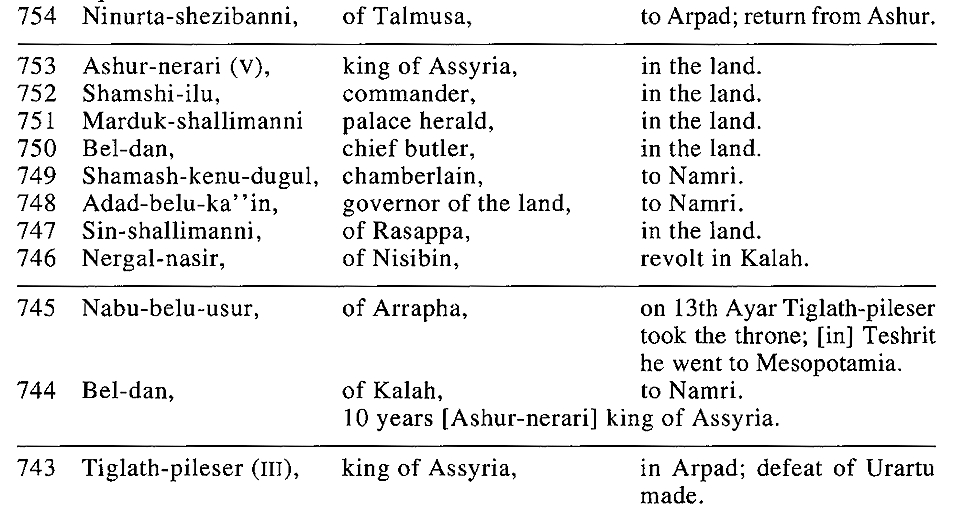
A line is not a regnal summary. Why the sudden departure from tradition? A few years earlier, just before the Bur-sagale event, another anomalous line is found; this is where Edmonds and Frahm would place their new Tiglath-pileser (not III).
They may well be right, although as far as I can see from their evidence, he could just as easily be placed during the line following Ashur-dan’s reign. What is interesting is how these scholars interpret that unexpected line…
It is noteworthy that the entry for 763 BCE [bur-sagale] is preceded in the Eponym Chronicle B1 by a horizontal ruling (fig. 5), a paratextual marker found several times in Eponym Lists and Chronicles before the eponymates of Assyrian kings to mark new reigns (Millard 1992, 12–13). The ruling looks like a spectral remnant from an earlier copy of the Chronicle that must have included an explicit reference to the new Tiglath-pileser’s rise to power in 763 BCE, a reference at some point purged from the record. (TNK)
The concept that a line may conceal a missing king is thus supported by today’s foremost scholarship; we simply take their own reasoning to its logical conclusion: every unsubstantiated line in the AEL is a “spectral remnant” of similar breaks and missing kings.
The limmus of the next king, Ashur-nirari V, are full of anomalies as well. First, note that another odd line appears after Ashur-nirari V’s 8th year; no explanation is given for this. Another “spectral remnant?” At first it seems it can’t be, since Ashur-nirari has a regnal summary of ten years after his reign.
… but does he though?
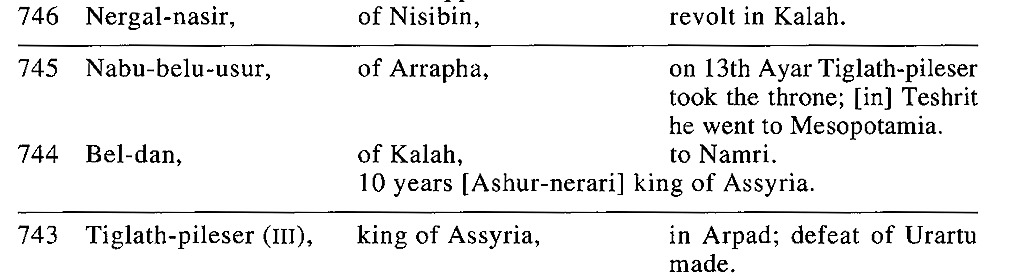
Following the line in his 8th year, two years later there is a summary that clearly gives ten years but not necessarily to Ashur-nirari! His name does not appear in the original text (bracketed names are supplied or restored by the translator). This, then, could be a summary of literally any unknown king who ruled for ten years.
We believe all of the anomalous horizontal lines in the AEL will ultimately prove to represent gaps of unknown length with presently unknown kings that later kings found inconvenient to acknowledge; in total, their reigns must represent 34 years of lost history.
TIGLATH-PILESER
But this section of the AEL is not done giving us anomalies to study. After the 8th year of Ashur-nirari V – who, it should be remembered, was the recipient of the insulting letter from Adad-shuma-usur the Kassite king for being a drunken idiot – there is the horizontal line we’ve noticed.
A fragment of an extraordinarily insulting letter is preserved in the Kouyunjik Collections in the British Museum and is addressed by Adad-šuma-uṣur, king of Babylon, to two rulers, Aššur-nerari III and Ilī-padâ, who are addressed as the “kings of Assyria.” (Wikipedia, Assur-nirari III)
As mentioned a few chapters ago, there is no evidence in this letter to tie it to one Ashur-nirari over another; they prefer III because it fits their Kassite chronology; we, for the same reason, prefer V; but also because the known political situation in the 8th century, when a weak and ineffectual monarchy saw new kings multiplying, fits perfectly with the contents of this letter.
Regardless, the AEL then says “Tiglath-pileser took the throne.” This is absolutely unique in the annals – this is the only time a king “took the throne” during the reign of another king. Assyriologists are quite confident, in fact, that the Assyrians never used co-reigns (they did, but that’s another chapter).
Usually, the beginning of a reign is as you see in year ‑743 there – “Tiglath-pileser, king of Assyria.” So something weird is going on here, because he began to reign in ‑745 and he also began to reign two years later. What gives?
The circumstances of Tiglath-Pileser’s rise to the throne are not clear. Because ancient Assyrian sources give conflicting accounts concerning Tiglath-Pileser’s lineage and there are records of a revolt around the time of his accession, many historians have concluded that Tiglath-Pileser was a usurper, who seized the throne from his predecessor Ashur-nirari V, who was either his brother or his father. (Wikipedia, Tiglath-Pileser III)
So clearly, there is the possibility that there is something hinky going on with these limmus again – as we can clearly see from their odd format and information. Remember what I said at the beginning? That to be the backbone of chronology, it needs to be without oddities and contradictions? Does this really pass that test?
Ancient Assyrian sources give conflicting information in regards to Tiglath-Pileser’s lineage. Tiglath-Pileser in inscriptions attributed his rise to the throne solely to divine selection, rather than the more typical practice of Assyrian kings ascribing their rise to both divine selection and his royal ancestry. The Assyrian King List, an ancient Assyrian document listing the kings of Assyria, states that Tiglath-Pileser’s father was his immediate predecessor Ashur-nirari V. Tiglath-Pileser in his own inscriptions claimed that he was the son of Adad-nirari III, making him Ashur-nirari’s brother. (Wikipedia, Tiglath-Pileser III)
It’s unlikely, even for historians, that Tiglath-pileser III was the son of Adad-nirari III who preceded him by almost forty years, even by their dating. When you consider that he himself had a reign of almost 20 years, it would mean that his many conquests were done in his 50’s, 60’s, and maybe even 70’s. It’s not outside the bounds of possibility, but generally it’s doubted.
But if he’s not the son of Ashur-nirari V, merely the next legitimate king on the list, and also not likely the son of Adad-nirari III, why does he claim to be? Why would he claim something that so obviously was not true? Something that anyone who was there at that time would know for a fact to be false?
As noted above, the ten-year regnal summary that follows Ashur-nirari V, and which overlapped Tiglath’s rule by two years, need not belong to Ashur-nirari V; it likely belongs to a completely different king.
Edmonds and Frahm believe that Tiglath-pileser III was immediately preceded by a previously unknown Shalmaneser, let’s call him IVb, who ruled for at most a year or two before Tiglath-pileser III. I agree with their placement, but argue that the AEL suggests that Tiglath’s predecessor ruled for 10 years, and all that’s left of his first eight years is a ghostly line.
Thus, our conclusion is that after Shalmaneser IVb died, Tiglath-pileser III ordered his rivals wiped from the limmu lists in order to sell a narrative about his own legitimacy; Stalin did it with Trotsky, after all. Thus the gaps were quietly filled and future generations would never know of the existence of alternate royal bloodlines.
After all, the whole reason we know about this new Shalmaneser is that his name was literally erased from the archaeological record and Tiglath-pileser’s name written over it; establishing a clear precedent for the literal deletion of his name from the limmu records as well; the AEL now shows only the last two years of his reign, in order to preserve the first two years of Tiglath-pileser’s own contested reign.
Suddenly, we understand the murkiness around Tiglath-pileser’s accession, and his need as a rebel king to strengthen his personal narrative by writing himself into the story of the last great king of Assyria, Adad-nirari III by claiming to be his son.
Tiglath’s new narrative would speak of him as the descendant of the last great king of Assyria, restoring order after decades of division and ecological disaster; and he would indeed go on to Make Assyria Great Again.
It’s funny how often I get to make MAGA jokes in history.
AGE OF THE MAGNATES
The time between the death of Shalmaneser III and the rise of Tiglath-pileser III, with the sole exception of Adad-nirari III’s early reign, was a time of very weak royal power when generals and governors of individual regions claimed prerogatives ordinarily reserved solely for the king.
After Shalmaneser III’s death, the Neo-Assyrian Empire entered into a period of stagnation dubbed the “age of the magnates,” when powerful officials and generals were the principal wielders of political power rather than the king. This time of stagnation came to an end with the rise of Tiglath-Pileser III (r. 745–727 BC), who reduced the power of the magnates, consolidated and centralized the holdings of the empire, and through his military campaigns and conquests more than doubled the extent of Assyrian territory. (Wikipedia, Assyria)
Since the “stagnation” neatly divides into two periods, which happen to coincide precisely with where Israelite history requires two gaps, we will focus on the second period in this chapter, the one after Adad-nirari III, and deal with the former period in the next.
After Adad-nirari’s death in 783 BCE, three of his sons ruled in succession: Shalmaneser IV (r. 783–773 BCE), Ashur-dan III (r. 773–755 BCE) and Ashur-nirari V (r. 755–745 BCE). Their reigns collectively appear to mark the low point of Assyrian royal power, as only a remarkably small number of royal inscriptions are known from them. In Shalmaneser IV’s reign, Shamshi-ilu eventually grew bold enough to stop crediting the king at all in his inscriptions and instead claimed to act completely on his own, more openly flaunting his power. … Though little information survives concerning Ashur-dan III’s reign, it is clear that it was particularly difficult. Much of his reign was spent putting down revolts. …(Wikipedia, Neo-assyrian Empire)
It is at precisely this point, starting with the 10th year of Ashur-dan III, that we insert several gaps totaling 34 years, during which time Tiglath-pileser (not III), Shalmaneser, and probably Shamshi-ilu, Ili-pada and other notables struggled for power until Tiglath-pileser III managed to unify the empire.
Throughout this period, we believe the Assyrians were suffering from the effects of the Late Bronze Age collapse in the aftermath of a geological catastrophe in the Mediterranean, which we will discuss at length in the coming chapters. But whatever the cause, we know little about this period. Of the last known king before Tiglath-pileser III, this is what we know…
Ashur-nirari V was a son of Adad-nirari III (r. 811–783 BC). He succeeded his brother Ashur-dan III as king of Assyria in 755. Ashur-nirari ruled during an obscure period in Assyrian history, from which little information survives. As a result, his reign is poorly known. During this obscure time, the Neo-Assyrian Empire experienced a period of decline. In particular, the power of the king himself was being threatened due to the emergence of extraordinarily powerful officials, who, while they accepted the authority of the Assyrian monarch, in practice acted with supreme authority and began to write their own cuneiform inscriptions concerning building and political activities, similar to those of the kings. (Wikipedia, Ashur-Nirari V)
Is it really a stretch to say that, in such an obscure period as this, there is room for several new kings and semi-kings with relatively lengthy reigns? I mean think about it; if “little information survives” of legitimate kings like Ashur-nirari who ruled for ten years…
…why would we be surprised if almost no information survived from the reign of another Tiglath-pileser or Shalmaneser during the same period, even if they likewise ruled for a decade – or even more?
Especially when subsequent kings had a powerful reason to see them wiped from history.
PUL, KING OF ASSYRIA
The first mention of Assyria in the Bible by name is when a mysterious king called “Pul” begins to attack Israel in the days of Menahem (‑772‑762). This is generally believed to be another name for Tiglath-pileser III, which is a reasonable conclusion.
2 Kings 15:19There came against the land Pul the king of Assyria; and Menahem gave Pul one thousand talents of silver, that his hand might be with him to confirm the kingdom in his hand.
(As for) the kings of the land Ḫatti (Syria-Palestine), the Arameans who are on the shore of the Sea of the Setting Sun, (the people of) the land Qedar, (and) the Arabs: Kuštašpi of the land Kummuḫu, Raqiānu (Rezin) of the land Damascus, Menahem of the land Samaria, Tu-Baʾil (Tu-Baʾlu) of the city Tyre, … I imposed upon them tribute (and) payment of silver, gold, tin, iron, elephant hide (s), ivory, blue-purple (and) red-purple garments, multi-colored linen garments, camels, (and) she-camels. (Inscription of Tiglath-pileser III, http://oracc.org/rinap/Q003448/)
Since Tiglath-pileser III took tribute from Menahem, and Menahem gave tribute to Pul, it stands to reason that Pul is Tiglath-pileser III. As I said, it’s reasonable… problem is, the Bible also uses the name Tiglath-pileser – and always later in the narrative than Pul.
2 Kings 15:19 and 29, in historical sequence, refer first to Pul, then to Tiglath-pileser; would the Bible really use two different names for the same king in the same chapter? Granting that Pul might be a nickname for a king, why would the Bible use his nickname one time, and his full name another? Especially when, in one particular case, they were used side-by-side!
1 Chronicles 5:26 The God of Israel stirredup the spirit of Pul king of Assyria, and the spirit of Tilgath Pilneser king of Assyria, and he carried them away, even the Reubenites, and the Gadites, and the half-tribe of Manasseh, and brought them to Halah, and Habor, and Hara, and to the river of Gozan, to this day.
It isn’t clear whether this is two contemporary kings working together, or two consecutive kings working in sequence, but given that these kings were mentioned separately, they can’t very well be the same king, can they? After centuries of scholarship, modern historians finally agree…
The existence of two kings named Tiglath-pileser less than two decades apart may, moreover, explain why the later ruler was referred to with the still unexplained byname Pūlu in the Babylonian King List A, and with variants thereof in classical and biblical sources, not to mention in the Phoenician inscription of the İncirli Stela created during his own lifetime. It might have helped distinguish him from the earlier rebel king. (TNK)
If we exclude Thiele’s butchery of the Bible’s chronology, the Menahem contradiction is typically solved in one of two ways; some argue that since aplu means “heir” in Assyrian, so “Pul of Assyria” might just be saying “the crown prince of Assyria.”
Others would argue that the Menahem reference is bogus, that Tiglath-pileser was appropriating the accomplishments of his predecessors. Either answer preserves the integrity of the Bible, but I propose a third option which I believe better fits the facts we know now.
As noted above, 1 Chronicles 5:26 differentiates “the spirit of Pul… AND the spirit of Tilgath Pilneser” which I consider a strong argument they are different Assyrian rulers cooperating to fleece Levantine states.
Since the ordering there gives priority to Pul, it suggests he held the senior rank, and was very likely officially known as Tiglath-pileser-not-III, the new king of Edmonds and Frahm. They were hesitant to assign an official number to him, so I’ll call him IIb for now.
It follows that in the ‑760’s, Tiglath-pileser III was junior co-king/crown prince of a king also called Tiglath-pileser; at the very least, he was a powerful general or a regional governor with delusions of grandeur, hence, a “magnate” in an age full of them.
This is plausible, since it’s only 15-20 years or so before he declared himself king in opposition to Shalmaneser IVb in ‑745. If we reconstruct the 10 years after Ashur-nirari V as the reign of Shalmaneser IVb, it means he began to reign in ‑753.
That in turn suggests that Tiglath-pileser IIb ended his reign then (although this becomes much more speculative at this point, since there could easily be other kings in between, a vacant, contested throne, or the reign of Ashur-nirari V himself).
However, the ability of Tiglath-pileser III to be active collecting tribute in the ‑760’s, while powerful enough to declare himself king against the heir apparent in ‑745, suggests he was active in between; suggesting his patron the former Tiglath-pileser was powerful late into this period.
Which means we would date Tiglath-pileser IIb, the Biblical Pul, very roughly from ‑770‑753. Thus, Menahem gave tribute to Tiglath-pileser III, which he dutifully boasted of; even though he was collecting it on behalf of his senior king Pul, which the Bible dutifully recorded.
So far we have excellent reason to believe that the Bible is the more accurate of the two records. Will our luck hold in part two, the reign of Shalmaneser III?
Tune in after the commercial break.

This is part 42 of The History of the World Series
 Ramesses and Assyria
 Rehoboam to Ramesses
 After Amarna
 Akhenaten the Heretic
 What Is The LOVE Of God?
 Everything You Believe About God Is WRONG!
 Make Up Your Mind!
 What Is Faith?
 How DARE you FEAR the judgment of God!
 Firstripe Figs
 The Bride Of The Father
 Exodus 40 – The Plan Of God
 The Temple Of God
 Pillars Of The Temple And The Brass Sea
 GEHENNA WITH ‘EM
 When Did God Forbid Polygamy?
 When You Shouldn’t Pray For Someone
 The Sins of the Father
 The First Paul