After Amarna
This is part 39 of the The History of the World Series
; The History of the World is part 1.
Click here to read in series
Anyone who is confident about the chronology of the Amarna period is naive. As this scholar puts it delicately…
Energetic scholarly discussion of the events of this period and the identity, parentage, personal history, and burial place of many members of the Amarna royal family is ongoing. (Art, Architecture, and the City in the Reign of Amenhotep IV … Hill)
Which is scholar-speak for no one can agree on the details of this period – and no one really knows what happened.
What we do know is that Akhenaten became a monotheist after learning about the Hebrew God from the writings of David – not the other way around. This allows us to have a leg up over traditional historians, because we can anchor Egypt to Israel – again, not the other way around.
Amenhotep III and Akhenaten’s changes towards a Hebrew-influenced monotheism were deeply unpopular, but the Egyptian people were in a quandary; Pharaoh was God, and what he said was law; his job was literally to maintain the order of the universe.
But what do you do when your God commands you to commit blasphemy against all your other gods? This quandary was unsolvable, and it was only their inborn conservatism and worship of the office of Pharaoh that kept them from an utter rebellion while he lived.
His later years were clearly troubled, and various family members held power after and probably even during his late reign. This has led to a lot of confusion in the timeline.
Possibly even Akhenaten’s last years and certainly the period after his death give evidence of a troubled succession. Nefertiti, Meritaten, the mysterious pharaoh Smenkhkare, and the female pharaoh Ankhetkhepherure—for whom the chief candidates in discussions so far have been Nefertiti and Meritaten, the eldest daughter of Akhenaten and Nefertiti—and ultimately Tutankhaten (Tutankhamun) all have roles …(Art, Architecture, and the City in the Reign of Amenhotep IV … Hill)
After all that, Tutankhamun began to reign at 9 years old, probably under the regency of Horemheb, a powerful general of his father, whereupon the court was promptly moved away from his father’s capital Akhetaten and moved back to Memphis.
With the reign of Tutankhaten / Tutankhamun, the royal court left Akhetaten and returned to Memphis; traditional relations with Thebes were resumed and Amun’s priority fully acknowledged. With Haremhab, Akhenaten’s constructions at Thebes were dismantled, and dismantling began at Amarna. (Art, Architecture, and the City in the Reign of Amenhotep IV … Hill)
Since we can presume a 9 year old didn’t really care where he played with his royal toys, there must have been a power behind the throne that wasn’t on board with his father’s reforms. Given that the other family members made no effort to institute changes like this, it is almost certainly the result of Horemheb’s influence.
He [Horemheb] is known to have served in the military during the reign of Akhenaten. In the earliest known stage of his life Horemheb served as “the royal spokesman for [Egypt’s] foreign affairs”… Horemheb quickly rose to prominence under Tutankhamun, becoming commander-in-chief of the army and advisor to the pharaoh. Horemheb’s specific titles are spelled out in his Saqqara tomb, which was built while he was still only an official: “Hereditary Prince, Fan-bearer on the Right Side of the King and Chief Commander of the Army”; the “attendant of the King in his footsteps in the foreign countries of the south and the north”; the “King’s Messenger in front of his army to the foreign countries to the south and the north”; and the “Sole Companion, he who is by the feet of his lord on the battlefield on that day of killing Asiatics.” (Wiki, Horemheb)
Horemheb also had enough influence over the young king Tut to get himself appointed as heir apparent in case of Tut’s death, provided Tut did not leave any male issue behind. As, in fact, he did not.
Tutankhamun married his older half-sister Ankhesenamun, and had two children who died in infancy. His short rule of nine years is only famous today because his is one of the very few ancient burials to survive intact until modern times.
A key figure during his reign was Ay, who was most likely also the father of Nefertiti and therefore grandfather of Tut’s wife. Despite Horemheb having been designated the default successor, it was actually Ay who reigned following the death of Tutankhamun. No one is sure exactly why.
What we do know is that Horemheb wanted to marry the widow Ankhesenamun, causing her to write a letter to the king of the Hittites asking for one of his sons to marry her, uniting their kingdoms. Her stated reasons were that she was afraid, claimed that she had no family left, and that she refused to marry “her servant” because of the shame involved.
The servant mentioned is certainly Horemheb, and the letter must be dated around the death of Ay. The king of the Hittites was very suspicious – the Egyptians had not been on good terms with the Hittites, and we have already mentioned their reticence to marry off their daughters, and so he suspected a trap.
The offer was sincere, but when the king of the Hittites sent his son to marry Ankhesenamun he was intercepted – almost certainly by Horemheb – and killed, causing the Hittites to conclude it had been a trap all along, whereupon they promptly attacked Egypt.
By this time, Horemheb had most likely killed Ankhesenamun and declared himself Pharaoh in Egypt, after a year of confusion where there was no king in Egypt following the death of Ay. He did lose territory to the Hittites, but managed to keep them out of Egypt.
He reversed all of Akhenaten’s policies and brought stability back to Egypt, effectively founding the 19th Dynasty. Unfortunately for him, he had no heirs so he appointed a general named Ramesses I who already had an adult son and therefore ensured succession.
The offer by Ankhesenamun to marry the Hittites was seen in Egypt as an act of high treason, surrendering Egyptian sovereignty to a foreign king. Horemheb did his best to punish, posthumously if necessary, all those he considered complicit in the affair – Ay, Ankhesenamun, and several other officials under their reign.
Horemheb then proceeded to deface the monuments of Akhenaten and dismantled his buildings for spare parts, and did his best to wipe the history of the Amarna period from history.
The Aten experiment was over; the one God had lost out to the many gods of Egypt.
MANETHO AND AMARNA
The history of the Amarna period is murkier than most because it was deliberately erased as much as possible. Which means ancient sources historians rely on, like the king lists of Ramesses III or Seti I, are of no use because they deliberately skipped from Amenhotep III to Horemheb.
Manetho is basically our only source for the succession of this period, but he gives us way too many kings, and too many years for them, for the time allotted; which is odd, since he’s quite accurate for most of the earlier 18th Dynasty.
The only way to make sense of Manetho is with a high number of co-reigns, but there is little hard evidence for most of them; which is a problem for traditional historians as well as for us. So we’ll try to tell the best story we can, but anyone who holds a strong opinion about the details of this period is foolish.
Historians are quite confident that Akhenaten ruled only 17 years since this is the highest year attested from contemporary inscriptions, ordinarily a reliable marker of reign length, within a year or two at most. But there is nothing ordinary about this period.
At the appropriate point in Manetho’s list he has two kings, Amenophis who reigned 30 years, 10 months and Orus who reigned 36 years, 5 months. Both Akhenaten and his father originally bore the name Amenhotep – which in Greek would corrupt to Amenophis – and both of them were ruling pharaohs, all of whom were called “Horus” which in Greek would be Orus.
So which is which? To go by the order, Amenophis would be Amenhotep III, but historians are pretty certain he reigned around 37 years, which is a far better match for Orus’ reign length. In fact, matching kings by reign length works better in Manetho for this dynasty than by name.
So we are going to assume that Manetho swapped the order of the two for some reason, and conclude that Orus must be Amenhotep III with 36 years and 5 months of reign, a close agreement with historians.
That means that Amenophis must be Amenhotep IV/Akhenaten, with almost 31 years of reign – which is 14 years more than historians give him. This is odd, but I think not beyond solving when you remember the oddities of his reign. We’ll come back to that.
After Akhenaten, Manetho tells us his successor was his daughter “Acencheres” for 12 years and 1 month; followed by her brother Rathotis for 9 years. Regarding Rathotis, that is precisely the length of time Tutankhamun ruled, which makes it likely that this is a corruption of his name.
It’s not as strange as it sounds, for “tut” and “thotis” are both derived from “thot,” name of the Egyptian god of knowledge, and Ra is an older name for the sun, just as Amun is (and Aten, for that matter).
A lot of the religious debates of that period were about the nature of the god of the sun, so it is quite plausible that a later scribe erased Amun and wrote Ra instead. Hence, Rathotis is the same name as Tut-amun; the ankh is missing, and the order is reversed, but Manetho has taken far bigger license with Egyptian names in other places.
Following him Manetho gives us two more generations of “Acencheres,” both male, whom he claims ruled in succession for 12 years 5 months and 12 years 3 months, respectively. This makes three people who ruled with this name.
The most likely candidates for these three “Acencheres” are Akhenaten’s wife Nefertiti, his daughter Meriraten and his son/son in law Smenkhkare; all three of these shared the secondary name “Ankh-Khepru-Ra” which is almost certainly the true Egyptian spelling of Acencheres before it was corrupted in Greek.
Since the names are the same no one knows which is which, but everyone agrees they did not enjoy sole rule for 12 years each as Manetho implies, since there are only 2-3 years worth of monuments for each of them.
That suggests lengthy overlapping co-reigns, which is consistent with the way they appear in monuments – and historians agree that the husband/wife pair of Smenkhare and Meriraten almost certainly ruled jointly.
A FAMILY AFFAIR
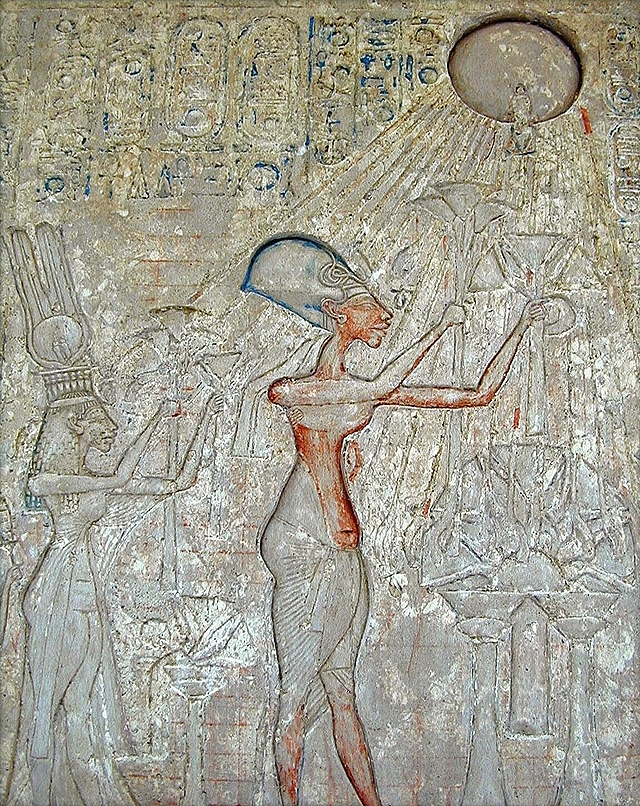 Akhenaten was one for breaking the rules, in every sense of the word. Besides the well known religious reforms, he also changed the entire art aesthetic of Egypt, replacing their idealism with a realism that showed his own deformed body and flaws.
It was the Egyptian custom that you write, paint, and carve the world as you wish it were, and absolutely never carve it as it actually is unless that’s your perfect world. Akhenaten seems to have broken with this superstition and painted realistic scenes making this period easily recognizable in Egyptian art.
He also shared a great deal of power with his wife and children, uncharacteristically for Egyptian pharaohs. His family values seem to have been very strong, with many artistic representations of intimacy with his wife and children.
This fact actually helps us hypothesize an explanation for the excessive kings of Manetho after Akhenaten while simultaneously explaining the discrepancy between Manetho’s 31 years and the 17 years historians give him.
Akhenaten appears in many images with his wife Nefertiti as the same size as him; Egyptians used size as an implication of authority, so important people were painted bigger than lesser people. Seeing a pharaoh and his wife painted the same size implies they were co-rulers.
To judge by his appearance on the monuments, Akhenaten was physically deformed and in ill health for much of his reign; all of these facts taken together suggest that 17 years into his reign he suffered a debilitating but not fatal illness – a stroke, say – that left him alive, but unable to actively rule.
So his monuments stopped, but his reign continued. Meanwhile, for roughly thirteen years his wife, daughter, and son-in-law shared the rule of Egypt among them. So even though Akhenaten yet lived, events were dated from his family’s years, as they took the lead in ruling for the ailing king.
This would explain the odd coincidence that the excess years of Manetho as compared to the monumental attestations (13-14) happen to be almost exactly the same years as all three of his family ruled (12+) until finally, a proper heir (Tutankhamun) became king upon the death of his father despite his young age.
RECAP
So to summarize what we have so far, Amenhotep III associated his son Amenhotep IV in his reign, he reigned as Amenhotep IV as long as his father lived, but as soon as he died he changed his name to get rid of the reference to the old god in his name (Amen=Amun) to become Akhenaten and honor the new god Aten.
He associated his wife with his rule early on, and later in his reign, he associated his daughter Meriraten and her husband Smenkhare as husband and wife co-kings, just as he had with his own wife, and just as Thutmose II and Hatshepsut were.
All of them ruled jointly with him in his final years while Akhenaten retired from public view as Pharaoh emeritus. They continued to serve as regent until his preferred heir Tutankhamun came of age – his firstborn son, and thus the rightful heir over his daughter and her husband.
The 12 years Manetho gives us are their total time in power; the three years that Egyptologists assign may refer to the time each spent as chief spokesman for Akhenaten, or some such. And all of these years overlap with the last of Akhenaten’s 31 years.
There are two other key figures in king Tut’s life, an aged vizier named Ay and a general named Horemheb. The former seems to have acted as a mentor for him – naturally enough, since he was his grandfather, sort of (what do you call your stepmother’s father?).
Horemheb seems to have been a much more dominant and self-serving figure, who had a clear eye on the throne after Akhenaten’s line died out. In spite of that, after Tut’s death at 18, Ay seems to have ruled for 4 years, apparently with Horemheb’s tacit consent; whereupon Horemheb seems to have usurped the throne, possibly murdering him, and ruled in his own name for 14 years more.
I need to stress that this period is very confusing to historians, and all of this is highly subjective. Several other interpretations are possible, even reasonable. This one fits all the facts best, as far as I can see, but I wouldn’t bet the farm.
Manetho tells us that after the death of Tutankhamun “Armesis” ruled for 4 years and 1 month. This could, plausibly, be either Ay or Horemheb. If it’ s Ay, then the reign length is correct and Horemheb is ignored by Manetho. If it’s Horemheb, then Ay is ignored and Horemheb’s reign length is off by 10 years, for it should be 14 years instead of 4.
Since that requires Manetho to have made two mistakes, I prefer the former – this refers to Ay, and for whatever reason Manetho’s list didn’t include Horemheb whom some ancient scribes might have seen as a usurper. Like I said, it’s a confusing period.
Upon becoming king, Horemheb seems to have really hated Ay, for he defaced his monuments. He also set about systematically undoing all of the reforms of Akhenaten, which he had already begun doing early in the reign of Tutankhamun by using his influence over the young prince.
Horemheb died without issue, and appointed his own vizier as his successor, who became Rameses I of the 19th Dynasty.
THE END OF HOREMHEB
Scholars are certain Horemheb ruled at least 14 years, however, there is an oddity from a court case in the time of Rameses II which references a date called “Year 59 of Horemheb.” Clearly, he didn’t reign that long, which means this must mark an era of some sort.
It makes sense when you remember that Horemheb did his best to wipe out the memory of the dynasty of Akhenaten; three separate king lists, prepared under his immediate successors, act as if there were no kings between Amenhotep III and Horemheb.
But while erasing the memory of a king is easily enough done, when the years of those kings are used for dating legal proceedings and contracts, it becomes a bit more complicated. They needed a way to keep track of the years of those kings, for record keeping purposes, without acknowledging their existence.
So to avoid having a gap in the historical record, Horemheb absorbed all of the years of their reign into his own, effectively backdating his reign to the end of the reign of Amenhotep III, thus preserving the chronological record of history even while he tried to wipe out the history itself.
…the Inscription of Mes, from the reign of Ramesses II, which records that a court case decision was rendered in favour of a rival branch of Mes’ family in year 59 of Horemheb. It was argued that the year 59 Horemheb date included the reigns of all the rulers between Amenhotep III and Horemheb. Subtracting the nearly 17-year reign of Akhenaten, the 2-year reign of Neferneferuaten, the 9-year reign of Tutankhamun and the reign of Ay suggested a reign of 26-27 years for Horemheb. However, the length of Ay’s reign is not actually known and Wolfgang Helck argues that there was no standard Egyptian practice of including the years of all the rulers between Amenhotep III and Horemheb. (Wiki, Horemheb)
All the best evidence suggests that Horemheb ruled for 14 years; but because the years of the kings they know about add up to far too few years, Egyptologists, with absolutely no evidence, assign them to Horemheb, lengthening his reign by 13 years more than the evidence shows.
What the evidence does show is that these years did exist, but they almost certainly do not belong to Horemheb. But we have evidence they belonged to someone else. Remember that Akhenaten is given a little over 17 years by Egyptologists, but Manetho assigns 30 years, 10 months.
This is a gap of precisely 14 years – just what we need to fix the Horemheb date!
As mentioned above, that Akhenaten associated his family with his reign as a certainty; he was very likely ill most of his life; these facts together with the witness of Manetho strongly suggest that these years belonged to him.
If Egyptologists complain about this decision, I would simply point out that they are perfectly willing to assign 13 equally unsubstantiated years to Horemheb without any evidence of any kind. At least I have the evidence of Manetho!
Besides, no one was trying to destroy evidence of Horemheb; it would be hard to explain that many unattested years in his reign. But Egyptians actively destroyed evidence for Akhenaten, making it much more likely that evidence for a longer reign might have been destroyed.
Another oddity about his reign is that Akhenaten celebrated a sed festival for no apparent reason – something only consistent with Manetho’s reign length:
Around regnal year two or three, Amenhotep IV organized a Sed festival. Sed festivals were ritual rejuvenations of an aging pharaoh, which usually took place for the first time around the thirtieth year of a pharaoh’s reign and every three or so years thereafter. Egyptologists only speculate as to why Amenhotep IV organized a Sed festival when he was likely still in his early twenties. (Wiki, Akhenaten)
So far, every time we have seen a Sed festival that Egyptologists think was not accurate, we have proven that what was not accurate was their dating (Hatshepsut, for example). Which makes us suspect that this Sed festival was celebrated in Akhenaten’s 30th year, as usual, which Manetho gives him plenty of time to perform.
I do not know the details of how and why Egyptologists assign the date to his 2nd or 3rd year – that uncertainty alone makes me question their confidence – but if this did indeed happen in his 30th, most all of these problems disappear.
AN ALTERNATIVE
Above I’ve sketched a reason I found very plausible for this longer length; an illness after the 17th year. However, there is another (mutually exclusive) possibility, which is worth mentioning even if I think it’s lower probability.
The dating of Akhenaten leaves a lot of room for error, and even Egyptologists admit that. He (probably) had a co-regency with his father, of an unknown length; he changed his name, apparently, after year 5, and began building a new capital city which was finished in year 8.
And there is evidence that something very bad happened to Akhenaten before the building of his city; perhaps there was some sort of rebellion forcing him into exile, in the midst of which he changed his name and came back – which could explain the missing years.
Historians do not know for certain why Akhenaten established a new capital and left Thebes, the old capital. The boundary stelae detailing Akhetaten’s founding is damaged where it likely explained the pharaoh’s motives for the move. Surviving parts claim what happened to Akhenaten was “worse than those that I heard” previously in his reign and worse than those “heard by any kings who assumed the White Crown,” and alludes to “offensive” speech against the Aten. Egyptologists believe that Akhenaten could be referring to conflict with the priesthood and followers of Amun, the patron god of Thebes. (Wiki, Akhenaten)
Given the paucity of records during the Amarna period, it’s hard to say what’s happened. But something truly terrible happened to him, and exile would, at that point, have been a first for any pharaoh as far as I know.
If, for example, the priesthood of Amun at Thebes had staged a coup and imprisoned or exiled him for heresy, it would explain his desire to build a completely new city once he, for whatever reason, came out on top.
It is interesting to note that Manetho says his daughter “Acencheres” ruled after him, but before his son Tutankhamun, and that she ruled for precisely 12 years and 1 month. What if she were a puppet installed by the priesthood of Amun, while Akhenaten was deposed? Her 12 years would just about make up the missing years of Akhenaten.
This is all just speculation, of course. What we do know, and most Egyptologists agree on, is that somehow the Amarna period must be 13 years longer. Those years belong to someone. While they add these years to Horemheb in the absence of any evidence, adding the years to Akhenaten agrees with the ancient sources and requires far fewer assumptions than any other solution.
So if we add 13 years to Akhenaten to bring him in line with Manetho’s record, then “year 59 of Horemheb,” beginning at the end of Amenhotep III’s reign, lands us in the last year of Horemheb’s reign, roughly where we would expect it to be.
I am certainly wrong about some of this. Anyone who doesn’t admit that would be inexcusably arrogant given the lack of evidence in this period. The successors of the Amarna period made a concerted effort to erase it from history.
And as I said, Egyptian history is hard enough when they weren’t trying to make it hard.
THE RAMESSIDE PERIOD
In contrast with the peaceful and diplomatic Amarna kings, Horemheb founded the expansionist 19th Dynasty that sought to conquer much of the Near East – unsurprising given his military background. Those are the so-called Ramesside kings, since most of them were named Ramesses.
As I mentioned above, Horemheb had a very powerful vizier with an extraordinary number of titles named Paramessu, who upon the death of Horemheb changed his name to Ramesses, the first of that name.
He was already quite old when he became Pharaoh and ruled, according to Manetho, only 16 months although historians think he may have reigned slightly longer, up to two years. Upon his death, his son Seti I began to reign, ruling for 11 years (‑867‑856).
His main task was to restore order after the tumultuous decades that preceded, and to reassert Egyptian dominance abroad. To that end he marched into Canaan in his first year, then in later years went to Phoenicia, Lebanon, and ultimately Syria where he engaged the Hittites and the Amurru.
Although we don’t have precise records of the year he did this, most of this campaigning happened in his earlier years. The Bible confirms that during this general period, the Hittites and the Egyptians were the major powers in the area, dominating the Syrians and the Israelite kings who lay between them:
2 Kings 7:6 For the Lord had made the army of the Syrians to hear a noise of chariots, and a noise of horses, even the noise of a great army: and they said one to another, Behold, the king of Israel has hired against us the kings of the Hittites, and the kings of the Egyptians, to come on us.
This took place in roughly ‑900, which shows that the Hittites and Egyptians were major powers at the time, in contradiction to traditional history which believed the Hittites did not exist at this time as a great power.
Seti’s successes in Syria were short-lived, and the places he conquered reverted back to the Hittite sphere by his later reign. Having learnt the value of a clear succession, he placed his son Ramesses II as his heir early in his life, while he was still a child.
Older histories placed a co-regency here, but there is no clear evidence of that, and modern reconstructions generally don’t use one. When Seti I died Ramesses II was probably around 25, and had already been highly visible in the government for most of his life, making the transition to Pharaoh seamless.
Ramesses II inherited a country in a vastly better place than it had been a few generations previous; a large army, monumental building projects, and so on. But he also inherited an unresolved situation with the Hittites, and clearly he was bracing for a storm.
He moved the capital to a new city, named modestly after himself, called Pi-ramesses in the northeastern delta, not far from Avaris. He robbed a lot of the building materials from nearby Avaris, in fact.
This city is not to be confused with the Pi-ramesses of the Bible that the Hebrews helped Pharaoh build 700 years earlier, which was almost certainly in the Fayoum. The name literally means “city of the son of Ra,” which all Pharaohs claimed to be.
RAMESSES ABROAD
The new capital was well situated both to defend from attacks via Canaan, and also to mount them, which says something about Ramesses’ mindset at this time – he was looking north. In his second year he engaged the Sherden, who were maritime raiders of some sort; possibly simple pirates, possibly something more. Historians tend to associate them with the island of Sardinia, west of Italy, but can’t be sure.
In his fourth year, he went to Syria where his father had campaigned and captured the Hittite vassal state of the Amurru. In his 5th year he returned and engaged the Hittites again, attempting to replicate his father’s feats in Syria at Kadesh.
After advancing through Canaan for exactly a month, according to the Egyptian sources, Ramesses arrived at Kadesh on 1 May 1274 BC [‑851, our dating]. Here, Ramesses’ troops were caught in a Hittite ambush and were initially outnumbered by the enemy, whose chariotry smashed through the second division of Ramesses’ forces and attacked his camp. Receiving reinforcements from other Egyptian divisions arriving on the battlefield, the Egyptians counterattacked and routed the Hittites, whose survivors abandoned their chariots and swam the Orontes River to reach the safe city walls. Although left in possession of the battlefield, Ramesses, logistically unable to sustain a long siege, returned to Egypt. While Ramesses claimed a great victory, and this was technically true in terms of the actual battle, it is generally considered that the Hittites were the ultimate victors as far as the overall campaign was concerned, since the Egyptians retreated after the battle, and Hittite forces invaded and briefly occupied the Egyptian possessions in the region of Damascus. (Wiki, Ramesses II)
He would return to Syria many times against the Hittites until the treaty of Kadesh was signed in his 21st year, which sealed a peace between the Egyptians and Hittites that lasted until the end of the Hittite empire, and even resulted in some intermarriages with Hittite brides.
They wrote the treaty in parallel, one version in Hittite cuneiform and one in Egyptian hieroglyphs, and both sides kept a copy of each. When modern scholars read the texts, they found them identical in every detail but one:
The Egyptian version says the Hittites begged for peace, and the Hittite version said the Egyptians begged for peace. Delicious pettiness.
Regardless, Ramesses would go on to reign for over 66 years, one of the longest reigns in history. Of his reign, we have much more to say, but first, we need to know more about what was happening in Israel. Because he played a surprising part in it.

This is part 39 of The History of the World Series
 Akhenaten the Heretic
  The Richest Man in History
  Thutmose III and Shishak
  Solomon and the Queen of Sheba
  What Is The LOVE Of God?
  Everything You Believe About God Is WRONG!
  Make Up Your Mind!
  What Is Faith?
  How DARE you FEAR the judgment of God!
  Firstripe Figs
  The Bride Of The Father
  Exodus 40 – The Plan Of God
  The Temple Of God
  Pillars Of The Temple And The Brass Sea
  GEHENNA WITH ‘EM
  When Did God Forbid Polygamy?
  When You Shouldn’t Pray For Someone
  The Sins of the Father
  The First Paul