Ur of the Chaldees
This is part 10 of the The History of the World Series
; Introduction is part 1.
Click here to read in series
Quite a while ago now, I raised the question we are now finally prepared to answer: how did Abraham find himself in Ur, when his family’s inheritance was the Indus Valley? Since the Bible doesn’t say, we will never know the details for sure. But we know more than you might think.
Genesis 11:25-28 Nahor lived one hundred nineteen years after he became the father of Terah, and became the father of sons and daughters. Terah lived seventy years, and became the father of Abram, Nahor, and Haran. Now this is the history of the generations of Terah. Terah became the father of Abram, Nahor, and Haran. Haran became the father of Lot. Haran died before his father Terah in the land of his birth, in Ur of the Chaldees.
Nahor, after giving birth to his firstborn Terah, “became the father of sons and daughters.” These are not mentioned anywhere in the genealogy, and it allows us to infer that his ancestors like Serug and Peleg also had more than just the one son named in the Bible, as we would expect.
With Terah, for the first time since Arphaxad, we are informed of three sons. One was Abram whom God later renamed Abraham, which is the name I’ll use throughout for simplicity. The others were Haran and Nahor.
The Bible tells us that Haran was born in Ur, and that he died there; this strongly argues that Terah and Abraham weren’t simply passing through, but were residents of Ur for a lengthy period of time:
Acts 7:2-4 He said, “Brothers and fathers, listen. The God of glory appeared to our father Abraham, when he was in Mesopotamia, before he lived in Haran, and said to him, ‘Get out of your land, and from your relatives, and come into a land which I will show you.’ Then he came out of the land of the Chaldaeans, and lived in Haran….”
But Stephen here adds important information; that when Abraham was in Mesopotamia, before he left for Haran, God said at that time that Abraham should “leave his land, and his relatives.” Which means that Ur was Abraham’s home country.
Yet we know that land was solidly Sumerian, Cushite, and certainly not Arphaxadite. How then, was it considered Abraham’s own country?
UR OF THE CHALDEES
I am not the first to notice this problem; many commentators get around it by saying that “Ur of the Chaldees” was not the Ur in southern Sumer, but another town named Urfa in eastern Turkey. This is still debated by scholars today, but ancient sources like Josephus clearly placed Ur in southern Sumer.
Still, rather than attack the concept of a northern Ur on textual or linguistic merits, let’s just use common sense by thinking about the purpose of Terah’s journey with his family; it was his intention to go “to the land of Canaan.”
Genesis 11:26-31 Terah took Abram his son… They went from Ur of the Chaldees, to go into the land of Canaan. They came to Haran and lived there. The days of Terah were two hundred five years. Terah died in Haran.
Note the clear point was to leave Ur, and go to Canaan. Yet for some reason, he journeyed from Ur as far as Haran and decided that was good enough. But that wasn’t the land of Canaan! It was barely 30 miles from Urfa!
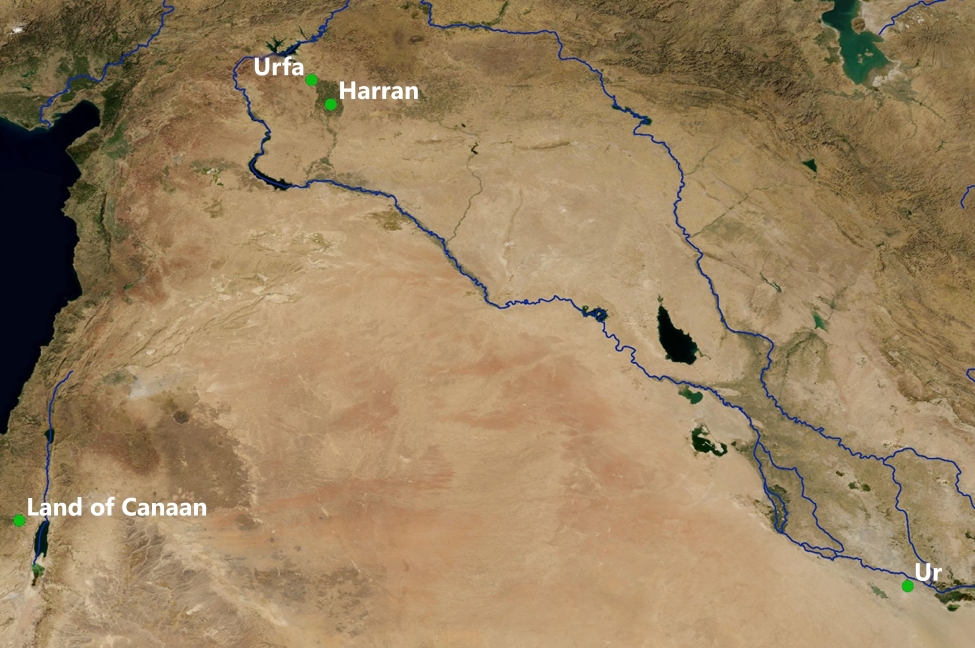
Now I can see how, after a journey of almost eight HUNDRED miles from the southern Ur, Terah might be tempted to call the journey “good enough,” particularly if political conditions were unexpectedly unfavorable at the time in Canaan.
But to quit after thirty miles when leaving from the northern Ur is ridiculous. Why leave Ur at all, just to go a stone’s throw away in what was literally the same country?
Thus, I’m confident that “Ur of the Chaldees” must have been Ur in southern Iraq. And this is setting aside the fact that the only certain home the Chaldeans ever had was in southern Iraq, where Nebuchadnezzar the Chaldean was from.
Still, it is odd that the Bible is so specific in saying Ur “of the Chaldees.” The Hebrew term is Kasdim, identical with later usages for Nebuchadnezzar’s race. The Chaldean Babylonians called themselves Kaldu, and Mesopotamian records have no information about them before the 10th century BC or so.
Which begs the question – why did Moses refer to a Chaldean Ur in ‑1450, which was supposedly already in existence in ‑2050 or so… when it wouldn’t exist until ‑1000 or so? Clearly there is a story here.
We’ll have to come back to that.
INDUS-SUMER TRADE
Sumer had very little to offer the Indus in trade; the Indus could grow their own food, build their own pots, mine their own gold, silver, gems; the Sumerians were poor in almost everything by comparison, except food and sheep.
Furthermore, trade between the Indus and Mesopotamia has always seemed unbalanced, the Indus receiving nothing obvious in return for its exports. If, however, the Harappans did not themselves produce wool, the woollen textiles that Mesopotamia produced on an industrial scale and exported widely may well have been a commodity that was highly prized by and valuable to the Harappans. (Ancient Indus Valley New Perspectives; McIntosh)
This is hypothetical, but perhaps true. They certainly got something. But it’s hard to imagine the value of the gemstones alone being balanced by wool, much less the many other known imports to Sumer such as wood and metal.
Overall, the flow of culture and objects seems to have been overwhelmingly from Indus to Sumer, not the other way around. Very, very little from Sumer has ever been found in the Indus; by contrast, quite a few Indus artifacts have been found in Sumer.
Not a single confirmed example of cuneiform has ever been found in the Indus Valley; odd, since the Indus script has been found in Sumer on various seals originally used to seal goods shipped from the Indus. No examples of the reverse, items sealed in cuneiform and sent to Indus, have ever been found.
This tells us that the flow of goods and merchants was mostly, if not entirely, from Indus to Mesopotamia. Few examples of cuneiform or specifically Sumerian artwork motifs have been found in the Indus; the few examples that might represent cultural transfer to the east are highly debatable. This casts the IVC in the culturally superior role.
Seagoing boats were now constructed and Indus merchants sailed through the Gulf to trade directly with the inhabitants of Oman and eventually with Bahrain and the cities of southern Mesopotamia. While there is little evidence of the ships themselves and nothing is known of their antecedents, the fact that Indus merchants are known to have traveled to Mesopotamia, while Mesopotamian ships did not venture outside the confines of the Gulf, suggests that the development of seaworthy vessels was an Indus innovation.
…But while the Mesopotamian texts attest to the importation of a range of Indus raw materials, and Indus beads are well known from Mesopotamian excavations, it is difficult to establish just what the Indus people obtained in exchange. (Ibid)
This is consistent with our knowledge that the IVC retained more master shipbuilders like Shem who could certainly have built a good ship, knowledge which was not necessary in Sumer and was therefore lost. This also confirms the ability of the IVC to have reached Sri Lanka (Dilmun), for if they could reach Mesopotamia they certainly could reach Sri Lanka.
Even more distant connections have been revealed by recent work. By 2000 BCE a number of African crops were being cultivated in parts of the Greater Indus region. These may have reached the Harappans via Oman, which could have acquired them by coastwise trade through southern Arabia. Or there is the intriguing possibility that the experienced sailors of the Indus had themselves reached East Africa. (Ibid)
This author hesitantly suggests a concept that we know must have been true; the IVC interacted with cultures from Africa to Sri Lanka, and given their clear nautical advantages, most likely controlled the seas in between.
This is very likely why Enmerkar chose to invade and communicate over land, since he couldn’t match the Arattan fleet. How could he hope to challenge the technology of the people who built the boat that survived the flood who were still living at the time?
There are tons of lapis lazuli in Egypt, the only source of which was Indus-controlled. Historians exclusively believe that the lapis traveled overland to Sumer, then upriver to the Mediterranean and then down through Canaan to Egypt.
But if the Indus was already trading directly with Sumer by boat, why not go a little bit farther into the Red Sea and trade directly with Egypt as well? We know for a fact that the Egyptians had trading outposts on the coast of the Red Sea; and that the IVC culture was able to reach the Arabian coast. Why wouldn’t they have gone that extra mile to save an immense amount of money on middlemen and transport coasts?
So why is the author above so hesitant to suggest this? Historians are always extremely reluctant to admit that an ancient civilization had relatively advanced technology and lost it, because they are psychologically primed to expect a steady uphill climb of man.
Yes, they will admit it (see the pyramids) when the evidence is undeniable, but it’s always a struggle because it runs contrary to the fundamental assumptions of their belief system. Historians are also by nature conservative; the absence of indisputable evidence is often subconsciously treated as evidence of absence, a logical fallacy.
No evidence of direct trade with the IVC has been found on the Red Sea; although some indisputably Indus artifacts have been found in ancient Egypt, there is no conclusive proof that they were carried there by the IVC itself.
But with the picture we’ve built so far from contemporary textual evidence, we can confidently state that the IVC turned the ocean from the tip of India to Africa into a Harappan lake. And as it happens, we do have one bit of evidence to offer that we’ll get to a little bit later.
OUTPOSTS
Historically, trade with different regions was often conducted by proxy; either with a dedicated intermediary, such as Tyre in the Mediterranean, who bought the goods and resold them locally; or with a designated foreign trade representative at the destination, who was trusted to make sure the deals done were favorable.
Craft production and the distribution of manufactured goods probably reflect several layers of organization. At the level of the individual community, many everyday commodities were locally produced and probably distributed among individuals and families by mutual exchanges of goods for goods or services. Cross-cutting this was the pattern of kinship-based exchange that had operated for millennia in this region (as in many other regions of the world in preurban times). By this means individuals and families in one community were supplied with the products of another, either of their own manufacture or obtained from other producers. Such goods changed hands in the context of such family events as marriages. The distribution of goods by such kinship-based exchanges forms an archaeologically detectable pattern. Their quantity steadily declines as the distance from their source increases. Though important in the cementing of kinship ties, such a system cannot account for the widespread distribution and universal availability of the Indus craft products. There was therefore a third layer, some mechanism that ensured the reliable and efficient supply and distribution of craft products. This seems to imply the existence of some form of bureaucracy and central control of production and distribution. (Ibid)
Historically, people have preferred doing long distance trades with members of their own family resident in the foreign land. Family provides some measure of trust in an otherwise unknown culture. And it is with this fact that we finally approach the answer to our question.
The Indus civilization has been shown to have been a major player in Gulf trade, its merchants establishing trading outposts in Mesopotamia itself. … (Ibid)
This means that in Sumer, there were IVC outposts. Nor could these have been one or two individuals; their collective presence must have been substantial, because Mesopotamian records speak of a full time Meluhhan [Indus] interpreter on staff.
Since we know the Indus was Aratta, and therefore Arphaxad, then these facts tell us that there were ethnic descendants of Arphaxad dwelling on a permanent basis in Sumer! This is an absolute fact.
It seems increasingly clear that the Indus objects found at interior sites [in Oman] are not simply the result of segmented trade of goods managed by the local communities, but they probably also testify to direct interactions with Indus traders and craftsmen and possibly even to the stable presence of small Indus groups settled in the Oman Peninsula.
Overall, this evidence, combined with other information about the organization of the Indus Civilization external trade in Middle Asia … allows proposing the possible implementation by the Indus merchants of an early prototype of coordinated «global marketing strategy», defined as an entrepreneurial strategy that takes commercial advantage from regional particularities by creating foreign subsidiaries to manufacture and distribute a product according to the local trends and/or to maximize the exploitation of strategic raw materials with high international demand … (The Indus Civilization Trade with the Oman Peninsula; Dennys Frenez)
This is based on the fact that there are many Indus-style goods found from Syria to Oman, some of which are made of local materials. Suggesting the presence of local artisans either trained by, or employed by, the Indus culture.
And certainly the largest of these Indus enclaves would have been in the port cities, chief of which was probably the port city of Ur in the century or so before Abraham.
You see where I’m going with this?
UR, OF THE CHALDEES
In a place like Ur, where would these Indus expats have dwelt? Based on examples elsewhere in history (British in Hong Kong, Chinese in Los Angeles, Indians in London, etc.), these emigrants would have tended to gather in one section of the city. And that city almost always takes their name; Chinatown, Little Italy, etc.
I said above there were two possible reasons that Moses went out of his way to clarify “Ur of the Chaldees”; historians universally focus on the first one, that it was differentiating between two cities known as Ur.
But the other possibility is differentiating between two regions within the city of Ur itself. We know for a fact that Uruk was divided into Unug and Kulaba, even though effectively it was one city. Thus, it is entirely possible that “Ur of the Chaldees” was meant to differentiate it from the main city, “Ur of the Sumerian Cushites.”
What we do know for certain is that there were ethnic IVC people – and therefore ethnic Arphaxadites – dwelling full-time in various important cities throughout the known world, which would certainly have included Ur. And along with this transfer of people inevitably comes transfer of ideas and technology.
In the course of the following Early Dynastic IIIA period, however, one stage of which is attested in the Royal Tombs of Ur, ca. 2400-2300 B.C., large quantities of metals and stone beads were imported, and many of the latter may have derived from the Indus. At Ur there seems to have been rapid technological advance, as craftsmen first learnt how to work gold and silver, and then how to use these materials economically. One possibility is that Ur owed its political importance in this period to wealth acquired as a result of its position as an entrepôt on the Gulf. (The Indus-Mesopotamia Relationship Reconsidered; Reade)
Note the association of Indus imports and a simultaneous burst in technology and wealth and political imports. These are not coincidental. We already know that the Indus had superior technology and wealth; their presence would have naturally spilled some of that bounty onto the city they lived in.
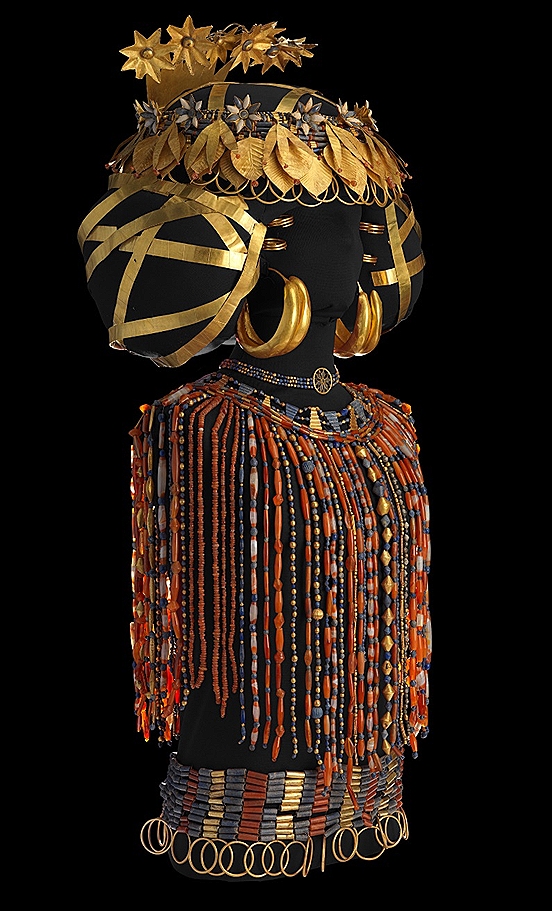
For example, Ur in precisely this period is the site of the most stunning imports from the IVC; its royal burials provided the most spectacular collections of Indus jewelry ever found in all of Sumer.
Ur also was the site of a “rapid technological advance,” otherwise unexplained. But we know that the IVC had precisely these skills; they are even mentioned in the Enmerkar cycle, where Inanna tells Enmerkar regarding Aratta…
“If he carries off from the city its worked metal and smiths, if he carries off its worked stones and its stonemasons, if he renews the city and settles it, all the moulds of Aratta will be his.” (LAB)
AboveAt right you see the headset of Queen Puabi, which was filled with what was, at that time, a kings’ ransom in jewels from the Indus. Though dating on this period is debated by scholars, they suggest she might have been the wife of Meskalamdug, whom I place broadly contemporary with, probably a generation or two before, Abraham.
The beads of her “necklace” are worth far more than the gold; because making beads with a hole in them was extremely time-consuming with bronze-age tools (no drill bits that are harder than rock!). Not to mention the price of the gems themselves. To understand the Mesopotamian perspective, just imagine she was wearing diamonds and emeralds and rubies (which, oddly enough, were not highly valued in ancient history).
So clearly, there was a massive influx of IVC material into Ur; given that there were resident merchants of the IVC in Ur, the fact that Ur is the obvious choice for the greatest contact with the IVC, and the evidence of rapid advances in the generation or two before Abraham…
All together this strongly suggests that there was an Arphaxadite delegation sent from the Indus who dwelt in Ur, interacted with the royal houses of Ur, and managed the Arattan interests in Sumer. This is all provable without using the Bible at all.
But without the Bible, we could not know who they were: Abraham’s ancestors.
ABRAHAM, THE HEBREW
Genesis 14:13 And there came one that had escaped, and told Abram the Hebrew…
Knowing this, we can solve another seemingly unrelated mystery. Why is Abraham called “the Hebrew?” It is obviously derived from his ancestor Eber, but… why? Why him?
Abraham is the 9th generation from Arphaxad. But in that lineage, Eber is not the first nor the last, nor the greatest as far as we know. In fact, we know precisely zero about the man Eber. So it’s strange that his name survived to this day.
Even someone who had never heard of Arphaxad, or even Shem, knows of the Hebrews. Why? Why not call him “Abraham, the Terahite,” after his father? Or Abraham the Arphaxadite, after his family’s inheritance? Or just, you know… Abraham?
Bible commentators have tried to answer this one of two ways; one way is to speculate that Eber was more righteous than the rest in his lineage. Which is impossible to prove, and frankly not that likely.
The other way is they connect “Hebrew” not to Eber, the ancestor, but to the etymology of the name itself, which means “beyond,” suggesting “beyond the river,” i.e. referring to Abraham’s homeland of Haran before emigrating to Canaan. I never found this very convincing.
However, we now have a new approach; family groups are generally called after the last ancestor common to that group. Thus, the tribes in the northern part of Mesopotamia are called Semites, because the last common ancestor is Shem.
The Israelites are called that because their last common ancestor was Israel; this excludes the Edomites, descended from Esau, brother of Israel. It excludes the Ishmaelites, son of the brother of Isaac. It excludes all the other sons of Abraham. And so on.
So we would expect that, at some point, Eber was the last common ancestor of a given group of which Abraham formed a part. And that, finally, allows us to answer our question; Eber must have been the head of the delegation from the Indus Valley that settled in Sumer.
It fits everything; when Abraham was born, Eber was not yet half-way through his 464 year long life; as grandson of Arphaxad, he was well placed to have been witness to the events of Enmerkar, and to thoroughly understand the political situation.
He was also old enough to be respected by both sides, and highly enough placed on the family tree to be able to speak authoritatively on matters pertaining to the relationships between the two groups, many of whom were his own offspring.
And don’t misunderstand; I am not saying that Eber was a mere traveling merchant; more like a high ranking ambassador, a prince sent to live in another country to represent the interests of the parent civilization.
And based on the archaeological evidence above, that included a significant amount of global trade and factories, with Indus sharing – or selling – its technology across the known world. Which, of course, would include trade as a part of the job.
THE STORY
Enmerkar’s reign began between ‑2200-2150; more likely later than earlier in that window. The Uruk-Aratta war took place at least 50, possibly 70 years later at the end of his reign; so approximately ‑2100.
This coincides closely with Terah’s birth in ‑2092. That’s relevant because Terah’s father and son were named Nahor; this pattern is unique in the entire lineage. Clearly, Terah named his son after his father. Why?
One explanation that comes to mind is that people tend to name things after what they miss; towns are often named after a homeland, towns and children are often named for a dead relative that is missed, and so on.
But that can’t fit here, because the elder Nahor’s life overlapped that of Nahor Junior by 50 years. But that doesn’t mean he was around. If Nahor had stayed in the Indus while Terah moved to Ur with Eber, it would explain why he named his son after his absent father.
This (admittedly) speculative line of thought would argue that Eber took his youngest mature descendant with him to find adventure “way out west”; meaning that the delegate left for Sumer around ‑2050, when Terah was around 30.
This may also explain why Terah was the first person since Shem to have his first child at 70; all his ancestors having them in their upper 20’s, low 30’s. It’s hard to settle down and have kids when you’re making your fortune in the west.
If true, then the IVC delegation settled in Ur in ‑2050, around 50 years after the war, well after the death of Enmerkar and Lugalbanda, both of whom were strong rulers of Uruk. At this point Gilgamesh, who was a complicated ruler – strong early in life, increasingly tormented later – was probably still alive and ruling Uruk, albeit some of that time was spent wandering to Dilmun.
But now we add another fact into the mix; well, more myth than fact. The SKL, for what it’s worth, tells us that Ur conquered Uruk at some point; and it records a dramatic shortening of reign lengths after Gilgamesh, which is usually associated with vassalage or political instability.
This suggests that something changed in Uruk around that time, possibly the conquest of Uruk by Ur, roughly ‑2030-2000 – around the time Abraham was born in ‑2022, and corresponding to the period of the obscenely rich burials at Ur.
And now we can offer one hypothesis on what the IVC got in return for their trade goods; military support against Uruk. Ur certainly benefited technologically by the presence of the Indus merchants, and profited handsomely as well.
So perhaps Ur was simply bribed by Aratta to destabilize Uruk sometime after Gilgamesh. They certainly had strong diplomatic links, given the jewels – something almost always given between kings to earn favor.
This would also finally explain how “Enmerkar destroyed the people of Uruk,” in the Babylonian legends of the Wiedner Chronicle. By picking a fight with Aratta which he could not win, he set into motion a series of events that led to their conquest by Ur at the behest of the Arattans a generation or two later.
Because despite the propaganda in the story of Enmerkar, Aratta definitely seems to have come out on top and navally was never challenged in the first place. Uruk, on the other hand, soon went into decline.
And in the aftermath, Aratta likely felt that having a presence in Ur to manage affairs in Sumer, and prevent a new Enmerkar from arising, would be a worthwhile investment. So Eber may or may not have stayed there permanently; but Terah certainly did, and had children there who grew up in Ur; “in their own country, among their own people from the Indus valley.”
They would have dwelt in their own section of the city, which to this day is largely unexcavated, known to them as “Ur, of the Chaldeans”; the Hebrew Ur Kasdim which, according to Josephus, is a corruption of the name Arpa-khesed, which you know as Arphaxad.
Moses went out of his way to specify which Ur so that no one would think that Abraham was an ethnic Sumerian; this attempt at avoiding confusion, ironically but as so often happens… caused confusion.
HEBREW MERCHANTS
But that allows us to finally answer another question: why did the Egyptians hate Hebrews?
Genesis 43:32 They served him [Joseph] by himself, and them [his brothers] by themselves, and the Egyptians, that ate with him, by themselves, because the Egyptians don’t eat bread with the Hebrews, for that is an abomination to the Egyptians.
At the time of Joseph, Abraham and his family were called Hebrews (Genesis 14:13, 40:15). And the Hebrews were well enough known in Egypt that the Egyptians had prejudices against them. But that’s weird… because there were literally only seventy of them, most of them children (Genesis 46:26).
How could the Egyptians possibly have prejudices against the Hebrews if they were literally the only ones? Even if we include the offspring of Abraham’s other children, and of Esau’s, there could only have been a few hundredby this time. Hardly enough to form prejudices.
Besides, Abraham spent time in Egypt and, as you will soon learn, was highly respected, even deified in later times. Where, then, did the Egyptian hatred from Hebrews come from? They must have interacted with someone else who was also descended from Eber!
Who, then, were these Hebrews? Terah’s family, back in Haran? Thousands of miles away in a place where the Egyptians almost certainly did not roam in those days? Hardly likely that Laban was hated by the Egyptians.
No, there were some other Hebrews that the Egyptians knew, and for some reason considered them unfit to eat with. And the obvious answer is Eber’s family from Ur.
Remember, we last left Eber as a merchant/ambassador resident in Ur. From there, Eber managed a vast trading empire around the Indian Ocean, as archeologists attest, finding evidence of the IVC across Arabia and the Iranian coast. No one knows the full extent of this trade, but it was certainly nautical and far ranging.
The ‘etched’ bead from tomb 197 is certainly not evidence for any direct trade between Egypt and the Indus Valley. In case the bead was really produced in the Indus Valley it was most likely brought to Egypt via various intermediate traders, in places such as Ur and Byblos. The only other material reaching Egypt from such a distance was lapis lazuli. Lapis lazuli was brought to Mesopotamia from Afghanistan. Lapis lazuli is a material frequently used in Ancient Egypt but it is not found there .(Tomb 197 at Abydos, further evidence for long distance trade in the middle kingdom; Grajetzki)
This historian believes that the trade was entirely overland through intermediaries, as most do. However earlier, we read where a different historian tentatively suggested the possibility of direct Indus-Egypt trade routes.
For sailors whom we know had trading posts with resident Arattans living along the coast of Saudi Arabia, there was surely no difficulty sailing a little farther up the Red Sea to one of the Egyptian coastal ports we know they had.
This is the only conceivable way that the Egyptians could have had significant contact with Hebrews. And something about them – their dress, their speech, their gods – offended the Egyptians. They would buy their lapis – but they would not eat with them.
WHO KNEW?
Moses grew up in Egypt, educated in the wisdom of the Egyptians. When he wrote the Bible, he no doubt learned many things from his direct ancestors, knowledge about the times of Ur and Babel passed down to him from Abraham.
But one thing he could not have learned are things that Abraham did not know. He would not, for example, have known that Noah died at 950 years old if he hadn’t had someone in contact with Dilmun tell him.
He certainly could not have known when Shem, Eber, and several other patriarchs died…since he died before they did! So how did Moses learn about that? As far as we know, Isaac and Jacob never went farther east than Haran; So who was in contact with the IVC to tell Moses what happened to the patriarchs? We find a clue…
Interestingly, lapis lazuli is common in the Predynastic Period when there are many attestations of Mesopotamian objects in Egypt, whereas there are very few occurrences in the early Old Kingdom, a time which corresponds to its disappearance in Mesopotamia. There was evidently a break in the trade routes around 2700 BC.
In the Middle Kingdom, lapis lazuli is again well attested in Egypt suggesting that supply routes were open again. It seems that after about 1750 BC the trade routes were again interrupted. That might relate to the end of the Indus trade. Like the bead, lapis lazuli reached Egypt most likely via Mesopotamia. (Tomb 197 at Abydos, further evidence for long distance trade in the middle kingdom; Grajetzki)
Note the time frames; it was common in the predynastic period – this would correspond to the early post-Babel years and the time of Sumer’s wars with Aratta, before the IVC put an outpost in Ur. During this time, trade with the IVC must have been brisk enough to make lapis “common.”
Then for some reason, the lapis trade stopped throughout the Old Kingdom period (Abraham’s timeframe), only to start up again in the Middle Kingdom (Joseph’s and Moses’ timeframe, as you’ll learn in time).
This can be explained in various ways, one possibility is that due to events in Sumer the IVC had to leave and lost their trade hub; it taking them some centuries to reconnect directly to Egypt. This diplomatic problem would explain why both Egypt and Sumer lost their lapis at the same time.
Another possibility is that the Egyptians and the Hebrews had a trade dispute of some kind – the Egyptians didn’t pay, the Hebrews raised their prices, whatever – and so Eber simply stopped sending ships.
After he died, right about the time Joseph went to Egypt, his descendants decided to reopen the trade routes bringing much news from the far east along with them. Either way, it was this information that Moses must have had access to in the Egyptian vaults, information which was likely well known to every Hebrew in Egypt.
Which, by the way, might explain why they are overwhelmingly called Hebrews in Egypt; they were rarely called Israelites until later. Probably because they were identified with the larger and better known group of Hebrews from the east.
HEBREW LONGEVITY
And one last thing; Pharaoh seems to have been familiar not only with the Hebrews, but with their longevity as well, which he was fascinated by.
Genesis 47:7-8 Joseph brought in Jacob, his father, and set him before Pharaoh, and Jacob blessed Pharaoh. Pharaoh said to Jacob, “How many are the days of the years of your life?”
Why that question out of the blue? Age is not something that was mentioned much in the Bible. In fact, I can’t think of a single example where anyone was ever asked their age, and if it was mentioned at all, it was in condescending ways like John 8:57.
So first, why did Pharaoh care; and second, why did Jacob then make excuses for “only” being twice as old as Pharaoh would ever get?
Genesis 47:9 Jacob said to Pharaoh, “The days of the years of my pilgrimage are one hundred thirty years. Few and evil have been the days of the years of my life, and they have not attained to the days of the years of the life of my fathers in the days of their pilgrimage.”
Reading that, we naturally assume Jacob meant his father and grandfather. But GWV translates it: “the years of my life have been few and difficult, fewer than my ancestors’ years.” Abraham (175) and Isaac (180) didn’t live much longer than he himself would go on to live (147).
So why did Jacob say this? Because while Jacob himself might not live an absurdly long time, Jacob’s ancestors had; in particular, his ancestor Eber, who had only just died 50 years or so before, at 464 years old.
Jacob’s days were at least roughly comparable to the days of his father and grandfather; but no, they didn’t hold a candle to the days of Eber! So it was to Eber and others that Jacob compared his “few and evil years.”
Now if Pharaoh knew of the Eber-ites (Hebrews), it’s highly unlikely he didn’t also know of their namesake Eber! That’s why Pharaoh’s first question was “how old are you?” Because Pharaoh must have heard of Hebrews with impossibly long ages and he wanted to know just how old this old man really was because he couldn’t tell by looking at him!
And that in turn is why Jacob said “I’m sorry to disappoint you, but I’m only a little bit older than normal, not absurdly old like my great-great-great-great-great-great-grandfather Eber!”
All of which only makes sense if Pharaoh was familiar with the legendary ages of the Hebrews which makes sense only if he had direct trade contacts with them.

This is part 10 of The History of the World Series
 Joseph In Egypt
  Did Abraham Know the Name of God?
  Sargon to Hammurabi
  Descendants of Abraham
  Mesopotamian Empire and Sargon
  What Is The LOVE Of God?
  Everything You Believe About God Is WRONG!
  Make Up Your Mind!
  What Is Faith?
  How DARE you FEAR the judgment of God!
  Firstripe Figs
  The Bride Of The Father
  Exodus 40 – The Plan Of God
  The Temple Of God
  Pillars Of The Temple And The Brass Sea
  GEHENNA WITH ‘EM
  When Did God Forbid Polygamy?
  When You Shouldn’t Pray For Someone
  The Sins of the Father
  The First Paul