Abraham in Egypt
This is part 11 of the The History of the World Series
; Introduction is part 1.
Click here to read in series
It is clear that God told Abraham to leave his home country and his father’s house, and that was the reason he left Haran (Genesis 12:1). Yet Genesis 11:31 tells us that “Terah took Abram his son, … They went from Ur of the Chaldees.”
This tells us that Terah was the driving force behind the first move, not Abraham. It also makes it clear that Haran died in Ur, before they left. Since the Bible says nothing without a reason, that this fact is mentioned at all suggests that Haran’s death inspired their move to Canaan.
Given that the place they moved to was also called “Haran,” certainly after their dead relative, it suggests that Haran’s death had a large impact on the family. Also, we know that Abraham effectively adopted Haran’s son Lot, bringing him along as they left Haran and sharing the best of the land of Canaan with him.
Together these things suggest that Haran died a hero. Which in turn suggests that, after a century or two of diplomatic relations with Ur, something happened to make it not a good place to be for descendants of Arphaxad.
In all fairness, they may have left simply because God said “move”; but God tends to work through “the rod of men” whenever possible (2 Samuel 7:14). In other words, God makes a place unsafe and hostile and his people leave. Consider Lot in Sodom, for example (Genesis 19).
It’s worth noting in passing that Haran is only a few dozen miles from the site of Gobleki Tepe where the family of man first settled. Abraham certainly visited the site during his time in Haran, for whatever that’s worth.
Moving on, the first dynasty of Ur, according to the SKL, was fairly short; adjusting for implausibly long reigns suspiciously divisible by 6, the dynasty may have only been a century or so, which accords well with the findings in the royal tombs of Ur with their rich burials contemporary with the IVC residents.
After that, IVC presence drops precipitously and this suggests Ur was conquered by some other power, whether militarily or diplomatically. Such a change could have made it an exceptionally good time for the foreign interlopers from Aratta to leave Ur. Particularly if Abraham was a troublemaker…
Now Abram…was a person of great sagacity… for he was the first that ventured to publish this notion, that there was but one God, the Creator of the universe; and that, as to other [gods], if they contributed any thing to the happiness of men, that each of them afforded it only according to his appointment, and not by their own power. This his opinion was derived from the irregular phenomena that were visible both at land and sea, as well as those that happen to the sun, and moon, and all the heavenly bodies, thus: “If [said he] these bodies had power of their own, they would certainly take care of their own regular motions; but since they do not preserve such regularity, they make it plain, that in so far as they co-operate to our advantage, they do it not of their own abilities, but as they are subservient to Him that commands them, to whom alone we ought justly to offer our honor and thanksgiving.” (Antiquities of the Jews, 1.7.154)
Abraham’s conclusion, to sum that up, was that if the stars were gods, they could do whatever they wanted, and flit willy-nilly across the sky like birds. But since they moved in orbits, they were bound by rules. And someone, therefore, had to have given them those rules.
And since every visible heavenly body was subject to rules, paths from which they couldn’t deviate even a little bit, then the true God who gave them those rules must be invisible to us. And it was only that God who acted independently, and only He who deserved our worship.
Good stuff – except that Uruk would have despised it. Abraham was discovering that the entire Sumerian religious system was flawed, and that idolatry itself was not only a sin, it was irrational and illogical; given my own experience arguing with religious types, I cannot imagine that was received warmly (compare to Acts 19:24-41).
Putting this together, it seems likely that the move was not entirely voluntary; but was a matter of self-preservation. The death of Haran was likely a martyrdom which led to Terah deciding it was an unhealthy place to live – even though Terah himself was an idolator (Joshua 24:2), a tradition which his family in Haran continued (Genesis 31:19). Which is why God needed Abraham to keep moving, to not be in the company of his idolatrous father’s house…
Genesis 12:1-4 Now Yahweh said to Abram, “Get out of your country, and from your relatives, and from your father’s house, to the land that I will show you. I will make of you a great nation. I will bless you and make your name great. … So Abram went, as Yahweh had spoken to him. Lot went with him. Abram was seventy-five years old when he departed out of Haran.
We can securely date this departure to Canaan as ‑1947. Soon after arriving, there was a famine in Canaan so he continued on to Egypt; afterwards, he returned to Canaan as a rich man (Genesis 13:1-2). But the story of what happened while he was in Egypt… that’s a tale worth telling.
JOSEPHUS’S CREDIBILITY
For what happened in Egypt, beyond the bare-bones account of Abraham’s wife being briefly taken into Pharaoh’s harem, we must rely on other sources. Fortunately, we have more than you might expect; chief among them the Jewish historian Josephus, whom I’ve referenced many times in this book and will return to many more.
When the temple was destroyed by the Romans in 70 AD, the Roman collaborator Josephus requested and was given the holy books of the temple by soon-to-be emperor Titus Caesar, which he then used as the basis for his history (Life of Josephus, 414). So he had access to a lot of documents, likely including at least some of the lost books of the Bible such as the Wars of the Lord, the books of Iddo, Nathan, Ahijah, and many others referenced in the Bible which don’t exist today (Numbers 21:14, 2 Chronicles 9:29).
Of course, he also had access to a lot of books we consider apocryphal, uninspired books full of Jewish fables which he probably also borrowed from – fables which Paul warned us about (Titus 1:14). And yet the New Testament writers did quote from books we don’t have.
For instance, Paul refers to Melchizedek as being “Without father, without mother, without descent, having neither beginning of days, nor end of life” (Hebrews 7:3). What’s important is that he isn’t teaching this, he is using this as an accepted fact which he then uses to prove that Melchizedek must be the Person who became Jesus.
Yet Genesis 14 says nothing about Melchizedek’s birth, or lack thereof. So what were Paul and his Hebrew audience reading? Likewise, Paul references “Jannes and Jambres,” the Egyptian magicians who withstood Moses (2 Timothy 3:8). And while the event is in our Bibles, there is no mention of their names (Exodus 7:11).
Yet there is an abundance of contemporary Hebrew stories – some obviously fantastical and absurd – which speak of these magicians by name. Honestly, I’d be inclined to dismiss them all as nonsense, but for the fact that their names were included in the inspired scriptures, which means there must be some truth to some of the Jewish fables of that time – those same fables Paul told us not to put faith in!
Similarly, Jude refers to Michael disputing with the devil over Moses’ body – which is not in our Bibles. And note, again, that Jude considered this a fact his audience already knew, which he was using to prove a different point.
But while the story isn’t in our Bibles, we do know that Moses was buried using supernatural methods (Deuteronomy 34:5-6). We know the Lord doesn’t generally do things Himself, but sends angels to do it for Him; and given Moses’ importance, we could guess He would probably send the highest ranking angel – which we know to be Michael, the “Archangel,” which literally means “chief angel.”
Given that, we could easily have guessed that the devil would have resisted – based on his behavior in Daniel and with Jesus. And finally, we could infer that since Michael was doing the Lord’s business, he wouldn’t need to fight the devil, simply rebuking him was enough.
And since we know him as a righteous angel, we can further conclude that he wouldn’t choose to curse the devil out since it wasn’t the right thing to do. Hence, we have reason to believe the words of Jude – besides faith in the inspiration of our Bibles – since they basically flesh out a story we could have inferred from the facts we do know.
But this in turn means that Jude was reading some book that told this true story we don’t have access to today! There are many other examples, but suffice it to say that Josephus had sources for facts about Abraham we simply don’t have. Indeed, it’s impossible that he didn’t have access to more things than we do, since NT writers reference them.
So while his story about Abraham may not be true, it might easily be based on facts. The only way to decide is to find more witnesses to confirm his words with archeology and history. And even though it was 4,000 years ago, there’s a lot more of them than you might think.
In the interest of being objective, we must concede that Josephus, writing around 90 AD from Rome, trying to convince a Greco-Roman audience of the antiquity and nobility of the Jewish nation, had reasons to embellish the Biblical narrative a bit.
Likewise we, as Christians, have a desire to write our heroes into the stories of great civilizations; to speculate that perhaps Samson inspired Hercules, or that Job built the great pyramid, or that Plato’s wisdom was acquired from Solomon’s writings. Some of these kinds of things are certainly not true. Most such things are highly speculative, at best.
So we need to keep a healthy dose of skepticism about any claims made by writers like Josephus; but that being said, Josephus was very conscientious for an ancient historian, and – by ancient standards – fairly rigorous in citing proof that his contemporaries were able to check, even though we may not have access to his sources today; for example:
Berosus mentions our father Abram without naming him, when he says thus: ‘In the tenth generation after the Flood, there was among the Chaldeans a man righteous and great, and skillful in the celestial science.’ (Antiquities 1:7:2)
This is the ancient equivalent of a modern scientific paper citing a reference known to his audience to bolster his claims. It was certainly not invented nonsense; Berossus may have himself been wrong, but Josephus would not have misquoted him in a day and age when it could easily be checked.
So with that survey of Josephus’ reliability, we proceed with what he said about Abraham.
FROM UR TO EGYPT
Berossus above told us that this man, whom Josephus connected to Abraham, was “skilled in the celestial sciences.” He goes on to be more explicit about Abraham’s wisdom:
[Abraham] introduced [the Egyptians] to arithmetic and transmitted to them the laws of astronomy. For before the coming of Abraham the Egyptians were ignorant of these sciences, which thus travelled from the Chaldeans into Egypt, whence they passed to the Greeks. (Josephus, Jewish Antiquities, 1.8.2)
It’s difficult to overstate the importance of this quote; if true, it means that the Egyptians did not know arithmetic and astronomy before Abraham visited them around ‑1947‑1937; it also means that these sciences came from the Chaldeans, whom Josephus believes were Arphaxadites, but whom we know to be the IVC culture.
And these sciences were absolutely essential to the construction of the pyramids and temples of ancient Egypt. Which means, if this one statement were true, all of ancient history is turned on its head, for it means that the pyramids were built after Abraham – and thus are far younger than historians would have us believe.
Of course, this is an extraordinary claim, for which we need more than the word of an ancient Jewish historian writing 2,000 years after the fact. It requires extraordinary evidence, which I intend to provide.
Beginning with the things we know for certain; Abraham came from Ur, then went to Haran, and later passed through Canaan, into Egypt, and back again. So he could have been the conduit for the transmission of knowledge.
His family’s presence at Ur we have already associated with a rapid advance in technology, due to the much higher technological sciences evident at the Indus Valley which were transmitted to Ur. Thus, he and his family were certainly potentially able to teach the Egyptians.
Further, it seems that the Egyptians had some mathematical and astronomical help to build the pyramids; for there is a rapid leap in technology associated with the building of the first pyramid in Egypt, that built by Djoser. A pyramid which was, in fact, not a true pyramid at all – but a ziggurat.
Before this time, the highest advancement in buildings was the low bench-like mastaba; then suddenly, a pyramid, with no antecedents in Egypt – yet eerily like those of Mesopotamia which we know for a fact existed in this time.
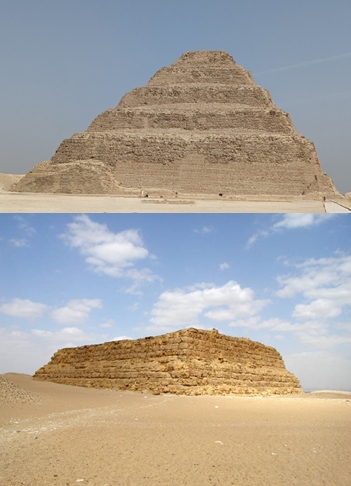 (The pyramid of Djoser (top) compared to an earlier tomb, called “mastabas” (bottom). )So impressive and novel was this pyramidal structure to the Egyptians that the man who designed it, Imhotep, was later deified and worshipped for his immense contributions to the wisdom of Egypt.
Imhotep was an ancient Egyptian genius – a brilliant architect, mathematician, physician, astrologer, poet, priest, and Chief Minister to Pharaoh Djoser. Imhotep’s name means “the One Who Comes in Peace.” Although he was born a commoner, Imhotep rose to become King Djoser’s vizier and was in charge of building Djoser’s tomb at Saqqara (egyptianmuseum.org/explore/old-kingdom-architects-imhotep).
It’s worth mentioning that Imhotep means “he who comes in peace” – as in, a stranger who came to Egypt from somewhere else. Also it’s worth noting that Imhotep’s skills correspond closely to what Josephus said about Abraham.
The time of Djoser began the third dynasty and with it the Old Kingdom which was Egypt’s first and arguably greatest golden age. The pyramid of Djoser was probably the tallest man-made structure in the world until the great pyramid surpassed it about a century later, becoming definitely the tallest structure in the world – a record it would hold at least 3,000 years, until 1311 AD!
What’s more, there are a truly astounding number of ways that the pyramids are aligned with stellar events and phenomena, either along their various axes or as seen from Heliopolis, the most holy temple in the area, literally “the city of the sun.” Something not possible without advanced (for the time) geometry.
The base of the Great Pyramid is nearly a perfect square, with only a 5.5-inch difference between the western and eastern sides, an astonishing 0.01 percent difference. Which for a structure of this magnitude and age is unbelievable. And the space between blocks is 1/50th of an inch (less than half a millimeter).
The Great Pyramid covers 13 acres but is level to within just over 3/4 of an inch (2.1 centimeters); the average deviation of the sides from true north is 3′6″ of arc; for comparison, that’s an error of about three times the apparent width of the planet Jupiter in the sky, as seen with the naked eye. So… really close.
So close it’s impossible that it was not based on extensive observations of the motions of the heavens over decades, if not centuries. And, if the written histories are correct, it was built in only 20-30 years… meaning that 2.3 million blocks of stone were placed, with one being cut, transported, and perfectly fit… every 3 minutes.
So where did they figure out how to do that? Yes, it is possible they gave birth to their own Newton or Da Vinci – but unlikely considering the knowledge of how to do these things already existed on the other side of the known world… in Abraham’s hometown!
OLDER PYRAMIDS
The tower of Babel – which predated Abraham by a few hundred years – was the first attempt to create a pyramidal structure, consciously imitating the mountains of Ararat where the family of man had recently left, from which God spoke to them.
The technology and science involved in creating this tower would have created a template for later efforts at pyramid building worldwide, from the Americas to Asia, after the nations were dispersed by God. Because they had all been there.
There are ruins of a massive pyramid at Babel, and several historical references to what it looked like; though to be fair it was rebuilt several times, most notably by Nebuchadnezzar who also enlarged it significantly.
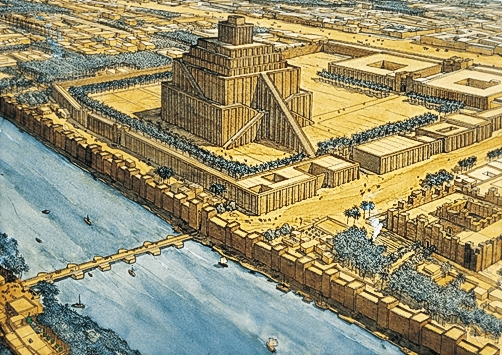 According to ancient Babylonian records it was about 200ʹ tall – the same as the pyramid of Djoser, give or take. Based on ancient descriptions, it would have looked something like the picture at rightabove.
And contrary to what most people assume, the Bible doesn’t say it was entirely destroyed – simply that the people “left off to build the city” (Genesis 11:8). On the contrary, it seems they went on and built towers in every town in the area. Most importantly for our purposes… in Ur of the Chaldees.
Ur was the center of worship for Sin, the moon god who was, at times, considered to be the king of the gods and father of all things 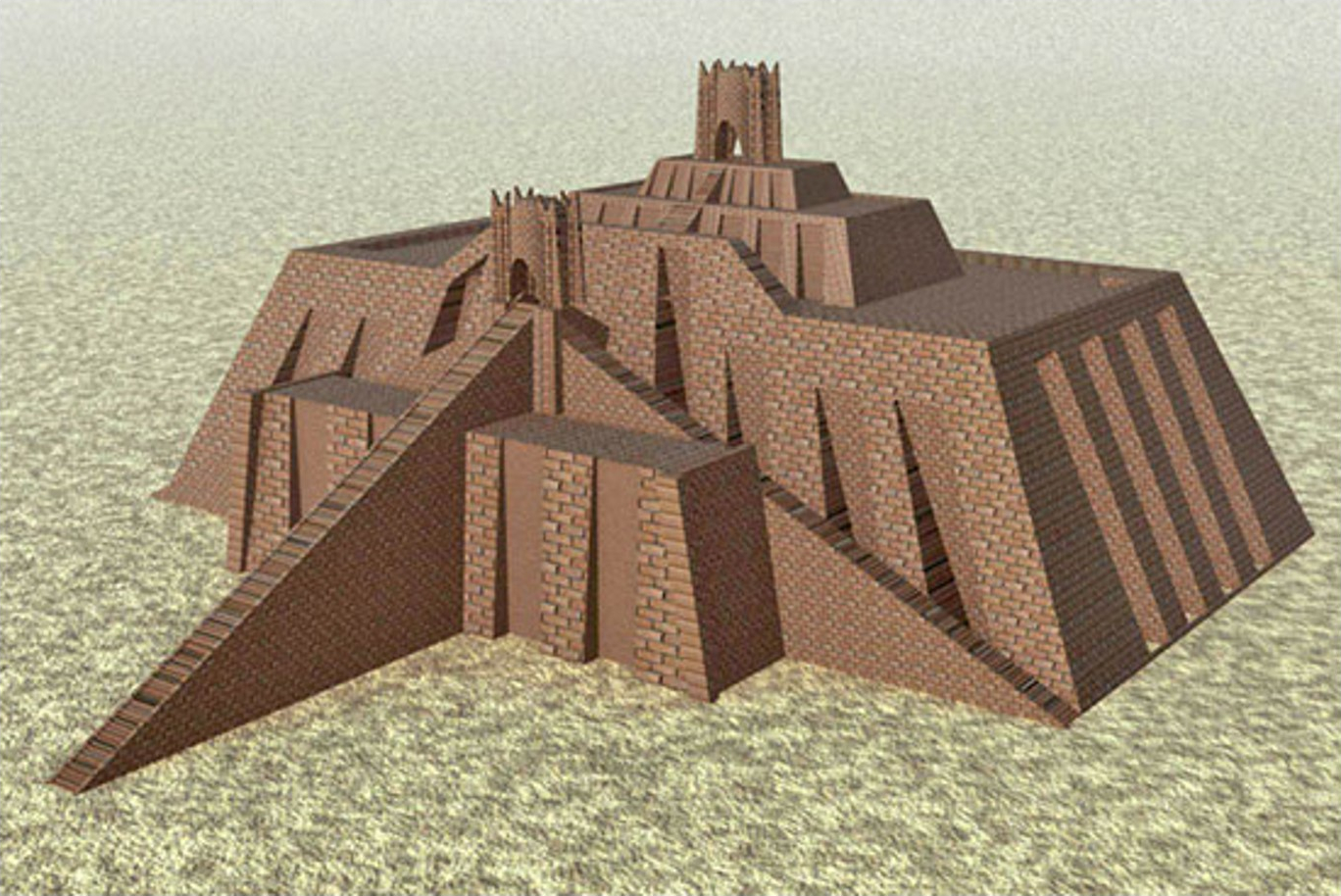 (Figure 1: Ziggurat of Ur) (at earlier times he was a lesser god, son of Enlil and Ninlin, grandson of Anu, father of the gods). At rightAbove is a computer reconstruction of the ziggurat of Ur as it was originally built by Ur-nammu and Shulgi in the Ur III period in the early ‑1600s (my dating). So after Abraham’s time, but certainly built on earlier templates, most likely rebuilt on top of earlier pyramids on the same site.
But what’s interesting about Ur and Sin is that the worship of Sin involved extensive astronomical observations for which they used the pyramids! For these were not used merely as temples, or houses for the god, but as astronomical observatories to keep track of celestial motions!
During the period that Ur exercised its supremacy over the Euphrates valley, the Moon-God became the head of the local pantheon, so he was designated as “father of the gods,” “creator of all things,” and so on. He was also the “wisdom” personified, imagined as “an expression of the science of astronomy or of the practice of astrology, in which the observation of the moon’s phases is an important factor.”
In fact, in the astronomical knowledge, the people of Mesopotamia surpassed the other ancient civilizations, even the Egyptians. They confined their observations to the Moon, instead of the Sun… They had built observatories, or watch-towers, called Ziggurats… From these towers the priests/astronomers had the possibility to observe the rising and setting of moon, sun, planets and stars on a free horizon. They recorded data and had tables from which they were able to predict the positions of celestial bodies… In this manner, the Babylonian astronomy discovered the main periods of the Moon’s motion and used data analysis to build lunar calendars based on the Metonic cycle. (Sparavigna, Amelia Carolina, A Ziggurat and the Moon. Philica. 2016).
So not only was the science of pyramid building very advanced in Ur, but the pyramid itself was one of the tools used to do the observations! Which is why it was aligned so closely to the cardinal directions – that was vital for its primary function as it must have been vital to the original, primary function of the pyramids of Egypt!
SIN AND INDUS
We know almost nothing about the Indus culture’s belief system; but we can say without hesitation that their favorite motif was the bull. It is found on most of their seals, usually with a bit of script which is speculated to be the owner’s name.
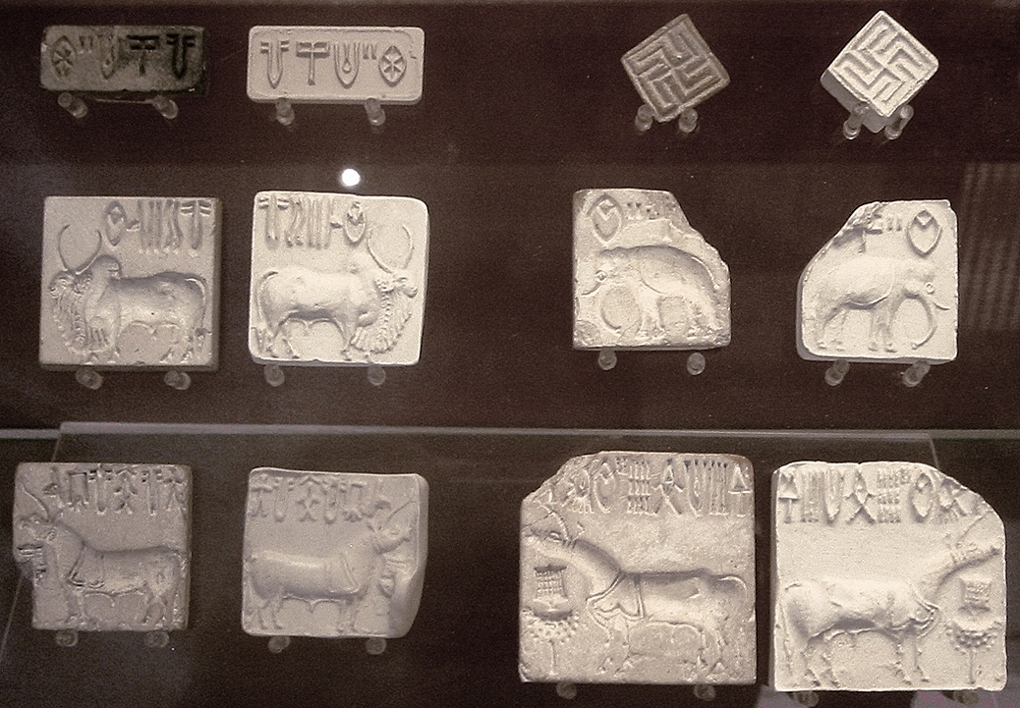
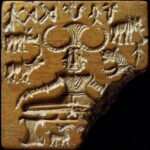
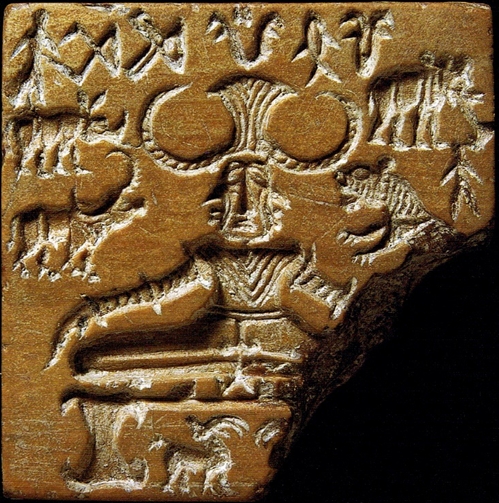 Even their leaders/deities are associated with a bull, through their horns. One of the famous works of Indus art is the Pashupati seal, found in Mohenjo-Daro (at rightabove), which shows a leader of some kind holding off other animals wearing a bull’s horn crown. This suggests that the bull or buffalo occupied a major place in their theology.
Now back in Mesopotamia, the image of the bull and of the moon god Sin were strongly associated;
Inscriptions from the Old Babylonian Period inform us that the crescent moon was identified with the Moon God Sin… The horns of the bull came to signify the crescent of the moon, which lies almost horizontally, like the horns of the bull, in the skies of Mesopotamia … The bull, the crescent moon, and the Moon God therefore became associated with each other. In Sumerian the Moon God was known as Nanna, Suen, or sometimes as Nanna-Suen. In Akkadian he was called Sin. … Not only was this god likened to a bull calf, in literary works he was commonly portrayed as one … A hymn to Sin begins, “Proud bull calf with thick horns and perfect proportions, with a lapis beard, full of virility and abundance.” (Mesopotamian Gods and the Bull, van Dijk-Coombes)
It’s intuitive; bulls have horns; the moon looks like horns. Ergo bull=moon. Why this is important to us is that the most significant iconography from the Indus is the bull; we can, therefore, infer that the moon probably played a significant role in their belief system.
It’s also worth noting that the cultural transfer was overwhelming from the Indus to Sumer, not the other way around; arguing that the association of the moon and the bull began in Indus, and was taught to the Sumerians; this would also explain why, at some periods, Sin was considered father of all the gods while other periods he is in a lower place in the pantheon.
That, in turn, is important because the center of the worship of the moon god Sin was Ur; precisely where the Indus outpost was. Abraham’s hometown.
HOW TO SIN
But the worship of Sin speaks to Abraham’s potential qualifications as a scientist because his worship involved intricate measurements of the moon’s rising, setting, phases, eclipses, and so on – which is how they developed such an advanced astronomical science.
In order to develop a proper calendar, you have to take systematic measurements, night after night, of certain stars, the moon, and so on. And to do that, you need a flat, level, square surface to sight along to take your measurements.
In the absence of handy mountain peaks (not really a thing in Mesopotamia or Egypt), the best thing to do is to make a massive, flat, surface of stone or brick and use it as a giant sight. The bigger it is… the more accurate the measurement. Which is why it was important that they be as enormous as possible!
In addition, having steps along the pyramid at particular angles, or unnecessary-seeming staircases that point to where important events in the lunar cycle occur, is also handy.
In late Babylonian times it is likely that instead of, or in addition to, their original function as temple towers, the ziggurats were employed as astronomical observatory posts. (Black and Green 1998, 189; Fletcher 1996; Tiede 2011; Nadali and Polcaro 2016; cf. Parrot 1955, 58-64; Shepperson 2012)
Vance Tiede did an excellent study of Babylonian-area ziggurats concluding that all of them are aligned with at least one major celestial event – the solstices, the equinoxes, the highest point Venus reaches in the sky, etc.
But most importantly for our purposes, the ziggurat of Ur – Abraham’s home temple, at least as rebuilt by Ur-Nammu – was aligned with the full moon rise at the lunar standstill.
Explaining that is complicated, but suffice it to say that the lunar standstill is to the moon what the solstice is to the sun, hence it’s also called a lunistice. It is a key event in the lunar cycle that happens every 18.6 years and requires precise observation – such as a tall staircase which looks directly at the place in the sky where it will happen!
These observations allow for very accurate prediction of eclipses, which always happen near certain points in this lunar cycle. And since eclipses were considered bad luck in most societies, often seen as foretelling the death of the king, it was very important to predict them, so that measures could be taken to get out in front of the bad luck with extra sacrifices, or by getting a fake king for a day who could get the bad luck instead of the real king, that sort of thing.
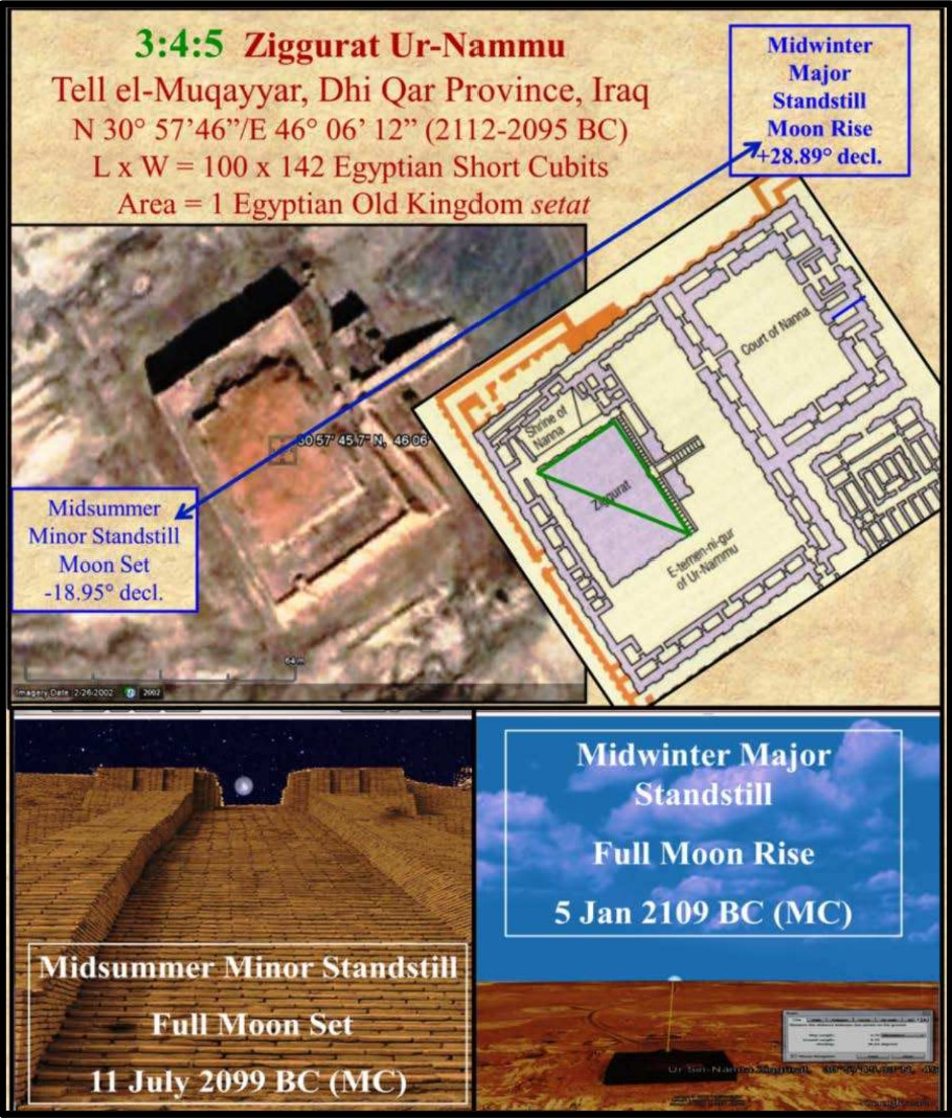 (Figure 2 From Ziggurats: An Astro-Archaeological Analysis, Vance Tiede)But back to the ziggurat of Ur; its dimensions were built using the Pythagorean theorem of a2 + b2 = c2 (see the green right triangle in the picture at rightabove). This speaks to an advanced (for the time) knowledge of geometry which would have been required to build structures such as the Great Pyramid.
And here’s something really interesting; ancient structures were nearly always built in round, whole numbers in their own local units; just as we typically aim to make things like buildings or bike tires a whole number of feet or inches or meters across, since it’s an arbitrary size anyway.
And most of the ziggurats around Babel were done in, predictably, round numbers of Babylonian cubits. The thing is, this pyramid in Ur wasn’t built in Babylonian cubits… but in round numbers of Egyptian cubits. Which further strengthens the connection that the Egyptians learned about pyramid building specifically from someone who had come from Ur! Because the Egyptian cubit was the same as the Urite cubit!
We know the ancient Egyptian royal cubit was 7 hands, each hand of 4 fingers width – exactly as the cubit of the Bible. God told Ezekiel, exiled in Babylon, that the Biblical cubit was not the Babylonian cubit of 6 hands, it was “one [Babylonian] cubit, plus a handbreadth” (Ezekiel 43:13). Thus, seven handbreadths. So why did the Egyptians have the same cubit as the Bible?
…the reason why Egyptians chose to divide a cubit into 7 parts might be quite hard to trace. It would seem to go back long before the construction of the Great Pyramid, at least to the time of Imhotep. (https://sites.math.washington.edu/~greenber/PiPyr.html)
The earliest attested standard measure is from the Old Kingdom pyramids of Egypt. It was the royal cubit (mahe). The royal cubit was… subdivided into 7 palms of 4 digits each, for a 28-part measure in total. The royal cubit is known from Old Kingdom architecture dating from at least as early as the construction of the Step Pyramid of Djoser around 2,700 BCE. (Mark H. Stone, The Cubit: A History and Measurement Commentary)
Note the association with the step pyramid of Djoser as one of the earliest certain uses of this unit of measurement! It’s hard to trace the origin of the cubit in Egypt before then… quite simply because it didn’t originate in Egypt but in Ur! Imhotep was the one who introduced it, “he who came in peace” from Ur.
Further, the Ur ziggurat’s area was one Egyptian setat or acre, as defined in the old kingdom – i.e, Abraham’s era. Which means that the Egyptian cubit and acre must have been learned from someone who brought it to them, not merely from Mesopotamia, but specifically from Ur!
The unexpected discovery of Egyptian setat in Babylonian ziggurat architecture may be ‘evidence of the transmission of mathematics’. (Neugebauer 1957, 1)
The conclusion that can be drawn from the existence of so many parallels of a non-trivial nature between hieratic and cuneiform mathematical texts is that Middle Egyptian and OB [Old Babylonian] mathematics must have influenced each other…. (Friberg 2005, 103; both as cited in Tiede’s paper above)
Or, as Josephus said… Abraham from Ur taught mathematics to the Egyptians!
Remember, Josephus couldn’t have guessed that Ur’s measurements were the same as ancient Egyptian measurements; he couldn’t have known that the Indus bull, and therefore the god Sin, were brought to Ur by Abraham’s ancestors.
Which means the existence of this legend that Abraham was involved just became a lot more credible.
THE OTHER TEMPLE OF SIN
We’ve proven Abraham had the opportunity to bring science to the Egyptians – we can place him at both places. We’ve also proven that there was motive – that Ur had better science than the Egyptians had, and we know that Abraham profited extensively by his time in Egypt – perhaps as a reward for this knowledge (Genesis 13:1-2).
But as early 2000’s police procedural shows taught us, we need motive, opportunity, and means. So did Abraham, personally, have the means? Could we show that he, personally, knew these facts beyond a reasonable doubt? That’s for you to judge.
As we’ve shown, Abraham came from Ur, the first known center of Sin’s worship in the ancient world. But what you don’t know is that the only other center of Sin’s worship was Haran – the same city where Abraham’s family went immediately after leaving Ur!
These cities are 600 miles (1,000 km) apart, so this was no casual transference. What’s more, we know that Abraham’s father Terah served other gods (Joshua 24:2), and since Sin was the patron deity of Ur, his erstwhile hometown, then Terah almost certainly served Sin!
Therefore when Terah left Sin’s temple in Ur he would have carried his images with him, and reestablished that worship in Haran – where, generations later, Abraham’s relatives still worshipped the images (Genesis 31:19, 34).
This is strong evidence that Terah’s family was involved in the worship of Sin; involved enough to bring it with them and reestablish it at their new home. Yet this would be impossible unless a highly educated priest of Sin was among them.
Because remember – Ur’s worship of Sin didn’t just involve prayers and bowing down in front of idols. It involved complex measurements of the heavens – not something your average farmer could have brought with him from Ur to Haran!
And yet this fact, that knowledge of the heavenly bodies was necessary to the ancestral worship of Abraham’s house, could not have been known to Josephus – it being 2,000 years before his time, when Sin was no longer worshipped by that name. Which gives us cause to believe him when he tells us that Abraham was a learned astronomer!
Remember, Josephus told us that Abraham was the first to realize there was one God; and says that this conclusion was formed “from the irregular phenomena that were visible both at land and sea, as well as those that happen to the sun, and moon, and all the heavenly bodies.”
But Abraham could not have formed these opinions without being intimately involved in the observation of those heavenly bodies; without observing the orbits of the moon and planets for himself. Something which required spending extensive time at a large astronomical observatory built to align itself with celestial events!
For only by sighting down various straight lines on the ziggurats and recording which stars appeared where on each day could you observe the regular cycles of the heavens. And that’s all well and good… except it means there is only one possible conclusion, and you might not like it.
Being an astronomer in a non-religious sense did not exist in the ancient world. Regular people didn’t learn to read, do math, or chart the skies. Only priests did.
And since Terah worshipped Sin, and was likely a priest of Sin; and since families always raise their children in their religion if they can, and since the office of priest is often hereditary…
…Then if Abraham was, indeed, an astronomer…
…it can only mean that Abraham must have been a priest of the temple of Sin in Ur, before he was called by the true God!
The role of priest is clearly being performed by Abraham in Genesis 15, where he prepares sacrifices. As it was by Noah in Genesis 8, Job in Job 1-2, and so on. The job of sacrificing to God fell to the firstborn until the time of Moses when God replaced the firstborn with the Levites (Numbers 3:12-13).
Therefore it makes perfect sense that the lineage of Abraham, firstborns of firstborns, would be actively involved in the priesthood and leadership capacities wherever they dwelt, including at Ur.
And since priests and royals were pretty much the only educated people in the ancient world, it means Abraham had means, motive, and opportunity to transfer the knowledge of the Chaldeans to the Egyptians.
That is enough for a conviction in a court; but it still doesn’t prove he actually did it. It isn’t quite a smoking gun. However… I think we can find that too.
THE CALENDAR
There are three ways to make a calendar; a solar calendar, where you start the year at a given point in the solar cycle – let’s say, the spring equinox – and between there and the next you have one year of either 365 of 366 days (since the true year is about 365.25 days long).
This keeps the years consistent, because it’s hot at the same time of year, rains at the same time of year, and so on. But, it doesn’t break up into smaller units well, that can be tracked by people who don’t have cell phones and calendars in their pockets. So months are really handy.
However, months don’t divide up into a solar year very well. In a year, you’ll have twelve complete lunar cycles – months – and then you’ll have about 11 days left over. The moon keeps moving, but they’re not really part of a “month” in the literal sense.
So you could just ignore the solar year, and have a lunar year. This means your year is 12 lunar cycles, then another year is 12 more lunar cycles. This is easy. HOWEVER… it means that over time, your months drift through the solar seasons.
So let’s say you start your first year with a new moon on the spring equinox, just in time for planting. So you call this month “planting month.” Next year, the first day of “planting month” falls 11 days before the equinox; and within 8 years, planting month falls in midwinter, by which time you’re wondering if “planting month” is really the best name for this month…
Now, there’s nothing technically wrong with this, unless you have your months tied to specific seasons like planting, harvest, or celebrating solar events like the winter solstice – which ancient cultures overwhelmingly did. In which case, the names you have given the months make less sense over time.
We’ve solved this in our modern calendars by having “months” that have no actual connection to the moon at all. They’re 28, 30, or 31 days – and every so often, one is 29 – which lets us have pretend months and yet not have the seasons drift.
But that’s a tricky solution to keep track of for peasants in a pre-industrial society. Without clocks and personal calendars, people just look at the moon to see roughly how much time has passed. So one solution to these problems is a lunisolar calendar, which involves adding an extra month back to the calendar every so often. This is called the Metonic cycle.
It works like this; you pick a point to start the year – let’s say the spring equinox. And let’s pick a year where the new moon is on that same day. This is day 1, month 1, year 1. You then count twelve months, and your next year starts 11 days before the equinox; that’s a bit off from last year, but it’s not a huge deal as long as it doesn’t keep going farther back next year.
Count twelve more months of year 2, and the new year would start 22 days before the equinox. Since the goal is to keep the calendar anchored to the equinox, you can actually start the new year closer to the equinox by adding a thirteenth month, called an “intercalary month.”
This month would mean that the next new year would start 8 days after the equinox, after the 13th month, and then another 12 months brings you back around and the fourth new year starts on the new moon that happens three days before the equinox.
In this way, no matter how many years pass, the seasons will never be more than about two weeks out of alignment with any other year, which means the month of “planting” might be off by a few days, but at least half of it will always fall in planting time!
THE UR CALENDAR
Why is this important in an article about Abraham? Because Babylonians, specifically at Ur, had discovered this calendar by the time of Abraham.
The Babylonian year of 360 days… was primarily based on the moon. They recognized months of 29 and 30 days… The average length of twelve lunar months (354 days) is too short for a solar year, while that of thirteen months (384 days) is too long. In order to harmonize the lunar and solar cycles the Babylonians used twelve months but intercalated a thirteenth one when necessary. This must have been done very early, [before] the third century at Ur (2294-2187)… (Vance Tiede, Ziggurats of Mesopotamia: An Astro-Archaeological Analysis)
In our chronology, the era he is talking about would be “before ‑1850 or so.” In other words, in Abraham’s time. But here’s the coolest part… the oldest of the Egyptian calendars, the sacred calendar, used the exact same method!
The Egyptian lunar calendar, the older of the two systems, consisted of twelve months whose duration differed according to the length of a full lunar cycle (normally 29 or 30 days). Each lunar month began with the new moon—reckoned from the first morning after the waning crescent had become invisible—and was named after the major festival celebrated within it. Since the lunar calendar was 10 or 11 days shorter than the solar year, a 13th month (called Thoth) was intercalated every several years to keep the lunar calendar in rough correspondence with the agricultural seasons and their feasts. New Year’s Day was signaled by the annual heliacal rising of the star Sothis (Sirius), when it could be observed on the eastern horizon just before dawn in midsummer; the timing of this observation would determine whether or not the intercalary month would be employed. (britannica.com/science/Egyptian-calendar)
The Egyptians, rather than using a solar event like an equinox, used the first time Sirius can be seen (a regular, yearly celestial event in mid-summer, around the time the Nile floods) as their anchor – which was a better fit to their agricultural cycle, which is very different from Mesopotamia.
Regardless, this proves that the Egyptians used the same method of counting their years as Abraham would have done in Ur! Something which, as a priest, he would certainly have been involved in! And therefore would have been one of the “laws of astronomy” he taught to them, according to Josephus!
Other civilizations found many different solutions to the calendar; later Egyptians used a strict 365 day year, which drifted slowly through the seasons. Other Sumerians used calendars that were very different. So what are the odds that at Ur and Egypt we find yet another connection – unless Josephus was right?
THE BIBLE’S CALENDAR
This, as a quick aside, solves a nagging question: Why doesn’t the Bible record anything about how to calculate the year? There are a few hints here and there, but nothing substantial. Really, God just acts like we already know how to count it. The only instructions God gave Moses about calculating the calendar was…
Exodus 12:1-2 And the LORD spake unto Moses and Aaron in the land of Egypt, saying, This month shall be unto you the beginning of months: it shall be the first month of the year to you.
The Bible does not directly mention intercalary months, precisely when the month begins, or where to calculate it from. (Sighting a new moon over Jerusalem will often be a day off from a month begun by a new moon sighted over Hawaii. And if that new moon causes an intercalary month to be added, it can make the year off by 30 days.)
So despite what calendar obsessives would tell you, there is no way, using the Bible alone, to conclusively prove how to calculate the calendar. So why wouldn’t God say more about it? Because He didn’t have to!
Moses already KNEW how to calculate the calendar! God assumed he already knew how to count it because he did know – the Egyptians had already taught him!!!
Acts 7:21-22 …Pharaoh’s daughter took him up, and nourished him for her own son. And Moses was learned in all the wisdom of the Egyptians, and was mighty in words and in deeds.
Moses was educated in all their wisdom, specifically involving “words.” Which means he knew writing, he knew math, and he would have known all about the calculation of the calendar! Because he was being raised as heir to Pharaoh, and these are things pharaohs, conduits of the divine, had to know!
Which is why when Moses was being led by God out of Egypt, God didn’t need to teach him how to calculate it! Because the sacred calendar the Egyptians used was the same one God had given to the Egyptians… through Abraham!
Which is why the only thing God ever told Moses about the calendar was “today is the first day of the first month of the year.” Because that one phrase fixed everything that the Egyptians did wrong with the calendar!
Moses called the first day of that month Abib, after the stage that the barley plants are at during that season – which tells us that the anchor of the Bible’s year must be the spring equinox – the only major solar event that happens around the time the barley is harvested. Which is exactly how they calculated the first day of the year at Ur!
The first month of the civil calendar during the Ur III and Old Babylonian periods was Šekinku (Akk. Addaru), or the month of barley harvesting, and it aligned with the vernal equinox. (Wikipedia, “Babylonian Calendar”)
Notice that! The calendar of Ur and the calendar of Moses both began the year at the same time and for the exact same agricultural reason! Because God was correcting the biggest thing the Egyptians had broken about the calendar He used Abraham to teach them!
Another thing Egyptians did wrong was they started their months at the first day the moon wasn’t visible, after the last visible crescent; one or at most two days before the Urites did, which is the first observable crescent as the Jews do to this day.
Finally, the last thing they did wrong was to start their days at dawn, instead of dusk. Which is why God said, in effect, “this exact moment – just after dusk, on the evening when the moon was first visible, in the springtime during the barley harvest, this moment begins the year.”
Exodus 12:2 This month shall be to you the beginning of months. It shall be the first month of the year to you.
Because with that one phrase, said at that exact moment, God corrected all three errors – the start of the day, the start of the month, and the start of the year. The rest was exactly what Abraham had taught them!
All of which adds to the evidence that Abraham brought the calendar to the Egyptians; who used its principles, but moved the alignment to fit the floods of the Nile, which is why all God had to tell Moses was “hey, you know that calendar I inspired the Egyptians to teach you? Move the start of the first of the first month of the first year to this exact moment and it’ll be right again.”
WISDOM
But how did he have an opportunity in Egypt to teach these things? Remember, Pharaoh was king. And Abraham was a herdsman. Rich, to be sure, but not a king – at least, not yet. A herdsman didn’t just pop into the palace of Pharaoh for a visit, nor hang out with priests and debate them without some sort of permission. Yet Josephus claims he did exactly that.
Now, after this, when a famine had invaded the land of Canaan, and Abram had discovered that the Egyptians were in a flourishing condition, he was disposed to go down to them, both to partake of the plenty they enjoyed, and to become an auditor of their priests, and to know what they said concerning the gods; designing either to follow them, if they had better notions than he, or to convert them into a better way, if his own notions proved the truest… [then after the truth about Sarah came out, Pharaoh] … gave him leave to enter into conversation with the most learned among the Egyptians; from which conversation his virtue and his reputation became more conspicuous than they had been before. (Josephus, Antiquities, 1.161-7)
As I said at the first, it’s tempting to assign to familiar Biblical characters all sorts of great attributes and treat mythology as a sort of fan-fiction for Biblical characters. I mean, the apocryphal books are full of just such flights of fancy.
And so we should be skeptical when Josephus claims Abraham was a brilliant debater and the wisest of men – because Josephus was trying to sell the Greeks on how cool the Jews were, and so telling them that Abraham was everything the Greeks looked for in a philosopher might just be telling them what they wanted to hear.
And yet, we can conclusively prove that Abraham was indeed among the wisest of men; for Abraham is one of the few men – Moses being the other in Exodus 32:9-14 – who is recorded as having debated God and actually changed God’s mind (Genesis 19:29). What greater proof of wisdom is there, than that? (Genesis 18:23-33, particularly verse 25). And it was his destiny to share this wisdom with all nations (Genesis 26:4-5).
For whereas the Egyptians were formerly addicted to different customs, and despised one another’s sacred and accustomed rites, and were very angry one with another on that account, Abram conferred with each of them, and, confuting the reasonings they made use of, every one for their own practices, demonstrated that such reasonings were vain and void of truth: whereupon he was admired by them in those conferences as a very wise man, and one of great sagacity, when he discoursed on any subject he undertook; and this not only in understanding it, but in persuading other men also to assent to him. (Ibid)
If this is true, it means that – rather than denouncing the Egyptians as heathens and idolators, he went to them with reason and convinced many of them that their own ideas about God were false. It means that he unified their religion, and consolidated a lot of their customs into one larger religion. Teaching them the truth as best he could… Something that we know happened around the time of Djoser!
THE AFTERLIFE
It’s well known that about the time when Abraham would have visited – the early third dynasty, beginning of the Old Kingdom period of Egypt – Egypt underwent major changes in religion and science.
Up until the third dynasty, the dead were buried in mastabas, short, flat-topped tombs. While the bodies often were buried facing in a particular, ritually significant direction, they were not mummified or embalmed.
Many of the earliest burials were in, or at least with, boats – reflecting the worldwide fear of another flood, with the idea that the flood was a symbol of death, and therefore to survive it one needed a boat as Noah had. Something which, being only a few centuries after the Flood, certainly was alive in the cultural memory. (Shem was still alive, after all, and Noah had only just died.)
They believed in an afterlife, but the preservation of the physical body didn’t seem to play as large a part in it as it did later. All of this changed at the beginning of the third dynasty. Suddenly, everyone who was anyone had to be mummified. So why the sudden change? And why the obsession with the physical body?
We know that Abraham “saw Jesus’ day, and was glad” (John 8:51-56) – a reference to the resurrection. We know that Abraham knew the gospel of the salvation of Christ (Galatians 3, particularly verses 8, 16-18, 29, etc.). Because the Being who became Christ, the Lord God, told him! Told him the same things He was telling the Pharisees.
And so when Abraham went to debate with the Egyptian priests, he did so armed with much of the same understanding we have – that after death there is a resurrection, and that God will return to judge all nations in a literal, physical sense.
Remember, literally every culture had some idea of an afterlife. Yet the vast majority of these did not require a physical body; various cultures burned their dead, turning them into literal spirit – for that is the meaning of air, or smoke – so that they could reunite with the Spirit of God.
But to the Egyptians, this was one of the greatest curses, for without their physical bodies they would experience permadeath. Why the obsession unless someone told them about the resurrection of the dead – one of the first things Paul tended to tell pagans?
Acts 17:18 Some of the Epicurean and Stoic philosophers also were conversing with him. Some said, “What does this babbler want to say?” Others said, “He seems to be advocating foreign deities,” because he preached Jesus and the resurrection.
So the Egyptians must, in the early days, have believed that their body was essential to the process of eternal life. Which is not actually true, but you can see how the Egyptians got there. In Ezekiel 37:1-11, we are told clearly that God will gather the bones and rebuild the bodies from the ground up.
But the Egyptians may not have known this… or believed it, even if they were taught it. So to them, mummification became absolutely necessary to guarantee resurrection, and the subsequent judgment of the dead.
TRUTH IN EGYPTIAN RELIGION
And that is something that the Egyptians very much believed in; that at death, their deeds were judged, as good or evil. If they failed the test, they were devoured by a monster; but if they passed, then they would join one of the “immortal stars” at the north pole (the ones which never set below the horizon; for setting symbolizes death). Isn’t that what we believe, in a way?
Daniel 12:3 Those who are wise shall shine as the brightness of the expanse; and those who turn many to righteousness as the stars forever and ever.
Isaiah 14:13 You said in your heart, “I will ascend into heaven! I will exalt my throne above the stars of God! I will sit on the mountain of assembly, in the far north!”
Another idea the Egyptians had is that they would go back to the original mound of creation, their version of the garden of Eden. Which isn’t that different from one symbol we believe in…
Isaiah 51:3 For Yahweh has comforted Zion; he has comforted all her waste places, and has made her wilderness like Eden, and her desert like the garden of Yahweh; joy and gladness shall be found therein, thanksgiving, and the voice of melody.
Since Zion is used a symbol of the resurrected saints, there’s definitely some common imagery here. They also believed they would, at death, be freed from their body to wander around haunting things in the daytime, often in bird form. We don’t believe that, because this is something they probably believed in before Abraham that was blended with their new beliefs.
From about 2000 BCE [-1500] onward it was believed that every man, not just the deceased kings, became associated with Osiris at death. (Encyclopaedia Britannica, “Osiris”)
But probably their primary belief was that after death, if they were judged worthy they would become one with Ra and/or Osiris, both solar deities, and pass through the heavenly circuit with Him on His solar boat. Now… is that really so different than what we believe?
John 17:21 that they may all be one; even as you, Father, are in me, and I in you, that they also may be one in us; that the world may believe that you sent me.
Psalms 89:36 His [David’s] seed [Jesus] will endure forever, his throne like the sun before me.
Revelation 3:21 To him that overcometh will I grant to sit with me in my throne, even as I also overcame, and am set down with my Father in his throne.
These verses, taken literally, mean that Jesus’ throne is like the sun, we will sit with Him in His sun-throne and we will be one with Him. Which is, after all, the whole point of joining the church – the body of Christ, thus in a very real sense being the same person as Him in death (Romans 6:6-11).
So really, the Egyptians weren’t that far from what we believe… albeit mixed with a lot of idolatry and misunderstandings. You can see how what Abraham would have certainly told them about God could have led to these misunderstandings, when mixed with their preconceptions and preexisting superstitions.
But what would you expect? Christianity today is what Jesus and the apostles said, mixed with a lot of misunderstandings. Why would Egypt in the time of the patriarchs be any different? They were curious about the God of Abraham; they were curious about the God of Joseph, who clearly had amazing power, more than their other gods.
Genesis 41:38-39 Pharaoh said to his servants, “Can we find such a one as this, a man in whom is the Spirit of God?” Pharaoh said to Joseph, “Because God has shown you all of this, there is none so discreet and wise as you.”
So they certainly would have asked them about what this God expected from them. And just as certainly, they wouldn’t have understood; and they would have tried to fuse the God of Abraham with the gods they already knew. Just like people have always done to the God of the Bible.
But most importantly to our story today… this finally explains why mummification became such a national obsession. Because the faith in the resurrection was based on the misunderstanding that God actually NEEDED your old body in as good a condition as possible!
Now we know why pyramids needed to be as secure and immense as possible, so that God could find your body, and no one else would disturb it. (Of course, burying themselves with gold had the opposite effect, guaranteeing grave robbers would indeed disturb it… but when has a religion ever thought things through?)
PORK
Egyptian religion has several curious customs that have led skeptics to believe that Moses’ religion was simply adopted from the Egyptians with the idolatry cut out. And there is evidence for that – only, they’ve got it backwards. Moses didn’t learn it from the Egyptians… the Egyptians learned it from Abraham.
A shocking number of Egyptian religious ideas can be traced to something Abraham would have believed. For example, Herodotus tells us “swine are held by the Egyptians to be unclean beasts. In the first place, if an Egyptian touches a hog in passing, he goes to the river and dips himself in it, clothed as he is” (Histories, 2:47). Now that’s odd, isn’t it? Because not eating pigs is a very expensive taboo:
Over a lifetime a pig can convert 35% of the energy in its feed to meat compared with 13% for sheep and a mere 6.5% for cattle. A piglet can gain a pound for every three to five pounds it eats while a calf needs to eat ten pounds to gain one. A cow needs nine months to drop a single calf, and under modem conditions the calf needs another four months to reach four hundred pounds. But less than four months after insemination, a single sow can give birth to eight or more piglets, each of which after six months can weigh over four hundred pounds. (Harris 1985:67)
Which is a long way of saying, pigs get fatter faster, on less food, than any other domesticated animal by a wide margin. Plus, pigs can eat almost anything, as opposed to the relatively picky diets of sheep and cattle. Not to mention that they apparently taste awesome.
Hence, there must be some powerful motivation to persuade a people to avoid eating them. It seems that the Egyptians, over the centuries, did have periods where they ate them but they are never depicted in temples or tombs as food, unlike cows, fish, ducks, and so on. Why not? Because “the [Egyptian] priests were forbidden to eat pork” (Alcock 2006).
According to Grivetti, before 3200 B.C. Egypt consisted of two distinctive geographical-cultural entities: a pork-consuming north or Lower Egypt, and a pork-avoiding south or Upper Egypt. Shortly after 3200 B.C., both regions were united politically when the Southerners invaded and conquered the north. One result of this conquest was the institution of broadly based pork avoidance throughout the Egyptian Nile valley and delta that pre-dates the Jewish pork prohibition by more than two thousand years. (Grivetti, L.E., Food prejudices and Taboos)
While I don’t agree with the dating methods, nor necessarily with their conclusions of how it happened – which are little more than guesses – it doesn’t matter, for there is no argument that this predates Jewish food taboos.
So why would the Egyptians have such an expensive taboo against pork? Very few ancient societies did. Except… you guessed it… Abraham’s hometown!
Pork was eaten in Ur in pre-Dynastic times…. After 2400 B.C., however, pork evidently became taboo and was no longer eaten. (Marvin Harris, Cannibals and Kings)
2400 BC – their dates – corresponds to the time of the Royal Burials at Ur, and the presence of the IVC in Ur, approximately ‑2050. As mentioned above, avoiding pork is an expensive and impractical taboo; plus, you know, bacon tastes awesome. So… why did it become taboo?
I think you know.
This is one more direct link tying Ur, Abraham, and Egypt together.
THE SIGN OF THE PRIEST
But still, there were many thousands of people in Ur who could have taught Egypt math, science, the calendar, and not to eat pork. So while we have a mountain of circumstantial evidence that Abraham was involved, we still don’t have a smoking gun.
For that, we need something that only one man, ONLY Abraham could have taught them. And as it happens… we have that too. Because you see, Egyptians practiced one particular custom that they could only have learned from Abraham. Something that the Urites did not do, which only Abraham did…
Circumcision.
The Egyptian priests were required to be circumcised, and many Pharaohs were as well. This proves that it was seen as a religious practice, and not a merely hygienic one. The common people do not seem to have been circumcised as a rule. Then again, in early times common people weren’t mummified either.
Yet circumcision was not practiced in Mesopotamia, nor in Syria, else Eliezar of Damascus wouldn’t have needed to circumcised (Genesis 17:23). Nor was it practiced anywhere else in that part of the world until Abraham was told to do it.
Therefore, the Egyptians learned it from Abraham.
Smoking gun found.
An astute reader will notice that Abraham received the sign of circumcision from God in Genesis 17, probably 20ish years after Abraham’s sojourn in Egypt in Genesis 13, and therefore argue that Abraham couldn’t have taught the Egyptians circumcision.
But first, if not Abraham, then who taught them? And second, Egypt was close, Abraham was respected, and it’s difficult to believe that having done so much for the Egyptians, they didn’t seek his advice more.
After all, Abraham would go on to live for another 75 years – so it’s plausible, even probable, that he maintained communication with Egypt and even visited it again, which would be when the knowledge of circumcision was passed on.)
A very well informed reader will note that circumcision was practiced in ancient Saudi Arabia; and rather than contradict, this strengthens the case – because Ishmael, the first person Abraham ever circumcised, went to live in Paran, which adjoins Midian, in Arabia.
ABRAHAM THE GOD
Which means we finally have conclusive proof; that math, science, unclean meats, circumcision, the calendar, the resurrection and redemption from sins and final judgment were learned by the Egyptians from Abraham, and further taught by his descendants, Joseph in particular.
That means that Abraham was either directly involved in, or at the very least responsible for the knowledge whereby the first pyramids were constructed; involved in the creation of their calendar, at the very least inspired the science of mummification and the other medical knowledge they possessed, and who knows what else.
And since the Greeks learned geometry and many other sciences from the Greeks – Pythagoras, Plato, and many other famous Greeks visited Egypt to study – it means Abraham is indirectly responsible for Greek wisdom, and therefore, in a very roundabout way, the ancestor of all our modern sciences.
Given his immense impact on their history, it would be odd if the Egyptians, given their worldview, didn’t see Abraham as a god-like figure. And of course, they did. It’s finally time to revisit this quote from earlier:
Imhotep was an ancient Egyptian genius – a brilliant architect, mathematician, physician, astrologer, poet, priest, and Chief Minister to Pharaoh Djoser. Imhotep’s name means “the One Who Comes in Peace.” Although he was born a commoner, Imhotep rose to become King Djoser’s vizier and was in charge of building Djoser’s tomb at Saqqara. (egyptianmuseum.org/explore/old-kingdom-architects-imhotep).
As I said earlier, Imhotep was eventually deified thousands of years after he lived. Some of those later legends are certainly embellished, to say the least; but even in his life he was immensely respected. And all of those things above are things that we have established Abraham either did, or directly inspired to be done.
The name of Imhotep is associated in Egyptological literature with the first pyramid, the famed stepped tomb of king Netjerkhet, later known as Djoser “the holy one.” Knowledge of both historical figures is shrouded in legend because only a few sources from their time have been found. In the case of Imhotep, contemporary references are limited to two inscriptions mentioning his name and titles in connection with Djoser and his successor Sekhemkhet, both of the 3rd dynasty in the Old Kingdom (2686–2613 BCE). These titles call Imhotep the royal seal bearer and great of seers (priest of the temple of Heliopolis), as well as overseer of sculptors. There is no explicit mention of his role as architect of Djoser’s pyramid complex. Nevertheless, the presence of his name and titles on the base of a statue of this king is evidence of his elevated position in the royal court. The original location of this statue in the funerary complex of the king, plus the titles related to building and sculpture, point to a historic role as designer of Egypt’s first monumental structure in stone. (Imhotep: A Sage between Fiction and Reality, Escolano-Poveda)
It’s interesting that Djoser changed his name; if indeed this was a Pharaoh who was converted to Abraham’s religion, it makes sense that he would change his name – as changing religions often causes that. I mean, Abram himself did it.
And if indeed Abraham convinced many priests as well, then “great of seers” would be the title he naturally bore. I mean, we know that was true – for Abraham did have visions from the true God recorded in the Bible on several occasions.
And calling him “overseer of sculptors” makes perfect sense if he was the one who taught them how to build pyramids based on his own ziggurat at Ur. Which, given Abraham’s conversion, was probably not intended by him to be a temple or tomb, but as an observatory to help them observe the motions of the heavens to set the calendar, as he had done in Ur.
There are several other episodes of Imhotep’s life that suggest Abraham; a much later text relates a legend about “his divine father Ptah, his mother Khereduankh, and his sister Renpetneferet, sometimes also referred to as his wife. Imhotep is depicted as a powerful magician in Djoser’s royal court.” (Marina Escolano-Poveda, Imhotep: A Sage between Fiction and Reality)
His sister was sometimes referred to as his wife. That’s hardly unknown in Egypt, but incest in Egypt was greatly frowned upon for non-royals, and Imhotep was known to be a commoner. But we know for a fact that Abraham did have a sister-wife – indeed, it’s how Abraham met Pharaoh in the first place!
And Imhotep’s father was said to be the God Ptah – one of the oldest all-powerful creator gods, and the oldest all-powerful creator God is indeed Abraham’s “Father” as He is of all the faithful sons of Abraham.
Egyptologists assume, and much later legends state, that Imhotep was an Egyptian – but there are no contemporary facts about his life whatsoever, except the royal titles cited above and his name – a name which implies “coming,” i.e. from somewhere else.
And so I consider it proven that Abraham was Imhotep. Which is why, despite extensive searching, Imhotep’s grave has never been found – which is odd, because considering his status, it should have been lavish and prominent, and near Djoser’s tomb.
But it’s never been found… because Imhotep was buried in the cave of Machpelah, in Canaan, by his sons Isaac and Ishmael (Genesis 25:9).
ABRAHAM OR JOSEPH?
Josephus and the Bible both mention a famine in the days of Abraham, which was the reason he went to Egypt in the first place. What’s interesting is that there is, to this day, a rock carved with a story that says that in the time of Djoser, there was a famine of seven years, and it was after consulting with the priest Imhotep, who then prayed to Khnum who promised to lift the famine.
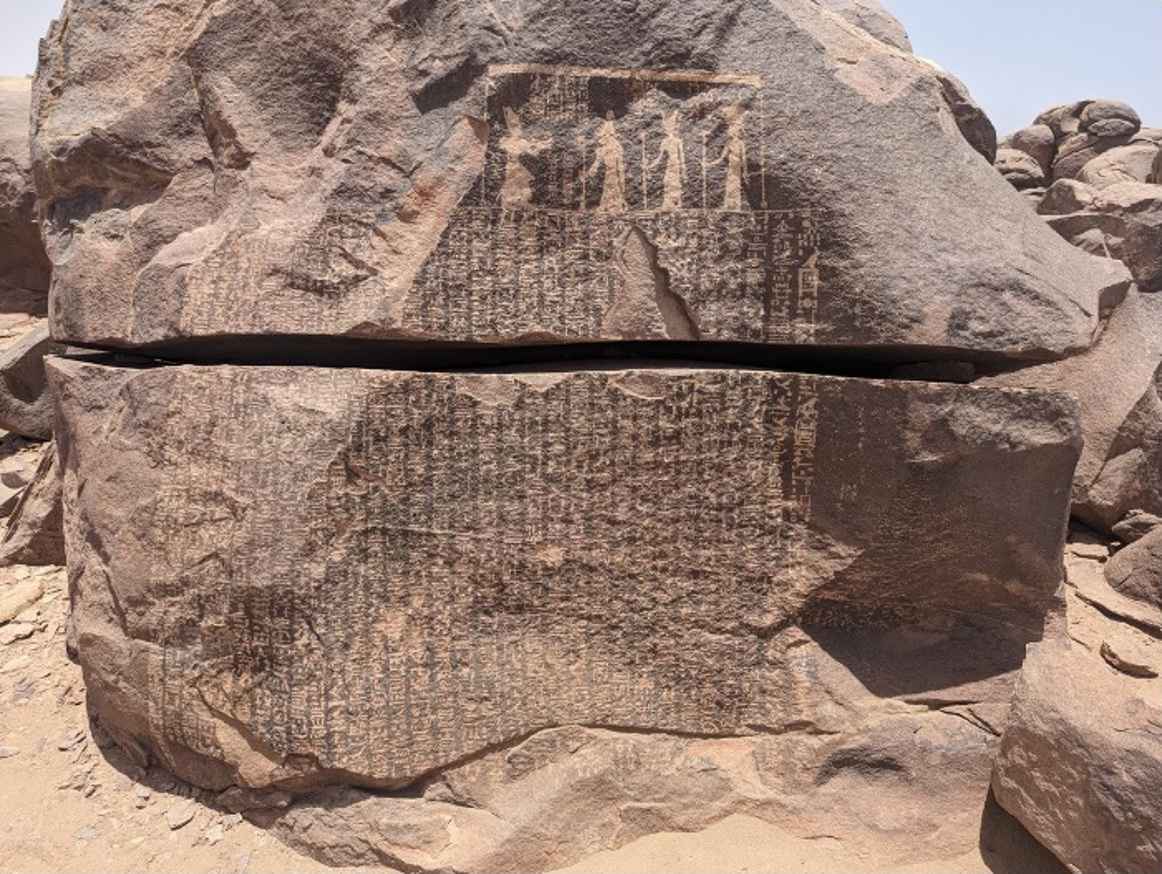 Granting that this was carved 2,000 years later, and a lot of embellishments might have happened between those two events, it once again connects Imhotep to an event in Abraham’s life – specifically, a severe famine which Imhotep is credited with lifting – something God would certainly have done for him.
However, based largely on this stela, many armchair archeologists with a Biblical axe to grind (like me) have concluded that Djoser’s famine was in the time of Joseph, because of the obvious seven-year connection.
And that’s reasonable, but this was time of frequent famine – Abraham went to Egypt because of an extreme famine, and Isaac went to the Philistines a generation later for a separate famine (Genesis 26:1), both different from the one of Joseph. So while I admit the seven-year connection is valid, it’s not conclusive.
On the other hand, the evidence connecting Djoser to Urite measurements and technological advances that Joseph would not have known is overwhelming. Remember, divinely inspired genius or not, Joseph was a mere 17 years old when he went to Egypt.
He could not have taught them the astronomy and measurements and temple-construction techniques of Ur, since he had never been there. Because genius or not, Joseph hadn’t spent the better part of a 75 year life as an astronomer-priest of Ur like Abraham had!
There’s a LOT more to say about Joseph, but I don’t want to get off-topic. Suffice it to say, Joseph could not have taught the customs from a city to which he’d never been to the Egyptians. Imhotep did, and therefore Imhotep was Abraham.
THE PRIEST OF ON
Above we cited a quote which connected Imhotep with the priesthood of Heliopolis; now that sounds bad, until you realize that Joseph married the daughter of Potiphar, a priest of On (Genesis 41:45). So clearly that wasn’t as bad as it sounds, especially in the patriarchal age before the name of the true God was known (Exodus 6:3). How can that be?
Well, interestingly, On is the Hebrew spelling of the Egyptian word for the holy city of Ianu – which is the original name of the Greek Heliopolis, meaning “the temple of the sun.” But Ianu does not mean any god’s name, which is a bit unusual for a holy site; instead, it derives from the Egyptian word meaning “the pillars.”
Pillars were generally set up as sights to do astronomical observations; and in Ianu, the earliest God associated with the city was not Ra, but Atum “the primordial God in Egyptian mythology from whom all else arose” (Wiki, Atum).
Its association with the primordial creator God, whatever his name might be, would not necessarily be problematic for Abraham and Joseph who likewise worshipped “the most high God,” even though they did not know his name. Provided the idolatry was kept out of it, of course.
All of the temples and pyramids on the Giza steppe are aligned with Ianu which suggests that originally this wasn’t a solar temple at all, but the focal point of an observatory. It may even have been begun by Abraham, or greatly improved with information provided by Abraham.
Obviously, the line between astronomy and astrology was blurry, so this would have inevitably been a temple of the almighty God. To the Egyptians of that place and time, this would have been Atum; but to Sumerians, his name was Anu. Which is strikingly similar to the place name Ianu.
Anu (Akkadian: 𒀭𒀀𒉡 ANU, from 𒀭 an “Sky,” “Heaven”) or Anum, originally An (Sumerian: 𒀭 An), was the divine personification of the sky, king of the gods, and ancestor of many of the deities in ancient Mesopotamian religion. He was regarded as a source of both divine and human kingship, and opens the enumerations of deities in many Mesopotamian texts. At the same time, his role was largely passive, and he was not commonly worshipped. (Wiki, Anu)
The heavenly deity in Sumer, Anu, with whom Abraham was most certainly familiar. Indeed, he had grown up speaking Sumerian in Ur, and that was literally the word for “sky.” So if this was a sky observatory… the name Ianu may derive from the place.
If that’s the case, it’s possible that the word isn’t named Ianu after the pillars there; but rather the pillars there were named Ianu after the Sumerian word for the heavens they were meant to chart. Later the site was taken over by the solar deities Atum and Ra.
This last section is more speculative than most, in all fairness, and if it’s wrong doesn’t really affect the overall theory; but Abraham’s and Joseph’s association with the Egyptian priesthood needs to be explained and put in context, and this is one way it would make sense.
ABRAHAM’S CONVERSION
It’s worth noting that Terah had idols, as did his great-great-granddaughter Rachel. Jacob, while in Haran, clearly tolerated idols among his men and family (Genesis 35:1-4). Up until this point, Jacob had not committed himself to the God of Abraham, pending the Lord’s fulfillment of the deal Jacob made at the pillar (Genesis 28:16-22).
What’s interesting about Abraham is he had realized, ON HIS OWN, that it was foolish to worship the created thing rather than the Creator! Long before he made a covenant with God and was required to get rid of his idols, he stopped doing it because he thought it was foolish. That’s why he was greater than Jacob.
Because through Abraham’s observations of the heavens in the course of his duties as priest, he came to realize that the moon could not be a god, since it was a slave to laws that Abraham discovered bound it to regular cycles!
And if the moon couldn’t free itself from the cycles of fate, how foolish was it to pray to the moon to free us from the cycles of fate?
Romans 1:20-25 For the invisible things of him from the creation of the world are clearly seen, being understood by the things that are made, even his eternal power and Godhead; so that they are without excuse: Because that, when they knew God, they glorified him not as God… Who changed the truth of God into a lie, and worshipped and served the creature more than the Creator, who is blessed for ever. Amen.
So Abraham had done exactly what Paul had said we should do; learned, by the thing created, what the nature of the Godhead was; and realized that it was foolish to worship the thing that was created instead of the Creator!
A truth which he told his fellow priests of Sin, and when they didn’t listen, his fellow citizens of Ur; who reacted with predictable violence and chased him out of the city, probably killing his brother Haran in the process (see my article, “Haran the Hero”).
For which doctrines, when the Chaldeans, and other people of Mesopotamia, raised a tumult against him, he thought fit to leave that country; and at the command and by the assistance of God, he came and lived in the land of Canaan. And when he was there settled, he built an altar, and performed a sacrifice to God. (Josephus, Antiquities)
But his discovery of this truth greatly impressed God; for this man, through love of truth alone, came to believe that all of the gods men worshipped were only servants of the true God and as such deserved no worship!
This was the first man to overcome the deception of the world; the first man to pierce beyond the veil of the angels, just as some few saw beyond the veil of Moses (2 Corinthians 3:12-18), and see the truth God really wanted – that God is a spirit, and must be worshipped in spirit, and in truth (John 4:23-24).
And it was that which impressed God, who appeared to Abraham, led him out of Ur and then out of Haran, where Terah’s idolatry continued; and then to distance him from that environment, God led him towards God’s own country, the small portion of the Earth that the Lord reserved for Himself.
And when he arrived, God appeared to him and promised that land to Abraham; and knowing Abraham’s background as an astronomer, it puts a whole new slant on…
Genesis 15:4-6 After these things the word of the LORD came unto Abram in a vision, saying, Fear not, Abram: I am thy shield, and thy exceeding great reward… . And he brought him forth abroad, and said, Look now toward heaven, and tell the stars, if thou be able to number them: and he said unto him, So shall thy seed be. And he believed in the LORD; and he counted it to him for righteousness.
God didn’t need to take him out of the tent to look at the stars; I mean, everyone knows there are a lot of stars! After all, God didn’t take him to a beach to show him how many grains of sand there are – despite using the exact same metaphor in Genesis 22:17. So why make him look at the stars?
Because Abraham was an astronomer, and as such Abraham would have a special appreciation of the size of this job of “numbering the heavens.” I mean, it was his job back in Ur! Knowing this, we can now hear the sarcasm in God’s voice when He says “count them… if you are able!”
This obvious belittling of him and his former job as priest of Sin was God making the point that Abraham’s former style of worship – knowing God by studying the stars – would no longer be necessary with the new covenant God would be making with him.
And, incidentally, also was a way of pointing out that Abraham’s own children would judge the world one day. For they would be as those stars, replacing those angels. For God had finally found a man who was capable of commanding his family after him, a man capable of having Seed who would actually bring light to the world.

This is part 11 of The History of the World Series
 Joseph In Egypt
  Did Abraham Know the Name of God?
  Sargon to Hammurabi
  Descendants of Abraham
  Mesopotamian Empire and Sargon
  What Is The LOVE Of God?
  Everything You Believe About God Is WRONG!
  Make Up Your Mind!
  What Is Faith?
  How DARE you FEAR the judgment of God!
  Firstripe Figs
  The Bride Of The Father
  Exodus 40 – The Plan Of God
  The Temple Of God
  Pillars Of The Temple And The Brass Sea
  GEHENNA WITH ‘EM
  When Did God Forbid Polygamy?
  When You Shouldn’t Pray For Someone
  The Sins of the Father
  The First Paul