The History of the World

This article is best read in series; Click here to read.
[The following is the introduction and first chapter of a much larger book, with expected publication in 2026; more information will be available at www.goldenruled.com]
The ancient history of the world has been written by the ancients, but no modern historian takes the ancient accounts seriously, labelling them “myth” or “literary devices,” mostly because the events they describe cannot take place in the accepted chronology of the ancient world.
It is my contention that that chronology is wrong and the eyewitness accounts were serious historians explaining the drama in their world in the best way they knew how. In this book, I will provide extensive reason to believe that most of the ancient accounts, whether cuneiform tablet or papyrus scroll or stone monument, were factual and accurate accounts of the world as that historian understood it.
With, occasionally, a bit of dramatic license to please the king or a bit of flattery to please the gods.
So in this book, we will attempt to reconcile secular and religious accounts of the ancient world. In this book we will be guided by historical facts, and the more settled the better. But we will use a source to inform these historical facts that no historian will even consider: we treat ancient sources, foremost among them the Bible, as history and not as myth; at least until proven otherwise.
Most people don’t realize that the Bible discusses the early history of civilization in some detail, and historians well know that the ancient Sumerian myths from the Euphrates valley echo closely many things in Genesis; the flood, the tower of Babel, Adam and Eve, and so on.
If historians are right, the Bible’s version of these events was inspired by later Babylonian legends acquired through time spent by Jews in Babylon; they believe that the origin myths of the Bible were copied from Babylonian events thousands of years after the fact.
But as you will see before we are done, the early part of Genesis was written by eyewitnesses to these events and preserved much later by Moses. But that requires that the traditional timeline of Sumer be adjusted down several hundred years.
In a similar way, many scholars believe that Hammurabi’s famous law code involving “an eye for an eye” inspired eerily similar laws of Moses in the Torah. But as you will see before we are done, it was quite the opposite: the Amorite Hammurabi learned of Moses’ laws through Amorite refugees from Canaan after the invasion of Joshua.
In a similar way, many historians believe that Moses learned of circumcision and monotheism from Egypt; it was in fact, quite the opposite: the Egyptians learned of those things from Abraham, who also taught them the mathematics and engineering necessary to build the pyramids, for which we have ancient historical witnesses and an abundance of evidence.
In yet one more example, historians believe that the heretic Akhenaten who worshipped one God inspired the monotheism of Judaism; his Hymn to Aten has passages that are almost word-for-word the same as Psalm 104.
But, you guessed it, we will demonstrate decisively that Akhenaten’s grandfather sacked Jerusalem after the death of Solomon and brought the writings of David to Egypt, thus making the religion of Aten inspired by the religion of Moses, not the other way around!
Each of these things are misunderstood because historians are convinced that certain historical events happened centuries before they actually did; which makes them seem far more ancient relative to the Bible than they actually are.
And we need not invoke the inerrancy of the Bible to prove these things; we will prove these things using their own historical documents, and the opinions of the most respected researchers in the fields of Egyptology, Assyriology, and so on.
We will be guided in our quest by the basic timeline given in the Bible, but we will not need to rely on the Bible to prove our thesis; only to flesh out the details.
And even then, we need not treat the Bible as infallible, even if we may believe it is; we simply have to treat it with the respect that historians accord most other ancient documents but which they absolutely refuse to give the Bible: we simply believe its record is true until proven false.
If an ancient Egyptian scribe scrawls a note on the back of a papyrus, historians will base the entire chronology of Egypt upon it; but if the Bible says that Babel was built first, then Uruk, they will scoff and ask “where’s your proof?” Only the Bible is singled out for such scepticism, which is frankly unscientific.
So we will not ask you to believe the Bible for its own sake; simply to treat it as what it is; an unarguably ancient document, carefully preserved as a sacred document for thousands of years; and which, thanks to that sacredness the scribes accorded it, makes it a witness which can provide a much needed perspective on very ancient events.
But unlike many other revisionist historians and conservative Christian types, at no point will we utterly reject a historical source as false or meaningless just because it happens to disagree with our preconceived notions about the Bible. We will do our best, in every case, to reconcile both witnesses and by so doing we will see a truth no one has ever seen before.
It is precisely this faith in the integrity of ancient historians as well as the Bible which allows us to tell the story of ancient history in a way that it has never before been told. Ancient people were superstitious yes, but not divorced from reality. Selfish, yes, but not stupid.
We are told, to cite one example, that the Egyptian king Taharqa copied a list of towns he claimed to have conquered – “with a few blunders” – from Seti and Ramses II. And that he did so for “propaganda.” But this list was found in the holy place of a temple, facing the God where no one but priests saw it.
For whom, we ask, was such propaganda intended? An illiterate population? What moron would boast to his God about cities he did not conquer? Lying to God has not, at any point in history, been seen as a wise thing to do. And yet we are asked to believe that Taharqa boasted of cities he did not conquer to his God.
The reason we are told this, is that according to historians Taharqa could not have conquered those regions in the time that historians have placed him. But if he ruled centuries later, we might not have reason to doubt his well-attested claims.
Historians have been obligated to rewrite and ignore the majority of ancient witnesses because their basic assumptions are flawed, and rather than challenge them they simply call any ancient historical record that disagrees with their historical picture a piece of propaganda, myth, satire or, my favorite “a literary device” – i.e., ancient fiction.
Fiction written for an illiterate population and hidden in a temple where none would see it. What would motivate such a fiction, I ask?
But if we’re right – and you, dear reader, will be the judge when we are finished – then when properly understood, the Bible’s narrative and that of Sumer, Egypt, and the Indus valley can be woven together and each illuminates the other in a way that no other historical theory can compete with.
We will show that there is in fact very little “literary” history, and that except for obvious fables and myths, the vast majority of ancient documents were compiled by sober historians well acquainted with their subjects; it is modern historians who are not acquainted with their own material.
We intend to demonstrate, using their own experts, their own artifacts, indeed their own beliefs, that the basic outline of history as shown in the Bible is the one that their own evidence requires to be true.
We do not expect them to thank us for this.
We do hope that you will.
PLACES OF AGREEMENT
We do not need to rewrite all of history; in fact, most historians broadly agree about most things. Everyone agrees, for example, that Hammurabi’s dynasty, called the 1st (Amorite) dynasty of Babylon, lasted 297 years. Traditional historians, Bible scholars, myself, no one disputes anything about this to speak of.
Thus, we say that the relative chronology of the 1st dynasty of Babylon is established; the question is where to place that dynasty in relation to surrounding dynasties, and ultimately how many years ago it was from now, which is called an absolute chronology; for Hammurabi, historians believe he ruled for 42 years starting around 1792 BC – give or take a hundred years.
But how did they arrive at this date? A few ways, but the most important is by connecting Hammurabi’s dynasties to other kingdoms that were nearby and who interacted with it, or with the dynasty which replaced it.
So in order to build a timeline, we have to connect a kingdom – the 1st dynasty of Babylon, for instance – with the kingdoms that preceded it and followed it. For example, Hammurabi is known to have killed Rim-Sim I of Larsa, in the 30th year of Hammurabi and the 60th year of Rim-Sim.
This is an ideal – and unfortunately rare – synchronism between two kingdoms which allows us to assemble larger blocks of dynasties. We know, from other ancient sources, who all the kings of Larsa were, which allows us to stretch 262 years further back into history.
Rim-sim himself had conquered Damiq-Ilishu of Isin in his own 30th year, which allows us to connect Isin to the network; and so on. Moving the other direction of history, Hammurabi’s son Samsu-iluna interacted with Ilum-ma-ili, first king of the 2nd dynasty of Babylon, also known as the 1st Sealand dynasty. This is confusing, so we made a chart:

Green arrows represent “to-the-year” interactions, while red arrows are more like “this guy knew that guy… at some point.” Unfortunately, green arrow interactions are rare in history, and most are red arrows, at best.
The worst are references like “the man of Uruk attacked in the 6th year.” Whose 6th year? Which man of Uruk? Who was ruling when he attacked? In this kind of synchronisms, which is most of them, there is a lot of room for interpretation, and therefore disagreement.
It is those places we will spend the most time; for most of history, the general timeline of the dynasty is so solid we have little reason to argue it. Where we do disagree, it’s often trivial; did Eshbi-erra of Isin declare independence from Ibbi-sin of Ur in his 8th year or his 16th? What’s 8 years either way, in the grand scheme of things?
Of course, some disagreements would move earlier kings forward or back in history by upwards of five centuries. It’s these that make the biggest difference, and therefore deserve more of our attention.
And honestly, we agree with historians about most of their conclusions – not surprising, really, since a lot of it is based on good evidence. But because they are guided by the idea of 10,000 years of human civilization, while we must make it fit in something like half that if the Bible is even a little bit true.
If we are right, then somewhere they must have stretched out a period that was much shorter; inserted years that were not there; put dynasties as consecutive that were, in fact, contemporary. And if so, their own documents, and their own scholars, will provide the evidence to prove it – not the Bible, which we will use solely as a guide to know what to look for.
As it happens, they did all of those things, and we will show you exactly where, why, and how the choice that happens to fit the Bible not only is plausible, it is the more reasonable choice to have made in the first place.
THE SUMERIAN KING LIST
It is generally agreed that the oldest civilization came from Sumer, in the valley formed by the Tigris and Euphrates; although what counts as “first” and what counts as “civilization” is debated and, indeed, debatable. We will follow the definition of civilization as “possessing a written history.”
Egypt generally is agreed to be a close runner up, although the belief is generally that it evolved independently. The Indus valley Harappans came third, with China trailing even later. Many others came later.
We chose to focus on writing because we know about the early history of all of these civilizations due to writing, which was invented in Uruk, the first city of Sumer. And the cornerstone of the history of Sumer comes from documents collectively called “the Sumerian King List,” or SKL.
The SKL presents ancient Sumerian history as a long list of consecutive dynasties. First kingship was in Kish, then in Uruk, then Ur; each dynasty lasting tens of thousands of years, if we take the source literally, which no one does.
The lengths of the earliest reigns are obviously fantastic (28,800 years, for example); curiously, most of them are in multiples of 60; which to the Babylonians was the equivalent of our “tens” column. Their equivalent of “hundreds” was 3600 (60×60) and so on.
So, if we assume that the sign for “1” changed over time or for some reason was misread by later scribes as “3600” – the equivalent of our reading “one” for “one (hundred)” – then this fantastic age would be meant to read as 8 years, a perfectly plausible reign.
Later kings still have fantastic reigns, but vastly smaller; in the realm of 360 or 1200, as opposed to tens of thousands of years. Here, instead of reading “1” for “3600,” the scribes apparently misread “1” as “60”; the equivalent of our dropping a zero off of the ten.
To be fair, this doesn’t work in every case, but cannot be denied that the vast majority of the absurdly large numbers are multiples of 60, or at least 6. Given that this was the base number of the Babylonian mathematics, it cannot be an accident and must mean an error was made in the placing of the proverbial decimal point.
Rather than unravel that the foremost scholars on the subject simply assign an average of 20-30 years to all the kings in the list. But even doing this would require thousands of years based on the assumption that all these dynasties ruled one after the other.
This is explicitly what the SKL says, but even historians know this isn’t true; we can prove that with contemporary ancient sources. Many of these dynasties such as the kings of Kish and Uruk and Ur were contemporary, at least part of the time – no scholar disagrees about this.
So then the SKL has two primary flaws; the absurdly long reigns, and the assumption that the dynasties were consecutive; correcting these flaws, Thorkild Jacobson in 1939 published a highly influential and still-respected (though not wholly accepted) study on the SKL.
His belief, which is still the majority opinion, is that the SKL is a basically accurate historical document, which was created for political reasons to legitimize a later king, in order to cast himself as the heir to the great kings appointed by the gods in the past. This caused the scribe to stack the dynasties end-to-end instead of in parallel, as they should have been.
And because the scribe was working off of what were, even then, ancient clay tablets which had been compiled in the earliest form of the written language, he made mistakes with the transcription, misunderstanding the dates as vastly larger than they really were.
Jacobson began by compiling all available copies of the SKL to create the most accurate source document possible, then used 20-30 years for the larger reigns as an average, then connected the various dynasties using synchronisms already available from ancient tablets; so, for example, if Gilgamesh conquered Kish in the time of Aga, which ancient sources attest, then these dynasties must be contemporary at that point.
Using this method, he estimated that from the first kings in Sumer to the aforementioned Hammurabi there were approximately 1,000 years. After a century of new discoveries and a lot of new scholarship, this is still generally agreed upon.
My own research brings this down to 900 years or so; but close enough to call this a broad point of agreement. The net result of this is we agree with scholars that 1,000 years or so of Sumerian history has been assembled, and can be moved around as a block – all we have to do is find out when Hammurabi lived, and we can date the first settlements in Sumer.
If only it were that easy!
AFTER HAMMURABI
From the first kings of Sumer to Hammurabi was about 900 years; after Hammurabi there were many more dynasties that ruled over Babylon, according to the Babylonian King List (BKL). This list places the 2nd dynasty of Babylon, also called the 1st Sealand dynasty, after Hammurabi, then the 3rd Kassite dynasty after that.
But historians believe that the 2nd dynasty was contemporary with the last half of the 1st, and that the 3rd overlapped both for about 150 years before it conquered the 1st and 2nd. They then believe that all successive dynasties were, well, successive. The internal chronology of these nine dynasties is reasonably solid and broadly agreed upon, and we have little reason to question it.
The 10th of these dynasties was the Neo-Babylonian Empire of Nebuchadnezzar, which began around 626 BC with the reign of his father Nabopolassar. We know these absolute BC dates from something called the Canon of Ptolemy, a complete list of kings from around 747 BC up to the Roman Emperors in the 2nd century AD.
We can confirm the accuracy of this list with the various other cultures with whom Nebuchadnezzar interacted (read: conquered); the histories of the Jews, Egyptians, Assyrians, and so on all talk about these invasions and help date his reign securely. Their histories, in turn, can be firmly connected to Greek and Roman dates, and finally to our own BC/AD dates.
So then, to date ancient events, we have the SKL from the dawn of civilization to Hammurabi, where that list ends; and we have the Babylonian King List from Hammurabi to Nebuchadnezzar; and then we have the Canon of Ptolemy to take us from Nebuchadnezzar to Rome; and Medieval Christians to take us from Rome to modern times.
No one anywhere disagrees with the dates for Nebuchadnezzar’s Neo-Babylonian Empire; so treating that as absolutely secure, we should – in theory – be able to add back the years from the BKL to find an absolute date for Hammurabi.
But there’s a problem. If we take the internal totals for these dynasties and add them sequentially, we wind up with a total of around 1860 years; add that to 626, and Hammurabi would have to reign around 2500BC, a date no one believes.
Hence, like the SKL, there must be some overlap in the BKL. As stated already, historians believe, with good reason, that the 1st, 2nd, and 3rd dynasties all coexisted at one point before the 3rd dynasty absorbed the other two. Their conclusions point to approximately 1200 years for Hammurabi to Nebuchadnezzar.
If that’s the case, then Hammurabi began to reign around 1800 BC. And if so, the earliest recorded history in Sumer dates to around 2800 BC. Since the Bible dates the flood at 2314 BC – give or take a few years depending who you ask – this presents a real conflict between Sumer and the Bible.
At this point, historians throw up their hands and say “the Bible a Jewish storybook written to justify their conquest of Canaan.” Christians and Jews throw up their hands and say some version of “well, we don’t care what history says, we believe the Bible.” Or else they just discard the Bible as a spiritual book full of symbolism, not meant to be taken literally.
We will do neither; for we can reconcile these dates using one simple trick we already learned from the SKL; these Babylonian dynasties were not all consecutive.
THE KASSITES
Historians already taught us that the BKL was not meant to be sequential; they are confident, and we agree, that the 1st, 2nd, and 3rd dynasties overlapped considerably. Why, we ask, are they so certain that 3rd dynasty did not overlap in any way with the 4th through 9th dynasties?
Because everyone’s problems are solved if the 3rd (Kassite) dynasty of Babylon is removed from the sequence, and placed contemporary with the 4th through 9th dynasties, all the way up to the year 750 BC.
This actually makes a lot more sense of the list; for example, following historians we have to place the 2nd Babylonian dynasty (called in the BKL the “1st Sealand dynasty”) 700 years before the 5th Babylonian dynasty (which the BKL calls the “2nd Sealand dynasty”). This would be odd, to retain a memory of a dynasty separated by such a great gulf of time.
Nor would it be alone; as mentioned above, Hammurabi’s dynasty conquered Larsa, which had itself recently conquered Isin; yet the BKL lists as its 4th dynasty the “2nd dynasty of Isin,” an obvious reference to the earlier dynasty of Isin conquered by Larsa.
If we are right, and the Kassites were entirely contemporary with the 2nd through 8th dynasties, then the 2nd dynasty of Isin followed the 1st by no more than 200 years – possibly much less. The 2nd Sealand followed the 1st Sealand promptly, not 700 years later.
This would be in keeping with how the SKL presented kingship, where the 1st dynasty of Ur was apparently split from the 2nd dynasty of Ur by four dynasties and thousands of years – even at an average of 20 years per ruler, 300 years.
Despite that, historians believe that the 2nd dynasty of Ur continued uninterrupted from the destruction of the 1st dynasty of Ur. Why would a later list, compiled about the same cities in the same basic culture, be different? Especially when we already know it had the 1st, 2nd, and 3rd dynasties contemporary?
There is an immense amount of evidence for the presence of Kassites in the 8th century where, according to historians, they do not belong; this change has knock-on effects to every other ancient history, like Assyrians and Egyptians, but we’ll deal with that in time.
Suffice it to say for now, that we are not making this choice merely because it is convenient for the timeline of the Bible, but rather because the evidence of Sumerian history makes this the more rational choice.
In fact, synchronisms between kings work better with the Kassites in the 8th century than when those same Kassites were erroneously placed in the 13th century – an error based on connections with Egyptian chronology, itself deeply flawed.
We will of course get to all of this in due time, and I won’t expect you to take my word for it; this is just to acquaint you with the foundational conclusions and assumptions that shape the dating process as we go.
But astoundingly enough, if you remove the Kassites from linear history, and add the later Babylonian kings to the earlier Sumerian ones, all of Mesopotamian history fits neatly, with no cramming or stretching, in the space after the flood of Noah in 2314 BC – leaving a century or two after the flood for mankind to multiply enough to form cities and anoint kings.
Which, if we can establish it beyond a reasonable doubt, will prove that the Bible’s written history is consistent with that of Sumer – my main goal in this project.
TO MY CRITICS
When one change makes everything wrong with chronology snap into place… you know you’re on to something. Especially when that change is consistent with the known practice of Sumerian scribes in general and the BKL in particular as understood by historians.
We will go into great detail on the subject later, but for now we will simply say that the Kassites were never kings in Babylon, they were overlords of Babylon who ruled from their native land to the northeast; and that the minor kings we know as the 4th-9th dynasties were puppets of the Kassite kings.
This is precisely how the scholarly world views the SKL, in the area of, say, how Kish was for a long time subject to Uruk but retained its own list of “kings.” We are not surprised, therefore, to find the same culture still recorded king lists the same way.
This explains why, although more ancient, there are vastly more records and monuments of Kassite kings than any king from later dynasties until the time of the Neo-Babylonian Empire in 626. Because Kassites were the real power, and documents and monuments were naturally made in their name.
Why were these intervening kings so poorly known and attested? Historians would say they were weak and inconsequential; we agree, but add that they were weak because they were subjects of the Kassites.
Historians educated in the dogma of this subject will object and point to the Amarna letters; we will indeed use those letters to place the Kassites in their proper place… once Egyptian chronology has been corrected and the Amarna kings put in their proper place
Those same historians will also object and point to the Assyrian King List (AKL) and the Synchronistic history, a document that purports to show contemporary kings of Babylon and Assyria stretching back into history, and which places the Kassites contemporary with various 14th century Assyrian kings.
But we will remind the critic that those documents were not written by Babylonians, but by Assyrian scribes in the time of Assurbanipal around 650 BC – hundreds of years after the kings they are describing.
And we will argue that they compiled these synchronized lists by the simple method of taking the BKL, as written, and laying it up next to the AKL, as written, and finding out which king would be contemporary if the BKL dynasties were sequential.
The ancient Assyrian scribes, in other words, made the same error modern historians have made; they assumed dynasties were consecutive that were in fact partially contemporary. And in doing so, artificially inflated the ages of early civilizations by centuries.
And no, this doesn’t violate my promise not to discard ancient sources that disagree with me; we will demonstrate, using Babylonia’s own historical sources, that the Assyrian documents about Babylonian history were wrong even when they were written. Ancient mistakes are, after all, still mistakes.
THE HOLLOW REED
Invariably, traditional historians and traditional histories begin with Egypt and make everything else fit their chronology. The idea is that Egypt is a stable and very ancient empire, with immense amounts of detailed records, and we can date individuals in other empires in the ancient Near East by their communication and interaction with Egypt.
It sounds good… Until you look closely. The chronology of Egypt is, without a doubt, the biggest mess of any nation in history. No ancient source agrees with any other about dating; many of the names, sometimes even the sequences of kings are different between sources.
We know what we know about Egypt from several ancient sources; chief among them is Manetho, who wrote a history in Greek around the 3rd century BC purporting to list all the dynasties of Egypt in order from the 1st to the 30th.
Unfortunately his original book has not survived, except in the form of excerpts quoted in later ancient historians such as Josephus and Eusebius. Only, the thing is… no Egyptologist actually believes Manetho.
He is the backbone for the chronology of Egypt, but read any article about any king of Egypt and you’ll hear things like the following; let’s just pick Khufu, alleged builder of the great pyramid, for example…
It is still unclear how long exactly Khufu ruled over Egypt. Dates from Khufu’s final years suggest that he was approaching his 30-year jubilee, but may have just missed it… The highest known date from Khufu’s reign is related to his funeral. Four instances of graffiti from the western of two rock-cut pits along the south side of the Great Pyramid attest to a date from the 28th or 29th regnal year of Khufu:…
The Royal Canon of Turin from the 19th Dynasty, gives 23 years of rulership for Khufu. The ancient historian Herodotus gives 50 years, and the ancient historian Manetho even credits him 63 years of reign. These figures are now considered an exaggeration or a misinterpretation of antiquated sources. (Wiki, “Khufu”)
Now multiply this uncertainty by literally hundreds of pharaohs…. Does this seem like a chronology you want to build literally every other ancient chronology around?? It’s out of context, but I can’t help but think of the Bible’s warning to Judah:
Isaiah 36:6 Behold, you trust in the staff of this bruised reed, even in Egypt, which if a man leans on it, it will go into his hand and pierce it. So is Pharaoh king of Egypt to all who trust in him.
This is literally what every Egyptologist has done, and with predictable results. The quote above mentioned the Turin Canon; this is a list of ancient pharaohs, which disagrees with Manetho on a number of points.
It has a great deal of information, and if it was intact it would go a long way towards making Egyptian history reliable. Unfortunately, it is highly fragmented and has been reassembled like a jigsaw puzzle that’s missing half the pieces. This has left it highly susceptible to bias and error, because it was reassembled based on what they expected to see there, not necessarily what was actually there.
Egyptologists also base their dating on the monuments of a pharaoh, which often mention the year of his reign in which the inscription was made. This is reasonably reliable, at least to provide a minimum reign length.
Unfortunately, this process is not entirely error-free because all pharaohs had five different names which they used. And the same primary name – the one we read about in the books today, like Ramses – was often used by many different kings.
There were 11 pharaohs named Ramses, for example, plus a few princes who never became pharaoh. And inscriptions which just say “Rameses” do not come with a handy “IV” after them, like they do in the textbooks, so they can only be identified if a secondary name is used (which is common, to be fair); still, sometimes Egyptologists have to make an educated guess.
Plus, even pharaohs not named Rameses believed themselves to be Rameses, for the name is literally Ra-me-su; which means “son of the sun,” which every pharaoh claimed to be. So any pharaoh was Rameses, in a sense, even ones not technically named that. This fact will be important when we discuss the Exodus, which mentions the “land of Ramses” and the “city of Ramses.”
In addition, often scraps of linen or papyrus will have a date “year 16” on it, which has no pharaoh’s name accompanying it; these dates, based on their location, style, and what Egyptologists expect, are used to assign this date to a handy pharaoh based solely on their best guess; this can, obviously, result in some major errors if their preconceptions are wrong.
SOTHIC DATING
There are huge gaps in the Egyptian king lists, three so called “intermediate periods” where there was some version of civil war and social dysfunction between the “kingdom periods,” of which there were also three.
Excepting only Manetho, whom Egyptologists trust about as far as they could throw him – the actual person, not his book which they could throw quite a bit farther than they trust him – according to Manetho, these intermediate periods lasted, in some cases, upwards of a thousand years.
We don’t believe that either. But various other textual sources – the Turin Canon, Abydos King List, Palermo stone, etc., cannot help us fill in the gap. So how do Egyptologists state so confidently exactly when, say Amenemhet I reigned?
For that, they rely entirely on Sothic dating. They believe that since the earliest pharaohs the Egyptian calendar drifted through the seasons over a 1461 year cycle, called the “Sothic cycle,” after the Egyptian name for Sirius around which the calendar was supposedly based.
They claim that they can use this method with absolute security to calculate back to 4200 BC or so with precision. However, there are an immense number of assumptions in this theory, chief among them that Egyptians used the exact same calendar, calculated the same way, for up to 4,000 years.
We will address the technical details and arguments later, but for now I just want you to apply the common sense test, which I believe this theory fails; it asks us to believe that, alone of all cultures in history, the Egyptians never changed their core calendar for 4,000 years.
And here’s another version of the common sense test; the Egyptians, throughout their history, had three seasons of four months each: inundation (flood), emergence (drying of the land), and harvest. These seasons were, obviously, named after the major event that happened in that season, the yearly flooding of the Nile and the resultant planting and harvest.
But if the historians are right, then these seasons slowly drifted through the year, moving one day every four years relative to the true solar year of 365.25ish days. Which means for several hundred years, the season called “planting” fell during the time of flood, which makes no sense.
So you can imagine, if this were true, a child asking his parent “daddy, why do we call this season planting when it’s impossible to plant now?” and his father responding, “Hush, we must never ask this question!”
There is simply no way the Egyptians were that stupid or that bound by tradition as to call a season by a wrong name for upwards of a 1,000 years at a stretch. So all dates concluded from Sothic dating – which is every date before the New Kingdom – are utterly untrustworthy and can be safely ignored.
Furthermore, and as I will show in due time, not only does Sothic dating not prove the extreme antiquity of Egypt, when understood correctly Sothic dating proves the Bible’s timeline must be accurate to within 20 years.
Because there was indeed a Sothic cycle; Roman and Greek documents prove this conclusively. But there was only one; and Manetho tells us that it started the calendar reforms of the Hyksos king Salitis, in what must have been 1321 BC, three hundred years after Egyptologists date him.
But that’s a chapter all its own.
PARALLEL PHARAOHS
And finally, Egyptologists universally assume that during the “kingdom” periods – Old Kingdom, Middle Kingdom, New Kingdom – that there was only ever one king over all of Egypt. That the 6th dynasty, based on Memphis, came completely after the 5th dynasty, based in Aswan 400 miles to the south (according to Manetho, but based in Memphis according to historians).
But the simple fact that a pharaoh claims to be king over upper and lower Egypt doesn’t mean they actually ruled upper and lower Egypt; and historians know this! Speaking of another of the main king lists, the one at Abydos, Wiki tells us…
Besides providing the order of the Old Kingdom kings, it is the sole source to date of the names of many of the kings of the Seventh and Eighth Dynasties, so the list is valued greatly for that reason. This list omits the names of many earlier pharaohs. The bulk of these appear to have been left out because although they claimed royal titles and rule over all Egypt, their actual authority was limited to only part of the country. (Wiki, Abydos King List)
This list gives no dates for these pharaohs, it is strictly a list of names. It was written in order to summarize all the divine ancestors (predecessors, really) of the then-current Pharaoh Seti I in order to invoke their blessings. So it’s almost useless for dating.
But notice that last quote; even though these pharaohs are known to have claimed to rule over all of Egypt in their inscriptions, their authority in fact was “limited to only part of the country.” In other words, pharaohs who claimed to rule over all of Egypt may in fact have ruled contemporarily with other pharaohs from a different part of the country who ALSO claimed to rule over all of Egypt! This opens up the possibility that many, if not most, of the dynasties of Manetho were contemporary, and not consecutive!
Historians trust Egypt’s chronology so much that they date literally every culture in the Middle East based on it. Hittites, Babylonians, Israelites, Greeks – literally every culture’s dating can be traced back to their interactions with Egypt, and therefore rests on the accuracy of Egyptian dating. Is that wise?
Even when full use has been made of the king lists and such subsidiary sources as have survived, the indispensable dynastic framework of Egyptian history shows lamentable gaps and many a doubtful attribution. If this be true of the skeleton, how much more is it true of the flesh and blood with which we could wish it covered.
Historical inscriptions of any considerable length are as rare as isolated islets in an imperfectly charted ocean. The importance of many of the kings can be guessed at merely from the number of stelae or scarabs that bear their names.
It must never be forgotten that we are dealing with a civilization thousands of years old—and one of which only tiny remnants have survived. What is proudly advertised as Egyptian history is merely a collection of rags and tatters. (Gardiner, Egypt of the Pharaohs)
This is one of the men who created that history, by the way. Now I respect the difficulty of the job. But given that difficulty, what justifies the confidence historians place in Egyptian dating? To say nothing of their smug certitude when you dare question it?
Are you comfortable with the entire history of the world resting on a collection of rags and tatters? Because I am not. I will deal with Egyptian history in its proper place; for now, it’s enough to simply discredit the laughable notion that the chronology of Egypt is reliable.
THE BUR-SAGALE EVENT
As I’ve said, ancient cultures usually based their dating systems on the reign of the current king. There were two ways of doing this; you could say “in the fourth year of the reign of Hezekiah,” for example, like the Israelites did.
But what most very ancient cultures in the Middle East did was to name the years; either after a succession of officials who were given the honor of naming the year after themselves or else after major events that happened that year, or both.
We have fairly complete lists of these year-names, called limmu lists, for the early part of the 1st millennium BC. And like with Babylonian dynasties, these limmu lists serve as blocks of kings that can be moved forwards or backwards to find their absolute chronology.
And so in the reign of Ashur-dan III, king of Assyria, in his 9th year, which was named after an official named “Bur-sagale” an event was noted in the limmu list;
“[year of] Bur-Sagale of Guzana. Revolt in the city of Assur. In the month Simanu an eclipse of the sun took place.” (Wiki, “Assyrian Eclipse”)
The importance of this event to chronology cannot be overstated. Based on this one line, every date in Assyrian history has been calculated. And with it, every single chronology of the Near East has been affected, as their chronologies were adapted to fit Assyria.
In 1867, Henry Rawlinson identified the near-total eclipse of 15 June 763 BC as the most likely candidate (the month Simanu corresponding to the May/June lunation), visible in northern Assyria just before noon. This date has been widely accepted ever since; the identification is also substantiated by other astronomical observations from the same period. This record is one of the crucial pieces of evidence that anchor the absolute chronology of the ancient Near East for the Assyrian period. (Ibid)
But here’s the thing. As I said, we have extensive records of limmu-lists. And in a list that spans hundreds of years, and must have seen many solar eclipses, this is the only one mentioned. That’s odd, isn’t it?
This list was concerned with military conquest and events like the death of rulers or revolts and plagues. Astronomical phenomena, while important to Assyrians, were not mentioned in these limmu lists at all. So why mention only this one?
The answer is simple. They didn’t.
The phrase used – shamash (“the sun”) akallu (“bent,” “twisted,” “crooked,” “distorted,” “obscured”) – has been interpreted as a reference to a solar eclipse since the first decipherment of cuneiform in the mid 19th century. (Ibid)
So the phrase “the sun was distorted” has been interpreted as an eclipse because chronologers were desperate for an astronomical event they could use to date the Assyrian lists. But it wasn’t an eclipse! Because the Assyrians have a word for eclipse. And this is not it.
The Neo-Assyrian word for eclipse (particularly a solar eclipse) is antalum (also written antal, from the verb atalu, meaning “to obscure” or “to darken”). In astronomical and omen texts from the Neo-Assyrian period (c. 911–609 BCE), eclipses were carefully recorded and interpreted as omens, especially solar eclipses. They often used the phrase: “shamash anta” — literally “the sun was darkened” — to describe a solar eclipse. So, in cuneiform texts, an eclipse might be recorded using the term antalum or by describing the phenomenon metaphorically, e.g.: šamšam anta or šamšu antalu – “the sun was eclipsed” or “the sun was obscured.” (ChatGPT translation; I have confirmed from other sources.)
So I find it mind-boggling that every date in the Near East was fixed by an eclipse which didn’t even happen! Based on an Assyrian record which doesn’t even use the word!
In the year of Bur-sagale, the sun was akallu, whichmeans “twisted, bent, distorted, obscured.” These are not words that describe an eclipse, a relatively common occurrence for which they had a word, and which would not have been mentioned in the limmu list in any case, but rather some major event that obscures the sun in an unnatural, almost unique way. But what?
This was an epoch-defining event – there is a horizontal line drawn across the Assyrian record at this point, which usually means a major event is about to be mentioned, like the death of a king or some such.
So this event changed the world for the Assyrians; and while they didn’t know what it was, they knew what it wasn’t. So they avoided using the word “eclipse,” an event too common and unimportant to have been noted in the limmu lists anyway!
But if it was such a major, unusual event, surely someone besides the Assyrians would have noticed it. And before this book is finished you’ll find that not one nation in the known world survived unscathed from this “eclipse,” and many nations’ timelines can be synchronized around their memories of this event.
And guess what… it didn’t happen in 763 BC. Which means that the year of Bur-sagale also wasn’t 763 BC.
GREAT RA’ASH
After this event, the Assyrian year-names record decades of plague, famine, and revolt, and historians note that “the Assyrian Empire went into a period of decline.” Not long before this, Jonah went to warn Assyria of total destruction which, thanks to their repentance, was averted; and a little bit later, Amos wrote a book warning of some truly apocalyptic events, and dates his book as follows…
Amos 1:1 The words of Amos… which he saw concerning Israel in the days of Uzziah king of Judah, and in the days of Jeroboam the son of Joash king of Israel, two years before the earthquake.
There was only a fourteen year overlap between these kings, which a literal reading of the Hebrew king lists establishes firmly at between 811-797 BC. Given that Amos specifically talks about the death of Jeroboam (Amos 7:9-11), who died in 797 BC, it’s fair to conclude that the events of this book and their aftermath are directly responsible for his death. A contemporary prophet, speaking to Israel, adds the following:
Hosea 13:9-12 You are destroyed, Israel, because you are against me, against your helper. Where is your king now, that he may save you in all your cities? And your judges, of whom you said, ‘Give me a king and princes’? I have given you a king in my anger, and have taken him away in my wrath. The guilt of Ephraim is stored up. His sin is stored up.
As it happens, the Bible records a gap of 24 years after the death of Jeroboam where there apparently was no king. And this king was “taken away in God’s wrath.” Given that this wrath is pretty much the entire topic of Amos, I’ve chosen to date the earthquake in the same year as Jeroboam died, thus, 797 BC. Could be a year or two earlier, but definitely not later.
But what’s interesting for chronology is that this “earthquake” of Amos’ prophesy caused the sun to be blacked out at noon! But not in an eclipse! Exactly as the Assyrian annals recorded!
Amos 5:8 seek him who made the Pleiades and Orion, and turns the shadow of death into the morning, and makes the day dark with night…
Amos 8:9 And it shall come to pass in that day, saith the Lord GOD, that I will cause the sun to go down at noon, and I will darken the earth in the clear day:
The Bible never uses “the sun going down at noon” as a way of referring to an eclipse. It refers to solar eclipses as the sun being darkened (Joel 2:31) – a literal translation of the Assyrian word atalu, it’s worth mentioning – or as the sun “putting on sackcloth,” a black garment made of goat hair used in mourning (Revelation 6:12).
Yet Amos specifically says the sun will go down at noon; not to be eclipsed, but to disappear entirely. And that the “day would be dark with night.” Even in the most total of eclipses, it’s not as dark as night time – in fact, it’s 10 times brighter than a night under a full moon.
Amos 5:18, 20 Woe to you who desire the day of Yahweh! Why do you long for the day of Yahweh? It is darkness, and not light… Won’t the day of Yahweh be darkness, and not light? Even very dark, and no brightness in it?
This would be a very sloppy description of an eclipse. Because the darkest part – the totality – lasts a few minutes at most. But this describes a day “very dark, and no brightness in it.” Thus we can see why the Assyrian scribes described this as an “obscuring/twisting of the sun” but not an eclipse. Because it wasn’t. But it wasn’t an earthquake either!
Think about it for a moment; Israel is a fairly earthquake prone territory; severe earthquakes occur once a century, on average. Why does the Bible refer to this simply as THE earthquake, or the GREAT earthquake?
The apocalyptic events of Amos are taken, as always, by historians as purely a metaphor, while Christians, as always, take them purely as prophecy… but the events in Amos happened – for they were referred back to, three centuries later… because they still remembered it!
Zechariah 14:5 You shall flee by the valley of my mountains; for the valley of the mountains shall reach to Azel; yes, you shall flee, just like you fled from before the earthquake in the days of Uzziah king of Judah. Yahweh my God will come, and all the holy ones with you.
The Bible takes the events of Amos literally, and so should we – and reading the rest of Amos you’ll immediately see that this was no ordinary earthquake. In fact, the earthquake was the least of the problems. Because, first of all… you don’t flee from an earthquake. There’s nowhere to go!
The word translated “earthquake,” ra’ash, means shaking, trembling, but it can also be translated in a broad meaning of disruption and chaos (Jeremiah 10:22, “commotion” in the KJV). Because “earthquake” is just not a big enough word to convey what really happened.
THE GREAT CATASTROPHE
So how do we explain this using lived human experience? Since we assume the sun didn’t completely cease to exist nor the Earth rotate half an orbit instantly, Amos must have referred to the sun being completely hidden by some form of pollution in the air – consistent with with the Assyrian akallu There is precedent for this in scripture:
Revelation 9:2 And he opened the bottomless pit; and there arose a smoke out of the pit, as the smoke of a great furnace; and the sun and the air were darkened by reason of the smoke of the pit.
This prophetic future event, stripped of mysticism, refers to a “bottomless pit” where there is a “great furnace” which belches out immense amounts of smoke which block out the sun and moon. If you think about it, that’s a perfect description of a volcanic eruption.
But it’s also a perfect description of what Amos says; for a massive eruption would indeed block out, color, and distort the sun! Not an eclipse, which is why the Assyrians deliberately did not use the word for eclipse!
Amos goes on to describe destruction by fire raining down on cities across the Middle East, such as might happen from a massive volcano (Amos 2:5, etc.). And he describes the death toll in Israel being 90% of all people killed! (Amos 5:2-6).
Amos also describes tsunami (Amos 5:8, Amos 8:8); now you can’t run from an earthquake, but you can see a tsunami coming and run for high ground, as Zechariah recorded the Israelites having done in the days of the “great earthquake.”
Amos also describes the aftermath of famine, plague, and invasion; and very specifically, darkness in the daytime. Because this was so much more than an earthquake! This was colossal volcanic eruption which caused immense tidal waves above 100 feet high, earthquakes, volcanic winter darkening the sun with ash for years; globally colder temperatures killing crops along with acid rain further poisoning them.
And he is not the only witness to these events; no less than three Biblical prophets lived through these events, and Isaiah paints a vivid post-apocalyptic picture of the state of things in his present day… not just in the prophet future:
Isaiah 59:9-11 Therefore is justice far from us, neither does righteousness overtake us: we look for light, but, behold, darkness; for brightness, but we walk in obscurity. We grope for the wall like the blind; yes, we grope as those who have no eyes: we stumble at noonday as in the twilight; among those who are lusty we are as dead men. We roar all like bears, and moan bitterly like doves: we look for justice, but there is none; for salvation, but it is far off from us.
Everyone knows prophets are… quirky, but can you imagine the ridicule Isaiah would have received if he said, in the name of the Lord, the following description of a prosperous and thriving country?
Isaiah 1:7-9 Your country is desolate, your cities are burned with fire: your land, strangers devour it in your presence, and it is desolate, as overthrown by strangers… Except the LORD of hosts had left unto us a very small remnant, we should have been as Sodom, and we should have been like unto Gomorrah.
The reference to Sodom and Gomorrah is interesting, because those cities were destroyed by fire and brimstone falling from heaven. Just as Amos predicted would happen in the “great earthquake,” which we can all agree now is much more than that; in fact, from now on I’ll refer to it simply as the catastrophe.
Nor is this mere metaphor and poetry; this was a epoch-defining event that was alive in the collective memories of the Middle East for centuries. The cities burned with fire, marauders invading it, famine, the dead unburied, disease; displaced peoples roaming the countries desperately searching for food.
The 8th century BC was not a good time to live in the Middle East. And it began with the Bur-sagale event where the sun was distorted by the ash cloud of an immense volcano, which we can synchronize with the “great earthquake” in the days of Uzziah which caused the sun to go down at noon, and men to stumble at noonday as in the night.
So we can see why the Assyrian and Hebrew scribes were at a loss for words to describe it; because they literally had no word for “volcanic winter.” Nor are they likely to have known, then or ever, that a super volcano erupted a thousand miles away and caused all their woes.
All they knew was that the sun was gone and the world had gone mad.
ASSYRIA AND ISRAEL
Another major point of disagreement between this and traditional history, also small in effect but major in significance, is related to the one above. Historians have known for years that something is wrong between Israel and Assyria. This is not in dispute.
The chronicles of the Israelite kingdoms and the annals of Assyria mention each other frequently, but if you date Assyria based on the Bur-sagale non-eclipse in 763 BC – but trust the Bible’s record-keeping – then the kings of Israel lived thirty or more years before the events in which they are said to have participated.
For example, Jehu paid tribute to Shalmanezer III. The Bible’s internal chronology has Jehu reigning from 899-871 BC. Assyrian chronology, based on Bur-sagale, has Shalmanezer beginning to reign in 859 BC and taking tribute from Jehu in his 18th year.
So how did Jehu pay tribute 30 years after he died? There are other problems, in a similar vein, connecting between Israel, Syria, Tyre, and Assyria which show a similar divergence of about 30+ years between what the Bible says must be true, and what Assyrian records show.
And there are two ways to solve this. All historians, and sadly most Christians, do the obvious; say the Bible’s chronology is wrong, and simply reduce it to fit the sacred cow of Assyrian chronology. The foremost example of this is the chronology of Edwin Thiele, who wrote a massively influential book synchronizing Assyrian and Israelite kings, in every case in favor of Assyria.
This required him to assume no less than nine co-regencies and in some cases simply to change the lengths of reigns as given in the Bible in order to collapse the Bible’s timeline to fit the Assyrian one.
Needless to say we won’t be following his chronology, but you should be aware that every scholar, every Wikipedia page, and sadly most revisionist historians (people like me, but not me) rely on his work because it’s the only way they can find to make it agree with Assyrian records.
And I agree, we do have a problem somewhere. But I contend that it’s not with the Bible. I’m not alone in this, though definitely in the minority; other scholars have proposed various solutions, such as lengthy co-regencies in the Assyrian king list; which almost certainly happened, and which do solve a few problems, but leave the thorniest one – Jehu – untouched.
Because to solve Jehu it would require a 35 year co-reign, which is unheard of; few indeed are the kings who have a sole reign this long. So the Christian apologists are forced to say things like “this was a retelling of an earlier event, ancient historians confused the name, etc.”
I really dislike lazy, easy answers like this which cast ancient historians as propagandist idiots just to conform to your preconceptions. Because if we give ancient historians a little more credit, and assume the story is true as told… we could fix the problem easily by aligning Bur-sagale with the Ra’ash catastrophe! Which we must do anyway!
If we trust Israel’s dates but move Assyria’s entire king list back in time 34 years, moving the obscuring of the sun from 763 BC to 797 BC to coincide with Amos’ catastrophe at the death of Jeroboam, suddenly Jehu’s tribute falls four years before he dies in 875 BC.
This solves most of the earlier chronology problems between these two kingdoms instantly. However, it creates a new one; for if we move everything in Assyria back, it breaks later synchronisms the Bible itself affirms.
The Bible’s own internal chronology puts the fall of Samaria in 721 BC, and attributes the fall after a three-year siege to Shalmanezer V and Sargon II, just as Assyrian king lists place it. Thus, at this point there is total agreement between Assyria and Israel. If we were to move it 34 years into the past, it would break that agreement; which means there must be a gap somewhere in the Assyrian king list.
In 739 BC Tiglath-Pilesar arranged for the deposing of Pekah, king of Israel, at the request of Ahaz. Here, too, the Assyrian years and the Bible agree perfectly, so the break must be earlier, because earlier in the time of Jehu… the dates don’t match up.
This means that all of history isn’t wrong. Just that something happened between 739BC and “763 BC” to mess up the timeline of Assyria. And now that we understand that the world was in an unprecedented state of chaos after the Bur-sagale event, the question is obvious:
Can we insert 34 years into the Assyrian annals before Tiglath-Pileser and after Ashur-Dan III’s 9th year? Or are the records really that tight and reliable?
INSERTING YEARS
As it turns out, they’re not. This is not as impossible as Assyriologists would have you believe; Assyrian kings of this time were very poorly documented because of the political upheaval and social unrest. They made few if any inscriptions, and were solely occupied surviving – and some of them probably failed to survive.
Historians simply say “Assyria was in a period of decline” at this point. The fact is, they really have no idea what happened between the end of Ashur-Dan III and the beginning of Tiglath-Pileser. No one knows how he came to the throne, nor under what conditions.
This period in history was one of revolution and upheaval, so there is no difficulty at all in imagining that the Assyrians had more important things to do than name years and write down what was happening while they were trying to survive what was happening. So would we really be so surprised if there were a gap in their records spanning a generation?
Ashur-nirari V was a son of Adad-nirari III (r. 811–783 BC). He succeeded his brother Ashur-dan III as king of Assyria in 755. Ashur-nirari ruled during an obscure period in Assyrian history, from which little information survives. As a result, his reign is poorly known. During this obscure time, the Neo-Assyrian Empire experienced a period of decline. (Wiki, Ashur-Nirari V)
And so when you insert a gap of 34 years between Ashur-Nirari V and Tiglath-Pileser, no one can contradict it because there are no records of any kind in this “obscure time… from which little information survives!”
Later Assyrian historians, when compiling the limmu lists, simply copied down the information they had. No gap was listed because they didn’t know (or perhaps, care) if one existed. But there are “oddities in the sequence of eponyms under Tiglath-Pileser, an unusual horizontal line in the list of eponyms after 744 BC” (Ibid.)
Of course, if this is true we’d have to find a similar gap in Babylonian kings, since there are many recorded synchronisms between later and earlier Babylonian and Assyrian kings. So if one moves, both must move. Is this the death knell for our theory? Are Babylonian kings of this period well documented and solidly connected to one another?
As luck would have, there is an “interregnum” (a period with no known kings), lasting for an unknown period, but no less than 4 years. We simply expand that interregnum to be an additional 34 years to align them with Assyria, and suddenly all kings known to have interacted still interact… but do so 34 years farther into the past.
We have no fear of contradiction when inserting 34 years in between these two groups of kings, those before and those after the Ra’ash catastrophe, because no one really knows what was happening at that time.
And so they should be more willing to consider that the Bible might have preserved information the Assyrians lost.
A WORD ON ECLIPSES
If you talk to historians, they will tell you they are “certain” of their dates because “they have been confirmed with astronomy.” This sounds amazing until you do your own research, then you realize that there are more unknowns in ancient eclipses than knowns.
First of all, the records themselves; ancient cultures recorded eclipses as omens. Sometimes they provided some detail, like “in the 12th month, a lunar eclipse happens in the evening.” Sounds good, right? Find an eclipse in the right month, and boom, you have a year date.
Only, using such an event to date the year, over a span of hundreds of possible years, provides literally dozens of candidates. Lunar eclipses are commonplace, happening every year or two or three, occasionally several times a year, in a given place.
So you can basically always find a suitable eclipse in the range of years you’re looking for; then cherry pick the one that supports your date best. But is that really science?
Solar eclipses, to be fair, are more rare; however, there are not that many clearly defined solar eclipses in ancient history. Many ancient “eclipse records” speak of things like “a bad omen of the sun.”
Now that could be an eclipse… or it might have been a dust storm, or sun-dogs, or a bird flying across it. I’m not saying there is no value to them – they must be used with caution.
And even with solar eclipses, even where the records probably are actually describing eclipses, historians always present 2-3 candidates that might fit, ranging across a century, then choose the one that supports their preferred dating schema, then say “the date is proven with Science!” But that’s not science – that’s still cherry-picking data.
Then there is the fact that every ancient culture used a different calendar – sometimes two or three at the same time, a civil, a religious, and sometimes also an old religious calendar – and we’re often not sure which of these calendars the “twelfth month” was calculated in.
Plus the calendars changed over time, as they were reformed or reset. Some began in the spring, some in the fall, some in summer. Without some confirmation, the twelfth month could be in practically any month in our calendar.
And that’s not all: the modern scientific part of calculating eclipses isn’t as exact a science as you’ve been told. The Earth’s rotation seems to be slowing down, and the moon is pulling away from the Earth, and its orbit varies more than you might think from year to year.
Which means that the farther back you go in history, the less certain you can be of exactly when the moon precisely blocked the sun; and a difference of a few hours means a certain area saw the eclipse in the morning, or didn’t see it at all.
Now this is possibly true; but how do they know for sure? And even if it is true, how do they know by how much it’s changed in the past? Well obviously, they compare it with known, dated eclipses… like Bur-sagale!
Historians, based largely on dated ancient eclipses like the Bur-sagale non-eclipse – have calculated the rate of the Earth’s slowing, and estimated – based in part on eclipses that never happened – a number called “delta time.”
There is considerable disagreement among scientists about this number, and in all fairness it is remarkably difficult to prove because you have to know the actual date of an event from an ancient source, and have precise measurements about the time of day it began, the direction you saw it in, that sort of thing. Very little of that survives, and what has is to some extent subjective as it was written 2,000 years ago in a dead language.
Regardless, the delta time adjustment ranges from a few minutes for recent years to over 10 hours for 3,500 years ago, depending on how far back in history you go; this number is used to “adjust” eclipse calculations.
But it has the effect of totally changing whether an eclipse was seen in a given area at all, or whether it was total or partial; in short, by fiddling with this number you can make an eclipse do almost anything in the name of science.
RADIOCARBON DATING
Lots of other authors have written critical things about radio-carbon (RC) dating. There are many reasons to distrust it, and I won’t repeat them here, I’ll only add a few observations of my own.
First, I’ve noticed in reading scientific literature that whenever a test result shows an unexpected date, it is simply explained away (“the old wood problem,” “later intrusion,” etc.). They only use it when it suits them.
Second, how do you think they calibrated carbon dating in the first place? They compared it to artifacts from Egypt. From the standpoint of conventional historians, Egypt was perfect; it was rich in organic artifacts, had remained dry and protected for thousands of years, and most importantly of all artifacts can be dated securely using the “known” chronology of Egypt.
It follows therefore that if Egyptian dates are wrong by up to 1,000 years in some cases, and they are, then the radio carbon dating which was calibrated based on it will also be wrong by the same amount. So for the purposes of this book, I ignore it.
Oh, and speaking of things Egypt has messed up, pottery dating – the comparison of a style of pottery between cultures, as a way of connecting them chronologically… guess where that was developed? Egypt.
The hollow reed.
SUMMARY
So that’s about it. If you accept that Egypt is, chronologically, a big hot mess, and ignore Egypt completely for now; ignore eclipses and ignore carbon dating, both on methodological grounds; realize that the Bur-sagale event was not an eclipse but an ecological catastrophe;
Then arrange the SKL using known synchronisms, remove the Kassites and put them parallel, insert 34 years in Assyrian dates before 747 BC or so… and then everyone on Earth would agree about chronology.
And the coolest part – with only those changes, of which the Kassites are by far the most consequential – the timeline fits precisely with what one would expect by a literal reading of the Bible’s chronology.
And so within that framework, we are now going to tell a story of history like no one has ever told before. A story that doesn’t just dismiss ancient records as fables, nor does it dismiss scholarly research on history and say “I believe the Bible and that’s that.”
No, this will attempt to reconcile Biblical history with what you read in the textbooks; it will attempt to show you that the burden of evidence is on our side, not on theirs. It will attempt to make you proud of your faith in the Bible, proud that the science supports you, and does not support the narrative you’ve been told since your first day of school.
Above all, it will attempt to be interesting. Whether that attempt succeeds, dear reader, will be for you to judge.
CHAPTER 1: OVERVIEW
I find I learn things best if I know about what I’m learning before I start. So I’m going to tell you a story, with no evidence or attempt at elaboration, sketching in the broadest way possible the history of the world.
Starting now, we will not be using the BC format dates, since all of these dates are in the BC range; for simplicity we will simply refer to BC dates with a –, thus, ‑3970 was when God created Adam and Eve.
They had sons and daughters, who multiplied and filled the Earth. They lived very long lives, but never more than 1,000 years long, God having set that as hard limit to our lifespans for “A thousand years is with God as one day” (2 Peter 3:8), and God had warned Adam “in the day you eat the fruit, you shall die” (Genesis 2:17).
Humans did a lot more bad than good, until God became fed up and decided to start over, and arrange humanity’s government differently after the flood, starting from one “breeding pair” of humans and their three sons and their wives.
This was in the year ‑2434, 120 years before the flood, when God started grooming Noah to build the ark (Genesis 6:3). He built it, collected two of every animal, but seven clean (eating) animals (Genesis 7:1-3); the flood came in ‑2314 and then the ark settled on Ararat in eastern Turkey in ‑2313.
Noah’s children grew, multiplied, and eventually migrated down to the valley of Sumer, where they built cities, chose a king, Nimrod rebelled against God, God confused the languages, and people finally began to leave Sumer and settle around the world.
In most of the world, we have little if any history of this period so we have to rely on the Bible and Sumer (and later, a little bit, Egypt). No one else left records to speak of. Those settlers who remained in Sumer, in the south of Mesopotamia, warred more or less constantly with each other.
The key players in this part of the story are the cities of Kish, where the first city was built; then Uruk, Nimrod’s first successful city (they stopped building Babel mid-way); then Ur, Lagash, Umma, Adab, and others.
Eventually some of these cities came out on top and established a semblance of an empire, reaching from the Persian Gulf to the Mediterranean Sea; this is now about ‑2000. It’s at this stage that Chedor-Laomer of Genesis 14 invaded Canaan in ‑1937 to re-establish control only to be killed by Abraham after kidnapping Lot, which plunged his empire into chaos.
He was not the first, nor the last emperor in this chain – the names are not important for now – but the empire rolled over from one conqueror to the next until Sargon of Akkad took over in ‑1896.
During his long reign (56 years) he managed to consolidate the empire and leave a stable throne to his sons. They unfortunately faced constant rebellions and invasions by barbarians from the east called the Gutians, and gradually lost power over about a century – we’re around ‑1750 now – until finally succumbing to a one-time vassal of theirs who had been governor of Elam to the east, Puzur-Inshushinak.
His success was short lived, and he – and the other barbarians – were overcome by Utu-Hegal of Uruk and his (probably) brother Ur-Nammu of what’s called the Ur III empire. His reign and that of his successors was a golden age in Sumer, and lasted about a century.
Meanwhile, Abraham was in Canaan, his descendants Isaac and Jacob and Joseph were having various adventures I’m sure you already know about (but will hear about later anyway), and the family of Jacob wound up migrating to Egypt around the time of Ur III, in ‑1733, where they would stay until Moses led them out of Egypt in ‑1507.
Early in that period, Joseph became the vizier of Sesostris I of the 12th dynasty, saved Egypt and earned the gratitude of the Egyptians. He died around the time the 12th dynasty was ending and Amenemhet IV began to persecute the Egyptians in ‑1596.
His wife Sobekneferu, without an heir, found Moses while she was praying to the river god for a son; raised him in secret until her father and/or husband died and she ruled in her own right. Not long after, her own dynasty was absorbed by the 13th dynasty, probably by more or less coerced marriage, but she retained power enough to protect and educate Moses.
Decades later, when she died, Moses no longer had a protector – and his status as non-Egyptian heir was deeply offensive to the Egyptians – and so he fled for his life to Arabia for 40 years before returning in ‑1508, setting the stage for the exodus of the Hebrews in ‑1507.
BACK IN SUMER
Back in Sumer, all good things must end, and Ur III faded under its final king, Ibbi-sin, who was beset by rebellions and invasions by new barbarians – the Amorites this time – and who gradually lost power until his city of Ur was overcome by Elamites and burnt, and then occupied by the Elamites for a handful of years starting in ‑1603.
One of Ibbi-sin’s generals, Eshbi-erra, had basically extorted his own independence early on in Ibbi-sin’s reign to become king of Isin. Ibbi-sin had also appointed Naplanum, a wealthy merchant, to be governor of Larsa. When Ibbi-sin died, Naplanum became king if he hadn’t been before.
It was Eshbi-erra who chased out the Elamites and recovered and rebuilt the city of Ur, which would stay under his dynasty’s control for about a century until Gungunum, king of Larsa, took it from him.
The cities of Isin and Larsa competed for control for above two centuries, and this is known as the Isin-Larsa period. In the end, the king of Larsa, Rim-sin, killed the king of Isin ending his dynasty.
Then just 30 years later, Rim-sin was killed himself by the young Amorite king Hammurabi in his quest to dominate Sumer, in ‑1356. As a quick side note, Hammurabi is famous for his law code, which skeptics say predated and therefore inspired Moses’ law.
By removing the Kassites, we have incidentally moved Hammurabi to a place about a century after Joshua invaded the promised land (-1467) where there were many Amorites. Some of these Amorites, being faced with imminent invasion and an apparently unstoppable enemy in Israel, fled east where they formed part of the emerging Amorite dynasty.
Having had contact with Israel, they certainly could have had contact with their laws; which certainly could have inspired Hammurabi; thus proving the maxim that “the law shall go forth from Jerusalem” (Micah 4:2).
One thing is certain; if this timeline is correct, Moses’ law was not inspired by Hammurabi – Hammurabi wasn’t even born when Moses died. Regardless, as so often happens after a great king creates an empire, Hammurabi’s descendants were unable to hold on to it.
So it was with Hammurabi whose son Samsu-iluna gradually lost the territory his father had gained, and over the course of the next century declined to the point that, in ‑1189 the Hittites sacked and destroyed Babylon, ending his dynasty.
Meanwhile, the 2nd dynasty of Babylon, called “the 1st Sealand dynasty,” since it ruled over the coastal southern regions of Sumer, has two clear interactions with the Amorite dynasty; first, when Samsi-iluna wanted to kill Ilum-ma-il, its first king; and last, when Gulkishar of Sealand wrote a nasty letter to Samsi-ditana, the last king of the Amorite dynasty.
These dynasties were, therefore, contemporary over the period of these kings. And historians are correct in believing that the Kassites prospered from the weakness of the Amorites, establishing themselves at some point in this period as overlords of both the Sealand and Amorite dynasties.
They would continue in this role, after the fall of Babylon, as sovereigns over the 4th through 9th dynasties, ruling hand-in-glove over them from their capital of Dur-Kurigalzu, while the Babylonian puppet kings ran the day to day things and pretended to be important.
Meanwhile, far to the north, the Assyrians grew in power starting in around ‑1550, and later competed with Kassites for control over land, going back and forth; sometimes being stronger, sometimes weaker.
Also meanwhile, to the northwest, the kingdom of Mari which had been a significant player in the ‑1900 Sargonic era had been replaced with the Mitanni, who gradually grew to become a greater player; meanwhile, even farther west, the Hittites controlled eastern Turkey and northern Syria, even after the conquest of Joshua.
The scope and power of these empires waxed and waned, but for now it’s enough to mention that they existed. And meanwhile Israel was going through the Judges period for about 350 years, which ended when Saul was crowned king in ‑1111.
Meanwhile in Sumer there was always drama but nothing worth noting until after the turn of the millennium. But to get to that, we have to make a brief detour to Egypt.
BACK IN EGYPT
If you know anything about history, you’ll notice that the following events are dated about five centuries later than traditional history places them; this is to be expected, based on what I told you about Egyptian history. For now bear with me, and we’ll prove these dates much later.
After the Exodus, Egypt was in tatters for some time – funny how 10 plagues of literally Biblical proportions can wreck a country – and as the Israelites fled east to Arabia, they met the Amalekites and defeated them.
The Amalekites, no doubt learning about the events in Egypt, saw a ripe fruit for the picking and circled around and invaded the greatly weakened land, conquering it without firing a shot, so to speak.
These Amalekites – known to history as the Hyksos – took the opportunity to invade and rule for some four centuries, finally being chased out by the 18th dynasty where they pushed towards southern Judea around the time of Saul, who faced the Amalekite refugees fleeing Egypt and conquered them once and for all.
The last Hyksos king, Apophis in the Greek or Apepi in Egyptian, was almost certainly the same as the last Amalekite king Agag; Egypt has no “g,” so Agag in Egyptian could not have been written with a G; a plausible alternative is Apepi. And we do know for a fact that Apepi was Canaanite.
After his death, the New Kingdom of Egypt began, with Ahmose and then a series of Thutmoses and Amenhoteps. Still reeling from its four century captivity and recovering from foreign rule, it needed allies to the north – the emergent state of Israel.
Meanwhile, Israel entered a golden era under David and Solomon, who pushed back their Hittite, Mitanni, Canaanite, and Syrian neighbors and took tribute from most of them, making them immensely wealthy. Solomon in particular was insanely rich.
2 Chronicles 1:15 The king made silver and gold to be in Jerusalem as stones, and cedars made he to be as the sycamore trees that are in the lowland, for abundance.
The Bible also tells us that the queen of Sheba came to visit him and was awed. Now Jesus called her “the queen of the South,” which basically has to be Egypt. There were very few women who ever ruled Egypt as a proper queen, and not a mere regent… and there was only one of them who also ruled over Sheba (a land to the south of Egypt).
This means, regardless of Egyptian chronological problems, that the queen of Sheba can only be the 18th dynasty queen Hatshepsut who was therefore contemporary with Solomon ‑1028-1006. And don’t worry, we have many reasons to believe that the chronology requires her to be contemporary with Solomon, not just circumstantial evidence.
Anyway, after Solomon died, Israel split into two countries, the northern ten tribes in Samaria, and the southern three based in Jerusalem. The northern tribes were ruled over by Jeroboam, who had fled to Egypt under Solomon and came back after his death and was anointed by God to be king.
The southern three tribes were ruled by Rehoboam, Solomon’s son, and was thenceforth called the kingdom of Judah. About 5 years after the split, “Shishak” king of Egypt invaded and plundered Judah and both Rehoboam and Jeroboam became his vassals.
Scholars think they know who this is, but as we’ll discuss later, they are wrong. It was actually Amenhotep II; now interestingly, his grandson Amenhotep III is known as being the richest pharaoh in the history of Egypt. But how? Did they suddenly discover more gold mines? No, his ancestors stole it from the piles of gold Solomon had heaped up “as stones.”
But this leads us to another fascinating story; his son was Akhenaten, the heretic monotheist. He instituted religious reforms that were deeply unpopular, for no apparent reason. He worshiped one god, the sun-disc, and penned a hymn that is eerily similar to Psalms 104 but directed at the worship of the sun god.
Now this, of course, leads historians to say “Look!” the 14th century Pharaoh Akhenaten wrote a hymn to his pagan god Aten, and David shamelessly stole it and addressed it to his God Yahweh!
But the 10th century Pharaoh Akhenaten was the great-grandson of the man who sacked the city of Jerusalem, pilfering it of everything of value! It’s not hard to believe that a copy of David’s psalms was among those things.
Indeed, historians are at an utter loss to explain how and why Akhenaten enacted such radical changes, unprecedented in Egyptian history. But his grandfather had stolen tons of things from Jerusalem; what if he really did have a come-to-Jesus moment because of something he read in the copies of the books of Moses and David that Shishak probably stole?
Meanwhile, in the ‑900-800s Assyria was growing stronger and reaching west, controlling more and more territory, pushing back and forth over the land of Canaan against the Egyptians and Hittites until the Bur-sagale catastrophe changed everything.
THE BRONZE AGE COLLAPSE
Historians have long noted that the Hittite Empire disappeared around ‑1200; simultaneously the Mycenean Greek culture ended, the 19th dynasty of Egypt fell to the mysterious “Sea peoples,” Troy fell, and many other cultures went into a period of darkness from which no history emerges until around ‑800.
However, this period of darkness did not exist; historians created it by pushing Egyptian history 400 years too far into the past; for when Egypt moves, so moves the history of every nation in the Middle East.
This void in history was created to make the rest of the cultures match the artificially inflated ages of the Egyptian 18th and 19th dynasties, which historians place in the 15th-14th centuries and we place in the 10th-9th.
When we lower the history of Egypt from the 1200’s to the 800’s, we simultaneously erase the dark ages of the bronze age collapse. Nor do we do this only for Egypt’s sake; removing the Kassites also happened to cut 400 years or so off the timeline, removing any need for a 400 year period of barbarism.
But the collapse itself was real; it was caused by the Bur-sagale event, the Biblical Ra’ash, which was almost certainly the explosion of Thera, the island now known as Santorini, with a force of ten times that of Krakatoa.
This would have caused massive tsunamis, earthquakes, molten ash falling from the skies burning cities, nuclear winter with globally lower temperatures for years, acid rain killing crops, with the nearer civilizations being more heavily affected.
This led to a period of mass migration of refugees, hunger, famine, a veritable post-apocalyptic zombie apocalypse movie. These were the sea peoples who invaded Egypt, the peoples who invaded Israel as prophesied by Amos; they are the reason Assyria and Babylon “entered into a period of decline” for no apparent reason after the “eclipse,” and so on.
Incidentally, this was also the cause of the destruction of the 9th century Greek civilization which later led to legends about Atlantis.
All in all, it was a time of chaos; so it’s not surprising that most of the ancient dating epochs – “year zero” in their calendars – date to around this time. The first Olympiad in Greece, the founding of Rome, the Canon of Ptolemy, all began in the early part of the 8th century. The world had ended; it began anew.
THE RISE OF ASSYRIA
The civilizations least affected by these events – though by no means unscathed – were Assyria and Egypt, and they emerged as the dominant players in the next two centuries. Assyria, after about 70 years wound up in the hands of Tiglath-Pileser.
For Christians, a defining event was the fall of Samaria in ‑721 and the exile of the northern ten tribes. It was standard Assyrian policy to move conquered peoples to new lands, to reduce the risk of rebellions by putting them in strange territory.
So the Israelites were scattered in various cities along the northern edges of their empire, along the Black Sea coast of Turkey, in Armenia and Georgia, and farther east. In their place, the Assyrians imported the newly conquered Elamites, who were settled in Samaria, and became known later as Samaritans.
After some bad luck, they oddly enough adopted the local religion of Yahweh, importing some priests to teach them how to do it, despite having no ethnic relationship to the Israelites or Jews. In the time of Jesus, they were still there, practicing their religion in a temple build to mimic the Jewish temple, which is what the woman alluded to in John 4:20.
Meanwhile in Egypt, the recovery from the catastrophe took a different form; Egypt became fragmented among four main groups, known to history as the 20th, 22nd, 23rd dynasties and the Theban High Priests of Amun (HPAs) of the 21st dynasty (not to be confused with the actual 21st dynasty who ruled from Tanis).
All these dynasties emerged from the ashes of the great catastrophe in the ‑760s or so. They ruled different parts of Egypt in more-or-less cooperative fashion, much like the city states of Medieval Italy or Germany, until ‑671 when the Assyrians finally succeeded in conquering Egypt under Esarhaddon and then Assurbanipal.
The Egyptians soon rebelled and were brutally crushed by ‑664, ending the 20th and 23rd dynasties at approximately the same time; the 22nd continued longer, but in a weakened state as vassals first of the Assyrians and later of the newly powerful HPAs of Thebes.
Eventually Assyrian power faded in the 630’s and 620’s as their neighbors – and vassals – to the east, the Medes, Persians, and Babylonians formed an alliance to overthrow them which led to the fall of the capital city of Nineveh in ‑612 – important because the burning of the libraries of Ashurbanipal inadvertently baked all of the clay tablets of his immense library.
This fire hardened the otherwise soft clay tablets, ensuring that they would survive 2500 years until they were dug up by modern historians. Without that fire, our knowledge of ancient history would be much more limited.
Oddly though, the Egyptians are recorded by the Babylonians as coming to the aid of the Assyrians in ‑616, and again in ‑610. The Egyptians also recorded the incident, although not where any Egyptologist would think to look – but we’ll get to that story in time.
So at some point during the previous 50 years, the Egyptians had regained their independence and had become allies of the Assyrians. This was no doubt because the Assyrians focused their attention eastward do deal with the rising Median threat and lost control of the west.
THE RISE OF NECHO
As usually happens, the Assyrians stole everything in Egypt that wasn’t nailed down. This left Egypt not only captive, but also broke. This caused the HPAs of Thebes to consider a novel solution; the robbery of the rich burials of their ancestors from the 18th dynasty.
One such burial, that of minor boy-king Tutankhamun was so fabulously wealthy that his coffin alone had 243 pounds of gold in it. It’s difficult to imagine what the other tombs of kings like Thutmose III, Hatshepsut, or Amenhotep III would have been like. Unfortunately, they had all been looted in antiquity.
But not, as is commonly believed, by common thugs or gangs of tomb robbers. We know this, because of two reasons; first, because the bodies were carefully preserved and moved to a new location, something that would only have been done by a priest. All of the rich gold in the mummies themselves were carefully removed, their valuable coffins missing, replaced with cheap imitations in antiquity.
And second, we have a confession from them; Piankh, HPA during the early Assyrian occupation, issued an order to dig up the graves of one of their rich ancestors, but to leave the seal intact until his arrival; clearly intending to loot its wealth.
These facts – and they will be supported much more in the proper place – convince us that the HPAs of Thebes systematically looted the rich gold tombs of their ancestors in the ‑660’s-640’s, using the gold extracted from the burial goods to rebuild Egypt after the Assyrians left.
But this had a curious side effect; these were religious men, not thieves; and they could not justify sacrilege without a purpose. So they came up with a clever solution; the gold exhumed from these tombs would be used in the name of the king who posthumously donated it.
So the HPAs themselves adopted the names of the earlier kings of the 18th dynasty, and proceeded to rescue Egypt from the Assyrians and expand its borders in the late 7th century BC. And we are not speculating – we have an actual confession from one of them, in addition to an immense amount of evidence to support it.
We have, among these 18th century mummies, the mummy of Thutmose III of the 18th dynasty. He is identified beyond all doubt. And according to historians, this king ruled for 54 years and conquered most of the Middle East as far as the Euphrates in the 15th century. They call him “the Napoleon of Egypt.”
Here’s the problem, though; his mummy is that of a man who died in his 40’s. Clearly, the history is mismatched. This mummy did not do what this man’s legend says he did. And Egyptologists are well aware of this, and offer no explanation:
The cases of Thutmose III and Ramesses II are particularly revealing. The estimates provided by Wente and Harris for the ages of the unequivocally identified mummies of these kings (40 and 55 years, respectively) are glaringly at odds with the well-documented long reigns of both rulers (53 and 66 years). “Something somewhere is badly wrong,” as Kitchen remarked. (Oxford History of Ancient Egypt)
The solution, now that we know the above facts, is easy; there were two men who carried identical names; the original king who died at 40, and the later HPA who deliberately took on his identity and rebuilt Egypt in the name of the king who donated his burial goods to pay for it.
This resolves an immense amount of conflict in the Thutmose narrative; he has two separate childhood stories, one as a prince under Hatshepsut and one as a priest chosen by the god to be king.
He has two separate reign lengths, 54 years according to monuments but only 13 years according to the historian Manetho, whose reign lengths for the 18th dynasty agree remarkably well with the monumental evidence except in this case.
He, and other kings of the 18th dynasty, have a remarkably schizophrenic history; a king Amenhotep II records his “first victorious campaign” in his third year, then in a separate monument in a different part of Egypt, records his “first victorious campaign” in his 7th year.
There are many other examples of this duality in the 18th dynasty, all simply explained by the fact that there were two sets of kings with identical names; the original 18th dynasty kings, and a group of priests from Thebes who borrowed their gold and identities and rebuild Egypt in honor of their ancestors.
The most successful of these was the priest Menkheperre, who took on the identity of Menkheperre Thutmose III, and who was also know as Piankhi and, in the Bible, as Pharaoh Necho.
This was the pharaoh who killed Josiah and fought the Babylonians at Carchemish, on the Euphrates – an event mentioned only one time, in only one place in all of Egyptian history; by Thutmose III. Historians don’t see it because to them, Thutmose was 900 years dead.
Historians place Thutmose III in the 15th century BC; the real Thutmose III actually lived in the early 10th century BC; but the priest who stole his identity and who performed most of the exploits ascribed to him actually lived in the late 7th century BC.
THE INVASION OF BABYLON
Despite Thutmose/
Nebuchadnezzar voraciously expanded his power, conquering Jerusalem in ‑598 and installing a vassal there, who then rebelled in favor of Egypt; whereupon Nebuchadnezzar returned and burned Jerusalem and the temple in ‑585, carrying away the bulk of the Jewish population to Babylon.
Among these captives were Ezekiel and Daniel. As I’m sure you know, Daniel rose to a position of prominence in Babylon, where he prophesied that Nebuchadnezzar would be insane for 7 years.
Meanwhile back in Judea, the remaining Jews and the daughters of the last king of Judah, Zedekiah, fled to Egypt with Rehoboam, where they lived in a city on the northeastern Delta; it was here that Jeremiah prophesied the captivity and destruction of Egypt by Nebuchadnezzar.
Simultaneously in Babylon Ezekiel announced the same message, in prophecies dated from ‑586 to ‑582, he promised extensive doom and gloom, the death of a pharaoh, and the captivity of Egypt that would last for 40 years and bring utter desolation on the Egyptians.
The thing is, according to historians, that never happened. They believe that, at most, Nebuchadnezzar reached the border of Egypt and decided this was too hard and went home. But this was the same man who spent 13 years besieging Tyre to capture it – “quitter” was not a name he had been called before.
The Bible, the Roman-era Jewish Josephus, the Babylonian historian Berossus, and even the Babylonian annals themselves support these facts; but historians reject them outright because of their confidence that, at the time of Nebuchadnezzar, the 26th dynasty of Egypt was thriving and could not have missed mentioning the invasion the Bible describes.
But if they’re wrong about the placement in history of the 26th dynasty… suddenly the ancient sources all agree. Several chapters of the book will be spent proving all of these claims, but for now we are just staking out the overview.
In ‑585, Shebitku of the 25th Nubian dynasty conquered the last of the native Egyptian pharaohs in the NE Delta, killing Pharaoh Hophra as God foretold. Three years later, according to Josephus, Nebuchadnezzar invaded and killed Shebitku and installed his brother Shabaka on the throne instead.
The later Pharaoh Taharqa was present at this battle, and went about fomenting rebellions in territories as far afield as Spain, according to classical historians, bringing about a massive counterattack against the Babylonians in the ‑570’s that reached as far as Nineveh.
But they underestimated the Babylonians, who pushed back and by ‑567 had re-invaded Egypt, killed Shabaka, chased Taharqa out of the county, and conquered the land as far as Nubia; sacking and pillaging everything in their wake.
God’s prophesies were fulfilled, regardless of what historians believe, all classical witnesses tell the same story: Egypt was nearly wiped out, barely a man left alive; not since the plagues of the Exodus had Egypt been in such a state.
Meanwhile the Jews who had been taken captive in Babylon returned in several waves to Jerusalem in ‑539, ‑515, and ‑457; they built various parts of the temple and city walls of Jerusalem, and had the usual ups and downs along the way.
This last date, ‑457, is significant because it was the decree of Artaxerxes to rebuild the city walls; Daniel’s prophecy in Daniel 9:27, given a century earlier, had foretold the Jews that from this event they could count 69 weeks of years – 483 years – and then the Messiah would come.
That calculation yields a date of 27 AD – the year Jesus began His ministry. That same prophesy also told us that in the midst of the 70th week, the Messiah would be killed – thus, 4 years later in 31 AD.
As it happens, this is exactly 4,000 years from the creation of Adam… to the day.
THE RISE OF PERSIA
Back to the main story, in the ‑550’s Babylonia was weakening, and the Medes and Persians were strengthening; Cyrus began to conquer, and in the ‑540’s conquered all the perimeter lands around Babylon to the north and west, as far as what is now Turkey.
Then we are told by Herodotus that he explicitly turned his face south to conquer Egypt; again, historians deny this happened, again because they believe the powerful Saites of the 26th dynasty were ruling there, but again they are wrong.
Precisely 40 years after Nebuchadnezzar’s first invasion in ‑582, Cyrus the Great entered Egypt, wiped out what Babylonian garrisons were there, and liberated the few Egyptians who had survived and moved on to the east, probably leaving behind a token presence in Egypt.
In ‑539 he invaded Babylon and conquered in a single night; the Babylonians were celebrating their new year festival, and called for some of the sacred vessels stolen from the Jewish temple; which, understandably angered the Jewish God.
What’s interesting is that this whole event also happened to fall on the Hebrew day of Atonement that year. So Babylon fell, and Cyrus – when he was shown in the old books of the Jews that God had prophesied his rise and his repatriation of the Jews over two centuries earlier – sent many of them home with money and orders to rebuild the temple.
Many people know that; what fewer people know is that Cyrus used the Babylonian wealth he had acquired to rebuild temples and restore stolen idols and temple goods to almost every land; he likewise did so to Egypt.
The Persians were a fair and just people; if you had to be conquered by someone, you would want it to be the Persians, who were religiously tolerant, not unnecessarily brutal like the Assyrians nor in love with money so much as the Romans.
History has painted the entry of Cambyses into Egypt in ‑525 as a brutal affair, based on a misunderstanding of Herodotus’ account, but it was in fact a mission to establish a stable government in what was still a largely unpopulated country.
Cambyses built temples and established priesthoods in Egypt, and most importantly he installed a set of local governors that ruled Egypt as pharaohs on his behalf.
It is these pharaohs who are called the 26th dynasty, who for the entirety of the dynasty ruled in parallel with the pharaohs of the 27th dynasty, who are simply a list of the kings of Persia, the true kings of the country during the 26th dynasty.
Modern historians place them 121 years too early, which is why they are so certain that the events the Bible mentions are impossible. But it is their own theories that are impossible, not the combined witness of every ancient historian.
The Egyptians rebelled from time to time, sometimes with the help of the Greeks who were at war with the Persians for most of the first half of the 5th century BC. But mostly, the Persians hung on to Egypt.
The war with the Greeks mentioned above is famous for the Athenians, Spartans, the battle of Thermopylae, the battle of Marathon which inspired the Olympic event, and the bridging of the Bosporus by a series of rafts chained together so that the Persians could walk across to invade Greece.
They almost won, but they didn’t, and in the end retreated; thus began a decline in the Persian Empire which, a few centuries later, paved the way for a briefly independent Egypt, and more importantly for Philip of Macedon to unite Greece and then for his young son, Alexander, to invade Persia and ultimately to conquer the entire known world to the east – as far as India.
AFTER ALEXANDER
He died young in ‑331, whereupon – just as Daniel had foretold – his kingdom was divided to his four generals, one each getting Greece, Turkey, Egypt, and the broader Mesopotamian area.
Of these generals, two emerged as the most powerful and eventually absorbed the others; Seleucus, who ruled over Mesopotamia and surroundings; and Ptolemy, who ruled over Egypt; and even though Ptolemy and his descendants were Greek, they adopted the customs and titles and manners of the Egyptians, ruling as pharaohs.
These two generals founded dynasties which lasted for around three centuries, who had a complex diplomatic history, warring and making treaties and intermarrying and warring some more – which led to a massive tug of war over the Judean area lasting centuries.
Daniel 11’s prophecy calls these kings “the king of the north” and “the king of the south” respectively. That prophecy, written in the 500’s BC, foretold in extensive detail those wars, treaties, marriages, and so on culminating in an event in ‑168 where the descendant of Seleucus, Antiochus Epiphanes, conquered Judea and blasphemed the holy place, entering the temple and sacrificing a pig on the altar.
This enraged the Jews, who under the leadership of Matthias Maccabeus declared independence and fought – and won – against the Seleucids. The Maccabees were high priests of God as well as kings, and held on to power – not without problems, of course – for some decades before eventually succumbing to a newly rising power of whom we have not yet spoken… Rome.
Rome was not very active on the international scene before ‑200, but their power grew exponentially over the next centuries; they first conquered the Italian peninsula – which before then had been populated by different peoples, such as Samnites, Etruscans, Greeks, and so on.
They then looked farther afield, warring against and finally annexing Carthage, Greece, Pergamon (Turkey), and taking bigger and bigger bites out of the Seleucid Empire which in due time fell to the Parthians from the east in around ‑100.
Meanwhile, Pompey the Great conquered Judea in ‑67 and also entered the temple; funny story, up until this time Pompey had been the golden boy of Rome, literally everything he touched prospered. His string of good luck was amazing.
But after entering the temple of Jerusalem where no one but priests could go, from that day forth he had nothing but back luck, eventually being killed by Julius Caesar. Meanwhile Caesar had a fling with Cleopatra – the 9th Egyptian queen to carry that name, by the way – who was descended from Alexander’s general Ptolemy.
Marc Antony also had a fling with Cleopatra, which led to the Roman Civil War. In the end Julius Caesar won and declared himself emperor – replacing what had, until then, been the Roman Republic – and was promptly murdered by his friend Brutus.
Julius’ nephew Octavius managed to spin Caesar as a martyr, and in some masterful strokes of statesmanship managed to get himself proclaimed emperor, whereupon he adopted the name Augustus in ‑44.
Rome kept expanding, annexing – peacefully or at the point of sword – the entire Mediterranean basin, with Egypt falling in ‑37. In the end, the Romans declared the entire Mediterranean Sea “a Roman lake.”
A side effect of the Roman conquest was that, by having one empire, there were no more internal wars between say, the Syrians and Egyptians; this created an environment that lasted for roughly two centuries known as pax romana, or “Roman peace.”
Augustus, after a long reign, died having declared “I found Rome a city of bricks, and I left it a city of marble.” His chosen successor Tiberius reigned in his place, and it was into this world that Jesus was born on April 15th, in the year 4 BC.
And the rest is, quite literally, history.
Thanks for reading. If you want to read the rest of the book, visit www.goldenruled.com for updates

This is part 1 of The History of the World Series
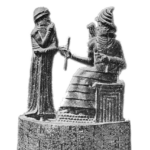 Hammurabi and the Dynasties of Babylon
  Moses’ Return
  The Exodus
  The Birth And Youth of Moses
  Joseph In Egypt
  What Is The LOVE Of God?
  Everything You Believe About God Is WRONG!
  Make Up Your Mind!
  What Is Faith?
  How DARE you FEAR the judgment of God!
  Firstripe Figs
  The Bride Of The Father
  Exodus 40 – The Plan Of God
  The Temple Of God
  Pillars Of The Temple And The Brass Sea
  GEHENNA WITH ‘EM
  When Did God Forbid Polygamy?
  When You Shouldn’t Pray For Someone
  The Sins of the Father
  The First Paul