Part 41: RAMESSES AND ASSYRIA

Ramesses II pushed well beyond Canaan into Syria in his 4th year and successfully captured Syria. But it was a long way from Egypt, while it was quite close to the Hittites, who also laid claim to the territory – at the very least as overlords.
It proved very hard to hold the territory and Syria didn’t stay captured. So Ramesses returned the next year, again won a major victory at Kadesh, but was again unable to hold the captured territory.
But the Israelites were not wasting their time; after God gave Israel deliverance indirectly through the armies of Ramesses in the last year of Jehoahaz (2 Kings 13:4-5), his successor was able to recapture much of the lost territory from Syria due to their weakened state:
2 Kings 13:25 Jehoash the son of Jehoahaz took again out of the hand of Benhadad the son of Hazael the cities which he had taken out of the hand of Jehoahaz his father by war. Joash struck him three times, and recovered the cities of Israel.
Given that the next event in the narrative is the accession of the king of Judah in this king’s second year, this battle probably dates to his first year, and coincides with the 5th year campaign of Ramesses, suggesting that he attacked the Syrians while they were distracted on another front with the Egyptians.
Looking at a map of Ramesses’ campaigns, he studiously avoided the Syrian inland regions, sticking to the coast and to the northern parts; it’s hard to explain why, unless he knew there was another, allied army attacking there.
But note the dramatic reversal of fortunes for Israel; no more than a few years earlier, we are explicitly told that Jehoahaz had only 10,000 foot soldiers. So how could Joash mount such a counterattack and turn it around as early as his first year?
Syria must have been greatly weakened, or Joash greatly strengthened, or both; and the arrival of the Egyptians satisfies both conditions. But new problems were on the horizon…
2 Kings 13:20 Elisha died, and they buried him [during the reign of Joash]. Now the bands of the Moabites invaded the land at the coming in of the year.
We don’t know a precise date for this Moabite invasion, but it was at some point fairly early into Joash’s sole reign, best guess is around ‑848‑849. And this would be the last Biblical mention of the Moabites for some 250 years.
What’s strange is that no information is given as to how they were defeated, much less how they were destroyed so badly that they aren’t heard from again for over two centuries. Why not? Again, why the silence on what must have been a great underdog victory, the second within the same decade?
Because the Israelites didn’t do it.
Who did? The savior, of course. And he told us so.
When Ramesses once more turned towards Syria, in the 7th year of his reign, he had to cope with new kingdoms that had been allowed to develop under the protection of the Hittites, such as Moab and Edom-Seir, as well as groups of Shosu bedouin who made frequent raids into Canaan. In order to resolve this situation he adopted a pincer movement, splitting his army into two sections. One section, led by his son Amonhir-khepeshef, pursued the Shosu across the Negev to the Dead Sea, captured Edom-Seir and marched on Moab as far as Raba Batora. Meanwhile, Ramesses II advanced with the rest of the army on Jerusalem and Jericho. He entered the territory of Moab from the north, took Dibon and joined up with Amonhir-khepeshef. The two armies then marched together on Hesbon and Damascus via Ammon, capturing Kumidi and completely regaining the province of Upi.(A History of Ancient Egypt, Grimal)
Before proceeding we need to point out that despite the confidence portrayed in this quote, there is no actual evidence he marched on Jerusalem or Jericho; that was inferred solely by the route he took – he never mentions it himself, so it really does not belong in the history books because it never happened.
It’s having to fact check every single statement by the authorities that makes my job so hard. They make up so much stuff, always presented with the same level of confidence, that without in-depth research it’s sometimes impossible to tell what’s true and what was invented to make the story seem plausible.
Ranting aside, we once again take a victory lap because the Bible records a Moabite invasion in ‑849, which happens to be the 7th year of Ramesses II in our reconstruction, when Ramesses was invading and conquering Moab and Edom!
Yet oddly, he didn’t attack Jerusalem or any other Judean cities. Historians either assume he did and forgot to mention them (as if) or else conclude this was because those cities had not yet been built; we conclude that it was because those cities were allied with Egypt, their savior.
Which, we believe, is the entire REASON Ramesses invaded Moab and Edom in the first place – an otherwise low-value target both economically and militarily. Why waste time there when his real target was Syria? To protect his allies, of course.
AMAZIAH AND THE THISTLE
Meanwhile, Amaziah king of Judah attacked Edom – which was south of Moab, on the same path as Ramesses II took in his 7th year. It’s interesting that one Israelite record mentions Moab attacking them, and another Judean one mentions the Judeans attacking the Edomites.
Meanwhile a third shows that Ramesses attacked both. And as a result of the Egyptian-reinforced counterattack, the Judeans were able to capture a city and rename it (2 Kings 14:7).
Following that, Amaziah provoked a war with Israel, which ended with the destruction of the wall of Jerusalem and the capture of Amaziah and his humiliating return to his city as a captive (2 Kings 14:8-14), not long before Joash died in ‑839, the 17th year of Ramesses II.
But what’s interesting is a parable that the king of Israel, Jehoash, tells Amaziah to try and talk him out of the war; note that there are three characters involved in the story – a thistle, a cedar, and a wild beast.
2 Kings 14:9-10 Jehoash the king of Israel sent to Amaziah king of Judah, saying, “The thistle that was in Lebanon sent to the cedar that was in Lebanon, saying, ‘Give your daughter to my son as wife. Then a wild animal that was in Lebanon passed by, and trampled down the thistle. You have indeed struck Edom, and your heart has lifted you up. Enjoy the glory of it, and stay at home; for why should you meddle to your harm, that you should fall, even you, and Judah with you?’”
Lebanon is a Biblical symbol for kingship, since royalty built houses out of cedars of Lebanon. The thistle is clearly Amaziah in this metaphor, just as clearly the cedar is Joash; who then is the “wild animal” who “passed by?”
Clearly, this wild animal is not in Lebanon, nor can it be the armies of Samaria as most commentaries have it. This wild beast wasn’t from there. He was just “passing by.” Who can it be, in context? Beasts, in the Bible, refer to kings (Daniel 7:17).
So this refers to some foreign king, passing through the area, who would trample on the thistle for his aggression. Who can that be? After all I’ve said, you’d think the answer would be Egypt. I did, at first. But there’s an even better answer.
THE OTHER BEAST
At this point we have to back up and provide a bit of context from a different direction. The third great power of the time was Assyria, to the east of the Hittites. And the two of them were at war, during the same time:
Adad-Nirari, mighty king… I mustered my chariots, troops, and camps; I ordered them, to march to the land of Hatti. In a single year, I subdued the entire land of Amurru and Hatti. I imposed upon them tax and tribute forever… I received 2,000 talents of silver, 1,000 talents of copper, 2,000 talents of iron, 3,000 linen garments with multicolored trim – the tribute of Mari' – of the land of Damascus. I received the tribute of Jehoash the Samarian, of the Tyrian ruler and of the Sidonian ruler. I marched to the great sea in the west. I erected a statue of my lordship in the city of Arvad, which is in the midst of the sea. I climbed Mount Lebanon; and I cut down timbers: 100 mature cedars, material needed for my palace and temples. (Tell al-Rimah Stela, Livius.org)
This is Adad-nirari III; we date him, for reasons we will explain in the next chapter, to ‑845‑817. This stela is one of two that discuss these events; one, the “Saba’a stela,” is clearly written in his 5th year; the second, the “Tell al-Rimah stela” quoted above, is undated.
Since their content is so similar, the obvious conclusion is that they were written at the same time; some historians agree, but most prefer to put this one far later than the other, saying it was written in his 18th year.
This is in large part due to the mention of Jehoash the Samarian, whom they believe was not yet ruling in Adad-nirari III’s 5th year. We, however, have no problem, since we follow the Bible’s dating and Jehoash was already ruling in Adad-nirari’s 5th year.
Hence, we follow the obvious conclusion – that on or before Adad-nirari’s 5th year (‑840) he took tribute from Jehoash of Israel, and carved both of these stelae.
Starting with his first year [‑845] he campaigned in Syria, and spent most of the next decade off and on in Syria. (Adad Nirari III in Syria, Millard, Tadmor)
As I said above, Ramesses II was also in Syria campaigning in this period; here would be an excellent place for our chronology to fail, for surely Assyria and Egypt and the Hittites cannot all be ruling Syria at the same time.
So we are incredibly pleased to learn that after his 10th year, Ramesses II suddenly stopped campaigning in Syria altogether for no apparent reason. His last visit to the region was the year ‑846.
It cannot be an accident that Adad-nirari III began to campaign in Syria the very next year ‑845.
Again, we are not choosing these dates; they are choosing us, based on conclusions we have drawn for unrelated reasons hundreds of pages ago. Now we simply lean back and let the story tell itself.
THE WILD BEAST
Why would Ramesses suddenly give ground to Assyria? Obviously he didn’t want to engage another great power; but more than that – he simply didn’t need to be in Syria anymore. Ramesses was attacking the Hittites to prevent their Syrian allies from developing a foothold too close to the Egyptian border.
If the Assyrians were campaigning in Syria instead, they could accomplish his goals without his own involvement so Ramesses stayed home, although still technically in a state of war with the Hittites.
So the Assyrians subdued Syria and continued Ramesses’ work pushing back the Hittites, then took tribute and established vassals farther south. One of these vassals was Jehoash, who at some point probably around ‑841 became a subject of Assyria.
Knowing that, we can see that when he sent a letter to Amaziah mocking him, speaking of a “wild beast in Lebanon,”it was well known to everyone in the region that Assyria had been in Syria for several years!
This must have been a very witty riddle to him, since at that very moment Adad-nirari was in Lebanon, cutting cedars for his palace; while both Jehoash and Amaziah dwelt in royal houses made from cedars of Lebanon.
The theory behind paying tribute was something like a mafia protection racket; if you paid them money then “accidents” wouldn’t happen to you, but they also protected you from other gangs. So Jehoash felt secure that if Judah attacked him and he needed help, he could call on his protection from Assyria, the wild beast in Lebanon “passing by.”
And now, the parable makes sense. If Amaziah attacked, he would face the wrath of Assyria even if he won – which, as it happened, he didn’t. So Jehoash had nothing to fear from Jerusalem.
Meanwhile Amaziah’s own confidence was based on his feeling that his own godfather would protect him; a common, and often fatal, faith of the Judeans that the Egyptians would save them (2 Kings 18:21, 24). And as always, they didn’t.
JEROBOAM’S SYRIA
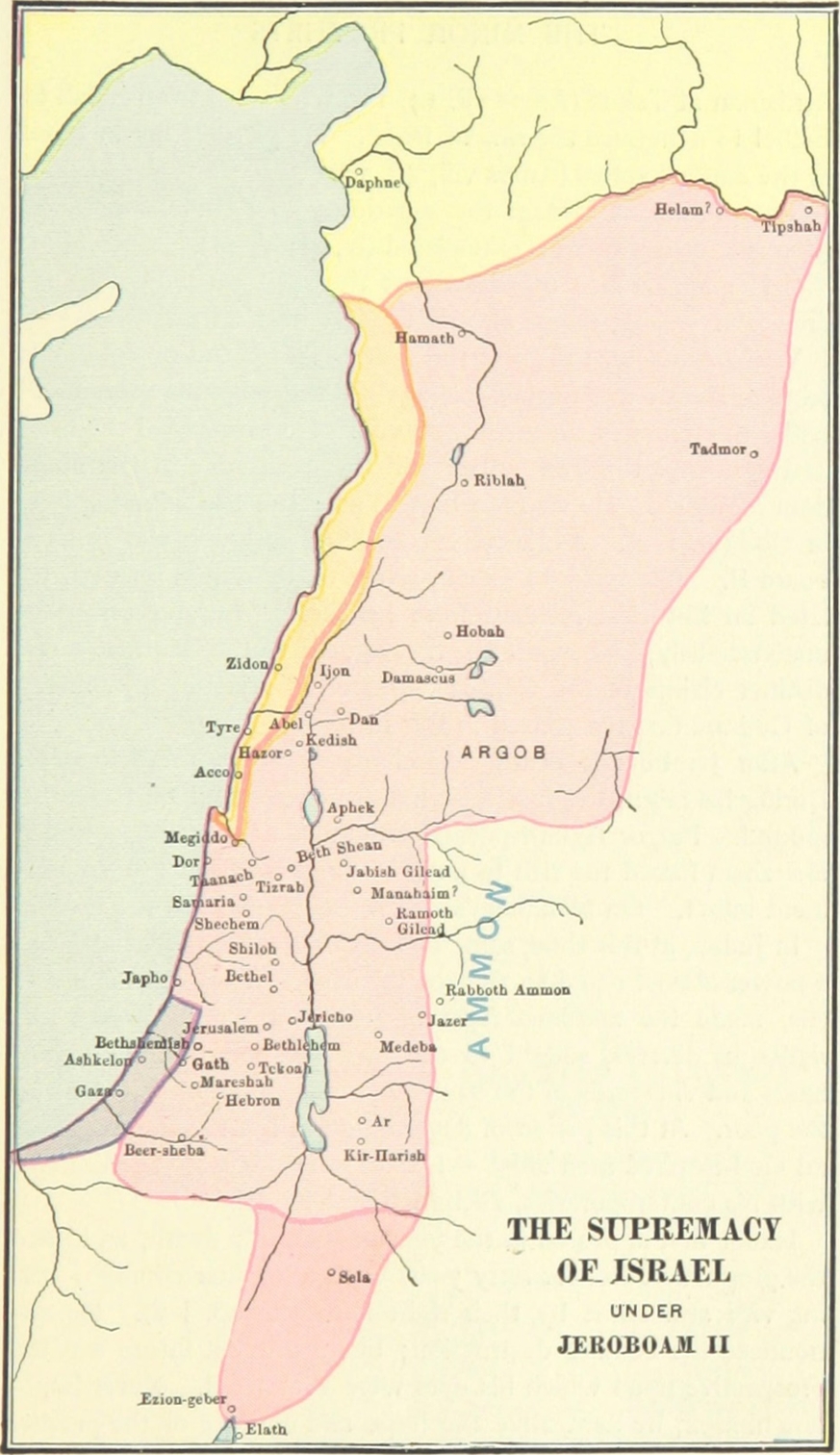 Jeroboam began to reign over Israel in ‑838, the 18th year of Ramesses. He ruled for 41 years, until the time of the Ra’ash catastrophe which we’ll address later. The Bible summarizes his exploits as follows…
2 Kings 14:25-27 He restored the border of Israel from the entrance of Hamath to the sea of the Arabah, according to the word of Yahweh, the God of Israel, which he spoke by his servant Jonah the son of Amittai, the prophet, who was of Gath Hepher. For Yahweh saw the affliction of Israel, that it was very bitter; for there was none shut up nor left at large, neither was there any helper for Israel. Yahweh didn’t say that he would blot out the name of Israel from under the sky; but he saved them by the hand of Jeroboam the son of Joash. Now the rest of the acts of Jeroboam, and all that he did, and his might, how he warred, and how he recovered Damascus, and Hamath, which had belonged to Judah, for Israel, aren’t they written in the book of the chronicles of the kings of Israel?
As noted in the previous chapter, God had saved Israel in the final years of Jehoahaz by the hand of Ramesses II. Jehoash then pushed back and conquered several Syrian cities. Yet here, just 14 years later, there was once again “none shut up nor left at large, neither was there any helper for Israel.”
So what had happened? How had Israel lost everything in such a short time? By the later reign of Jehoash, a little over a decade later, all of the gains had been lost and it was as bad as before. Why? Now we are in a position to answer: the Assyrians happened.
The thin strip of territory pinched between Amurru and Kadesh did not make for a stable possession. Within a year, they had returned to the Hittite fold, so that Ramesses had to march against Dapur once more in his tenth year. This time he claimed to have fought the battle without even bothering to put on his corslet, until two hours after the fighting began… He took towns in Retjenu, and Tunip in Naharin, later recorded on the walls of the Ramesseum. This second success at the location was equally as meaningless as his first, as neither power could decisively defeat the other in battle. In year eighteen, Ramesses erected a stele at Beth Shean… (Wiki, Ramesses II)
Egypt had lost all of this territory over the preceding 8 years precisely when Israel was losing catastrophically to someone in Syria! But interestingly, the Bible never says that they were losing to the Syrians.
Reading closely, the Syrians are clearly named in every earlier conflict to the north; but now, suddenly, it simply says they were “shut up.” The Bible doesn’t identify their oppressor, but we know from the Assyrian inscriptions that Jehoash was paying them tribute – which means he was a servant of Assyria, not Syria.
But for the Assyrians to be able to demand tribute, they must have already passed through, and therefore conquered, Syria itself! Which is why the same stela says that “Mari of Damascus” paid an extensive tribute. Mari is a title, not a name, so most likely refers to Ben-hadad III, whom we never hear from again in the Bible.
The Egyptians had no desire to confront a second great power enemy, so the savior who had helped Israel before, Ramesses II, left them to the Assyrians after his 10th year in ‑846 “and there was no helper for Israel.” Which implies that earlier there had been a helper/savior – Egypt!
And all of this coincided with the accession and first campaign of Adad-nirari III in ‑845. For the next eight years Ramesses did not venture into Syria, but in his 18th year he made some sort of a foray into southern Syria, leaving behind a stela in Beth Shean… in the same year Jeroboam II began to rule, ‑838.
The same year God said “he saved them by the hand of Jeroboam the son of Joash” (2 Kings 14:27), suddenly the Egyptians appear in the region again. Once again we are shocked by the coincidence. The Egyptians seem to show up whenever our chronology needs them, doesn’t it?
The Egyptians don’t have any internal record of this battle; but the stela they left behind is proof positive they were there. After the 18th year, they may or may not have returned to Syria again. But in Ramesses’ 21st year he signed the famous treaty of Kadesh with the Hittites, ending their war in Syria – this would be in the year ‑835.
And guess what? Adad-nirari III never campaigned in Syria again after his 9th year – which is to say, after the year ‑836.
The year the treaty of Kadesh made Syria a neutral zone for great powers, Assyria suddenly vanished.
Aren’t we lucky.
TRIPOLAR WORLD
These facts fit together very neatly. Too neatly to be anything but the truth.
The history of Syria is the 9th century BC version of the “great game” played in central Asia among the great powers in the 19th century. It wasn’t very valuable for its own sake, but for some reason everyone needed to own Afghanistan – and it was the same with Syria.
One of the strongest proofs of our chronology is that whenever we find one nation in the region, the other is suspiciously absent for precisely the number of years we need them to be.
Let me remind you one more time that we have moved the Egyptians 420 years into the future, along with the Hittites. The Assyrians we have moved 54 years into the past, and Jeroboam 45 years into the past compared to conventional Wikipedia dates.
We had excellent reasons for all of these changes, none of which were related in any way to making the timeline of Ramesses II, Adad-nirari III, the Hittites and the Israelite kings align. And yet they meet at every point.
Having done so, we can also extend the same pattern into the past. We already noted how when the Mitanni controlled the region, the Assyrians were notably absent. As soon as they were conquered by the Hittites, Shalmaneser III campaigned extensively in the area.
His last visit to Syria was in his 21st year, which we place at ‑896, following which Assyria made no incursions into Syria until the 1st year of Adad-nirari III in ‑845. Into this vacuum we just happen to know that Seti I attacked Syria in his early reign, roughly ‑860‑858.
Convenient that no Assyrians were there to oppose him; only Hittites, who would certainly have taken control as soon as the Assyrians left in ‑896 to deal with their own internal struggles; struggles which ultimately led to civil war after the death of Shalmaneser III.
Starting shortly after ‑891 the Hittites moved in; then in ‑860‑858 the Egyptians under Seti I challenged them, but left soon after. As a result, the Syrians – no doubt encouraged by the Hittites – set out to conquer Israel and Judah, so that the Hittites could have a larger buffer against Egyptian aggression.
It nearly worked, and Egypt, seeing that the Syrians were about to conquer the Israelites and fearful of a Hittite-dominated neighbor, responded at precisely the right time in history with Ramesses’ 4th year campaign in ‑852.
Then the Moabites invaded Israel in what would be his 7th year, and once again Ramesses invades to defend his Hebrew allies. He continues to invade Syria off and on up until his 10th year (‑846), then suddenly and mysteriously decides he is done in Syria even though the job was very much unfinished.
At precisely this time, Adad-nirari invades Syria in his own 1st year in ‑845. Adad-nirari claims to have conquered the Syrian and Hatti (Hittite) lands, as had the Egyptians, but the Assyrians were much closer, and more committed to keeping the land.
So starting in ‑845 the Egyptians bowed out of the Syrian conflict, leaving the Hittites and the Assyrians as the major players in Syria. Israel suffered immensely under the heavy tribute, until God decided to deliver them through Jeroboam II, whose rule began in ‑838.
Conveniently, the only evidence of Egyptian presence in Syria during the years ‑845‑835 is a stela that was erected by Ramesses in northern Israel at Beth Shean in Ramesses’ 18th year; ‑838, the same year Jeroboam began to conquer there, no doubt with Egyptian help.
Finally in the 21st year of Ramesses, ‑835, the Egyptians signed the treaty of Kadesh with the Hittites. But strangely, there is no evidence the Egyptians were campaigning against the Hittites at the time; so why a spontaneous peace treaty to end a state of war that had lasted for decades?
MUTUAL DEFENSE
The most interesting feature of the treaty is that it not only created a mutual non-aggression pact but also a mutual defense treaty.
‘If another shall come as an enemy to the lands of Ramessu Miamun, the great prince of Egypt, then let him send an embassy to the great king of Kheta to this effect: “Come! and make me stronger than him.” Then shall the great king of Kheta [assemble his warriors], and the king of Kheta [shall come] to smite his enemies. But if it should not be the wish of the great king of Kheta to march out in person, then he shall send his warriors and his chariots, that they may smite his enemies. Otherwise [he would incur] the wrath of Ramessu Miamun, [the great prince of Egypt. … [and the reverse language is used that Egypt will help Kheta – the Hittites];’ (The treaty of Kadesh, the Hittites, Sayce)
Let’s be clear: a mutual defense treaty means there is a third great power which both fear. But in the early 13th century BC, there was no power capable of threatening Egypt with more than border skirmishes.
Which is why historians are surprised that the treaty was made, which didn’t seem to give Egypt anything it needed, and are even more surprised that it was kept. Because they are looking for 13th century reasons!
Considering his relatively stronger position over Hattušiliš, it is unknown what Ramesses hoped to achieve by an alliance with his hated Hittite enemies. After 15 years of futile attempts at regaining his lost territory in Syria, scholars argue that Ramesses now realised that his opportunities to match the military achievements of Tuthmosis III were unrealizable. In that light, it became increasingly important for Ramesses to obtain an international victory through diplomacy to bolster his deeds as pharaoh. (Wiki, Egyptian-Hittite Peace treaty)
This is a very thin speculation, though not impossible. A hollow victory to save face at home is reaching, as explanations go; and reaching is only necessary in the 13th century; because in the 9th century, this makes perfect sense.
Assyria was truly an existential threat at the time, and the treaty of Kadesh is best explained as two great powers aligning in defense against an ambitious and aggressive third… and that only works if Ramesses II is contemporary with Adad-nirari III.
As for the treaty giving Egypt nothing Ramesses II wanted, that’s because historians think the war was motivated by Ramesses’ desire to reconquer territory once held by Thutmose III; but we have already demonstrated that Thutmose III made no such incursions into Syria, nor would he until the 7th century BC.
We, on the other hand, know that Ramesses invaded Palestine solely to defend the Judean and Israelite states from Syrian and therefore Hittite incursions; his desire was not to reclaim lost territory held by a former great king, but to secure a buffer state between him and potential invasions.
Which means this treaty gave the Egyptians exactly what they wanted all along; a buffer against the Hittites and through them, a buffer to the rising threat of Assyria. This was not a hollow victory, it was a total achievement of all of the aims of the war.
That treaty applied only to great powers, however, and did not prevent Jeroboam from retaking what had been the territory of David, which included Damascus and Hamath (2 Kings 14:28). Since all the great powers had withdrawn after pounding Syrian cities for upwards of 30 years, it was an easy target.
How else could a country like Israel, so weak so recently, suddenly take so much territory? Syria had to have been beaten by some great power, which then abandoned it for some reason, whereupon Jeroboam took advantage of their extreme weakness.
Without the Bible, the Egyptian campaigns and the Assyrian withdrawal make no sense.
Without the true history, the actions of the Biblical characters make a lot less sense.
Only together can you get a full picture of what really happened.
UZZIAH
During the middle of the reign of Jeroboam, there is no king mentioned in Jerusalem for 12 years following the death of Amaziah and before the accession of Uzziah; given how long Uzziah reigned (52 years) he was probably a child when his father died, and it’s most likely there was a regent while the young king Uzziah was growing old enough to take the throne.
Whatever the circumstances of the regency, Uzziah began to reign in Judah in ‑811, and God mostly liked him. He rebuilt Jerusalem, which had been conquered and its wall destroyed several times recently, and put catapults and other defensive weapons on its walls (2 Chronicles 26:15).
2 Chronicles 26:6-8 He went forth and warred against the Philistines, and broke down the wall of Gath, and the wall of Jabneh, and the wall of Ashdod; and he built cities in the country of Ashdod, and among the Philistines. God helped him against the Philistines, and against the Arabians who lived in Gur Baal, and the Meunim. The Ammonites gave tribute to Uzziah: and his name spread abroad even to the entrance of Egypt; for he grew exceeding strong.
His reign lasted 52 years until ‑759 and would have overlapped the last 20 years of the reign of Ramesses II, continued into the reign of his successor Merenptah, and even beyond into a period of chaos and civil war in Egypt followed by the rule of Ramesses III (‑751‑720).
For now, what’s interesting is that Ramesses II never again campaigned in Canaan during his long reign, which lasted for 45 years after the treaty of Kadesh, because he didn’t need to. Jeroboam II began ruling in Ramesses’ 18th year, and secured northern Canaan and Syria by proxy.
And Uzziah began to reign in Ramesses’ 45th year, securing southern Canaan by proxy – and it specifically mentions the fame and presumably friendship that he had with Egypt. Another interesting thing is that Uzziah warred with, and conquered, the Philistines.
Meanwhile Ramesses III, who would have reigned shortly after Uzziah’s reign, claims to have fought off an invasion by the “Pelistim,” widely believed to be the first mention of the Philistines in history.
At least… in traditional history. In our history, they’ve been well known since the time of Samuel! And in all that time, they never invaded Egypt. Because it was suicide. And yet we know why they invaded now: Uzziah chased them out of their homelands.
Again – we are either very fortunate, or very lucky, to be able to synchronize a known Philistine invasion of Egypt with a known invasion of the Philistine homeland by a powerful Jewish king, forcing them to retreat to the only possible option: Egypt.
THE END OF UZZIAH
And yet, for all the good that Uzziah did, he made one huge mistake, and we have to wonder what drove him to such a foolish, desperate act. I’m referring to the time when he pushed his way into the temple to offer incense directly to God – the province reserved for the priests (2 Chronicles 26:16-20).
It did not go well, and when the priests tried to stop him and he persisted, he developed leprosy on the spot (Biblical leprosy, which is more of an extreme version of eczema or psoriasis, not what is called leprosy today), which he would have for the rest of his life.
The interesting part for our narrative is, why was Uzziah driven to offer his own incense? Well, incense is directly associated with prayers (Psalms 141:2). Which means Uzziah wanted something from God very badly, something God wasn’t doing when the priests offered it on his behalf, something he was willing to risk breaking the ritual laws of the temple to ask for.
What could that be? Militarily, he was strong, so it wasn’t an enemy. His health seemed to be fine, until that point. Which leaves us the realm of natural disaster, famine, that sort of thing. So it cannot be a coincidence that Uzziah is most famous for “the Ra’ash that occurred in the days of Uzziah” (Amos 1:1, Zechariah 14:5).
The great catastrophe which wiped out most of the Middle East and signaled what’s called “the late bronze age collapse” by historians, a time of mass migration, famine, natural disaster, plague, and invasion.
The end of the bronze age would be an event so terrifying that a king might break the rules in order to try and beg God’s protection. Which of course, is not how you get God’s protection, but when you’re afraid… sometimes you do dumb things.
Don’t worry, we will spend much more time on the Bronze Age Collapse and the events that follow very soon.
THE DECLINE OF ASSYRIA
After the signing of the treaty of Kadesh in Adad-nirari’s 10th year, the Assyrians never again reached the sea like they did in his 9th year. In fact, only two campaigns after that are mentioned in the region, both extremely vague; one just says “campaign against Lusia,” which is generally believed to be near Syria or southeastern Turkey, but may well lie beyond the borders of the treaty.
The other just says “campaign against Mansuate,” which likewise is believed to be in Syria but no one knows exactly where, and may also have lain beyond the borders covered by the Egyptian-Hittite treaty.
Which means in the 9th year of Adad-nirari III, he campaigned in Syria. The next year, he heard that the treaty of Kadesh was signed in ‑835. Knowing that henceforth he would have to confront a united force of Hittites, Egyptians, and their allies the Syrians and Israelites, respectively, he decided that Syria wasn’t worth it, and he never tried again.
Adad-nīrārī’s youth, and the struggles his father had faced early in his reign, caused a serious weakening of Assyrian rulership over their indigenous Mesopotamia, and made way for the ambitions of officers, governors, and local rulers… Despite Adad-nīrārī’s vigour, Assyria entered a several-decades-long period of weakness following his death. (Wiki, Adad Nirari III)
Assyria at this time had a huge border with enemies on every side – Urartu to the north, Babylonians to the south, Medes and Persians to the east, and so on. None of whom were particularly enthusiastic about being Assyrian vassals. And so against all odds, the treaty of Kadesh was kept.
Even the silent third party for whom it was signed, Assyria, didn’t want to upset the balance of power again. In the history books, there is no apparent motivation for this – but we can see clearly why neutral territory there favored everyone involved.
And again, we pause to marvel at the fact that the dates line up so perfectly, even though we’ve moved the Egyptians, Hittites, Assyrians, and Israelites far from their traditional places in chronology.
Yet having done those things for completely unrelated reasons, and having stuck to those committed dates faithfully… what are the odds these events between Israel, Egypt, and Assyria all line up so perfectly, with no fiddling required?
What else could explain such repeated coincidences, to the year, other than our timeline being correct?
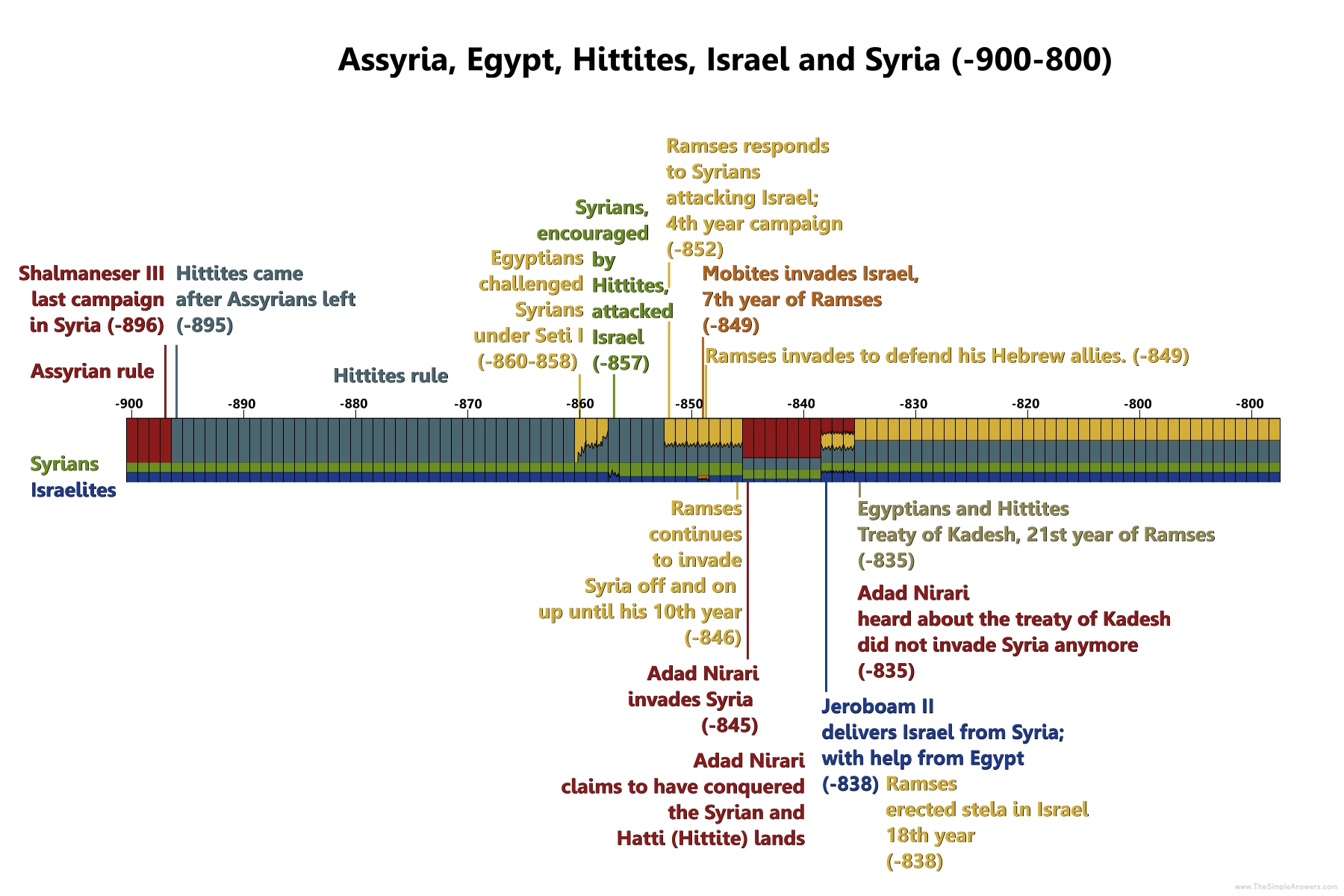
In the traditional history, historians can offer no persuasive explanation why, after decades of campaigning in Syria, Ramesses II suddenly just gave up in his 10th year, nor why they agreed to a peace treaty – nor why the Hittites let them.
Nor is there any convincing explanation for why (in the traditional history) 450 years later the Assyrians spent a decade subjugating Syria then suddenly vanished after a decade.
No one can explain how Israel went from being “shut up” and powerless to conquering lands not held since the time of David two centuries before.
The treaty of Kadesh solves everything for us, just as it did for the signers.