The Richest Man in History
This is part 37 of the The History of the World Series
; The History of the World is part 1.
Click here to read in series
King Solomon was rich beyond imagination, relative to civilizations of the time. And one of his main sources of wealth was the fabulous gold mines of Ophir; general consensus places it in Africa. That is not, however, correct.
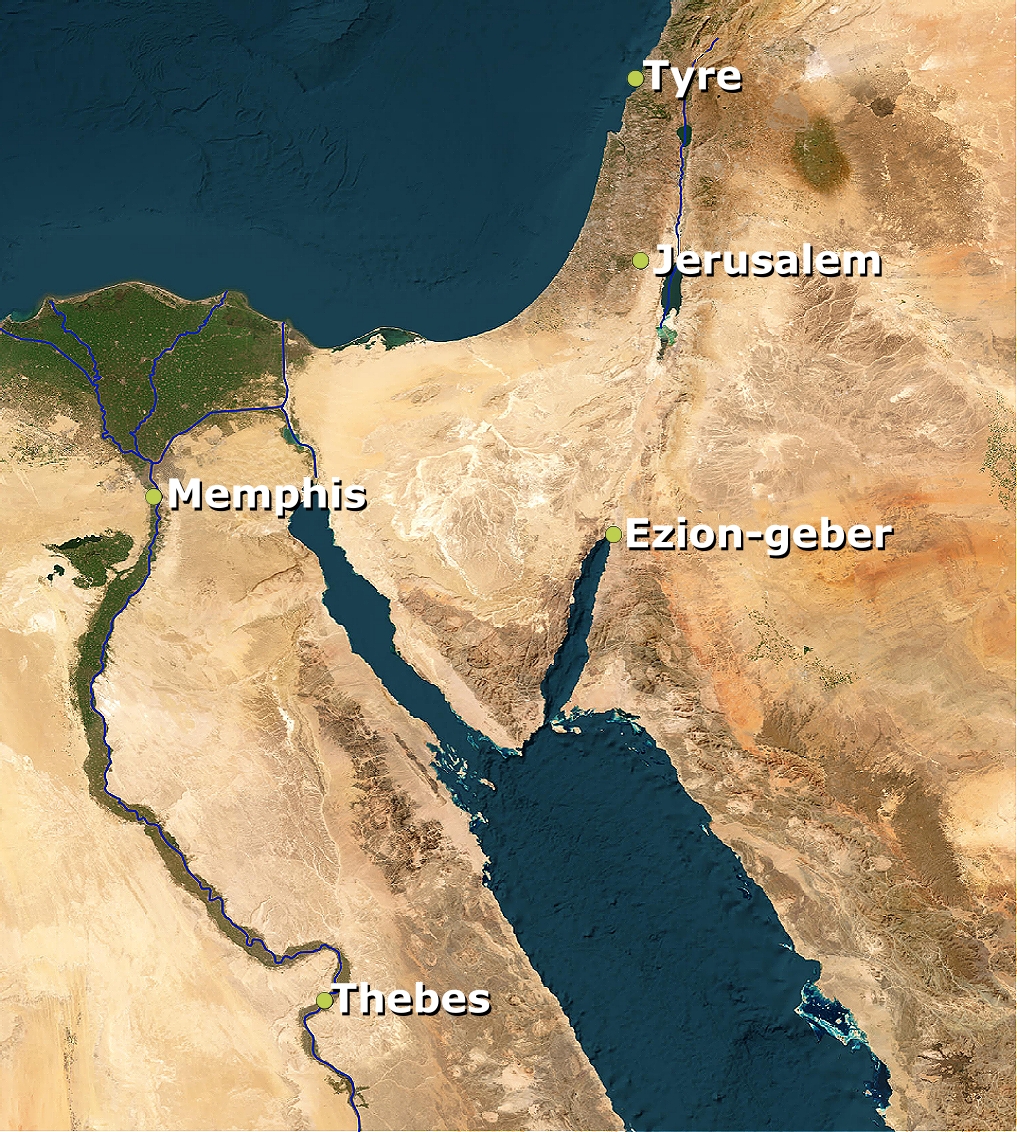
1 Kings 9:26-28 King Solomon made a navy of ships in Ezion Geber, which is beside Eloth, on the shore of the Red Sea, in the land of Edom. Hiram sent in the navy his servants, sailors who had knowledge of the sea, with the servants of Solomon. They came to Ophir, and fetched from there gold, four hundred and twenty talents, and brought it to king Solomon.
 The wealth of King Solomon’s mines has long been fabled, and if these measurements are to be believed, every three years the mines brought something like 14-18 metric tons, worth something like 2-3 billion dollars today; but that grossly understates the real purchasing power of that much gold in those times; if you compare it to what that gold could buy in those days – labor, cattle, grain, etc. – you reach a valuation in our terms on the order of 100 billion dollars income per year.
But that also doesn’t capture the meaning, since it needs to be understood in the context of ancient empires. This is roughly the value of the yearly tribute of the entire Persian Empire under Darius, which was roughly 40 times larger by land area, with a proportionately larger population.
So saying that Solomon was rich is like saying the British Empire was rich. Of course, Solomon had spent a great deal of this revenue on buildings and luxuries and wives and gifts to other nations – but still, “the king [Solomon] made silver and gold to be in Jerusalem as stones… for abundance” (2 Chronicles 1:15).
And a significant portion of that came from Ophir. So to find Ophir, we need only locate an immense deposit of gold, worked in antiquity, that could be reached by these boats using hired sailors from Hiram, king of Tyre. The harbor was built in Ezion Geber, which is the highest point of the northeast fork of the Red Sea in what is today the gulf of Aqaba.
This means the destination must be somewhere in the Indian Ocean; either the east coast of Africa or the coasts of Mesopotamia, Iran, or India. Since there are no gold deposits to speak of in all of Mesopotamia, and few in Iran, this narrows it to Africa or India.
1 Kings 10:22 For the king had at sea a navy of Tarshish with the navy of Hiram: once every three years came the navy of Tarshish, bringing gold, and silver, ivory, and apes, and peacocks.
These nouns are modern translations; and whenever you have a rare word in an ancient text, you have to be very careful how you translate it. This is why many Biblical translations for precious stones, exotic spices, and rare animals must be considered only one of many possible things meant by that Hebrew word; think words like onyx, diamond, badgers, unicorns, owls, etc. We really don’t know what these words mean for sure.
Fortunately, in the case of peacocks and apes, we do, and we can prove it beyond a reasonable doubt. Why? Because they are loan words from the Tamil language – the language of southern India.
There is no question among scholars and scientists but that these statements are true, as the ships of Solomon are known to have visited the coasts of India and Ceylon, and Tarshish was on the Malabar coast of India, where the native name of the peacock was tokei, from which tukkiyim undoubtedly was derived … The historian Tennant says that the Hebrew names for “ivory” and “apes” were also the same as the Tamil. (International Standard Bible Encyclopedia)
Words for exotic things are adopted into a culture in one of two ways; a native-language descriptor either describing the item (pine-apple, prickly pear, etc.) or describing where it came from (Guinea pig, although it is neither from Guinea nor a pig; Sardines, from Sardinia, Italy; fine china from China, etc.).
The second way is simpler; you simply copy the foreign word and use that as the name for this new item. Examples of this in English include “banana” from the native Wolof word in west Africa via Portuguese traders, “coffee” from Arabic “qahwah,” “tomato” from Aztec “tomatl,” etc.
To our point, Hebrew simply adopted the Tamil word for exotic creatures no Israelite had ever seen; tukkiyim is the plural of the Hebrew tukki; obviously derived from the Tamil word tokei. And since peacocks are only native to east Asia, this means Solomon’s ships went to Asia – and therefore, that Ophir was also in Asia.
Precisely where we placed it in chapter 9, for completely different reasons.
THE MINES OF OPHIR
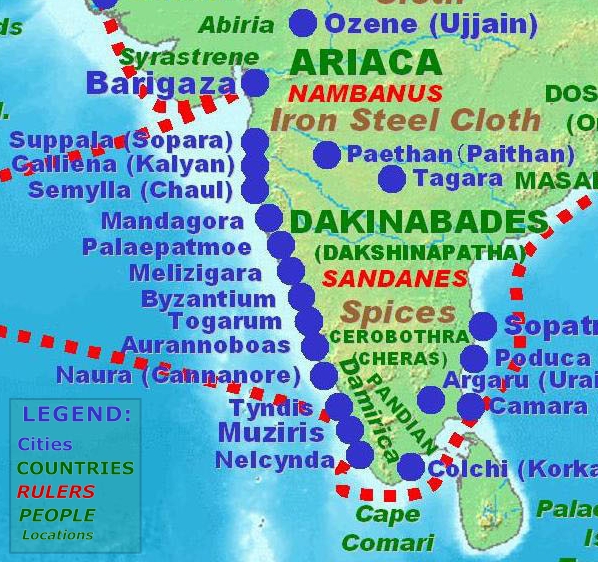 As already noted in chapter 9, around the time of Christ a document was prepared by sailors called the “Periplus of the Eastern Sea.” As we said then, Sopara in this document is effectively identical to Ophir, linguistically:
In the Septuagint, other variants of the name are mentioned: Ōpheír, Sōphír, Sōpheír and Souphír. (Wiki, Ophir)
Sopara (by some identified with the Ophir mentioned in the Hebrew texts) was an ancient port town and the capital of the ancient Aparanta. The ancient port of Sopara was the most important port in western India after the celebrated port of Cambay. The site of this ancient town is located near the present-day Nala Sopara. In ancient times, it was the largest township on India’s west coast, trading with Mesopotamia, Egypt, Cochin, Arabia and Eastern Africa. (Wiki, Nallasopara)
But can we narrow it down to a specific mine? I think we can. There are only two ancient gold deposits of size sufficient to even potentially supply the enormous amount of gold Solomon received from Ophir, Hutti and Kolar.
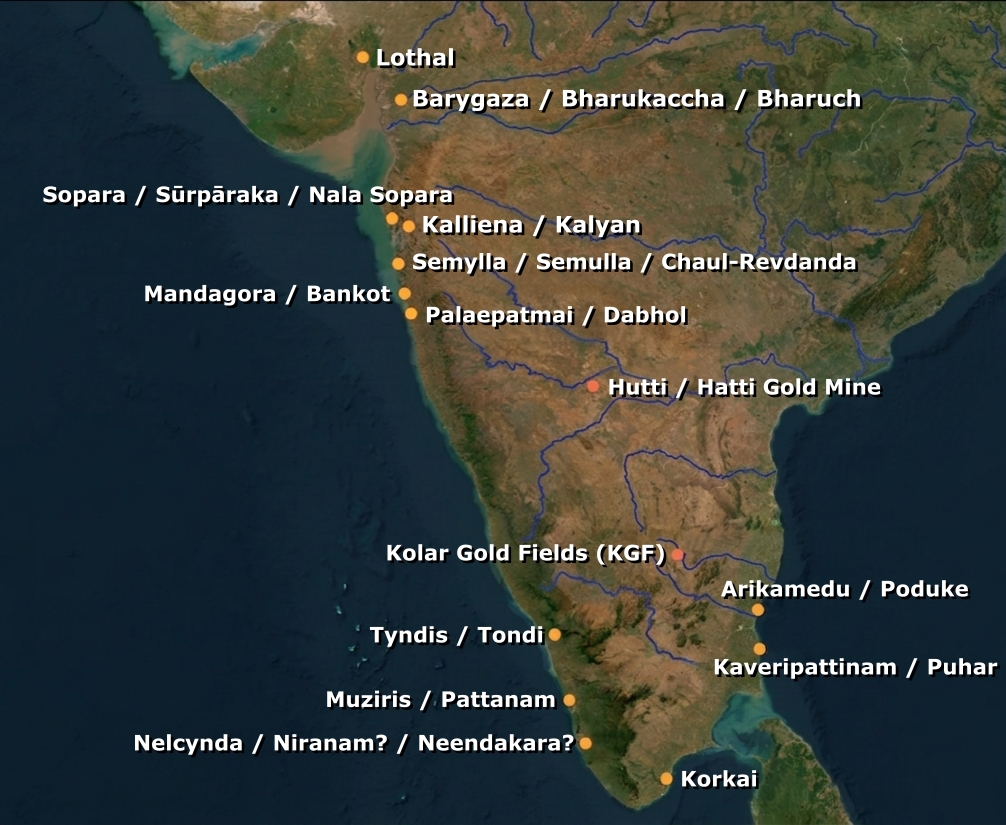 The map aboveat right shows ports that were potentially viable in Solomon’s time, and the two mines that could potentially have supplied him – Hatti and Kolar. There are in fact dozens of gold sources in this region, but not many that were mined that far back in antiquity or which could have supplied gold on the scale he received.
…the KGF [Kolar Gold Fields] have a history that extends way back before any European involvement. These mines, in effect, provided great wealth to the rulers of southern India in medieval times and much earlier, as suggested by carbon dates of 1890 +/- 70 BC and 1810 +/- 70 for timbers found in old workings at a depth of eighty metres underground in the Oakley shaft at the Hutti gold field, which lies about 100 km [north] of Kolar.
The deposits are rather unusual in that almost all the ore is in primary quartzite veins with little or no secondary deposits. Thus, the mines are nearly all in hard rock, and as the veins dip very steeply even the early workings can be at depth. At Kolar the early workings have been intercepted at up to thirty metres below ground, and at Hutti workings worked by the traditional method of firesetting have been encountered over 200 metres below ground (Old Ways in the Kolar Gold Field, Craddock).
Both of these fields were worked in antiquity long before Solomon, and the sheer scale of that ancient working is hard to fathom; a 200 meter – 700 foot – deep pit through solid rock is no small feat without modern engineering; it’s not that easy with industrial technology!
This excavation was done by building a fire on a quartz vein to get it hot, then dumping water on it; the thermal shock caused it to shatter, making it possible to pry it out and crush it to dust and then pan the dust to separate the gold from the quartz. A labor intensive process, especially considering an especially rich vein might contain only 100 grams of gold (3 ounces or so) per ton of ore.
Of these two sources, Kolar is much richer, capable by itself of supplying sufficient gold for Solomon – although whether it could do so fast enough with traditional technology is debatable. However, the gold probably didn’t come from a single mine, but rather from a single culture, “gold from Ophir.”
As you see on the map above, Sopara/Ophir is not particularly close to either site. This suggests either that it was the head of trading network which brought gold to that point for trading to the west, or else that Ophir was the farthest town name that was familiar to the Hebrews, and they inaccurately gave that name to the entire region beyond it.
This is not at all unprecedented; the name “India” is derived from the Indus River, which today isn’t even in India; it was merely the most famous feature given to the immensely varied lands and peoples beyond it by the Greeks, which persisted up to modern times.
So whether Solomon sent boats to Poduke near the Kolar gold fields and his sailors called that “the land of (beyond) Ophir,” or whether they went to Sopara and purchased gold brought overland via trade routes is, and probably will remain, unknown.
But he did trade with India, and Ophir was definitely there somewhere; and the ultimate source of the gold is almost certainly the Kolar gold deposits, possibly with help from the Hutti gold mines and others scattered across southern India.
THE MERCANTILE EXCHANGE
Hatshepsut is known to have had basically peaceful relations with her neighbors, and to have traded with Canaan. Indeed, scholars believe her trade contacts with many countries might have been made through Canaan:
Similar paintings in the reigns following Hatshepsut show less familiarity with the dress and trade objects from Crete, and scholars have concluded that the trade contact may have been through Syria-Palestine rather than directly. (Oxford)
Given that the Bible records the extensive trade networks of Solomon across the world, this makes perfect sense; Egypt traded with Jerusalem, which in turn traded with Tyre, which in turn traded with the whole Mediterranean.
Not satisfied with that, Solomon put them to work plying their wares across the Indian Ocean as far as India – and if they went east, they may have gone south as well. And this is only his sea-based traders. We know he also controlled an immense number of land trade routes.
1 Kings 10:23-27 So king Solomon exceeded all the kings of the earth in riches and in wisdom. All the earth sought the presence of Solomon, to hear his wisdom, which God had put in his heart. They brought every man his tribute, vessels of silver, and vessels of gold, and clothing, and armour, and spices, horses, and mules, a rate year by year. … The king made silver to be in Jerusalem as stones, and cedars made he to be as the sycamore trees that are in the lowland, for abundance.
Israel is uniquely well situated to be a merchant nation; you cannot get from Egypt to Asia by land without passing through it, nor vise versa. It has access to both the Mediterranean and Red Seas, allowing it to connect to two immense and diverse trade networks by sea.
1 Kings 10:28-11:1 The horses which Solomon had were brought out of Egypt; and the king’s merchants received them in droves, each drove at a price. A chariot came up and went out of Egypt for six hundred shekels of silver, and a horse for one hundred fifty; and so for all the kings of the Hittites, and for the kings of Syria, they brought them out by their means. Now king Solomon loved many foreign women, together with the daughter of Pharaoh, women of the Moabites, Ammonites, Edomites, Sidonians, and Hittites;
When strong enough to stand between these nations that surrounded it, Israel could name its own prices on goods that passed through its borders, as it did above with fixed rates for Egyptian horse and chariots.
Strong alliances with the Phoenicians, indisputably the best sailors of the time, working in both oceans, would guarantee that not a camel or a boat could pass between Egypt and Asia without payment going to Hiram and Solomon.
1 Kings 4:21 Solomon ruled over all the kingdoms from the River [Euphrates] to the land of the Philistines, and to the border of Egypt: they brought tribute, and served Solomon all the days of his life.
His control of the land as far as the Euphrates meant that the east-west trade routes between Mesopotamia and the Hittites would have had to pass through his territory as well, or else would have required a costly detour north through Assyrian-Mitanni lands.
Thus, this kingdom was uniquely situated, geographically, to extract a percentage of almost every trade that happened between every kingdom in the known world from India to Spain and possibly beyond. No wonder he was wealthy beyond compare.
As the wisest man to ever live, he learned long before modern financiers did that if you want to become stupid rich, you don’t work, you don’t make things yourself, you don’t even hire people to make things for you; instead, you need to be in a position to take a small slice of everyone else’s work.
And that’s exactly the position God placed him in. And the position he left to his heir Rehoboam, who managed to lose it all in just five years. A risk Solomon was acutely aware of:
Ecclesiastes 2:18-19 I hated all my labour in which I laboured under the sun, because I must leave it to the man who comes after me. Who knows whether he will be a wise man or a fool? Yet he will have rule over all of my labour in which I have laboured, and in which I have shown myself wise under the sun. This also is vanity.
Rehoboam was definitely in the fool category; and with that background, we can now solve another mystery; the wealth of Amenhotep III.
EARLY DIVIDED ISRAEL PERIOD
Amenhotep II – Shishak – reigned 26 years, and was succeeded by Thutmose IV in ‑969. During this time Jeroboam had solidified his grip on Israel, and adopted at least one Egyptian practice: the worship of Hathor.
1 Kings 12:27-30 “If this people goes up to offer sacrifices in the house of Yahweh at Jerusalem, then the heart of this people will turn again to their lord, even to Rehoboam king of Judah; and they will kill me, and return to Rehoboam king of Judah.” Whereupon the king took counsel, and made two calves of gold; and he said to them, “It is too much for you to go up to Jerusalem. Look and see your gods, Israel, which brought you up out of the land of Egypt!” He set the one in Bethel, and the other put he in Dan. This thing became a sin; for the people went to worship before the one, even to Dan.
This is a conscious mimicry of the golden calf they made at Sinai, down to the exact same words – although why he’d think that was a good plan to copy is beyond me. And that calf was itself a direct adaptation of the Egyptian goddess Hathor, often worshiped as a golden cow.
Anyway, God reacted about as well as you’d expect Him to, vowing that Jeroboam’s entire line would be cut off after his reign, which of course happened (1 Kings 13-14).What’s interesting for our purposes is when it happened, and how it happened:
1 Kings 15:25-28 Nadab the son of Jeroboam began to reign over Israel in the second year of Asa king of Judah; and he reigned over Israel two years… Baasha the son of Ahijah, of the house of Issachar, conspired against him; and Baasha struck him at Gibbethon, which belonged to the Philistines; for Nadab and all Israel were laying siege to Gibbethon. Even in the third year of Asa king of Judah, Baasha killed him, and reigned in his place.
Thanks to the many synchronisms between Judah and Israel like the one in the last part of that quote, we know that Baasha formed a conspiracy against Jeroboam and formed a rebel kingdom that was parallel with Nadab’s in ‑968 or ‑969.
At first, the Bible simply says that Jeroboam “slept with his fathers,” without saying anything about the manner of his death; but later, when Baasha turned out to be no better, God cursed him for “provoking him to anger with the work of his hands, in being like the house of Jeroboam; and because he killed him” (1 Kings 16:7).
Which makes sense, because the death of Jeroboam coincides with the beginning of Baasha’s reign; regardless, he was not able to take the kingdom immediately and competed with Nadab for 2 years, until he finally achieved sole rule.
What’s interesting is the timing; why didn’t Baasha do something before this? Why only now conspire against Jeroboam and his family? It surely can’t be a coincidence that Baasha’s rebellion began, and Jeroboam died, in ‑969… the same year as Amenhotep II died!
RISE OF AMARNA
Without Pharaoh’s support, Jeroboam’s house was weak. Judah had a new king, Asa, who had gotten rid of most of the idols and God was happier with them, so they were rising in power and (apparently) were no longer vassals of Pharaoh after the death of Rehoboam.
1 Kings 15:16-20 There was war between Asa and Baasha king of Israel all their days… Then Asa took all the silver and the gold that were left in the treasures of the house of Yahweh, and the treasures of the king’s house, and delivered them into the hand of his servants; and king Asa sent them to Ben Hadad, the son of Tabrimmon, the son of Hezion, king of Syria, who lived at Damascus, saying, “There is a treaty between me and you, between my father and your father. Behold, I have sent to you a present of silver and gold. Go, break your treaty with Baasha king of Israel, that he may depart from me.” Ben Hadad listened to king Asa, and sent the captains of his armies against the cities of Israel, and struck [them].
This confirms a lot that we said in the previous section; Asa of Judah was allied with Syria against Israel – enemy of my enemy, and all of that. We also learn that his father had also been allied with Syria, for the same reasons.
But it also says that there was currently a treaty between Syria and Israel; why? Syria clearly hated Israel, and both Asa and Rehoboam had, at one point, been allies with them against Israel; how, then, did they come to make a treaty against Israel? Because Egypt forced them to, in the 7th year of Amenhotep II when he invaded Syria!
For the first 5 years of his reign, Rehoboam must have made treaties with them to encourage the Syrians to invade Israel and harass them; at that time, he still had tons of gold (literally) from Solomon’s tribute. Jeroboam, who had no such golden resources then requested Egypt’s help, who then invaded the Syrians and forced a peace treaty with Israel, which they respected as long as Amenhotep II lived.
Then two years later in ‑986 when Jeroboam was being invaded by Judah, Egypt again intervened in favor of Israel and made Rehoboam a vassal. After Amenhotep’s death in ‑969 Judah must have declared independence.
At the same time, to the year probably, Baasha killed Jeroboam and then opposed Nadab; whereupon Asa bribed Baasha to break the Syrian-Israelite treaty imposed by Egypt – which means they must not have feared reprisals from Egypt.
Why not? Because a new, weak king was in power?
THUTMOSE IV
Since his identity was also stolen by a 7th century copycat, it’s hard to say what happened during the decade that Thutmose IV reigned; the dream stela from the Sphinx, associated with his unexpected rise from a younger heir to becoming pharaoh, almost certainly belongs to Thutmose IVb. More on that in its proper place.
In the southern regions of Palestine, Thutmose [IV] can only be said to have taken punitive action against Gezer; actual warfare cannot be proven. (Oxford)
That’s interesting, because a silent Egypt is usually a weak Egypt. And so to flesh out this period, we have to turn back to the Bible. As has been said, Asa was a good king and “In his days the land was quiet ten years… for the land had rest, and he had no war in those years; because the LORD had given him rest” (2 Chronicles 14:1, 6).
What’s interesting is that coincides almost exactly with the decade of Thutmose IV’s reign as we have it, ‑969‑959. Thus, the land had rest until the 11th year of Asa, ‑960. Then the land no longer had rest. We don’t know what happened at first, but in the 15th year things came to a head:
2 Chronicles 14:9, 12-14 There came out against them Zerah the Ethiopian… So Yahweh struck the Ethiopians before Asa, and before Judah; and the Ethiopians fled. Asa and the people who were with him pursued them to Gerar: and there fell of the Ethiopians so many that they could not recover themselves; for they were destroyed before Yahweh, and before his army; and they carried away very much booty. They struck all the cities around Gerar; for the fear of Yahweh came on them: and they despoiled all the cities; for there was much spoil in them.
Asa’s army fielded 580,000 men, against a million-strong army led by Zerah the Ethiopian; this was certainly an Egyptian-commanded army, since the Ethiopians and Libyans couldn’t possibly have gotten to Judah without going through Egypt, nor would they have had any reason to attack such a distant country.
The subsequent loss of one million troops would go a long way towards explaining why Egypt was not expansionist for the next few generations. The peace that Asa enjoyed after the victory endured through the reign of his son Jehoshaphat.
As for the dating, the battle is narratively connected to Asa removing the idols from Israel and restoring the altar to the Lord, and then the nation making a new covenant with God which was finished in the 15th year of Asa, or ‑956.
The covenant was made after considerable cleansing of priesthood and rebuilding of the temple was done (2 Chronicles 15:1-10). This could have taken anywhere from a month to a few years; all we know for certain is that the battle above could have taken place any time between the 11th and 15th year of Asa.
The 11th year of Asa would coincide with the 9th year of Thutmose IV’s ten years; so it’s interesting that at the very end of the reign of Thutmose, the Bible records an attack on Canaan which resulted in a catastrophic defeat.
It should be noted Zerah was not said to be a pharaoh here. He must have been the general of either Thutmose IV or Amenhotep III, almost certainly the former, and the battle was probably in some way related to the cause of Thutmose IV’s death. If so, it took place in Asa’s 12th year, ‑959.
What is beyond argument is that the next pharaoh, Amenhotep III – though immensely wealthy – is only known to have participated in a single military action, to quell a rebellion in Kush. Possibly unrest caused by the death of one million Kushites – Ethiopians – in a failed military action in Canaan.
So once again, we are very pleased that our chronology reliably places the destruction of the Egyptian army as told in the Bible to coincide with the death of Thutmose IV and the arrival of peace in Canaan.
THE RICHEST MAN
Following the death of Thutmose IV, Amenhotep III kept his armies in Egypt and pursued a policy of peace and diplomacy, using gold to influence the balance of power throughout the Middle East.
His reign was a period of unprecedented prosperity and splendour, when Egypt reached the peak of its artistic and international power, and as such he is considered one of ancient Egypt’s greatest pharaohs… When Amenhotep died, he left behind a country at the very height of its power and influence, commanding immense respect in the international world. (Wiki, Amenhotep III)
He is widely considered to be the richest man to have ever lived. Ever. His net worth is estimated at something like 4-6 trillion dollars in today’s money. That’s T-Trillion. How does a country, less than a century after being slaves to the Hyksos, find that level of wealth?
Historians have a lot of vague explanations like trade and so on, but there had always been trade. There had always been mines in Nubia; there had never, before or since, been this level of wealth. So what made this generation so immensely rich? Solomon’s money, which he had gathered from the four corners of the Earth.
Amenhotep II, Shishak, had looted the temple of all of Solomon’s immense wealth, then taken over all of the treaty relationships that Solomon had cultivated with the Hittites, Babylonians, and Mitanni – which means money which flowed to Solomon would now flow to him.
This is in addition to Egypt’s own mineral and agricultural wealth, gold mines in Nubia, and so on. Fortunately for Israel and Judah, Egypt wasn’t particularly expansionist at this point, provided the money kept on coming.
The first half of Amenophis III’s long reign was an era of prosperity such as Thebes had never previously enjoyed. The most costly products of Nubia and Asia flowed to the Southern City in an uninterrupted stream, to which Crete and even Mycenae seem to have added contributions. (Gardiner)
Long inscriptions recount his [Amenhotep III] benefactions at Karnak and at Luxor, and one dedicatory text even furnishes details of the gold and semi-precious stones which he devoted to their adornment; needless to say, the figures are quite incredible. (Gardiner)
Gardiner is referencing the following text, to give you an idea of what we’re talking about:
The king made a monument for Amun, making for him a very great gateway before Amun-Re lord of the thrones of the two lands, sheathed entirely in gold, a divine image according to respect, filled with turquoise [one-half ton], sheathed in gold and numerous stones [two-thirds ton of jasper]. The like had never been made… Its pavement was made of pure silver, its front portal inset with stelae of lapis lazuli, one on each side. Its twin towers approach heaven, like the four supports of the sky. Its flagpoles shine skyward sheathed in electrum. (Wiki, Precinct of Amun-Re)
Amenhotep III made a temple in Egypt, a place known for its flamboyant monuments and offerings to the gods, that “the like had never been made,” the floor paved with silver – which was more valuable in Egypt than gold, since it was more rare, and a half ton of turquoise. And this was just one offering.
When Amenhotep III died, he left behind a country that was wealthier and more powerful than it had ever been before. The treaty with Mitanni concluded by his father had brought peace and stability, which resulted in a culture of extraordinary luxury. A large percentage of the income generated by Egypt’s own resources and by foreign trade went into building projects of an unprecedented scale; inscriptions enumerate the enormous quantities of gold, silver, bronze, and precious stones used in the construction and decoration of the temples. Egypt’s wealth was symbolized by the sheer size of the monuments – everything had to be bigger than before, from temples and palaces to scarabs, from the colossal statues of the king to the shabti figures of his elite. (Oxford)
Thanks to Solomon’s wealth, and Israel’s sins, Egypt became the most powerful civilization in history up to that time. Truly a high-water-mark for Egypt’s position in the world, beginning what’s known as the Amarna period – when a well-intentioned but ultimately catastrophic attempt to convert Egypt to the religion of the one true God brought it all tumbling down.

This is part 37 of The History of the World Series
 After Amarna
  Akhenaten the Heretic
  Thutmose III and Shishak
  Solomon and the Queen of Sheba
  What Is The LOVE Of God?
  Everything You Believe About God Is WRONG!
  Make Up Your Mind!
  What Is Faith?
  How DARE you FEAR the judgment of God!
  Firstripe Figs
  The Bride Of The Father
  Exodus 40 – The Plan Of God
  The Temple Of God
  Pillars Of The Temple And The Brass Sea
  GEHENNA WITH ‘EM
  When Did God Forbid Polygamy?
  When You Shouldn’t Pray For Someone
  The Sins of the Father
  The First Paul