Solomon and the Queen of Sheba

This is part 35 of the The History of the World Series
; The History of the World is part 1.
Click here to read in series
After Kamose and then Ahmose chased out the Hyksos in the time of Saul, his son Amenhotep I ruled for 21 years which we date to ‑1075‑1054. Since he seems to have had no sons, he chose Thutmose I as his heir, who married a royal woman – generally believed to be Amenhotep I’s sister – to ensure his legitimacy.
Thutmose I reigned 13 years, it’s generally believed; he appointed his son Thutmose II as his heir along with his half-sister Hatshepsut, who was also his wife (ancient Egyptians, am I right?) whose rule is… complicated.
Historians have spent a lot of time debating the exact details of Hatshepsut’s succession, and her relationship to Thutmose I and II. For one thing, she claimed that Thutmose I appointed her as king directly, which would make her co-Pharaoh, not merely a queen subject to a king.
Historians are, of course, very skeptical of this and call it later propaganda. But in their haste to dismiss her claim to have been co-king, they then must struggle to explain why despite reigning only 22 years, she celebrated a 30-year jubilee (a big deal in Egypt)… and stranger still, it was celebrated in her 16th regnal year.
As a festival celebrated (with the object of replenishing his powers) in the 30th year of a king’s reign, the sed-festival is chronologically relevant, and has frequently been included in chronological discussions. The apparent exceptions to the 30-year rule led to the assumption that this festival was regularly celebrated every 30 years, regardless of actual reigns. However, most of the exceptions have been eliminated, and there remain only a few uncertain cases (Hatshepsut, Akhenaten), which can be explained in terms of particular circumstances. In the case of Hatshepsut, the celebration can be linked to the accession of Thutmosis I (or II); in Akhenaten’s case it can be anchored to the transition to the worship of Aten as king. A rigid 30-year sequence—as has occasionally been proposed—is improbable in the extreme. (Ancient Egyptian Chronology, Hornung)
We agree completely; her husband’s 13 year reign, if included as her own co-reign, would give her a total of 35 years of reign; plausible for a woman whose mummy was 60 or so years old at death. This also explains why she was such a powerful figure at court after the death of her husband – she was already co-Pharaoh for 13 years.
When Thutmose II died leaving behind his young son Thutmose III, historians believe that Hatshepsut was hungry for power and transitioned from regent to proper king, leaving Thutmose III in her shadow until her death.
When he died, historians consider her to have been queen regent, and later in her life decided to grab for power at the expense of her now-adult son Thutmose III, for which – in their narrative – he later resented her.
But based on her sed-festival celebration, she considered herself to have already been co-Pharaoh with her husband from the beginning of his reign. Which means there was no need for her to use her son’s rule to claim power as regent; she was already a Pharaoh, although possibly a junior Pharaoh in Thutmose II’s shadow.
That being said, she may have been the real power behind the throne of her husband all along. I say that because despite ruling 13 years, Thutmose II is very poorly documented in ancient monuments; so much so that historians question whether he really ruled that long at all, despite Manetho giving him 13 years.
But a powerful queen who ruled in her husband’s name would create just such a vacuum of evidence; perhaps Thutmose II was weak, sick, or simply an idiot. His mummy has been found – at least, we think so, although it’s not beyond question – and it died at less than 30 years of age, supporting the idea that his wife was the real power behind his throne.
And why not; she was appointed co-Pharaoh by their father.
HATSHEPSUT
As the most powerful female Pharaoh ever, and the first since Sobekneferu, Hatshepsut stands out. While we have yet to place her precisely in history – though we are about to – she clearly belongs to the era of Solomon (‑1031‑991) in our chronology.
This makes her not only a prime candidate, but the only candidate for the famous “Queen of Sheba” who came to visit Solomon, to learn of his wisdom and see the wealth of his kingdom, specifically including the house he had built (1 Kings 10:1-10).
We know this took place during or shortly after his 24th year, because the building of the Temple in Jerusalem began in his 4th year and together with his own house took a total of 20 years to finish (1 Kings 6:37, 9:10), which is the immediate context of this chapter, and which he explicitly showed her.
Josephus adds a bit of detail, telling “There came to him the queen of Egypt and Ethiopia, to see him and to behold his glory” (Antiquities 8.165). Now at this point, Hatshepsut did indeed control Egypt and the land of Nubia – called Kush by the Egyptians, and synonymous with Ethiopia in ancient times.
In ancient times, the name Ethiopia was primarily used about the modern-day nation of Sudan which is based in the Upper Nile valley and is located south of Egypt, also called Kush. (Wiki, “history of Ethiopia”)
Which makes it basically proof-positive that Hatshepsut is one and the same person with the Queen of Sheba. It really couldn’t have been anyone else – there weren’t that many powerful queens of Egypt who also ruled over Ethiopia!
And as always, the only reason everyone hasn’t always known this – because all the evidence points to it – is that she is wrongly believed by basically everyone to have lived 450 years too early! Because in all of Egyptian history, no other queen of Egypt could possibly fit the bill.
As an interesting aside, though of almost no value as proof, the 14th century A.D. Ethiopian legend of the Queen of Sheba identifies her as Makeda; Hatshepsut’s throne name was Ma’atkare, often spelled Makare. Take that for whatever it’s worth.
Now if her reign after the death of Thutmose II was 22 years as both Manetho and Egyptologists tell us, that means she began her sole reign not before – and probably not much after – Solomon’s 2nd year. But we can refine that dating, establishing a very nearly precise synchronism with Israel:
1 Kings 3:1 Solomon made affinity with Pharaoh king of Egypt, and took Pharaoh’s daughter, and brought her into the city of David, until he had made an end of building his own house, and the house of Yahweh, and the wall of Jerusalem all around.
The Bible specifically refers to her as a “queen” every time it mentions her (1 Kings 10:1, etc.) – the Hebrew word Melkah (queen) being different from the Hebrew word Melek (king), as in “king of Egypt,” which it also uses; meaning both a king and a queen were ruling in Egypt in Solomon’s 3rd year.
Which means that the dominant Pharaoh (at least, in name) in Solomon’s 3rd year (‑1028) was not yet Hatshepsut, but still her husband Thutmose II. She may have been ruling in all but name, but diplomacy would certainly have been conducted through her husband.
The marriage to Pharaoh’s daughter comes after Solomon’s third year in the narrative (1 Kings 2:39), but before the fourth (1 Kings 6:1), so it is generally agreed to have been in Solomon’s 3rd year (‑1028).
Later, the Queen of Sheba visited Solomon around his 25th year (‑1006), after his houses were finished. As it happens, Hatshepsut only reigned 22 years, the precise window of our time gap; meaning we have a year-perfect synchronism between the 18th dynasty and Israel. A rare gift, indeed.
This means that Hatshepsut didn’t live long after her trip to see Solomon, and that Thutmose III’s sole reign began in ‑1006. Much more on him later.
SOLOMON’S EGYPTIAN WIFE
The significance of Solomon marrying an Egyptian princess is lost on us, because to avoid foreigners having any claim on the throne of Egypt, no daughter of Pharaoh was given to a foreign king. So if this really happened, then it is utterly unique in the annals of history:
Amenhotep is quoted by the Babylonian king Kadashman-Enlil I in firmly rejecting the latter’s entreaty to marry one of this pharaoh’s daughters, saying “From time immemorial, no daughter of the king of Egypt is given to anyone.” (Wiki, Amenhotep III)
If my chronology is correct, this was said less than a century after Solomon did indeed do just that. It’s hardly possible they forgot. And unless I’m wrong about everything said so far, Amenhotep III cannot precede Solomon.
That means we have to come up with a plausible reason why Amenhotep should tell such a baldfaced lie – or better yet, why he didn’t consider it a lie. Which of course, I totally intend to do.
But first we need to identify her by name; given our synchronism between Hatshepsut and Solomon, he must have married either her daughter or her sister, or possibly step-daughter. And in this fairly well-documented period there are only two people it could possibly be.
The first was a daughter of Thutmose I and sister of Hatshepsut named Neferubity, who is shown with her parents at a young age and then disappears; as tempting as that sounds, she’s a generation earlier than Solomon, and unlikely to be his bride.
Before this chapter ends we will identify her and her husband, for she also married someone in the Bible; but that story must wait until the end. Meanwhile, we are all but certain that Solomon married Hatshepsut’s own daughter Neferure.
Neferure was tutored by some of Hatshepsut’s most trusted advisers, at first Ahmose Pen-Nekhebet, who served under several of the preceding pharaohs and was held in great esteem… Neferure’s next tutor was Senenmut… After Hatshepsut became regent, Senenmut became her advisor and the role of tutor for Neferure was handed over to the administrator Senimen…
Following her mother’s accession to the Egyptian throne, Neferure had an unusually prominent role in the court, exceeding the normal role played by a royal princess to the pharaoh. As Hatshepsut took on the role of pharaoh, Neferure took on a queenly role in public life. Many depictions of her in these roles exist. (Wiki, Neferure)
No one knows what happened to her in her later life; no one knows her husband, when she died or where she was buried. She just disappears, except that she is represented on the wall of her mother’s tomb, suggesting she was likely present for the funeral.
While there were almost certainly other daughters of Thutmose I and II, this is by far the most famous – and as far as I can see, she is the only one who could have pulled off the unprecedented feat of marrying a foreign king. To learn how she did that, we simply have to let her tell us.
SONG OF SOLOMON
The Song of Solomon is a bit difficult to follow because it was written in three different voices; it is like an operatic composition in that it’s a sung conversation between two lovers, with a chorus interjecting comments or questions every so often. This explains the shift in pronouns between male and female.
Christians find the clearly erotic imagery of this poem unsettling, and rush to pronounce it as a metaphor of the relationship between Jesus and the Church, utterly devoid of sex and therefore a “pure” emotion.
This, as always, blinds them to what’s right in front of them: this is a song, probably written collaboratively, by Solomon and the daughter of Pharaoh, telling the story of their love and courtship – and her jealousy and their making up.
And we can prove that, because the book is full of verses that absolutely require the author to be a female, royal, Egyptian.
Song of Solomon 1:5 I am dark, but lovely, you daughters of Jerusalem, like Kedar’s tents, like Solomon’s curtains. Don’t stare at me because I am dark, because the sun has scorched me. My mother’s sons were angry with me. They made me keeper of the vineyards. I haven’t kept my own vineyard.
Clearly, she is foreign, with a different skin color than the Jewish women. As we showed in an earlier chapter, the early 18th dynasty had significant Nubian blood, and the positively identified mummies all show Nubian features.
This also tells us that “her mother’s sons were angry with her.” There are two very interesting facts here; first, that she was a powerful woman whose brothers or half-brothers were jealous of her power. And second, that her mother was more important than her father.
Think about it; this was a patriarchal society, and while both Israel and Egypt had the exceptionally rare queen, “my father’s house” is the normal expression. Why would she care about her mother’s sons? Because her mother was Hatshepsut.
Verse 7 Tell me, you whom my soul loves, where you graze your flock, where you rest them at noon; For why should I be as one who is veiled beside the flocks of your companions? Lover
The ancient Israelites, like most Semitic tribes then as now, practiced veiling (Genesis 24:65, Ruth 3:15). But you know who didn’t? Egyptians. This, then, is an Egyptian princess saying “why should I be veiled, like the other women here are?”
Verse 9 I have compared you, my love, to a steed in Pharaoh’s chariots.
At this point in history, Pharaoh’s chariots weren’t a force marching across all nations; so how did this person ever even see a horse pulling Pharaoh’s chariots? And who, if not an Egyptian, would compare someone using an Egyptian metaphor in a positive way?
Song of Solomon 6:12 Without realizing it, my desire set me with my royal people’s chariots.
Here she was talking about wandering into a valley and seeing “my royal people’s chariots.” In context, this would certainly be Pharaoh’s chariots, of which therefore SHE was royalty! So whether or not we identify her with Neferure, the author is certainly the Egyptian royal wife of Solomon!
THE MEETING
Song of Solomon 2:9-10 My beloved is like a roe or a young hart. Behold, he stands behind our wall! He looks in at the windows. He glances through the lattice. My beloved spoke, and said to me, “Rise up, my love, my beautiful one, and come away.”
Note the term “he stands behind our wall.” Who is “we” in this context? Presumably the same “we” of “my royal people,” thus, “my royal people’s wall.”
And as it happens there was an immense wall that marked the border of Egypt between Israel and Egypt called “walls-of-the-ruler,” which according to the prophecy of Neferti was built recently by Amenhotep I (not Amenemhet I as commonly believed, as we explained in the chapter on the Hyksos).
The allusion to windows and lattice implies a physical building, but this was poetry – it is literally nothing but metaphors. So she describes how he looked at her from the beyond the wall, and called to her to “rise up, my beautiful one, and come away.” That is, to come away from Egypt to Jerusalem.
He also calls her “beautiful one.” Now this could be a coincidence – calling your lover beautiful hardly requires a reason, it’s just polite – but Neferure literally means “beauty of Ra.” Regardless, Pharaoh’s daughter goes on to describe her search for true love before meeting Solomon:
Song of Solomon 3:1-4 By night on my bed, I sought him whom my soul loves. I sought him, but I didn’t find him. I will get up now, and go about the city; in the streets and in the squares I will seek him whom my soul loves. I sought him, but I didn’t find him. The watchmen who go about the city found me; “Have you seen him whom my soul loves?” I had scarcely passed from them, when I found him whom my soul loves. I held him, and would not let him go, until I had brought him into my mother’s house, into the room of her who conceived me.
A lot of extraordinary things here to unpack. Why would she look for her lover in her own bed? Because she didn’t know who he was. She was dreaming about him, fantasizing about what he might be like, as one does.
So then she looked around her city – poetically, her country – and when she “passed from the watchmen” she found him. This means she left home and found him abroad, beyond the walls-of-the-ruler.
And when she found him, she would not let him go “until I had brought him into my mother’s house.” Now there’s that phrase again. Why not her father’s house? In a patriarchal society, the mother’s house had little significance.
So somehow her mother is important, and not just important, but important in Egypt. That really narrows it down to Hatshepsut. So why would she need to bring Solomon back to Egypt, to her mother’s house? To get the extraordinary permission necessary to marry him.
Song of Solomon 3:6 Who is this who comes up from the wilderness like pillars of smoke, perfumed with myrrh and frankincense, with all spices of the merchant? Behold, it is Solomon’s carriage! Sixty mighty men are around it, of the mighty men of Israel. They all handle the sword, and are expert in war. Every man has his sword on his thigh, because of fear in the night.
This means that Solomon came to visit her across a wilderness – desert – raising clouds of dust “like pillars of smoke,” and with gifts of “myrrh and frankincense and all spices of the merchant,” bearing an honor guard of the most elite Israelite troops (David’s mighty men) for protection in the desert.
This can only be describing a diplomatic royal visit between Israel and Egypt, and that – in context – can only be because they had already met, and he was coming “to her mother’s house” to arrange the marriage.
AMBASSADOR NEFERURE
All of this – plus Neferure’s extensive education, and the fact that she behaved in a queen-like role for her mother in public, suggests that she was the envoy that Pharaoh Thutmose II had sent to Israel to congratulate the newly crowned Solomon.
This was standard practice, indeed not doing so was extremely rude and risked war. And sending a highly ranked official was a matter of respect, the more highly ranked and personal the better. Thus it could easily have been Neferure’s mission, given what we know of her position in Pharaoh’s court.
And while there, she fell madly in love with Solomon – a feeling which was apparently reciprocated. But it was a marriage which should have been impossible. It. Just. Wasn’t. Done. However, this was a time for things which had never before been done.
Egypt was still recovering from four centuries of foreign oppression, and desperately needed allies – and a strong Israel who was, at that time, invincible in battle, and who was positioned to be a human wall between Egypt and all of her enemies would certainly be an ally worth having.
To the north and east of Israel at this point in history there was a truly terrifying amount of strong and hostile nations; the Hittites, Mitanni, Assyrians, Kassite Babylonians, among others – none of whom could invade Egypt without passing through Israel, which was a powerful kingdom after forty years of David’s wars.
It would certainly be a good time to make an exception and allow a diplomatic marriage to secure an ally in the bottleneck. Plus, Hatshepsut was herself a tradition breaker in the extreme, and so would be likely to have more patience with her daughter doing so – particularly “her mother’s favorite daughter” (Song of Solomon 6:8).
Besides, her daughter wielded tremendous influence in court – and having a highly educated ambassador/spy/messenger in Solomon’s court would have been an immense asset. All of these would have conspired to convince Hatshepsut and Thutmose II to grant the extraordinary request.
And as a dowry, Egypt conquered some cities in the western side of Canaan and gifted them to their daughter, and by extension Solomon – Gezer among them.
1 Kings 9:15-17, 24 This is the reason of the levy which king Solomon raised, to build the house of Yahweh, and his own house [several other cities…] and Gezer. Pharaoh king of Egypt had gone up, and taken Gezer, and burnt it with fire, and slain the Canaanites who lived in the city, and given it for a portion to his daughter, Solomon’s wife. Solomon built Gezer, and Beth Horon the lower, … But Pharaoh’s daughter came up out of the city of David to her house which Solomon had built for her: then he built Millo.
Note again that “his daughter” proves Thutmose II was still alive at this point after the marriage, and yet Song of Solomon’s repetitive use of “my mother’s house” tells us that she was the real power even then.
By the way, I know I’ve said I was going to ignore radiocarbon dating, but it’s worth pointing that occasionally their dates actually favor the Bible – when they aren’t trying to fudge them too much to fit their own ideas:
Lindelle C. Webster’s excavation team concluded recently that correlation of Stratum IX, in Tel Gezer, with Solomon’s era and Siamun “[is] improbable [as the end] of Tandy Stratum 10A is estimated by [radiocarbon] within the 11th century BCE, contemporary with the 21st Dynasty of Egypt but too early for Solomon by any estimate.” (Wiki, Gezer)
You can ignore the reference to the 21st Dynasty Siamun which is based entirely on the assumption that that dynasty existed in that era, which we know to be false.
The key takeaway here is their conclusion that the burned layer that shows when Pharaoh destroyed Gezer cannot be used to confirm the Bible, they say, because “the 11th century B.C [date given by radiocarbon]” is “too early for Solomon by any estimate.”
Well, except ours which places him in the last half of the 11th century. Convenient, eh?
AFTER THE HONEYMOON
1 Kings 3:1 told us that Pharaoh’s daughter, Neferure, lived in Jerusalem while he was building his house and the temple for 20 years, but after that he went down and built her own house, which she moved into.
No one is quite sure where this is, but since Gezer was built for her, and given to her, I can’t imagine that it wasn’t where her house was built. This move from Jerusalem to Gezer was alluded to in…
Song of Solomon 4:8-9 Come with me from Lebanon, my bride, with me from Lebanon. Look from the top of Amana, from the top of Senir and Hermon, from the lions’ dens, from the mountains of the leopards.
This now is in the voice of Solomon himself, describing coming with her from “Lebanon.” Since Lebanon as a place doesn’t figure into this story, this must have another meaning. As it happens, Lebanon or the cedars of Lebanon are often used as an allusion to the royal house of Solomon in Jerusalem, which was built of the coveted cedars of Lebanon.
Thus, this passage is referring to the time when they moved from Solomon’s palace down to the house he built for her in Gezer. Which must have been awesome at first… and then Solomon went back to Jerusalem and his other wives. And how do you suppose that went?
At this point in the story, in chapter 5, there is apparently a lover’s spat; he knocks on her door, she doesn’t answer fast enough, he disappears, then she goes and searches for him – wearing a veil, now, by the way – and the watchmen take her veil and bruise her.
This is probably a result of her living in her new house in a different town and being jealous of Solomon spending time with his other wives, and the masters of the harem refusing to let her go to him – and her resulting anger.
Song of Solomon 6:4-5 You are beautiful, my love, as Tirzah, lovely as Jerusalem, awesome as an army with banners. Turn away your eyes from me, for they have overcome me.
This is Solomon trying to appease a wife who is as “awesome [read: scary] as an army with banners.” And telling her that she is as “lovely as Jerusalem” (as in, I love you as much as my other wives that still live there).
The context supports this meaning, since the previous verses had her lamenting that “My beloved is gone down into his garden, to the beds of spices, to feed in the gardens, and to gather lilies” – this is almost certainly an allusion to his being distracted by his other wives. Which is why a little later he tells her she is more important than they are…
Song of Solomon 6:8-9 There are sixty queens, eighty concubines, and virgins without number. My dove, my perfect one, is unique. She is her mother’s only daughter. She is the favourite one of her who bore her. The daughters saw her, and called her blessed; the queens and the concubines, and they praised her.
He soothes her by telling her that she is unique; she’s her mother’s only daughter, her mother’s favorite, and the first Egyptian royal female to ever marry outside the country – again underlining her mother’s role in the story. He goes on to describe her:
Song of Solomon 6:10 Who is she who looks forth as the morning, beautiful as the moon, clear as the sun, and awesome as an army with banners?
This is almost certainly a play on words; because she was named Neferure, which means “Beauty of the sun.” Thus telling her “she looks forth as the morning” (like the sun does), and that she is “beautiful as the moon and clear as the sun” is telling her she lives up to her name. Plus, again… scary as an army when she’s mad. She responds…
Verses 11-12 I went down into the nut tree grove, to see the green plants of the valley, to see whether the vine budded, and the pomegranates were in flower. Without realizing it, my desire set me with my royal people’s chariots.
Given that the chariots of Egypt were mentioned in chapter one, this can only be Egyptian chariots. Now the house of Pharaoh’s daughter was in Gezer, which was situated on a major trade route out of Egypt; a prime location to “accidentally” see Egyptian chariots.
Its importance was due in part to the strategic position it held at the crossroads of the ancient coastal trade route linking Egypt with Syria, Anatolia and Mesopotamia, and the road to Jerusalem and Jericho, both important trade routes. (Wikipedia, Gezer)
Continuing in his efforts to mollify her, Solomon calls her a “Shulamite:”
Verse 13 Return, return, O Shulamite; return, return, that we may look upon thee. What will ye see in the Shulamite? As it were the company of two armies.
Some translate this as a place name, but that would contradict all the Egyptian references so far; but it’s easier to explain when you realize that Shulamite is literally the feminine form of Solomon; thus, he is calling her his female self – or if we want to get poetic, his other half, soulmate, whatever. Shulamite even sounds a bit like soulmate! (Kidding, that means nothing.)
Song of Solomon 7:1 How beautiful are your feet in sandals, prince’s daughter! Your rounded thighs are like jewels, the work of the hands of a skilful workman.
This is the first and only reference to her father in the book; which makes sense, because her father died 20 years before this point, but her mother still ruled Egypt! And this further solidifies her identity, for Neferure has the distinction of being the only woman in Egyptian history known to be the daughter of two Pharaohs, the daughter of Thutmose II and of Hatshepsut.
Verses 10-11 I am my beloved’s, and his desire is toward me. Come, my beloved, let us go forth into the field; let us lodge in the villages.
These would be references to the villages of Gezer that Pharaoh conquered; in other words, she is trying to get him away from Jerusalem to spend more time with her.
Song of Solomon 4:9-10 You have ravished my heart, my sister, my bride. You have ravished my heart with one of your eyes, with one chain of your neck. How beautiful is your love, my sister, my bride!
This is an odd phrase, used once in the masculine and once in the feminine. Since she certainly wasn’t his actual sister, we must look for other allusions. Royalty often referred to each other by equal rank as brothers in their letters, which was an acknowledgment of equality (1 Kings 20:32). So here Solomon acknowledges the royal status of Pharaoh’s daughter as “my sister, my bride.”
Song of Solomon 8:1 Oh that you were like my brother, who nursed from the breasts of my mother! If I found you outside, I would kiss you; yes, and no one would despise me… I adjure you, daughters of Jerusalem, that you not stir up, nor awaken love, until it so desires.
It was the standard practice of Pharaohs to marry their sisters, particularly in this dynasty, who usually became their “great wife,” or primary wife. Therefore this might have been her yearning to have the primary relationship with Solomon that a sister-bride would have had in Egypt, to be his “great wife.”
The theme of jealousy is supported by the fact that, in context, she commands the daughters of Jerusalem to leave him alone until he asks them for their presence. And finally, the part that to me seems utterly conclusive as to her Egyptian identity:
Verse 6 Set me as a seal on your heart, as a seal on your arm; for love is strong as death. Jealousy is as cruel as Sheol.
The meaning of this is lost on a non-Egyptian, but in death – the clear context – the Egyptians placed a scarab on the mummy, over the heart. The scarab’s job was to bind the heart and prevent it from answering truthfully when, during the final judgment, it was asked if it had ever done evil (the correct answer is always “no”).
Giving the wrong answer would cause a horrible monster to devour your heart, leading to permadeath or worse. So since the pharaohs all knew they were not perfect, they would place this scarab on their hearts with the command not to let it rat them out to Osiris.
So here, someone intimately acquainted with that religion asks to be placed like a scarab over the heart of Solomon, because love is strong as death and jealousy as cruel as the grave. Once again underlining the clearly death-and-afterlife themes of this verse, and her own jealousy.
Basically, she wants to be the seal on his heart so he cannot love anyone else but her. So that if anyone else tried to love him, a horrible monster (her) would devour them. Only in this way, she figures, will she not be jealous. It’s sweet, in a controlling, dark, Egyptian sort-of-way.
Verses 13-14 You who dwell in the gardens, with friends in attendance, let me hear your voice! Come away, my beloved! Be like a gazelle or a young stag on the mountains of spices!
It’s unclear who is speaking these final verses, but it’s worth noting that the image of a gazelle had a very particular significance in Egyptian mythology, which once again connects us back to a royal princess.
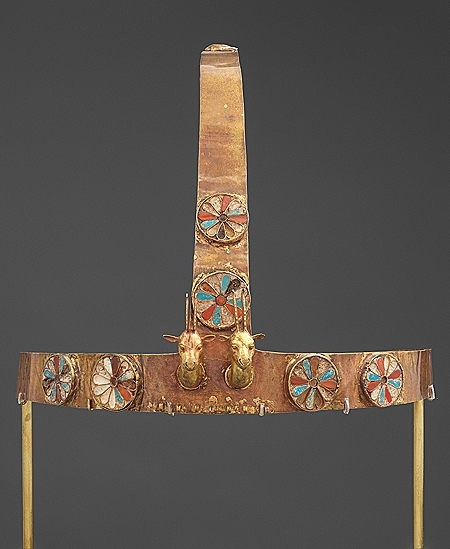
The picture aboveat right is from the reign of Thutmose III, the very next king after Hatshepsut and thus contemporary with the lifetime of Neferure. The Metropolitan Museum of Art says of this artifact…
During her lifetime, a queen wore this delicate diadem tied over her wig. The headband not only identified her elite rank but also identified her as a woman participating in a cultic performance. Tomb depictions illustrate high-ranking women wearing similar ornaments when they took part in rituals that likely honored important goddesses like Hathor, Mut, or Sakhmet. The reason for depicting gazelles is not clear, although they are associated with the sun god, fertility, and rebirth—all subjects connected to these great goddesses. (https://www.metmuseum.org/art/collection/search/553269)
Thus, this may have actually been a crown worn by Neferure, although more likely it was a contemporary symbol worn by royal females in general. Hence, the reference to a gazelle in the song of Solomon.
CONNECTING EGYPT TO ISRAEL
So what have we learned? That early in the reign of Solomon, before his third year, the king of Egypt sent an embassage to congratulate the new king, and offer their best wishes for his reign – as was standard practice.
Due to her high status and education, Thutmose II and Hatshepsut’s daughter Neferure was sent along as an ambassador. There, she found the love of her life, early in his reign, and fell madly in love. The feeling seems to have been mutual, but marrying an Egyptian princess was out of the question.
Solomon, at some point thereafter, made a royal visit to Egypt, passing walls-of-the-ruler, and was entertained at court. There, he convinced the Egyptians to break their rule against marrying their daughters to foreign kings.
All was well, but then after 20 years, especially after she moved into her own house Solomon built for her, she felt neglected and jealous of the other wives, leading her to write this song, with or without Solomon’s input (his voice may have been supplied by the poet, after all).
At about this time, since she had been talking to her mother, sending letters back and forth to Egypt on a regular basis, and since she was clearly obsessed with Solomon, she certainly wouldn’t stop talking about how awesome he was. So Hatshepsut came to see for herself.
1 Kings 10:6-7 She said to the king, “It was a true report that I heard in my own land of your acts, and of your wisdom. However I didn’t believe the words, until I came, and my eyes had seen it. Behold, the half was not told me! Your wisdom and prosperity exceed the fame which I heard.”
Interestingly, in the narrative of 1 Kings 3 the gift of wisdom granted him by God follows immediately after his marriage to the princess of Egypt. Which means Solomon had not yet been granted supernatural wisdom when last Hatshepsut had seen him.
And a state visit to Jerusalem was a very rare thing indeed – pharaohs left home with an army, for war; I cannot think of an example where a pharaoh ever left his borders for diplomacy. But it was no doubt also to see her daughter that she came; thus providing two reasons for her visit.
She brought an immense amount of wealth and gifts with her, as was customary for diplomacy of the day, but she also clearly had some more selfish reasons from coming as well, since she “asked” for things:
1 Kings 10:13 King Solomon gave to the queen of Sheba all her desire, whatever she asked, besides that which Solomon gave her of his royal bounty. So she turned, and went to her own land, she and her servants.
All told, both parties were happy with the trade, and Egyptian-Israelite relations reached the highest point they ever would. Hatshepsut died soon after her visit, at around 60 years old according to her mummy.
Naturally, Solomon permitted his wife to go to her mother’s funeral, which explains her presence in the tomb carvings of Hatshepsut even though there was absolutely no other evidence of her presence in Egypt around that time.
In fact, because of the silence about her until that point, Egyptologists think she had already died and was carved posthumously. But we know better. She died happily married to Solomon. Well, married; “happily” is debatable.
SOLOMON’S SINS
When Solomon got older, his wives whom he gathered from the corners of the earth wanted to worship their gods, and so Solomon not only allowed it, but actively participated. His God, needless to say, did not approve.
1 Kings 11:4 For it happened, when Solomon was old, that his wives turned away his heart after other gods; and his heart was not perfect with Yahweh his God, as was the heart of David his father.
Solomon’s sins are then listed, mostly idolatry and child sacrifice as required by the gods of his many wives, and so God said…
1 Kings 11:11-13 Therefore Yahweh said to Solomon, “Because this is done by you, and you have not kept my covenant and my statutes, which I have commanded you, I will surely tear the kingdom from you, and will give it to your servant.
Notwithstanding I will not do it in your days, for David your father’s sake; but I will tear it out of the hand of your son. However I will not tear away all the kingdom; but I will give one tribe to your son, for David my servant’s sake, and for Jerusalem’s sake which I have chosen.”
Suffice it to say that because of Solomon’s sins, as soon as he died, the kingdom of Israel would be split into two parts, known as the kingdom of Israel and the kingdom of Judah.
The larger part with ten tribes going north would be the kingdom of Israel under Jeroboam, a former general of Solomon’s, and would be based first at Shechem and then at Samaria. This is the kingdom that generated such famous people as Ahab and Jezebel, and would be captured by the Assyrians in ‑721.
The smaller part, with Judah, Benjamin, and Levi, would remain under the rule of David’s descendants until the captivity to Babylon in ‑586. This would be known as the kingdom of Judah, and was the source of the only decent kings after David.
HADAD IN EGYPT
Before even the kingdom was split, while he yet lived, God sent trouble Solomon’s way:
1 Kings 11:14 And the LORD stirred up an adversary unto Solomon, Hadad the Edomite: he was of the king’s seed in Edom.
The Bible then backs up to tell of Hadad’s origin story, beginning in the time of David (‑1071‑1031). For reasons that are not explained clearly, David and Joab had made a concerted effort to kill all the males in Edom, but missed a prince called Hadad:
1 Kings 11:17-22 …that Hadad fled, he and certain Edomites of his father’s servants with him, to go into Egypt, Hadad being yet a little child… and they came to Egypt, to Pharaoh king of Egypt, who gave him a house, and appointed him food, and gave him land.
Note that he was “yet a little child,” so probably under 10, possibly much younger. The events in Edom aren’t specifically dated, but scholars generally place it early in David’s reign over all Israel, around year 10-15 of his reign or very roughly ‑1061‑1056.
This would have been during the reign of either Amenhotep I (‑1075‑1054) or Thutmose I (‑1054‑1041). We favor the latter, meaning that Thutmose I was the Pharaoh who “gave him a house, and appointed him food, and gave him land” and for his substantial entourage as well.
1 Kings 11:19 Hadad found great favour in the sight of Pharaoh, so that he gave him as wife the sister of his own wife, the sister of Tahpenes the queen.
Since he was yet a child, time then had to pass for him to grow up before Pharaoh, probably a different one, gave him a wife around ‑1045‑1040 or so. This would mean he matured either late in the reign of Thutmose I (‑1054‑1041), or early in that of his successor Thutmose II (‑1041‑1028).
Since Thutmose I would be older by this time and nearing the end of his life, it’s unlikely that his sisters-in-law were young enough to be marriageable to such a young Edomite king. Which is why we favor Thutmose II as the husband of “Tahpanes.”
Unfortunately the name Tahpanes doesn’t exist in Egyptian as a proper name, so most scholars think it is the title ta hemet nesut, meaning “the king’s wife/royal wife.” I find that a bit odd, since “the sister of his own wife” was already specified, so “the sister of his royal wife, the queen” would be quite redundant.
Clearly, for whatever reason, the wife of this Pharaoh was significant, and a remarkable woman worthy of being extremely explicit about her identity. Which, if the Pharaoh in question was Thutmose II, she was indeed; for that was the husband of Hatshepsut. And she has a missing sister!
Neferubity (Ancient Egyptian: nfrw bity) was an ancient Egyptian princess of the 18th Dynasty. She was the daughter of Pharaoh Thutmose I and Ahmose, the sister of Hatshepsut and the half-sister of Thutmose II … She is depicted with her parents Thutmose I and Ahmose in Hatshepsut’s Deir el-Bahari mortuary temple, then vanishes. It is assumed that she died young, with her only depiction having a “sidelock of youth.” (Wiki, Neferubity)
So here we have an unmarried royal sister of the queen who “vanishes” shortly after the death of Thutmose I (‑1041). Almost exactly at the time we expect her to have been given in marriage to Hadad! Which means that the daughter of Thutmose I, Neferubity, must be the sister of Pharaoh’s wife who married Hadad of Edom!
1 Kings 11:20 The sister of Tahpenes bore him Genubath his son, whom Tahpenes weaned in Pharaoh’s house; and Genubath was in Pharaoh’s house among the sons of Pharaoh.
And this all fits very well, chronologically; because the claim that Genubath was “weaned in Pharaoh’s house” and raised “among the sons of Pharaoh” is a clean fit with known 18th Dynasty court practice.
The men and women entrusted with the upbringing of the royal children, both male and female, were highly honored members of Egyptian society in Dynasty 18. … Although there were probably nurses and tutors serving the royal family in earlier times, specific titles identifying people as “royal nurse” (mnʿt nswt) or “royal tutor” (mnʿ nswt) only seem to occur during Dynasty 18. These individuals are known from a variety of sources, including tombs, funerary equipment, and statuary. A few, such as Senenmut, who was chief steward of Amun during the reign of Hatshepsut, are well-known figures in Egyptian history; others are almost completely undocumented. (The Eighteenth Dynasty Titles Royal Nurse (mnʿt nswt), …, Roehrig)
… “tutors” or “wet nurses of the king” (New Kingdom; …) were responsible for raising and educating the royal children. The sons and daughters of distinguished officials could be raised together with royal children, thus creating a close personal bond between the future ruling class and the successor to the throne … (Harem, Roth; excessive citations and Egyptian spellings elided)
Thus, the raising of Genubath in this harem during the 18th Dynasty is perfectly aligned with known diplomatic practices from that period and only that period. Which is just another way of confirming that we are on the right track to place the 18th Dynasty in around the turn of the 1st millennium.
THE RETURN OF HADAD
Historians largely ignore this story, since it shows a royal female marrying a foreign dignitary, something that was so rare in Egypt that it is believed to have never happened. But Pharaoh did not intend for Hadad to leave; he believed, with reason, that his kingdom no longer existed. That’s why when he tried to leave, Pharaoh resisted:
1 Kings 11:21-22 When Hadad heard in Egypt that David slept with his fathers, and that Joab the captain of the army was dead, Hadad said to Pharaoh, “Let me depart, that I may go to my own country.” Then Pharaoh said to him, “But what have you lacked with me, that behold, you seek to go to your own country?” He answered, “Nothing, however only let me depart.”
Thus, this was not a diplomatic marriage to secure a treaty with a foreign king; after Joab and David’s work, there wasn’t much of a kingdom left. Instead, it was welcoming a foreign king as a refugee into your Egyptian family. It would not, therefore, have fallen under the usual rules that Solomon had to overcome forbidding marriage to foreign kings.
It may, however, have been used as a precedent by her niece Neferure to convince her parents; it’s a solid argument, after all; “look, you married aunt Neferubity to Hadad and they left, why can’t I marry Solomon, an actual king who can defend Egypt from Asiatics?”
This is why Neferubity completely disappears from the record; unlike Solomon’s wife, her niece, she was the wife of a rebel king who was in hiding from Solomon, and couldn’t be communicating openly with Egypt like Neferure did since to them, Israel was hostile territory.
Regardless, since Hadad’s departure was a direct result of the death of Joab at the beginning of Solomon’s reign (1 Kings 2:33-34), we conclude that Hadad left Egypt with his wife in ‑1030. He apparently didn’t begin stirring up problems until later in Solomon’s reign, when God punished Solomon for his sins using Hadad and Rezon the Syrian:
1 Kings 11:23 God raised up an adversary to him, Rezon the son of Eliada, who had fled from his lord Hadadezer king of Zobah. He gathered men to him, and became captain over a troop, when David killed them of Zobah: and they went to Damascus, and lived therein, and reigned in Damascus. He was an adversary to Israel all the days of Solomon, besides the mischief of Hadad: and he abhorred Israel, and reigned over Syria.
This was the beginning of a relationship that would plague Israel for centuries, as Syria rose in power and Israel declined. This Rezon was the founder of a dynasty that included Hazael, Rezin, and other enemies of Israel. All of which will be discussed in its proper place.
Oh, I promised to explain why Amenhotep III lied when he said that no daughter of Egypt had ever been married to a foreign king. I will, but it needs to wait for two chapters for the groundwork to be laid. Just… hold that thought.

This is part 35 of The History of the World Series
 Judges to Kings
  Joshua and Jericho
  Hyksos and the Amalekites
  Aftermath of the Exodus
  What Is The LOVE Of God?
  Everything You Believe About God Is WRONG!
  Make Up Your Mind!
  What Is Faith?
  How DARE you FEAR the judgment of God!
  Firstripe Figs
  The Bride Of The Father
  Exodus 40 – The Plan Of God
  The Temple Of God
  Pillars Of The Temple And The Brass Sea
  GEHENNA WITH ‘EM
  When Did God Forbid Polygamy?
  When You Shouldn’t Pray For Someone
  The Sins of the Father
  The First Paul