Tyre, Syria, and Assyria
When we moved Assur-dan III back 34 years in the last chapter, we automatically moved Adad-nirari III as well, which now aligns his 5th year (‑840) with the 15th year of Jehoash the Samarian (‑855‑839) from whom he received tribute.
But these changes do not explain the earlier disagreements with Ahab, Jehu, and Hazael, which require Shalmaneser III to be a further 24 years in the past. Can we reconcile them with the Assyrians?
Of course we can.
The Black Obelisk of Shalmaneser records that in his 18th year he took tribute from “Jehu of the house of Omri,” “Baalimanzer of Tyre,” and “Hazael of Syria.” This, it turns out, will be the linchpin that anchors the chronology of the entire Near East.
But to understand why, we have to establish the background of these kingdoms, then tie it all together with our customary flourish and snark.
SYRIA
To start with, the name Syrian is in fact a mistranslation, since they would not have recognized the name for themselves. They were Arameans to themselves and most of their neighbors, or more specifically citizens of Damascus, Haran, Adina (Biblical Eden), and so on.
But it is in the land we call Syria today, mostly, especially the inland parts, so we’re stuck with the name. To the Hebrews the region was Aram, reflecting the fact that it was originally settled by Aram, son of Shem.
Since Terah and the rest of Abraham’s family settled there, plus some of Abraham’s sons by Keturah were in the region as well, most of them were related to Abraham in some way. Their language was Aramaic, which oddly enough became the lingua franca of the entire region later in history.
In fact, it’s likely it was the native language of Jesus based on the untranslated portions of the New Testament where he is quoted saying the Aramaic phrase “Eli, Eli, lima sabachthani?” in Matthew 27:46.
They were Israel’s closest northern neighbor and a constant thorn in their side, sometimes independently but more often propped up by the Hittites to the north who had reasons to hold a grudge against the Israelites after the whole Joshua-conquering-Canaan thing.
Unfortunately there is no complete list of Syrian kings, which the Bible generally treats as synonymous with kings of Damascus, their most important city. Which means their chronology must be reconstructed from the Bible and, later, from Assyrian records.
The first kings of Syria known to us are those contemporary with David and Solomon in 1 Kings 15:18, which gives us Ben-hadad, contemporary with Asa, his father Tabrimon, and his father Hezion.
Off and on for the next 56 years, the king of Syria is called Ben-hadad in the Bible; this is an improbably long reign, but possible. However, Ben-hadad tells Ahab that the cities his father had taken away from Ahab’s father would be restored (1 Kings 20:34).
Those cities are highly unlikely to have been taken away under the peace enforced by Shishak that Asa bribed Ben-hadad to break, so were probably not taken from Israel by Tabrimon. More significantly, Ben-hadad goes on to mention that his father “made streets in Samaria,” which had been built by Omri, Ahab’s father.
Since Omri had built Samaria just a few decades earlier at most, and Ben-hadad had been king for decades before that, it’s effectively certain that there were two Ben-hadads in succession, whom we’ll title with the imaginative names Ben-hadad I and Ben-hadad II.
Ben-hadad II was replaced by Hazael, his general, due to a prophecy of God (1 Kings 19:15-17). It was a battle with Hazael which directly led to the death of Ahaziah of Judah and Jehoram of Israel at the hands of Jehu, the next king of Israel. This means Hazael was ruling not later than ‑899, Jehu’s first year.
Hazael died and was replaced by his son Ben-hadad III around the second year of Jehoash of Israel (2 Kings 13:24-14:1).This would be ‑854. After this, the Bible is silent on Syrian kings – we now know it’s because Syria was almost completely wiped out by wars in this period, first with Egypt, then Assyria, and finally Jeroboam.
A “Mari” of Syria paid tribute to Adad-nirari III in ‑840 but Mari is probably a title, not a name. Later Hezion II paid tribute to Shamshi-ilu in the 10th year of Shalmaneser IV (‑807). The next period is completely unknown until the rise of Rezin.
Rezin is first mentioned in the days of Jotham (‑757‑741) and Pekah (‑759‑739), and attacked Jerusalem after Jotham’s son began to reign in ‑741 (2 Kings 15:32-16:6). Rezin was killed, according to the Assyrians, in ‑732.
It’s unknown when his reign began, although we will offer an interesting possibility in a future chapter on the decline of the 19th Dynasty in Egypt; turns out he may have briefly conquered Egypt. Cliffhanger, right?
DELAYED GRATIFICATION
God had told Elijah to anoint Hazael and Jehu as kings and to anoint Elisha in his own place in 1 Kings 19, narratively connected to the lifetime of Ahab, thus not later than ‑911. But weirdly, it was not Elijah but Elisha who told Hazael he would be king (2 Kings 8:13).
Weirder still, not only did Elijah not anoint Jehu, Elisha didn’t even do it – he outsourced it to a disciple (2 Kings 9:1-3). Just to show you that sometimes prophecies in the Bible were fulfilled a bit more flexibly than some interpreters might insist on. The prophecy happened as said, but not in the way we might assume it had to be done.
Another odd thing is that the anointings didn’t happen right away. At first glance, it appears to be before the 5th year of Joram/Jehoram of Israel (‑906), the next event to be recorded. Unfortunately, we have several reasons to believe this section of Kings is not written in strict chronological order for some reason, which means we can’t go off that alone.
What we do know for certain is that no later than ‑899 Hazael was already king, because Ahaziah of Judah and Jehoram of Israel warred against him, lost, returned to recover (2 Kings 8:28-29) and then Jehu killed both and became king of Israel (2 Kings 9).
It was common for kings to attack their enemies soon after a regime change to test the mettle of the new leader. Given that, we can speculate that Hazael may have just recently become king, since Israel and Judah were the aggressors.
Thus, we would tentatively conclude that Hazael became king not before ‑900, possibly even in ‑899. Which means a dozen years or more passed between God’s proclamation about anointing Jehu and Hazael and it actually happening.
Which goes to show you that things that seem worded like they’re going to happen right away sometimes… God never meant to happen immediately (Luke 19:11, Romans 13:11-12, etc.).
ELIJAH IN HEAVEN
As another brief aside, Elijah went on strike during the days of Ahab, and God let him resign as head prophet (1 Kings 19), and after some time to train his replacement Elisha, God took him up in a whirlwind just after the death of Ahaziah in ‑910.
Based on 2 Kings 2:1-15, most Christians believe he went to heaven without passing go or collecting $200. A reasonable assumption at first, albeit contrary to John 3:13. But when you know your Bible better, and add a dash of history, you’ll see that the go-to-heaven-instantly Christians cannot possibly be right. Because four years later, Elijah sent a letter… from Earth.
2 Chronicles 21:12 A letter came to him [Jehoram of Judah] from Elijah the prophet, saying, “Thus says Yahweh, the God of David your father, ‘Because you have not walked in the ways of Jehoshaphat your father, nor in the ways of Asa king of Judah, […the usual curses]
Since I doubt heaven has a post office, it is clear that Elijah was still on the Earth and very much alive. As for the whirlwind, we have another example of this in Acts 8:39, where “the spirit of the Lord” carried him away – and explicitly did not take him instantly to the Christian afterlife (verse 40).
“Spirit” is just another word for air or wind; and so if the Lord called a “spirit” to “carry” someone, a tornado would be the real-world explanation of that miracle, moving a person Wizard of Oz style. Granted, a special tornado, but still – not magic.
The chariot of fire and such that accompanied the miracle was either a vision, or angels, or both (2 Kings 2:11). Regardless, it’s clear it did not kill or translate Elijah to heaven, it simply moved him through the sky. Same as I’m doing as I write this, only I’m cheating – I’m using an airplane to create the whirlwind.
HAZAEL’S TAKEOVER
Knowing that Hazael was king by ‑899, and that God explicitly prophesied that Hazael and Jehu were meant to work as a sort of team, “he who escapes from the sword of Hazael, Jehu will kill,” (1 Kings 19:17), which requires a certain degree of contemporaneity.
Thus it is reasonable that Hazael and Jehu began to reign at roughly the same time, although Hazael certainly preceded Jehu by a month or two at the bare minimum, even a year or two perhaps, since Hazael’s war began a sequence of events that led to Jehu’s coronation.
Since we know Jehu paid tribute to Shalmaneser III in the latter’s 18th year, obviously he did so not earlier than Jehu’s kingship in ‑899, and since he took tribute from Hazael at the same time, Hazael was already king in ‑899.
In my eighteenth regnal year, I crossed the Euphrates River for the sixteenth time. Hazael of Damascus, trusting in the might of his soldiers, carried out an extensive muster of his troops. He fortified Mount Saniru, a mountain peak that is before Mount Lebanon. I struck down 16,020 of his fighting men with the sword (and) took away from him 1,121 of his chariots (and) 470 of his cavalry with his military camp. In order to save his (own) life, he ran away, (but) I pursued him. I imprisoned him in Damascus, his royal city, cut down his gardens, (and) burned his shocks. (Royal Inscription of Shalmaneser III, http://oracc.org/riao/Q004615/)
But Shalmaneser also took tribute from Hazael’s predecessor in Syria, Ben-hadad (probably), in his 14th year – thus, not earlier than ‑903. Which means that Hazael cannot have become king earlier than that date, since his predecessor was still ruling four years earlier.
In my fourteenth regnal year, I mustered (the troops of my) extensive land in countless numbers (and) crossed the Euphrates River in flood with 120,000 of my troops. At that time Hadad-ezer (Adda-idrī) of Damascus (and) Irḫulena of the land Hamath, together with twelve kings on the shore of the sea, above and below, mustered their troops, which were too numerous to be counted. They attacked me, I fought with them, (and) defeated them. I took away their chariotry, cavalry, (and) military equipment. In order to save their (own) lives, they ran away. (Ibid.)
Which means that Shalmaneser’s 18th year cannot fall earlier than ‑899 nor later than ‑895. This gives us a fairly tight window which we can lock down to a precise year later. Before we get there, however, we need to make a few qualifications.
The Bible tells us that Ben-hadad was sick, and his general Hazael smothered him and became the new king (2 Kings 8:13-15). The Assyrian annals confirm this transition, saying it happened between the 14th and 18th year of Shalmaneser.
I defeated Hadad-ezer (Adda-idrī) of Damascus [in my 14th year], together with the twelve rulers who were his allies. I laid low 29,000 of his brave warriors like sheep (and) threw the remnant of his troops into the Orontes River. In order to save their (own) lives, they fled.
Hadad-ezer (Adda-idrī) passed away (and) Hazael, son of a nobody, took the throne. He mustered his numerous troops (and) moved against me to wage war and battle. I fought with him (and) defeated him. I took away his walled camp from him. In order to save his (own) life, he fled (and) I pursued (him) as far as Damascus, his royal city. (Royal inscription of Shalmaneser III, http://oracc.org/riao/Q004645/)
The general story fits, but the names don’t quite match. Ben-hadad is not the same name as Hadad-ezer; Hadad is a common theophoric (name element based on the name of a god) and ben (son) is not ezer (help). For that matter, “ezer” is not “idri.” So this association is not certain.
The only reason we accept it at all is because of the transition narrative; the odds of another king of Damascus in this time frame being succeeded by a “son of a nobody” – a usurper – named Hazael who isn’t the general Hazael who murdered Ben-hadad in the Bible are slim.
Given that, we accept the narrative as understood by most historians that these are the same events as those in the Bible, where Ben-hadad/Hadad-ezer is killed by his general Hazael between the 14th and 18th years of Shalmaneser.
Since we have established that Jehu’s first year was in ‑899, and that Shalmaneser’s 18th must be after that, since Hazael was already ruling at that point then Shalmaneser’s 14th cannot be after ‑899 either.
That, in turn, means Shalmaneser’s 18th year is constrained to be one of the years between ‑899 and ‑895. There are no other options, so we cannot be off by more than a few years – meaning that Assyrian history has a cumulative error of 54-58 years at this point, and a gap must exist between Shalmaneser III and Adad-nirari III of 20-24 years.
And with that we introduce the next witness to our dating.
THE KINGDOM OF TYRE
Sidon, son of Canaan, was the ancestor of the Sidonians who built the cities of Sidon and Tyre; although Tyre was built later, it eclipsed its sister-city Sidon for wealth and importance and by Biblical times Tyre was the capital of the Sidonians, both cities being united into one nation.
An early key to the rise of Tyre had been the discovery of a certain kind of conch shell and a highly secret process to extract a brilliant purple dye for fabrics, which was sought after by royalty the world over and became known as “Tyrian purple” – which was probably why the region became known as Phoenicia to the Greeks, based on their word for that same purple dye, phoinix.
Tyre was built on an island about a kilometer off of the coast, making it very defensible and essentially one giant port. It already existed by the time of Joshua (‑1467) according to Joshua 19:29, and was already “a strong city” then.
Building on their monopoly on purple dye, Tyre set itself up as the premier merchant city and Phoenicians earned renown as the best sailors in the known world. They were the first to venture beyond Gibraltar into the Atlantic Ocean, and established trading ports and ultimately colonies all over the Mediterranean.
Trade in the Mediterranean was set up in a vast circle; where ships would go to ports along the coast of Israel, Egypt, Libya, Spain, Italy, Sicily, Greece, Turkey, Crete, and so on – using their modern names – and at each port they would sell something rare there, and buy something common there.
It was a very lucrative business model, and led to them becoming immensely wealthy. And so when Solomon went to build his temple for God, he went to Hiram, king of Tyre, for help. This was the luxury capital of the Mediterranean world, after all.
So Hiram traded Solomon materials and workmen in exchange for food, oil, and cities (1 Kings 5:10-11, 1 Kings 9:11-14), and was a friend of David as well (1 Kings 5:1). The work itself was presided over by a different Hiram, half Israelite and half Tyrian.
Interestingly, until the end of the temple period – 1,000 years later – the atonement tax was paid to the temple exclusively in Tyrian coins. It was this, in fact, that the money changers were doing at the temple – changing regular Roman coins for Tyrian half-shekels to pay the temple tax (Mark 11:15). Jesus didn’t have a problem with the concept necessarily, just their presence in the temple itself.
The preference for Tyrian currency was due to the fact that they kept their coinage of a very consistent size and didn’t debase their currency – make their coins contain less precious metal over time as a way of causing inflation – like most other cultures did.
This allowed the Jews to be confident that when they gave the tax God had demanded from Sinai – a half shekel – it actually was a half shekel in weight, roughly a quarter-ounce or 7.1 grams; slightly more than a US quarter dollar, back when it was made from silver.
MENANDER
Following Hiram, we know of the history of Tyrian kings through Josephus, who claims to have them from the historian Menander who copied them directly out of the temples in Tyre. Fortunately, we have reign lengths and a fairly detailed succession.
And at first, it lines up with the Bible exceptionally well. Josephus tells us that Hiram’s 12th year was equivalent to Solomon’s 4th year, giving us the chronologer’s dream synchronism, connecting Hiram with David beginning in ‑1039.
Counting forward, we find that Ithobaal I, Ethbaal in the Bible (1 Kings 16:31), father of Jezebel, winds up being where he should be, broadly contemporary with Ahab. So far, so good.
The next synchronism is with Shalmaneser III. In the same inscription we cited above that mentions Hazael, Shalmaneser mentions a certain man of Tyre, still in his 18th year.
…I marched to Mount Baʾali-raʾasi, which is a cape (jutting out into) the sea before Tyre, (and) erected a statue of my royal majesty there. I received the payment of Baʾal-manzēr of Tyre (and) Jehu (Iāūa) of (Bīt-)Ḫumrî (Israel; lit. “son of Omri”). (Royal inscription of Shalmaneser III, http://oracc.org/riao/Q004615/)
In 1951, Fuad Safar published a record of tribute from Baaʿli-maanzer, king of Tyre, to Shalmaneser III of Assyria in 841 BCE [‑899, our dates]. There followed several studies that attempted to relate this Baaʿli-maanzer to the list of kings given in Menander/Josephus. It was argued, based on philological considerations, that the name as given in the Assyrian text could be matched to a Phoenician Baʿal-ʿazor and the Greek Baal-Eser/Balazeros, a name corresponding to two kings in Menander’s list. The first Balazeros was a son of Hiram I, contemporary of David and Solomon, so this was too early, but the second name referred to the grandfather of Pygmalion and was therefore in the right date range. (Wikipedia, Pygmalion of Tyre)
“Philological considerations” basically means that you try to connect a word in one written language (say, Hittites in English) with that word as spelled in another language (say, Keteians in Greek).
When names move between languages and scripts, a certain amount of change is unavoidable; sometimes a lot of change. Nebuchadnezzar, in English, was originally spelled Nabu-kudurru-usur in Akkadian.
So Baalimanzer is not exactly Baal-eser, but it’s close enough to be plausible, if not conclusive. Compare the Biblical Joash/Jehoash, who were the same person and transmitted through a single script.
Baal-Eser II … was a king of Tyre, the son of Ithobaal I, brother of Jezebel and brother-in-law of Ahab. Baal-Eser reigned at the height of Tyrian influence in the affairs of the Levant. During his reign, his sister was queen of Israel and his niece Athaliah reigned as queen of the Kingdom of Judah, creating a zone of Tyrian influence unrivaled at any period in its history. (Wikipedia, Baal-Eser II)
Why would the pinnacle of Tyrian influence coincide with a humiliating tribute to a rampaging foreign empire? It wouldn’t; so either this isn’t the right Baal-eser, or else the tribute happened in the final year of his short six-year reign.
WORKING BACKWARDS
Having said that, let’s see if the numbers add up. We know Shalmaneser’s 18th year is between ‑899 and ‑895. Counting forward from the Hiram-Solomon synchronism and adding up the kings of Tyre, Baal-eser II ruled Tyre ‑923‑917 – around 20 years too early to be giving tribute to Shalmaneser even in our revised Assyrian dating system.
But maybe there’s a solution.
Above, we were working forward from the reign lengths in Josephus. But there’s a problem with that. We have Josephus in four different ancient copies, and due to scribal errors, sometimes they disagree with each other – this is one of those times.
All four manuscript variants give us a total summary of the dynasty up to the 7th year of the final king, Pummay-yaton, called Pygmalion in the Greek; the total time is 155 years, 8 months. Unfortunately, not one of our four versions of Josephus adds up to that number precisely.
In Josephus’s Laurentianus codex version, 18 years are missing, for example. How exactly to solve that question depends on how much you trust ancient historians. But before we get into that, let’s try a quick test of the numbers.
Since we know years are missing, but we don’t know where, let’s assume they’re missing in just one place. When we counted forward from David-Hiram, Baal-eser aligned poorly with Shalmaneser. But what if we count backwards from the end?
We know that Pummay-yaton’s 7th year is 155 years, 8 months from David-Hiram; hence, we work back from there. And since only one king (Mattan II) separates him and Baal-eser II, counting this way Baal-eser II reigns ‑905‑899.
Immediately we are pleased; the final year of his reign, the end of the “height of Tyrian influence” coincides precisely with the earliest possible date for the 18th year of Shalmaneser who takes credit for ending that very same influence with a hefty tribute.
Aren’t we lucky.
MENANDERING EXPLANATION
The traditional approach, following Cross’s research, is the most heavy-handed. It requires three alterations to the transmitted chronology. Baal-eser I (not II)’s reign is changed from 7 to 17 years, following an alternative reading preserved by Theophilus’s version of Josephus; this is reasonable, at least.
But then Astartus, to whom the text gives 12 years, is assigned a conjectural reign of 20 years; and Deleastartus, whom the surviving text identifies as Astartus’s father, is instead reconstructed as his younger brother and king, with a reign of 12 years even though the surviving text neither calls him king nor gives him a regnal length.
Taken by themselves these alterations add 30 years, but Cross’s reconstruction also eliminates the separate 12-year reign of an unnamed “eldest son” in the list by identifying that position with Astartus. The net addition is therefore 18 years, bringing the individual reigns into agreement with Josephus’s stated total of 155 years, 8 months.
These changes push Baal-eser forward 18 years and make him align with Shalmaneser III in their construction (once they’ve cut 60 years out of Israelite history to move Solomon’s reign later). This is a very arbitrary solution, and not one I would endorse even if I liked the answer.
Gertroux attempts a much more elegant solution, by comparing all four variants and choosing to emend the Laurentian text of Josephus with variant readings which would supply the missing years through alternative versions of the text.
To this end, he chooses to follow the version of Josephus preserved by Theophilus for two reigns, giving 17 years for Baal-eser I (not II) instead of the Laurentian just as Cross does; and he chooses Theophilus’s 29 years for Mattan II instead of the Laurentian 9.
These changes give him an additional 30 years – 12 too many to match the 155-year total – so he postulates that a period of usurpation recorded by Josephus where “the eldest brother” ruled 12 years was not intended to be part of the total, again, just like Cross.
While I like his approach in principle, I disagree that this period was not counted. On the contrary, Josephus spends considerable time on the story and gives a specific reign length of 12 years for one of the four usurping kings that both scholars ignore.
Let’s hear him out.
FOUR SONS OF A NURSE
Josephus tells a story about the four sons of Abdastartus’s nurse; the eldest of whom is not named, but is said to have reigned 12 years. Then it seems a new dynasty begins with a certain Astartus, son of Deleastartus who does not seem to have been a king.
Baleazarus (I) his son took the kingdom; he lived forty-three years, and reigned seven years: after him succeeded his son Abdastartus; he lived twenty-nine years, and reigned nine years. Now four sons of his nurse plotted against him and slew him, the eldest of whom reigned twelve years: after them came Astartus, the son of Deleastartus; he lived fifty-four years, and reigned twelve years: after him came his brother Aserymus; he lived fifty-four years, and reigned nine years: he was slain by his brother Pheles, who took the kingdom and reigned but eight months, though he lived fifty years: he was slain by Ithobalus, the priest of Astarte. (Josephus)
Scholars are quite divided on how to interpret this, but it seems quite simple to me. Since the successors of Abdastartus were four sons, it stands to reason that the three named brothers who reigned after him were those same four sons of a nurse.
But that might just be an easy coincidence. Reading closer, that narrative, tempting as it is, just doesn’t fit. First of all, the narrative requires four brothers, says “the eldest of whom” reigned twelve years, and then says “after them came….”
Thus, the four brothers’ reigns were finished, and only then the “three brothers” who are listed by name came after. Thus, they are separate from the usurpers. This seems very straightforward to me, but no one else seems to read it this way.
Cross, whose chronology is among the most popular on the subject, believes that there is a textual error here, concluding that Deleastartus was not merely the father of these boys, but was himself the missing brother.
While that is tidy – four brothers, four names, four kings – it doesn’t really fit the text’s story at all. Josephus specifically says that “four sons of his nurse … slew him… after them came Astartus…”
One minor textual mistake (“son of” instead of “brother of”) we might accept, but this requires wholesale editing of the narrative in antiquity. Such things might have happened in highly politicized cases like the Amarna period, but no one in the centuries after Josephus would have had an axe to grind about the family relationships of thousand-year-dead Tyrian kings!
MY ANSWER
So my solution is what it always is – give the ancients some credit, and try to make their narrative fit before we assume it was completely corrupted in antiquity. And when you do that, a very obvious answer appears.
Remember, we are missing 18 years – we need only find a place the text requires there to be missing years to make a plausible solution and tell a story faithful to the original text. And we find it staring us in the face.
Abdastartus was murdered by his nurse’s four sons; none of these sons is named in the text. In acknowledging the reign of the eldest, we are merely told “the eldest of whom reigned twelve years.” Damnatio memoriae was commonly done to ancient usurpers, their names wiped from the books to discourage future uprisings. This, we infer, is what happened to these four.
Following them, we are clearly told, a new dynasty was begun by a certain Astartus, son of Deleastartus; this is the first king whose father is named; most likely because he founded a new dynasty, unrelated to the assassin brothers.
The biggest key is the phrase “after them came Astartus,” which proves Astartus was not viewed by Josephus as one of these four brothers, all of whom reigned before Astartus and his two brothers.
We are only given the reign length of the eldest of the four, who held on to power for 12 years. Between the reign of this unnamed king, and that of Astartus, three brothers must rule. How long was their rule? This is not accounted for in the text! Which means we must insert some time here, if we are to be faithful to the text.
Rather than arbitrarily adjusting reign lengths and assuming errors in the text just to make a chronology fit (Cross), or selecting other variants’ numbers to make things add up, but ignoring this significant episode in Tyrian history, we simply… shut up and listen to the text.
We need 18 years; the three younger sons of the nurse need years to rule; the two problems solve each other. The narrative continues by giving the patronymic of the first king of the new dynasty, then finishes with the rest of the kings of Tyre, falling 18 years short of the expected total, meaning the other three sons reigned an average of 6 years each.
An elegant solution, to place a gap where we are told there is a gap.
This isn’t hard, people.
WHAT IT MEANS
In the end, whether you do it my way or the conventional way, starting from the Hiram-Solomon connection and counting forward, Baal-eser II ends up reigning in ‑905‑899, meaning his last year is the same as the 18th year of Shalmaneser in ‑899 with whom he interacted.
You will recall that Jehu gave us a window of ‑899‑871, which Hazael allowed us to narrow to ‑899‑895. Since Baal-eser II died in ‑899, we have now narrowed it to a single year, uniting three ancient near eastern chronologies down to the very year.
If Baalimanzer of Tyre is Baal-eser II, king of Tyre, and if we are to take all the historical records literally – Josephus, the Masoretic text of the Bible, and Shalmaneser III’s annals – then ‑899 is the only year which can be the 18th year of Shalmaneser.
But pause for a moment and consider what that means.
The kings of Tyre now stand as an independent witness that the Hebrew chronology from David to Jehu was kept perfectly for a period of 139 years; from David-Hiram to Baal-eser-Jehu-Shalmaneser not a year was lost.
And this is the second perfect period we’ve found in Hebrew history. Remember, from ‑745 to ‑610 the Assyrians witness that the Hebrews kept perfect time, arguably excepting the siege of Jerusalem. Throughout 135 years, not a year was lost.
So we ask historians an awkward question; are we expected to believe that the Hebrew chronologers kept accurate time for 139 years…
…then somehow lost roughly sixty years in the period from ‑899 to ‑745 by means of undocumented coregencies and chronological compression…
…and then suddenly began keeping accurate time again once the Assyrian evidence becomes abundant in the late 8th and 7th centuries for another 135 years…
Or is the simpler explanation that the missing sixty years are not in the Hebrew chronology at all… but in the Assyrian one?
THE BATTLE OF QARQAR AND… AHAB?
The final piece of this puzzle is the battle of Qarqar. In his 6th year Shalmaneser III fought a coalition of twelve kings including Ben-hadad of Syria and Ahab of Israel in a place called Qarqar.
Every other historian, revisionist and traditional alike, has to do something to the Bible’s dates to make them at least a little bit later to line up Ahab and Shalmaneser’s 6th year. But since we date Shalmaneser’s 18th year to ‑899, it puts the battle of Qarqar in ‑911 in our reconstruction and no one else’s…
…where a literal interpretation of the Masoretic text dates Ahab’s reign (‑933‑911), his very last year to be precise. Given this quadruple convergence on these dates, we are quite pleased:
- Jehu’s tribute in Shalmaneser’s 18th year not before ‑899.
- Hazael’s accession not before ‑903, making Shalmaneser’s 18th not later than ‑895.
- Baal-eser’s death in ‑899, making Shalmaneser’s 18th not later than ‑899.
- The battle of Qarqar in Shalmaneser’s 6th year not later than Ahab’s death in ‑911, making Shalmaneser’s 18th year not later than ‑899.
In sum, if any three of these are correct, we have a confirmed year-perfect date for Shalmaneser III.
…that being said…
Every chronologer on Earth believes Ahab was at Qarqar. I, however, am not convinced. Let’s go to the actual evidence, then let’s see if you are. The actual monument that mentions “Ahab of Israel” spells his name as “A-ha-ab-bu Sir-ila-a-a.” Is that a standard way of spelling the nation of Israel in Assyrian?
Schrader wrote that the name “Israel” (“Sir-ila-a-a”) was unique among Assyrian inscriptions, as the usual Assyrian terms for the Northern Kingdom of Israel were “The Land of Omri” or Samaria. This fact has been brought up by some scholars who dispute the proposed translation. (Wikipedia, Kurkh Monoliths)
Despite how confidently historians tell us Ahab was at Qarqar, their only evidence is an unattested and very unusual term for Israel… that doesn’t even really sound like the name. I mean, the basic sounds are there, but in a very jumbled order even considering the linguistic/cuneiform transmission. So Ahabbu of Sir-ila-a-a is not necessarily Ahab of Israel.
Twelve years later the same Shalmaneser, presumably with the same scribes, interacted with Ahab’s successor Jehu; they recorded his name as Jehu, of the house of Omri; not Jehu of Sir-ila-a-a. Which is especially strange when you realize that Ahab actually was the son of Omri, when Jehu was not even related – he just inherited the throne.
So we have grave reason to doubt the identification of Ahab with Ahabbu and yet we still believe that Ahab was involved in these events, albeit indirectly.
AHAB AND SYRIA
Since these events happened in Shalmaneser’s 6th and 18th years, and Ahab’s reign is only 12 years from Jehu’s, the battle of Qarqar would have to be the very last thing Ahab did, and the tribute the very first thing Jehu did. Both of which are improbable.
But there’s a bigger problem. Because it’s hard to believe that Ahab met Shalmaneser as an ally of Syria in battle in his last year – since Ahab died in battle against the Syrians! In a battle in which the king of Syria despised him personally. Like, a lot.
1 Kings 22:31-37 Now the king of Syria had commanded the thirty-two captains of his chariots, saying, Fight neither with small nor great, except only with the king of Israel… A certain man drew his bow at random, and struck the king of Israel between the joints of the armour… So the king died, and was brought to Samaria; and they buried the king in Samaria.
Which means that we would have to conclude that, in the course of mere months, they went from friendly enough to fight and die side by side – something not likely in the first place, given the history of war between them – only to turn on each other after the battle with the Assyrians.
If we tried to spin the narrative as a falling out among allies over blame for the Qarqar crash (sorry, I couldn’t help myself), we run up against the time problem again; Shalmaneser said the allies fled in tatters.
That means we would have to surmise that Ahab and Ben-hadad returned home from Qarqar with a fraction of their armies, then decided the best use of their resources, in the face of an imminent Assyrian threat, was to immediately turn and fight each other.
As I said, highly unlikely. And directly contradicted by the Biblical narrative. In that, Ahab died in battle against the Syrians in a battle that he instigated over a land grab. No mention of Qarqar, mutual hostility, or any sort of a broken alliance is in the Bible.
The Biblical narrative of Ahab’s death is, however, compatible with a completely different narrative, where an earlier war with Ahab so weakened the Syrians that the Assyrians were able to conquer them.
1 Kings 20:16-18 They went out at noon. But Ben Hadad was drinking himself drunk in the pavilions, he and the kings, the thirty-two kings who helped him.
In approximately ‑915, Ben-hadad was able to field 32 kings against Israel. Why then, in an existential battle against a much fiercer foe in ‑911 was he only able to muster 12 to meet Shalmaneser III’s armies?
The Bible supplies the answer, because Ben-hadad lost several catastrophic battles to Ahab in ‑915 and ‑914. The Syrians had repeatedly blasphemed God, saying Yahweh couldn’t help Israel in different terrain.
God took this personally, and decided to make an example of them, causing them to lose catastrophically to Ahab, who otherwise would surely have lost. Ben-hadad surrendered to Ahab and begged for his life, and was sent home with a promise to make reparations.
1 Kings 22:1-4 They continued three years without war between Syria and Israel. In the third year, Jehoshaphat the king of Judah came down to the king of Israel. The king of Israel said to his servants, “You know that Ramoth Gilead is ours, and we do nothing, and don’t take it out of the hand of the king of Syria?” He said to Jehoshaphat, “Will you go with me to battle to Ramoth Gilead?” Jehoshaphat said to the king of Israel, “I am as you are, my people as your people, my horses as your horses.”
Three years passed after that, ‑914‑911, with peace between these kings; why only now, after three years, was Ahab suddenly emboldened to go take back Ramoth-gilead? The year was ‑911, the year we know the battle of Qarqar happened.
So could it be that he had heard that the Syrians had just taken a beating at the hand of the Assyrians, and thought they would be pushovers? In our chronology, that is precisely what must have happened – he attempted to profit from his enemy’s weakness after the battle of Qarqar.
Once again, the Bible can’t be fully understood without the proper historical context, and there is no hope of creating that historical context without the facts in the Bible.
SOPHISTRY
Let me point out that for the greatest strength of my argument, I could have accepted the majority opinion that Ahab=Ahabbu; it would strengthen my chronological point considerably to use that connection, since an iron-clad connection between Ahab, Ben-hadad, and Shalmaneser in ‑911 would be effectively conclusive.
Most, if not all, of my educated audience believes that Ahabbu is indeed Ahab. Personally, I seriously doubt Ahab was there, but ironically the conventional identification strengthens rather than weakens my chronology.
Historians have to cling to a lot of tenuous conclusions – linguistic, Biblical, diplomatic – to make it work, and it still ends up a bit iffy. Solely to preserve the conclusion that Ahab of Israel is Ahabbu of Sir-ila-a-a.
Does that one link seem strong enough to you to warrant the effort? All things being equal, I can see the temptation to connect them – but there are too many reasons to reject them. Ahabbu was some other king of some other minor city-state in Syria, not the king of Israel.
But Ahab was alive at the time, and the loss at Qarqar emboldened him to attempt to retake Ramoth-gilead… but if we don’t have to connect him with the actual battle, all the tenuousness evaporates.
Still, if historians insist that Ahab was at Qarqar, they are free to do so; he died in the same year, either way, so it doesn’t affect the timeline at all. But if they want all these facts to fit the easy, literal reading of our primary source texts, Ahab was connected to Qarqar in ‑911, not ‑853.
And that requires there to be a significant gap in Assyrian history after Shalmaneser III, but before Adad-nirari III, of 24 years; making his reign 58 years earlier than traditional dates.
HOW TO FILL THE GAPS
But can we persuasively fill those 24 years that must lie vacant in the Assyrian annals between Shalmaneser and Adad-nirari III? As a matter of fact, yes, we have very good reason to believe there are missing years in the history books.
The end of Shalmanezer [III]’s long reign was darkened by extremely serious internal disorders. One of his sons, Ashur-danin-apli, revolted and with him twenty-seven cities, including Assur, Nineveh, Erbil and Arrapha (Kirkuk). The old king, who by then hardly left his palace in Nimrud, entrusted another of his sons, Shamshi-Adad, with the task of repressing the revolt, and for four years Assyria was in the throes of civil war. The war was still raging when Shalmanezer died and Shamshi-Adad V ascended the throne… With the new king began a period of Assyrian stagnation which lasted nearly a century. (Ancient Iraq, Roux)
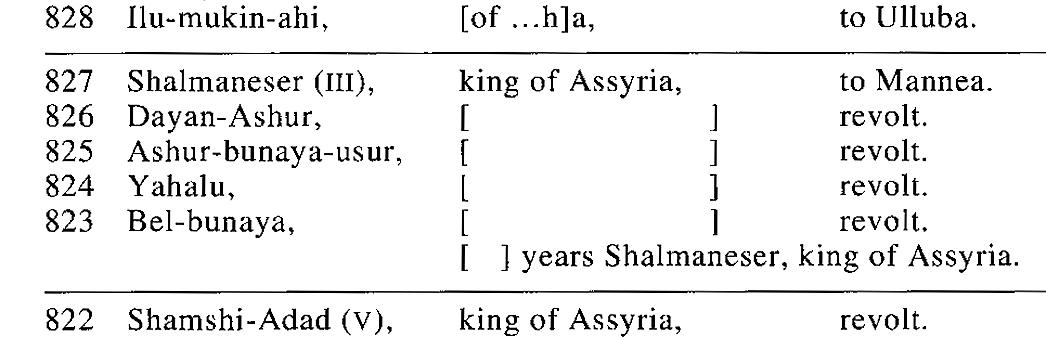 These limmus represent the 29th to 35th years of Shalmaneser III; the strange thing is that Shalmaneser chose to restart his limmu cycle, being limmu in his 31st year for the second time; then having his entire cabinet repeat their limmus.
This is utterly unprecedented in Assyrian history, since the entire point of a limmu is to have a single limmu name within the reign of a king so a year can be identified clearly; having two years with the same name is akin to having two years named “my third year.”
Certain people were limmus more than once, but never within the reign of a single king. And at no point in history was any other Assyrian king limmu twice. Worse, no one can satisfactorily explain why Shalmaneser did this.
It’s almost as if a new king named Shalmaneser was reigning here, since the limmu cycle repeats following the traditional cycle for a new king. Unfortunately, other evidence (genealogical, in particular) weighs against that possibility.
What we can say with certainty is that this is unprecedented, and must conceal something of note. Historians generally say that due to the rebellion of Ashur-dain-apli they were unable to elect limmus; however there was another procedure for this already established.
When limmus could not be elected, the scribe would simply say “the year after the year of Ilu-mukin-ahi,” and “the year after the year after the year…” and so on. Because for the purposes of year naming, literally any name is better than repeating a name.
A HIDDEN REIGN
We have not yet called attention to the horizontal line before Shalmaneser’s 30th year and the recycling of his limmus. We determined previously that a horizontal line in an unexpected place was a “spectral remnant,” to use Edmonds and Frahm’s phrase, of another king being quietly edited out of the list.
Here, we have documentation that another king was in fact ruling Assur and 26 other cities, and a horizontal line right where we would expect it to be; Shalmaneser III went to Mannea on campaign, and while he was gone, his reign was challenged by his son, so the next year and all the years after were “revolt.” This continued into the reign of Shamshi-adad V, who tells us…
When Aššur-daʾʾin-aplu, at the time of Shalmaneser (III), his father, acted treacherously by inciting insurrection, uprising, and criminal acts, caused the land to rebel and prepared for battle, he won over the people of Assyria, above and below, to his side and made them take binding oaths. He made the cities revolt and made ready to wage battle and war [most of the great cities of Assyria are listed] … altogether twenty-seven cities, together with their fortresses, which had rebelled against Shalmaneser (III), the king of the four quarters, my father, (and which) had sided with Aššur-daʾʾin-aplu. By the command of the great gods, my lords, I subdued (them). (Shamshi-adad V’s inscription, http://oracc.org/riao/Q004738/)
What’s interesting is that the AKL says nothing of this; Ashur-dain-apli is not mentioned, despite ruling the key cities of the empire for, according to most historians, 4-6 years. The whole episode is quietly dismissed by the official Assyrian record, making us wonder… what else did Assyrians find it convenient to forget?
The AKL’s presentation of an uninterrupted linear transmission of Assyrian kingship during the first millennium BCE, without mention of usurpation (see fig. 1), presents difficulties, however. Not only Tiglath-pileser III’s murky rise to power (see below, §2), but also the six years of succession war surrounding the end of Shalmaneser III’s reign and Šamšī-Adad V’s accession (826–820 BCE) go unremarked in the AKL. This latter conflict is particularly suspicious, as the city of Aššur—the traditional site of an Assyrian king’s enthronement—at least initially took the rival claimant Aššur-da’in-apla’s side, giving him the opportunity to have been crowned there as a parallel, “rebel king.” If this is what actually happened, then the AKL would not be a complete list of Neo-Assyrian kings for the era, but rather include only those kings recognized by its compilers as “canonical.” (Three New Kings Of Assyria, Edmonds and Frahm, henceforth TNK)
At first Ashur-dain-apli seemed to have won, as Shamshi-adad V specifically says “he won over the people of Assyria, above and below, to his side,” meaning he was not an unpopular king in the eyes of most of the nation.
He would certainly have set about establishing his own legitimacy in every way possible, with statues, king lists, priestly blessings, and so on; but none of this has ever been found. Because just as certainly, Shamshi-adad V would have wanted all of that destroyed.
Notably, given that he was governing the core cities of a rather large empire for at least a few years, he would certainly have made his own limmus in Assur; yet these limmus never made it into the “official” record of Assyria. Why not?
We suspect that later scribes, not wanting to legitimize this rebel king and unwilling to accept years named after his hated henchmen, simply deleted him and any successors from the record – just as the Egyptians did their best to scrub Amarna from the record.
TUKULTI-ASSUR
Another non-canonical king who is finally starting to be acknowledged is one we have already mentioned, Tukulti-assur. We know of him from Chronicle P, where his name is almost universally reconstructed as “Ninurta-tukulti-Assur”;
… The statue of the great lord Marduk he removed from his dwelling-place and sent him to Assyria. … For sixty[?]-six (until the time of Ninurta-tukulti-Aššur), Bêl stayed in Assyria, in the time of Ninurta-tukulti-Aššur, Bêl. (Chronicle P)
However, as Goldberg observes, that is not the name of the king in the original text.
In 1967, Brinkman noted that this Tukulti-Aššur is “usually assumed” to be identical with a later 12th century Assyrian king Ninurta-tukulti-Aššur, but considered this identification “uncertain.” (The Tukulti-Aššur Question… Jeremy Goldberg)
We addressed this at length in our chapter on the Captivities of Marduk, where we concluded that the statue had been taken in the first year of Tukulti-ninurta II, not Tukulti-ninurta I as universally assumed, placing his captivity exactly 66 years before the end of Shalmaneser III’s 35-year reign.
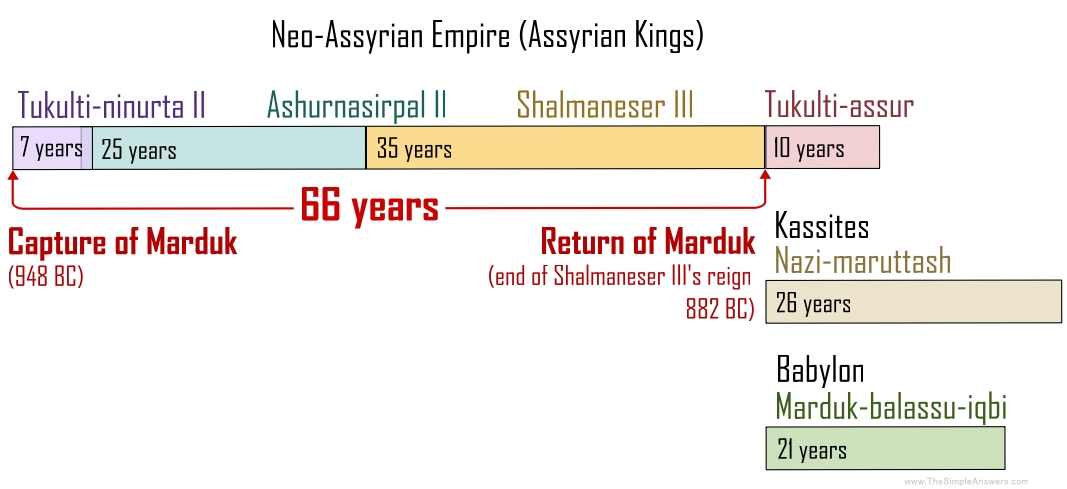
The coincidence of those two numbers being precisely 66 years, happening to end precisely during a period of rebellion that caused all the core Assyrian cities to follow the rebel Ashur-dain-apli is compelling.
We can see how a rebel king, trying to hold on to power against the rightful heirs and high officials in the military who supported Shamshi-adad V would reach out to Babylon with a gesture of peace by restoring their beloved icon of Marduk.
But why Tukulti-assur, and not Ashur-dain-apli? I can offer no proof at the moment besides Chronicle P’s assertion that he was ruling Assyria the year after Shalmaneser III’s death. But here’s the hypothetical story I would tell, taking all this information into account…
Shalmaneser III weakens in later years and delegates a great deal of power to generals, in particular Dayan-assur. Threatened by this and fearing he will lose power to them when his father dies, Ashur-dain-apli preemptively rebels and takes most of the empire with him.
It is possible he was even the heir apparent to the throne; that would explain why he was able to win over most of the empire; he was due to be king anyway. But his impatience cost him his legitimacy, as his father disowned him and made Shamshi-adad V heir instead.
After his rebellion, Shalmaneser III retreated with Shamshi-adad V and his loyal generals to a safe location; given the cities that went with Ashur-dain-apli, they very likely fled to the Khabur River valley in the upper Euphrates, whereupon he died in his 35th year.
Coincidentally or not, Ashur-dain-apli died around the same time as Shalmaneser III, leaving his own heir Tukulti-assur to rule the heartland in his stead while Shamssi-adad V remained in exile to the west.
Since the rebellion still claimed the city of Assur, “the traditional site of an Assyrian king’s enthronement” (TNK) Shamshi-adad could not count his reign as having begun yet, so the rule of Tukulti-assur with its own limmus continued for an unknown amount of time, time not tracked in the AEL or the AKL since Tukulti-assur and his predecessor were only deemed illegitimate later.
During this time, he reached out to Babylon with a diplomatic gesture to get them to recognize him as the legitimate king, which they did; hence why only Chronicle P, a Babylonian document, remembers his time as king.
Eventually Tukulti-assur died or was forced to flee and Shamshi-adad V was able to be officially crowned in Assur, whereupon his limmus began. But further pretenders to the throne kept the rebellion alive into the first three years of Shamshi-adad’s reign.
This is a story, and must be deemed hypothetical; it does, however, explain every single fact about the period without dismissing any source. It explains why Shalmaneser’s later limmus are weird, the unusually long and powerful nature of the rebellion, the existence of the non-canonical Tukulti-assur and his recognition by Babylon…
And it all but requires us to insert years into the Assyrian timeline. How many is uncertain, but given the needs of the Israelite timeline, I’ve chosen to add 10 for this period as the reign of Tukulti-assur. But that is not the end of the strife in Assyria.
SEMIRAMIS
After the rebellion was put down and Shamshi-adad V was established on his throne, he died unexpectedly leaving an heir too young to rule. Knowing this fact, there is good reason to suspect a regent ruled over the empire until he came of age – which Assyriologists nonetheless strongly reject:
Adad-nīrārī was a son and successor of king Shamshi-Adad V, and was apparently quite young at the time of his accession, because for the first five years of his reign, his mother Shammuramat was highly influential, which has given rise to the legend of Semiramis. It is widely rejected that his mother acted as regent, but she was surprisingly influential for the time period. (Wikipedia, Shammuramat)
Any time a historian says something is “surprising” that’s code for “doesn’t fit our theories,” which is a clue to us that we should dig deeper since there’s a weak spot here.
Nothing is known of her life or relative influence and power in the reign of her husband. Under Adad-nirari, her role was exceptionally prominent for a woman of the time. Per the Pazarcık Stele she accompanied her son on a campaign against the Hittites Kummuh in Hittite and both she and Adad-nirari are credited with expanding the borders of the empire in all directions into Levant, Anatolia and Ancient Iran. In some inscriptions, local governors made dedications not only to the king (as was customary) but exceptionally also to Shammuramat. All evidence suggests that Shammuramat was among the most renowned figures of her time. (Wikipedia, Shammuramat)
A lack of evidence never causes humility in the statements of historians. In all these ways, she acts as a queen-regnant, and therefore very likely ruled in her own right, but historians are absolutely certain she did not. What justifies that confidence? As Edmonds and Frahm rightly conclude…
As we hope to have demonstrated, the trust that virtually all students of Neo-Assyrian history have so far placed in the AKL is not entirely justified, as it is a less than impartial account. Instead, the AKL reduced the complex political realities of the Neo-Assyrian period to an uninterrupted succession of rightful kings, omitting those complicating its narrative. (TNK)
We now have conclusive evidence that the AKL was not an objective record of kingship, but rather an idealized narrative of “rightful” kings. So if Shammuramat ruled for a decade or two while her son languished in her shadow, we can hardly be surprised that the Assyrian scribes preferred to quietly erase the shame of it along with her limmus.
Because of the limited source material, her exact role and position remains disputed, though it is clear that she was among the most renowned figures of her time. In 2013, David Kertai suggested that Shammuramat’s continued use of the title “queen” in her son’s reign, the only certain Assyrian example of this, could indicate that she for a time was queen regnant. … In 2012, Svärd wrote that regardless of her formal position, Shammuramat was clearly an authoritative female figure who played an important role in running the empire, perhaps acting as a sort of pater familias after the death of Shamshi-Adad while her son was young. Shammuramat does not appear in later Assyrian accounts, perhaps, per Svärd, due to Assyrian royal ideology finding it difficult to “accommodate the presence of an authoritative female figure.” (Wikipedia, Shammuramat)
Remember Hatshepsut; if, like her, Shammuramat’s reign was systematically erased later, we would struggle to find any evidence of her sole reign and her name certainly wouldn’t appear on the limmu-lists or king lists!
But later Greek writers still knew of her by legend under the name Semiramis, considering her one of the most powerful rulers of Assyria. Generally historians consider these legends, which are incorrectly set by the Greeks at the foundation of the empire around 2000 BC, to have been inspired by Shammuramat.
In almost all legends, Semiramis becomes the wife of Ninus (a purely legendary figure), a legendary founder of Nineveh and the Assyrian Empire and a figure who in virtually all stories he appeared in was overshadowed by his wife… In the accounts of Ctesias and Diodorus Siculus, Ninus is old at the time of their marriage and dies soon after the birth of their son Ninyas. The death of Ninus while Ninyas is still young leaves Semiramis to rule the empire. Semiramis erects a huge mound over Ninus’s grave, using his bones to embellish Nineveh and turning his grave into a monument of her own strength and power. (Wikipedia, Shammuramat)
If there is any core of truth to these legends, and if they are indeed based on Shammuramat – neither of which is certain – then it would be a strong argument that she was, in fact, the empress of Assyria after the death of Shamshi-adad V and well into the life of her young son Adad-nirari III.
And if that’s true we would not be at all surprised if she ruled for ten or even twenty completely undocumented years in Assyrian history. Since the missing years before and after Shamshi-adad V must add up to 24 in total, how they are distributed we cannot say for sure, but we assign her 14.
SUMMARY
With this, we have reconciled all conflicts with the Bible, Syria, Tyre, and Assyria. Beginning with the synchronism of ‑899/18th year of Shalmaneser, we place a gap of 10 years after Shalmaneser III when Tukulti-assur was ruling before Shamshi-adad V took back the throne.
We then place another gap of 14 years after the reign of Shamshi-adad V, who died leaving a young son and whose wife Shammuramat – Semiramis in Greek – was regent until he was of age; the specific numbers are debatable, but together these gaps sum 24 years.
We freely admit there are other possible interpretations of this chaotic period; the force of our argument rests with the Bible and Tyre’s historical data requiring Shalmaneser III to be pushed back 54 years.
For the missing years, we need only give reason to believe that years are indeed absent from the record which I think we’ve done. Specifically how those missing years are apportioned is hard to reconstruct since the original authors of these documents didn’t want us to know.
Now our dating for Egypt is derived completely independently from our dating for Assyria; so it acts as an independent check of our findings. According to that research, during the 10th and 9th centuries Syria was a pawn in the great power struggle between Hittites, Egyptians, Israelites, and Assyrians.
We know the Hittites were there most of the time, we know that the Egyptians were present in western Syria in the 1st year of Seti I (‑867) and again in the early reign of Ramesses II between the years ‑852 and ‑846, when Ramesses and the Hittites were going back and forth over Syria.
Obviously, if Assyria were also campaigning in this place, at this time, we would expect them to be named as an involved party. And in the traditional history, they would be – the battle of Qarqar and Shalmaneser’s raids fall in the ‑850’s and ‑840’s in traditional dates.
If true, this would have destroyed our Egyptian chronology for this period; aren’t we fortunate then, to see in our revised chronology Shalmaneser’s major raids on Syria end with his 27th year, which we now date to ‑890.
After that, as has been said, the Assyrian Empire fell into disarray, civil war, and weak kings; giving plenty of time for the Hittites to reassert their control, and the Syrians themselves to recover, by the time of Seti I and Ramesses II.
The Assyrians would remain out of Syria until the time of Adad-nirari III, specifically his 1st-9th years, which we date to ‑845‑836. You will notice this perfectly fits the time when Ramesses wasn’t in Syria, to the year. That, if a coincidence, is an incredibly fortunate one.
And then the treaty of Kadesh was signed as a non-aggression and mutual defense pact in ‑835, securing the Hittite-Egyptian alliance against unnamed foreign powers. And from the year it was signed, the Assyrians didn’t set foot in western Syria for nearly a century.
Again, what an amazing coincidence. I want to stress one more time that we did not move the Assyrians to fit the Egyptians in any way, even indirectly; the Assyrians were moved because of Hazael-Baal-eser-Ahab-Jehu-Shalmaneser and the Adad-nirari III-Jehoash and Bur-sagale-Ra’ash synchronisms.
Meanwhile the Egyptians were moved primarily based on Solomon and Rehoboam’s many synchronisms with Hatshepsut and Amenhotep II, and that of Ramesses II the “savior” of Israel and the way the resultant wars with Moab, Edom, Syria, and so on mesh the years of Ramesses with datable events in the Bible.
The fact that two thoroughly unrelated changes should happen to make the presence of unrelated nations in Syria fit like a zipper with each other is a strong, testable, independent argument of the accuracy of the reconstruction.
Because what are the odds that three kingdoms, all displaced from their traditional places for other reasons – Assyrians moved back by 54/34 years, Egyptians moved forward by 423 years, Jeroboam moved back by 45 years, all manage to be in Syria precisely in the years that the others are somewhere else? As if they were coordinating their presence there?
As I always say, we’re either incredibly lucky, or right.

 Neo-Assyrian Chronology
 Ramesses and Assyria
 Rehoboam to Ramesses
 After Amarna
 What Is The LOVE Of God?
 Everything You Believe About God Is WRONG!
 Make Up Your Mind!
 What Is Faith?
 How DARE you FEAR the judgment of God!
 Firstripe Figs
 The Bride Of The Father
 Exodus 40 – The Plan Of God
 The Temple Of God
 Pillars Of The Temple And The Brass Sea
 GEHENNA WITH ‘EM
 When Did God Forbid Polygamy?
 When You Shouldn’t Pray For Someone
 The Sins of the Father
 The First Paul