The Birth And Youth of Moses
This is part 19 of the The History of the World Series
; The History of the World is part 1.
Click here to read in series
The Egyptians, duly impressed by Joseph and his God, were slow to turn on their Hebrew friends. The Bible specifically says it took the lifetime of Joseph, and the death of all those who knew him, before the Egyptians started to oppress the Hebrews.
Exodus 1:6-8 Joseph died, as did all his brothers, and all that generation. The children of Israel were fruitful, and increased abundantly, and multiplied, and grew exceedingly mighty; and the land was filled with them. Now there arose a new king over Egypt, who didn’t know Joseph.
This would have taken at least 30 years or so after the death of Joseph, more likely 50 or more. This puts the beginning of the persecution no earlier than the late 12th dynasty, or possibly the early 13th dynasty.
Israel was still dwelling in the Fayoum/Goshen in the time of Moses (Exodus 9:26), and Moses was regularly going back and forth between him and the elders of Israel, a journey that is not pictured as lengthy in the Bible.
This means that Pharaoh and Israel lived fairly close to each other, and since no other capital was near Goshen, Pharaoh must have still had his capital at Ity-tawy. And since no other dynasty but the 12th was based in Ity-tawy, the Pharaoh of the Exodus had to have been one of the kings of the 13th dynasty.
In later texts, this dynasty is usually described as an era of chaos and disorder. However, the period may have been more peaceful than was once thought since the central government in Itj-tawy near the Faiyum was sustained during most of the dynasty and the country remained relatively stable. The period was undoubtedly characterized by decline, with a large number of kings with short reigns and only a few attestations. The true chronology of this dynasty is difficult to determine as there are few monuments dating from the period. Many of the kings’ names are only known from odd fragmentary inscriptions or from scarabs. (Wiki, Dynasty 13)
Furthermore, since the events of the Exodus so badly weakened Egypt that they may not have even had a government left at all, he must have been one of the final kings of that dynasty. Regarding the transition between dynasties and the beginning of the persecution, Josephus says…
And having, in length of time, forgotten the benefits they had received from Joseph, particularly the crown being now come into another family, they became very abusive to the Israelites, and contrived many ways of afflicting them; for they enjoined them to cut a great number of channels for the river, and to build walls for their cities and ramparts, that they might restrain the river, and hinder its waters from stagnating, upon its running over its own banks: they set them also to build pyramids. (Josephus)
Between Joseph and Moses the crown “came into a different family.” So we would expect the persecution to be after the 13th dynasty began, or at least at some point late in the 12th where the family lineage changed. More on that later.
Josephus also says “they cut a great number of channels for the river.” Egyptologists tell us there was an immense amount of hydraulic engineering, particularly of the Fayoum, in the Middle Kingdom – which is what we would expect from people with food-security issues and an immense slave-labor source based in Goshen, the Fayoum.
By far the most interesting part of the quote says that the Israelites built the pyramids; while the Bible does not explicitly mention pyramids, although it does mention large-scale brickmaking for various projects. But if Josephus is correct here, there is only one possible dynasty for Moses’ timeframe.
The Old Kingdom pyramids (3rd through 6th dynasties), were made of solid stone or rubble cores, not brick. These are the famous pyramids at Giza, the ones on all the postcards. But what many people don’t realize is that the later pyramids were not made of solid stone – they were a stone outer casing surrounding a brick core!
This architectural fact alone requires the Exodus to have been in the Middle Kingdom period (11th through 13th dynasties). The vast majority were built in the 12th dynasty, although building continued to the end of the 13th.
These were the only large-scale pyramids ever built of brick, meaning that somewhere in this period we will find the Hebrew slaves building bricks and gathering their own straw. It certainly wasn’t any dynasty after the 13th, because large-scale pyramids were never again built in Egypt.
And that’s not an accident – the Exodus is the reason they were never built again.
PROOF OF THE EXODUS
If you ask Wikipedia about the Exodus narrative, it will tell you the following…
There is no direct evidence for any of the people or events of Exodus in non-biblical ancient texts or in archaeological remains, and this has led most scholars to omit the Exodus events from comprehensive histories of Israel. (Wiki, Exodus)
When this article is done, you will know that statement to be what it is – the reasoned, sober consensus of the most respected historians and archeologists in the world.
And one of the dumbest things historians have ever said.
Because there is so much hard evidence, both from the ancient Egyptian historians who describe the river of blood and the chaos following the plagues, and also hard archeological evidence of specific, unique events in the Exodus narrative.
And the worst part is, archeologists have known this for over a century. Near the Fayoum, Sir Flinders Petrie excavated the town of el-Lahun, which commands the canal leading from the Nile into the Fayoum. But the town had a very unusual layout…
At el-Lahun … it was evident that the west block was a ‘barrack-like camp’ or a sort of ‘dormitory for confined people.’ … The town planning and the consequent social order at el-Lahun may have imposed a condition of coercion over the population, effectively caging people in ‘ghetto-quarters’ with the intention of centralizing the resources of thousands of individuals. … the contextual evidence from el-Lahun that seems to indicate that a punitive institution known as a xnrt (‘prison,’ ‘fortress/enclosure’ or ‘workcamp’) was in existence in the western part of the town called the Sekhem. (The Ghetto of el-Lahun, Mazzone)
This “workcamp” was a later addition to the city of el-Lahun, which was built at least as early as Sesostris II for laborers, although some researchers make a strong case it was used as early as Amenemhet I to work on building projects in the Fayoum.
Originally, these laborers were free citizens, but it was only later, probably after the time of Sesostris III – or, as I believe, even later, under Amenemhet IV – that it was turned into a concentration camp. And what was the ethnicity of these slaves?
The population of el-Lahun, composed mainly of confined men and women, often of Syrian-Palestinian origins and scarcely motivated by religious devotion to the sovereign, were most likely subject to a certain amount of coercion. Seclusion and beatings were probably common, and were most likely aimed toward subduing the foreigners. There is evidence documenting this in the historical record, in literature and in iconography. The role of foreigners within Egyptian society, a society considered by some to have been liberal in some respects, was clearly one of total subjugation. (The Ghetto of el-Lahun, Mazzone)
So the Fayoum in general, and el-Lahun in particular, had a large population of Syria-Palestinian – i.e., Hebrew – slaves forced to work on monumental projects against their will. Just to be clear, I don’t believe this town contained all the Hebrews – it was unlikely to have held more than 5,000 people.
However, the Egyptians had a complex system of forced labor required by all citizens, and there is significant evidence that this and other forced-work camps were for those who refused to voluntarily submit to the work – these, then, would have been the more stubborn Hebrews.
Slaves, especially of Levantine [i.e., Hebrew] origin were grouped in ghetto camps to perform labor for the state where they lived in harsh conditions, often including beating by their masters. The term for “male Asiatic” in ancient Egyptian language became synonymous with “slave.” (Wiki, “Slavery in ancient Egypt”)
Now Sir Flinders Petrie, when he excavated el-Lahun, was shocked to find an immense amount of valuable and useful artifacts left behind – far more than was discovered at other archeological sites. Forgive the length of the quote, but it’s worth it to see what all was left behind…
Those wooden hoes, and rakes, and grain-scoops; that curious brick-maker’s mould; those plasterer’s floats and carpenter’s tools; and, most interesting of all, that primitive wooden sickle set with flint-saws, … the ivory castanets and the painted canvas mask from the House of the Dancer, together with the grotesque little wooden figure of that long-departed ballerina. … flint and bronze tools, and … numerous forms of cups, jars, pots, ring-stands, bowls, and other domestic vessels in pottery of that remote period. That so large a number of objects, many of them at that time of considerable value, should have been left in the houses when the town was deserted is very strange, and would seem to point to some sudden panic. The women, for instance, left not only their whorls and their spindles, of which a large number were found, but also a store of dyed wool, not yet spun; the net-makers left their netting-needles, their netting, and the balls of twine which were not yet made up; the weaver left his beam and the flat sticks with which he beat up his weft; and in the shop of a metal-caster were found, not only a fine bronze hatchet ready for sale, but his whole stock-in-trade in the shape of moulds for casting chisels, knives, and hatchets. Bronze mirrors, toilet objects, children’s toys, draught-boxes, amulets, scarabaei, beads, rush-mats, baskets, brushes, and sandals, handbags made to draw with a cord, spoons, combs, and other personal possessions of these people were also found in their houses. (Kahun, Gurob, and Hawara by W. M. Flinders Petrie Review by: Amelia B. Edwards, December 1890)
Under what conceivable circumstances would an entire city of slaves leave behind their most prized possessions, their toys and tools, their wool and their metal – and even more shocking, under what possible circumstances would those artifacts be left untouched for 3,500 years??
Deuteronomy 16:3 …for you came forth out of the land of Egypt in haste: that you may remember the day when you came forth out of the land of Egypt all the days of your life.
Why, people who knew they would have no need for hoes and plows, no need for mortar-trowels and whose shoes would not age on their feet for 40 years (Deuteronomy 29:5). People whose freedom from slavery depended on leaving NOW. And in an explicit counterpart of this, Jesus warns His followers that when their own Exodus comes…
Matthew 24:16-18 then let those who are in Judea flee to the mountains. Let him who is on the housetop not go down to take out things that are in his house. Let him who is in the field not return back to get his clothes.
And if this didn’t convince you that this city housed Hebrew slaves before the Exodus, I have one last ace to play. Because there is one more thing that Petrie found at el-Lahun that conclusively proves the Exodus narrative…
Petrie found wooden boxes buried beneath the floors of many of the houses in the village that he found at Lahun (Fayoum) and dates back to the Middle kingdom. When opened, they were found to contain the skeletons of infants, sometimes two or three in a box, and aged only a few months at death. (Children’s Burials in Ancient Egypt, Magdy)
Note the agreement between the ages of the dead infants, and the story of the Exodus:
Exodus 2:1-3 …The woman [Moses’ mother] conceived, and bore a son. When she saw that he was a fine child, she hid him three months. When she could no longer hide him, she took a papyrus basket for him…
Thus, three months was as long as she could keep the baby secret; Moses managed to escape because she let him sail down the river, trusting God to save him; other parents, trusting to themselves to protect their babies, had their babies caught and killed by Pharaoh’s agents at about the same age.
‘…beneath the brick floors of the rooms were, however, the best place to search; not only for hidden things, such as a statuette of a dancer and pair of ivory castanets, but also for numerous burials of babies in wooden boxes. These boxes had been made for clothes and household use, but were used to bury infants, often accompanied by necklaces and other things…’. (Kahun, Gurob, and Hawara by Petrie)
Do I need to say it? El-Lahun was a city of Hebrew slaves, forced to build monuments for Pharaoh – yes, pyramids among them, although not the famous ones at Giza – and whose babies were murdered because of Pharaoh’s paranoia that one of them would be the downfall of Egypt.
And he managed to kill all but the most important one, apparently.
No archeological evidence of the Exodus, my foot.
THE BIRTH OF MOSES
The Bible kept track of the time between Abraham and the Exodus internally, and using that information we can attach Egyptian chronology to a more secure framework; first, we align Sesostris I’s 25th year with the end of the 7 years’ famine and Joseph’s 45th year.
Doing that, and using the widely-agreed chronology of the 12th dynasty (which for once Manetho, monuments, and most Egyptologists agree on), you find the end of the 12th dynasty in ‑1582.
Now the Bible places the Exodus in ‑1507, at which point Moses was 80 years old. Which means Moses was born in ‑1587 – five years before the end of the 12th dynasty, which cannot be a coincidence. Indeed, it’s a great story.
Because when you think about it, the story of Moses is very strange. Why would Pharaoh’s daughter adopt a random Hebrew boy, particularly in a time of cruel oppression of the same Hebrews by her government?
Remember, the whole reason Moses’ mother gave him up was that Hebrew boys were to be killed on sight by drowning in the river (Exodus 1:22). Yet Pharaoh’s daughter not only didn’t kill him, she adopted him and intended to make him her heir!
Can you picture the scene? Pharaoh sends out an order to murder all Hebrew boys on sight specifically by casting them into the river. A year or so later, Pharaoh’s daughter comes into his throne room all excited “Daddy, daddy, look what I found! A pretty Hebrew boy! Oh, by the way, he’s going to rule Egypt when you’re dead!”
And then Pharaoh must have been all like “Uh, dear, the point of throwing the Hebrews in the river was to kill them. No, you can’t keep him. No! Don’t name him! OK, well, yes he is very cute dear, but the Egyptians will never accept him as king. Ok, ok, don’t cry… fine, yes you can keep him but if he makes a mess you’re cleaning it up.”
Can you picture that? Me neither. There is simply no way that the king who wanted to kill the Hebrew babies let his daughter adopt one of them and make him the heir. Nor is it possible that she would want to adopt him, if she had any other choice.
This sequence of events has never been properly explained, beyond vague gesturing towards “God’s blessing” and so on. Because it cannot be explained if you don’t know the political situation in Egypt at the time!
Oh, about that. You may he wondering who was king those last five years of the 12th dynasty, the first five years of Moses’ life?
Well, technically no one. Because the king of Egypt wasn’t a king at all – she was a woman named Sobekneferu. And she began to reign the year after Moses was born.
Which means when she adopted Moses, she was just “Pharaoh’s daughter,” but the next year she became Pharaoh herself. How else could she have protected a hated Hebrew boy and made him heir of the throne of Egypt?
THE SUCCESSION OF AMENEMHET IV
Everyone agrees that Sobekneferu was the daughter of Amenemhet III, identified in the last chapter as the Pharaoh who began the oppression. But as said before, that oppression most likely did not single out Hebrews per se, it just included them as part of a large forced-labor gang.
After he died, and before Sobekneferu ruled, he was succeeded by Amenemhet IV. No one knows what relationship, if any, Amenemhet IV had to his predecessor but we know he wasn’t a son, because Amenemhet III had only daughters – definitely 2, possibly 5.
These daughters had been groomed to become king themselves, in a very unusual move that indicates he had no male issue. One daughter, Neferuptah, died before she could become king. No one is sure where Amenemhet IV came from or why he ruled for 9 years, but after he died Amenemhet III’s other daughter, Sobekneferu, began to reign and reigned for almost 4 years.
What’s weird is that Manetho calls Sobekneferu the sister of Amenemhet IV, even though Amenemhet III is known to have had no sons! Which means the brother of his daughter must be her husband who Amenemhet III adopted! And finally, Josephus’ statement makes sense.
And having, in length of time, forgotten the benefits they had received from Joseph, particularly the crown being now come into another family, they became very abusive to the Israelites, and contrived many ways of afflicting them. (Josephus)
Josephus says the crown “came into a different family.” This fits perfectly – since Amenemhet IV WASa different family. He was adopted into the 12th dynasty, but was not a part of it at all. And it makes perfect sense, if you put yourself in Amenemhet III’s shoes.
You’re an aging king with no male issue, with no choice but to groom your daughters to rule. We know this happened, beyond a doubt. But your patriarchal society strongly questions the ability of your daughters to keep the country in line, so what do you do?
You would marry your eldest daughter off to a trusted general or noble, and – to make sure he continued your dynasty – you would adopt him as your stepson, whereupon he would take your throne name and become Amenemhet IV.
When he in turn died he, too, left no heirs so his wife, Pharaoh’s daughter, ruled in his stead.
SOBEK ANSWERED
But before he died, still childless, Sobekneferu went down to the river to bathe. This is a curious event, but it doesn’t jump off the page to us today because we don’t realize that princesses don’t have to take a bath in the river! She had a perfectly nice tub in the palace.
And she didn’t just happen to go for a swim; because to the Egyptians, the gods of the Nile, Hapi and/or Sobek, were the gods of life and fertility. Bathing in the Nile, then, was one of the rites a woman would perform to get pregnant.
So imagine yourself praying to God for a baby, then one floats by in a basket. You would certainly take it as a sign that your prayer had, quite literally, been answered. Now consider the following quote:
She was the first ruler to have a theophoric association with the crocodile god Sobek, whose identity appears in both her given nomen Sobekneferu and her chosen praenomen Sobekkare. (Wiki, Sobekneferu)
So she was the first ruler to ever use “Sobek” in a throne name. There has to be a reason for that. But when you realize that Sobek is the crocodile god of the Nile associated with childbirth, and that the Nile gave her the baby she prayed for… well it make sense, doesn’t it?
The origin of his name, Sbk in Egyptian, is debated among scholars, but many believe that it is derived from a causative of the verb “to impregnate.” (Wiki, Sobek)
These things, and her willingness to adopt a random boy, tell us she was barren and that she believed God had literally given her a child to answer her prayer – which in fact, He did, although it was not the God she thought it was.
THE SLAUGHTER OF BABIES
But this also tells us that when Moses was born, her husband was still alive. What’s the point of praying for fertility, if you don’t have a man to do the fertilizing? And given that he ruled for ten years, he must have been the same man who gave the following order…
Exodus 1:22 And Pharaoh charged all his people, saying, Every son that is born ye shall cast into the river, and every daughter ye shall save alive.
Pharaoh wanted to oppress the people, and reduce their population, but this is a very poor way of doing it. If you want the population to die out, you kill females, not males. So why would Pharaoh attack male infants in this way? The Bible doesn’t tell us. But Josephus does…
One of those sacred [Egyptian] scribes, who are very sagacious in foretelling future events truly, told the king, that about this time there would a child be born to the Israelites, who, if he were reared, would bring the Egyptian dominion low, and would raise the Israelites; that he would excel all men in virtue, and obtain a glory that would be remembered through all ages. Which thing was so feared by the king, that, according to this man’s opinion, he commanded that they should cast every male child, which was born to the Israelites, into the river, and destroy it; that besides this, the Egyptian midwives should watch the labors of the Hebrew women, and observe what is born, for those were the women who were enjoined to do the office of midwives to them; and by reason of their relation to the king, would not transgress his commands. He enjoined also, that if any parents should disobey him, and venture to save their male children alive, they and their families should be destroyed.
Josephus claims that Moses was prophesied by one of Amenemhet IV’s magicians to overthrow Egypt; and that was why all male Hebrew children were killed. Not as population control, but specifically to get rid of a potential competitor to the Egyptian throne!
This also explains why he turned to oppress the Hebrews, particularly; Amenemhet III had used the labor of everyone, Egyptians and Hebrew alike; but after this prophecy, Amenemhet started to fear the Hebrews and so set out to exterminate them, starting with male children.
Which, as has already been pointed out, is conclusively confirmed from archeology by an abundance of infant burials below houses in a concentration camp in precisely the area of Egypt we locate Goshen – in El-Lahun, in the Fayoum.
But why just kill the adults, when you can work them to death? Thus, we finally know why the mood shifted in Egypt. In fact, it’s exactly what happened with Herod; the wise men told Herod that Jesus would be the king of the Jews.
And as it happened, Herod was also king of the Jews – and a very paranoid one at that. So Herod commanded to kill every child that could possibly be his replacement, killing every one under 2 years old.
The fact that the Bible likes patterns, and that in a way Moses and Jesus were representative of each other as lawgivers and saviors, it stands to reason that something similar might have motivated Pharoah. That makes us inclined to believe that Josephus’ story was based in fact.
In the time of Herod, the infant Jesus escaped – oddly enough, to Egypt – where He hid for 2 years until God told Joseph in a dream that it was safe to return as “those who sought the young child’s life are dead” (Matthew 2:20).
So just to keep with the pattern, I’m going to say that this edict of Amenemhet IV to kill all the male children went forth 2 years before the birth of Moses, in ‑1589. At this point, Sobekneferu was not yet sole ruler; just a childless mother trying to perpetuate her father’s dynasty.
THE ADOPTION OF MOSES
Moses was born in ‑1587, the year before Sobekneferu became queen. This cannot be a coincidence nor did we have to fiddle with the numbers to make this fit; it’s simply a result of aligning Joseph’s famine with that of Sesostris, and following the firmly established internal chronology as established by Egyptologists for the 12th dynasty.
The reason that the exact date is so important is, as mentioned above, it’s impossible to imagine that Sobekneferu came in and said “Daddy, look at the cute Hebrew boy I’m adopting!” But can you POSSIBLY imagine this Pharaoh approving of one of the very babies he himself had ordered cast in the river being dragged out of it by his daughter and becoming his own heir?? I mean… he was killing them SPECIFICALLY so that wouldn’t happen!!
Josephus claimed that Pharaoh was consenting to the arrangement, but here I must disagree with him; it is unthinkable to me that the same Pharaoh who ordered this to happen tolerated Pharaoh’s daughter choosing one of these babies as his heir.
And if, as we believe, the Pharaoh at the time was her husband, not her father, as we believe, it would have gone even worse. There is no way a Pharaoh young enough to have his own children would have even considered making a random Egyptian boy his heir, much less a Hebrew whose race he was trying to exterminate.
Yet the Bible comes to the rescue with a perfectly fitting explanation; now put yourself in Sobekneferu’s shoes; you’re a young woman desperate for an heir to carry on your father’s dynasty, and you pray to Sobek for a baby and you get one. Why don’t you take him home with you on the spot??
Exodus 2:8-10 Pharaoh’s daughter said to her, “Go.” The maiden went and called the child’s mother. Pharaoh’s daughter said to her, “Take this child away, and nurse him for me, and I will give you your wages.” The woman took the child, and nursed it. The child grew, and she brought him to Pharaoh’s daughter, and he became her son. She named him Moses, and said, “Because I drew him out of the water.”
She didn’t dare bring him home with her because she knew her husband had commanded to kill all such babies on sight! Why else would she send away a child she obviously loved at first sight?
Exodus 2:6-7 …and when she saw the ark among the flags, she sent her maid to fetch it. And when she had opened it, she saw the child: and, behold, the babe wept. And she had compassion on him, and said, This is one of the Hebrews’ children.
So while her husband was still alive, Sobekneferu, barren, went to the river to pray for a child from the god Sobek. She saw Moses, loved him, and determined to make him her heir but didn’t tell her husband. She didn’t dare – she sent him off to be raised by his own parents.
Meanwhile, according to our timeline, her husband died; on her accession she chose a name honoring Sobek, the same god who had given her Moses – the first ruler of Egypt to ever do so. With her father and husband dead, she was left as sole ruler of Egypt and in a position to adopt whomever she felt like.
But not without consequences. But before we tell that story, we have to talk about the 13th dynasty which succeeded the 12th after the end of Sobekneferu’s reign.
THE THIRTEENTH DYNASTY
We are confident that the Exodus happened after the 12th dynasty; most likely in the 13th dynasty. Since the Exodus was meant to ruin Egypt, it would certainly have spelt the end of that dynasty – which means that the Pharaoh of the Exodus was almost certainly the final king of the 13th dynasty.
But if we align the final king of the 13th dynasty with the Exodus and counting backwards, we find the beginning of the 13th dynasty in ‑1634. This overlaps badly with the end of the 12th dynasty, creating a problem we must resolve. Fortunately, the solution is easy.
Stephen Quirke proposed, based on the numerosity of kingships and brevity of their rule, that a rotating succession of kings from Egypt’s most powerful families took the throne. They retained Itj-tawy as their capital through the Thirteenth Dynasty. Their role, however, was relegated to a reduced status and power rested within the administration. It is generally accepted that Egypt remained unified until late into the dynasty. (Wiki, Sobekneferu)
Given that all of the early 13th dynasty kings had extremely short reigns, historians have guessed that they may perhaps have been elected or chosen from among Egypt’s powerful families… and they’re almost right: they were chosen, by the Pharaohs of the 12th dynasty… because they were vassals.
In reading what little we know of these kings, most of whom ruled less than 3 years, it frequently appears that they “had a military background.” This is because for the first 60 or so years of this dynasty, they were not Pharaohs at all, but vassals of the kings at Ity-tawy.
If our construction is right, the first of these “kings” began to “reign” in ‑1632, the 25th year of Sesostris III. So it’s very interesting that it was just at that point that the government of Egypt was reorganized to place a powerful semi-king at Thebes!
Nevertheless, Senusret III did install other officials (based at the royal court) as governors of very large sections of the country, and in this way made a sharp break with practices of the past. Two bureaus (waret) were created, one each for the northern and southern areas of Egypt, operated by a hierarchy of officials… (Oxford history of ancient Egypt)
Note that they governed the upper and lower sections of the country – meaning one would be the extremely powerful governor of the southern areas of Egypt in Thebes, and the other would govern the north from Xois, centrally located in the delta. These are known to history as the 13th and 14th dynasties, respectively.
But one interesting fact is that both were based at the royal court in Ity-tawy! Egyptologists can’t explain why kings of the 13th dynasty seemed to rule both at Ity-tawy and Thebes. But we can… they seemed to rule in both places because they did! Their capital was Thebes, but they were based at the royal court in Ity-Tawy!
Further, this explains why their reigns are so short; simply because they were appointed and replaced at the whim of the kings of the 12th dynasty. Many have a military background because they were chosen from the higher ranks of the army, a common source for governor appointments.
In the chart below I’ve summed the first 25 kings (who are too numerous to display on the chart), but none of whose reigns surpassed 5 years (and most were far shorter). But then, all of a sudden the reign lengths change from 1, 2, or 3 years to 11, 10, 22, etc. Why?
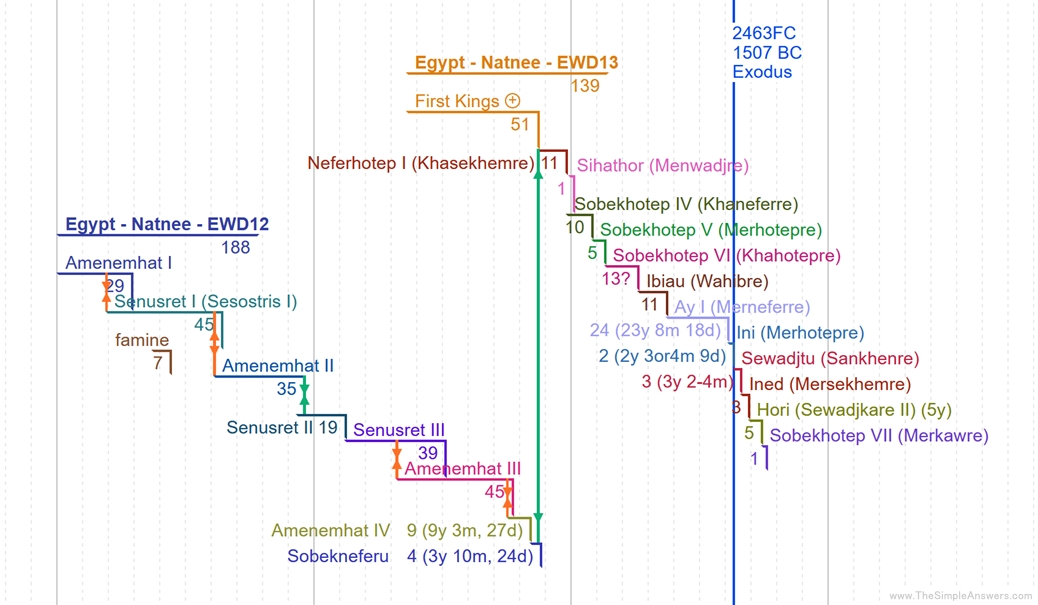
Well, notice that the first lengthy reign was that of Neferhotep I in ‑1583. What was happening at that time in the 12th dynasty? There is a green arrow above to show the alignment with the beginning of Neferhotep I and the final ruler of the 12th dynasty, Sobekneferu; and it shows that Neferhotep began to rule one year before the end of the dynasty in ‑1582.
It can’t be a coincidence that the end of the short “appointed” reigns starts with Neferhotep I at the exact same time as the end of the 12th dynasty! He was the first “Pharaoh” in this dynasty to rule longer than 5 years because he was the first person who ruled as Pharaoh at all!
The grandson of a non-royal townsman from a Theban family with a military background, Neferhotep I’s relation to his predecessor Sobekhotep III is unclear and he may have usurped the throne. (Wiki, Neferhotep)
His “military background” explains how his coup was successful, since the best coups come with an army behind them. So for the balance of the 13th dynasty, until Merhotepre Ini, we see more normal reign lengths, as we would expect from the dominant dynasty at the time.
After the death of Queen Neferusobek, the decision was made to move the capital to Thebes in the south, which had the effect of reducing northern control. This was the beginning of the end for the Middle Kingdom. (https://pharaoh.se/ancient-egypt/period/second-intermediate-period/)
The order of reading Egyptian hieroglyphs is tricky, it can be done forwards or backwards and in some cases even more randomly. But suffice it to say that Neferusobek is the same person as Sobekneferu. Also, there is no evidence that Sobekneferu died at this point, and we have reasons to believe otherwise as I will explain soon.
Regardless, this shows us that the capital was moved to Thebes after Sobekneferu, at the end of the 12th dynasty. Yet we learned above that the capital was moved to Thebes at the end of the 13th dynasty. Both are true.
The 13th dynasty governors had always been based in Thebes, but when Neferhotep I conquered Ity-tawy and replaced Sobekneferu they moved to Ity-tawy, the center of the empire; when Merhotepre Ini died, they retreated to what had always been their home!
All of this lets us conclude that in ‑1582, give or take a year or two, the vassal governor of Thebes decided to rebel against his erstwhile masters in Ity-tawy. This is generally agreed upon by Egyptologists, except the identity of the rebel – they assume, with no evidence, that it was the first king of the 13th dynasty when in fact it was Neferhotep I, the first non-puppet of the 13th dynasty.
What’s interesting is that no Egyptologist can tell you why he rebelled in the first place… but the Bible can. Because he was rebelling for two very good reasons; the first one is obvious; Sobekneferu was a woman. One of the first to hold sole rule, and the first woman we know of to rule as a king, and not a queen (there’s a difference to the Egyptians).
And the second reason – and I think, probably even more offensive to the Theban governors of the 13th dynasty – Sobekneferu intended to make the son of a slave the Pharaoh of Egypt. So really, the birth of Moses is to blame for independence of the 13th dynasty.
MOSES’ STEPDAD
This allows us to finally tell the story; because a lone woman whose unpopular choice in heirs was a target too tempting for the powerful general that ruled Thebes to resist. And yet the fact that Moses was not killed in the coup strongly suggests that Sobekneferu was also not killed.
Acts 7:20-23 In which time Moses was born, and was exceeding fair, and nourished up in his father’s house three months: And when he was cast out, Pharaoh’s daughter took him up, and nourished him for her own son. And Moses was learned in all the wisdom of the Egyptians, and was mighty in words and in deeds. And when he was full forty years old, it came into his heart to visit his brethren the children of Israel…
At the time of the fall of the 12th dynasty, Moses would have been 5 years old, and yet went on to be educated in “in all the wisdom of the Egyptians, and was mighty in words and in deeds” (Acts 7:20). Which means some royal protector kept a watch over him – and who else but Sobekneferu?
The 13th dynasty was no friend to the Hebrews, as we see by the fact that the oppression continued throughout the entire dynasty; for if it had stopped, why would the Hebrews have needed to be rescued from their bondage?
How could such people possibly tolerate Moses’ existence, being – as he truly was – a threat to their power. He must have had a powerful patron, and that can only have been Sobekneferu who cannot therefore have been dead.
So ask yourself; you’re Neferhotep I, the de-facto king of upper Egypt, but want to be king of all Egypt. You can go to war against lower Egypt and maybe win, maybe lose. Or you could form an alliance – one that leaves you as king, yet yields some autonomy to Ity-tawy.
Then imagine yourself as Sobekneferu, an unpopular widow facing an uprising from the south. Neferhotep might not win, but you would likely die in the process. Better to sue for peace, to extract certain guarantees from the soon-to-be-Pharaoh, and give Moses a chance to grow up and one day take back the throne for your house.
And the best way to legitimize an alliance like that would be… a royal wedding.
Hence, we can conclude that Neferhotep showed up at Ity-tawy with his army behind him and told the widow-queen Sobekneferu she could marry him or there would be civil war. She agreed, but retained enough power from her loyal court to prevent Neferhotep from killing Moses or preventing his education.
As long as she lived, she protected him and made sure he knew everything he needed to be a Pharaoh; still nursing the hope that one day he would be king. Which, in a manner of speaking, he would be. Just not of the Egyptians.
Deuteronomy 33:4-5 Moses commanded us a law, An inheritance for the assembly of Jacob. He was king in Jeshurun, When the heads of the people were gathered, All the tribes of Israel together.
THE LIFE OF MOSES
We have very little information about Moses’ life. We know he was educated to be a Pharaoh, and from Egyptian history we know that would have included the ability to read and write in hieroglyphics and hieratic (let’s just say, cursive hieroglyphics) – and probably some other languages as well.
We know his education would have included a great deal of mathematics and astronomy/astrology (the division is nonexistent in ancient cultures). He would have been taught the Egyptian calendar systems, and the various mythologies and sacrificial systems of the Egyptians, since Pharaoh was expected to be a sort of high priest for the country as well, a bridge between the human and the divine.
Stephen tells us he was “mighty in word and deed,” which means he was also taught Pharaoh-like masculine skills like hunting and the various martial arts. Josephus told us that Moses was a general for the Egyptians who fought against an Ethiopian (Nubian to the Egyptians) invasion; this may or may not be true, just quoting it for what it’s worth.
Egypt was becoming weaker during this dynasty, and more susceptible to invasions from the north and the south; we do know that there were “happenings” in Nubia in this period, which led to their independence around the time of Moses’ departure from Egypt.
Nevertheless, enough evidence has survived of the reign of Sobekhotep IV [-1572-1562] to suggest that he had all the hallmarks of a strong king, and continued to hold some control over Nubia, where two of the king’s statues were found south of the third cataract (other statues of this king survived reused at Tanis). It was, however, during the reign of Sobekhotep IV that the first signs of revolt emerged in Nubia, which was eventually to slip out of Egyptian control, to be ruled instead by a line of Nubian kings based at Kerma. (Oxford History of Ancient Egypt)
Moses would have been around 25 at the time of this Pharaoh’s death. Nubia was lost by the time of the end of the 13th dynasty, so the idea that there was a Nubian invasion as Josephus describes isn’t impossible – it’s not like the Egyptians would have bragged about being invaded, nor would they have wanted to give Moses credit, so it might have been an event better left forgotten.
What we do know for certain is that much later in life, Aaron and Miriam complained about Moses’ Ethiopian wife. The Bible doesn’t say where she came from, but Josephus said that it was during his counter-invasion as head of the Egyptian armies that he encountered and married a princess of Ethiopia.
That might not be true, but I do know one thing; Ethiopia is not on the way between Egypt and Midian; so if that’s not how he met his Ethiopian wife, I don’t know how it would have ever happened given what we know about his life.
Since she doesn’t appear in the narrative in Midian, where Moses married another wife, it’s likely she remained behind in Egypt when he fled. This was not so uncommon; compare to David leaving behind his wives on several occasions (1 Samuel 19:11-13, 1 Samuel 30, 2 Samuel 15:16, etc.).
Josephus also said that it was Moses’ fame for delivering Egypt from Ethiopia that led the Egyptians to plot to kill him – here contradicting, or at least adding to, the Bible’s statement that it was his fear about the Egyptian he killed which Pharaoh tried to kill him for.
This Pharaoh who tried to kill Moses was probably Sobekhotep V, although possibly one king earlier or later (this part of the 13th dynasty is give-or-take a decade or so, as historians are very unsure of the reign lengths).
What’s strange is that the kings of Egypt had probably wanted to kill Moses his whole life. Why did this one time finally scare him into leaving? The answer is obvious; Sobekneferu must have recently died.
Consider that she was still child-bearing age when she was praying to Sobek at Moses’ birth – thus, 20-40 years old; if so, then she would be 60-80 or so when Moses fled. A normal lifespan, even a bit long for the age. And consider also what the Bible said Moses did at this time…
Acts 7:23 But when he was forty years old, it came into his heart to visit his brothers, the children of Israel
Why did it take 40 years before this “came into his heart?” Easy; what happens when you lose family? You reach out to what family you have left. Moses knew that without Sobekneferu he had no “family” among the Egyptians. He knew they were jealous of him and hated him. So he was looking for family.
This, ironically, led to him losing everything because after killing the Egyptian, he no longer had mommy to protect him from the Egyptians. So he fled to Midian, presumably without parting the Red Sea this time, and without his Ethiopian wife.
Which means he either snuck on a boat, or more likely went north across the Sinai desert (not south like the Israelites would later do); Josephus says he avoided the roads and snuck through the deserts, which is certainly what I would have done.
Arriving in Midian he did a favor for some girls at a well, whereupon their father invited him to live with them and married his daughter to him. He had two children, whose names indicate his state of mind:
Exodus 18:3-4 …The name of one son was Gershom, for Moses said, “I have lived as a foreigner in a foreign land.” The name of the other was Eliezer, for he said, “My father’s God was my help and delivered me from Pharaoh’s sword.”
These names show that, while Moses was grateful to be alive, he was homesick. Who wouldn’t be? And the next forty years passed before he knew it! Just kidding. I’m sure they seemed like… well, forty years.
FORTY BORING YEARS
We know nothing specific about what happened during Moses’ time in Midian, except that he tended sheep for his father-in-law (Exodus 3:1). But we can infer some things. Remember, Moses was a highly intelligent, highly educated, cultured individual used to the palace life. Becoming a shepherd had to be an… adjustment, to say the least.
A mind like his couldn’t have been idle; a shepherd has a lot of time to think, and his thoughts would certainly have been with his oppressed brethren back in Egypt. And as we know from every political exile in history, they spend their time in exile plotting and preparing to return and free their kinsmen.
And so what would a highly educated, motivated, intelligent, and mind-numbingly bored man of his time do? With no dancing girls, chariot races, hunting parties, musicians and feasting to keep him busy, what would he do?
You’re going to love this one.
These words you are reading are an alphabetic script in the Latin alphabet. We inherited these letters, naturally enough, from Latin. Latin learned them from Greek – with a few modifications to fit the sounds of Latin.
The Greeks learned them, again with modifications to suit Greek (including the addition of proper vowels) from the Phoenician traders who brought them from the Canaanite towns on the eastern coast of the Mediterranean.
The Phoenicians spoke Canaanite which, like Hebrew, is a Semitic language. In fact, in those days it was probably very similar, probably even mutually intelligible. And the Phoenician/Canaanite script is, as far as historians can tell, the first alphabetic script in the world.
And where do you suppose the earliest examples of this writing were discovered? Care to guess? Canaan? Nope. You’d think so, right? You’d naturally assume that Canaanite scripts came from Canaan… but nope.
Ok, fine; you guess Syria? Nope. Aram? Nope. You could guess all day, and you’ll never guess where the first examples of Semitic script – the writing system of Phoenician and Hebrew – came from.
The first alphabetic writing was developed by workers in the Sinai Peninsula to write West Semitic languages c. 1800 BC, “in the context of cultural exchanges between Semitic-speaking people from the Levant and communities in Egypt.” This earliest attested form is known as the Proto-Sinaitic script… (Wiki, history of writing)
The first examples of alphabetic writing and the Phoenician script are found, not in Canaan, but in EGYPT! There has to be a great story there. This fact deserves an explanation, and no historian can provide a better one than “miners interested in foreign cultures.”
It’s laughable ideas like this that scientists and historians have to invent to get around obvious facts that make my job so easy sometimes. Because slaves in mines have lots of free time for cultural exchanges, right? Miners are well known for attending the ballet and writing poetry, right?
Does it make sense to you that miners, slaves at that, were interested in “cultural exchanges” to the point that creating an alphabet was necessary? And that they had the education required to construct one? What possible use could a mine-slave have to write down his language??
The generic word for Aamu (‘male Asiatic’), became synonymous with ‘slave’ to indicate those condemned to live on the fringes of Egyptian society, in awful conditions, occupied in heavy labor in the mines and in the quarries of the eastern desert. The term Xsy (‘miserable,’ ‘wretched’ or ‘vile’) is often associated with it. Lorton noted that in the context of the Instruction for King Merikare this emphasizes the misery of their daily life and their hopeless situation. (The Ghetto of el-Lahun, Mazzone)
Mines have never been a joyful place to work where cultural sharing and intellectual curiosity was nurtured. These mines, in particular, were where Egypt sent people as a punishment. Do people in “the misery of their daily life” invent alphabets to improve their “hopeless situation?” Really?
The site’s name is derived from these as well, with ‘Serabit el-Khadim’ translating to “Columns of the Slave,” in reference to the tall inscribed columns that make up and surround the temple. The copper and turquoise mines at the site were in use throughout the Middle Kingdom and New Kingdom periods. The mines were worked by prisoners of war from southwest Asia who presumably spoke a Northwest Semitic language, such as the Canaanite that was ancestral to Phoenician and Hebrew. (Wiki, Serabit el-Khadim)
Again, it is merely an assumption that these were prisoners of war and not the Hebrew contemporaries of Moses which at least the majority of them in fact were. So we reject outright the idea that this was enlightened Semites who wanted to be able to record for posterity the joy of working in the mines, and look for a completely different motive for these inscriptions.
This earliest attested form is known as the Proto-Sinaitic script, and it adapted concepts and at least some of its written letterforms from Egyptian hieroglyphic writing; it adopted wholly West Semitic sound values for its letters, as opposed to adapting existing Egyptian ones. (Wiki, history of writing)
And we find our reason in the fact that the Hebrew writing system was adapted from the EGYPTIAN WRITING SYSTEM! I can’t stress this enough. The writing system of Semitic peoples was made based on Egyptian writing.
Which means that somewhere, someone who spokeboth Egyptian and Hebrew or Canaanite, and who knew how to write Egyptian, sat down one day with a stick and decided to create a way of expressing words in Hebrew in their own native script.
Starting to guess what Moses might have done for 40 years now?
And this happened, according to historians, “circa 1800 BC.” They arrived at this number based on the names of the Pharaohs who exploited these mines. This of course, means that their dates are off by several hundred years, just as their dating of those Pharaohs are off.
But guess who was, according to historians, on the throne of Egypt in 1800 BC? (You’re gonna love this!) The king of Egypt in 1800 BC according to Egyptologists was…
Drumroll please…
Sobekneferu, Moses’ stepmom! Whom we date to ‑1587. Which means the earliest examples of semitic writing systems date to roughly the time of MOSES!
MEANS, MOSES, OPPORTUNITY
So alphabetic writing was invented in the time of Moses, but was it invented by Moses? Well, we know for a fact that Moses wrote things down in a book (Deuteronomy 31:24), and he certainly didn’t do it in Egyptian. Therefore, it happened before then.
Even traditional historians agree that alphabetic writing was invented somewhere around his era (once the Pharaohs are put in their proper timeline). So if he didn’t invent it, then he certainly knew the guy who did.
We know, from Stephen, that he was “mighty in words,” skilled in “all the wisdom of the Egyptians,” which means he had the necessary ability. We know he had the time. And he lived at the right time in history.
We also know that he was a “Hebrew nationalist,” who longed to free his people from Egypt, and give them a national identity, telling the Egyptians that Yahweh had said “let my people go!” One thing that commonly happens with newborn nations is that they make a script designed for their language, and abandon the script of their colonizers.
A relatively recent example of this is Turkey under Mustafa Kamal Ataturk; having just freed themselves from the Ottomans and the British, Ataturk instituted a western alphabet to replace the Arabic one – adapting letters as necessary to express sounds that only exist in Turkish. As Ataturk’s successor described it…
The alphabet reform cannot be attributed to ease of reading and writing. That was the motive of Enver Pasha. For us, the big impact and the benefit of an alphabet reform was that it eased the way to cultural reform. We inevitably lost our connection with Arabic culture. (Wiki, Turkish alphabet)
The historian Bernard Lewis has described the introduction of the new alphabet as “not so much practical as pedagogical, as social and cultural – and Mustafa Kemal, in forcing his people to accept it, was slamming a door on the past as well as opening a door to the future” … Atatürk told his friend Falih Rıfkı Atay, who was on the government’s Language Commission, that by carrying out the reform, “we were going to cleanse the Turkish mind from its Arabic roots.” (Wiki, Turkish alphabet)
Just as we know the Israelites needed to “lose their connection to Egyptian culture.” Substitute “Israelite” for “Turkish” and “Egyptian” for “Arabic,” and you would have the exact mindset Moses (and God) would have had about the Exodus.
Leviticus 18:3 You shall not do as they do in the land of Egypt, where you lived: and you shall not do as they do in the land of Canaan, where I am bringing you; neither shall you walk in their statutes.
Thus we know that Moses would have wanted to, would have needed to, would have been able to, and had forty years of boredom in which to work out a new alphabet which would “cleanse the Hebrew mind from its Egyptian roots.”
PURIFYING THE GODS OF EGYPT
But we also have a better reason; God was about to write down words with His own finger which the people of Israel were supposed to be able to read. It makes sense that God would have wanted the letters to accurately convey precisely what He meant, the precise sound He spoke to them.
Now I don’t presume to claim that God speaks Hebrew at home – nor do I rule it out – but I do know that the Hebrew language carries a depth of meaning in some places that cannot be accidental, and which would be – is – lost in translation.
It’s also a fact that if you force people to write their language in a foreign script, the language itself inevitably changes to follow the sounds of the letters they’re given. The letters also change meaning somewhat, until the letters and sounds reach an equilibrium that accurately express neither the original language nor the meaning of the original script.
God would not have wanted this to happen to His law or to the Hebrew language in which it was written. Therefore, God would have needed, for His inspired words, a language that correctly represents His commands and a script that captures just the right truth of that language.
The 3rd century BC writer Artapanus of Alexandria wrote of the exploits of the Patriarchs in Egypt; and while these are Jewish legends which may or may not be true, it’s interesting that one of the stories is just as I’ve said it above…
“…On account of these things Moses was loved by the masses, and was deemed worthy of godlike honor by the priests and called Hermes, on account of the interpretation of sacred letters.” Hermes was a Greek messenger god who was in Egyptian traditions associated with Thoth (Djehuty), the god of wisdom and time who invented writing. (Wiki, Artapanus of Alexandria)
Having laid all this groundwork, the actual story is easy to tell. Moses spent his time in Midian thinking, planning, being inspired by God to write an alphabet – after all, it wouldn’t do to write “thou shalt not serve idols” with letters which are literally images of the gods of Egypt!
And after all… wasn’t the main point of the plagues, as stated by God Himself, to execute judgments against “all the gods of Egypt?” How then, could He leave the hieroglyphs untouched? Hieroglyphs, which literally means “sacred carvings” in Greek?
Exodus 12:12 Against all the gods of Egypt I will execute judgments: I am Yahweh.
He is Yahweh, the Existing One; but He also calls Himself the Alpha and the Omega – the Greek equivalent of “the A and the Z.” Letters which literally evolved from the letters Moses created! And when you think about it… how can you make the WORD of God without… letters?
And how can that Word be holy if the alphabet used to create it are not holy as well?
With that in mind, consider this (admittedly much later and out of context) verse, talking about Nebuchadnezzar destroying Egypt at God’s behest. Listen closely to what it says; for many Egyptian letters were literally pictures of gods, and what are words but “houses” for letters?
Jeremiah 43:12 I will kindle a fire in the houses of the gods of Egypt; and he shall burn them, and carry them away captive: and he shall array himself with the land of Egypt, as a shepherd puts on his garment; and he shall go forth from there in peace.
And so as the final judgment against Egypt, the final way in which the Hebrews spoiled the Egyptians, they carried their letters away captive, the very finger of God Himself burned them with fire on Mt. Sinai to purify them…
Numbers 31:23 whatsoever thing can go into fire, ye shall pass through fire and it shall be clean, only with the water of separation, shall ye cleanse it (from sin). But whatsoever cannot go into fire, ye shall pass through water.
Thus, the letters we use – some of which have demonstrably Egyptian origins, such as the A which traces back to the bull’s head of Apis/Ptah – have been purified and given new meaning by the fire that is the very finger of God.
And THAT is how you got your alphabet.

This is part 19 of The History of the World Series
 Hammurabi and the Dynasties of Babylon
  Moses’ Return
  The Exodus
  Joseph In Egypt
  What Is The LOVE Of God?
  Everything You Believe About God Is WRONG!
  Make Up Your Mind!
  What Is Faith?
  How DARE you FEAR the judgment of God!
  Firstripe Figs
  The Bride Of The Father
  Exodus 40 – The Plan Of God
  The Temple Of God
  Pillars Of The Temple And The Brass Sea
  GEHENNA WITH ‘EM
  When Did God Forbid Polygamy?
  When You Shouldn’t Pray For Someone
  The Sins of the Father
  The First Paul