Part 18: JOSEPH IN EGYPT

After Joseph was kidnapped, as I’m sure we all know, Joseph was a trusted slave, and God blessed his master immensely because of Joseph. Then the man’s wife tried to seduce him, failed, then accused him of raping her, so Joseph was thrown in prison.
There he dreamed dreams, helped some people who promptly forgot about it; then Pharaoh dreamed a dream, finally the guy whom Joseph helped remembered him, and then Joseph interpreted Pharaoh’s dream as being a prophecy of seven good years and seven very bad years of famine.
To understand what this means to Egypt, you have to understand that the Nile is everything in Egypt. The Nile floods at a predictable time every year, bringing rich nutrients and flooding a large area for agriculture and making otherwise useless land incredibly fertile.
But the size of the flood varies based on rainfall in the Ethiopian highlands. So if there is a lot of rain, the flood is very high, and a lot of land is irrigated. If the Nile doesn’t flood, or the flood is very low, then little or no land gets irrigated.
So what was really being prophesied here was seven years of a very high Nile flood and abundant food; followed by seven years of little or no flood at all. Regardless, Pharaoh was suitably impressed and took Joseph’s suggestions to the letter:
Genesis 41:33-41 “Now therefore let Pharaoh look for a discreet and wise man, and set him over the land of Egypt. Let Pharaoh do this, and let him appoint overseers over the land, and take up the fifth part of the land of Egypt’s produce in the seven plenteous years. Let them gather all the food of these good years that come, and lay up grain under the hand of Pharaoh for food in the cities, and let them keep it. The food will be for a store to the land against the seven years of famine, which will be in the land of Egypt; that the land not perish through the famine.”
The thing was good in the eyes of Pharaoh, and in the eyes of all his servants. Pharaoh said to his servants, “Can we find such a one as this, a man in whom is the Spirit of God?” Pharaoh said to Joseph, “Because God has shown you all of this, there is none so discreet and wise as you. You shall be over my house, and according to your word will all my people be ruled. Only in the throne I will be greater than you.” Pharaoh said to Joseph, “Behold, I have set you over all the land of Egypt.”
Joseph’s main job as vice-pharaoh was to make sure that they survived the famine; to do that, they needed as much grain, and as much grain storage, as was humanly possible. Grain storage is a fairly simple matter; Egyptians are nothing if not good at building monumental buildings quickly.
But the grain production was more complicated. The arable land in Egypt is finite; it’s just a few miles on each side of the Nile plus the delta. And most of the Nile has a narrow valley which quickly becomes higher in elevation and is full of rocks and impossible to irrigate. So you can’t just make more land to irrigate and farm.
But Joseph did anyway. In the center of Egypt there is a low spot west of the Nile which, provided a canal was made, could open up an immense amount of new farmland now called the Fayoum oasis. The name of this canal is today called the Bahr Yussuf, or Joseph’s canal.
This name dates back to Arabic times, and doesn’t prove too much, but it is intriguing nonetheless. Granting that the Muslim legend is biased, it’s remarkable that there is a tradition connecting Joseph to something not mentioned in the Bible… but something that Joseph would certainly have had to do.
JOSEPH’S PHARAOH
The names of the pharaohs in Genesis are, unfortunately, not listed. What names we do have, like Potiphar, don’t match anyone we know in Egypt. We even know Joseph’s Egyptian name, but it doesn’t seem to help:
Verse 45 Pharaoh called Joseph’s name Zaphenath-Paneah; and he gave him Asenath, the daughter of Potiphera priest of On as a wife. Joseph went out over the land of Egypt.
Most commentators translate this as some variation of “revealer of secrets,” which is possible, but the following argument convinced me it has a more interesting meaning, which is more consistent with the Biblical narrative and Pharaoh’s spontaneous exclamations (Genesis 41:38-39).
The Egyptian equivalent of Zaphenath is almost certainly ḏf3wn‘ty, which translates into modern English as ‘Overseer/Minister of the Storehouse of Abundance’. … The second section, p3nn’i3ḫ is a proper name, and … [these elements] combine to express Joseph’s new Egyptian name literally as [p3n]n’i3ḫ ‘[He of the] Excellent/Gracious Spirit’ where n’i translates as ‘excellent/gracious’ and 3ḫ translates as ‘spirit’. (Joseph’s Zaphenath Paaneah—a chronological key, Patrick Clarke)
So Zaphenath Paaneah means “the overseer of the storehouse of abundance – he of the excellent spirit.” The same author does a good job trying to discern the original Egyptian pronunciation of the Hebrew name, concluding that it would be pronounced Djefaneti Paneniakh (assuming AI correctly transliterated his Egyptian characters for me).
Unfortunately, I have not been able to find any example of this name, or a plausibly similar name, anywhere in Egyptian history. But Egyptians were extremely fond of names and titles; each Pharaoh had five different names, and one particular vizier boasted over 34 different titles. So the fact that this name/title which Pharaoh gave him on a whim is not the name he used at home, nor the name Egyptians primarily recorded shouldn’t really surprise us.
But if not by his name Joseph, nor by his name Zaphenath Paaneah, how can we find him?
Genesis 50:25-26 And Joseph took an oath of the children of Israel, saying, God will surely visit you, and ye shall carry up my bones from hence. So Joseph died, being an hundred and ten years old: and they embalmed him, and he was put in a coffin in Egypt.
We can be certain that he was buried with highest honors, in a grand tomb probably close to his Pharaoh. What’s more, it should be empty since his bones were carried out of Egypt by Moses. So is there such a vizier in the record?
Mentuhotep was an ancient Egyptian official and treasurer under the 12th Dynasty pharaoh Senusret I. Mentuhotep is one of the best attested officials of the Middle Kingdom period. There is a series of statues found at Karnak, showing him as a scribe. On these he has been given the title of overseer of all royal works, which would suggest that he was involved in overseeing the construction of the temple at Karnak. (Wikipedia, “Mentuhotep”)
First, consider his name; you’ll notice an immediate similarity between Mentuhotep and Imhotep (Abraham) – but don’t get too excited, because Mentuhotep was a common Egyptian name in the 11th dynasty for pharaohs.
Breaking it down, the word hotep is just a word meaning “peace, satisfaction,” and mentu or montu refers to a relatively minor Egyptian god of war. Most people stop here, saying surely Joseph wouldn’t be named after a god of war – but if you look closer you see there’s more to it than that!
Montu’s name, shown in Egyptian hieroglyphs … is technically transcribed as mntw (meaning “Nomad”). (Wikipedia, Montu)
So Joseph wasn’t named after the god! Joseph was named the peaceful nomad! Or “the nomad who satisfied.” Do we have any Biblical reason to believe Joseph might have adopted this as one of his names?
Genesis 41:16 And Joseph answered Pharaoh, saying, It is not in me: God shall give Pharaoh an answer of peace.
Joseph was from a nomadic people, which is well documented by the wanderings of the patriarchs (Hebrews 11:38). And Joseph brought peace and satisfaction, through giving Pharaoh “an answer of peace” and through satisfying their hunger when otherwise they would have all died.
So this name is certainly plausible, but it’s by no means proof. Fortunately, we have a lot more. Let’s go back to the fact that Mentuhotep was “overseer of all royal works,” for that corresponds precisely to the title we’d expect for Joseph…
Genesis 41:40-44 “You shall be over my house, and according to your word will all my people be ruled. Only in the throne I will be greater than you.” Pharaoh said to Joseph, “Behold, I have set you over all the land of Egypt.” …They cried before him, “Bow the knee!” He set him over all the land of Egypt. Pharaoh said to Joseph, “I am Pharaoh, and without you shall no man lift up his hand or his foot in all the land of Egypt.”
So that’s definitely an overseer of all the royal works. For all practical purposes, he was Pharaoh himself according to his brother Judah “…don’t let your anger burn against your servant; for you are even as Pharaoh” (Genesis 44:18).
Given this, it is impossible that abundant statuary and references to Joseph would not exist. People haven’t found them simply because they’re looking in the wrong place. Which is why Mentuhotep “is one of the best attested officials of the Middle Kingdom period.”
Because after all… Joseph lived to be 110 years old, 80 of which were after his elevation to vizier. While he surely wasn’t in power the whole time, he was respected throughout his entire life as evidenced by the fact that he was given a royal burial – commoners at this point in history were not mummified or put in tombs next to Pharaoh!
At el-Lisht he [Mentuhotep] had a large tomb next to the pyramid of Senusret I. When it was found it was badly damaged, but there are remains of high quality reliefs and fragments of statues. The burial chamber still contained two sarcophagi, one smashed and the other one well preserved, made of granite and with brightly painted interiors. (Wikipedia, “Mentuhotep”)
And this, to me, is the most important evidence of all. Try to imagine a circumstance where one sarcophagus is smashed, and the other well preserved. Priests who needed to access the body for some reason would have done it respectfully, carefully.
Thieves would have broken both, to get at the gold inside. Why would only one be broken, and the other not? I can only think of one reasonable answer: only one had Joseph’s bones in it – and the Israelites fled Egypt in haste, and were not interested in preserving the sarcophagus!
Exodus 13:19 Moses took the bones of Joseph with him, for he had made the children of Israel swear, saying, “God will surely visit you, and you shall carry up my bones away from here with you.”
Whomever was in the other coffin – his wife, his son, who knows – wasn’t important to the Israelites and they were in a hurry. But the size and location of the coffin is surprising to historians, since he was unusually honored for a mere vizier…
The size and proximity of Mentuhotep’s tomb to the pyramid of his sovereign Senwosret I, the exceptional number of life size statues inscribed for him, and his lengthy list of titles, prompts the justifiable question of whether Senwosret I might have been his Father. (Biri Fay, “Mentuhotep, Custodian of the Seal, Overseer of All the Works of Senwosret I”)
There is no genealogical data to support this conclusion; but there is a scripture to support it!
Genesis 45:8 So now it was not you that sent me hither, but God: and he hath made me a father to Pharaoh, and lord of all his house, and a ruler throughout all the land of Egypt.
Joseph was “a father to Pharaoh,” and would certainly have deserved this royal burial, since he was explicitly permitted to do literally anything he wanted in Egypt!
THE FAMINE OF SENUSRET I
But there is much more; and as you’re about to see, the weight of evidence that Mentuhotep was in the right place at the right time to be Joseph is just… overwhelming. Because Egyptian history also records a famine lasting “years” in the time of Mentuhotep, one so severe that they were reduced to cannibalism!
‘If – watch out that you’re not angry about this! Look, the whole household is like my children; everything is mine.’ A message: ‘Being half alive is better than death altogether. Look, one should say “hunger” (only) about (real) hunger. Look, they are starting to eat people here. Look, they haven’t been given such rations in any place (here). Until I reach you, you shall bear yourself with strong hearts! Look, I shall spend the Shemu here.’ (Mattias Karlsson, Translations and Interpretations of the Heqanakht Letters, quoting Parkinson)
These letters, written in the reign of Senusret I, speak of a famine in year 25 of his reign. One extreme enough that people had become cannibals – justifying his reducing an already low grain ration for his household.
Famine was rare in Egypt; that was the beauty of living there. Indeed, that’s why every time people were hungry, they went to Egypt (Abraham, Jacob, etc.). So a famine this extreme was exceptional, and cannot have happened very many times.
That it happened during the reign of Senusret, whose vizier Mentuhotep has so many traits in common with Joseph, is just further proof. If this was indeed the famine of Joseph, this 25th year of Senusret I would be towards the end of the 7 years of famine, when Joseph was around 45.
Finally, [under Senusret I] Egypt was placed under much tighter state control: those living in the outer reaches of the country also had to pay taxes, and most people had to do corvée work – hard unpaid labour for the state … Further evidence for Sensuret’s tighter grip on the country is the ‘great enclosure.’ This was an institution that organised work for the state. Most Egyptians had to work there at least for a certain amount of time. The work was not popular.… (The-past.com, “Senusret I”)
Which is precisely what we would expect from a Pharaoh who literally owned the people of his country because of their hunger during the extreme famine!
Genesis 47:15-19 …“We will not hide from my lord how our money is all spent, and the herds of livestock are my lord’s. There is nothing left in the sight of my lord, but our bodies, and our lands. Why should we die before your eyes, both we and our land? Buy us and our land for bread, and we and our land will be servants to Pharaoh. Give us seed, that we may live, and not die, and that the land won’t be desolate.”
Another thing this Pharaoh did was a systematic rebuilding of all the temples of the land; after all, he had immense manpower and every last cent that was available throughout Egypt or the entire Middle East to spend – what better use of your money, to an ancient king?
THE UNKNOWN GOD
One curious thing is that, given the story in the Bible, we are shocked not to find some mention of Yahweh or some other sign that Pharaoh and the Egyptians were impressed by the power of Joseph’s God. They certainly would want to build Him a temple, and would most certainly have asked His name.
Problem is... Joseph didn’t know the name of his God! No one did.
Exodus 6:2-3 God spoke to Moses, and said to him, “I am Yahweh; and I appeared to Abraham, to Isaac, and to Jacob, as God Almighty; but by my name Yahweh I was not known to them.”
Moses was the first person to whom God identified Himself by name. To the others, he was known as “the god of Abraham,” or simply “the most powerful God.” Though the Bible does record the name Yahweh in earlier stories, these are written as Moses, who knew the name, told them; inserting the name where appropriate for clarity to his audience (for a full explanation, see my article “Did Abraham know the name of God?”).
So this means when Pharaoh asked Joseph, all he could have said was “I don’t know his name.”
Amun and Amaunet are mentioned in the Old Egyptian Pyramid Texts. The name Amun (written imn) meant something like “the hidden one” or “invisible,” which is also attested by epithets found in the Pyramid Texts “O You, the great god whose name is unknown.” (Wiki, Amun)
You literally could not describe Joseph’s God any better. It is inconceivable that the Egyptians would not have acknowledged what this unknown God did for them; this, then, is how the Egyptians interpreted the situation. And guess when Amun became popular?
The history of Amun as the patron god of Thebes begins in the 20th century BC, with the construction of the Precinct of Amun-Ra at Karnak under Senusret I. The city of Thebes does not appear to have been of great significance before the 11th Dynasty. (Wiki, Amun)
This is strongly persuasive; for unrelated reasons, which we will get to in time, I have concluded that the 6th dynasty overlapped the 12th dynasty, thus the Pharaoh Unas of the 6th dynasty was precisely contemporary with the early years of Joseph. So we are gratified to learn that “Amun was first attested in the tomb of Pharaoh Unas” (Wiki, Amun).
So Joseph taught them the concept of the unknown God, who became – for understandable reasons – wildly popular, persisting as the primary God of Egypt throughout the rest of its existence as a nation:
…After the rebellion of Thebes against the Hyksos and with the rule of Ahmose I (16th century BC), Amun acquired national importance, expressed in his fusion with the Sun god, Ra, as Amun-Ra (alternatively spelled Amon-Ra or Amun-Re). On his own, he was also thought to be the king of the gods.
Amun-Ra retained chief importance in the Egyptian pantheon throughout the New Kingdom (with the exception of the “Atenist heresy” under Akhenaten). Amun-Ra in this period (16th–11th centuries BC) [12th-8th centuries BC, my dating] held the position of transcendental, self-created creator deity “par excellence”; he was the champion of the poor or troubled and central to personal piety. With Osiris, Amun-Ra is the most widely recorded of the Egyptian gods. (Wiki, Amun)
The nature of this God is not unlike what Joseph might have described Him as, granted that the Egyptians played fast and loose with the nature of their gods; still…
The victory against the “foreign rulers” achieved by pharaohs who worshipped Amun caused him to be seen as a champion of the less fortunate, upholding the rights of justice for the poor. By aiding those who traveled in his name, he became the Protector of the road. Since he upheld Ma’at (truth, justice, and goodness), those who prayed to Amun were required first to demonstrate that they were worthy, by confessing their sins. Votive stelae from the artisans’ village at Deir el-Medina record:
[Amun] who comes at the voice of the poor in distress, who gives breath to him who is wretched … You are Amun, the Lord of the silent, who comes at the voice of the poor; when I call to you in my distress You come and rescue me … Though the servant was disposed to do evil, the Lord is disposed to forgive. The Lord of Thebes spends not a whole day in anger; His wrath passes in a moment; none remains. His breath comes back to us in mercy … May your ka be kind; may you forgive; It shall not happen again. (Wiki, Amun)
This is not to say that we should worship Amun; merely to say that the Egyptians had to worship something, so they, like the Greeks, worshipped the Unknown God; precisely as we would have expected.
Acts 17:23 For as I passed along, and observed the objects of your worship, I found also an altar with this inscription: ‘TO AN UNKNOWN GOD.’ What therefore you worship in ignorance, this I announce to you.
Try to imagine a reason why the Egyptians would worship a God whose name they didn’t know? Without His name, how did they even learn of His existence, much less desire to elevate Him to the top of the pantheon as king of the gods?
That is to say… try to imagine a reason that doesn’t involve Joseph.
THE LAND OF GOSHEN
The ancient Egyptians called the “canal of Joseph” the Mer-wer or “great canal,” and it was greatly expanded by later Middle-Kingdom Pharaohs Senusret II and Amenemhet III, but the agricultural part of the oasis was first developed by Senusret I – Joseph’s Pharaoh!
In the early Middle Kingdom, Amenemhat I ordered the construction of canal work along the Bahr Yusef which flooded the Faiyum and created the great Lake Moeris. … Amenemhat I’s successor, Senusret I…, seems to have felt the lake was too great a luxury and wasted prime agricultural land and so ordered a series of canals built to drain it.
Senusret I’s canal system operated off a series of hydraulics which moved the water out of the Faiyum basin to other locales while still preserving a body of water there. The result was a reclamation of fertile land, the transport of water to areas in need of irrigation, and a continuation of the eco-system the lake sustained. (WorldHistory.org, “Fayum”)
So can it possibly be a coincidence that Senusret I, who experienced a crippling famine bad enough to cause people to resort to cannibalism, “considered a lake a luxury that wasted prime agricultural land?” Especially when he knew the famine was coming ahead of time thanks to Joseph?
Almost every person who has ever researched the Israelites in Egypt has concluded that Goshen was the northeastern part of the delta. It seems strange to me that I’m one of the first people to ever question that identification, because first of all, it wasn’t the best of the land. Fayoum was!
But even after the harvest when Egypt’s fields were dry and bare, and the Nile had shrunk to an unpalatable trickle – “heated in its bed, becoming greenish, fetid, and filled with worms” in one French orientalist’s acerbic account – premodern observers consistently remarked that the Fayyūm, an oasis-like depression west of the Nile Valley in Middle Egypt, remained verdant, its canals full and flowing. Marveling at its uniqueness, the first-century BCE Greek geographer Strabo wrote that “this nome is the most remarkable of all in its appearance, prosperity, and design; it is the only one planted with large and full - grown olive trees, which produce a fine crop.” (The Garden of Egypt, Brendan Haug)
The best of the land, according to Strabo, is not the delta but the Fayoum. The quote goes on…
Centuries later, Arab writers would offer still more fulsome appreciations. In his history the Futūḥ Miṣr (“The Conquest of Egypt”), the ninth-century Egyptian author Ibn ʿAbd al-Ḥakam credited the Hebrew patriarch Joseph (Yūsuf), pharaoh’s vizier, with the Fayyūm’s design and construction. At pharaoh’s command the divinely guided prophet (nabī) drained the marsh from this wasteland pit (jawba) and excavated its unique canal system, thereby transforming the Fayyūm into a garden whose canals always delivered the right amount of water at the right time. “Those who look upon what Joseph brought to life from the Fayyūm,” Ibn ʿAbd al-Ḥakam averred, “know nothing like it in all of Egypt.”
In the following century al-Masʿūdī likewise extolled the virtues of Fayyūm irrigation, particularly the dam near the village of al-Lāhūn that regulated the head of its canal system, which he loftily described as “among the most wondrous objects and most ingenious structures, an edifice that has long endured upon the face of the earth.” The dam, he claimed, was designed to admit only such water as the Fayyūm needed and no more. Moreover, every ruler who had ever conquered Egypt traveled to admire it, drawn by the renown of its construction and workmanship. (The Garden of Egypt, Brendan Haug)
We will never know why the Arab conquerors saw this as Joseph’s canal, if they had any evidence or not for their claim; all we need to know for sure is that this area was the best in Egypt, because that is where Joseph’s family was placed.
Yet even this breathless hyperbole was surpassed by the late Ayyūbid functionary Abū ʿUthmān al-Nābulusī, author of a detailed fiscal survey of the Fayyūm entitled Bilād al-Fayyūm (“Villages of the Fayyūm,” 1244 CE). In al-Nābulusī’s account, the Fayyūm’s ceaselessly flowing waters and perennial bloom were nothing less than an earthly reflection of the Qurʾānic Garden of Paradise (Janna) with its “orchards and trees and ‘gardens beneath which rivers flow.’” A local Fayyūmī couplet that al-Nābulusī transcribed put it similarly: “How wonderful is the land of the Fayyūm among countries / like the Garden of Eternity (Jannat al-khuld) in its rivers and trees.” (The Garden of Egypt, Brendan Haug)
Surely there could be no better fit for Jacob’s family.
The rich produce of the region, which reportedly was better tasting than any other, resulted in a high demand and lucrative trade with other regions in Egypt and also abroad. (Worldhistory.org, “Fayoum”).
Anciently called the “Garden of Egypt,” the Fayoum sits in a large natural depression west of the Nile Valley. The depression is about 65 kilometers across and covers about 12,000 square kilometers. … Due to the abundance of water and the milder climate (compared to the Nile Valley), the Fayoum was and is lush in vegetation, home to a variety of animals and birds, and the only substantial area of farmland outside of the Nile Valley. Anciently, many plants and crops were grown in its fertile soil including grapes, olives, figs, wheat, barley, flax, onions, sesame, indigo, cabbage, sugar cane, and turnips. (The Fayoum … A Background, Kerry Muhlestein)
A place like this would be necessary to support a population of millions, as the Israelites numbered by the time of the Exodus. This is also one of the only places in Egypt that wine can be grown, incidentally. And everyone agrees it is the best part of Egypt. That fact, alone, proves it was Goshen.
UP TO GOSHEN
Another major problem is that Joseph told Jacob “You shall dwell in the land of Goshen, and you will be near to me” (Genesis 45:10). Now if you take the traditional interpretation of Goshen as the NE delta near Avaris, no matter where the Pharaoh of Joseph lived – Memphis, Luxor, or Ity-tawy… in no sense of the word could the NE delta be considered “near to Joseph.”
To solve this problem, other chronologers try to put Joseph under a much later Pharaoh, of the 15th dynasty Hyksos or even of the 20th dynasty kings who ruled from Avaris or Pi-Rameses in the delta. But that requires the Bible’s timeline to be off by centuries and which is therefore unacceptable to our history.
But if I’m right and Joseph worked for Senusret I, then he would have lived in the newly constructed capital of Ity-tawy started by Amenemhet I and expanded by Senusret I. No one knows the precise location of Ity-tawy but it was near Kahun and el-Lisht, both of which are on the narrow strip of land separating the Nile from the Fayoum oasis!
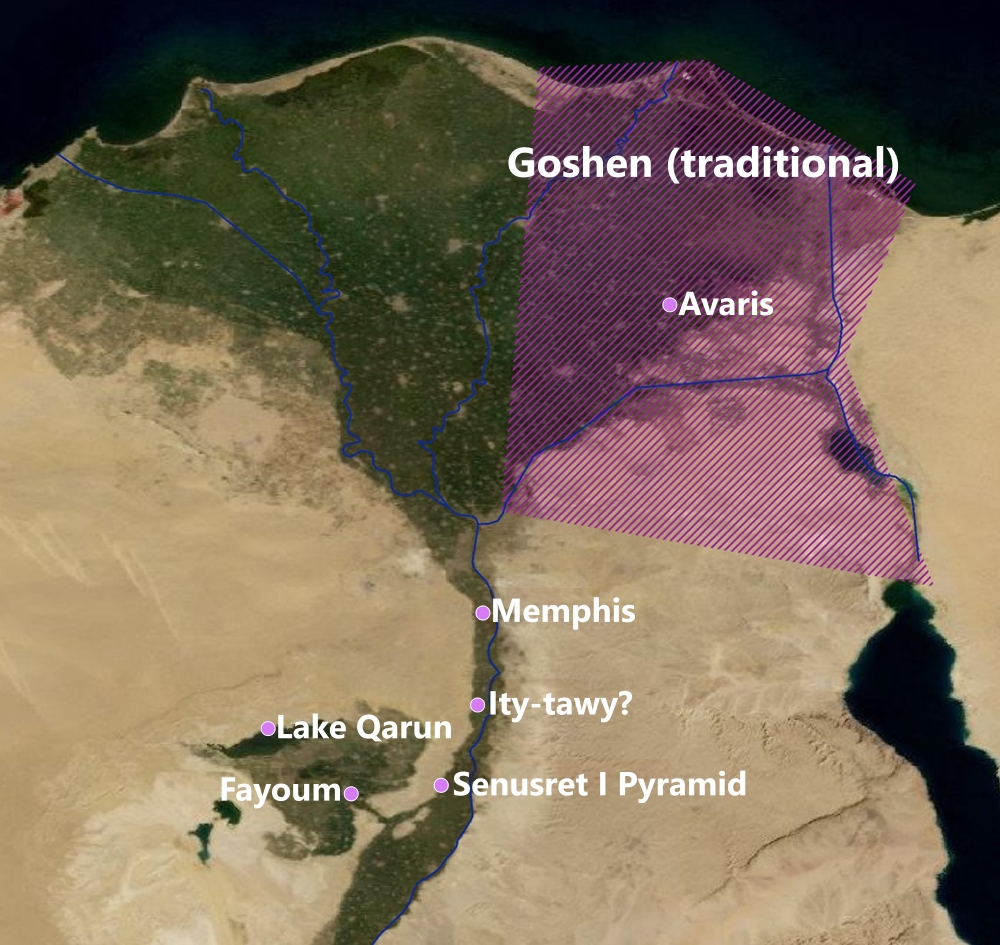
Thus, the only possible place for Jacob to be near Joseph’s capital city was the Fayoum! In fact, aside from Avaris which was capital of the Hyksos 15th dynasty, there has never been an Egyptian capital close to the traditional Goshen. That alone suggests it’s the wrong choice.
And if it was the Fayoum, then there was only ever one capital close to it, Ity-tawy; and since only a handful of Pharaohs ruled from there in the 12th dynasty, it strongly reinforces the belief that Joseph was indeed Mentuhotep. But we’re just getting started.
Genesis 46:28-29 He sent Judah before him to Joseph, to show the way before him to Goshen, and they came into the land of Goshen. Joseph prepared his chariot, and went up to meet Israel, his father, in Goshen.
Now if Goshen was indeed the NE delta, there would not be any confusion about the location; it’s literally the first thing you see when you enter Egypt. You cross the border, and you’re in Goshen. What’s more, every nomad in Canaan would have known exactly where it is, since it’s where everyone – Abraham included – went when grass got scarce in Canaan!
But we can prove it another way; because it says clearly that Joseph went UP to meet him. To our modern sensibilities, “up is north.” But not to the Egyptians! To the Egyptians, among whom Joseph had lived for decades and who educated the author of this passage, Moses, for 40 years… up is UP the Nile River! Thus, southern Egypt has always been called UPPER Egypt!
So if Joseph went UP to meet his father in Goshen, he had to go upriver! But close, as Joseph said “that you be near me.” So close, and upriver… And Ity-tawy is just a bit downstream and towards the Nile from the Fayoum.
Another thing; Joseph went to the Fayoum in a chariot. Not in a boat! The vast majority of Egyptian travel was water based since almost the entire country was connected by the Nile. Had Joseph gone from any capital, including Ity-tawy or Avaris to the NE delta he would have absolutely taken a boat, not a chariot!
And as it happens that there was an ancient road that led from Ity-tawy into the Fayoum, right over the desert.
Gerza cemetery was in turn associated with an old and traditional trade route that connected the Nile Valley to the Fayoum. … Any road that cut across the desert from the Nile Valley in this eastern-most area would have run into the Gebel el-Rus ridge, whose extremely steep hills would have barred passage. The ridge suddenly ends just north of Seila, at the exact place the canal bends towards the east for a short distance. This is exactly where a road coming from the Nile Valley area of Meidum would enter the Fayoum, making this road the most direct route between the fertile depression and the concentration of population and culture that was next to the Nile. (The Fayoum… A Background, Kerry Muhlestein)
This is literally the only possible explanation for Joseph’s use of a chariot. Because this is the only pair of destinations, Ity-tawy and the Fayoum, between which it was even possible to travel by chariot.
And another thing; consider the very strange way that Joseph told his brothers to tell Pharaoh about their occupation:
Genesis 46:31-34 Joseph said to his brothers, … “It will happen, when Pharaoh summons you, and will say, ‘What is your occupation?’ that you shall say, ‘Your servants have been keepers of livestock from our youth even until now, both we, and our fathers:’ that you may dwell in the land of Goshen; for every shepherd is an abomination to the Egyptians.”
Joseph makes a very clear causative link between them being allowed to dwell in Goshen, and their being shepherds, because shepherds were abominations to the Egyptians. Why would Joseph want Pharaoh to know that his brothers were shepherds, “abominations to the Egyptians?”
And how could that possibly help them live in Goshen? To my knowledge, this has never been satisfactorily explained until now.
Genesis 47:3 Pharaoh said to his brothers, “What is your occupation?” They said to Pharaoh, “Your servants are shepherds, both we, and our fathers.”
Here, again, our ignorance of Egyptian thinking is the cause. To the Egyptians, the Nile represented life. It was the source of all good things in Egypt. But it was also the barrier between life and death.
The Egyptian religion associated the human life and death cycle with the daily journey of Ra, the sun-god, from the east to the west. They were born in the east, and died in the west. Thus, for the entire length of Egyptian history, the Nile divided two cities in Egypt – the city of the living on the east, and the city of the dead on the west.
They didn’t have a word that means “tomb”; their word meant “palace for the dead,” because they believed the dead continued to live in their burial chambers, magically consuming the food on the walls of the graves and enjoying the fun scenes of dancing and feasting on the walls, which came to life for the dead.
Superstitious Egyptians considered it all kinds of bad luck to live on the west side of the Nile. It would be literally like living on a graveyard. While it did, at times, happen, it was very reluctantly and, when possible, temporary.
So you can see they would have been reluctant to live in the Fayoum, which was west of the Nile where the dead lived! But Jacob’s family would have had no problem with this at all. And to make sure that Pharaoh settled them there, and not among the Egyptians in their cities… Pharaoh needed to know that they were… gasp! … disgusting shepherds, best kept as far from civilized people as possible.
THE LAND OF RAMSES
Genesis 47:11 Joseph placed his father and his brothers, and gave them a possession in the land of Egypt, in the best of the land, in the land of Rameses, as Pharaoh had commanded.
Few verses have caused more problems with Biblical chronology than this one. The Pharaohs named Ramses are all from the 19th and 20th dynasties, far later than Joseph could possibly have lived even by the most skeptical critic – in the 13th century BC by traditional chronology, 8th century BC by mine.
Exodus 1:11 Therefore they set taskmasters over them to afflict them with their burdens. They built storage cities for Pharaoh: Pithom and Raamses.
Yet here Joseph settles his family in “the land of Ramses,” and then two centuries later, the Israelites were used to build “the city of Ramses,” and then years later Israelites departed from that same “Rameses” (Exodus 12:37).
This is a problem for every chronology, even conventional ones, because if we take this to mean that Jacob entered Egypt under a Ramses, and that Moses left under a Ramses, the Bible places these events 224 years apart.
The total time between the first and last, Ramses I and Ramses XI, was 215 years; this seems almost close enough at first, but it really isn’t because the first Ramses reigned only 2 years; surely not Joseph’s Pharaoh, and was followed by Seti. So we really have to count from Ramses II, so 202 years.
Yet Joseph’s Pharaoh had already been Pharaoh for some time before Joseph was appointed vizier – long enough to put people in prison for awhile and then pull them out of it, at the very least. Which means we can’t really count the 224 years from less than a decade into this Pharaoh’s reign, which means really, the conventional dating between these points allows us less than 192 years.
So no matter how we look at it, Ramses presents a problem; you either have to accept that the Bible’s dates are wrong and do some heavy refiguring, or else accept that “Ramses” has a meaning other than “a Pharaoh named Ramses I-XI.”
So how do we resolve this? Easily. In fact, I’m surprised no one figured it out before me. Because the name “Rameses” literally means born of Ra. And that’s something that literally all Pharaohs believed about themselves! Thus, in a very literal sense, all Pharaohs were Rameseses!
The birth name of Senusret I is: “son of Re, Senusret” … This is the king’s own birth name and might be common to other members of the Dynasty. The [“son of Re” in the name] emphasizes the king as the heir of the sun-god Re on Earth. (Bibalex.org, “names of Senusret I”)
All Pharaohs were born of Ra, particularly including Senusret I! Thus this doesn’t need to be the well-known Pharaoh Rameses the Great who ruled nearly a millennium later! It was simply a style of speaking about himself in the third person, saying “give them my land,” the land of the son of Ra!
But why was the Fayoum in particular Pharaoh’s land? Remember, at this point the famine was just starting. Joseph wouldn’t buy the entire land of Egypt for Pharaoh until later (Genesis 47:13-20). So why was this land Pharaoh’s?
Because Pharaoh, with Joseph’s help, had literally just created this land out of lake and desert. So of course it belonged to him, and of course he named it after himself!
I mean when you think about it, all these Israelites moving in and multiplying… why is nothing said of them displacing the native Egyptians who already lived there? Of taking land from the owners and giving it to Jacob? Because at this time, the land had literally just been created and no one lived there yet!
Now one last thing about the Fayoum, and I’ll let the matter rest until we get to Moses’ time; remember the cities that the Israelites built for Pharaoh, one was called after Pharaoh’s name – not necessarily literally the name Rameses, by the way – and the other was called “Pithom” (Exodus 1:11). Hold that thought.
The name [Fayoum] derives from the ancient Egyptian word Pa-yuum or Pa-yom meaning “the Lake” or “the Sea” and refers to Lake Moeris, created by Amenemhat I (c.1991-1962 BCE) of the 12th Dynasty during the Middle Kingdom (2040-1782 BCE) when the kings of the 12th Dynasty, in particular, paid special attention to it. (Worldhistory.org, “Fayoum”)
And one of the cities in Goshen that later Israelite slaves helped build was called Pithom. Pa-yom. Pi-thom. When you consider that it was transliterated from Egyptian to Hebrew, and you’re reading it now in English… that’s close enough to be very compelling. And it’s a name which refers to this exact place in Egypt. What are the odds? Nor are we the first to think this – although modern scholars reject it:
Early on, the location of Pithom—just like the locations of other similar sites, such as Tanis—had been the subject of much conjecture and debate. The 10th-century Jewish scholar Saadia Gaon identified Pithom’s location in his Judeo-Arabic translation of the Hebrew Bible as the Faiyum, 100 kilometres (62 miles) southwest of Cairo. (Wiki, Pithom)
So I consider Goshen… found.
JOSEPH’S LATER LIFE AND DEATH
Joseph ruled as vizier for 9 years before Jacob came, at which point Jacob was 130. Jacob died at 147, 26 years after Joseph’s rise to power. At this point, Joseph was still highly in favor, and when his father died he was given the same seventy-day mourning that was accorded to the elite dead.
Genesis 50:2-12 Joseph commanded his servants, the physicians, to embalm his father; and the physicians embalmed Israel. Forty days were fulfilled for him, for that is how many the days it takes to embalm. The Egyptians wept for him for seventy days. When the days of weeping for him were past, Joseph spoke to the house of Pharaoh, saying, … “please let me go up and bury my father, and I will come again.” Pharaoh said, “Go up, and bury your father, just like he made you swear.” Joseph went up to bury his father; and with him went up all the servants of Pharaoh, the elders of his house, all the elders of the land of Egypt, all the house of Joseph, his brothers, and his father’s house. … they lamented with a very great and severe lamentation. He mourned for his father seven days. When the inhabitants of the land, the Canaanites, saw the mourning in the floor of Atad, they said, “This is a grievous mourning by the Egyptians.” Therefore, its name was called Abel Mizraim, which is beyond the Jordan.
At this point Joseph had been powerful in Egypt for 26 years; he might not have been vizier anymore, but certainly was in a position of high favor. Proven by the fact that everyone who was anyone in Egypt went to Canaan – a large distance – to mourn the father of Joseph.
If the famine had its last year in year 25 of Senusret, at that point Joseph was already 13 years into his power, which means that Jacob would have died in year 38 of Senusret I. Joseph’s place of honor was assured for he said “let me go up and bury my father, and I will come again.”
Senusret I ruled 45 years; if the historians are right, his son Amenemhat II was co-ruler for his final three years. Whether Joseph continued in office through his reign or not I can’t say, as there is no evidence that Mentuhotep did, at least that I can find.
Whatever Joseph did politically after the famine, he continued to prosper and be in favor his entire life in Egypt, for when he died he was embalmed and placed in a coffin in ‑1661 (Genesis 50:26). This would have been a very fancy, typically Egyptian style burial.
Yet at this point in history, this was not something the common people could afford; it was reserved for the nobility. Thus, Joseph remained influential and in favor throughout his life – and therefore, through the reigns of Amenemhat II and Senusret II.
Exodus 1:6-8 And Joseph died, and all his brethren, and all that generation. And the children of Israel were fruitful, and increased abundantly, and multiplied, and waxed exceeding mighty; and the land was filled with them. Now there arose up a new king over Egypt, which knew not Joseph.
The king after Senusret II was, imaginatively enough, Senusret III, who began to rule after ‑1655, about 6 years after the death of Pharaoh. It’s unlikely that he didn’t know Joseph, or at least of him. But after his rule of 39 years, the memory of Joseph would be well-faded.
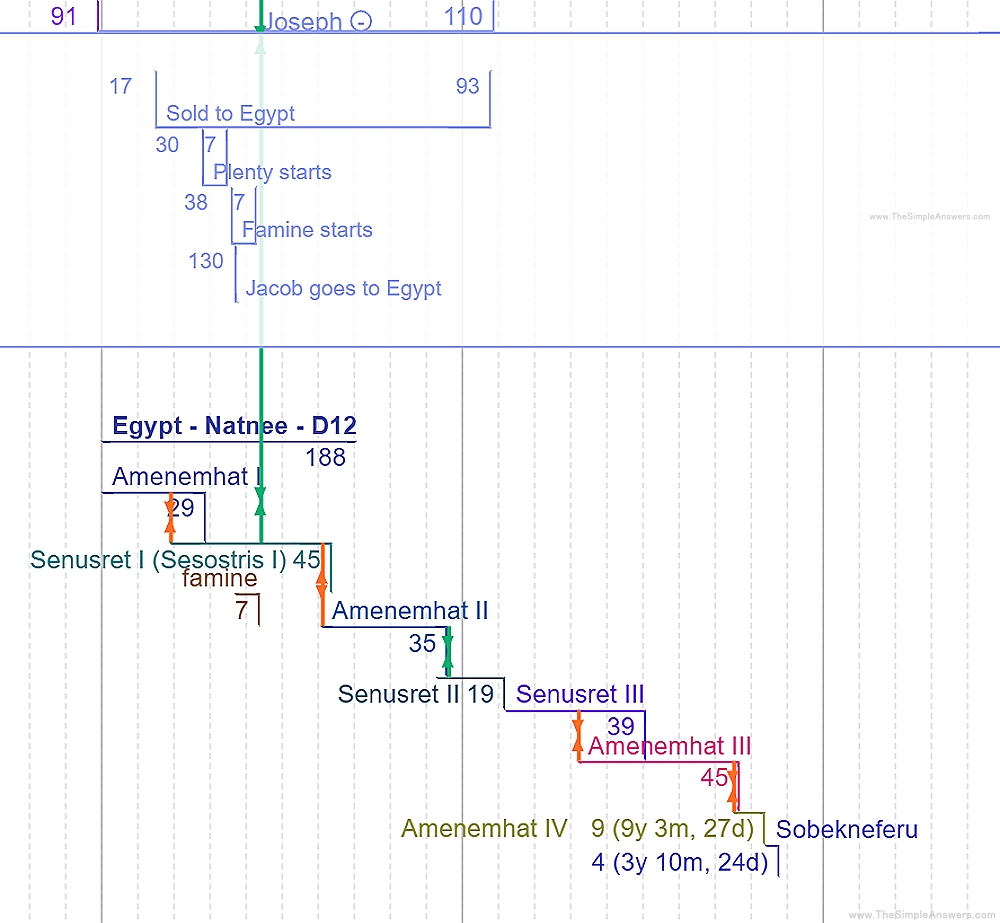
So Joseph and all those who knew him would be well forgotten by the time the next Pharaoh Amenemhat III began to rule in either ‑1640 or possibly as late as ‑1616 (Egyptologists can’t agree if the kings of the 12th dynasty had joint rules or not, so it makes a difference – but not much of one to us for now).
Regardless, this Pharaoh Amenemhat III would have ruled no less than 21 years, and quite likely up to 45 years after the death of Joseph. Ample time for “Joseph to die, and all his brethren, and all that generation.”
THE OPPRESSION
It’s important to realize that the Israelites were not slaves the entire time they were in Egypt. Joseph certainly wouldn’t have let his brothers serve hard bondage in Egypt; indeed, Pharaoh put Joseph’s relatives in positions of authority over flocks and such (Genesis 47:6).
The Israelites, who by this time must have numbered at least in the tens of thousands, were no doubt used for laborers, like all the native Egyptians were, but like the natives, they would have been paid and housed. But Amenemhat III decided to change that…
Exodus 1:9-10 And he said unto his people, Behold, the people of the children of Israel are more and mightier than we: Come on, let us deal wisely with them; … Therefore they did set over them taskmasters to afflict them with their burdens. And they built for Pharaoh treasure cities, Pithom and Raamses.
This is odd; what is a “treasure city,” or as some translations have it, a “storehouse city?” This had to be a unique structure of some king, to be mentioned in this way. So when we read about Amenemhet III, we are fascinated to read about his unusual building activities in the Fayoum/Pithom area…
Senusret III’s successor was Amenemhat III … who devoted significant attention to the region [of the Fayoum]. He returned to the policies of Senusret I and installed retaining walls, dikes, and canals to lower the level of Lake Moeris further and provide more arable land. He built the famous Labyrinth as part of his temple complex at Hawara which Herodotus would later record as more impressive than any of the Seven Wonders of the Ancient World. Amenemhat III also erected a number of other remarkable monuments throughout the area, as the kings of the 12th dynasty had done before him, and instituted policies which stimulated the economy further and encouraged trade.
Wikipedia says “the floorplan of the Labyrinth itself is estimated to have covered around 28,000 m2 (300,000 sq ft).” In Herodotus’ own words:
[The Egyptians] made a labyrinth [… which] surpasses even the pyramids. It has twelve roofed courts with doors facing each other: six face north and six south, in two continuous lines, all within one outer wall. There are also double sets of chambers, three thousand altogether, fifteen hundred above and the same number under ground. … We learned through conversation about [the labyrinth’s] underground chambers; the Egyptian caretakers would by no means show them, as they were, they said, the burial vaults of the kings who first built this labyrinth, and of the sacred crocodiles. … The upper we saw for ourselves, and they are creations greater than human. The exits of the chambers and the mazy passages hither and thither through the courts were an unending marvel to us … Over all this is a roof, made of stone like the walls, and the walls are covered with cut figures, and every court is set around with pillars of white stone very precisely fitted together. Near the corner where the labyrinth ends stands a pyramid two hundred and forty feet high, on which great figures are cut. A passage to this has been made underground. (Herodotus, as quoted in Wikipedia)
This sounds like a “storage city” to me. An absolutely unique structure, surpassing the pyramids in difficulty; built at exactly the right time in history by exactly the Pharaoh we would expect to find oppressing tens of thousands of Hebrews and putting them to work on grandiose projects.
But then Moses was born. And then Amenemhet’s own daughter adopted the boy who would destroy the Egyptian empire.