Assyria and the Mitanni
This is part 29 of the The History of the World Series
; The History of the World is part 1.
Click here to read in series
To tell the next story, we need to know the Mitanni. But to tell their story, we need to back up to the time of Abraham and introduce a culture we have not yet discussed – the Hurrians.
The Hurrians … were a people who inhabited the Ancient Near East during the Bronze Age. They spoke the Hurrian language, and lived throughout northern Syria, upper Mesopotamia and southeastern Anatolia.
The Hurrians were first documented in the city of Urkesh, where they built their first kingdom. The largest and most influential Hurrian kingdom was Mitanni. The population of the Hittite Empire in Anatolia included a large population of Hurrians, and there is significant Hurrian influence in Hittite mythology. By the Early Iron Age, the Hurrians had been assimilated with other peoples. The state of Urartu later covered some of the same area. A related people to the Hurrians are the Urarteans. (Wiki, Hurrians)
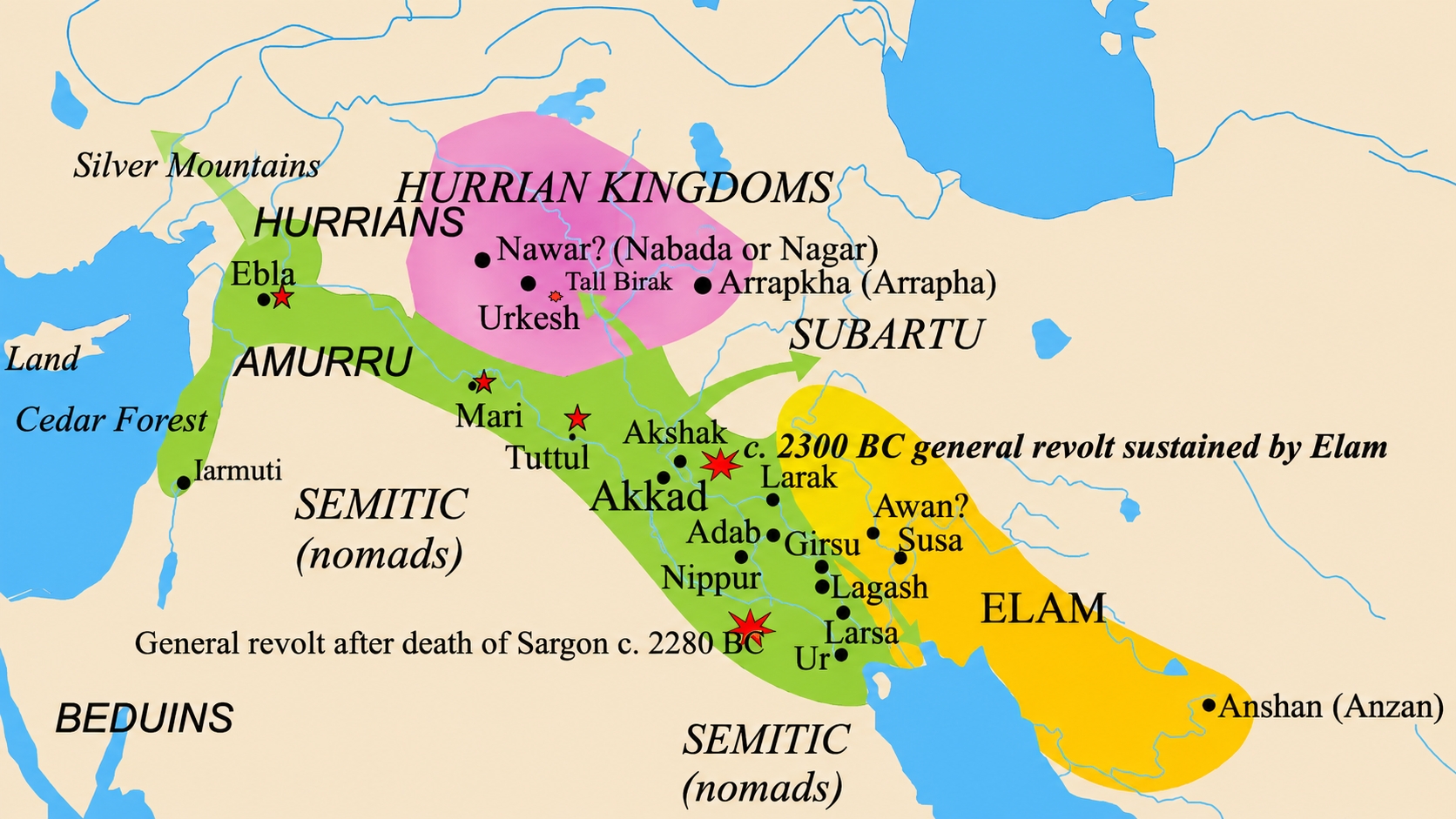
It is clear that these people are from a land to the north of the Amurru, above the typical desert/ river-dwellers of Mesopotamia. They were, however, heavily influenced by them, adopting their gods and the cuneiform script, at least around ‑2000.
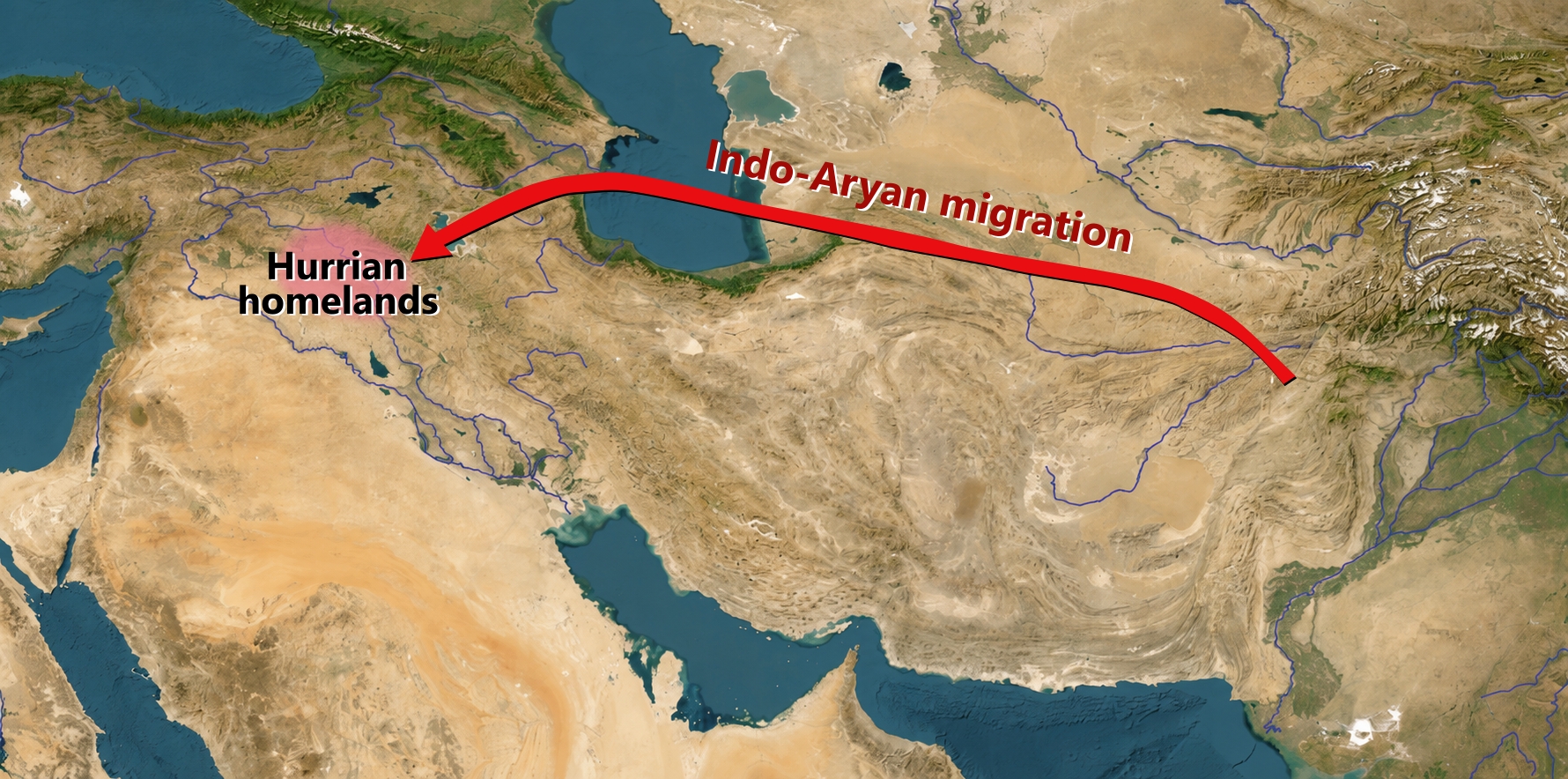
Strangely, the Hurrian language is an isolate – it doesn’t seem much like any other language. Its rulers, however, spoke a different language which is related to Sanskrit – as in, most likely the language of Arphaxad.
The ancient Middle Eastern state of Mitanni (modern-day Northeast Syria, Southeastern Turkey, 2nd millennium BCE) used a dialect of Hurrian as its main language. This dialect however contains some loanwords of evidently Indo-Aryan origin, i.e. related to the parent of Sanskrit, the ancestor of many modern languages of the Indian subcontinent. The loaned vocabulary seems to be related to an elite group in Mitanni society, as they appear in the names of rulers and gods as well as in relation to horse-breeding and the military (thus forming a so-called superstrate).
It is thus generally believed that Indo-Aryan peoples settled in Upper Mesopotamia and northern Syria, and established the kingdom of Mitanni following a period of political vacuum, while also adopting Hurrian. This is considered a part of the Indo-Aryan migrations. (Wiki, Indo-aryan superstrate in Mitanni)
So it seems like the Hurrian people were overcome by a small population of warlike horse breeders from the Indo-Iranian region, a place we last saw descendants of Arphaxad; for some reason it seems some of them migrated north out of Pakistan and into Central Asia and worked their way west, skirting north to avoid Mesopotamia.
Somewhere between the Euphrates and the Tigris, they settled and established sufficient power for Tushratta of the Mitanni to be included among the “great kings” club of the Amarna letters, which included Amenhotep III/Akhenaten of Egypt, Suppilliuma of the Hittites, Assuruballit of Assyria, and Kadashman-enlil/Burnaburiash II of the Kassites.
Few records of the people themselves exist, but correspondence between kings of Mitanni and those of Assyria and Egypt (the Amarna Letters) as well as the world’s oldest horse-training manual, and a treaty between the Mitanni and Hittites, give evidence of a prosperous nation which thrived between 1500 and 1240 BCE. In the year 1350 BCE, Mitanni was powerful enough to be included in the Great Powers Club along with Egypt, the Kingdom of the Hatti, Babylonia, and Assyria. (Worldhistory.org, Mitanni)
In the Wikipedia versions of the story, historians have done a masterful job of piecing together a tellable story about this era, relying heavily on the Amarna letters. In that story, the Mitanni began to rise to prominence in the ‑1500’s, sacked Assur at one point, and were conquered by Assyrians in the 1200’s, never to rise again.
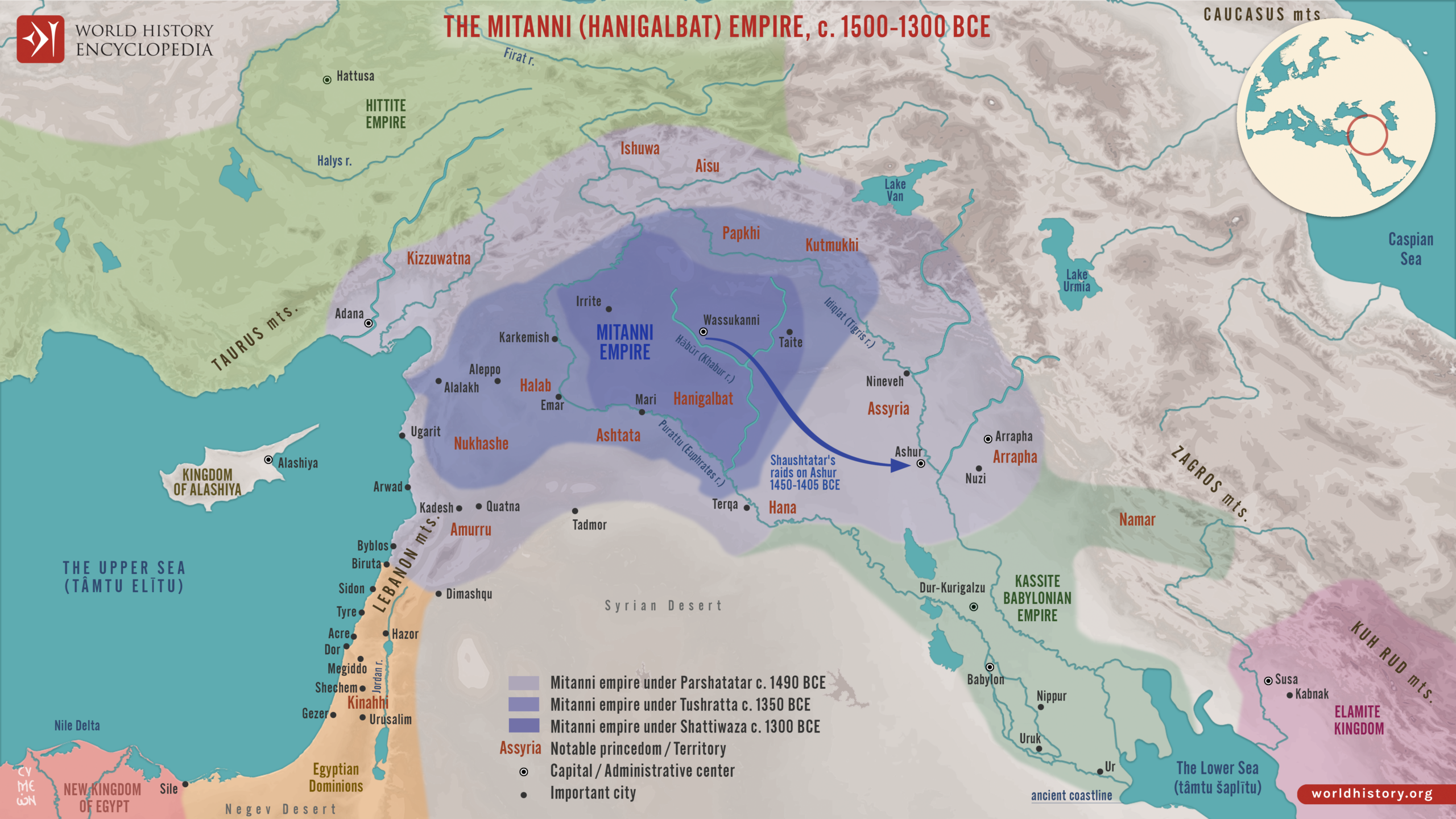
At their height (‑1490 in traditional dates) they controlled an area across the entire breadth of the fertile crescent, including dominating Assur itself. This coincided with a period of weakness in Assyria in the late old Assyrian period.
In the traditional narrative the early middle Assyrian kings Assuruballit I, Adad-nirari I, Shalmaneser I, and Tikulti-ninurta I pushed them back and eventually conquered them by the end of the 13th century BC.
From that point, the Mitanni disappear from history. At least, that’s the traditional version. And it’s a great story.
But here’s the problem.
Outside of the Amarna letters, which we date to the ‑900’s in any case, the first time the Mitanni was mentioned in history by name was in the time of Tiglath-pilesar I… whom we date to ‑1158‑1119.
How can the Assyrians have warred and conquered these people in the 15th-13th centuries without once mentioning their names? Easy; they didn’t exist yet.
Tiglath-pileser was the first to mention the Mitanni because he was the first Assyrian to meet them; and that is simply because they were recently arrived in the region, not yet a great power, and quite far from Assur.
HANIGALBAT-MITANNI
If we move the Amarna letters to the 10th century, as we have done, then all the related Mitanni kings naturally must move with them, placing the height of this nation’s power in the 11th and 10th centuries. At first, it looks like this creates many problems, but in the end it actually solves a great many.
But before we can get to that in detail, we have to break a false equivalence historians have been forced to believe; that Hanigalbat is the Assyrian term for the Mitanni and their lands.
The Kingdom of Mitanni, known to the people of the land, and the Assyrians, as Hanigalbat and to the Egyptians as Naharin and Metani, once stretched from present-day northern Iraq, down through Syria and into Turkey and was among the greatest nations of its time, though today it is largely forgotten. (Worldhistory.org, Mitanni)
Their reasoning goes like this; we know the Mitanni were living in Syria; the Egyptians called that region Naharin; the Assyrians called that region Hanigalbat; therefore all references to any of these names in the appropriate time period must refer to the Mitanni.
Surely you see the flaw in the logic; if they have moved these kings four centuries into the past, references to this region by, say, Assyria in that period will be assumed to apply to Mitanni kings who didn’t yet exist. The narrative of history will then be written around that assumption.
Besides, there is no evidence that the Egyptians called the kingdom of the Mitanni naharin. They certainly knew that region as that name, in another time; and the name is consistent with the Hebrew name for the region, Aram-naharaim meaning “between the rivers,” but its application to the Mitanni themselves is hypothetical.
Hanigalbat is more complicated; in the Amarna letters Tushratta refers to himself most frequently as “king of Mitanni”; although he occasionally references the land of the Hurrians and the land of Hanigalbat as being his territory, or at least among his territories.
Based on that, historians use the term Hanigalbat as if it were completely synonymous with the Mitanni kingdom during the Mitanni period, but that is flatly contradicted by the Assyrian inscriptions themselves.
In fact, it may surprise you to learn that the word “Mitanni” is used only once in the entire Assyrian corpus. Especially when you learn in that one instance it is contrasted against the land of Hanigalbat!
We find that reference in the annals of Tiglath-pilesar I (writing ‑1158‑1119):
I became lord of the wide Naʾiri lands in their entirety. Moreover, I made all of their kings bow down to my feet. In the course of that (same) campaign, I marched to the rebellious and insubmissive city Melid (Milidia) of the land Ḫanigalbat. Frightened by my strong belligerent attack, they grasped my feet and I had mercy on them. I did not storm that city, (but) I took hostages (instead). As uninterrupted, annual payment, I imposed upon them one homer of lead ore. (Tiglath-pileser I’s annals, http://oracc.org/riao/Q005926/)
Note that Milidia is the only city in the annals explicitly said to be “in the land of Hanigalbat.” Tiglath claims to have spared because of his benevolence; perhaps he did, but other Assyrian kings are known to have used that excuse to save face when unable to conquer a city.
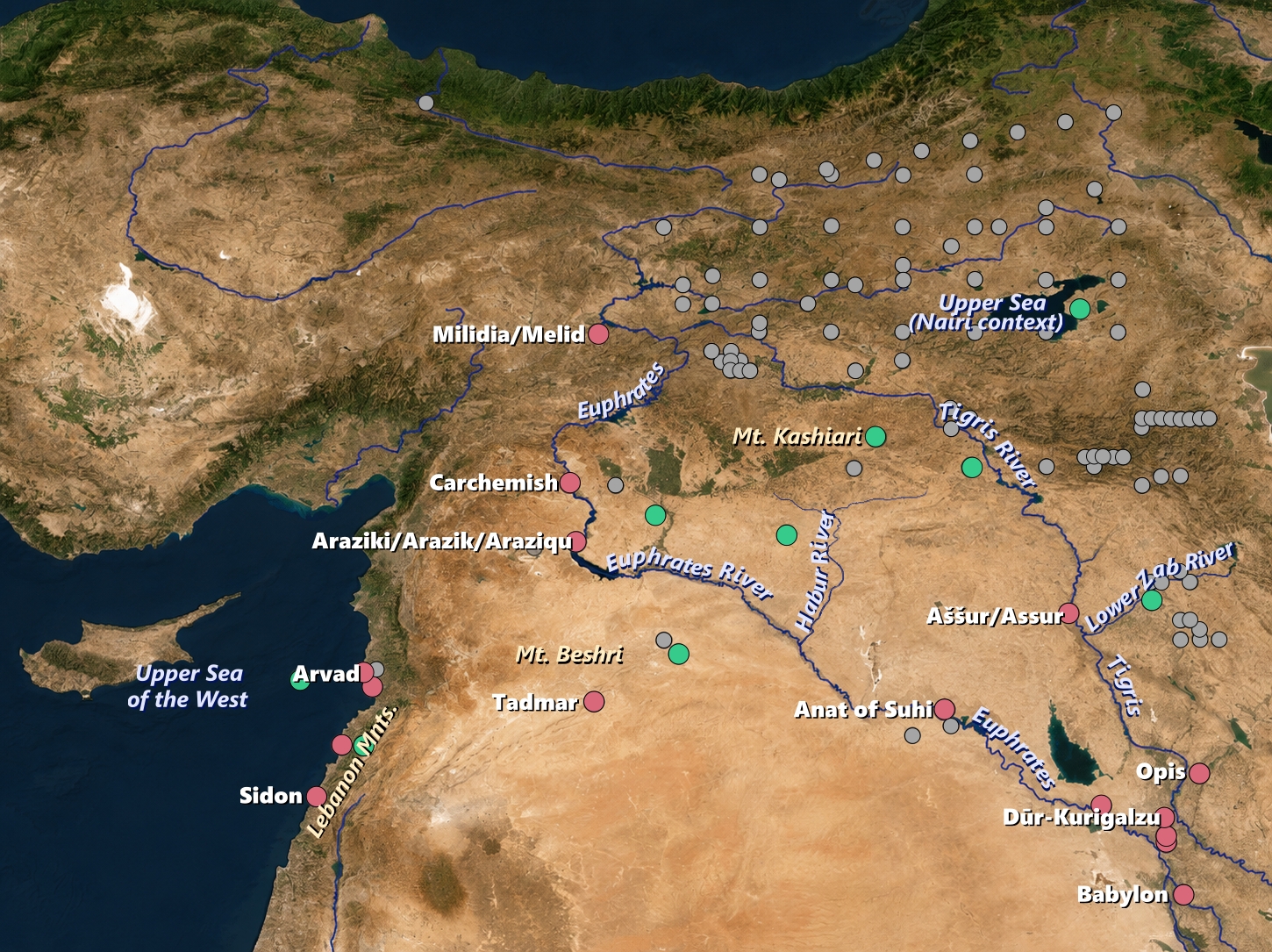
In the picture above, I’ve attempted to map every reference point and city in his extensive annals; the gray dots are more speculative, but must be generally correct in that region. The green dots are certainly known locations of landmarks, and the pink dots are the cities whose locations are secure.
It’s worthy of note that he did not proceed farther west of the upper Euphrates river at Milidia or any other point, suggesting that the occupants of that land were too powerful to invade. And we know those inhabitants to the west were Hittites:
In a single day, I plundered from the border of the land Sūḫu to the city Carchemish of the land Ḫatti. I massacred them (and) carried back their booty, possessions, and goods without number. The rest of their troops who fled from the weapons of the god Aššur, my lord, crossed the Euphrates River. I crossed the Euphrates River after them on rafts (made of inflated) goatskins. (Ibid.)
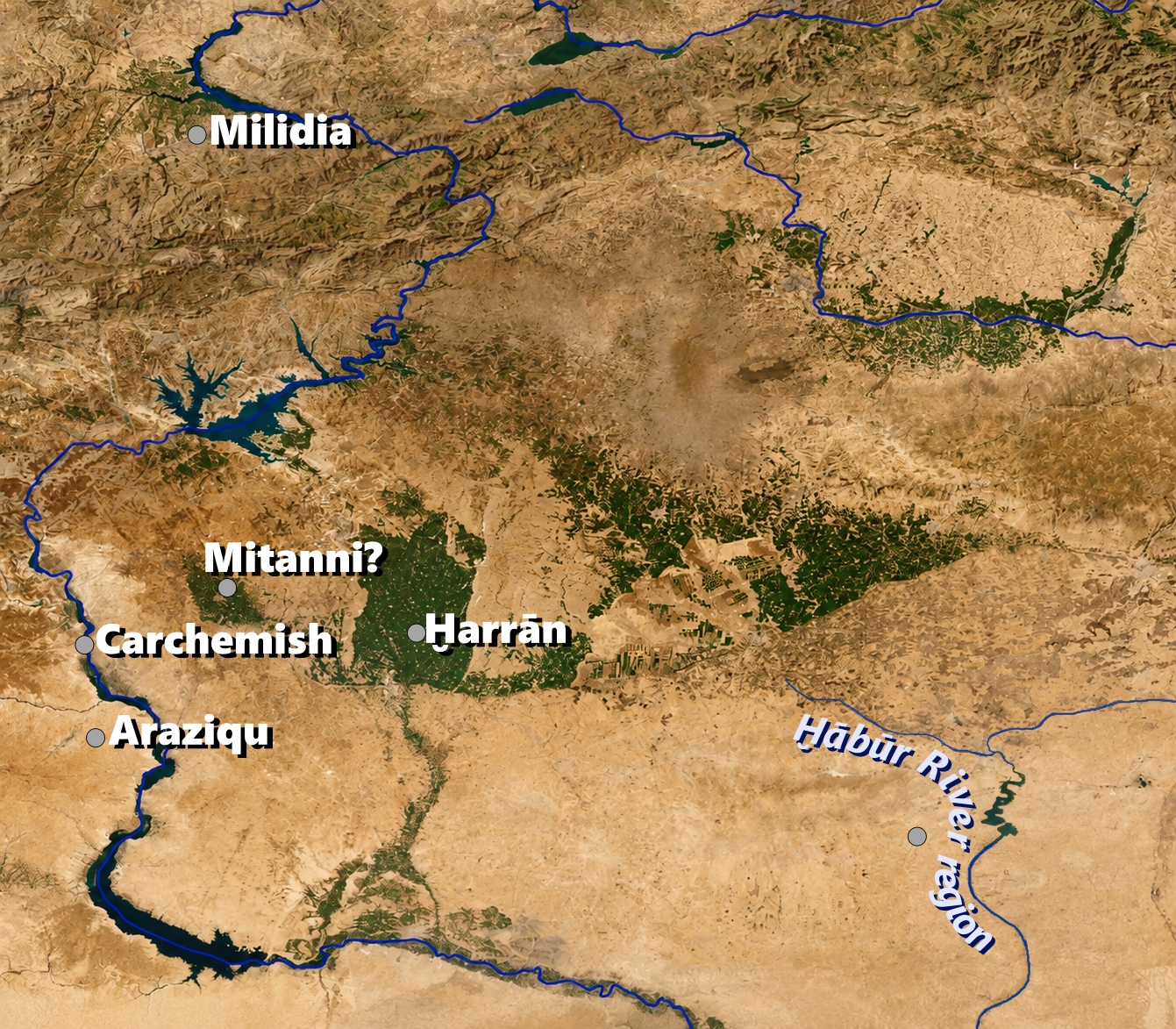 Carchemish was said to be on the Hittite border; given that geographical regions are often defined by features, it stands to reason that the upper Euphrates River was the boundary between Hittite lands and what were formerly Nairi lands, which were now claimed by Assyria.
…I slew four extraordinarily strong wild virile bulls in the desert, in the land Mittani, and at the city Araziqu which is before the land Ḫatti. I brought their hides and horns to my city, Aššur. (Ibid.)
And that leads us to Araziqu, the only certainly-known location securely labeled in antiquity as in or near “the land of the Mitanni.” Using this information, we can see that while Carchemish was in the Hittite lands, Araziqu was not; it was either in or very near the Mitanni lands.
WHAT THAT MEANS
There are several uncomfortable things in these annals that historians need to explain away. First, this was written around ‑1150, closer to ‑1100 in their chronology. But at that time, the Mitanni and the Hittites should both have been utterly gone from the late Bronze Age Collapse; why, then, does Tiglath-pileser mention both?
Historians answer simply “the memory of the civilization lived on in the name long after the people were gone,” but that’s… reaching. We will find many more examples of living Hittites in the four hundred year Hittite dark age where they supposedly did not have a thriving civilization.
Next, and more to our point, the Mitanni are clearly located to the extreme southwest of the map; far, far away from Hanigalbat and Milidia. This is disturbing, especially since it’s literally the only mention of the word Mitanni in Assyrian history. But let’s read that part again, in context.
By the command of the god Ninurta, who loves me, with my strong bow, iron arrowheads, and sharp arrows,I slew four extraordinarily strong wild virile bulls in the desert, in the land Mittani, and at the city Araziqu which is before the land Ḫatti. I brought their hides and horns to my city, Aššur.
I killed ten strong bull elephants in the land Ḫarrān and the region of the Ḫābūr River (and) four live elephants I captured. I brought the hides and tusks (of the dead elephants) with the live elephants to my city, Aššur. (ARAB 86, sect. 247)
Since the narrative mentions Araziqu, Haran, and the Khabur River in that order, it seems to record Tiglath’s journey east from the Mitanni land, which must either include Araziqu, or be immediately west or north of it – but not so far as to be considered “the land of Harran,” which was mentioned separately from “the land Mitanni,” and certainly not the Khabur River region which is mentioned much later.
This is what we get from a literal reading of the annals; a very tight location for the Mitanni somewhere near the bend in the Euphrates, which is far from “the land of Hanigalbat” where Milidia was located.
The most troubling thing of all, is that historians are convinced that the Mitanni homelands were in the upper Khabur River area (the blue dots in the map below); but that is impossible to square with Tiglath’s description of the land of Mitanni. Whom are we to believe? Historians, or someone who was actually there?
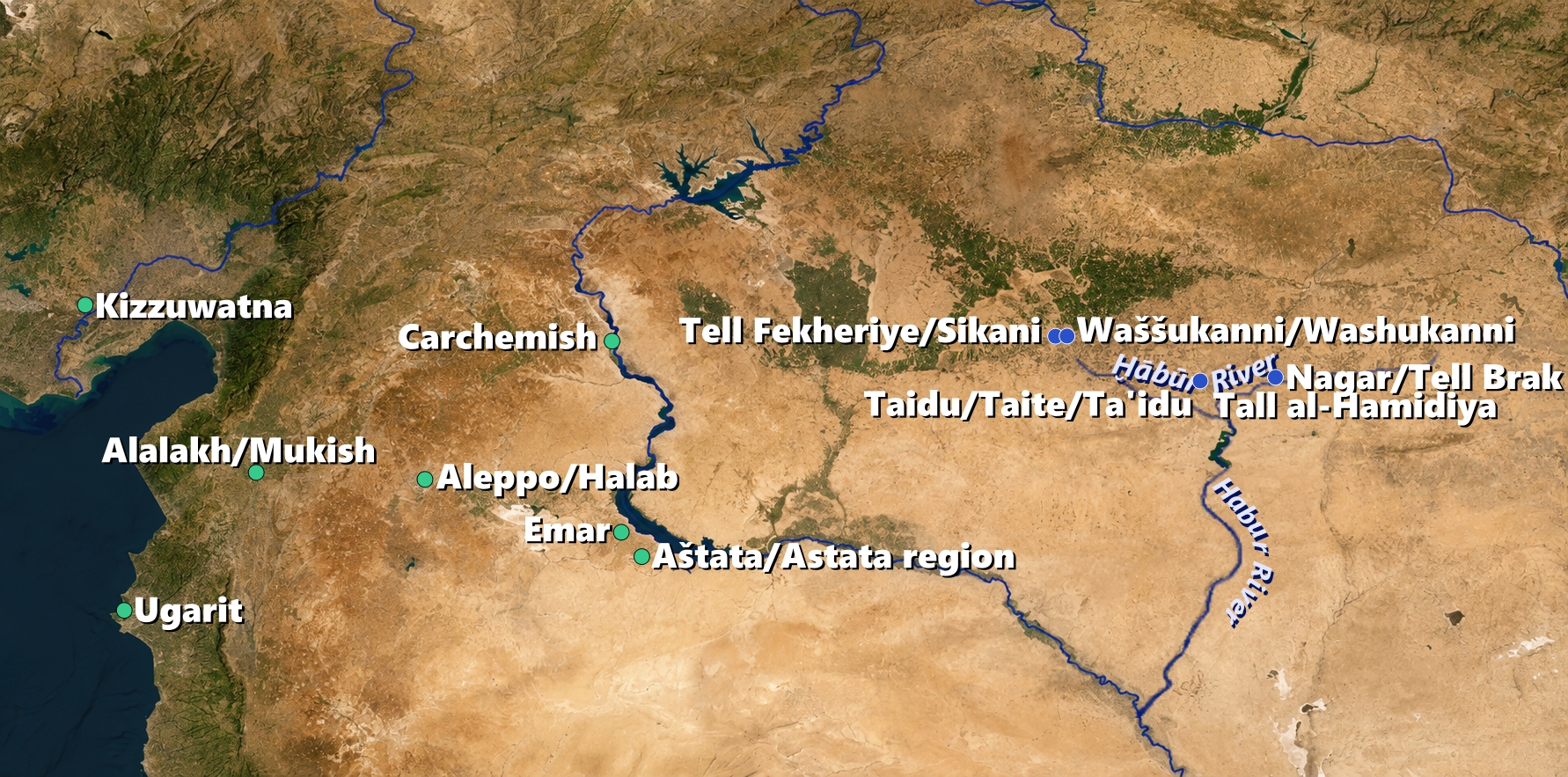
Given he traveled across the entire northern and eastern region of what historians call Hanigalbat with no mention of the Mitanni, it stands to reason that those were not Mitanni lands either, at least at that time.
Now let’s map the places we know for a fact that the Mitanni, by name – not Hanigalbat – projected power; those are the green dots above. Note the extreme mismatch between these locations; a lot of Mitanni influence stretches west, none to the east; but all the blue dots are in the east.
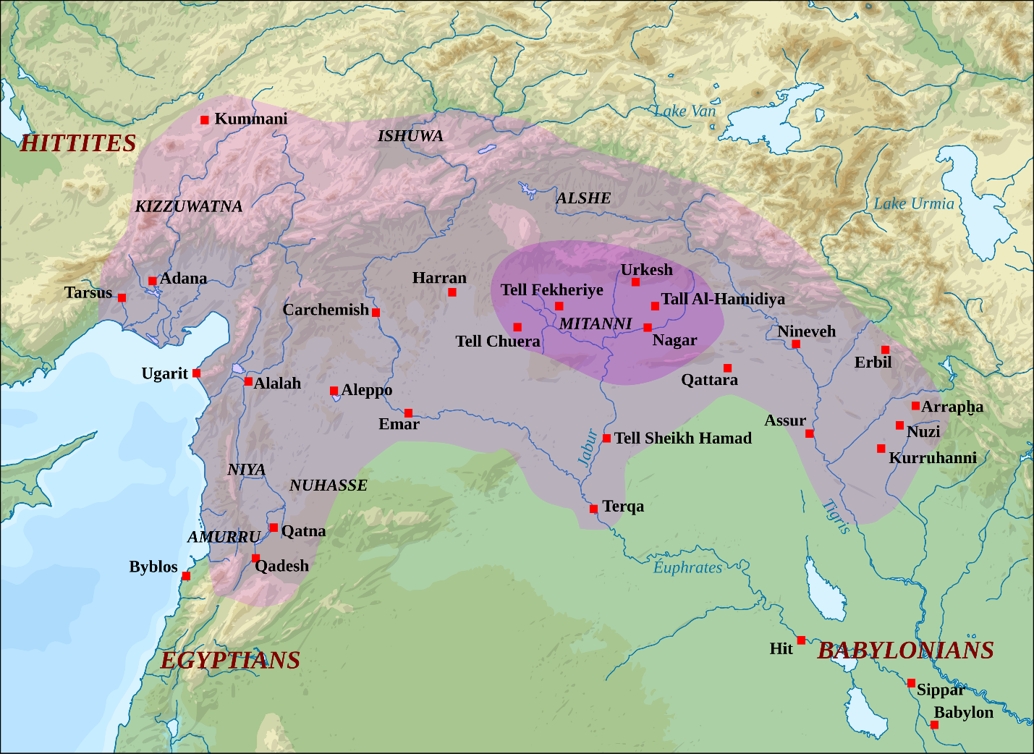 This suggests to me that the actual Mitanni homelands are somewhere around where Emar is on the map aboveat right. The Mitanni capital was called Washukanni in the Amarna letters, and its location is speculated to be as shown here; but it has never been proven, no tablets have been excavated that prove it was Washukanni.
They have found Hurrian remains there, and evidence of Mitanni culture; which is completely reasonable, for two reasons; first, the Mitanni were not Hurrians, the Mitanni was an elite population that ruled over a Hurrian population.
And second, the Mitanni did in fact control that area at the peak of their kingdom. In fact, they did indeed control land from the Mediterranean to the Zagros mountains at their peak… in the 10th century, as you can see in the above image.
Our primary point is that the sole textual evidence we have for the location of the Mitanni homeland is from the annals of Tiglath-pileser I, which places them “in the desert, in the land Mittani, and at the city Araziqu which is before the land Ḫatti.”
This explains why they projected such power to Alakakh and Kizzuwatna, so far in the west, because their capital was closer to those cities. Thus, the purple region you see in the map above should be centered closer to Emar, much farther west than historians believe.
And yes, this does actually matter a great deal for the story of history. Because if you believe Hanigalbat and Mitanni are synonymous, nothing makes sense. And we’re not yet done separating them.
HANIGALBAT
As has already been noted, Tiglath-pileser I differentiated between the Mitanni lands and Hanigalbat in his annals around ‑1150, placing the Mitanni lands to the southwest and Hanigalbat to the northwest.
Not long after his death the empire went into steep decline and a documentary dark age; historians have no idea why, but we will soon show exactly why that happened. The next time the veil lifts over Assyrian history is with the reign of Assur-dan II at the start of the Neo-Assyrian period in ‑992‑969, and especially with his successors.
There we find Assyria once again confined to their own immediate region, whereupon several generations of kings devote themselves to expanding their territory, with the explicit intent of recapturing their lost territory in Hanigalbat.
Below you will find a map showing all the locations mentioned by Adad-nirari II when he campaigned to restore the boundaries of Assyria. He spent by far the most time in the north making repeated incursions into the headwaters of the Euphrates territory.
He seems to have begun his reign with a very small territory, since his first campaigns targeted Arrapha and the region around Kummu. He didn’t begin major campaigns, as far as we know, until his 10th year when he targeted the upper Tigris (called the lower Zab), calling it Hanigalbat.
In the eponymy of Dūr-māti-Aššur [955], I marched to the wide land Ḫanigalbat. Nūr-Adad of the land Temannu, mustered his troops (and) we drew up in battle formation at the city Paʾuzi, (which is situated) at the foot of Mount Kāšiāru. We fought with one another, (but) I brought about his defeat from the city Paʾuz to the city Naṣībīna (Naṣīpīnu). I repulsed his numerous chariots. (Annals of Adad-nirari II, http://oracc.org/riao/Q006021/)
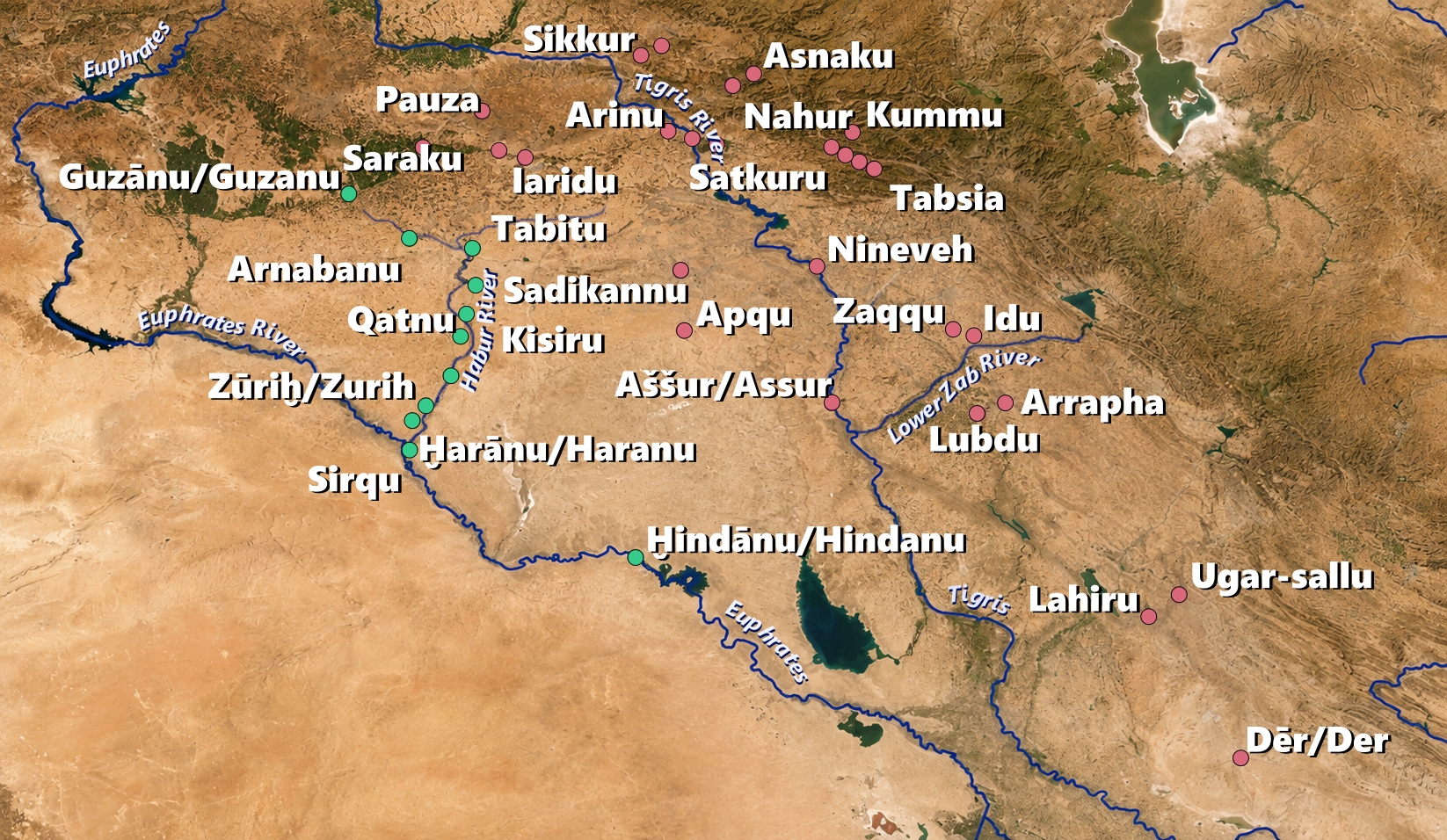
Note that now “Hanigalbat” is considered “a wide land,” which includes Pauza (as it’s spelled on the map of above). This city is still far to the north of what historians consider Hanigalbat, but Adad-nirari would spend the next seven years campaigning in this region, calling it Hanigalbat the whole time.
Finally, In the month Sivan, in this same eponymy (= Šamaš-abū’a, [‑947]) I marched for a fifth time to the land Ḫanigalbat. I received the tribute of the land Ḫanigalbat above and below. (Thus) I became lord of the extensive land Ḫanigalbat to its entire extent (and) brought (it) into the boundaries of my land.
Look at the map above; the pink dots represent all of his known campaigns up until his 18th year, and after subduing all those cities he said “(Thus) I became lord of the extensive land Ḫanigalbat to its entire extent (and) brought (it) into the boundaries of my land.”
The term “to its entire extent” allows us a very precise mapping of the region of Hanigalbat, as known to Adad-nirari; it went from Kummu to Pauza, and basically included the upper Tigris valley and that’s it. There is no indication he believed the term to include anything near the Euphrates or west towards Harran.
Then after that statement, the annals record that he took a trip down the Khabur River – the green dots – and collected tribute from them. As far as we know this is his only visit to that region, and no evidence of fighting is recorded; he basically shook the cities down for tribute money.
Why, we wonder, did he not push west into the rich lands around Harran and Carchemish, to reclaim lands his ancestors had owned? Clearly, he could not. Someone else was there, someone too powerful for the Assyrians at this time.
We’ll come back to that. For now, let’s focus on the definition of Hanigalbat in his annals; he considered himself, upon conquering the upper Tigris region, to be in control of the “extensive land Hanigalbat to its entire extent.” This is how scholars interpret the data:
In sum, the official sources seen above—and especially the passages from the annals of Adad-nirari II—indicate that in the ENA [early Neo-Assyrian] period the area called “Ḫanigalbat” coincided by and large with the Kašiyāri/Kašiyēri range of uplands, which—as already noted above—may be identified with the present-day Ṭūr ‘Abdīn. This is a mountainous plateau of limestone in present-day SE Turkey delimited by the Upper Tigris river valley (up to its confluence with the Batman Su) to the north, bordering on its steeper southern and western flanks the flat plain of NE Syria… (Hanigalbat in early neo-assyrian inscriptions, Fales).
Note that this author agrees that the Khabur valley was excluded from the region known as Hanigalbat. This is key to our argument; the Mitanni, it is agreed, dwelt nowhere near the uplands of the Tigris region. They cannot, therefore, in any sense, be considered identical with Hanigalbat.
THE MIDDLE ASSYRIANS
Middle Assyrian kings – generally defined as Assuruballit I to Assur-dan II, traditionally ‑1363 to ‑912, are placed more-or-less correctly on the timeline; we date them ‑1375 to ‑969, but close enough. The problem is that the rest of the world has quite literally passed them by, and placed them four centuries or so back in time.
This creates a lot of misunderstandings. Because historians have spent centuries painting a picture built around Assuruballit and the Amarna letters, which connects Assyria in the 14th century BC indirectly to Egyptians, Hittites, Mitanni, and Kassites who would not exist for 400 years. And then painted the story of his successors based on those conclusions.
What this means is that the 14th century BC world that historians have painted based on the Amarna letters is… a very accurate description of the –10th century, and bears no relation at all to the circumstances of the –14th.
So we begin with the premise we have already established that every related civilization moves forward in time relative to Assyria; Egypt, Kassites, Mitanni, Elamites and Hittites are all contemporaries with Assur-dan II, give or take; and from there we back up and tell what actually happened.
In the time of Assuruballit, as we have said, Shamsi-adad conquered Assur, then a minor city-state, and shortly thereafter Hammurabi took over from him. In ‑1335 the Kassites conquered Babylon, freeing the Assyrians to explore their own interests, which they did by conquering north and west – the only place not controlled by Kassites.
Babylon was already weakening before this happened, and Assuruballit himself probably took the initiative in the ‑1340’s to begin conquering; the conquests of the first four kings of the middle Assyrian empire are summed up as follows by Adad-nirari I:
Adad-nārārī (I), holy ruler, pride of the gods, lord, appointee of the gods, founder of cult centers, defeater of the heroic — the arm (ies) of the Kassites, Gutians, Lullumê, and Šubareans — scatterer of all of (his) enemies above and below, trampler of their lands from (the city) Lubdu and the land Rapiqu to (the land) Eluḫat, conqueror of the cities Taidu, Šuru, Kaḫat, Amasaku, Ḫurra, Šuduḫu, Nabulu, Waššukanni (Uššukani), and Irridu, the entirety of Mount Kašiāru, as far as (the city) Eluḫat, the fortress of the city Sūdu, the fortress of (the city) Ḫarrān, as far as the city Carchemish, which is on the banks of the Euphrates River, capturer of all of the people, extender of borders and boundaries, the king at whose feet the deities Anu, Aššur, Šamaš, Adad, and Ištar made all of the kings and rulers bow down, exalted priest of the god Enlil;
son of Arik-dīn-ili, appointee of the god Enlil, vice-regent of (the god) Aššur, conqueror of the Turukkû and the land Nigimhi to its full extent, (as well as) all of the rulers of the mountains and mountainous regions of the wide border of the (land) Qutû, conqueror of the land Katmuḫi and all of its allies, the hordes of Aḫlamû, Suteans, (and) Yaʾuri, and their lands, extender of borders and boundaries;
grandson of Enlil-nārārī, (who was) also vice-regent of (the god) Aššur, (the one) who killed the army of the Kassites and defeated all of his enemies, extender of borders and boundaries;
(and) offspring of Aššur-uballiṭ (I), the strong king whose priesthood was outstanding in awesome Ekur and the well-being of his kingship was established as far away as the mountains, subduer of the land Muṣri, disperser of the hordes of the wide land Šubarû, extender of borders and boundaries. (Tablet of Adad-nirari I, http://oracc.org/riao/Q005738/)
So we see in these four generations a gradually increasing Assyrian sphere, beginning with Assuruballit who established territory “as far away as the mountains,” meaning the Zagros to the northeast; the location of the “land Musri” is debated. I highly doubt it was in the west where it appears on this map, since it wasn’t until Adad-nirari I (‑1323‑1291) that the territory stretched as far as the Euphrates. Other maps place it north and east of Assur, outside the upper right corner of this map.
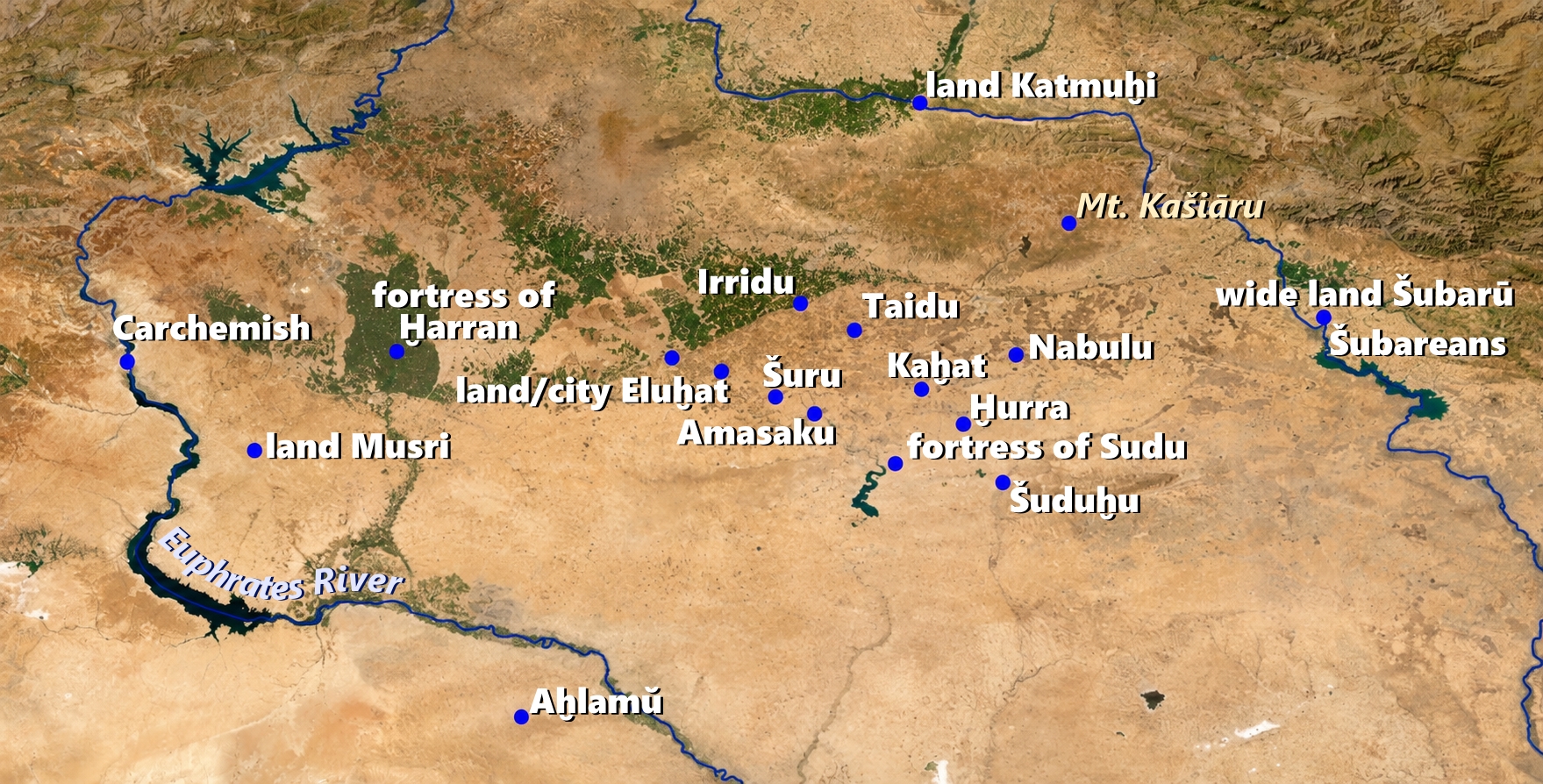
It is noteworthy that Adad-nirari I captured Washukanni, which we know from the Amarna letters to be the capital of the Mitanni kingdom; yet strangely, he did not mention the Mitanni nation. He mentioned a lot of other nations; “defeater of the heroic — the arm (ies) of the Kassites, Gutians, Lullumê, and Šubareans,” etc.
But the Mitanni do not make the list, even though victory over them would have been, in light of their supposed recent vassalage to the Mitanni, an extremely significant accomplishment. He does mention two kings of Hanigalbat elsewhere in his annals, but not in terms one would expect for a great empire:
Adad-nārārī (I), king of the world, strong king, king of Assyria, son of Arik-dīn-ili, king of Assyria, son of Enlil-nārārī, (who was) also king of Assyria. When Šattuara, king of the land Ḫanigalbat, rebelled against me and committed hostilities, I seized him by the command of (the god) Aššur, my lord, the one who comes to my aid, and the great gods who decide in my favor, and I brought him to my city, Aššur. I made him take an oath and allowed him to return to his land. Annually, as long as (he) lived, I regularly received his audience gift within my city, Aššur. (Adad-nirari I inscription, http://oracc.org/riao/Q005740/)
So we must ask, if these are the last traces of a great Mitanni empire, as historians believe… when exactly did they become vassals of the Assyrians, as they are here?
THE FREEING OF ASSYRIA?
Remember, according to the traditional narrative, it was Assuruballit I who threw off the Mitanni yoke; but among the many accomplishments cited by Adad-nirari I for him and his ancestors, that is not one of them. Yet surely their liberation from vassalage would be the greatest achievement he could mention.
Somehow dozens of minor cities and people make the list while the overthrow of the great Mitanni kingdom was summed up by Assuruballit’s title “subduer of the land Muṣri?” I find that impossible to believe. Adad-nirari I continues…
After his death, Uasašatta, his son, revolted, rebelled against me, and committed hostilities. He went to the land Ḫatti for aid. The Hittites took his bribes, but they did not render him assistance.
With the strong weapons of the god Aššur, my lord … I captured (and) seized the cities Taidu — his large royal city — Amasaku, Kaḫat, Šuru, Nabulu, Ḫurra, Šuduhu, and Waššukanni (Uššukani). I took the possessions of those cities, the accumulated (wealth) of his (Uasašatta’s) ancestors, (and) the treasure of his palace, and brought (those things) to my city, Aššur.
I conquered, burned (with fire), (and) demolished the city Irridu. Moreover, I sowed salty plants over it. The great gods gave me (the territory) from the city Ta’idu to the city Irridu, the city Eluḫat, and Mount Kašiāru to its full extent, the fortress of the city Sūdu, the fortress of the city Ḫarrān, to the bank of the Euphrates River, and I ruled (over it). (Adad-nirari I inscription, http://oracc.org/riao/Q005740/)
This certainly has Adad-nirari in possession of the entire area north of the Euphrates, which was previously under the (vassal) rulership of these “kings of Hanigalbat.” But this shows no connection with a great Mitanni empire; simply ethnic Mitanni kings as vassals over related lands.
What’s worse for the historical narrative is that Adad-nirari specifically calls Taidu “his large royal city,” i.e., the capital. Yet in the Amarna letter time frame, the capital is always treated as Washukanni, which here is simply another city on the list.
So in the traditional narrative, historians need to explain why, during the decline of an empire and civil war after the death of its last great king Tushratta in the ‑1340’s, and while a vassal of first Hittites then Assyrians…
Somehow the Mitanni kings found the time and money to move their capital to a different “large royal city” – which certainly would have required considerable effort and money – and done so in the 40 or so years that elapsed between the Amarna period and Adad-nirari I.
Really?
And somehow, despite all of those calamities and not one but two vassalages in less than two generations, which would certainly have led to the plunder of everything not nailed down, and while paying heavy yearly tribute, and after bribing the Hittites… somehow there was still “the accumulated wealth of his ancestors” and the “treasure of his palace” left for Adad-nirari to take?
Again I ask… really?
We, on the other hand, have no difficulty explaining this, since the Amarna letters would not be written for four hundred years. Plenty of time for a capital city to shift as the Mitanni empire, here in its earliest phases, rose to power and shifted to Washukanni, possibly as a result of Adad-nirari’s plundering!
Adad-nirari didn’t consider the Mitanni people worth mentioning in his list of conquests because they were a minor ethnic group recently arrived on the scene who, perhaps through technology or wealth or other means, found themselves the ruling elite of a Hurrian population, few of whom were ethnically Mitanni.
LATE MIDDLE ASSYRIA
Assyria expanded west because the Kassites were expanding south and east, trying to consolidate all of Babylonia; Adad-nirari I and Enlil-nirari had both held off Kassite invasions in their territories, which forced the great empires to push away from each other.
Adad-nirari’s successors, Shalmaneser I and Tikulti-ninurta I both continued to expand and maintain this territory; something their own successors would not be able to do.
The Middle Assyrian Empire was founded through Assur, a city-state through most of the preceding Old Assyrian period, and the surrounding territories achieving independence from the Mitanni kingdom. Under Ashur-uballit, Assyria began to expand and assert its place as one of the great powers of the Ancient Near East. This aspiration chiefly came into fruition through the efforts of the kings Adad-nirari I (r. c. 1305–1274 BC), Shalmaneser I (r. c. 1273–1244 BC) and Tukulti-Ninurta I (r. c. 1243–1207 BC), under whom Assyria expanded to for a time become the dominant power in Mesopotamia. The reign of Tukulti-Ninurta I marked the height of the Middle Assyrian Empire and included the subjugation of Babylonia and the foundation of a new capital city, Kar-Tukulti-Ninurta, though it was abandoned after his death. (Wiki, Middle Assyrian empire)
We need to stop and talk about Tikulti-ninurta I, because his battle with Kashtiliashu IV of the Kassites is one of the prime anchors historians use to keep the Kassites 400 years before they belong.
His [Shalmaneser I’s] son was Tukulti-Ninurta (c. 1233–c. 1197), the Ninus of Greek legends. Gifted but extravagant, he made his nation a great power. He carried off thousands of Hittites from eastern Anatolia. He fought particularly hard against Babylonia, deporting Kashtiliash IV to Assyria. When the Babylonians rebelled again, he plundered the temples in Babylon, an act regarded as a sacrilege, even in Assyria. (The rise of Assyria, Brittanica.com)
The original text says, among other things…
…I approached Kaštiliašu, the king of Karduniaš (Babylonia), to do battle. I brought about the defeat of his army (and) struck down his warriors. In the midst of that battle, I captured Kaštiliašu, the king of the Kassites, (and) trod with my feet upon the neck of his lordly majesty as though it were a footstool. I brought him bound as a captive into the presence of (the god) Aššur, my lord. I became the lord of Sumer and Akkad to its full extent. I fixed the boundary of my land as the Lower Sea of the Rising Sun (Tikulti-ninurta inscription, http://oracc.org/riao/Q009242/)
This Tikulti-ninurta gives his ancestry, which confirms him as Tukulti-ninurta I, dating this to ‑1275‑1238 (our dates); and since historians universally conclude his adversary was Kashtiliashu IV, one of the late Kassite kings, it seems to confirm that the Kassites existed four centuries earlier than we believe.
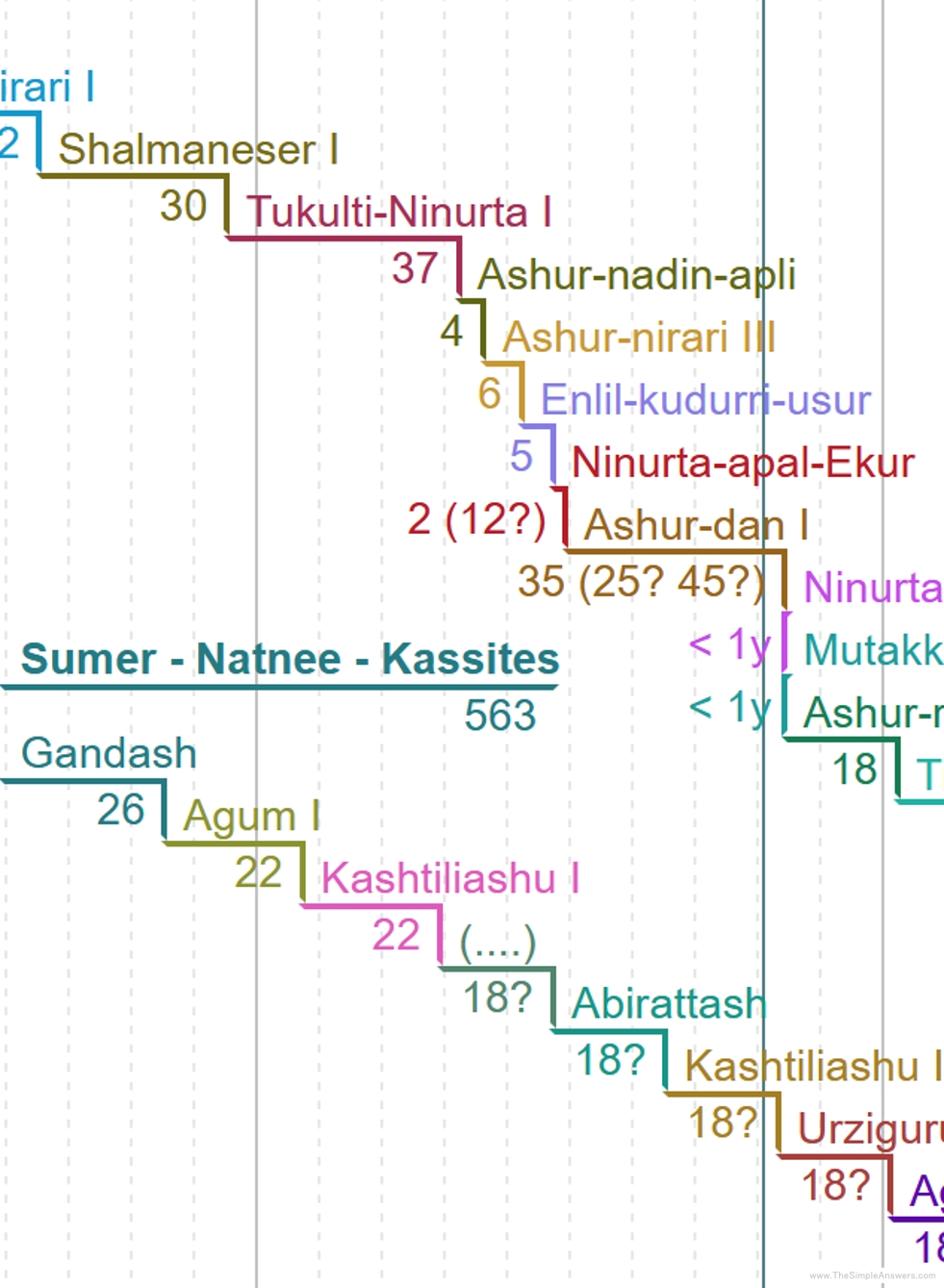 But if we slow down, we’ll note there is no “IV” on the name in the text, nor an ancestry given for the Kassite king. And so if we simply look at our chart, without any fiddling, we find Tikulti-ninurta I opposite Kashtiliashu I. Aren’t we lucky?
Nothing exists to tie this to one Kassite king or the other; the proof tying it to the first Kassite king by that name is just as strong as that which ties it to the fourth.
Besides this fact, almost nothing is known about the early Kassite kings; not so much as a single inscription, just their name on the BKL. Which is not surprising, if they were losing to the Assyrians, as this text says. But we are fascinated to find that once again, what might have been a fatal piece of evidence against our theory… actually fits perfectly.
The reign of Tukulti-Ninurta I marked the height of the Middle Assyrian Empire … Though Assyria was left largely unscathed by the direct effects of the Late Bronze Age collapse of the 12th century BC, the Middle Assyrian Empire began to experience a significant period of decline roughly at the same time. The assassination of Tukulti-Ninurta I c. 1207 BC led to inter-dynastic conflict and a significant decline in Assyrian power. (Wiki, Middle Assyrian empire)
In our timeline, the decline makes very good sense; the Kassites were growing stronger to the south and east, not weaker as in the traditional history. Also, the Hittites were growing stronger, not weaker, in this period – again in contradiction to the traditional history.
But most importantly of all… the Mitanni were about to take vengeance for Adad-nirari’s plundering.
Even during its period of decline, Middle Assyrian kings continued to be assertive geopolitically; both Ashur-dan I (r. c. 1178–1133 BC) and Ashur-resh-ishi I (r. 1132–1115 BC) campaigned against Babylonia. Under Ashur-resh-ishi I’s son and successor Tiglath-Pileser I (r. 1114–1076 BC [our dates ‑1158‑1119]), the Middle Assyrian Empire experienced a period of resurgence, owing to wide-ranging campaigns and conquests. Tiglath-Pileser’s armies marched as far from the Assyrian heartland as the Mediterranean. Though the reconquered and newly conquered lands were held on to for some time, the empire experienced a second and more catastrophic period of decline after the death of Tiglath-Pileser’s son Ashur-bel-kala (r. 1073–1056 BC [our dates ‑1119‑1102]), which saw the loss of most of the empire’s territories outside of its heartlands, partly due to invasions by Aramean tribes. Assyrian decline began to be reversed again under Ashur-dan II (r. 934–912 BC [our dates ‑992‑969]), who campaigned extensively in the peripheral regions of the Assyrian heartland. The successes of Ashur-dan II and his immediate successors in restoring Assyrian rule over the empire’s former lands, and in time going far beyond them, is used by modern historians to mark the transition from the Middle Assyrian Empire to the succeeding Neo-Assyrian Empire. (Wiki, Middle Assyrian empire)
This period of “catastrophic decline” between ‑1102 and ‑969 is largely unexplained by traditional historians, but we can provide an excellent cause for it; those of you paying attention will notice that we are now approaching the actual time of the Amarna letters (around ‑930‑900), and will have already realized we are about to introduce the actual Mitanni empire.
Around c. 1430 BC, Assur was subjugated by Mitanni, an arrangement that lasted for about 70 years, until c. 1360 BC. (Wiki, Assyria)
As it happened, we have almost no Assyrian records during this period in history, so it’s difficult to prove this; certainly there is no evidence from the Assyrian side that the Mitanni were the masters of Assyria in this period, while we have considerable evidence to show that it was in fact Naram-sin and Erishum of Ekallatum, then Shamsi-adad, then Hammurabi who controlled them at that time. So the captivity is real, but the captors are not.
The history of the ancient Near East in the 12th–10th centuries BCE is still an unsolved riddle. At times the veil is lifted and tiny components of this elaborate puzzle glow in a new light. But many questions are as yet unanswered, and most details are still vague. (Hanigalbat in Early Neo-Assyrian Inscriptions, Fales)
However there is another dark age in Assyrian history where a foreign occupation would fit; indeed, as weak as Assyria was during that period, it’s hard to believe they were not vassals of someone.
And so we are, as always, fortunate to find that just where we must place the Mitanni empire in history as masters of Assyria… there are no Assyrians around to argue with us. It is therefore this period in which the Mitanni ruled the northern part of Mesopotamia from the Mediterranean to the Zagros mountains as you saw in all those maps above.
Little is known of the first kings of the Middle Assyrian period or of their contacts with their foreign counterparts. … Most scholars agree that Assur was under Mittani dominance during part or most of this period, although we have little information from this period (Lion 2011). … The hypothesis of the Mittani domination over Assur is based on the introduction to the treaty between the Hittite king Šuppiluliuma (Frantz-Szabó and Wilhelm 2012) and the Mittani king Šattiwaza (Wilhelm 2009a), in which the plundering of a gate from Assur around 1450 BC by the Mittani king Šauštatar (Wilhelm 2009c) is mentioned and Šattiwaza is reported as saying that his opponent to the Mittanian throne, Šuttarna, ‘threw himself down before the Assyrian, the subject of his father, who no longer pays tribute, and gave him his riches as a gift’ (KBo I 3: 6-9; Beckman 1996: no. 6B). The documentation found in Assur itself does not support a Mittani domination, as no attestation of Mittani occupying forces, political dependence or payment of tribute has been found in the texts found there. No data related to foreign kings or foreign domination are found in Assur in this period because only few archival documents have been unearthed. They can be used, at most, to confirm the filiation of the Assyrian kings. (Saporetti 1979a: 29-44; 1979b)
Long story short, all evidence of Mitanni dominance over Assyria comes from the Amarna period, when the Hittites and Mitanni kings made a treaty that references Assyria. Hence, that dates to the ‑900’s, not to the ‑1400’s.
But if we accept this as a ‑900’s document based on that Amarna dating, then it conclusively proves the Assyrians were vassals of the Mitanni only a generation or two before the treaty was made in ‑909, when “he threw himself down before the Assyrian, the subject of his father, who no longer pays tribute, and gave him his riches as a gift.”
Since this probably coincided with either a rebellion or the first conquering of Assur by the Mitanni, we would expect to find little evidence of Assyrian power during this time. And that’s exactly what we find – the Assyrian dark age between ‑1100 and ‑950, give or take.
THE STORY SO FAR
Somewhere around the ‑1500‑1400’s or so Indo-Aryan peoples migrated west from the area around Afghanistan and eastern Iran. Their skill with horses gave them the upper hand and somehow they wound up in a ruling position in the western Euphrates region.
They built or took over cities and ruled from Taidu, which has never been found but which historians believe was in the Khabur River valley. Perhaps it was, but the bulk of the Mitanni themselves lived farther west around the bend of the Euphrates as identified by Tiglath-pileser I, so I would look for it there.
Meanwhile with the breakup of the Amorite kingdoms of Mesopotamia the Assyrians flexed their military might and made vassals of these proto-Mitanni kings, who still retained a lot of autonomy provided they kept paying protection money.
This arrangement lasted until the time of Adad-nirari I, when Shattuara “king of the land Ḫanigalbat” rebelled around ‑1310. He was quickly crushed and reinstated as vassal, and after his death his son also rebelled, and this time was utterly conquered.
We demonstrated repeatedly above that Hanigalbat explicitly referred to the northern regions and we still maintain this; either historians are wrong about the location of these cities – it would make more sense if they were farther north – or else this was a regional capital whose main function was to control the lands to the north.
It certainly does not seem that they projected any power to the west from these cities, to the Mitanni homelands. Either way, after the rebellion of two successive kings of Hanigalbat, the Assyrians must have been tired of losing control, so the next king, Shalmaneser I, placed his own relative on the throne, as vassal king.
After conquering the Mitanni kingdom in the 13th century BC and establishing administrative districts there, the Middle Assyrian king Shalmaneser I named his brother, Ibashi-ili, as grand vizier (sukallu rabi’u) and king of Hanigalbat. The title šar māt Ḫanigalbat was identical to the title used for the Mitanni kings by the Assyrians. The title might intentionally have implied that the conquered Mitanni territories had vassal-like status (rather than being fully incorporated) as a way to appease the locals. The Assyriologist Masamichi Yamada wrote in 2011 that he believed that the kings of Hanigalbat were relatively autonomous, their realm, which he designated as “Assyrian Hanigalbat” (as opposed to the earlier Mitanni kingdom, “Hurrian Hanigalbat”), being a satellite state rather than a full vassal kingdom. (Wiki, King of Hanigalbat)
I remind you to ignore the gratuitous use of the word “Mitanni” in this quote, which does not appear in any of the original sources. These kings of Assyrian Hanigalbat would continue to rule for several generations according to Wikipedia, with the last known king of Hanigalbat being…
Ili-ipadda, son of Ashur-iddin. Active during the late reign of Tukulti-Ninurta I, and the reigns of his successors Ashur-nadin-apli and Ashur-nirari III in Assyria. [Thus from around ‑1230‑1216] …There are records of a grand vizier of Ibašši-ilī’s line in the reign of Ashur-dan I, the successor of Ninurta-apal-Ekur [‑1202‑1167].
A generation later, when Tiglath-pileser I visited the area, as already said he encountered no resistance; we now know why, since the broad plains north of the Euphrates were ruled by Assyrian vassal kings until recently, if not still. But that was changing.
The absence of these viziers from the record suggests that Assyria no longer had direct control over the region, and had to collect tribute by a show of force; as soon as Assyria weakened, those tables turned and the Mitanni kings flipped the loyalty of the kings of Hanigalbat and began to spread east.
In time, they would conquer Assur and Nineveh, and in an unusual act of vengeance, loot the doors of the city.
Shaushtatar reigned as King of Mitanni c. 1480–1460 BC. He sacked the Assyrian capital of Assur some time in the 15th century during the reign of Nur-ili, and took the silver and golden doors of the royal palace to Washukanni. This is known from a later Hittite document, the Suppililiuma-Shattiwaza treaty. After the sack of Assur, Assyria may have paid tribute to Mitanni up to the time of Eriba-Adad I (1390–1366 BC). (Wiki, Middle Assyrian empire)
Obviously, these dates are the traditional ones; they are based on the Hittite-Mitanni treaties which took place a few decades after the Amarna letters, so we would adjust Shaushtatar’s dates to ‑1080‑1060, and therefore put the sack of Assur in ‑1070 to minimize the margin of error.
Now aren’t we fortunate, that the place where we have no choice but to place the sack of Assur fits neatly into the beginning of the Assyrian dark age!
…the empire experienced a second and more catastrophic period of decline after the death of Tiglath-Pileser’s son Ashur-bel-kala [our dates ‑1119‑1102], which saw the loss of most of the empire’s territories outside of its heartlands, partly due to invasions by Aramean tribes. (Wiki, Middle Assyrian empire)
I said before that we would provide a reason for this “catastrophic period of decline” between ‑1102 and ‑969; and now it’s obvious. The early Mitanni empire kings warred against, and ultimately conquered, the Assyrians.
Given that Shaushtatar’s dates are hypothetical based on the generations given in the Hittite-Mitanni treaty, they are somewhat flexible; historians differ by decades on the precise dates for his reign. But we can do better, because the Assyrian record drops off precipitously shortly after the death of Ashur-bel-kala.
Šamšī-Adad, strong king, king of the universe, king of Assyria, son of Tiglath-pileser (i), king of the universe, king of Assyria, son of Aššur-rēša-iši (i) (who was) also king of the universe (and) king of Assyria: (Assyrian rulers…, Shamsi-Adad IV, Grayson)
The two successors of Ashur-bel-kala, though their reign was brief, both left us inscriptions like these claiming to be king of the universe. This formulaic claim was hardly literal, and most likely they were rapidly losing territory to the Mitanni. Still, they left us something. The next king did not:
Apart from the White Obelisk, there is no evidence of military or building activities of Ashurnasirpal I. There are some prayers or hymns addressed to Ištar by an Ashurnasirpal, possibly the first king of this name. (Assyrian rulers… Ashurnasirpal I, Grayson)
Grayson explains that the white obelisk likely belonged to a different king by this name, leaving us with almost zero inscriptions of this king despite a reign of 19 years. This virtually screams “vassal,” and certainly not “king of the universe.”
Hence, we would date the sack of Assur at the beginning of his reign in ‑1097; though we view his “coronation” as his installation as king following the death of Shamsi-adad IV at the hand of the Mitanni when they sacked Assur.
We must pause to marvel at our luck that this fits at all; randomly moving Mitanni kings around by 400 years should have created unsolvable problems, like powerful Mitanni alongside powerful Assyria; yet in our timeline just when the Mitanni are weak, Assyria is strong; then when Mitanni was strong, Assyria was weak.
Lucky.
THE REVENGE OF THE ASSYRIANS
After over a century and a half of weakness, the Assyrians again began to build their empire back from zero under Assur-dan II. We do not intend to suggest that for this entire period the Assyrians had been docile, or even unsuccessful; a century and a half is a long time, after all.
There is limited evidence that during this period, at least at a few points, the Assyrians were able to claim vassals on the Khabur River; but those vassals may have simply been sub-vassals of the Assyrians who were still themselves vassals; that sort of thing happened all the time in the ancient world.
With Aššur-dān II (934‑912 BC) the Neo-Assyrian imperial period can be said to begin. This monarch regained territory captured and held for more than a century by Aramaeans (see the introduction to the reigns of Tiglath-pileser i and Aššur-bê1-ka1a) and returned fugitive Assyrians to these lands. (Assyrian rulers… Ashur-dan II, Grayson)
Regardless, under Assur-dan II the fortunes were reversed, starting in what we date to be ‑992. There must have been some reason that he felt emboldened to do this; the Mitanni kingdom was weakening somehow. But still not nearly enough to invade the Mitanni lands; merely enough to rebuild a power base near Assur.
His successor Adad-nirari II, as has been mentioned, likewise strictly avoided the core Mitanni lands, focusing his efforts in Hanigalbat far to the north; “(Thus) I became lord of the extensive land Hanigalbat to its entire extent (and) brought (it) into the boundaries of my land.”
Then, as has been mentioned, he took a trip down the Khabur River and collected tribute from them. It’s time to look more closely at that trip, since we now know that this was a zone of loyalty switching between the Mitanni to the west and the Assyrians to the east.
I crossed the Ḫābūr River and marched to the city Guzāna, which Abi-salamu of the land Bīt-Baḫiāni held. I entered the city Sikāni, which is situated at the source of the Ḫābūr River. By the exalted strength of the god Šamaš, lord of my turban who loves my priesthood, I received from him his numerous chariots, teams of horses, silver, and gold, the property of his palace. I imposed an annual payment upon him.
On that same campaign of mine, I made my way along the banks of the Ḫābūr River. I spent the night in the city Arnabāni. Moving on from the city Arnabāni, I spent the night in the city Ṭābete. Moving on from the city Ṭābete, I entered the city Šadikanni. I received tribute payment of chariots and gold. Moving on from the city Šadikanni, I spent the night in the city Kisiri. Moving on from the city Kisiri, I entered the city Qatnu. I allowed Amēl-Adad of the city Qatnu, a servant obedient to me, to remain there. I received from him the property of his palace, chariots and horses, wagons, and oxen. I imposed an annual payment upon him. (Inscription of Adad-nirari II, http://oracc.org/riao/Q006021/)
This narrative shows no battles, but also indicates that these kings are just now having payment imposed upon them. It’s unclear whether Amel-adad had been a servant before, or was just now becoming a servant and allowed “to remain there,” i.e., in charge.
Regardless, it pushes the Mitanni boundaries back. But not yet far enough to threaten Mitanni homelands, which we contend were nowhere near the Khabur River. So let’s see when exactly the Assyrians did grow that bold, and see if we can connect it to known events in the Mitanni kingdom.
TIKULTI-NINURTA II
His successor likewise campaigned, and left a fairly detailed list of the cities he campaigned to; actual fighting is largely confined to the north, the upper Tigris region again; the long tour south and west seems to have been another shakedown tour.
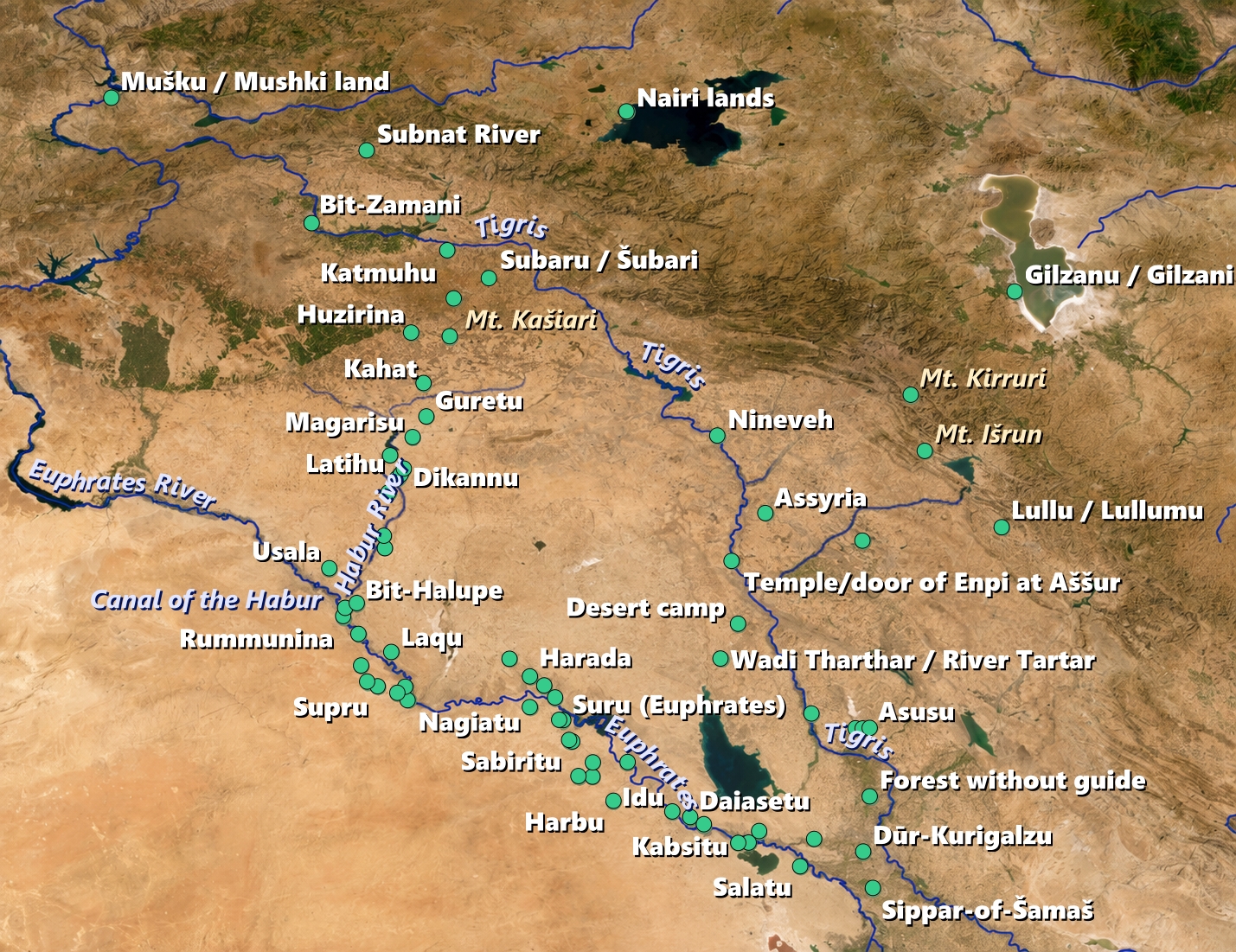
We are drawn to the enormous blank spot to the west; why didn’t he go west of the Khabur? What was he afraid of? Or rather, whom? Historians believe the inhabitants to have been a loose hodgepodge of Aramean tribes in this period, and Tukulti-ninurta was expressly out to expand the borders of the empire.
Why not go just a little farther west to Harran, Carchemish, and other rich cities in that region? And again we answer, there must have been a powerful kingdom there he was afraid to invade; and he himself identifies it as “the land Hatti” – at least in the northern part.
[Palace of Tukultī-Ninurta (II), king of the world, king of Assyria], son of Adad-nārārī (II), king of the world, king of Assyria, son of Aššur-dān (II), (who was) also king of the world (and) king of Assyria; […] to its full extent. The king who […] (the territory stretching) from the opposite bank of the Tigris River to the land Ḫatti, […] the Naʾiri lands to their (text: “its”) full extent, the land Sūḫu, including [the city Rapiqu, [(…); he] captured [… from the passes of] the land Ḫabruri to the land Gilzānu, Apâ, king of the city Ḫubuškia, [… H]e conquered (the territory stretching) from the passes of Mount Babite to […, …] in its entirety, from the Lower Zab [to the city Tīl-bāri, which is] upstream from the (city) Zabban, the lands Ḫirimmu (and) Ḫarutu, [(which are) fortresses of Kar]duniaš (Babylonia), from the city (A)ṣūṣi, which is on the Tigris River, to [… Dūr-Kurigalzu to the cities Sippar of the god Šamaš (and) Sippar of [the goddess Anunītu, (… ]. (Tikulti-ninurta II tablet, http://oracc.org/riao/Q006036/)
It is noteworthy that he completely ignores the lands we have inferred must belong to the Mitanni in this period; because at this time (‑948‑941), they were still a force not to be trifled with.
ASHURNASIRPAL
His own successor, Ashurnasirpal, came closer but still made no attempt to actually conquer that region.
…fearless in battle, mighty flood-tide which has no opponent, the king who made (the territory stretching) from the opposite bank of the Tigris River to Mount Lebanon and the Great Sea, the land Lāqê in its entirety, (and) the land Sūḫu, including the city Rapiqu, bow down at his feet. He conquered from the source of the Subnat River to the interior of the land Nirbu.
I brought within the boundaries of my land (the territory stretching) from the passes of the land Ḫabruri to the land Gilzānu, from the opposite bank of the Lower Zab to the city Tīl-bāri, which is upstream from the land Zabban, from the city Tīl-ša-Abtāni to the city Tīl-ša-Zabdāni, (and) the cities Ḫirimmu (and) Ḫarutu, (which are) fortresses of Karduniaš (Babylonia). Moreover, I gained dominion over the wide Naʾiri lands, to their (text: its) full extent. (Assurnasirpal tablet, http://oracc.org/riao/Q004485/)
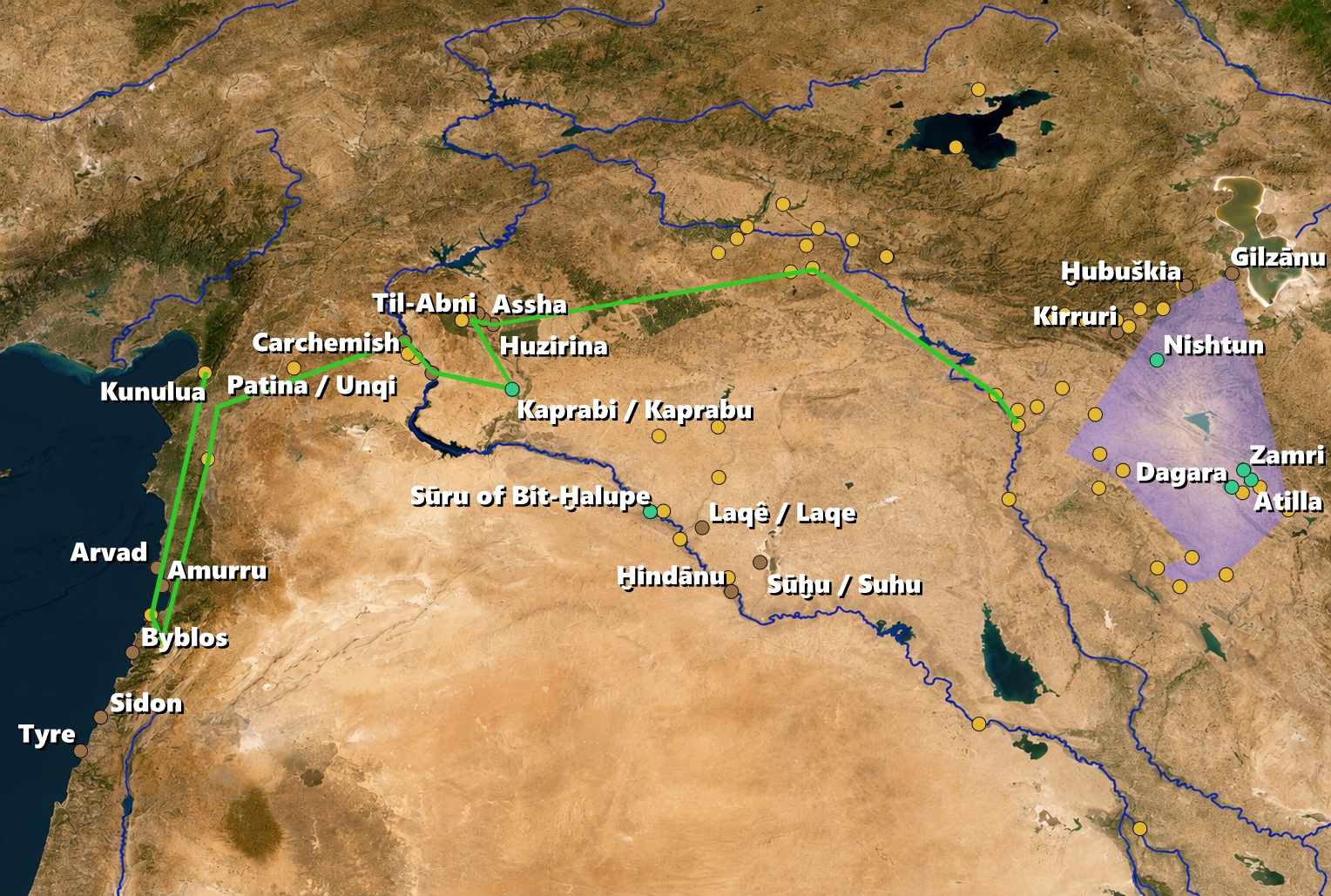
Once again he spent most of his early years campaigning to the same regions as his predecessors in Hanigalbat; only in his 7th year did he make a trip to the Mediterranean as far as Lebanon in ‑935 (green line above).
But he made no claim to have actually annexed those lands, this was just a tribute and souvenir collecting mission. You’ll notice above that while he said “from the Zagros to the Mediterranean… they bowed down at his feet,” he only took credit for actually adding to the land of Assyria the purple shaded area to the east.
This means that these lands he passed through with a massive army paid him to leave, but did not formally join Assyria at this time. Thus, something had changed between the 950’s and the 930’s; something that made it possible for him to bully his way west but which didn’t allow him to be so bold as to outright annex the territory. And finally, we’re ready to see what that was.
THE MITANNI IN DECLINE
In the Amarna letters around the year ‑929, Tushtratta tells Amenhotep III of his childhood – which should correspond to the ‑940’s and ‑930’s:
Sa[y] to Nibmuareya, the k[ing of Egypt], my brother: Thus Tušeratta, the king of [M]itani, your brother. … When I sat on the throne of my father, I was young,¹ and UD-ḫi had done an unseemly thing to my country and had slain his lord. For this reason he would not permit me friendship with anyone who loved me. I, in turn, was not remiss about the unseemly things that had been done in my land, and I slew the slayers of Arta[š]umara, my brother, and everyone belonging to them.
Since you were friendly with my father, I have accordingly written and told you so my brother might hear of these things and rejoice. My father loved you, and you in turn loved my father. In keeping with this love, my father [g]ave you my sister. [And w]ho els[e] stood with my father [a]s you did?⁴
[The ver]y next year, moreover, my brother’s … all the land of Ḫatti. When the enemy advanced against [my] country, [the God] Teššup, my lord, gave him into my hand, and I defeated him. There was [n]ot one of them who return[ed] to his own country. (Amarna letter EA17)
Historians tend to believe these events all took place within the preceding few years; if so, then the year ‑931, when Ashurnasirpal went to the sea, he did so in the midst of a succession crisis, with a regicidal regent presiding over a boy king on the throne.
The Mitanni would hardly have been in a place to pick a fight with the Assyrians, yet could have mounted a strong defense if attacked. Hence, they allowed the Assyrians to pass through their territory unharmed.
But a generation earlier when Adad-nirari II came down the Khabur in ‑959, the kingdom was in the hands of his father Shuttarna II. He had such a good relationship with Egypt as to have given his daughter in marriage. This clearly was a more powerful king, and not someone Adad-nirari II or Tikulti-ninurta would have wanted to engage directly, lest he bring Egypt into the fight.
In ‑935, the boy king Tushratta was not allowed by his regent to make diplomatic relations with Egypt, so the risk was much lower – and of course, Assyria itself was also stronger, more willing to take risks.
It is nice how it lines up, so that the one small window when the throne was unstable and the Hittites were invading the Mitanni land happens to be the same time that Ashurnasirpal went through the area unaccosted.
SHALMANESER
Ashurnasirpal’s successor Shalmaneser hit the ground running and campaigned heavily, and successfully, on all sides. Most significantly for us, he is the first Assyrian king to interact with a Biblical king when he took tribute from Jehu (‑899‑871).
Though not mentioned in the Bible, Shalmaneser’s black obelisk states that he took tribute from “Jehu bit-Omri,” or Jehu of the house of Omri; not technically true, although Omri was founder of the dynasty of Ahab, Jehu’s predecessor. Close enough for an Assyrian king.
This allows us to prove that Shalmaneser’s trip to Israel in his 18th year must fall during the life of Jehu, which among other things forces us to date Shalmaneser to ‑917‑882, about 50 years before traditional historians do, for reasons we will go into at length in a future chapter.
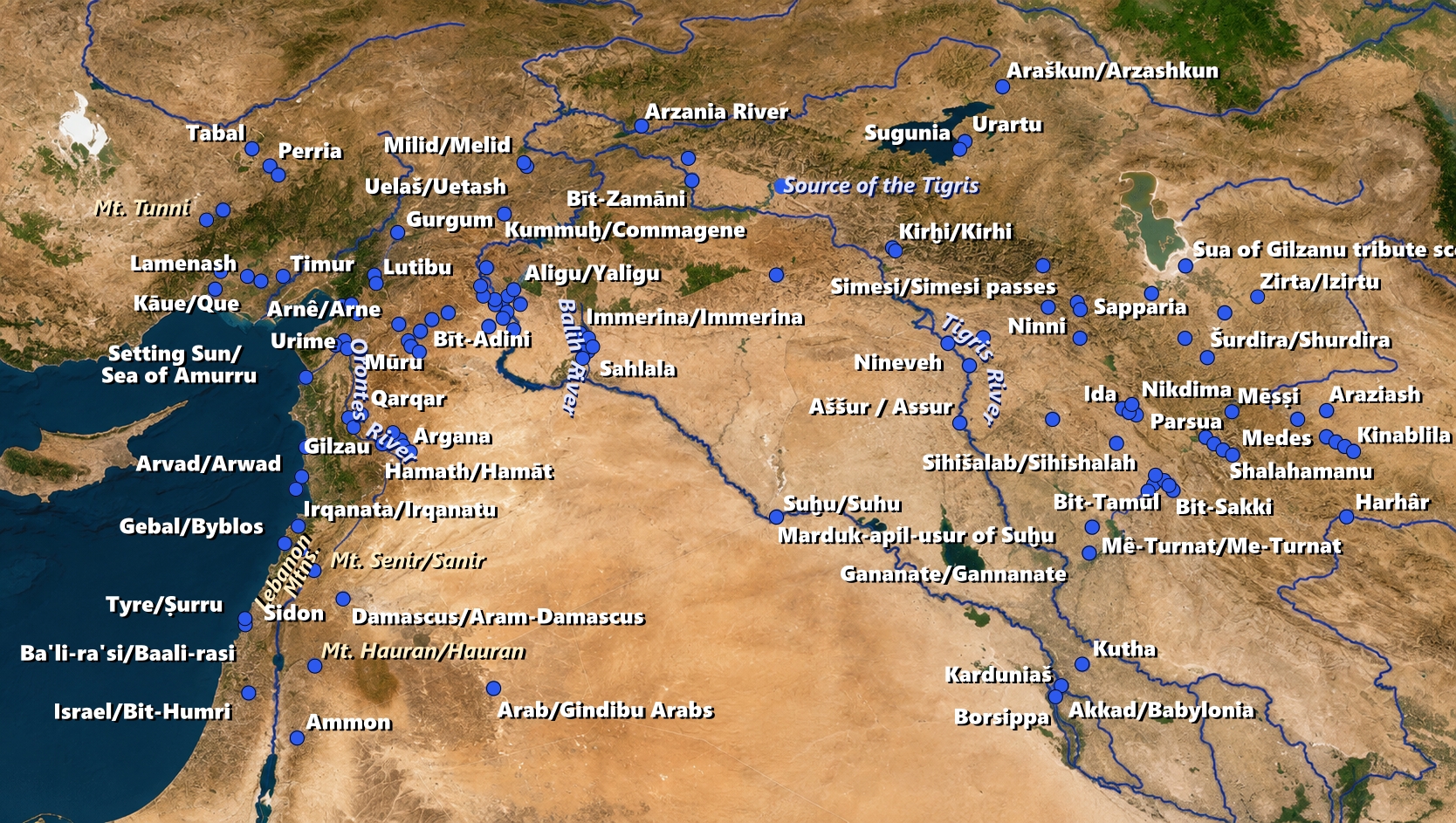
As you can see, Shalmaneser was busy, particularly in the regions his ancestors avoided in the west, which we identified as Mitanni homelands. But this is not a problem for us, because by the time of Shalmaneser in ‑917 the Mitanni are long gone, conquered by Hittites a generation before.
What surprises us is that a generation earlier Ashurnasirpal passed through these regions without a single battle, cut down trees from Lebanon and returned home. When Shalmaneser his son passed through the same regions, he warred extensively. What had changed?
As we have said, the Assyrians didn’t push their luck to try and capture them because in ‑935 the Mitanni were still too strong to conquer. But around ‑924 Tushratta was murdered by his son, whereupon rival claimants to the throne appeared.
Artatama II and his son Shuttarna III were probably cousins of Tushratta in some way, and were anti-Hittite and pro-Assyrian. Meanwhile Shattizawa son of Tushratta fled to the Hittites, and with their help eventually recaptured the kingdom around ‑919 as a Hittite client state.
After that the Mitanni disappear from history, absorbed into the Hittite kingdom. No successors of the royal line are known, and now we know why; because Shalmaneser III invaded two years later and attacked the Hittites, eventually overrunning the entire region.
P.S.: THE HITTITES
Obviously the Hittites are a major player in this game, and deserve their own chapter. But since their datable synchronisms all lean west – Egypt, Israel, etc. – we need to firmly establish those timelines first.
But really, the bulk of the story has already been told; take everything you read about them in the history books, delete 400 years, and the story is basically correct. The Hittite king Suppliluliumas conquered Tushratta, ending the Mitanni kingdom; shortly thereafter, their territory was taken over by the Assyrians, and the Hittites told us this.
When his son conspired with his subjects, he killed his father, King Tushratta. And with the death of King Tushratta, the Storm-god decided the legal case of Artatama. His son brought the dead Artatama back to life. The entire land of Mitanni went to ruin and the land of Assyria and the land of Alši divided it between them. Until now, I, great King, Hero, King of Hatti, have not crossed to the east bank and have not taken even a blade of straw or a splinter of wood of the land of Mitanni…
And this fits exactly with what we saw above, that as the Mitanni weakened, the Assyrians profited; the annals don’t acknowledge that, because Assyrians are not big on acknowledging the powers of foreign kings.
But the chart shows that as Tushratta weakened, in large part due to pressure from the Hittites to his west, successive generations of Assyrians pushed farther and farther west. He was caught between the proverbial rock and a Hittite place.
As I said, the full story requires more context; to get that context, it’s time to finally look west, and pick up with Moses where we left him wandering in the wilderness for forty years. I figured he was wandering anyway, he wouldn’t notice if we talked about Mesopotamians for ten chapters.

This is part 29 of The History of the World Series
 Solomon and the Queen of Sheba
  Judges to Kings
  Joshua and Jericho
  Hyksos and the Amalekites
  Aftermath of the Exodus
  What Is The LOVE Of God?
  Everything You Believe About God Is WRONG!
  Make Up Your Mind!
  What Is Faith?
  How DARE you FEAR the judgment of God!
  Firstripe Figs
  The Bride Of The Father
  Exodus 40 – The Plan Of God
  The Temple Of God
  Pillars Of The Temple And The Brass Sea
  GEHENNA WITH ‘EM
  When Did God Forbid Polygamy?
  When You Shouldn’t Pray For Someone
  The Sins of the Father
  The First Paul