Thutmose III and Shishak
This is part 36 of the The History of the World Series
; The History of the World is part 1.
Click here to read in series
The 18th Dynasty presents extreme challenges to Biblical scholars, because if understood as historians do, it makes the Bible flatly impossible. The weird thing is that even if the dates are adjusted as we do, it creates major problems for us, too.
We are comforted by the fact that historians likewise are pained by the 18th Dynasty, although for different reasons; but as it turns out, their pain is our cure. Let me explain.
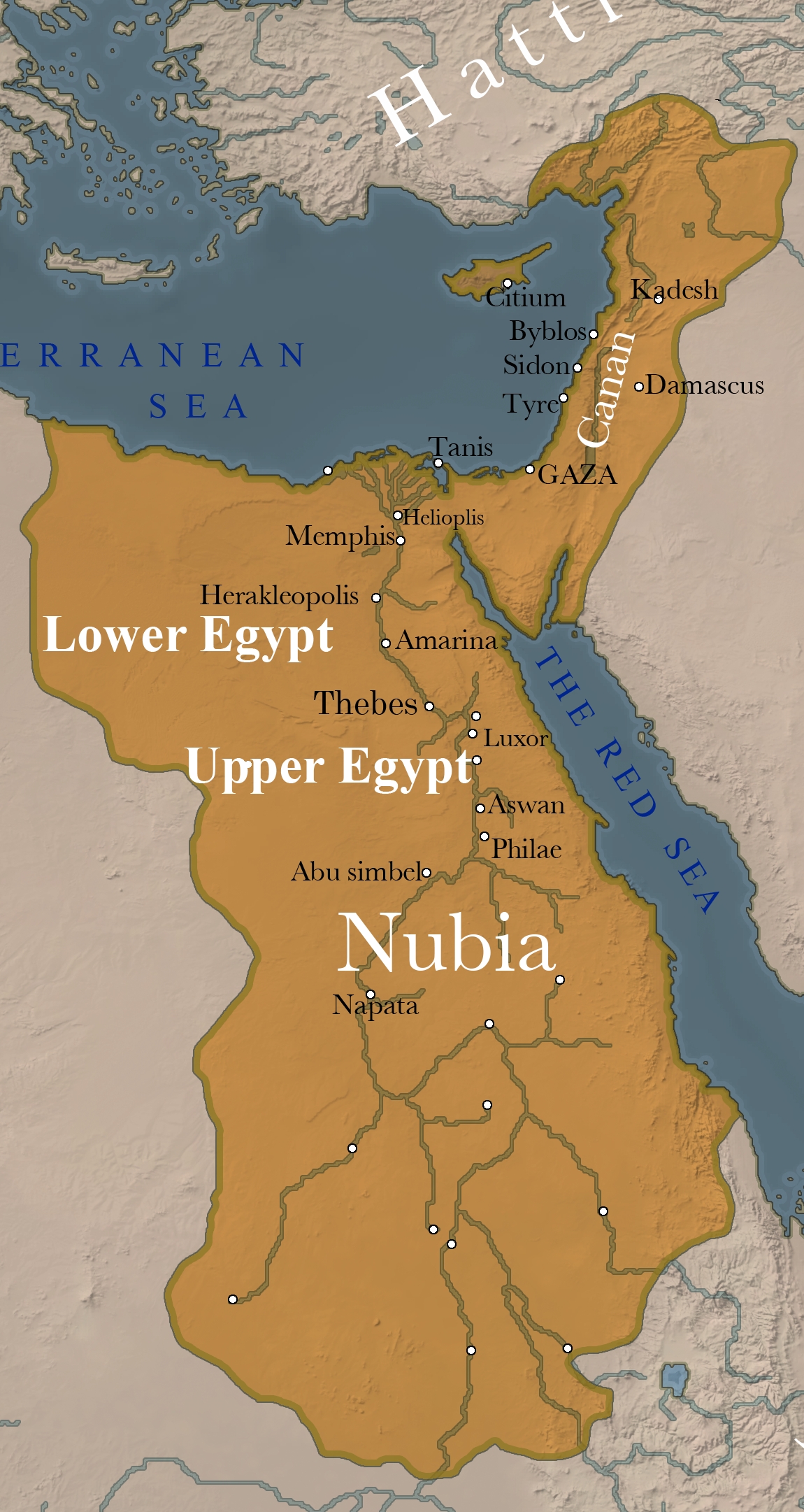
If we follow the traditional timeline, then Thutmose III was a powerful king who ruled most of the Middle East as far as the Euphrates River, from ‑1479‑1425. Specifically including the land of Canaan right at the time when Joshua was supposedly invading it. This is one of the main reasons historians reject the early parts of the Bible as fictional, because it conflicts with this particular fact.
Obviously, we have moved Thutmose III to around ‑1000, but there we run into very similar problem; he would overlap with Solomon, who claimed to have ruled this exact same area; and at the very least, he would overlap with the early kings period (‑1000‑900) and surely some mention of Egyptian armies marching back and forth for decades would have made an appearance in the Biblical narrative.
So no matter where we place him, Thutmose III is a problem; even if we move him around a hundred or more years in either direction, he simply cannot be squared with the Biblical narrative. This is one of the key conflicts between the Bible and traditional history, and it is not an easy one to solve.
But when you do, boy is it a great story. Because sometimes, the truth really is stranger than fiction.
THE PROBLEM
The Bible provides a reasonably continuous record from the entry to the Promised Land to the fall of Jerusalem a thousand years later, with a particular emphasis on pointing out failures in battle and captivity to foreign empires, since these served to underline the point that if you didn’t serve God, these things happen.
And there simply is no place in Egyptian history, even when adjusted the way we have done, for an all-powerful 18th Dynasty of Egypt to exist alongside Israel at any point from ‑1500 to ‑800. If that had happened, we would certainly know of it from the Bible.
From this, the vast majority of historians draw the conclusion that the Bible is nonsense and stop thinking. But when you look closely at the narrative, with a few minor exceptions, the conflicts with the Bible almost all stem from Thutmose III’s claims.
And those are rock solid, beyond all question… right?
He is regarded as one of the greatest warriors, military commanders, and military strategists of all time; as Egypt’s preeminent warrior pharaoh and conqueror; and as a dominant figure in the New Kingdom period.
Officially, Thutmose III ruled Egypt [for 54 years]. But for the first 22 years of his reign, he was coregent with his stepmother and aunt, Hatshepsut, who was named the pharaoh. He became sole ruler after Hatshepsut’s death… Thutmose III conducted between 17 and 20 military campaigns, all victorious, which brought ancient Egypt’s empire to its zenith. … He also created the ancient Egyptian navy, the first navy in the ancient world. Historian Richard A. Gabriel called him the “Napoleon of Egypt.” (Wiki, Thutmose III)
Now if you read the entire Wikipedia page, you will be given no reason to doubt these confident pronouncements. You have to dig deep into the scientific literature – or at least, read between the lines in the popular summaries – to be given any reason to doubt this narrative.
But there is a reason to question it.
The cases of Thutmose III and Ramesses II are particularly revealing. The estimates provided by Wente and Harris for the ages of the unequivocally identified mummies of these kings (40 and 55 years, respectively) are glaringly at odds with the well-documented long reigns of both rulers (53 and 66 years). “Something somewhere is badly wrong,” as Kitchen remarked. (Oxford)
When even Egyptologists admit “something somewhere is badly wrong,” we really do have a problem. And not a minor one; because how can a man whose body died at 40… rule for 54 years and be the Napoleon of Egypt??
Thutmose III invaded Palestine, warred with half the states in the Near East as far as the Euphrates over his 54 year career. Which means he must have been a man of at least 60 or 70 years of age… and yet his body died at 40?
Explain that to me.
Now I don’t want to use the word “cover-up,” but this is a serious problem, affecting one of the most significant pharaohs in Egyptian history, and no mention is made of it on the Wikipedia page.
What word would you use?
Despite almost a full page devoted to the discussion of his mummy, the problematic age of that mummy is not mentioned once, which naturally leads the public to believe it is settled science. But this is a direct conflict between physical evidence and the traditional narrative, one with very broad implications, and it is quietly swept under the rug in public.
Again, what word would you use?
Because if we accept that this mummy is, beyond argument, that of Thutmose III (which Egyptologists do); and further accept that this mummy was 40 years at death (which Egyptologists also do, although they have tried very hard to spin it as old as possible – as much as 50 years, perhaps!); then only one answer is left to us:
There were two Thutmose III’s. One of whom died at 40, and one of whom died at 70 or so after conquering most of the Middle East.
There literally is no other choice.
HOW IS THAT POSSIBLE?
Without getting too deep into a story which properly belongs 300 years later in the narrative, the answer is basically that after a period of brutal captivity to Assyria, a destitute Egypt was rescued by Egyptian priest-kings in the ‑600’s who robbed the fabulously wealthy tombs of their 18th Dynasty ancestors to finance their rebellion against foreign occupation.
Knowing this was sacrilege, they justified it by adopting the identities of the kings whose tombs they robbed, and went out to reconquer their land in the names of their royal predecessors to honor the sacrifice of their burial goods to the living.
This is not just speculation spun to make the Bible fit; there is substantial hard evidence for this, and it explains a lot of things that historians must dismiss about the later dynasties of Egypt. But that’s a big story and belongs in its proper place.
For now, you just need to know that it was this much later Thutmose IIIb who ruled for 54 years and conquered the entire Near East… in the time of Josiah, king of Judah – the latter half of the 7th century B.C. In fact, you know him as Pharaoh Necho (2 Chronicles 35:20-22).
But Thutmose IIIa, who was stepson and successor of Hatshepsut, died at 40 having accomplished little of import, but certainly not invading Palestine, which was at that time enjoying the peak of its golden age under Solomon!
Meaning almost everything on the Wikipedia page about Thutmose III belongs to the second of that name, the one who ruled in the 7th century, whom we title Thutmose IIIb. It remains to be seen what can be learned about Thutmose IIIa.
I must confess to being deeply indebted to the excellent work on this period by Jim Reilly of DisplacedDynasties.com, without whose work I very likely would never have tumbled to this amazing fact; and whose books present many persuasive arguments I won’t repeat here.
I will, however, add that the witness of Thutmose III’s mummy is not alone; Manetho also knows nothing of a 54 year rule by anyone during the 18th Dynasty; the successor to Hatshepsut is given a mere 13 years of rule, which is what we follow in our chart.
Anyone can see that Manetho’s reign is vastly more consistent with the physical evidence; 13 years for Thutmose IIIa, plus 22 years of co-rule with Hatshepsut, added to the fact that he was a child at the death of his father would certainly leave behind a 40-year old mummy.
When you just listen to the evidence, most problems evaporate.
THE RISE OF ISRAEL
This preface was necessary to establish the correct reign length for Thutmose III (‑1006‑993), meaning he fully overlapped with Solomon’s reign and was not a Napoleon-like figure, but a weak king who seems to have been contented to live in the shadow of his powerful mother.
This means there is no conflict with the Bible and the 18th Dynasty, since the Thutmose III who invaded Palestine would not do so for centuries, precisely when the Bible records Pharaoh Necho invading Palestine and killing Josiah.
After the death of Thutmose III in ‑993, two years before Solomon’s own death, Amenhotep II began to reign. By this point, God was quite peeved with Solomon and was stirring up various rebellions around the territory in preparation for the removal of half the kingdom from his son.
The most significant development in that regard was when God sent a prophet to tell one of Solomon’s chief generals, Jeroboam, that he would be the next king (1 Kings 11:23-39). Naturally, word of this found its way back to Solomon…
1 Kings 11:40 Solomon sought therefore to kill Jeroboam; but Jeroboam arose, and fled into Egypt, to Shishak king of Egypt, and was in Egypt until the death of Solomon.
Jeroboam remained there until the death of Solomon, then returned. Meanwhile Rehoboam, upon inheriting his father’s throne, was approached by the people to lower the apparently ruinous taxes Solomon imposed on them.
He considered the advice of his father’s advisers, who suggested he comply with the requests; then he considered the advice of his friends, whom he’d grown up with, who suggested a firm hand. Guess which he followed.
1 Kings 12:12-20 So Jeroboam and all the people came to Rehoboam the third day, as the king asked, saying, “Come to me again the third day.” The king answered the people roughly, and forsook the counsel of the old men which they had given him, and spoke to them according to the counsel of the young men, saying, “My father made your yoke heavy, but I will add to your yoke. My father chastised you with whips, but I will chastise you with scorpions.”
So the king didn’t listen to the people; for it was a thing brought about of Yahweh, that he might establish his word, which Yahweh spoke by Ahijah the Shilonite to Jeroboam the son of Nebat. When all Israel saw that the king didn’t listen to them, the people answered the king, saying, “What portion have we in David? Neither do we have an inheritance in the son of Jesse. To your tents, Israel! Now see to your own house, David.” So Israel departed to their tents.
But as for the children of Israel who lived in the cities of Judah, Rehoboam reigned over them. Then king Rehoboam sent Adoram, who was over the men subject to forced labour; and all Israel stoned him to death with stones. King Rehoboam made speed to get him up to his chariot, to flee to Jerusalem. So Israel rebelled against the house of David to this day.
It happened, when all Israel heard that Jeroboam was returned, that they sent and called him to the congregation, and made him king over all Israel: there was none who followed the house of David, but the tribe of Judah only.
This overstates it slightly; later the narrative clarifies that Benjamin also remained with Judah under David’s descendants, and since the Levites’ duties involved the temple, most of them came to Judah as well, giving him effectively three tribes and leaving ten with Jeroboam.
The northern ten tribes were thenceforth called Israel in the Bible, or sometimes later referred to as Samaria; foreign kings like the Assyrians seemed to call it after the ruling dynasty, as Shalmaneser III referred to it as the kingdom of “Jehu, son of Omri.”
The southern kingdom was called Judah in the Bible and by the Egyptians, occasionally as the Jews which is an abbreviation of Judah, and in Roman times it roughly corresponded to the province of Judea. But this was never called the nation of Israel after this point; that referred to the northern ten tribes.
Most Christians are unaware of this split and constantly confuse “Jews” with “Israel,” but they were two distinct nations for three centuries until the Israelites were taken captive by the Assyrians in ‑721.
At which point they disappeared from history – at least, they seemed to disappear. In fact precisely where the Israelites disappeared, ethnic groups known as Scythians, Cimmerians, and others appeared seemingly out of nowhere. These went on to form the ethnic basis of much of NW Europe, but that’s another very large story and doesn’t belong here.
SHISHAK, KING OF EGYPT
Shishak, to whom Jeroboam fled in the final years of Solomon, is the first named king of Egypt in the Bible. Within a few years he would return to sack the temple of Jerusalem in the 5th year of Rehoboam.
2 Chronicles 12:9 So Shishak king of Egypt came up against Jerusalem, and took away the treasures of the house of Yahweh, and the treasures of the king’s house. He took it all away. He also took away the shields of gold which Solomon had made.
Most scholars think this was Sheshonq I of the 22nd Dynasty, a much later king whose traditional dates sort of match Israelite dates, provided they lower the dates for Solomon’s kingdom by 61 years. Of course, this identification is a non-starter in our chronology for a variety of reasons.
However, Shishak is very close to the Hebrew word meaning “robber,” meaning that it may never have been meant to be a proper name. Ancient cultures frequently did not name their enemies, preferring to use a title; this is found in the Bible on several occasions (Cushan-rishathaim/twice-wicked Cushan, Nimrod/rebel, Satan/adversary, etc.).
Thus, we will take this as a title of a king whom the Jews hated for sacking their most holy site and whose name they did not deign to preserve, and not as a literal name of the king of Egypt, unless more evidence comes to light.
So Jeroboam fled to a king of Egypt who ruled before the death of Solomon, and yet who also invaded Jerusalem in Rehoboam’s 5th year. This would have to be Amenhotep II, who began his co-reign in Solomon’s 36th year, and his sole reign in his 38th.
This means that, circumstantially at least, we suspect Amenhotep II of being Shishak. It remains to prove it.
AMENHOTEP IN CANAAN
Amenhotep II is extremely confusing to Egyptologists, because his monuments are among the most contradictory. They do their best to reconcile what they can, and dismiss the rest as exaggeration; never realizing that the contradiction is simply because Amenhotep IIa had a completely different set of experiences than Amenhotep IIb, his 7th century copycat!
The Amada stela is dated in year 3 and the Syrian campaign is there described as the first campaign of victory. This expression has caused puzzlement to Scholars because the same words are applied to another great stela of year 7. (Egypt of the Pharaohs, Gardiner)
This is an understatement. There are two sets of monuments, each set containing a pair of monuments, that claim to describe Amenhotep II’s first campaign; explicitly his first. One, found in the far south of Egypt, says his first campaign was in his 3rd year; so far so good.
But the other, found in the north of Egypt, says his first campaign was in his 7th year, with a second one in his 9th year. Egyptologists postulate a co-reign with his predecessor, then assume that his first campaign didn’t really count, since it wasn’t done on his own.
Amenhotep’s first campaign took place in his third regnal year. It is known that the pharaoh was attacked by the host of Qatna while crossing the Orontes river, but he emerged victorious and acquired rich booty, among which even the equipment of a Mitanni charioteer is mentioned. … Amenhotep called this campaign his first in a Stele from Amada, however he also called his second campaign his first, causing some confusion. (Wiki Amenhotep II)
Really? That causes “some confusion?” It’s straight-up bonkers. Did they not teach counting in ancient Egypt? Historians are simply forced to draw this conclusion because they are locked into the assumption that there was only one Amenhotep II; a reasonable assumption, under normal circumstances; but not in the face of the blatant contradictions in the 18th Dynasty.
However, it’s quite easy to explain these monuments if you realize that someone stole Amenhotep II’s social security number and impersonated him 300 years after his death. Because the reason they have problems reconciling these monuments is that they were written by different kings.
The monuments in the south were carved by Amenhotep IIb, a Nubian pharaoh speaking of events in the 7th century B.C; thus, the monuments in Amada – Nubia – were naturally by the Nubian Pharaoh.
Amenhotep IIa on the other hand lived in the 10th century and did not invade Canaan until his 7th year, with a follow-up campaign in his 9th year. He was a Theban ruler, and so naturally enough the monuments at Karnak and Memphis were his.
Historians try very, very hard to unite the narrative of these two pharaohs separated by three centuries, and their attempts stretch the limits of credibility. One was a brutal warrior who brought slaves back to Egypt expressly to nail them to the walls of the cities in Egypt, another was a diplomat who was thrilled to accept a peace treaty with the Mesopotamian nations.
One spoke pleasantly and respectfully of the Syrians and Mesopotamians, and the other one described how much he despised them on his monuments. Historians have to accuse him of borderline bipolar disorder to explain the shift in tone between the monuments.
But knowing these were two different kings separated by three centuries, we have the opportunity to tell a great story here that no one else knows.
THE ANNALS OF SHISHAK
As noted above, the campaign in his 7th year was called his first campaign; since this was the monument found at Thebes, it was therefore the first campaign of Amenhotep IIa. But right away we find something else strange about the monument.
He presents a very long list of cities which were conquered, but every single one of them is in the northern part of Palestine, in the area around Syria and the Euphrates River called “naharin.” You may remember this word from the Hebrew Aram-naharim, meaning “Aram of the two rivers.”
So this, then, was Syria; why would he invade such a distant place, ignoring the powerful kingdom of Israel and Judah?
And why wait so long into his reign? Warlike kings tended to hit the ground running with invasions in their first year or two.
And why, after only two campaigns, would he make peace with these enemies?
And why was so excited about it?
After the campaign in Amenhotep’s ninth year, Mitanni sought to make peace with Egypt, and from then on, their armies never fought again. Amenhotep records that the kings of Babylon, the Hittites, and Mitanni came to make peace and pay tribute to him after his ninth year, although this may be outlandish boasting. However, a second passage appears on the walls of Karnak, saying that the princes of Mitanni came to seek peace with Amenhotep, and this cannot be so easily explained away. (Wiki, Amenhotep II)
Note their desire to “explain away” these nations making peace with Egypt, and dismiss Amenhotep’s claims as “outlandish boasting”; because it totally contradicts their narrative, because the understanding historians have of the relations Egypt had with these nations is based on 7th century stories by the brutal copycat kings!
Applying those relationships to what historians believe prevailed in the 14th century BC will, indeed, create conflicts. Hence their desire to call it “outlandish boasting” which needs “explained away.”
In fact, Amenhotep IIa – once you remove the 3rd year campaign and assign it to the proper king, IIb – was a peaceful king, not known for brutality or aggression. He ruled for 26 years, and even when invading Palestine no battles are mentioned.
In April of his seventh year, Amenhotep was faced with a major rebellion in Syria … and dispatched his army to the Levant to suppress it… His stele of victory carved after this campaign records no major battles, which has been read a number of ways. (Wiki, Amenhotep II)
Our chronology requires that Shishak is Amenhotep IIa; we have locked in these dates quite precisely, using the synchronisms of Hatshepsut’s visit, her reign length, and the date of Solomon’s marriage. We really can’t fiddle with any of it by more than a year.
So we are very encouraged to find that the first campaign in his 7th year, corresponding to the 3rd year of Rehoboam when the Egyptians still had peaceful relations with Israel and Judah, records no battles whatsoever even though he went overland through their territory.
In that campaign, no city that would have belonged to Jeroboam or Rehoboam was attacked; only cities to the north of Jeroboam’s Israel in Syria. Which is consistent with them being allies as they had been for fifty years or more.
But we are even more gratified to find that in the 9th year of Amenhotep IIa, which happens to also be the 5th year of Rehoboam in our chronology, Amenhotep II invaded southern Canaan! Precisely as Shishak did, in precisely the same year!
Amenhotep’s last campaign took place in his ninth year, however it apparently did not proceed farther north than the Sea of Galilee. According to the list of plunder from this campaign, Amenhotep claims to have taken 101,128 slaves. These numbers however are difficult to substantiate, leading some to question the accuracy of Amenhotep’s court scribes. Others have suggested that such exaggerated figures may instead be simply due to compounded accounting mistakes. Examples include a possible recount of the 15,070 prisoners taken in his year 7 campaign in Nukhash being combined with the figures from his year 9 campaign. (Wiki, Amenhotep II)
The second campaign took immense plunder from lands south of the sea of Galilee, capturing cities in the area which we know belonged to Rehoboam at that time in history; but he did not attack any of the lands belonging to Jeroboam of Israel.
Why? Because Jeroboam was his friend!
EGYPTIAN SUZERAINTY OVER PALESTINE
Remember that Jeroboam, fleeing the wrath of Solomon, went to Egypt for asylum, where he was warmly received by Shishak – Amenhotep IIa. Having spent several years in Egypt with Pharaoh, they were certainly allies – unlike the new king of Judah, Rehoboam, who to judge by 1 Kings 12 was arrogant and rude.
Presumably, this rash behavior would have extended to his allies as well, earning him no friends in Egypt. After Jeroboam left Egypt and was declared king of the northern ten tribes, Rehoboam tried to attack him with an enormous army, but God forbade it (1 Kings 12:21-24). So he retreated, but despite this particular battle being forbidden, there was some level of war between them for their whole lives:
1 Kings 14:30 There was war between Rehoboam and Jeroboam continually.
But Jeroboam had other problems besides Judah; even while Solomon was still alive, Rezon king of Syria made his life miserable (1 Kings 11:23-25). If Solomon failed to subdue him, then with far fewer resources, and a hostile Judean kingdom to his south, Jeroboam couldn’t possibly have conquered Syria to the north. So what would he do? Appeal to his friend in Egypt.
So it cannot be an accident that the area that Shishak invaded coincides precisely with the area north of the border of Israel ruled by Syria at that time – translated from Aram in the Bible, as in Aram-naharaim, as in Naharin, the land invaded by Amenhotep II!
This invasion happened in the 7th year of Amenhotep IIa, which corresponded to the 3rd years of both Rehoboam and Jeroboam. Since no battles were fought, pharaoh was evidently granted safe passage through both of their lands – proving that the treaties of Solomon with Egypt were still being honored by Rehoboam.
2 Chronicles 11:17 So they strengthened the kingdom of Judah, and made Rehoboam the son of Solomon strong, three years; for they walked three years in the way of David and Solomon.
Something happened in the 4th year, something big; it’s not mentioned in the Bible as far as I can see, but something really angered God.
1 Kings 14:22-24 Now Judah did evil in the sight of the LORD, and they provoked Him to jealousy with their sins which they committed, more than all that their fathers had done. For they also built for themselves high places, sacred pillars, and wooden images on every high hill and under every green tree. And there were also perverted persons in the land. They did according to all the abominations of the nations which the LORD had cast out before the children of Israel.
Israel serving idols was hardly news; for God to react so strongly in a single year argues that they must have done something extreme. Regardless, after this Shishak was sent against Jerusalem. At least, that’s God’s version – and spiritually, that’s true.
But let’s think practically, from the Egyptian point of view: why would Shishak invade Israel?
A mere two years earlier, he had passed through unharmed to help Jeroboam. Why would they now be attacking their erstwhile ally Judah? For the exact same reason as Amenhotep’s first campaign; to help Jeroboam against his enemies.
Because something strange happened in this 9th year campaign of Amenhotep II – it started in November. Winter in the Holy Land is miserable; cold, wet, rainy (Song of Solomon 2:11, Jeremiah 36:22, Matthew 24:20, etc.).
Kings went to war in the springtime; good weather, plentiful food, less mud to wade through (2 Samuel 11:1). This means there must have been a powerful and urgent reason for Pharaoh to invade Judah in winter.
In context, what could that be? We know that Judah warred with Israel all the days of Jeroboam; we know that Rehoboam desperately wanted to reconquer it, and that he had raised a 180,000 man army he was not allowed to use, then set about fortifying his cities (1 Chronicles 11). And then…
2 Chronicles 12:1-2 It happened, when the kingdom of Rehoboam was established, and he was strong, that he forsook the law of Yahweh, and all Israel with him. It happened in the fifth year of king Rehoboam, that Shishak king of Egypt came up against Jerusalem, because they had trespassed against Yahweh.
Note that there are two reasons here; a general sin “forsook the Law of Yahweh” (i.e., had idols or some such) and also a specific one “trespassed against Yahweh”; a trespass means someone did something very specific they were not supposed to do; the narrative requires it to be something bigger than a mere idol.
And the historic context makes it probable that Rehoboam decided to try again to invade Israel, prompting Jeroboam to send a desperate cry for help to his Egyptian friend Amenhotep II! Only this can explain the November departure from Egypt – an urgent attempt to overtake the armies of Judah as they marched towards Israel. Something God had specifically forbidden them to do!
Verse 4 He [Shishak] took the fortified cities which pertained to Judah, and came to Jerusalem.
These cities had literally just been immensely fortified, as described in the Bible. How could they be taken so easily? A fortified city, stocked and prepared as Rehoboam prepared these, can withstand a siege for years.
Yet Pharaoh took dozens of them in less than a year. Why? Because the Judean army was caught off-guard, off on an offensive action against Jeroboam. And probably not expecting Pharaoh to attack, particularly at that time of year.
Verses 5-6 …Thus says Yahweh, “You have forsaken me, therefore have I also left you in the hand of Shishak.” Then the princes of Israel and the king humbled themselves; and they said, “Yahweh is righteous.”
Why would they say this? Not for idols, which Israel never really seemed to understand and which were not removed after this; but because they realized they had violated God’s explicit command not to invade Jeroboam’s Israel.
Verses 7-8 When Yahweh saw that they humbled themselves, the word of Yahweh came to Shemaiah, saying, “They have humbled themselves. I will not destroy them; but I will grant them some deliverance, and my wrath shall not be poured out on Jerusalem by the hand of Shishak. Nevertheless they shall be his servants, that they may know my service, and the service of the kingdoms of the countries.”
So Rehoboam king of Judah became a vassal of Egypt. And because they accepted God’s judgment and surrendered to Pharaoh, he did not burn the city as he otherwise would have done – but he did plunder it.
Verse 9So Shishak king of Egypt came up against Jerusalem, and took away the treasures of the house of Yahweh, and the treasures of the king’s house. He took it all away. He also took away the shields of gold which Solomon had made.
We’ll revisit the wealth of Solomon being transferred to Egypt in the next chapter. Suffice it to say… it changed the world.
PEACE WITH ASIA
Let’s revisit the victory stela of Amenhotep II one more time…
The inscription singles out Syria, stating: ‘The chiefs (weru) of Mitanni (My-tri) come to him, their deliveries upon their backs, to request offering gifts (hetepu) from his majesty in quest of the breath of life.’ By the close of Amenhotep II’s reign the portrayal of Mitanni, so recently the vile enemy of the king, was brought into line with that of Egypt’s other close allies. In monuments within the Nile Valley, these brother kings of Babylon, Hatti, and Nahrin were always portrayed as suppliants who requested life from the Egyptian king. The hard-won peace with Syria is betrayed, however, by Amenhotep II’s enthusiasm for it. (Oxford)
“Monuments within the Nile Valley” are those made by Amenhotep IIa in the north; the quote contrasts these with the ones in Nubia made by Amenhotep IIb which show a much more hostile relationship with these tribes, calling them “the vile enemy of the king.”
This schizophrenia seriously confuses historians, because it shows an about face from a fierce and passionate war against Syria to gleefully settling for peace against his bitter enemies. But the peace in Syria wasn’t hard-won at all if we exclude the monuments in Nubia which talk about the other “first” campaign from the 7th century.
In the campaigns of Amenhotep IIa, no major battles are reported in the 7th year. It looks like an overwhelming Egyptian force caused the surrender of basically every city in Syria that they marched to, according to the Karnak stela.
Which is what we’d expect from the rebel Syrian chieftain Rezon when faced with the Egyptian “armies without number.” Because he wasn’t a world-class king, his main accomplishment up to that point had been harassing Solomon and Jeroboam.
Apart from the standard toponyms in ‘name rings,’ none of the monumental texts of Amenhotep II contains a hostile reference to Mitanni or Nahrin (despite the fact that the inscriptions narrated his Syrian campaigns) – and this is probably intentional. Instead of Thutmose III[b]’s designation, ‘that foe of Nahrin,’ Amenhotep II several times uses the archaic Egyptian generic term setjetyu (‘Asiatics’). (Oxford)
I’ve added [b] after Thutmose III to clarify which king they are referencing here; and yes, Asiatics was an archaic term compared to the usual usage of the 7th century copycat dynasty, yes. But quite consistent with the usage by the real 18th Dynasty kings, who had only just chased out the Hyksos after 400 years and still called anyone to the east “Asiatics.”
The language of the stelae, composed after the conflicts had ended, in year 9 or later, reflects the fact that peace with Mitanni was at hand. Indeed, the Memphis stele contains an addition at the end, reporting that the chiefs of Nahrin, Hatti, and Sangar (Babylon) arrived before the king bearing gifts and requesting offering gifts (hetepu) in exchange, as well as asking for the breath of life. This was certainly the first official announcement of the creation of a Mitanni peace, although good relations with Babylon and others already existed in the reign of Thutmose III[b]. (Oxford)
Scholars are confused about why these kings would want peace (since Babylon wasn’t involved in this battle at all and was far away) and about why they would only sue for peace now; and further, why Amenhotep II would be so happy about it.
For us, the answer is easy: Solomon’s house no longer ruled in Palestine except as vassals of Egypt. Solomon had made alliances with all of these countries (1 Kings 10:23-25) who brought him tribute. But now Rehoboam was a vassal of Egypt, which means they needed to make a new treaty with the new Egyptian overlord!
Thus was Amenhotep IIa catapulted from a king of Egypt in the shadow of Solomon to the most powerful king on Earth in the space of less than a year after conquering Jerusalem, which was a meteoric rise to power. So OF COURSE he was thrilled by these nations bowing and scraping to him!
Especially since he had hardly lifted a finger to do so!
DAMNATIO MEMORIA
After her death for some unknown reason Hatshepsut’s name was systematically erased from the record to the point that she was almost unknown until she was rediscovered in the 19th century. But this campaign to destroy her memory didn’t happen promptly upon her death, Egyptologists say it was done late in the reign of her successor, or even in the reign of his successor – Amenhotep II.
“Equally obscure are the reasons for the damnatio memoriae inflicted upon her by her former co-regent some twenty years after the period of joint rule.” This was surely too long a time for Hatshepsut’s youthful co-regent to have waited, if simmering resentment were his motivation, before embarking upon the task of defacing her monuments and destroying her images. (Hatchepsut: The Female Pharaoh, Tyldesley)
The history books will generally tell you that Thutmose III, motivated either by sexism or out of anger for being forced to be subservient to her for so long, tried to erase her memory. But though that statement is often repeated, the most current research says that Thutmose III was not the architect of the destruction.
The destruction of Hatshepsut’s images began during the co-regency of Amenhotep [II] when his father was very old, but stopped during his reign. (Wiki, Amenhotep II)
By the time the monuments of Hatshepsut were damaged, at least 25 years after her death, the elderly Thutmose III was in a coregency with his son Amenhotep II. (Wiki, Thutmose III)
According to historians it was not Thutmose IIIa, but his successor Amenhotep IIa who defaced the statutes of Hatshepsut. But it could not have been 25 years into Thutmose IIIa’s sole reign, since he did not have a sole reign of that length.
This leads us strongly to suspect that Amenhotep II was not only the prime motivator, but the sole culprit for Hatshepsut’s erasure from existence. The usual arguments about Thutmose’s possible motivations wouldn’t hold water for Amenhotep. So why wipe her from existence?
There hangs the tale.
As promised in the last chapter, we are finally ready to explain Amenhotep III’s statement that Egyptian princesses were never given to foreigners, when we know for a fact that both Hadad and Solomon had Egyptian royal wives.
And as it happens, we get a two-for-one deal, because the same answer also explains the attempt to erase Hatshepsut from history by her son and/or grandson.
At the Deir el-Bahari temple, Hatshepsut’s many statues were torn down and in many cases, smashed or disfigured before being buried in a pit. At Karnak, an attempt was made to wall up her monuments. While it is clear that much of this rewriting of Hatshepsut’s history occurred only during the close of Thutmose III’s reign, it is not clear why it happened… Amenhotep II, the son of Thutmose III, who became a co-regent toward the end of his father’s reign, is suspected by some as being the defacer during the end of the reign of a very old pharaoh. He would have had a motive because his position in the royal lineage was not so strong as to assure his elevation to pharaoh. He is documented, further, as having usurped many of Hatshepsut’s accomplishments during his own reign. (Wiki, Hatshepsut)
Remember, Hatshepsut had been ruling jointly with Thutmose III for her entire reign. Given his public presence on her monuments, he seems to have respected and agreed with her polices, and no attempt to erase her happened until the very end of his reign, after the beginning of his son’s reign.
Ironically, evidence of Hatshepsut’s building effort is today invisible, since the face of the pylon was erased and redecorated in the first years of Amenhotep II …, son of Thutmose III. (Oxford)
But after Thutmose IIIa’s death, all of the monuments for Hatshepsut were systematically erased, and the Egyptians tried very hard to forget about her. Why? Apparently the successor to Thutmose IIIa had a reason to want her to vanish. What would that be?
Now, finally, we are prepared to explain why Amenhotep II felt a need to erase her from the record. She had made treaties with the Syrians – the Egyptian word for anyone in Canaan as far as actual Syria.
Her sister was married to Hadad of Syria and her daughter was married to Solomon of Israel. It’s possible that Jeroboam himself acquired an Egyptian bride as well during his time there. And these things were a threat to Amenhotep’s succession.
Currently, the purposeful destruction of the memory of Hatshepsut is seen as an attempt to ensure a smooth succession for Amenhotep II, as opposed to any of the surviving relatives of Hatshepsut with an equal or better claim to the throne. Amenhotep II would have had a motive because his position in the royal lineage was not so strong as to assure his elevation to pharaoh. Later, Amenhotep II even claimed that he had built the structures he defaced. (Wiki, Thutmose III)
If Neferure had any son with Solomon, which is not mentioned but likely, then they would become threats to Amenhotep’s succession. So would children of Hadad and possibly even the sons of Jeroboam.
How could Amenhotep ensure his succession went unchallenged, when Egyptian blood flowed through Canaanite royal veins? One answer cost nothing: wipe the females of the early 18th Dynasty from the historical record and deny their very existence.
The so-called dishonouring of Hatshepsut, which had begun around year 46 or 47, may have paved the way for the joint rule, for Amenhotep II himself completed the desecration of the female king’s monuments. In order to eliminate the claims of Hatshepsut, and her family line, her monuments were systematically adjusted: some were obscured by new work; some were mutilated to remove any evidence of her name; and many were altered such that the names of Thutmose III or Thutmose II replaced those of Hatshepsut. (Oxford)
The erasure of Hatshepsut’s name – by the men who succeeded her for whatever reason – almost caused her to disappear from Egypt’s archaeological and written records…. (Wiki, Hatshepsut)
Note that it was to eliminate the claims of Hatshepsut “and her family line.” But it is known that she had no sons. She did, however, have a daughter married to Solomon, and a sister married to Hadad.
And this fact was inconvenient to a prince “whose position in the royal lineage was not so strong as to assure his elevation to pharaoh. So he denied it.
…Moreover, you my brother when I wrote to you about marrying your daughter in accordance with your practice of not giving a daughter, wrote to me saying, ‘From time immemorial no daughter of the King of Egypt is ever given to anyone.’ Why not. You are king you do as you please. Were you to give a daughter who would say anything. (Amarna letter EA4)
This cannot possibly have been true; Solomon’s wife, we are certain, was Egyptian royalty. So why would Amenhotep III have lied? Because if Hatshepsut had not been a legitimate queen, then her sister and daughter were not royalty.
And then Amenhotep III could truly say no daughter of a king of Pharaoh of Egypt had ever been given to a foreign king; for the daughter of an illegitimate queen is not, herself, a princess!
Thus the erasure of these women was not because of Thutmose III’s resentment, nor for misogynistic reasons, but rather for quite practical ones.
Amenhotep II sought to erase any record that Egyptians had ever been allied with the kings of Canaan, and thereby to deny that the progeny of Neferubity and Neferure would have the slightest claim on the throne of Egypt.
Mystery solved.
He, according to Manetho, ruled for 13 years until ‑993 – which was the 38th year of Solomon.
Because to understand Hatshepsut, you need to know when she lived, and what she did – and you need to hear it from someone who wasn’t trying to protect the Egyptian royal image, from somewhere that the later Egyptian Pharaohs couldn’t rewrite the history. That, of course, means the Bible.
SO WHERE DOES THAT LEAVE US?
The histories of any of the kings of the 18th Dynasty whose names were later reused by the 21st Dynasty have to be carefully untangled from each other – a monumental job, no pun intended, which cannot ever be done with certainty.
Because how can you tell the difference between a Thutmose III who “in his 23rd year, invaded Palestine” and a Thutmose III who didn’t? You would have to find conflicts between different monuments they wrote, or things that they did which contradict physical evidence like their mummy.
You could also compare the record to that of surrounding nations like Israel, but since Egyptologists universally base the histories of other nations on Egypt, not the other way around, that is impossible… for them.
We of course, have the Bible to shine a light on Egyptian history. But this light indicates that everything that Egyptologists “know” about the 18th Dynasty is suspect; this is why Thutmose IIIb and his 54 year reign contradicts the mummy of Thutmose IIIa, who died at 40.
Hence Kitchen’s statement that “something somewhere is badly wrong” in the 18th Dynasty. Because this is not an isolated incident; there are other things like this in the 18th Dynasty that scholars struggle mightily to explain.

This is part 36 of The History of the World Series
 Solomon and the Queen of Sheba
  Judges to Kings
  Joshua and Jericho
  Hyksos and the Amalekites
  What Is The LOVE Of God?
  Everything You Believe About God Is WRONG!
  Make Up Your Mind!
  What Is Faith?
  How DARE you FEAR the judgment of God!
  Firstripe Figs
  The Bride Of The Father
  Exodus 40 – The Plan Of God
  The Temple Of God
  Pillars Of The Temple And The Brass Sea
  GEHENNA WITH ‘EM
  When Did God Forbid Polygamy?
  When You Shouldn’t Pray For Someone
  The Sins of the Father
  The First Paul