Joshua and Jericho
This is part 33 of the The History of the World Series
; The History of the World is part 1.
Click here to read in series
Having determined the historical context surrounding Israel from ‑1500 to ‑1000, we are now finally ready to tell the story of the same period from a Biblical perspective.
We left Moses at Mt. Sinai, so we pick up the story there. As you probably know, they wandered forty years in the desert before finally entering Israel, but you may be surprised to learn that Israel isn’t that far from Sinai.
In fact, they reached there within the first two years, even though they dallied for almost a year around Sinai. They then spent the next year approaching the border of Canaan, spending spies, and they could have entered right then if they had trusted God.
However, because of their lack of faith, they were cursed to wander in the wilderness until 40 years had passed from the Exodus. But “wandering” is a bit overstated, as they arrived in Kadesh-Barnea the first day of the third year, where they would remain for 38 years.
They basically killed time there until everyone who was over 20 at the spying of the land – the Biblical age of adulthood – had died off for their lack of faith in God’s power. It must have been boring, since nothing whatsoever is recorded of this period from year 3 until year 38 in the book of Numbers.
Incidentally, although it is depicted in nearly all Bible maps much farther to the west, Steven Rudd’s work on Bible.ca has convinced me that Kadesh-Barnea actually was located near Petra in modern Jordan. I refer you to his site for his reasons.
After that, Moses and the Israelites began to move again, and conquered the Amorites on the east side of Jordan; they asked for a peaceful passage, but the Amorites refused, and so they warred, and Israel wiped them out utterly (Deuteronomy 2). The news of this spread:
Deuteronomy 2:25 This day will I begin to put the dread of you and the fear of you on the peoples who are under the whole sky, who shall hear the report of you, and shall tremble, and be in anguish because of you.
And it spread into the Promised Land as well, for when the spies visited Jericho, Rahab the harlot said…
Joshua 2:9-10 and she said to the men, “I know that Yahweh has given you the land, and that the fear of you has fallen on us, and that all the inhabitants of the land melt away before you. For we have heard how Yahweh dried up the water of the Red Sea before you, when you came out of Egypt; and what you did to the two kings of the Amorites, who were beyond the Jordan, to Sihon and to Og, whom you utterly destroyed.”
So I want you to consider this from the Amorites’ point of view; the Israelite juggernaut is pointed in your direction. You believe that God is with them, and that you are doomed. What do you do? You “melt away” before them – i.e., run like your life depended on it in the opposite direction.
Not everyone, of course, would leave their home. But this verse specifically says that a large portion of the inhabitants of the land, Amorites, fled from the incoming Israelites. But where were they to go? Not to Egypt, wrecked by the plagues and under new Hyksos ownership. Not east, which is deadly desert.
So they would go north; and having gone north, turn east and follow the river down, looking for new opportunities. As you have seen, at this point the population of Sumer was rapidly shifting towards Amorite; the first Amorite kingdom had just been started by Sumu-abum, ancestor of Hammurabi, in ‑1486, and Shamsi-adad’s Amorite kingdom would start in ‑1401.
The Amorite migrations forced by Joshua’s invasion would help explain why it was only at this time that the Amorites successfully conquered Mesopotamia. The refugees from Canaan would have gone a long ways towards swelling the loyal population base of Amorite Mesopotamia.
This would also provide a likely conduit whereby Amorites could have carried information like the law of Moses from Canaan to Mesopotamia. We know for a fact that these inhabitants of Canaan were in contact with the Babylonian Amorites…
Joshua 7:21 When I saw among the spoil a beautiful Babylonian robe, two hundred shekels of silver, and a wedge of gold weighing fifty shekels, then I coveted them and took them. Behold, they are hidden in the ground in the middle of my tent, with the silver under it.”
This event dates immediately after the entry to the Promised Land, so to ‑1467. The presence of a Babylonish garment indicates relatively recent trade with Sumer; and at that time, it was ruled by Hammurabi’s ancestors, Amorites.
ANTIRACISM
After the 40 years was finished and all the elders had died, God commanded them to go ahead and invade Canaan. Moses, because of his frustration in striking the rock, was not permitted to enter the land, but God allowed him to see it (Deuteronomy 32:48-52).
We pick up the story in Joshua 1, after the Israelites mourned Moses 30 days. Aaron had already died, leaving Joshua to lead Israel and Eleazar as high priest; Caleb seems to have been head prophet at this point.
Israel had already conquered a large amount of territory on the eastern side of the Jordan from the Amorites, which would later become part of the territory of Israel proper. This territory was claimed by Reuben, Gad, and half of the tribe of Manasseh, who asked to be allowed to leave their families and herds there, while their warriors would go on into the land with their brethren to fight as needed (Joshua 1:12-18).
Joshua sent some men to spy out the land, and Rahab the harlot protected the spies – she believed God was with the Israelites and her people were doomed anyway, so she played it smart and saved her house (Joshua 2:8-16).
Incidentally, she found her way into the lineage of Jesus (Matthew 1:5), marrying into the tribe of Judah and becoming great-grandmother to David. Proving that God is not racist – since she was descended from Ham, through Canaan, and yet Jesus was not ashamed to carry her blood.
It also proves that Jesus was not averse to being descended from prostitutes either. Interestingly, the next generation of the lineage was also a non-Israelite, Ruth who was from Moab – descended from Lot (see the Book of Ruth for that story, which is fun but not part of our history here).
This means that – genetically – Jesse, father of David, was only 25% Israelite, being 25% Canaanite and 50% Moabite. Presumably David’s mother was Israelite, which would bring his genetic makeup back up to 62.5% Israelite.
David’s son Solomon would go on to have his heir Rehoboam by an Ammonite woman, further diluting the Judean blood. Since these people were direct ancestors of Jesus, it proves that God was less concerned with a “pure” bloodline of Israelites, and more concerned with the kind of people they were; specifically, the faith Rahab and Ruth demonstrated in His abilities.
THE GENOCIDE
Which brings us to one of the reasons that reasoning people consider the Old Testament God to be a monster. Namely, His command to utterly wipe out every last person, even every ox, of the Canaanites; and if you’re not revolted by that, there is something seriously wrong with you.
Deuteronomy 7:16 But of the cities of these peoples, that Yahweh your God gives you for an inheritance, you shall save alive nothing that breathes; but you shall utterly destroy them… that they not teach you to do after all their abominations, which they have done to their gods; so would you sin against Yahweh your God.
As mentioned above, this is not an ethnic problem, not about race. Because God had no problem with Rahab and Ruth being part of the ancestry of Christ. Indeed, God provided a path for legal immigration involving circumcision and three generations (Deuteronomy 23:8).
God’s open-mindedness about race as such is witnessed not only by Moses’ black Ethiopian wife, but also by the “mixed multitude” of Egyptians that left Egypt in the Exodus, who from then on seem to have been treated like everyone else.
So it’s clear that God’s concern is that “they not teach you to do after all their abominations, which they have done to their gods.” This is repeated dozens of times, making it clear this was God’s motivation, not ethnicity.
Nevertheless, the punishment of wiping out utterly a people – for whatever reason – is unconscionably harsh. It’s literally a war crime. The fact that a Being called “God” does it, does not make it OK just because He says so.
Therefore, the only possible justification, the only way God is not a monster who does not deserve your worship, would be if the alternative was even worse. That not wiping them out would allow an evil to continue far worse than genocide.
And so to see this from God’s point of view, we have to see what He saw; and for that, we need to learn about the religion of the Canaanites at that time. God tells us more about these “abominations” He saw them do:
Deuteronomy 12:31 You shall not do so to Yahweh your God: for every abomination to Yahweh, which he hates, have they done to their gods; for even their sons and their daughters do they burn in the fire to their gods.
These were not innocent pacifists who were invaded out of nowhere. These were people who, in the service of their own gods, burned their own children alive in the most gruesome fashion imaginable. This has been confirmed archaeologically, so it was not mere propaganda.
It is considered virtually impossible to reconstruct a clear picture of Canaanite religious practices, but child sacrifice by the Canaanites was known to surrounding peoples. According to K.L. Noll, under the duress of military crisis, human sacrifice was offered to the divine patron of a besieged city, as well as the sacrifice of prisoners of war to the victorious god. (Wiki, Canaanite religion)
And not only in situations like this – they considered it good luck to kill their children and bury them under the foundations of the city, so their spirit would protect the city. When Jericho was destroyed, Joshua cursed the person who rebuilt it, saying he would bury his firstborn under the city gates (Joshua 6:26); 500 years later…
1 Kings 16:34 In his days Hiel the Bethelite built Jericho: he laid its foundation with the loss of Abiram his firstborn, and set up its gates with the loss of his youngest son Segub, according to the word of Yahweh, which he spoke by Joshua the son of Nun.
This was a conscious, deliberate sacrifice of their children – usually by fire, in the most painful way possible – in order to bring good luck to the city. It was not an act of desperation in a moment of crisis, but a cold, calculated choice to bring better fortune to the people.
And God was the monster to wipe them out, in the hopes of wiping such practices off the face of the Earth?
They did a lot of other awful stuff too, but this is enough to make my point; these were not good people with slightly different religious beliefs. These were monsters themselves; not because of their inherent nature or race, but because of their religion.
And killing a belief system, however blatantly evil, is almost impossible; hence why we still have neo-Nazis today. Like a virus, the only way to contain it is through complete isolation – the wilderness of Sinai, or by exterminating all carriers – the invasion of Canaan.
ONE RIGHTEOUS JUDGE
No human being should ever take such responsibility to judge humans as worthy of death, however awful their religion appears. Such responsibility lies with God alone. Not you, certainly not me, no head of any religion should set out to kill any person, or group of people.
And no, the wars of Joshua are not a contradiction to that; for God did not, initially, ask the Israelites to do it. God judged that the world would be a better place without the Canaanites; something that He, as their Creator, is solely qualified to do. As for the Israelites, they were just supposed to stand back and watch:
Exodus 23:27-28 I will send my terror before you, and will confuse all the people to whom you come, and I will make all your enemies turn their backs to you. I will send the hornet before you, which will drive out the Hivite, the Canaanite, and the Hittite, from before you.
God’s initial plan, announced at Sinai, was to use natural forces like bees, hailstones, and so on to drive the Canaanites out of the Promised Land. The “genocide,” if any, would have been God’s sole responsibility. But the Israelites lacked faith, and insisted on being involved in their own deliverance. But that wasn’t the original plan:
Exodus 23:20-24 “Behold, I send an angel before you, to keep you by the way, and to bring you into the place which I have prepared…. if you indeed listen to his voice, and do all that I speak, then I will be an enemy to your enemies, and an adversary to your adversaries. For my angel shall go before you, and bring you in to the Amorite, the Hittite, the Perizzite, the Canaanite, the Hivite, and the Jebusite; and I will cut them off.”
Remember, Israel did not fight against Pharaoh; not one finger was raised by humankind against the armies of Egypt, or any single Egyptian in the Exodus. Because God is capable of taking care of an army by Himself.
He showed Himself willing to do this in various miraculous ways throughout the kingdom period; causing the enemy to kill each other, causing a plague to kill them, or just causing them to have a panic attack and run away.
Exodus 14:13 Moses said to the people, “Don’t be afraid. Stand still, and see the salvation of Yahweh, which he will work for you today: for the Egyptians whom you have seen today, you shall never see them again.”
2 Chronicles 20:17 “You will not need to fight this battle. Set yourselves, stand still, and see the salvation of Yahweh with you, O Judah and Jerusalem. Don’t be afraid, nor be dismayed. Go out against them tomorrow, for Yahweh is with you.”
These examples are the exception in the Bible, but not because God preferred to let Israel get their hands dirty, but because the people lacked faith, and insisted on fighting their own battles. So God allowed them to get their hands dirty, provided they did it His way.
But that was not the ideal; the ideal was, and to this day is, to “stand still, and see the salvation of the Lord.”
So in sum; the “genocide” of Canaan was actually meant to exterminate a religion, not a people. And if ever there were a religion that deserved to be forgotten, it was a religion where your children’s deaths are good luck charms for your town, meant to bribe your gods into blessing or saving you.
And the Israelite participation in this war of extinction was not God’s idea, but theirs; God tolerated it, like divorce and so many other things He hated, because of their lack of faith in His abilities and in His willingness to do the job which belonged uniquely to Him.
THE PARTING OF THE JORDAN
The entry to the Promised Land was accompanied by a miracle not much less impressive than the Red Sea parting, but far less well known. God told Joshua to send the Ark ahead of them, and the priests carried it down into the Jordan River…
Joshua 3:14-17 …when those who bore the ark had come to the Jordan, and the feet of the priests who bore the ark had dipped in the edge of the water (for the Jordan overflows all its banks all the time of harvest),that the waters which came down from above stood, and rose up in one heap, a great way off, at Adam, the city that is beside Zarethan; and those that went down toward the sea of the Arabah, even the Salt Sea, were wholly cut off.
Then the people passed over right against Jericho. The priests who bore the ark of the covenant of Yahweh stood firm on dry ground in the middle of the Jordan; and all Israel passed over on dry ground, until all the nation had passed completely over the Jordan.
The exact mechanism for this is not clear; but parting a raging river during the flood season is no small feat. In the Red Sea, God used a strong wind to blow a tide back, exposing a sandbar; but that wouldn’t have worked here. But we can explain this without resorting to magic…
The Jordan was apparently blocked at Adam, modern Damiya, some 18 miles upstream from the fords opposite Jericho. How could this happen? Historians and Bible scholars have focused on the “miraculous” nature of the event, with little regard for the seismology of the southern Jordan Valley. In fact, the blocking of the Jordan has happened a number of times in recent recorded history. Jericho is located in the Rift Valley, an unstable region where earthquakes are frequent. Geophysicist Amos Nur of Stanford University has studied the well-documented earthquakes of this area in an effort to find ways to predict them. He has noted several earthquakes that caused phenomena quite similar to what is described in the Book of Joshua:
Today Adam is Damiya, the site of the 1927 mud slides that cut off the flow of the Jordan. Such cutoffs, typically lasting one to two days, have also been recorded in A.D. 1906, 1834, 1546, 1267, and 1160.
The 1267 C.E. mudslide was recorded by the Arab historian Nowairi. He writes that a large mound on the west side of the Jordan at Damiya fell into the river damming it up. No water flowed south from Damiya for 16 hours. In the 1927 quake, a section of a cliff 150 feet high collapsed into the Jordan near the ford at Damiya, blocking the river for some 21 hours.
So the stoppage of the Jordan’s flow as described in the Bible is not so far-fetched as it might at first seem (Did the Israelites Conquer Jericho…, Wood;)
As always, the miracle was in the convenient timing, not in an event beyond human experience. And it provides an interesting symmetry, for they left Egypt and entered Canaan almost exactly 40 years apart, both of which events were accompanied by a miraculous parting of water.
And if one was inclined to symbolism, it could be observed that forty is precisely the separation (in weeks) between the fertilization of a human egg with “living water” and the birth of that child following the mother’s “water breaking.” Do with that what you will.
THESE STONES
While the waters were stopped, God told Joshua to have one man of each tribe in Israel, twelve in total, each pick up a large stone from the bottom of the river and carry it out of the river, and to use them to make a monument to this crossing for all time (Joshua 4:5-9).
This is interesting because these stones were referred to much later, by John the Baptist, although almost no one realizes it. This was the place where the Hebrews crossed the river Jordan, and was thereafter known as Bethabara, the “house of the [river] crossing.”
In a speech to the hypocritical Pharisees, John the Baptist gave a scathing speech telling them not to bother getting baptized without changing their actions and attitude first; and attacking their smug security as God’s chosen people, saying…
Luke 3:8 Bring forth therefore fruits worthy of repentance, and begin not to say within yourselves, We have Abraham to our father: for I say unto you, That God is able of these stones to raise up children unto Abraham.
Everyone has always assumed “these stones” is an arbitrary reference to random stones. But John 1:28, speaking of the same events, said “These things were done in Bethabara beyond Jordan, where John was baptizing.”
Which means John was standing within sight of the stone monument that Joshua had set up, 1500 years earlier. So it was from those particular 12 stones that John claimed God was able to raise up children to Abraham.
There’s a lot of symbolism at play here, which is far beyond the scope of this book; suffice it to say that in the Bible, the Jordan represents the grave (which is why people were baptized in it), and that these twelve stones represented the righteous dead of the twelve tribes whom God was able to raise up from the dead to replace the self-righteous Pharisees.
Regardless, once the stones had been collected and carried out of the river bed and the people had finished passing through, the priests with the Ark – who had been standing still in the river all this time – continued to walk out of the river and then “the waters of the Jordan returned to their place, and went over all its banks, as before” (Joshua 4:18).
THE FALL OF JERICHO
Immediately after the entry to the Promised Land all of the male Israelites were circumcised, for they had not circumcised their children since leaving Egypt (Joshua 5:2-7). This happened on the 10th day of the first Hebrew month – usually sometime in April in our calendar.
On the 14th day they kept the Passover, to commemorate the escape from the death angel in Egypt, and the following day, the 15th, they kept the first day of the Feast of Unleavened Bread. This day marked precisely 40 full years since their departure from Egypt, and thus was ‑1467.
Shortly thereafter God commanded them to attack Jericho, which was expecting a siege and was prepared for them. Remember, this was in April, just after the grain harvest season and so food stores in the city would be ample. Curiously, God forbade them from looting the city of anything except metals (Joshua 6:24).
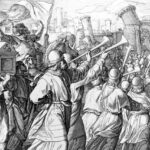
Then, to break the siege, He told them to walk around it 6 days, very quietly, once a day. Then on the 7th day, to go around seven times and then to have the priests blow the trumpets, and all the people shout as loud as they could.
Joshua 6:20 So the people shouted, and the priests blew the trumpets. It happened, when the people heard the sound of the trumpet, that the people shouted with a great shout, and the wall fell down flat, so that the people went up into the city, every man straight before him, and they took the city.
When this happened, the walls of Jericho fell flat, and the people who surrounded the city when they attacked it “went every man straight before him.” This implies that there was an access point from nearly every direction, which is an interesting fact the archaeological record confirms.
Excavations of the city of Jericho have shown that the walls were originally in two parts; the lower, older part was stone, but had been damaged at some earlier point in history and had been rebuilt but with mud bricks on top. Also, the interface between these two phases of the walls tended to slope out – a bad design.
According to archaeological excavations at Jericho, including the Kenyon and Italian–Palestinian excavations, the mudbrick wall on top of the stone retaining wall had collapsed and fallen in front of the retaining wall around most of the city and had essentially formed a pile of sloping bricks resembling a ramp… The outward falling of the city walls, which was followed by a massive fire that engulfed Jericho and included the collapse of buildings in the city, was proposed by excavators as possibly being the result of an earthquake rather than a battering ram or other siege equipment.
…Excavations in the destruction layer at Jericho uncovered numerous ceramic storage jars containing significant amounts of grain, specifically barley, that had been burned along with the buildings rather than looted… These finds indicate an attack on Jericho soon after barley harvest time in March/April and by an army that was not concerned with looting the food supplies of the city, matching the timing and methodology of the invading Israelite army in the Joshua narrative…(The Bronze Age Destruction of Jericho, Archaeology, and the Book of Joshua, Titus Kennedy)
This was highly unusual military practice, as food was a valuable commodity in ancient times, and was almost always looted before the city was burned. In addition, sieges were generally timed before harvest, so the defenders would have little food to support a long siege, the point of which was starvation-to-surrender.
And we cannot forget the key point in all this, which is that the walls of Jericho collapsed outwards, in a manner that only makes sense in the Bible’s telling. Walls attacked by battering rams collapse in only one place, but these walls have fallen in a full circle around the city.
Some researchers have proposed an earthquake, but that would be as likely to make the walls fall in as out, which is not what the archaeological record shows. Given the Bible’s claim that it was a direct result of the shouting and the stomping and the trumpets, it is likely to be the result of harmonic resonance.
When 600,000 men march in step around a city, you’re going to feel that. Now a well-built wall wouldn’t be affected, but a badly-built wall – one built in haste, in fear of the imminent Israelite invasion – might well be.
Jericho is a very earthquake-prone site; so while the walls weren’t knocked down by an earthquake, they may well have been shaken and softened by one, leaving it so that all it would take is one good push to collapse and make a perfect ramp for invasion.
As always, it was a miracle; but the miracle was in the timing, the miracle was in the fact God knew about harmonic resonance which Joshua certainly did not. The miracle was that the walls had been built badly, prepared in haste, weakened by an earthquake perhaps, and only God knew that.
CONNECTIONS TO EGYPT
All of these things fit the Joshua narrative very well. Historians disagree for two reasons; first, their strong bias against the Bible’s history causes them to treat its narrative as guilty until proven innocent, no matter the context.
Second, the Bible’s narrative “cannot” be true because there are disagreements with – you guessed it – Egyptian dating. According to them, Joshua cannot have invaded Jericho in ‑1467 because they’ve found Egyptian seals in the city cemeteries dating to the 13th through 18th Dynasties.
The next item of chronological significance is a scarab series discovered by Garstang. Scarabs are small Egyptian amulets shaped like a beetle with an inscription (sometimes the name of a pharaoh) on the bottom. In his excavation of the cemetery northwest of the city, Garstang recovered a continuous series of Egyptian scarabs extending from the 18th century B.C.E. (the XIIIth Dynasty) to the early 14th century B.C.E. (the XVIIIth Dynasty). The XVIIIth Dynasty scarabs include four royal-name scarabs – one of Hatshepsut (c. 1503-1483 B.C.E.), one of Tuthmosis III (c. 1504-1450 B.C.E.) and two of Amenhotep III (c. 1386-1349 B.C.E.) – as well as a seal of Tuthmosis III. The continuous nature of the scarab series suggests that the cemetery was in active use up to the end of the Late Bronze I period. (Did the Israelites Conquer Jericho…, Wood)
Now if true as stated, using traditional dates, we would certainly be wrong. If a continuous series of scarabs exists from the 18th century to the 14th century, then certainly Joshua cannot have destroyed the city in the 15th century.
But we have a large advantage over other researchers, even Bible believing researchers, because we know better than to rely on traditional Egyptian dating. Most of them have no reason not to trust historian’s conclusions, and cannot spend two years of their life scrutinizing their conclusions.
I did. And I have. And as often happens, if you look closer this overstates the facts considerably; there is no such thing as a continuous series of kings from the 13th to 18th Dynasties anywhere in the world. No one has any idea who was ruling Egypt for most of the Second Intermediate Period, for how long or in what order.
The hard facts that I can find are, that they found a single scarab dated to the reign of Khahotepre Sobekhotep VI, who ruled in the 13th Dynasty before the Exodus. There is also a possible 14th Dynasty scarab for a king named Sheshi.
Neither of these cause us any problems, because it meant that Jericho was communicating with Egypt before Joshua invaded, precisely as we would expect.
There are no records of any scarabs from the 15th or 16th Dynasty pharaohs, and only with the 17th Dynasty king Kamose and Ahmose do we again find scarabs; then we find more from the 18th Dynasty kings Hatshepsut, Thutmose III, and Amenhotep III.
Hardly a “continuous sequence.” On the contrary, we have an enormous gap between – in our dating – around ‑1500 to around ‑1100. Exactly what we would expect. Because after the destruction of Joshua, the city became a Benjamite city:
Joshua 18:21 Now the cities of the tribe of the children of Benjamin according to their families were Jericho, and Bethhoglah, and the valley of Keziz,
It existed as an unwalled settlement at least by the time of David (2 Samuel 10:5, roughly ‑1051). It was not fortified with walls and gates until Joshua’s curse was fulfilled in 1 Kings 16:33-34, sometime around the ‑930’s‑910’s.
From ‑1500 to ‑1100 or so, Egypt was ruled by the Amalekites, who hated Israel; during that time contact between Egypt and Jericho would have been possible only through invasion. So we would not expect to find much, if any, mid-period Hyksos relics in Jericho.
All of which means we have no conflict with our Egyptian history whatsoever. In fact, I could not ask for better evidence of my conclusions; during the reign of the pre-Exodus king Sobekhotep VI, whom we date to ‑1557‑1544, there was contact between Egypt and Jericho – long before Joshua destroyed it.
Then during the fall of the Hyksos during the reign of Kamose (‑1108‑1100), Egyptian trade resumed between Jericho – now a Benjamite city – and the native Egyptian dynasties. And once again Egyptian seals are again found in Jericho.
When properly placed, the 13th and 18th Dynasty artifacts confirm the story of Joshua and the Judges period perfectly.
THE INVASION
After this Joshua conquered Ai with a clever ruse involving a fake retreat and an ambush (Joshua 8). Then the Gibeonites, hearing what had happened, developed a clever ruse of their own to trick Joshua into making a forbidden treaty with them; they pretended to be from a far country, and secured an oath from Joshua that he wouldn’t attack them.
Foolishly he did so only to find out that they were basically the next city on the list to conquer. But a deal’s a deal (Joshua 9). After that, Adonizedek king of Jerusalem – which at this point, was still a Canaanite city – was afraid, so gathered a coalition of five kings to attack Gibeon.
They, of course, appealed to Joshua, who was given permission to engage by God who also attacked the coalition with hailstones to soften them up (Joshua 10:10-11). Following this came the miracle of Joshua’s long day:
Joshua 10:12-14 Then Joshua spoke to Yahweh in the day when Yahweh delivered up the Amorites before the children of Israel; and he said in the sight of Israel, “Sun, stand still on Gibeon! You, moon, stop in the valley of Aijalon!” The sun stood still, and the moon stayed, until the nation had avenged themselves of their enemies…. The sun stayed in the midst of the sky, and didn’t hurry to go down about a whole day. There was no day like that before it or after it….
Some interpret this as an eclipse. And because the sun and moon are both mentioned in the same context, meaning they were clearly both visible, this is a reasonable idea. However, they are mentioned as stopping in two different places (Gibeon, Aijalon) which argues against an eclipse.
Also, the Bible says “there was no day like that before or after,” which argues that this was a unique event, and not a solar eclipse which is relatively common. Explaining this particular miracle with observed human experience is challenging, so you can choose to believe it happened or not.
Regardless, after decisively conquering these five kings and taking their cities, the northern Canaanite tribes banded together to bring an army “even as the sand that is on the seashore in multitude, with very many horses and chariots” (Joshua 11:4-9).
Joshua of course won again, and again warred with other cities; “Joshua made war a long time with all those kings. There was not a city that made peace with the children of Israel, except the Hivites, the inhabitants of Gibeon. They took all in battle” (Joshua 11:18-19).
Following this, God told Joshua he was getting old, and there was still more land to conquer; but to go ahead and divide the land they were going to conquer among the tribes on that day (Joshua 13:1-6), so he did so.
This was seven years into the Promised Land, and we can prove this by Caleb’s statement just after that in Joshua 14:6-12. Doing the math there, the spying of Kadesh-Barnea happened in the second year, and that was 45 years earlier. Since they were in the wilderness 40 years, that makes this the seventh year after the entry to the Promised Land, or ‑1460.
At about this time, the Tabernacle was reared up in Shiloh, where it would remain until the time of David (‑1071), about 300 years. This became the spiritual hub of Israel for the Judges period, and later – due to Israel’s many failures in this period – became a byword for what happened when God abandons a place (Jeremiah 7:12).
During this time, there was no centralized leadership, no constant chain of judges or rulers. The only continuous presence was the high priest, who spoke for God and not for themselves; thus, as Samuel would much later tell them…
1 Samuel 12:12 …you said to me, ‘No, but a king shall reign over us;’ when Yahweh your God was your king.
The last few chapters of Judges (17-21) seem to be out of place chronologically, and tell some stories of that early period after the death of Joshua, when “every man did that which was right in his own eyes” (Judges 17:6).
These stories in the end of Judges properly belong here, chronologically; things about the founding of Dan, an alternate Levite priesthood based there, and the near-extinction of the tribe of Benjamin because of a particularly gruesome act they did, and how the tribe was saved.
Fun stuff, but not part of our main narrative, so we’ll skip it to focus on our next narrative: the Judges period.

This is part 33 of The History of the World Series
 Akhenaten the Heretic
  The Richest Man in History
  Thutmose III and Shishak
  Solomon and the Queen of Sheba
  Judges to Kings
  What Is The LOVE Of God?
  Everything You Believe About God Is WRONG!
  Make Up Your Mind!
  What Is Faith?
  How DARE you FEAR the judgment of God!
  Firstripe Figs
  The Bride Of The Father
  Exodus 40 – The Plan Of God
  The Temple Of God
  Pillars Of The Temple And The Brass Sea
  GEHENNA WITH ‘EM
  When Did God Forbid Polygamy?
  When You Shouldn’t Pray For Someone
  The Sins of the Father
  The First Paul