Kurigalzu and the Berlin Letter

This is part 25 of the The History of the World Series
; The History of the World is part 1.
Click here to read in series
Using Chronicle P we have told the story of Assuruballit, the rise of Kurigalzu I and his war with Adad-nirari II; but winning a battle is not conquering a nation; we don’t believe the Kassites ruled Assur at any point.
He went to conquer Adad-nirari, king of Assyria. He did battle against him at Sugaga, which is on the Tigris, and brought about his defeat. He slaughtered his soldiers and captured his officers. He put his governors in Karduniaš. (Chronicle P)
Adad-nirari lost, yes, but nothing is mentioned about Kurigalzu capturing the city or the king himself. If he had, it probably would say so since it does say “he slaughtered his soldiers and captured his officers.”
Still, it gives us an opportunity to confirm our timeline in yet another way; since it is known from Assyrian annals that Adad-nirari II engaged Babylonia – Karduniash – twice in his campaigns, once near the beginning and once near the end of his reign.
The Assyrians, as always, portrayed themselves as victorious in their versions of the story, even though we believe the first battle was an outright loss. It must have been inconclusive at best, else there would have been no need for a second.
In the wake of this early victory, it seems that Adad-nārārī II already assaulted and took the Babylonian protectorate of Arrapḫa between late 911 and mid‑909 [‑965‑963, our dates]. As discussed, it is unclear whether his Karduniaš campaign should be linked with this activity or not. (A New Reconstruction of the Reigns of Adad-nārārī II and Tukultī-Ninurta II… Edmonds)
Decades later near the end of his reign, he took a tribute-collecting trip down the Khabur river, and the same historian continues…
Curiously, he stopped before reaching Sūḫu, previously his tributary, the southmernmost point rendering tribute being Ḫindānu … Considering the ensuing war with Babylonia and the subsequent “defeat” of Sūḫu … it is likely that Sūḫu’s governor had accepted Karduniaš’ offer of protection, and that a Babylonian military contingent large enough to deter Adad-nārārī II had been stationed there, much as would be the case in 878.
This may well have been casus belli for the conflict which ensued. It seems unlikely that this had begun prior to mid‑893 [‑947, our dates], as Adad-nārārī II inaugurated a temple of Gula at Aššur in the middle of the summer (17th Abu [V]), when he would have been expected to have been busy prosecuting his war (Ibid)
This date is the third-to-last year of Adad-nirari’s reign, which means the 2nd war with Babylon “is unlikely” to have begun before then. We suspect even later, at the very end of his reign. Remember, Chronicle P tells us that Tukulti-ninurta II, his successor, would attack and rule Babylon for seven years, the entire length of his reign – we suspect that began in the same battle that Adad-nirari II fought, and may even have died in.
In 885 [‑939, our dates], Tukultī-Ninurta II toured the Middle Euphrates collecting massive tribute from the flourishing trade emporia of the region … The genius of his route was that it took him through ‘allied’ Babylonian territory so as to approach Sūḫu from the south, an act of calculated political brinksmanship. While not breaking the decade’s truce between Babylonia and Assyria, it was a remarkable demonstration of Assyrian might. The absence of Nabû-šuma-ukīn or any other Babylonian sovereign in this narrative is also telling; it may well be that the king of Karduniaš had died and his successor Nabû-apla-iddina had not yet been crowned, leaving a power vacuum for Tukultī-Ninurta II to exploit. (Ibid)
In traditional history, relying heavily on the synchronistic history, the Babylonian (not Kassite) kings of Karduniash had made a treaty with Adad-nirari II to end the war; hence their belief in a “peace treaty” – but that doesn’t quite fit the facts we have.
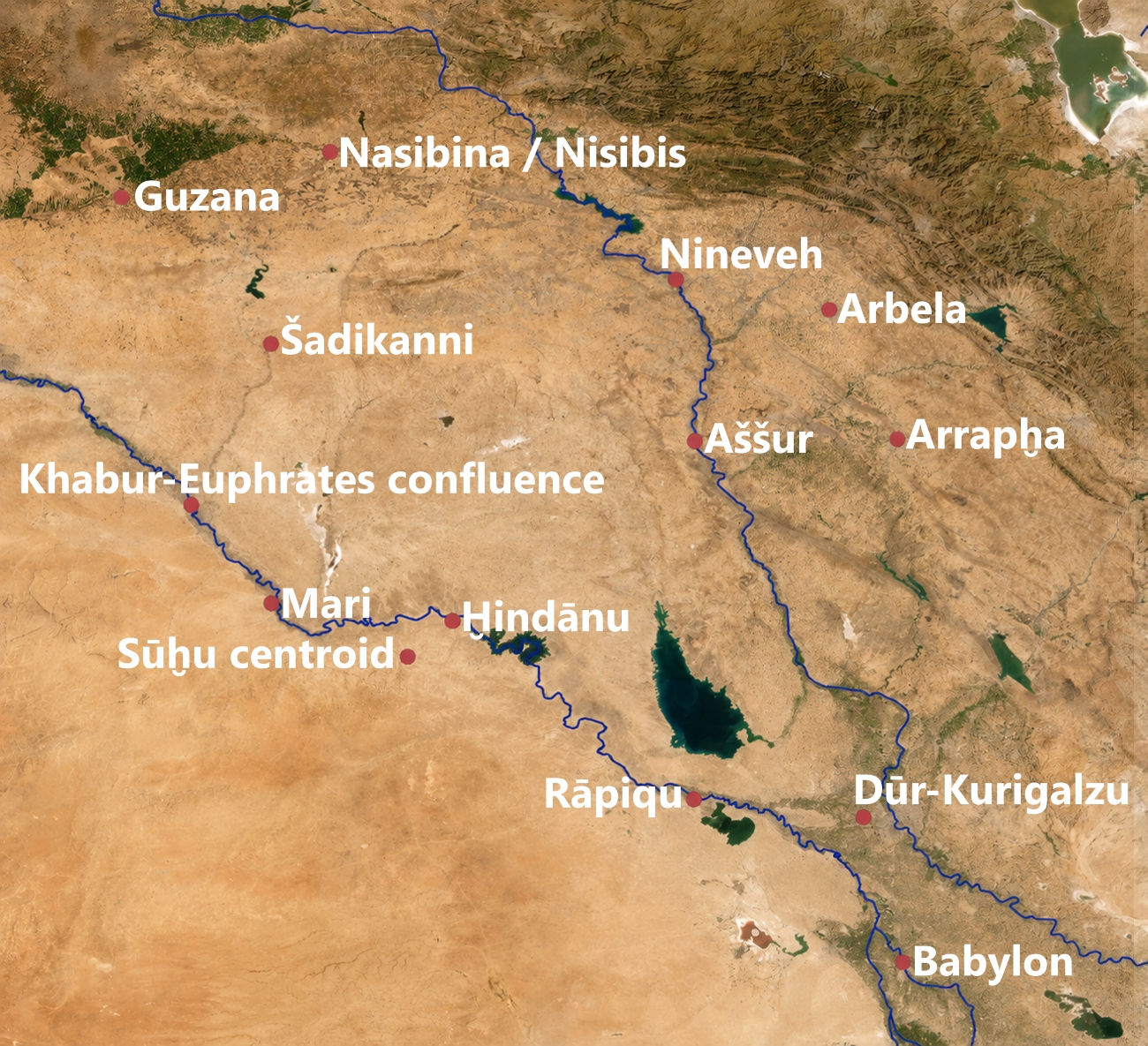
Meanwhile in the Chronicle P version, Babylon had been completely conquered by Tukulti-ninurta II at the very beginning of his reign. Which means this wasn’t allied territory, it was literally his territory.
Thus, the “absence” of Babylonian kings in the narrative is indeed “telling”; for Chronicle P tells us “He put his governors in Karduniaš. For seven years, Tukulti-Ninurta controlled Karduniaš.” We would therefore not expect any king to be ruling in Babylon.
To pass through territories owned by another king with a massive army, even an allied one, would be very risky, as it could be perceived as an act of war – especially since hostilities were so recent. Hence historians’ confusion.
We, however, know that Tukulti-ninurta wasn’t exploiting anything, he was taking a tour of his own vassalized territories.
TIBERIUS
In our chronology, the seven-year Assyrian domination of Babylon by Tukulti-ninurta II starts at the beginning of Kadashman-enlil’s 14 years of reign. This does not mean he was a vassal; remember, Kassites and Babylonians were different.
The Kassite throne was not in Babylon, as it specifically said Kurigalzu “placed his governors in Karduniash.” Which means their throne was somewhere else; at the very least in Dur-kurigalzu, quite possibly far away to the east in their mountainous homeland.
So the loss of Babylon to the Assyrians does not mean that Kadashman-enlil was subjugated. He probably merely lost territory, as had often happened. So he retreated, built his strength, and waited for an opportunity.
Seven years into his reign it came, when Tukulti-ninurta was killed by his son Assur-nasir-apli II, and the Akkadians – ethnic Babylonians, not Kassites – rebelled against their Assyrian governor and put Adad-shuma-ushur on the Babylonian throne in opposition to the Kassites.
There is no independent evidence of these events in any other history besides Chronicle P, but the circumstances of the Assyrian succession after Tukulti-ninurta II are unclear according to the aforementioned author…
No further campaigns can be confirmed for Tukultī-Ninurta II’s reign, and he must have died while his Assyrian Sanssouci at Nēmed-Tukultī-Ninurta was still under construction, as Aššur-nāṣir-apli II would reuse some of his father’s inscribed slabs in Ninūa. … While there is nothing to suggest any irregularity in Aššur-nāṣir-apli II’s succession, it is striking that ‘Tukultī-Ninurta’ did not see use as a throne name thereafter, particularly in light of the turgid successions of Aššur-nārārī’s which the Assyrian entracte brought. One might ask if there was something maudlin or Tiberian about this figure; his son’s throne name, Aššur-nāṣir-apli II, displays a tonal shift, his namesake having been a successful king in an ill-fated epoch, more Arthur than Alfred. (Ibid)
“Tiberian,” for those of you who don’t know, is from the Roman emperor Tiberius who in later years became paranoid, suspicious, and moody and spent his final years away from the capital in a villa on the isle of Capri.
Ancient rumors held that he was smothered by the prefect of the praetorian guard with the complicity of his successor Caligula, who was by all accounts a monstrous sociopath. And this author suggests that Tukulti-ninurta II was reminiscent of Tiberius. Compare to Chronicle P:
After the Akkadian officers of Karduniaš had rebelled and put Adad-šuma-uṣur on his father’s throne, Aššur-nāṣir-apli, son of that Tukultī-Ninurta who had carried criminal designs against Babylon, and the officers of Assyria rebelled against Tukultī-Ninurta, removed him from the throne, shut him up in Kār-Tukultī-Ninurta, and killed him. (Chronicle P)
This can probably never be proven from the Assyrian side – Ashurnasirpal II lived a long time and was one of the most sadistic kings in history up to that time. He and Caligula could totally have hung out. And any scribe of theirs who wrote “my king murdered his father” would not live to see the sunrise.
Regardless, our main purpose in going through these kings in detail is to show that there is nothing in them to prevent the application of Chronicle P to these kings, and every reason to believe that they must apply to them.
All this having been said, a failed Assyrian campaign by Adad-nirari II in ‑965‑963 would tie in very well; that would be Kurigalzu’s 7th-9th years, and given that Kurigalzu conquered on all sides and mentions the battle with Assyria last, it’s a good fit.
Further, a successful Assyrian campaign between ‑947‑944 also fits extremely well, as it coincides with the death of Kurigalzu I in ‑945 – possibly in battle. Note that even a few years’ difference in our Kassite or Assyrian timeline and these dates wouldn’t work at all.
Lucky.
KADASHMAN-ENLIL AND BURNABURIASH
Following Kurigalzu I, Kadashman-enlil I (‑945‑931) ruled the Kassites. A century later, a second king by that name, Kadashman-enlil II, reigned (‑838‑824). We mention it because there is firm proof that one or the other of these kings lived in our late timeframe and not four hundred years earlier as historians place them:
Iran, too, has yielded many datable Babylonian texts. From the far northwestern section of the country, Hasanlu level IV (early first millennium B.C.) has yielded a vessel bearing an inscription of a Kadašman-Enlil (No. ?18/25). (Materials for the study of Kassite History, Brinkman)
The early 1st millennium – 1000-800 BC – would fall three hundred years or more after the traditional dates for Kadashman-enlil I and II. Why, then, is a text dated to his reign found in Iran in layers that date to so many centuries after his death?
The answer is obvious: It wasn’t buried in Iran three centuries after his death. It was buried there during or shortly after the period in which he lived – in the early 1st millennium BC.
Otherwise, it would be the equivalent of finding George Washington’s coffee mug in a modern dumpster. And while today it might have been stolen from a museum, ancient cultures weren’t that interested in three hundred year old cups from other countries.
Which means George Washington lived at the same time as the dumpster he left his mug in. So to speak.
After Kadashman-enlil I, Burnaburiash II ruled the Kassite throne. He wrote some Amarna letters, one of which gives both us and historians pause:
With Assyrian power firmly established in Mesopotamia, northeast Levant and southeast Anatolia, Ashur-uballit started to make contacts with other great nations. His messages to the Egyptians angered his Babylonian neighbour Burnaburiash II, who himself wrote to the Pharaoh: “with regard to my Assyrian vassals, it was not I who sent them to you. Why did they go to your country without proper authority? If you are loyal to me, they will not negotiate any business. Send them to me empty-handed!” (Wiki, Assuruballit I)
Prior to achieving peace, Burnaburiash had been a prominent enemy of the Assyrians. At one point, he had attempted to tarnish Assyrian diplomatic and trade relations with Egypt by sending a letter to the pharaoh Akhenaten wherein he falsely claimed that the Assyrians were his vassals. (Wiki, Middle Assyrian Empire)
In their reconstruction, Assuruballit I was a strong king, never a vassal of Burnaburiash II. In our reconstruction, Burnaburiash II ruled opposite two strong kings, Assurnasirpal II and Shalmaneser III; there’s no way either were his vassals.
So while I would prefer a better explanation than Kassite chest-thumping, we content ourselves that historians must likewise say Burnaburiash’s claims were false – it’s not as if Pharaoh had an easy way to confirm the political situation a thousand miles way. Or for that matter, any reason to care.
THE BERLIN LETTER
Following Burnaburiash there were two very brief reigns, suggesting some sort of turmoil in the succession, or a rebellion of some sort, followed by the reign of Kurigalzu II (‑903‑879). Historians use Chronicle P to inform this period, even though almost none of the names match, so the stories you’ll read about it are not correct; for now, we don’t know what the turmoil was.
But with Kurigalzu II, we have a bridge to another key document – although historians will tell you it was actually about Kurigalzu I, but we will show that is quite impossible. This document is called the Berlin letter; it annoys historians for many reasons, hence we love it.
As the Berlin “letter” discussed above (Table 7.5) makes clear, its author was married to the daughter of the thirty-third Kassite king, Meli-Shihu or Meli-shipak (1186–1172 BC). [‑762‑748 my dating] …While the name of the author of the Berlin letter is no longer preserved, it seems likely that it must have been none other than Shutruk-Nahhunte … rather than his son Kutir-Nahhunte. (Archaeology of Elam, Potts)
The purpose of the letter was to establish a genealogical connection between a Kassite king named Kurigalzu and the author, believed to be Shutruk-nahunte I, an Elamite king whom historians believed lived in the 12th century, but who actually who lived in the 8th century.
We already referenced this in the chapter on the Kassites, since it uses 9th century Babylonian king Nabu-apla-iddina as an example, an obvious impossibility if it was written in the 12th century when historians believe Shutruk-nahunte I lived.
In this letter he cites three kings in succession who were unworthy, yet whom the Babylonians accepted as king; with the basic idea “you accepted these illegitimate losers, but not me with the royal pedigree I have??”
But the problem for historians is that for various reasons, each of these kings make little sense in the traditional history. The answer? Discredit the letter as much as possible.
Scholars have raised justifiable doubts about the historicity of these literary compositions (e.g. Brinkman 2004: 292), but one has to admit that the author of the “Elamite letter” had a good knowledge of the Babylonian line of succession, going back as early as Kurigalzu I. In some details he is even more reliable than the author of Chronicle P. (van Dijk 1986: 165; Lambert 2004: 201)
He must have had access to historical sources, and the information provided by him on three negative precedents — in which the Babylonian throne was imprudently given to non-Elamite descendants — may contain a kernel of truth. (The ‘Berlin Letter’ and the Political Relations Between Elam and Babylonia at the End of the Kassite Period, Itamar Singer)
Note the term “literary” – fictional – applied to this letter. First, they concede the author clearly had accurate knowledge of the history of the Babylonian kings, which they have confirmed independently.
Their concession after this confirmation? The letter is fictional, but “may contain a KERNEL of truth.” What justifies that skepticism? Simply the fact that if this is taken literally, their version of history cannot be true.
The name of the first “villain” is very damaged (l. 25), and though his description as: “the one who took Babylon, but whose reign until the present day has not been acknowledged” (ll. 26–29) would best fit Tukulti-Ninurta I, the remaining traces would seem to better fit Kash[tiliash] or some other name. (van Dijk 1986: 168)
The second “villain” is Adad-shuma-usur (ll. 30–32), who will be discussed in detail below.
The third is: “Nabu-apal-iddina,” the son of a Hittite woman (DUMU KUR Hat-ti-ti), an abomination for Babylon, a Hittite (KUR Ha-at-tu-ú) whom you have chosen for the neglect (?) of Babylon and have placed on the throne of Babylon; his sin, his misdoing, his contempt and his … you have experienced …” (Ibid)
In the traditional interpretation, the examples seem to refer to Tukulti-ninurta I (traditionally ‑1243‑1207), Adad-shuma-usur the Kassite king (traditionally ‑1216‑1187), and one of the final Kassite kings of Babylon, and Nabu-apla-iddina (traditionally ‑888‑855), a king of the 8th dynasty of Babylon (the dynasty of E).
Obviously, the last king gives them fits and makes them doubt the entire letter; when what they should doubt is their chronology. Because really, none of these kings fit well with the story. With their story, that is. Start with the presumed first, Tukulti-ninurta:
Tukulti-Ninurta returned to Babylon and brought … near. He destroyed the wall of Babylon and put the Babylonians to the sword. … He put his governors in Karduniaš. For seven years, Tukulti-Ninurta controlled Karduniaš. After the Akkadian officers of Karduniaš had rebelled and put Adad-šuma-ušur on his father’s throne, Aššur-nasir-apli, son of that Tukulti-Ninurta who had carried criminal designs against Babylon, and the officers of Assyria rebelled against Tukulti-Ninurta, removed him from the throne, shut him up in Kar-Tukulti-Ninurta, and killed him. (Chronicle P)
Historians try to match the Berlin letter with this event; and it very well may match, but if so then it refers to Tukulti-ninurta II, not I; having major implications for the timing of the letter and the dates of Shutruk-nahunte.
However, remember that even though the events sound like Tukulti, historians concede that “the remaining traces would seem to better fit Kash[tiliash] or some other name.” I have no idea which other names would better fit the cuneiform sign, but knowing the events of the time I can offer a better candidate: Shuzigash.
There is no indication the Babylonian people ever accepted Tukulti-ninurta as king, especially since they revolted the second they sensed weakness in him and chose another king, Adad-shuma-usur.
Shuzigash, on the other hand, was explicitly chosen in Chronicle P by the Babylonian people to be the successor of Kurigalzu’s Assyrian-sympathizing father Kadashman-harbe. This seems like a far better fit to the point of the letter, to wit, showing that the Babylonians pick bad kings.
Either way, the events of Chronicle P and the Berlin letter are clearly related in time.
ADAD-SHUMA-USUR
The second example is that of the aforementioned Adad-shuma-usur, of whom it says…
Adad-shuma-usur, son of Dunna-Sah, from the region by the bank of the Euphrates, whom you chose and put on the throne of Babylonia: H[ow has h]e frustrated the daughter’s son! (Berlin letter)
Historians unanimously believe this to refer to the Kassite king by that name who ruled near the very end of the Kassite dynasty. But this interpretation creates many problems. The biggest one being that his father is different from the father of the Kassite king by that name.
The identity of his father is never explicitly stated in the chronicle but it was assumed in antiquity to have been Kaštiliašu IV. A Luristan bronze dagger in the Foroughi Collection is inscribed with his filiation to this king, … and this claim may have helped reinforce his legitimacy. It reads:… “(property) of Adad-šuma-uṣur, king of the world, son of Kaštiliašu, king of Babylon.” (Wiki, Adad-shuma-usur)
Adad-shuma-usur the Kassite king was the son of Kashtiliashu IV, not Dunna-sah! In any other context, a contemporary attestation like this would be enough to conclusively settle the question of his ancestry.
But in this case, based solely on their identification of this king as the one mentioned in Chronicle P and the Berlin letter, historians cast doubt on his ancestry, suggesting that he merely pretended to be descended from the previous king “to help reinforce his legitimacy.”
Easier answer: they have the wrong king.
And we have proof of this, because Adad-shuma-usur the Kassite king used a double-dating formula, as mentioned in the Kassite chapter, strongly indicating that he shared a co-reign and had a peaceful transition from his predecessor.
Now if we are dealing with only one Adad-shuma-usur, then that cannot be true. A co-reign and a coup are incompatible. Therefore historians reject all double-dating formulas for Kassites because they are that certain that this king came to power through a coup.
But that was based on their confidence that he is the king in Chronicle P and the Berlin letter. If that’s wrong, if they are two different kings – which is why they have two different fathers – then double-dating stands as it obviously should.
And if that stands, then the Kassite king Adad-shuma-usur didn’t come to power in a coup, which means this is not the same Adad-shuma-usur.
Which is ironic because Shutruk-nahunte tried very hard to tell us that he wasn’t the same king!
The Kassite king Adad-shuma-usur’s reign ended shortly before the reign of Shutruk-nahunte; so he knew if he had just said the name, everyone would have wrongly assumed that he meant the recent king; so he used what passed for last names back in the day, the name of the father and his place of origin.
Thus, he spelled it out in that he meant the Adad-shuma-usur who was son of Dunna-sah, the one who was from “the region by the bank of the Euphrates,” implying that he did not mean Adad-shuma-usur son of Kashtiliashu IV who was from the Kassite homelands!
And all his efforts to avoid confusion are simply ignored by historians who persist in identifying him as the same king. Because you cannot be clear enough to prevent someone determined to misunderstand you.
NABU-APAL-IDDINA
The final king is the one that gives them the worst fits, since he’s so out of place.
Nabu-apal-iddina, the son of a Hittite (fem.), an abomination for Babylon, a Hittite (masc.), whom you chose to the detriment (?) of Babylon and put on the throne of Babylonia; you have experienced his sins, his failure, his crime and his… (Berlin letter as quoted in AOE)
Historians explain this as “an unlikely slip of the stylus” for Marduk-apla-iddina, who would have ruled in at acceptable time for their chronology. But it wasn’t. Because when you look at the dates of all three of these kings in my timeline, you see that they are in a natural sequence:
First, Shuzigash in ‑972 (or, if it is a Tukulti-ninurta, then Tukulti-ninurta II in ‑944‑937)
Second, Adad-shuma-usur in ‑937
And finally Nabu-apla-iddina in (roughly) ‑940‑907
The final king in particular could slide around a little bit, datewise. Each was illegitimate in his own way; the first was a Kassite rebel; the second was a Babylonian rebel; and the third, though otherwise legitimate, was half-Hittite through his mother.
You may wonder why Shutruk-nahunte I, writing around ‑750, would reach so far back into history for his examples. But then you realize that the entire purpose of the Berlin letter was to connect the history of Kurigalzu II to Shutruk-nahunte I…
And Kurigalzu II began to reign in ‑903, just after the end of Nabu-apla-iddina’s reign.
The whole point of the letter was to show that, starting with the reign of “the great king Kurigalzu,” everything came up roses… and that if they wanted that to continue, they would pick Kurigalzu’s descendant, the Elamite Shutruk-nahunte, as their next king.
Now doesn’t that just make perfect sense? He couldn’t use any later examples without undercutting his own ancestors who provided him with legitimacy.
MORE FUN IN BERLIN
While we have connected the letter to Kurigalzu II for many reasons to be detailed below, historians almost universally believe “the great king Kurigalzu” mentioned in the letter to be a reference to Kurigalzu I, but that creates… problems.
The start of this series [of princesses] is marked by a broken synchronism between Pahir-issan (the second Igihalkid king, formerly dated to around the end of the 14th century) and a Kurigalzu. Since a Burnaburias occurs two marriages later and no king Burnaburias is known following Kurigalzu II, Pahir-issan’s contemporary would appear to be clearly identifiable as the early 14th century Kassite Babylonian king Kurigalzu I. This identification fits very well with Burnaburias II’s apparent position as Kurigalzu I’s second successor. However the resulting backdating of the early Igihalkid dynasty by up to a century has had a number of unhappy chronological consequences. (The Berlin Letter, Middle Elamite Chronology and Sutruk-Nahhunte I’s Genealogy, Goldberg; henceforth TBL)
Long story short, if they accept that the Kurigalzu mentioned is the first of that name, then it means they have to push the chronology back to be contemporary with him; this, however, “has had a number of unhappy chronological consequences.”
The main problem is that there aren’t enough generations given in the letter to bridge the gap between Kurigalzu I’s daughter, the first princess named, and Meli-shipak’s daughter, the final one and mother of the author.
To fix this, they are forced to insert large gaps in the Elamite lineage – around 60 years in one place – since there aren’t enough princesses to fill the necessary time between Kurigalzu I and Meli-shipak.
To explain these gaps, they speculate that only ancestors who married Kassite women were mentioned, ignoring the rest. But since the entire point of the letter is to firmly establish a claim to the throne, it’s difficult to understand why he would have left a gap in his ancestry.
Impossible, really, since such a gap would invalidate his claim completely. Hence, “unhappy consequences.”
KADASHMAN-HARBE/ENLIL
On the other hand, if they choose Kurigalzu II as the ancestor of the Elamite brides as we do, then the chronological side of things adds up very well – but then they run into a conflict with the deeds of Kurigalzu II as believed to be recorded in Chronicle P – specifically his Elamite invasion.
According to historians, somewhere around the time of the Kurigalzus the Elamites transitioned, in an unknown fashion, from a poorly documented series of kings known as Kinuids to the Igihalkid dynasty, so named from their first king Igihalki.
The Igihalkids would intermarry with the Kassites culminating in the aforementioned Shutruk-nahunte. The reason this creates such a problem is an Elamite document which tells of a Kinuid king named Tepti-ahar, who defeated a Kassite king named Kadashman…something.
Tepti-Ahar built a new capital of Kabnak (modern Haft Tepe, 10 km from Susa). The excavated archive shows the diplomatic exchange with Babylonia, possibly even dynastic marriages. A tablet found at Haft Tepe (HT38) is dated to the “year when the king expelled Kadašman-KUR.GAL.” The tablet has a seal of Tepti-Ahar, King of Susa. KUR.GAL could be read either as “Harbe” or “Enlil” (since Harbe is a Kassite god parallel to Babylonian Enlil). (Wiki, Tepti-ahar)
Saying it could be read as either one is misleading. It is almost certainly Enlil, as it requires some tortuous logic to read it as Harbe. The only reason they look for an alternative is because Kadashman-harbe came before Kurigalzu I, which fits better with their interpretation of Chronicle P. Unfortunately…
Kadašman-Ḫarbe I seems very weak because the linguistic basis for reading KUR.GAL as Ḫarbe is indirect, flimsy and unrelated to Elam, and requires a very dubious reading of other at least partly Semitic PNs naming KUR.GAL at Haft Tappeh as likewise honoring the Kassite god Ḫarbe. … A Kadašman-Enlil reading finds positive support from evidence very reasonably characterized by Glassner as “capital:” a bilingual letter from Šulgi found at Susa names KUR.GAL as the Sumerian equivalent of Enlil (Glassner 1991, 119). … Since Elamite evidence deserves priority, Glassner’s conclusion seems justified and even understated: a Kadašman-Enlil reading is “reasonable to accept.” (TBL)
If we follow the obvious reading of the name, Kadashman-enlil, then it would mean that the successor of Kurigalzu I was at war with the Elamite king Tepti-ahar. But this presents a large problem for historians.
See, if it was Kurigalzu I in the Berlin letter as they’d like it to be, then that means he gave his daughter in marriage to Elamites. As did a fairly continuous succession of his descendants; all this diplomatic marriage while openly at war with Tepti-ahar?
Hard to believe. Besides, the name of his daughter’s husband is given as “Pahir-issan, son of Iki-galhi,” meaning that Igi-halki was contemporary or even earlier than Kurigalzu I, simultaneously with Tepti-ahar somehow; how are there two kings of Elam at the same time?
You see the problem.
…However, on the now-usual view, even Kadashman-Enlil I (traditionally c. 1374–1360 BC; apparently the immediate successor of Kurigalzu I) already falls within the period of the Igihalkid–Kassite alliance. (Ibid)
This shows us that the Berlin letter and Chronicle P must be about different Kurigalzus; it’s the only answer that makes sense. Historians generally agree, but they prefer Kurigalzu I for the Berlin letter, and Kurigalzu II for Chronicle P; they are, as often happens, precisely wrong.
[if we choose Kurigalzu I as the first ancestor in the Berlin letter] No room is left for the challenge issued to a Babylonian king Kurigalzu (at least ostensibly II) by an otherwise unknown and seemingly Hurrian-named (i.e. hardly Igihalkid) Hurpatila ‘king of Elammat’ (Chronicle P iii 10-19)11: If the series of Igihalkid-Kassite intermarriages cited by the Berlin letter indeed started under Kurigalzu I, there would appear to be no political space left for a non-Igihalkid Elamite king to issue such a challenge to Kurigalzu II. And the alternative, identifying Hurpatila’s Babylonian contemporary as Kurigalzu I (pace Chronicle P), is hard to fit timewise with the currently-favored short Babylonian chronology or the now seemingly hard-to-avoid (albeit problematic) Tepti-Ahar / Kadasman-Harbe I. (TBL)
So he basically says that Kurigalzu I makes more sense as the king in the Berlin letter, particularly in light of Chronicle P, “but is hard to fit timewise with the currently-favored … chronology.” Once again, their big-picture preconceptions prevent them from accepting the obvious reading of a text.
But if they would just choose Kurigalzu II as the father of the first princess in the sequence, then these problems evaporate; it was Kurigalzu I who warred with the last Kinuid kings of Elam, along with his successor Kadashman-enlil I, as named by Tepti-ahar.
Then much later, after the Elamite political situation had been rearranged – probably as a result of the Kassite interventions – it was Kurigalzu II whose daughter was given to the Igi-halkid king of Elam.
That choice then gives us an unbroken sequence of princesses and kings from Kurigalzu II to Meli-shipak with every single generation present leading up to Shutruk-nahunte I, making sense of the Berlin letter’s claims.
Easy, obvious, plain readings of the texts. The only reason historians haven’t chosen this narrative is that it conflicts with their gross misinterpretation of Chronicle P as applying to Kurigalzu II.
Because if he was the conqueror of Elam in the time of Hurpatila, as they think it claims, this doesn’t fit. If he was not, but rather a close ally of the Elamite dynasty who replaced Hurpatila and Tepti-ahar… then all the facts fit the Berlin letter perfectly, and that rejects their interpretation of Chronicle P.
And they can’t do that, because without Kurigalzu II being the king in that story, Assuruballit can’t be tied to the sequence of Kassite kings in the right spot, and without that, the whole dating system of the ancient Near East falls apart.
We, of course, are perfectly fine with that.
SUCCESSION PROBLEMS
The Berlin letter gives a clear succession of the kings of Elam in the 14th century, which are also attested from various Elamite building inscriptions. Potts sums the later ones up as follows:
The genealogy of Untash-Napirisha’s successors is, in part, revealed by the Berlin letter (Table 7.5) which tells us that his Kassite wife bore him a son called Kidin-hudurudish or Kidin-Hutran (II) in Elamite. The latter himself married yet another Kassite princess, daughter of … ‑dduniash, who gave birth to Napirisha-Untash. As noted above, the Shilhak-Inshushinak building inscription listing those kings who contributed to the maintenance of the Inshushinak temple at Susa suggests that following the reign of Untash-Napirisha, whether directly or indirectly, he was succeeded by his second cousins, i.e. Pahir-ishshan’s sons, Unpahash-Napirisha and Kidin-Hutran I. If this was indeed the case, then both men must have been fairly advanced in years, but it is not an impossibility. Vallat has suggested that these two may have died without issue (Vallat 1994: 5), and if this were so then it would explain why succession reverted to Untash-Napirisha’s son Kidin-Hutran II, who was in turn succeeded by his son, Napirisha-Untash. (AOE, Potts)
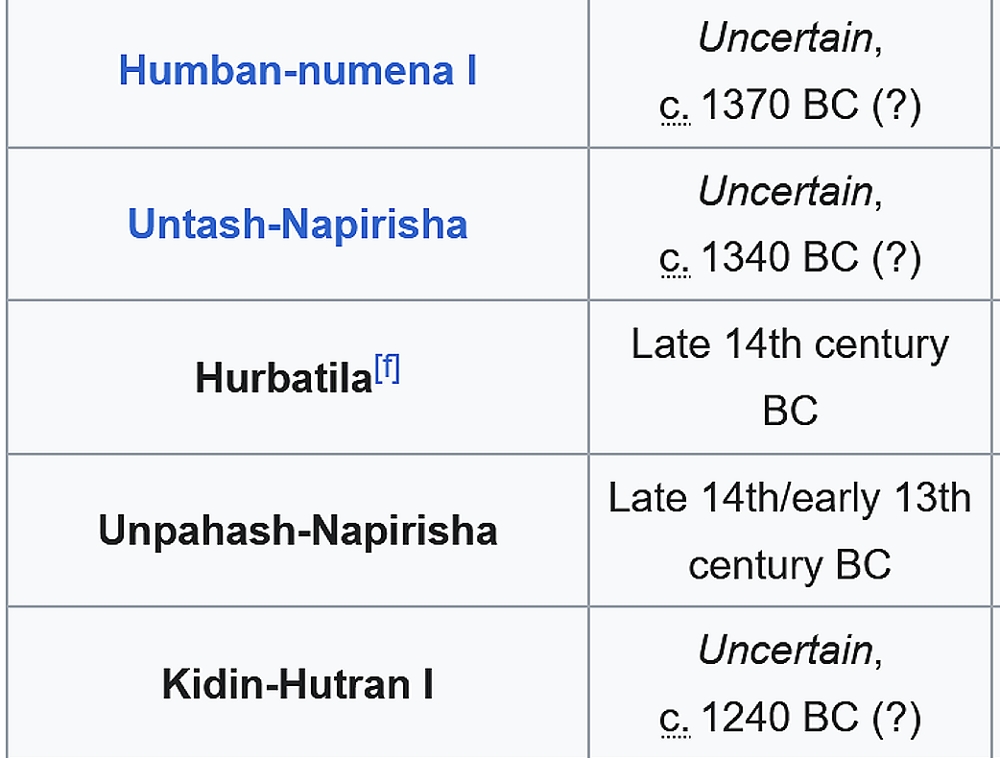 So far so good. Yet historians are forced to awkwardly insert an unattested king named Hurbatila into this list after Untash-napirisha in direct contradiction to the evidence of contemporary inscriptions. (See image aboveat right from Wikipedia, “list of kings of Elam”)
Why do they do this? Their reasoning goes like this…
- The Igi-halkid kings ruled in the 1300s.
- Kurigalzu II ruled from ‑1332‑1308.
- Kurigalzu II fought Hurbatila in Chronicle P.
- Therefore Hurbatila, an Elamite king, likewise lived between ‑1332‑1308.
Which means… he must be in there somewhere!
Only… why don’t any of the Elamite kings mention him? The Kurigalzu-Hurbatila battle was epic, resulting in an invasion and looting of Susa and Anshan which forced the Elamites to submit and bring tribute.
So how come not one of the Igihalkid kings mentions anything like this? In fact, they were marrying Kassite princesses the whole time! So how can you squeeze this king Hurbatila into the midst of that? Well, you can’t.
We, of course, have the very simple explanation: Hurbatila fought Kurigalzu I before the first Igi-halkid king ruled in Elam.
But that means Chronicle P must refer to Kurigalzu I, not II; and as has been noted, that throws a wrench into the gears of ancient Near Eastern chronology from Egypt to Elam because it puts Kurigalzu I ruling before his great-grandfather Assuruballit I of Assyria.
I know I’m a bit of a broken record, but it really does all come back to that.
THE STORY
The story pretty much tells itself once you sweep their misinterpretations out of the way. Kurigalzu I was a powerful king, and established a Kassite power base in Sumer. Meanwhile during the time of the poorly-known Kinuids the Elamite king Hurpatila challenged him, and was roundly defeated around ‑965; Kurigalzu then invaded and plundered Susa.
When Ḫur-batila, possibly the successor of Tepti Ahar to the throne of Elam, began raiding the Babylonian Empire, he taunted Kurigalzu to do battle with him at Dūr-Šulgi. Kurigalzu launched a campaign which resulted in the abject defeat and capture of Ḫur-batila, who appears in no other inscriptions. He went on to conquer the eastern lands of Susiana and Elam, recorded in the Chronicle P. He went on to conquer the eastern lands of Susiana and Elam, recorded in the Chronicle P out of sequence and credited to his later name-sake. … This took his army to the Elamite capital, the city of Susa, which was sacked, celebrated in two inscriptions found there bearing his name. It is thought that he may have installed as his vassal, Ige-Halki, the founder of the new dynasty. (Wiki, Kurigalzu I)
At the risk of repeating myself, Chronicle P recorded the event in order as ancient chronicles always did; and it is historians who have wrenched the identification away from Kurigalzu I and given it to II, not the chronicle itself.
Also, their own evidence proves that Kurigalzu did not put Igi-halki on the throne since Chronicle P’s conclusion of the story has Hurbatila bringing tribute to Kurigalzu I. Again, just listen to your own sources before drawing conclusions.
Still, the bringing of tribute does not mean eternal peace; so a generation later, another Elamite king named Tepti-ahar challenged his successor Kadashman-enlil, winning at first but probably losing in the long run, this around ‑935.
That defeat probably instigated regime change in Elam and set the stage for Igi-halki to come out on top, founding his own dynasty shortly thereafter.
Another generation later around ‑890 his son Pahir-issan sought a diplomatic marriage with Kurigalzu II, who granted it, and they formed an alliance of marriages that lasted well over a century.
And that leads us to the Elamites.

This is part 25 of The History of the World Series
 Aftermath of the Exodus
  The Rising of Sothis
  Assyria and the Mitanni
  Old Assyria
  The Captivity of Bel-Marduk
  What Is The LOVE Of God?
  Everything You Believe About God Is WRONG!
  Make Up Your Mind!
  What Is Faith?
  How DARE you FEAR the judgment of God!
  Firstripe Figs
  The Bride Of The Father
  Exodus 40 – The Plan Of God
  The Temple Of God
  Pillars Of The Temple And The Brass Sea
  GEHENNA WITH ‘EM
  When Did God Forbid Polygamy?
  When You Shouldn’t Pray For Someone
  The Sins of the Father
  The First Paul