The Kassites
This is part 23 of the The History of the World Series
; The History of the World is part 1.
Click here to read in series
We’ve established that the Kassites were ruling at least parts of Babylon beginning during the reign of Samsu-ditana around the ‑1330’s, and dominant over all of it by the end of the 1st and 4th dynasties, which ended at the same time in ‑1061.
The next two dynasties – remembering we are dealing with two contemporary vassal kingdoms, one based on Isin and the other based in the Sealand – were the 5th dynasty called the 2nd Sealand and the 6th dynasty called the Bazi dynasty.
Both of these were ethnically Kassite dynasties. The first 2nd Sealand king, Simbar-shipak had a Kassite name, and Bazi is the name of a Kassite tribe:
Bit‐Bazi [the house of Bazi] is attested during the Kassite and Isin II period as a clan which probably derived its name from the town Baz on the Tigris River. Some high officials under Isin II belonged to that clan. One of them is a certain Eulmash‐shakin‐shumi, descendant of Bazi, a homonym of the first king of the Dynasty of Bazi; he appears in two kudurrus from the reign of Marduk‐nadin‐ahhe. A Kassite connection for the Dynasty of Bazi might be inferred from the name of its last king, Shirikti‐Shuqamuna “gift of the god Shuqamuna,” which, although linguistically Akkadian, honors the patron god of the former Kassite dynasty. (AHOB)
To historians, these dynasties are quite strange; to them, the Kassite dynasty was at least 155 years gone; odd, to find so many Kassite connections to this supposedly “Babylonian” dynasty. It’s almost as if… the Kassites are still in power?
To us, this makes perfect sense; tiring of ruling the region through ethnically Akkadian/Sumerian vassals, they now ruled the regions through Kassites, no doubt relatives of the contemporary ruling Kassite kings of the 3rd dynasty.
Interestingly, as noted above, a Bazite named Eulmash‐shakin‐shumi was the first king of the 6th dynasty and also a high official under Marduk-nadin-ahi, one of the middle kings of 2nd Isin dynasty. Chronologically this is odd.
We place Marduk-nadin-ahi, under whom the former served, at ‑1134‑1117. The end of the 2nd Isin dynasty we place at ‑1061. This creates three interesting possibilities, none of which look good for the traditional chronology.
Remember, the evidence shows a lot of Bazites in the 2nd Isin dynasty. So if we assume that the second Eulmash‐shakin‐shumi was the son or grandson of the former, then we would be able to show continuity between 2nd Isin (not 2nd Sealand) and the 6th Bazite dynasty. Thus suggesting the dynasty follows 2nd Isin in time/location, parallel with the 2nd Sealand.
There is also a faint possibility that the two names refer to the exact same person; if he was a high official late in the reign of Marduk-nadin-ahi, perhaps 30 years old at the time, then in ‑1061, 56 years later, he may still have been alive.
The third possibility is simply that the 6th dynasty ruled another region of Babylonia contemporarily with the 4th and 1st dynasty around the time of Marduk-nadin-ahi, again making these two refer to the same person. Regardless, the possibilities favor a revised, contemporary timeline.
Following the 6th dynasty with its three short-lived kings (19 years in total), the BKL records the 7th Elamite dynasty, with a lone occupant. Presumably, this refers to an Elamite invasion – these were frequent – who established a foothold, most likely in the south since it’s on the Elamite border, and therefore this would follow the 2nd Sealand dynasty which occupies the same region.
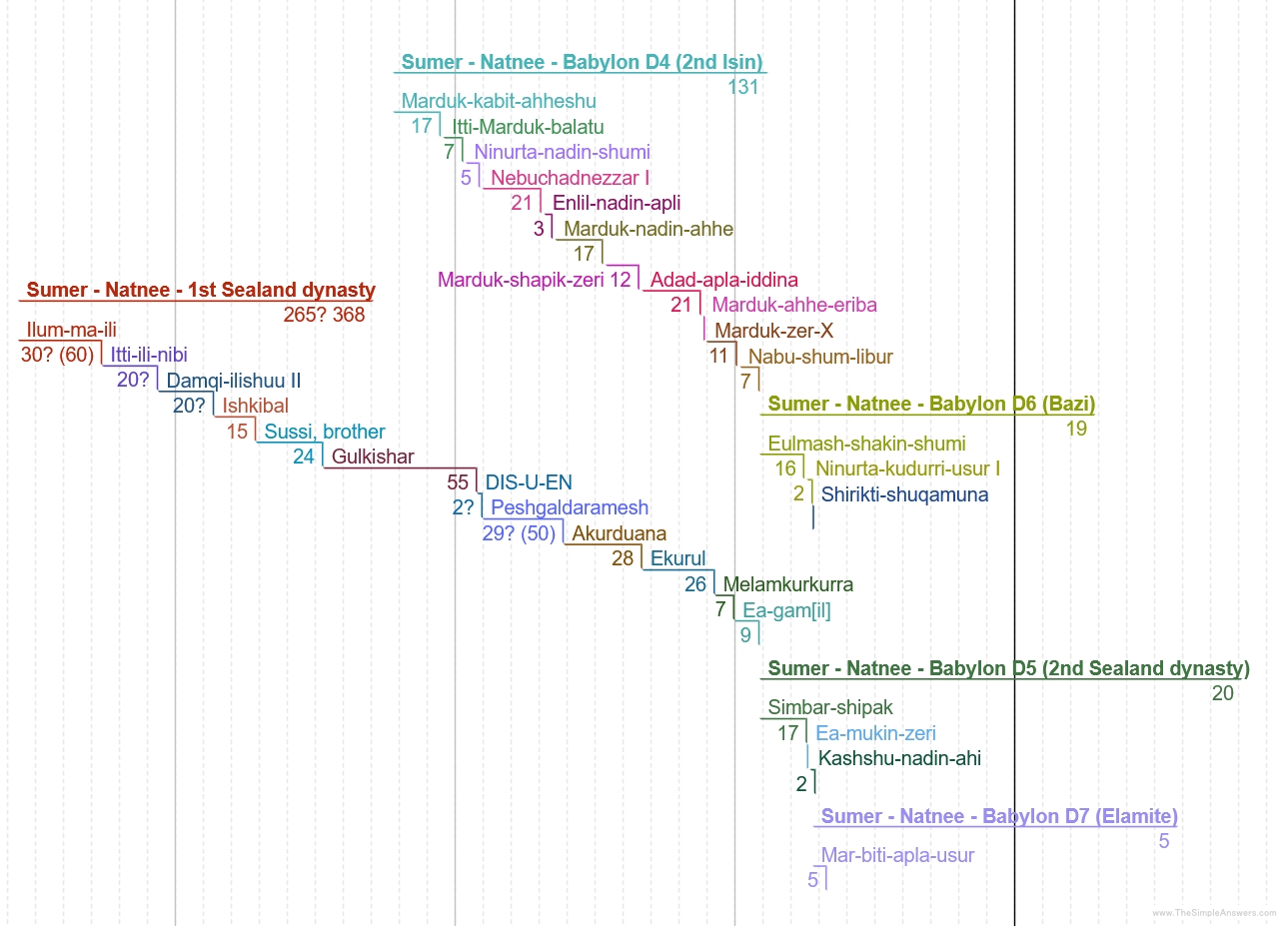
The next dynasty according to King List A is the so‐called Dynasty of E, the term E referring probably to Babylon. King List A contains a major gap at this point, preserving only the length of the reign of the first king (Nabu‐mukin‐apli) and the partly broken names of the last five kings (from Eriba‐Marduk to Nabu‐shuma‐ukin II). It then sums up the royal line as palû of E. The designation “Dynasty of E” occurs only in King List A. The Dynastic Chronicle assigns rulers of that period to shorter dynasties, but unfortunately its preserved portion covers only the eighth century. The Dynasty of E hardly formed a cohesive royal line. Very little information has survived on the family relations between successive rulers. (AHOB)
When historians want to add more or less time to their histories, they tend to wiggle in this area since very little is known. It’s simply a “period of decline,” a “dark age.” We offer a proper explanation; remember, the Kassites conquered all of Babylonia in ‑1060.
The next three dynasties, arranged the way we have them, required only a few decades and by ‑1040 or so they all came to an end, suggesting rapid political reorganization, usually associated with rebellions or turmoil of some sort.
The next three centuries, until the time of Nabonassar in ‑748, are very spotty, historically. So can it be a coincidence that the Kassites were at their most powerful during this exact same period?
KASSITES AND KINGS OF E
A few interactions with these kings and their neighbors such as Assyria are known, but many of these Babylonian kings are completely unknown; what little we do know, however, shows the constant presence of Kassite officials:
The list of officials witnessing the transaction recalls those of Isin II kudurrus; the governor of Isin heads the list, and two high officials are of Kassite descent (from Bit‐Karzi-abku and Bit‐Tunamissah). Another kudurru from his twenty‐fifth year (950) deals with a dispute between two prominent families, one belonging to the Kassite clan of Abirattash. (AHOB)
If you peruse Wikipedia, you will find extensive gaps in the king list of this period. From ‑1040 to ‑900, we really don’t know much, including reign lengths; even the number of kings is debatable. We offer a good explanation: The kings, when they did exist, were weak and unimportant. The first secure anchor comes from…
Since he [Nabu-apla-iddina] was a contemporary of the Assyrian kings Ashurnasirpal II … and Shalmaneser … and his death occurred at the latest in … [the 9th year of Shalmaneser] when Shalmaneser III led a campaign to Babylonia to help his son Marduk‐zakir‐shumi quell a rebellion… (AHOB)
I’ve removed the dates given in the original source so as not to introduce any more confusion. Suffice it to say that we put the 9th year of Shalmaneser as ‑904, meaning that Marduk‐zakir‐shumi was already ruling, giving us at least a rough anchor for this point in the king list.
Once in control Shamshi‐Adad turned against Babylon, where Marduk‐balassu‐iqbi had succeeded his father Marduk‐zakir‐shumi. According to his Annals, Shamshi‐Adad campaigned to Babylonia during three consecutive years. In his fourth campaign [‑865] he engaged in northeastern Babylonia with Marduk‐balassu‐iqbi who had mustered an impressive array of allies; the Annals mention the Kassites, the Arameans, the Elamites, and Namri. The Babylonians were defeated at Dur‐Papsukkal. In his fifth campaign [‑864] Shamshi‐Adad marched again to northeastern Babylonia and after some failed attempts captured Marduk‐balassu‐iqbi at Der and deported him to Nineveh together with the city’s divine statues. Finally in his sixth campaign [‑863] he captured the new Babylonian king Baba‐aha‐iddina and deported him to Assyria. [AHOB]
Again, I’ve replaced the dates with our dates which are 51 years earlier, but otherwise left the quote intact. But let’s pause to note something strange; the Kassites and Babylonians are allies. The Kassite empire has been extinct, in the traditional history, for over 300 years.
Yet here they come to the aid of a Babylonian king, and with Elamite support to boot; that part will become important in a few chapters, when we see that the Kassites and Elamites were closely allied in this period, with a long series of royal marriages between them.
That is, in our history, where the Kassites are at their strongest in this period, with Babylonian vassals and Elamite intermarriages. In their history, the Kassites no longer exist as an organized kingdom, and there is likewise no organized Elamite kingdom in this period either.
After the capture of Baba‐aha‐iddina, who reigned probably not more than a year, the Babylonian throne seems to have become vacant. At this point Chronicle 47 has an entry stating that “there was no king in the country.” An isolated administrative document which might belong to that period bears the date formula “Month Kislimu, twenty‐first day, fourth year when there was no king in the land.” During this interregnum of indeterminate length Chaldean princes asserted their independence. (AHOB)
The length of this time is completely unknown; historians typically put it at around 50 years, to keep it in line with Assyrian history; we place it around 57 years, but this is a complete guess for us as well as them; the fact is no one knows who or what was happening in Babylonian at this point.
For now, suffice it to say that the last dynasties of Babylon were completely ineffectual and meaningless, at precisely the time the Kassites were at their strongest; and when the Assyrians began to be more powerful, we find the Kassites fighting alongside the Babylonians.
The same Kassites who were supposedly defeated by Elamites in ‑1155, and should have been gone from the political landscape centuries earlier.
MOVING THE KASSITES
We’ve offered a tidy solution, with extensive precedent; parallel dynasties in king lists abound in the SKL, BKL, and in the Egyptian king lists as well. But if that’s true, where is all the correspondence between the Babylonians and Kassites?
We would not expect to find much, because in our theory they were allowed to act semi-autonomously. And it’s not expected that they would acknowledge a distant power over them; vassal kings rarely did.
Consider Rehoboam, a vassal of Egypt (2 Chronicles 12:7-9); he acts autonomously throughout the Bible, and never once acknowledges a foreign power which is nonetheless called his master in his own sacred texts.
And when the Babylonian kings warred or were invaded by Assyrians, Elamites, or others, they likewise warred in their own name, even though they paid tribute to Kassites at the same time. So we would not expect to see many Babylonian-Kassite interactions recorded.
Kassite-Babylonian relationships were probably as a rule more like the relationship between Russia and Cuba in the ‘60s, not the relationship between the US and Puerto Rico or Hawaii; Babylon was a dependent ally with a weak monarchy, not an annexed territory.
But few Kassite-Babylonian records are offset by many Kassite-Assyrian records. The Assyrians frequently mentioned Kassite armies during the supposedly post-Kassite period, precisely as we would expect; historians dismiss this as a post-Kassite population, but it actually makes much more sense if this were during the height of the Kassite period.
VICE-KINGS OF NIPPUR
But the main reason the Babylonians have few correspondences with their Kassite overlords is that most of their instructions were probably delivered verbally, from an on-site delegate of the king, not through tablets.
Babylonian kings of the “post-Kassite” period were mostly unimportant rulers who were allowed to play king provided they did what they were told. The real power during this period rested with a Kassite-appointed governor at Nippur called a Shandabakku who seems to have been something like the British Prime Minister today, a prime minister who served the Kassite royalty.
Most of the archival sources dated to the Kassite kings stem from Nippur and any description of the social or economic structure of Kassite Babylonia necessarily depends on these texts … An official named the shandabakku headed the administration of Nippur; he seems to have occupied almost a vice‐regal function, second only to the king in the state hierarchy. We know a number of shandabakkus by name; it appears that the office became hereditary since we have evidence for a father to son succession with the second, third and fourth incumbents in the list. (AHOB)
What’s strange about the office of shandabakku is that despite being a specifically Kassite invention, several Shandabakkus are mentioned in the “post-Kassite” period. It’s almost as if the Kassite bureaucratic state continued 400 years after the Kassites themselves died out.
Another possibility, of course, is that these records are parallel, referring to the same officials for the same period of four hundred years. Because when we take what is believed to be 800 years of Shandabakku records and compress them into 400 years, we would expect there to be unresolvable conflicts – two Shandabakkus at the same time.
But when we take all those Shandabakkus who are mentioned with a Kassite ruler, and all those who are mentioned with a Babylonian ruler, and correlate the Babylonian ruler with the Kassite overlord he must have served, in our chronology, we find that every place we must put a “Babylonian” Shandbakku fills one of the gaps where there is a missing Kassite Shandbakku!
Do you realize the odds of randomly moving a group of individuals 400 years into the future, and having them not overlap with people already living and ruling in that time? Yet fortunately for this theory, there are no overlaps; they fold together like a zipper.
Table 1: List of the known shandabakku officials governing Nippur during the Kassite and Post-Kassite periods as understood by the traditional history.
During the Kassite period (ca 1600-1154 BC)
During the post-Kassite period (1154-732 BC)
Amilatum
father of Enlil-bani
(uncertain date)Nusku-zera-iddina
(Nabu-shumu-libur year 1 or 1033 BC)
Uššur-ana-Marduk
son of Usi-ana-nuri)
(uncertain position in sequence, but early)Nazi-Enlil
(during Marduk-zakir-shumi’s reign, 855-819 BC)
Ninurta-nadin-ahhe
son of Enlil-bani (from Kadashman-Enlil I until Burna-Buriash, 1359-1333 BC)
Enlil-apla-usur
Son of Nazi-Enlil (during the reign of Marduk-balassu-iqbi, 814-813 BC)
Enlil-kidinni
son of Ninurta-nadin-ahhe (from Burna-Buriash, through Kurigalzu II, 1332-1308 BC, until early Nazi-Maruttash, 1307-1282)
Kudurru
(during the reigns of Nabu-nasir, 747-732 BC, and Nabu-mukin-zeri, 731-729 BC)
Enlil-alsa
son of Enlil-kidinna
(attested in Nazi-Maruttash year 8, 1300 BCEteru and Ereshu
(around the time of Kudurru)
Uzi-Shul[gab]
(during Nazi-Maruttash’ reign)
?Shuma-iddina
(executed by Esarhaddon in his sixth year, 675 BC)
Nazi-Enlil
(during Nazi-Maruttash’ reign)
Enlil-bani
Shamash-shum-ukin’s seventh year, c. 660 BC
Ninurta-apla-iddina
son of Nazi-Enlil (Nazi-Maruttash or later, Kadashman-Turgu, 1281-1264 BC, Kadashman-Enlil, 1263-1255 BC)
Enlil-shapik-zeri
(apparently of surru near Uruk and not actually Nippur, during the reign of Nabu-kudurri-usur II, 634-562 BC)
Kadashman-Enlil II
(1263-1255 BC)
Nabu-shumu-eresh
(during the reign of Nabu-na’id, 556-539 BC)
Amil-Marduk
(from Kudur-Enlil, 1254-1246 BC, until Shagarakti-Shuriash’ reign, 1245-1233 BC)
Shiriktu-Ninurta
(from last year of Nabu-na’id [539 BC] until the accession year of Darius I [522 BC])
Enlil-zakir-shumi
(during the reign of Adad-shuma-iddina, 1222-1217 BC)
Enlil-shuma-imbi
Son of Daian-Marduk
(during the reign of Adad-shuma-usur, 1216-1187 BC)
This and the following chart were taken from Displaceddynasty.com’s 7th Mesopotamian paper by Reilly; while he and I disagree slightly, a matter of decades, on specific dates I have left his dates as is for clarity’s sake.
Table 2: List of the known shandabakku officials governing Nippur during the overlapping Kassite/dynasty 4-9 period, as understood by the revised history.
During the combined Kassite/dynasty 4-9 period.
Nusku-zera-iddina
(Nabu-shumu-libur year 1 or 1033 BC)
Amilatum
father of Enlil-bani (uncertain date)
Uššur-ana-Marduk
son of Usi-ana-nuri) (uncertain position in sequence, but early)
x
Ninurta-nadin-ahhe
son of Enlil-bani (from Kadashman-Enlil I until Burna-Buriash, 919-893 BC)
Enlil-kidinni
son of Ninurta-nadin-ahhe (from Burna-Buriash, through Kurigalzu II, 892-868 BC, until early Nazi-Maruttash, 867-842)
x
Enlil-alsa
son of Enlil-kidinna (attested in Nazi-Maruttash year 8, 860 BC
Uzi-Shul[gab]
(during Nazi-Maruttash’ reign)
Nazi-Enlil
during the reign of Nazi-Maruttash (867-842)
x
Nazi-Enlil
During the reign of Marduk-zakir-shumi (855-819 BC)
Ninurta-apla-iddina
son of Nazi-Enlil (Nazi-Maruttash or later, Kadashman-Turgu, 841-824 BC, Kadashman-Enlil, 823-815 BC)
x
Kadashman-Enlil II
(823-814 BC)
x
Enlil-apla-usur
son of Nazi-Enlil (during the reign of Marduk-balassu-iqbi, 814-813 BC)
Amil-Marduk
(from Kudur-Enlil, 814-806 BC, until Shagarakti-Shuriash’ reign, 805-793 BC)
Enlil-zakir-shumi
(during the reign of Adad-shuma-iddina, 782-777 BC)
Enlil-shuma-imbi
son of Daian-Marduk (during the reign of Adad-shuma-usur, 776-747 BC)
x
Kudurru
(during the reigns of Nabu-nasir, 747-732 BC, and Nabu-mukin-zeri, 731-729 BC)
Eteru and Ereshu
(around the time of Kudurru)
?Shuma-iddina
(executed by Esarhaddon in his sixth year, 675 BC)
Enlil-bani
Shamash-shum-ukin’s seventh year, c. 660 BC
Enlil-shapik-zeri
(apparently of surru near Uruk and not actually Nippur, during the reign of Nabu-kudurri-usur II, 634-562 BC)
Nabu-shumu-eresh
(during the reign of Nabu-na’id, 556-539 BC)
Shiriktu-Ninurta
(from last year of Nabu-na’id [539 BC] until the accession year of Darius I [522 BC])
He explains his reasoning in detail for the placement in that paper, so I won’t repeat that argument here. Suffice it to say, the “post-Kassite” Shandabakkus fit far better than they have any right to fit with the “Kassite” Shandakkus, strongly arguing that they are different sections of the same list as seen from different perspectives.
For us, the most significant takeaway from this is that Nazi-enlil was Shandabakku during the reign of the Kassite king Nazi-murrutash (‑878‑853) and also a Nazi-enlil was Shandabakku during the reign of the Babylonian king Marduk-zakir-shumi (‑906‑879).
Historians would say these are different people, with the same name. But aren’t we fortunate that when we put the kings they served side by side, as we must for a host of other reasons, their Shandabakkus turn out to be one and the same person?
Note also the single year difference; suggesting that he was dated to the reign of the Babylonian king because Nazi-murrutash was not yet king, Although we don’t contend that any of these dates are to-the-year accurate, still, it’s interesting.
It’s also interesting that the Shandabakkus are first attested in the reign of Nabu-shumu-libur, the final king of the 2nd Isin dynasty who reigned ‑1068‑1061; given that, within a decade both Sealand and Isin would fall, this suggests that the Kassites created the position of Shandabakku at Nippur specifically to administer their Babylonian possessions in Isin, Babylon, and the Sealand.
Historians cannot provide a need for the Shandabakku, but we can; a power vacuum created by the fall, for whatever reason, of both the 4th and 1st dynasties which just happens to date to precisely the time of the first Shandabakku. Tidy.
KUDURRUS
To keep track of boundaries and land grants, the Kassites invented the kudurru; a pillar-shaped stone with images of the gods and a text describing the land granted, sometimes with a history of the land’s ownership or the reasons for the owner’s rights, followed by curses for those who move or deface the kudurru.
Traditional historians believe they began to be used in the time of Kurigalzu I, if not earlier, whom they date to around ‑1400; yet after the demise of the Kassite kingdom in ‑1155, kudurrus continued to be made, albeit at a slower rate. In fact the last one ever found dates to the 9th Babylonian dynasty four hundred years later in the ‑700’s.
That’s odd; why would a Kassite invention continue to be used after the end of the Kassite period? One might argue that it was such a good idea that the succeeding empire kept it; but if so, why did the neo-Babylonian empire (10th dynasty) abandon it entirely?
One possibility, of course, is that the “Kassite” and the “post-Kassite” period were in fact the same stretch of time. In the previous chapter we cited a kudurru probably dating to the reign of Marduk‐shapik‐zeri (‑1116‑1104), which discussed the situation after the fall of Babylon when…
…the Kassites upset the boundaries of Sumer and Akkad during the reign of Samsu‐ditana and the ground plans could not be recognized and the borders were not designed.
This bit of history was introduced on the kudurru to establish the basis for the claim by going back to when the records were destroyed and all land had to be reparceled out.
But what’s strange is that if historians are right, then five hundred years separated Marduk-shapik-zeri from the events surrounding the fall of Babylon (‑1596, give or take a century, their dates) mentioned on his boundary marker.
This would be the equivalent of going back and citing the story of Christopher Columbus in a legal battle to prove your land claim, and is highly suspicious when you think about how long five hundred years actually is in the real world.
Especially in that world; those five hundred years had seen the rise and fall of dozens of kingdoms and immense turmoil; Kassites, Amorites, Elamites, invasions and destruction of all sorts. Babylon itself had been sacked twice during that time, according in their history.
So why go back so far to the first sacking to prove a legal claim? Why not refer to the more recent Elamite sacking and start from there? Quite simply because there was no Elamite sacking, not at that point in history.
If we’re right, Marduk-shapik-zeri lived ‑1116‑1104, while the fall of Babylon, the only fall of Babylon so far, had happened in ‑1189. A much more likely scenario, still in living memory, just barely.
THE EVOLUTION OF THE KUDURRU
Another point of confusion; historians believe kudurrus were made for around 800 years; you would naturally expect an evolution of form over time, showing a clear improvement of form and style as beliefs and cultures changed – especially after the fall of the Kassites.
We, on the other hand, believe that the 3rd dynasty was parallel to the 4th through 9th dynasties, so we would expect the forms at the beginning of the 3rd and 4th dynasties to be very similar, while the 9th corresponds to the forms at the end of the 3rd. What does the historical record show us?
[A certain kudurru] warrants closer study not only for the light it sheds on the literary language of the dark age between the time of Nebuchadnezzar I and the Chaldean kings, but also because a shadow of doubt continues to hang over the authenticity of the text. The following analysis strongly suggests that BBSt., no. 36 is indeed an authentic product of the ninth century B.C.E.; so true is the orthography and grammar to the standards of the MB [Kassite] kudurru corpus, that the text appears to be well beyond the skills of the much later Chaldean forgers who produced such flawed works as the Cruciform monument.
It is clear that Nabû-apla-iddina not only resurrected the kudurru as a means of commemorating land grants, privileges, and incomes, but also revitalized the archaizing Middle Babylonian dialect in which such entitlements were traditionally expressed; for despite its firm, albeit early, Neo-Babylonian date (ca. 856; year 31), the language of the text is nearly identical to that of the MB kudurrus of several hundred years earlier. In accord with the poetic style of the narrative and imprecations, in some instances the text displays characteristics of SB as well as other purposeful OB archaisms. (The Sun-God Tablet of Nabû-apla-iddina Revisited, Woods)
Remember that “dark age?” This kudurru sheds light on that period. And what light does it shed? That in that dark age, they used “language … nearly identical to that of the MB [middle Babylonian, i.e. Kassite,] kudurrus of several hundred years earlier.”
Another pro tip for reading history: whenever a historian says “archaizing,” that’s code for “this work looks like it belongs centuries earlier, but our chronology forces us to place it far later.” Hence, the only solution they will consider is that it was made out of nostalgia for a better time, which is called “archaizing.”
To us, we see that as an opportunity to set the record straight; if it looks like it was made in during the 3rd dynasty it probably was, because the 8th dynasty existed at the same time, meaning the kudurru could have literally been made by the same person!
But to them, “a shadow of doubt continues to hang over the authenticity of the text.” Why? Not because of any internal evidence, but because of what the text itself says: that it was written with a language and made in a style that, in their understanding, should have died out half a millennium earlier.
Archaizing, indeed.
We find this word frequently in Egypt, where the 11th and 12th dynasty produced works shockingly like those of the 5th and 6th dynasties; this was also called “archaizing,” portrayed by historians as “a conscious effort to hark back to the glory days of the old kingdom.”
But our work has proven that there was much overlap in time between these dynasties they believe to be separated by hundreds of years; the fact is, the work was not made to look like that work done in earlier workshops; it was literally done in the same workshops, by the same craftsmen.
So where historians see a developmental sequence of kudurrus from a pre-canonical phase through proto-canonical, canonical, paracanonical, re-canonical, and late archaizing… We see the “archaizing” as being contemporarily with these other phases, simply done by a poorer, vassalized kingdom in a different region.
HEIRLOOMS
When archeologists find something that doesn’t fit their theories, they have a bag of tools with which to dismiss it. One of their favorites is the “heirloom” theory. The idea goes, if you find an obviously ancient object in a much later setting, it must have survived for centuries; perhaps as a family heirloom.
The other alternative, of course, the obvious one, is that the objects were not separated by nearly as much time as their theories demand. Case in point: the Kassite heirloom.
Remnants of two Kassite glass beakers were found during the 1964 excavation in a (c. 800 BC) destruction layer of Hasanlu, in northwest Iran. The mosaic glass beakers are thought to have been heirlooms, possibly for ritual use the find spot being a temple. The panes of glass used to create these images were very brightly colored, and closer analysis has revealed that they were bright green, blue, white, and red-orange. A Kassite text found at Dur-Kurigalzu mentions glass given to artisans for palace decoration and similar glass was found there. Other similar glass dated 1500 BC was found at Tell al-Rimah. (Wiki, Kassites)
It’s starkly impossible, in the traditional timeline, for these to have been contemporary. But if we remove 400 years from the timeline, suddenly ‑800 falls right into the late Kassite period, making it perfectly reasonable why Kassite glass beakers were found in the ‑800’s – because they had been made not long before.
The alternative is that in a highly unstable and war-wracked area, heirloom objects made of the most fragile material were kept intact for half a millennium while in regular use in a temple while entire civilizations fell around them.
Which do you find easier to believe?
TYPOS
Another of their favorite excuses is “scribal confusion.” This is when a king who doesn’t belong in a story shows in up in it, which would cast serious doubt on the traditional timeline; a quick solution: the scribe was confused with an earlier king.
Neo-Babylonian copy of a literary text which takes the form of a letter… addressed to the Kassite court by an Elamite King and details the genealogy of the Elamite royalty of this period. … The author of the letter is thought to be Shutruk-Nahhunte, ca. 1190-1155 BC, who claims descent from Kurigalzu’s eldest daughter and also wed the eldest daughter of Meli-Šipak, the 33rd Kassite king. Unfortunately the letter inserts Nabu-apla-iddina (888 – 855 BC) “an abomination, son of a Hittite,” into the narrative in the place one might have supposed that Marduk-apla-iddina I was to appear, the substitution of dAMAR.UTU by dAG being an unlikely slip of the stylus, making a chronological conundrum and this may be the purpose of the “letter,” to denigrate the later king through the tongue of the earlier one. (Wikipedia, Kurigalzu I)
Let’s unpack this, since it’s a great story. According to them, during the late Kassite period, a letter is sent by an Elamite king to the Kassites, a few generations after Kurigalzu I the Kassite. But as part of the rant the Elamite king goes off on, he attacks Nabu-Apla-Iddina, a late Babylonian king who ruled 300 years later – in their timeline.
Clearly, the most orthodox scholar must admit this is odd; how can a letter written in the 12th century BC talk about a king who ruled in the 9th century BC? It is quite obvious that this is impossible, and the best answer to this grave problem that scholars have?
“An unlikely slip of the stylus.” In other words, an improbable typo; like when you’re spelling “Marduk,” but you accidentally spell it Warduk, accidentally inserting a letter from the other side of the keyboard!
We have a simpler explanation; the letter was written in the 9th century BC; and Kurigalzu I and Nabu-apla-iddina were contemporaries. Precisely as they happen to be in our timeline for completely unrelated reasons.
Since their explanation is patently ridiculous, they try one more explanation at the end – that this is a “literary” (read: fictional) document might have been composed in the 9th century “to denigrate the later king through the tongue of the earlier one.”
So let me get this straight; their alternative story is that a scribe in the 9th century thought it would be very clever to invent a letter by a king from four centuries earlier, complete with complicated genealogy and court drama…
…solely for the purpose of indirectly insulting a 9th century using the tongue of a 12th century king from another country??
If you buy that… well, you know the old line about bridges.
The easier answer is that they were contemporary, and the Elamite king likewise lived in the 9th or 8th century BC, which we have many reasons to believe – and will explain in the chapter on Elamites.
But just in case the “typo” answer or the “court satire” didn’t settle your doubts, historians have one final trick they always pull out:
There are some concerns over the authenticity of this “letter” as it makes a derogatory reference to a later king, Nabu-apla-iddina, ca. 888 – 855 BC. It may, however, preserve some traditions of the period. (Wiki, Zababa-shuma-iddin)
Let me be clear; there is no reason whatsoever to doubt the authenticity of this letter except that it says things historians don’t want to accept: that their timeline is off by more than 400 years. So their best answer is simply to cast doubt on the source…
…which they would not doubt at all if it agreed with them.
Objective science, indeed.
KARDUNIASH
The name for the region of Babylon under the Amorites and earlier was either “māt Akkadim” (land of Akkad) or “māt Bābili (m)” (land of Babylon). The Kassites however spoke a different language, probably of Indo-aryan descent, and they called Babylon Karduniash.
I want to make this explicit: Karduniash was a foreign term for Babylon, not a Babylonian term. This name was imposed by their conquerors; so why then was the term Karduniash used 400 years after the supposed end of the Kassite period?
King of Karduniash (šar Karduniaš) – refers to rule of southern Mesopotamia as a whole. ‘Karduniash’ was the Kassite name for the Babylonian kingdom, and the title ‘king of Karduniash’ was introduced by the city’s third dynasty (the Kassites). The title continued to be used long after the Kassites had lost control of Babylon, for instance as late as under the native king Nabu-shuma-ukin I (r. c. 900–888 BC) and the Neo-Assyrian king Esarhaddon (r. 681–669 BC). (Wiki, List of kings of Babylon)
The term was widely used by Babylonians and foreigners throughout the period leading up to the end of the ‑700’s; then suddenly it vanished, and the Babylonians called themselves Babylonians again, or Chaldeans (the dominant ethnicity of the time).
Why wouldn’t the Babylonians of the 4th dynasty, upon ousting the 3rd dynasty as historians believe, proudly proclaim the identity of their land in their own language? Instead, they continued to use the foreign name for their country for 400 years more.
In addition, many supposedly Babylonian rulers of the post-Kassite period had Kassite names, exalting Kassite deities; doesn’t that strike you as odd, when ethnic Babylonians had no reason to love the Kassites who oppressed them for three centuries or more – much less to keep them as soldiers and public servants for an additional 400 years?
Doesn’t it seem strange that the Kassite name for the region, the Kassite bureaucracy, the Kassite Shandabakkus, Kassite Kudurrus, Kassite names… all of these survived far beyond the Kassite period but all ceased utterly to be used after 400 more years?
The Kassite period ended, according to them, in ‑1155; yet they are mentioned frequently in later texts throughout the supposedly post-Kassite period. But if we are correct, then the Kassites were a powerful, often dominant force throughout that period, ending somewhere around ‑734.
One would expect that, when the empire was crushed, the people would be killed, moved, absorbed into the new society or otherwise disappear as a people. In their history, that doesn’t happen for four hundred years, until… suddenly it does.
The final mention of the Kassites as a powerful ethnic group comes from the annals of Sennacherib; we would date this to ‑713 (historians would say ‑703, but for reasons we will discuss in the proper place, this had to be ‑713, at the beginning of Sennacherib’s co-reign).
On my second campaign, the god Aššur, my lord, encouraged me and I marched to the land of the Kassites and the land of the Yasubigallians, a dangerous enemy who since time immemorial had not submitted to the kings, my ancestors. In the high mountains, difficult terrain, I rode on horseback and had my personal chariot carried on (men’s) necks. In very rugged terrain I roamed about on foot like a wild bull.
I brought down from the mountains the people of the land of the Kassites and the land of the Yasubigallians who had fled from my weapons and I made (them) dwell in the cities Ḫardišpu (and) Bīt-Kubatti. (Royal Inscriptions of the Neo-Assyrian Period)
Note the story here: this is a powerful people, the Kassites, above 400 years after their period ended! Who were still a “dangerous enemy,” who “since time immemorial had not submitted to the kings, my ancestors” – the kings of Assyria.
Hard to believe that a minor, conquered people had such power, particularly when those mountainous regions were regularly visited and conquered by Assyrian kings during that time. Where, we wonder, were these Kassites hiding?
Of course, it’s not hard at all to explain in our story; because the last king of the Kassites died just a decade before this campaign. Which is why the Assyrian king says the Kassites “had fled from my weapons,” to these rugged mountains, in their ancestral homeland, where Sennacherib chased them to put an end to the dynasty once and for all.
Whereupon their history records no more Kassite bureaucracy, no more kudurrus, no more Kassite armies, no more Kassite names in positions of authority… because the 3rd dynasty of Babylon had finally ended.
KASSITE COREIGNS
Historians have a bias against co-reigns, taking the stance that they did not exist until conclusively proven otherwise. In the textbooks, you will read that Kassite co-reigns did not exist. We will demonstrate that they did.
The practice of a co-reign is a time-honored practice were an ailing king, before his death, chooses his heir and makes him junior co-king. This way, when he dies his son is already well established on the throne.
It is almost certain that this happened in practice in every culture, but some cultures counted their reigns in such a way that it was not a problem for chronology; by counting only the years of sole reign, no overlaps are possible.
But not all cultures did that, not wanting to take away years from a king that he technically ruled, even if it was jointly. So some cultures wrote down the entire length of the king’s reign, including co-reign, and if we add all those reigns up we get an unexpectedly long series of reigns that doesn’t reflect chronological reality.
The best proof of co-reigns is so-called double-dating – where a document is dated something like “year 6, month 3, day 1, year 3, month 3, day 1.” The two sets of dates here often indicate the first year of his co-reign with the first date, and the second date counts from his sole reign.
Rowton has suggested that a date such as MU.4.KAM.2.KAM be interpreted as “the fourth year (after) year 2 (when) RN (became) king” and that the second ordinal number in each case represents the years of a coregency of the king with his predecessor. There is no question that these three kings represent successive generations of the royal family, which occupied the throne one after the other. But Adad-šuma-uṣur came to the throne as the result of a rebellion against the Assyrians, and a coregency immediately preceding his accession would be quite unlikely in this case. (MSKH)
In other words, this looks like a co-reign, but it cannot be one because the circumstances of Adad-shuma-usur’s reign makes that “quite unlikely.” However, the document in question – Chronicle P – does not refer to this king, but a different one, as you will learn very soon. That fact makes this objection irrelevant, and restores this as proof of Kassite co-reigns.
According to Brinkman, the author of the above quote, the kings whose date formulas we have found specifically are Adad-shuma-usur, Meli-shipak, Marduk-apla-iddina, and Kadashman-turgu, each of whom show a 2 or 3 year co-reign with their predecessor.
Since there was a consistent pattern during these successive kings, we could infer this applied to all of the Kassite kings and significantly shorten the overall timespan if that should prove necessary.
For now, we will apply only the known co-reigns to our timeline, but we reserve the right to adjust later if needed. This shortens our timeline for late Kassite kings by about a decade, which will help to fit with the Elamite kings they interacted with when the time comes.
Speaking of making adjustments, there is considerable wiggle room in the lengths of some kings. The BKL gives us reign lengths for many Kassites, which are generally confirmed by dated economic texts, but for some…
The length of the fourth reign [Kadašman-Enlil II] is in doubt; we have given above reasons for believing that it lasted nine years, though it has occasionally been assigned a length as high as fifteen years. (MSKH)
For reasons of making things fit, I prefer the 15 year age. The point is that ancient history is as much art as science; many things are absolutely impossible to nail down with certainty, and a decade here and there can always be gained or lost.
We don’t intend to be dogmatic about any of these dates in the early 1st millennium; the Kassites, Babylonians, Hittites, Mittanni, and so on are too reliant on one or two uncomfirmed texts to claim certainty. Historians are wrong to do so.
For our part, in the 10th century BC we are only truly confident about the dates of Egypt and Israel, with Assyria a close third. Our sole purpose in this entire work is to demonstrate that without doing too much violence to the original sources – far less than historians do, as a matter of fact – all these cultures can fit into the 1st millennium comfortably.
THE END OF THE KASSITES
That being said, we are forced by the Amarna letters, which connect the Kassite kings Kadashman-enlil and Burnaburiash to Amenhotep III and Akhenaten of Egypt, to date the end of the dynasty somewhere around the year ‑725‑745, give or take.
The Assyrian annals give us a precise year for the last mention of the Kassites; Sennacherib chased them into the Kassite homeland in the mountains, where they had fled. This was probably no less than a year, no more than a few decades, after the fall of the Kassite empire, which means that ‑714 is the latest-possible date to place the dynasty.
For the earliest-possible date we need to discuss the Ra’ash briefly. This is the Hebrew word poorly translated the “the great earthquake” in the Bible, though it was far more than that. It was a natural disaster of literally apocalyptic proportions that caused chaos from Italy to Elam, and Assyria to Egypt.
It was the sort of thing that caused record-keeping to stop, and survival became a priority for everyone. Historians know it as the start of the “late bronze age collapse,” which we are certain happened in ‑797 since it was described in detail by the Hebrew prophets Amos, Hosea, and Isaiah, and referenced by others.
Historians use this to explain why there is a 400 year dark age in every civilization in the Middle East, but while the disaster happened, the supposed dark age that followed it did not; depending on how badly the civilization was struck by the disaster, it lasted 40 years at most.
We will discuss this in great detail in the future, but for now to date the Kassites we need to look for clues that they experienced this catastrophe, and we are not disappointed. We find one mention in Wikipedia, in the reign of Meli-shipak:
Meli-Shipak’s rule is understood to have been peaceful. Not so for the edges of his kingdom, where the catastrophic collapse at the end of the Bronze Age was starting to dramatically unfold with many of the cities of the Levant experiencing destruction. The city of Emar, situated in northern Syria, was sacked and a legal document was found on the floor in a private house there, dated to his second year. The tablet (Emar 26, found in House 5 of Chantier A) was made of local clay and is a short-term contract involving a teacher, Kidin-Gula. Historian Daniel Arnaud has concluded that only a very short time (“weeks”) elapsed between its preparation and the cataclysmic destruction of the city by “hordes of enemies.”
Despite the carnage wrought by the times on mighty empires such as that of the Hittites, whose capital Hattusa was sacked around the middle of his reign, there continued to be scribal and construction activity in Babylonia. … (Wiki, Meli-shipak)
This tells us that the 2nd year of Meli-shipak was certainly after ‑797, which gives us an earliest-possible date of ‑771 for the end of the Kassites. So far, we have three witnesses; the Assyrian destruction, the Ra’ash of Meli-shipak’s 2nd year, and the Amarna correspondences which all agree and provide us with us a maximum of 54 years for a margin of error.
But we can do better. The after-effects of the Ra’ash (the Hebrew word for the event) lasted for decades; so Meli-shipak’s 2nd year could have come decades after the Ra’ash, and probably did. He was the 33rd Kassite king; did his predecessors experience anything we can connect to the precise year of the Ra’ash?
The years from Burna-Burias II (No. ?19) year 3 through Kastiliasu (No. 28) year 8 are abundantly covered by dated economic texts, averaging more than ten texts per year for slightly more than 130 years. The reigns of the other kings listed (Nos. ?18, 30-34) are not well documented by economic materials: about 40 texts covering a total of six reigns and at least 80 years, averaging about one text every two years. (MSKH)
So the Kassites produced an average of 10 texts per year which have survived to us for 130 years. Then suddenly with kings #30 and onward it drops to an average of one every two years – that’s 1/20th of their former output. Certainly something big happened, quite a while before Meli-shipak.
The next seven kings [starting with Kurigalzu II], spanning slightly more than a century, account for the vast majority of texts of the dynasty. Over 90 percent of the dated texts in the Nippur economic archives fall during these years, with heaviest average concentration toward the close (Kudur-Enlil through Kastiliasu IV, Nos. 26-28). (MSKH)
This was the time of their greatest prosperity, and also the period of the best-attested Shandabakkus. So towards the end, we have more records; naturally enough, because more recent records are almost always better preserved. Then, on the footnote to this paragraph, he continues…
About 1200 dated economic texts from Nippur come from this time, as opposed to approximately 85 dated texts for the rest of the dynasty (almost all of which come from the reign of Burna-Buriaš II, No. ?19). The reigns of Kudur-Enlil, Šagarakti-Šuriaš, and Kaštiliašu IV (Nos. 26–28) average more than 15 texts per year, though the average for Kaštiliašu drops sharply after his fourth year. … For the final period of the dynasty (kings 32-36), the most important contemporary records are the kudurrus. Economic texts slow to a mere trickle. (MSKH)
This suggests that something serious happened to cause economic texts to almost completely stop in the 4th year of Kashtiliashu IV – yet not so serious it caused it to completely stop, or end the dynasty which would persist for another 63 years or so.
Historians believe it was caused by a war with Assyria is what historians believe and afterwards controlled Babylon for seven years; this is based on the misinterpretation of a document called Chronicle P, which you will get to know very well soon.
And also based on the belief that Tikulti-ninurta I warred with Kashtiliashu IV, which we will address in the chapter on the Assyrians; suffice it to say Tikulti-ninurta warred with a Kashtiliashu, but it was not the fourth king by that name.
But it’s hard to see why such a defeat – which was, in the traditional history, reversed in seven years leaving the Kassites independent once more – caused economic texts to “slow to a mere trickle” for the entire rest of the dynasty.
On the other hand, if the 4th year of Kashtiliashu was the year of the Ra’ash, then we snap that date to ‑797 and we find that the end of the Kassite empire was in ‑734 when Enlil-nadin-ahi was conquered by the Elamite king Kutir-nahunte.
The Assyrians were growing exponentially more powerful at this time, and all of the lands of the former Kassite lands were snapped up over the next 20 years, ending with the pursuit of the last Kassite refugees in their mountainous homelands in ‑713.
A good fit. Far better than the four hundred and twenty years historians would have us believe they survived beyond their empire.
MERODACH BALADAN
For my Biblical audience, I have saved the best for last. In the time of Hezekiah the Assyrians were besieging him in his 15th year, around which time he became deathly ill; thanks to a miracle, the Assyrians left, and he recovered, around the same time (2 Kings 19-20, Isaiah 37-38). Based on the Bible’s internal dating, we date this to ‑712.
Isaiah 39:1 At that time, Merodach Baladan the son of Baladan, king of Babylon, sent letters and a present to Hezekiah; for he heard that he had been sick, and had recovered.
Historians universally agree this is a Hebrew corruption of the Chaldean name Marduk-apla-iddina II, a well known king from the 9th dynasty of Babylon who was the enemy of the Assyrians and ruled from ‑722‑710 in the traditional history, which we fully agree with.
Markuk-apla-iddina II was engaged in a rebellion against Assyria, and anyone who could send the Assyrians fleeing was someone he wished well from the bottom of his heart. A few years after the Hezekiah incident, the Assyrians eventually conquered him and he fled to Elam and returned successfully for a brief rule in ‑703 before being completely conquered by Assyria.
What’s interesting for the chronology is that the Bible calls him the son of another Baladan, certainly another king with the ending apla-iddina, and presumably also a king named Marduk-apla-iddina.
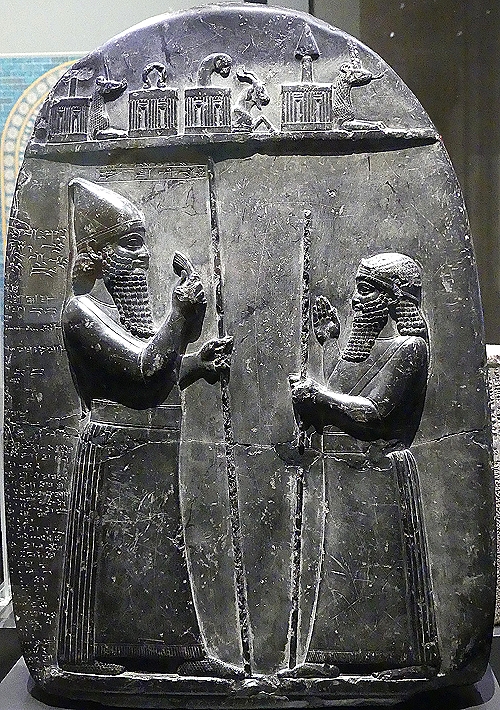 The problem is, this name is nearly unique in the history of Babylon; none of his recent predecessors had a related name who could be the Biblical Baladan. Only one other king with this name exists, but he was a late Kassite king, ruling over 400 years earlier.
That is… in the traditional history.
But if we move the Kassites forward to match the Ra’ash and the other things mentioned above, then we find that Marduk-apla-iddina I, a Kassite king, ruled from ‑750‑738, shortly before the reign of Marduk-apla-iddina II the Babylonian king, who was therefore “Merodach Baladan, son of [Merodach] Baladan.” You will find a picture of the younger king aboveat right on a kudurru (he is the larger figure).
Without properly placing the Kassites in history, the Bible’s reference to the elder Baladan cannot be explained. Without the Bible, we cannot be certain there is a connection between Baladan the Kassite and Baladan the Babylonian.
Using them both, we have a powerful synchronism that anchors people in history where they ought to be.
[Editor’s note: there are literally hundreds of pages of things that can be added to these arguments; many connections, major and minor, can be added to strengthen these arguments. I have chosen the easiest and most interesting, but if you want the rest I refer you to DisplacedDynasties.com for hundreds more pages of evidence.]

This is part 23 of The History of the World Series
 Hammurabi and the Dynasties of Babylon
  Moses’ Return
  The Exodus
  The Birth And Youth of Moses
  What Is The LOVE Of God?
  Everything You Believe About God Is WRONG!
  Make Up Your Mind!
  What Is Faith?
  How DARE you FEAR the judgment of God!
  Firstripe Figs
  The Bride Of The Father
  Exodus 40 – The Plan Of God
  The Temple Of God
  Pillars Of The Temple And The Brass Sea
  GEHENNA WITH ‘EM
  When Did God Forbid Polygamy?
  When You Shouldn’t Pray For Someone
  The Sins of the Father
  The First Paul