Moses’ Return
This is part 21 of the The History of the World Series
; The History of the World is part 1.
Click here to read in series
While I believe in miracles, simply listening to the Bible allows us to explain most, if not all, of them with lived human experience. The miracle is nearly always in the timing, not in the event itself.
For example, “fire falling from heaven” with Elijah is simply lightning. A “pillar of cloud” is most likely a dust devil, a common sight in the desert. The river turning to blood, much like the sea turning to blood in Revelation, is almost certainly an algal bloom. And so on.
Exodus 3:2-3 The angel of Yahweh appeared to him in a flame of fire out of the midst of a bush. He looked, and behold, the bush burned with fire, and the bush was not consumed. Moses said, “I will turn aside now, and see this great sight, why the bush is not burnt.”
And so, after Moses’ nearly 40 years in Midian, when God called him out of a burning bush, I don’t rule out that this could actually be a miraculous event, but it’s also possible – and much more in keeping with how God works – that it was something which to Moses, seemed to be burning.
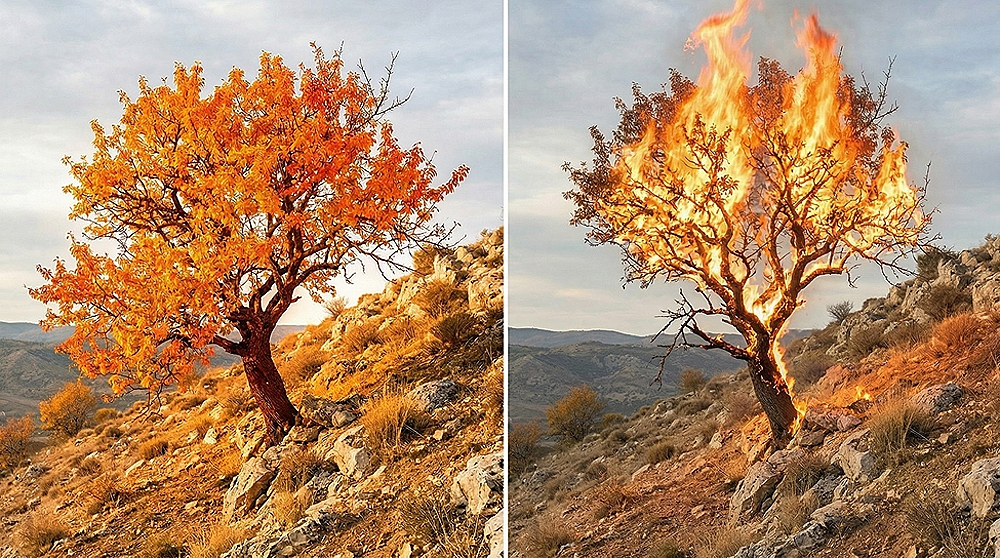
For reasons I discuss at length in another work, the burning bush was probably an almond tree. And when almond trees lose their leaves, they look the color of flame – and when the wind blows, they dance like flame. This has not been lost on poets of any age.
“…the maple tree is new. Come autumn and its leaves will turn to flame.” (Clive James)
So certainly a “burning bush” would be no stretch for fall colors. Yet Moses seemed genuinely surprised by this unusual event. Why would Moses be so in awe of fall colors? Well, remember, Moses was from Egypt. Almonds are not native to Egypt; indeed, in the Nile region there are no native deciduous trees, so no autumn color to be found.
They do not even have autumn, in the temperate-zone sense. So it’s entirely possible Moses had never seen a tree shedding its leaves before! Which, of course, explains why it “was not burnt.” Because it was not, in fact, on fire – it just seemed to be, from a distance.
Literally flaming bush or not, God spoke to him from the bush, Moses protested he wasn’t worthy, God got a bit testy and said “fine, let Aaron talk for you, I know he can speak!” (Exodus 4:14). God can use sarcasm in a pinch.
So he told his father in law he was leaving, and took his wife with him (verse 20). Then – very strangely – God tried (and somehow failed?) to kill Moses. Which suggests He didn’t try very hard (verses 24-26).
The Bible tells us nothing about why God was angry at Moses, but the fact that Zipporah angrily circumcised their sons suggests that God had commanded Moses to do it, Zipporah didn’t want him to, and so he had been dragging his feet about it.
Interestingly, she is not mentioned again until her father Jethro brings her to Moses from Midian after the Exodus. Which means after this event, she returned home with her children and did not go on with him to Egypt as planned; which suggests marital problems of some sort.
But the circumcision of Moses’ sons raises an interesting side point; the Bible does not record that Moses ever circumcised a single person – not even his own sons. In fact, for the entire time Moses was in charge after leaving Egypt, not one Israelite was circumcised; not until Joshua led them into the Promised Land (Joshua 5:2-7). Just a #funFact.
THE MOUNTAIN OF GOD
Back to the narrative, this took place when they were staying at their version of a Motel 6. This means they had already left Sinai, and were well on their way to Egypt. Otherwise, why stay at an inn? Clearly, they had left home – and Mt. Sinai – far behind.
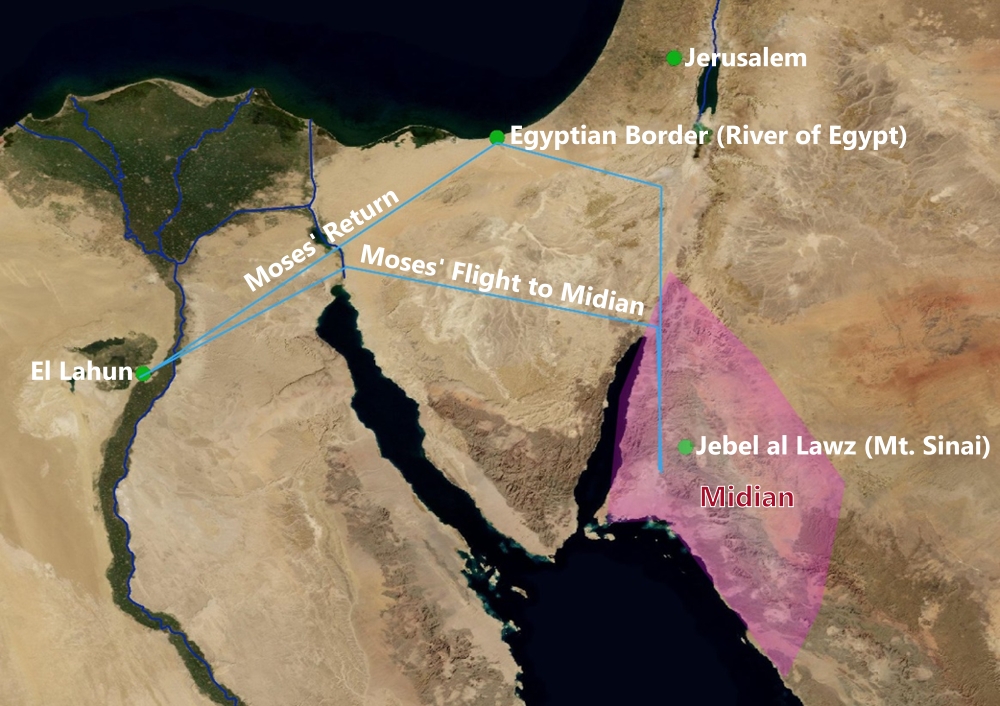
Meanwhile, God told Aaron, still in Egypt all this time, to go meet Moses halfway (Exodus 4:14, 27-28). Indeed, Josephus tells this part of the story…
Now when they were near the borders [of Egypt], Aaron his brother, by the command of God, met him, to whom he declared what had befallen him at the mountain, and the commands that God had given him. But as they were going forward, the chief men among the Hebrews, having learned that they were coming, met them. (Josephus)
So Moses had nearly reached the border of Egypt; generally, this border was seen as at the “river of Egypt” between Israel and Egypt.
They had certainly left Midian; they were far enough away from home to have to stay at an inn, which they would not have found anywhere in the wilderness of Sin which was, you know… a wilderness. The same goes for the route across the Sinai, the way Moses came the first time; it was barren and desolate. And wildernesses don’t have enough traffic to support inns!
Which means their meeting – the first meeting with Aaron in 40 years, it seems – must have happened near a major trade route – inns require regular travelers. The main trade routes of the day ran across Palestine and along the sea coast, connecting Egypt with Mesopotamia.
Exodus 4:19 Yahweh said to Moses in Midian, “Go, return into Egypt”; … Moses took his wife and his sons, and set them on a donkey, and he returned to the land of Egypt. … It happened on the way at a lodging place, that Yahweh met Moses and wanted to kill him. … Yahweh said to Aaron, “Go into the wilderness to meet Moses.” He went, and met him on God’s mountain, and kissed him.
I stress this, because the Bible says something very odd in that passage I just quoted – it said that Aaron “met him in the mount of God.” This cannot be Sinai! Sinai was far, and I mean far, behind them. Every bit of evidence places them far from Sinai.
Josephus places the meeting at the border of Egypt, which agrees with the Bible’s description that Moses was returning to Egypt. And yet the Bible says Aaron met Moses “at the mount of God.” If this wasn’t Sinai – and it can’t have been – then where was it?
Remember, Sinai wasn’t the only mountain of God in the region. Abraham – as Moses and Aaron would certainly have known – nearly sacrificed Isaac on Mount Moriah, which Moses’ own pen told us was called…
Genesis 22:14 And Abraham called the name of that place Jehovahjireh: as it is said to this day, In the mount of the LORD it shall be seen.
And in Moses’ song, he made it clear that Jerusalem – the site of Mt. Moriah, where the temple was later built – was the Lord’s mountain (Exodus 15:17). Jerusalem, which was, at that time, a thriving city where one might find an inn to stay at!
Remember, they had no cell phones, no way to arrange a meeting point. Indeed, the only reason they were meeting at all is because God sent them to meet each other. God must, therefore, have arranged for them to meet at a certain place they both knew!
A place from their own ancestral history – the sacrifice of Isaac – would be a prime location, which just happens to be on well-known trade routes. Thus, it seems to me that the Bible records Aaron and Moses meeting after 40 years with great joy in the mountain of the Lord at Jerusalem.
One of them having just left Sinai, the dwelling place of the Father, the Lawgiver; and one having just left Egypt, the future high priest leaving behind the dwelling of sinners. That has to mean something.
But that’s for another day.
THE END OF THE YEAR
A few chapters ago, I showed how Moses invented the alphabet. What I didn’t mention is that we have actual glyphs which may have been written by Moses himself. How cool is that?
The earliest Proto-Sinaitic script, as Moses’ script was called, has been found in three places; Wadi el-Hol, in southern Egypt towards Thebes; in el-Lahun, unsurprisingly; and in Serabit el-Khadib, on the Exodus route towards Midian. Of these, the last are by far the most interesting.
Right [Correct], do Ba`alat’s pleasure [bring joy to Ba`alat] but there is no strength! – They deserve to die [lit: their judgment is death].” (translation following Michael Bar-Ron)
As I understand that translation, it’s basically saying “Go ahead! Serve Baal – but you will not prosper, and the judgment of such people is death.” A theme which is repeated many times in the Bible (Joshua 24:15, Judges 10:14, 1 Kings 18:21, for instance).
The one who bound [in captivity] was removed. Then the year ended, [and] ended [no more] were those who strayed to Ba`alat! (translation following Michael Bar-Ron)
It is interesting that among the first Hebrew inscriptions in the world are references to the captivity being removed – that is, after all, why they were in that exact spot at that exact time, because they had just been freed.
The inscriptions were probably there because Serabit was a very important mining colony, one known to have large numbers of Hebrew slaves. Moses stopped on the way – probably at the stop called “Succoth” – to gather them into the fold before leaving Egypt.
The second part of the inscription, which is the main content of the others I won’t quote here, is a condemnation of the worship of “Ba’alat,” a Canaanite goddess which translates as “the Lady,” i.e., the queen of heaven; the goddess whom Israel never ceased going a-whoring after.
Every inscription contains curses against those who worship “Ba’alat”; in Egypt, this Lady was identified with Hathor – represented as a golden cow, whom they would very shortly be sinning with at Sinai.
THE YEAR ENDING
But the central phrase in that last passage was “then the year ended,” which apparently resulted in the death of those who served Hathor. Which year was this which had just ended? In context, it would have to be the ten plagues. Did they really take that long?
Reading the Bible in the most conservative way possible, the plagues required no less than a few weeks, perhaps a month; and this is the way I used to read it; like I assume most casual readers did.
But in the last chapter we showed that the plagues were extreme versions of the annoyances of living on the Nile in a given year; so if these were, indeed, semi-natural events tied to the yearly flood cycle, then they would have taken about one full year.
God probably appeared to Moses in the burning bush near Sinai around the Passover season – April or so; this is consistent with when a tree would shed its leaves in Arabia, before the hot, dry season.
God routinely interacts with people around holy day seasons (for example, the fall of Babylon and Daniel’s writing on the wall on the day of Atonement; the anointing of Saul on Pentecost (the time of the wheat harvest); Abraham’s sacrifices in Genesis 15 on Passover, 430 years to the day before the Exodus (Galatians 3:16-17); etc.).
So a full year accords well with the time required to pack and leave Midian, meet Aaron, travel to Egypt, and announce the first plague of water turning to blood just before the low season of the Nile in June.
And an entire year from Moses’ call at Sinai to Moses’ stop at Serabit after the Exodus explains why Moses wrote at Serabit “the one who bound in captivity was removed, then the year ended.” Because the year that began with the burning bush (the Hebrew year begins around March/April) now ended with them leaving Egypt.
When Moses returned to Egypt, around 10 months before the Exodus happened, his first stop was to meet with the elders of Israel (Exodus 4:29-31). He would have certainly shared his new alphabet with them, which at least some of them embraced as the technological and cultural leap forward that they were.
This explains why we find an inscription at Wadi-el-hol, south towards Thebes; and at el-Lahun itself. These were pre-Exodus inscriptions, made by the Hebrews there in the months before the Exodus.
It also explains why those symbols seem cruder than the ones at Serabit; they were earlier in the formation of the script, or else being practiced by those less familiar with them. These symbols would have had the added benefit of being unknown to the Egyptians, thus a way for the slaves to communicate with each other in a literal secret language. Not only was it in a language they didn’t speak, but in a script they didn’t recognize.
While he was waiting for the Exodus, Moses must have looked up his Ethiopian wife and brought her out of Egypt with the rest of the Hebrews, since there is no indication she was in Midian all this time.
Then over the course of the next nine months various plagues came and went, culminating in the Exodus itself after the death of the firstborn in April of ‑1507. Whereupon Moses broke the Sarcophagus of Mentuhotep, leaving the other sarcophagus untouched – he wasn’t after gold, after all – in order to fulfill the promise of Joseph to “carry up his bones out of Egypt.”
CROSSING THE RED SEA
As I said before, I don’t believe I can improve upon Stephen Rudd’s well-documented research regarding the route of the Exodus found at Bible.ca (except to start it at the Fayoum instead of the delta). Suffice it to say the Israelites walked for a total of 50 days to arrive at Sinai, where they received the law on the day of Pentecost, 53 days after the Passover.
There is a massive 20 mile wide flat strip of land all along the west coast of the Sinai peninsula making it easy to lead 2 million or so people out of Egypt. They walked, miraculously apparently, day and night for at least part of the time:
Exodus 13:21 Yahweh went before them by day in a pillar of cloud, to lead them on their way, and by night in a pillar of fire, to give them light, that they might go by day and by night:
Eventually they rounded the southern tip of Sinai – atop which was an Egyptian watchtower, the Biblical “Migdol,” who reported to the Egyptians that the Israelites were fleeing the country – probably by pigeon or some such.
They then turned north along the eastern coast and found themselves trapped in a cul-de-sac of mountains, which you can see on any terrain map of the area, which area the Bible calls “Etham.” Then they “turned back,” meaning they retraced their route back to the tip of the peninsula…
Exodus 14:2 “Speak to the children of Israel, that they turn back and encamp before Pihahiroth, between Migdol and the sea, before Baal Zephon. You shall encamp opposite it by the sea.”
This is the precise area of the tourist trap known as Sharm el-Sheikh today, a large flat spot of land, just between the mountain tip behind and the island in the straits of Tiran separating Saudi Arabia (Midian) and Egypt.
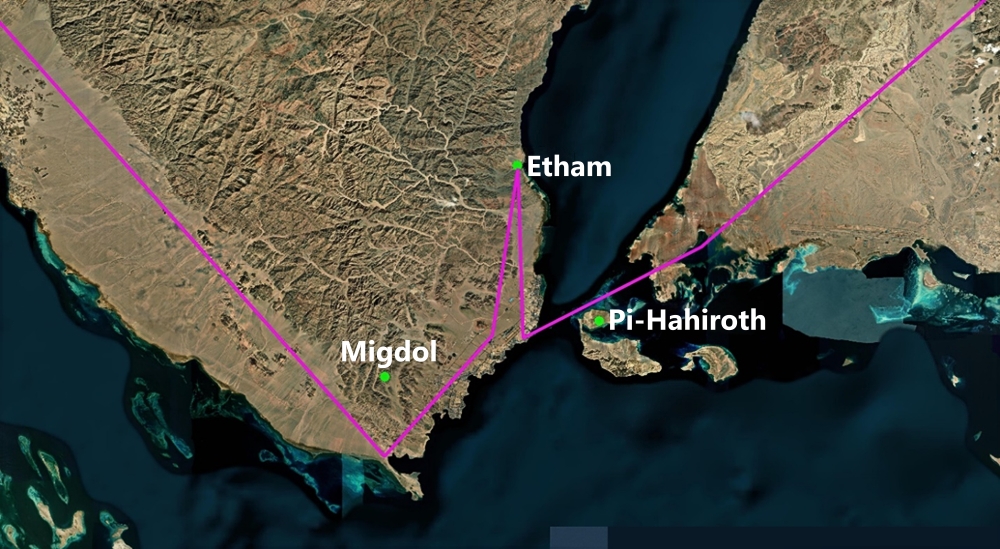
This is one of the shallowest places in the Red Sea today, dotted by an abundance of tourist-attracting coral reefs. Moses’ song says “Pharaoh’s chariots and his host hath he cast into the sea: his chosen captains also are drowned in the Red Sea. The depths have covered them: they sank into the bottom as a stone” (Exodus 15:4-5). This requires a shallow area surrounded by deep water.
Exodus 14:27-28 And Moses stretched forth his hand over the sea, and the sea returned to his strength when the morning appeared; and the Egyptians fled against it; and the LORD overthrew the Egyptians in the midst of the sea. And the waters returned, and covered the chariots, and the horsemen, and all the host of Pharaoh that came into the sea after them; there remained not so much as one of them.
Traditional historians and classical Christians considered the crossing of the Red Sea to be a wading through a shallow marsh at the top of the Gulf of Suez (the first right turn below “Goshen?” on the map before this one) but the crossing site must have “depths,” of which there aren’t any, nor ever were, at that spot.
Today you could not cross the straits of Tiran at the lowest of imaginable tides; but the area is rich in coral reefs, which do provide a lot of very shallow surface to you might be able to “walk across” in the right conditions.
Thus, the story I see is that, 3,500 years ago conditions were such that coral must have grown in abundance and formed a coral/sand land bridge across the straits, visible only at the lowest of tides, and only when the wind conditions were just right – but which were uncrossable under any normal circumstances.
Crossing the Red Sea in the way the Bible describes requires a massive tide and heavy wind to push the water north up into the Gulf of Aqaba; the drowning of Pharaoh would be the reversing of that tide, with massive amounts of water released at a high current to flood the land bridge.
Thus, this very action of the super-tide of Moses likely broke parts of the reef when it returned, paving the way for its destruction over the thousands of years since, until only pieces of it remain today – but enough pieces to see a clear path that once led all the way across to Arabia.
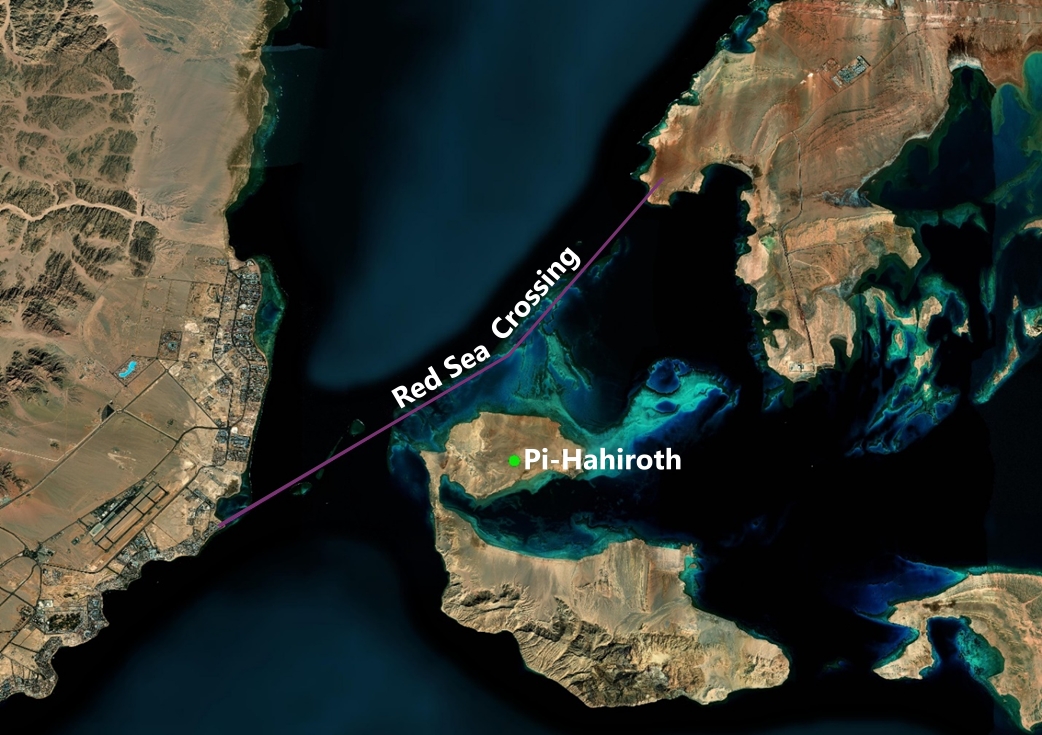
All of the other proposed crossing sites fail to live up to the Biblical requirements; the Nuweiba beach crossing to the north isn’t really a trap and is almost half a mile deep! The Suez crossing is just embarrassing, basically calling it a “miracle” that people could wade through a marsh.
These straits of Tiran, seen in the photo above is also deep – today – but you can see the remnants of a coral bridge across it even now, which would have allowed them to “walk across the sea on dry land,” provided the coral had accumulated some sand on top, to make a road for the chariots, as reefs often do.
So Pharaoh followed them across this bridge, but once Moses had passed over, the tide turned on Pharaoh, pun intended. They turned and tried to run but the water returned too fast and the current swept them off the bridge and into the depths below.
See, when you just listen, everything fits.
AT SINAI
From there Israel went to Sinai, which is not located in the traditional place you’ll see in your Bibles, which was in those days still part of Egypt. Rather it was located – as the Bible says – across these straits in Midian, modern Saudi Arabia, almost certainly at a mountain called Jebel al-Lawz today.
There, the Israelites had various adventures you can read about yourself in the Bible; suffice it to say that there are, to this day, many of the features like the bitter waters and the 12 wells and 70 palm trees in SW Arabia, as you can see yourself on YouTube by searching “The Real Mount Sinai.”
Finally, Israel arrived on the backside of Sinai, where they were thirsty so Moses split the rock and water gushed out; to this day that rock is visible, showing signs of erosion caused by upward-flowing water.
After that, they were met by Amalek. We’ll be hearing a lot of about the armies of Amalek in the future – spoiler alert, they were the Hyksos – but for now it’s enough to say that Isreal defeated Amalek, then Moses went to Sinai, the law was given, and the old covenant was made.
While Moses was gone for 40 days and nights getting the Ten Commandment tablets from God, the people gave him up for dead and decided to “make gods” to lead them (Exodus 32:1). So Aaron made them a golden calf.
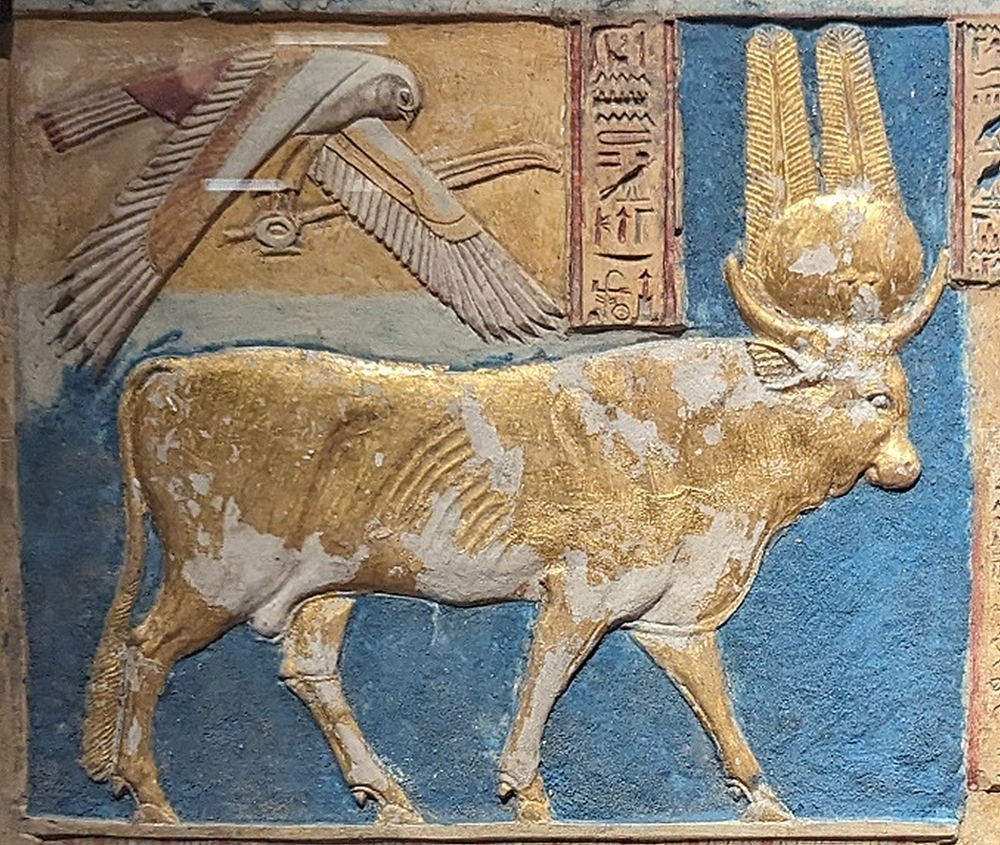
This choice of a god was not arbitrary; these people had been in Egypt for nearly two centuries. A golden calf, to them, represented Hathor, whom the Egyptians identified with the Syrian Ba’alit “lady of heaven” whom Moses had written inscriptions about at Serabit.
Hathor was the Egyptian goddess of sex, drugs, and rock and roll and was, therefore, a highly popular deity since her worship involved doing all of those things. This is why Moses descended the mountain and found them feasting (verses 5-6), singing (verses 17-18), and dancing naked (verses 19, 25).
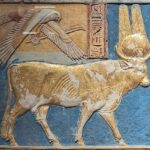
The picture at right, from the Egyptian Museum in Cairo, shows a literal golden calf such as the Israelites might have made. They certainly were thinking of these images, for they had spent their whole lives around them.
It’s just one more way to show that the Bible makes a lot more sense when you know the historical and cultural context; and that’s only possible when you know the history of the pagans around them.

This is part 21 of The History of the World Series
 Asshuruballit, Key To Chronology
  The Kassites
  Hammurabi and the Dynasties of Babylon
  The Exodus
  What Is The LOVE Of God?
  Everything You Believe About God Is WRONG!
  Make Up Your Mind!
  What Is Faith?
  How DARE you FEAR the judgment of God!
  Firstripe Figs
  The Bride Of The Father
  Exodus 40 – The Plan Of God
  The Temple Of God
  Pillars Of The Temple And The Brass Sea
  GEHENNA WITH ‘EM
  When Did God Forbid Polygamy?
  When You Shouldn’t Pray For Someone
  The Sins of the Father
  The First Paul