Old Assyria
This is part 28 of the The History of the World Series
; The History of the World is part 1.
Click here to read in series
We have said that the Assyrian nation, at least as it existed in the time of Moses, was descended from Abraham, via his grandson Dedan: “And the sons of Dedan were Asshurim, and Letushim, and Leummim” (Genesis 25:3).
We know that Abraham sent his sons by Keturah “away from Isaac his son, while he yet lived, eastward, to the east country” (verse 6).We have further found a very early king of Assyria named Dedanu, making this a plausible connection, at the very least.
It is known that in the time of Hammurabi the king of Assyria was Shamsi-adad, who is known to be an Amorite – literally, a person “from the west.” It is he who claimed Dedanu as among his ancestors “who dwelt in tents.”
I have already explained that this concept was an abomination to Mesopotamians, to whom dwelling in tents was a sign of a barbarian; no Mesopotamian would claim such an ancestor unless it were true.
And since we know that Hammurabi ruled ‑1386‑1344, and Shamsi-adad was contemporary with him, he must also have ruled around that time – using his dates relative to Hammurabi as supplied by historians, he ruled ‑1401‑1368.
But now we confront a different problem… if Shamsi-adad was ruling in the time of Hammurabi, he was also ruling at the same time as Assuruballit I (‑1371‑1335). Surely there couldn’t be two kings of Assyria at the same time. Right?
The first Assyrian royal dynasty, founded by Puzur-Ashur I c. 2025 BC came to an end when the city was captured by the foreign Amorite conqueror Shamshi-Adad I in c. 1808 BC. Shamshi-Adad ruled from the city Shubat-Enlil and established a short-lived kingdom, sometimes called the Kingdom of Upper Mesopotamia, that collapsed after his death in c. 1776 BC. Events after Shamshi-Adad’s death until the beginning of the Middle Assyrian period are poorly known, but there appears to initially have been some decades of frequent conflict in Assur and the surrounding region, not only between different states and empires, such as the Old Babylonian Empire, Mari and Eshnunna, but also between different Assyrian dynasties and nobles who vied for power over the city. (Wiki, Old Assyrian empire)
As you can see, historians concede ignorance between around ‑1776 and ‑1336, the rise of the middle Assyrian empire. My readers will be quick to notice that is a roughly 400 year dark age in Assyrian history, a number which by now should automatically raise suspicions.
Why is this period poorly known? Because records of this period were not kept? Or because something was misinterpreted that made Shamsi-adad and his cohorts seem four centuries older than they really are?
ASSYRIAN KING LIST
The Assyrian King List (AKL) portrays an unbroken sequence of rulers supposedly back to at least the ‑1800’s, arguably back to the ‑2000’s, which would overlap with Sargon of Akkad as we have dated him, and that surely must make us rethink our position. Well, it would if we hadn’t been working with king lists since practically the first chapter of this book.
In the Mesopotamian tradition linear king lists have always turned out to be blocks of contemporary rulers assembled in a sequence to give the illusion, intentional or otherwise, of thousands of years of rulers when in fact there were only hundreds.
Even if initially it was understood that these kings were contemporary, later generations in antiquity were confused by the list and interpreted them as consecutive. And so of course, do all modern scholars.
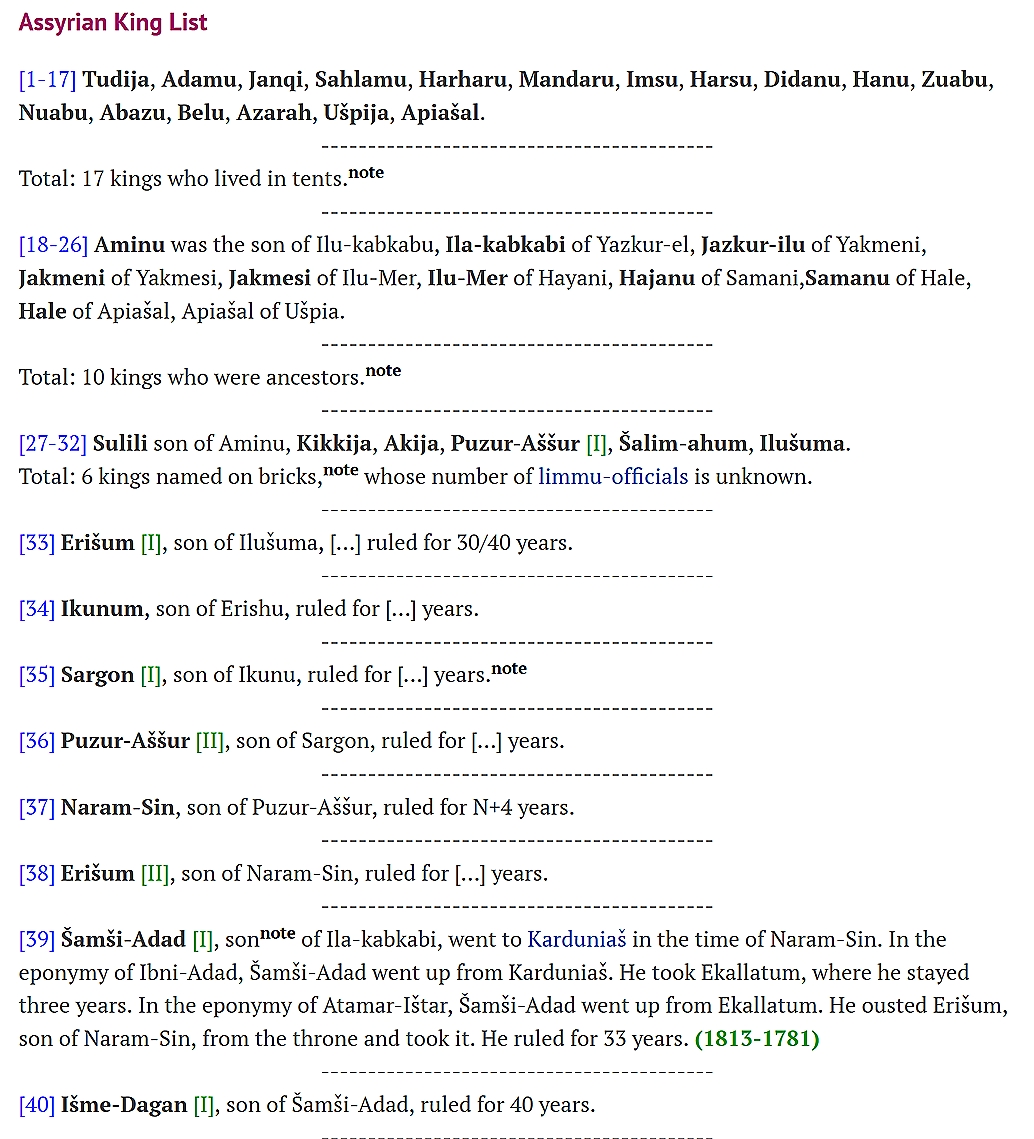
Above we reproduced the early part of the AKL as shown on Livius.org; note how it forms four clear blocks before Shamsi-adad. This immediately suggests some form of parallelism, which scholars have, for once, noted.
One problem that arises with the Assyrian King List is that the creation of the list may have been more motivated by political interest than actual chronological and historical accuracy. In times of civil strife and confusion, the list still adheres to a single royal line of descent, probably ignoring rival claimants to the throne. Additionally, there are some known inconsistencies between the list and actual inscriptions by Assyrian kings, often regarding dynastic relationships. For instance, Ashur-nirari II is stated by the list to be the son of his predecessor Enlil-Nasir II, but from inscriptions it is known that he was actually the son of Ashur-rabi I and brother of Enlil-Nasir. (Wiki, list of Assyrian kings)
We agree that the construction of the list was motivated by political interest – it always was – but by whom, exactly, and when? For that we refer the reader to the old principle “follow the money.” In this case, that means “who benefited from this list?”
Given that the earliest rulers are described as “kings who lived in tents,” they, if real, may not have ruled Assur at all but rather have been nomadic tribal chieftains somewhere in its vicinity. As in the Sumerian King List, several names may also have belonged to rulers who were contemporaries/rivals, rather than successors and predecessors of one another. Some researchers have dismissed these names as a mixture of Amorite tribal-geographical names with no relation to Assyria at all. It is possible that the ‘kings who were ancestors,’ who are not attested in any other sources as present at Assur, refer to the ancestors of Shamshi-Adad I (r. c. 1808–1776 BC), given that other sources claim that his father was named Ilu-kabkabu, and they might thus not have been kings of Assyria, but rather rulers of Terqa, Shamshi-Adad’s supposed ancestral home. Including these figures may have served to justify Shamshi-Adad’s rise to the throne, either through obscuring his non-Assyrian origins or through inserting his ancestors into the sequence of Assyrian kings. (Wiki, list of Assyrian kings)
Once again, we agree; scholars are doing our work for us. Shamsi-adad is known to be an Amorite; these, therefore, must be his ancient relatives. But they are not ethnic Assyrian rulers, and probably never set foot in Asshur. Why, then, do they appear at the head of an Assyrian king list? Because someone who was Amorite wanted them there.
Šamši-Adad, son of Ila-kabkabi, went to Karduniaš in the time of Naram-Sin. In the eponymy of Ibni-Adad, Šamši-Adad went up from Karduniaš. He took Ekallatum, where he stayed three years. In the eponymy of Atamar-Ištar, Šamši-Adad went up from Ekallatum. He ousted Erišum, son of Naram-Sin, from the throne and took it. He ruled for 33 years. (AKL, Livius)
This is by far the longest entry in the entire AKL, and the only one to receive a significant biography for 700 years, if you believe the list to be linear. Most kings were lucky to get a name and year count, or at most “he ousted him, seized the throne and ruled for X years.”
So follow the money; who benefited most from this list? Who is the star of the story? Shamsi-adad. Hence he, or his immediate successor, almost certainly began the list; rulers #1-39 on the list are his ancestors, not those of the later ethnic Assyrian kings.
THE ANCESTRY OF SHAMSI-ADAD
For once, we are not at odds with traditional history on this – at least, not at first. The earliest parts of the AKL are odd, and mainstream researchers have done a lot of the work for us. The following quote is long, in case you want to really understand the situation; but feel free to skim the details to read the bold parts if you like.
The first section [of the AKL] is a list of seventeen names that are called “17 kings who dwelt in tents.” The second section then lists “10 kings who are ancestors” and gives them in genealogical order with the formula RN₁, son of RN₂, RN₂, son of RN₃. This produces a list in reverse chronological order from the rest of the text. The last two names in section two, Apiashal and Ushpia, are repeated in reverse order from the last two names of section one, thus connecting the two sections. Section three lists six kings and begins with “Sulili, son of Aminu” but then gives five names without any genealogical designation. As earlier, the filiation in the first line is intended to make a connection with Aminu, of the previous section. Section four follows with a series of names using the formula RN₂, son of RN₁, he ruled x years. These are given in correct chronological order and tied to the last name of section three. The formula for section four becomes the fixed formula for the rest of the text.
The list is interrupted again after the first six names in section four by the name “Shamshi-Adad (I), son of Ilu-kabkabi,” and a chronicle-like account of how he seized the throne from the previous rulers. Now Ilu-kabkabi, Shamshi-Adad’s father, occurs at the beginning of the list of ten ancestors in section two along with Aminu, who was probably Shamshi-Adad’s brother and immediate predecessor. Section two is thus a genealogy of Shamshi-Adad. Aminu’s name cannot, therefore, stand at the head of section three as the beginning of a line of thirteen rulers before Shamshi-Adad. The duplication of the names Apiashal and Ushpia in sections one and two is also suspect. This means that the first three sections, which have their own distinct styles, were originally independent, and that the connections made between them were artificial. (In Search of History: Historiography in the Ancient World and the Origins of Biblical History, Van Seter; henceforth ISOH)
Long story short; the first four parts of the AKL are done in very different styles, and therefore they must have been compiled from different lists and patched together. We agree, and the clear point is to establish the ancestry of Shamsi-adad, as we said.
On the other hand, the first section of AKL must be related in some way to the recently published Babylonian genealogy of the Hammurapi dynasty, which also has at the beginning a list of eleven or twelve names that parallel rather closely the first twelve names of AKL. Since most of these names are tribal or geographic, the list has the character of a group of eponymous ancestors. A rather widespread opinion is that the names represent a common, oral, West-Semitic (“Amorite”) tribal heritage which became the traditional basis for both Babylonian and Assyrian kingships. Shamshi-Adad, the “Amorite,” is then credited with introducing this tradition into Assyria. (ISOH)
The author is almost right; these kings who dwelt in tents do reflect a common West-Semitic tribal heritage; the sons of Abraham. This is quite likely a list of the grandsons and great-grandsons who made it as far east as Assyrian and Babylon; thus, it is not a list of ancestors as such, but of the tribes they became after a few centuries.
As indicated above, the “10 kings who are ancestors” in section two have been interpreted by most scholars as a genealogy of Shamshi-Adad. Consequently, it has been suggested that the earliest document was composed in the time of Shamshi-Adad and was created by combining the West-Semitic tribal eponyms (1) and the Shamshi-Adad genealogy (2) with the native traditions of the rulers of the city of Assur (3–4). The purpose of this work was the legitimation of Shamshi-Adad’s rule. The rest of the list grew simply by supplementing it with additional names after the accession of each new king. (ISOH)
We agree in broad, but we take issue with one thing. According to them, sections 3-4 were the ancestors of the ethnic Assyrians. But here’s the problem… at least some of those kings… didn’t rule in Assur.
WAS HE KING OF ASSYRIA?
We have already seen how the Kassites could be “king of Babylon,” yet rule from Dur-kurigalzu, or even farther away in the Kassite homelands in the Zagros, even as a puppet king ruled from Babylon styling himself the king of Babylon. Could that have happened in Assyria?
Hallo, however, has recently raised some serious objections to this reconstruction. He points out that Shamshi-Adad did not rule his empire from Assur but from Shubat-Enlil, and that Assur was not even maintained as the capital of its provincial region. In his inscriptions Shamshi-Adad mentions only his father in his royal descent and claims no succession from the Old Assyrian kings. In fact, for at least a century Shamshi-Adad and his son Ishme-Dagan were not considered legitimate members of the Assyrian royal line, so that the legitimation of Shamshi-Adad and his successor must have come some time later.
Furthermore, in comparing AKL with the genealogy of the Hammurapi dynasty, another fact is often overlooked or obscured. In the latter document the list is homogeneous in its form from the beginning through the enumerations of the first dynasty of Babylon. But as we have already noted, section one of AKL, which contains the tribal names, does not belong together with the Shamshi-Adad genealogy. It becomes highly unlikely that we can speak of a common oral tradition that came into Assyria with Shamshi-Adad. Instead it must be viewed as a separate source used by the author of the original version of AKL.
Of the names preceding Shamshi-Adad, Puzur-Ashur I to Puzur-Ashur II are known from inscriptional evidence to belong to the native dynasty of Assur, and they constitute an overlap of sections three and four. But the successor of Puzur-Ashur II, Naram-Sin, was not the former’s son as AKL suggests, but an invader from Eshnunna. Erishum II, the next name, may or may not be his son. This period of foreign rule of Assur has been suppressed in AKL by the fiction of genealogical connection. (ISOH)
Forgive the long quotes, but this author basically proves my point as well as I could; Shamsi-adad did not rule from Assur, and didn’t even consider it a capital of the province. Was he really a king of Assur, then? Or just the head of an empire which happened to include Assur?
What’s more, his two predecessors on the AKL, Naram-sin and Erishum II ruled from Ekalattum and began a “period of foreign rule of Assur”; why would we believe that did not continue under Shamsi-adad?
It is certain that Shamsi-adad did conquer Erishum II and take over his throne but no evidence suggests that took place in Assur. On the contrary, all the evidence suggests it took place at Ekalattum, or even north of there – i.e., farther from Assur.
One minor topic or textual query which, to my knowledge, has not yet been raised concerns the place where Erishum II, son of Naram-Sin, ruled. According to the wording of the section of the Kinglist dealing with Shamshi-Adad I, Shamshi-Adad, after proceeding north from Babylonia to Ekallate, then “came up” (ēlá) [in the sense of going upstream] further north to depose Erishum. This, taken literally, would imply that Erishum was ruling north – or upstream – of Ekallate and not, as Landsberger and David Oates have implied, at Assur. Was the capital north of Ekallate at this time, perhaps removed thither temporarily because of Shamshi-Adad’s invasion? Or should ēlá be taken simply as a repetition of the customarily used verb without intended geographical precision? In any case, it is worth observing that the normal sense of the verb seems to require that Erishum was deposed from a seat north or upstream of the now agreed on location of Ekallate. (Brinkman, Orientalia 42; from DD)
Thus, for at the very least two generations before Shamsi-adad, Assur had been ruled by foreign powers from different region altogether, a practice that is known to have continued. So calling him a king of Assur, except in the sense that his empire included Assur, is misleading.
Its first known king [Ekalattum’s] was the Amorite Ila-kabkabu, who seems to have entered into a conflict with Iagitlim of Mari. His son Shamshi-Adad I ascended to the throne c. 1800 BC, continuing the conflict and attempting to extend into the valley along the Khabur River. He was a sometime ally, sometime enemy of Dadusha of Eshnunna (whose second year name was “Year in which Dadusza defeated the army of Ekallatum”) in regional conflicts. His expansion was halted by Iagitlim’s son, Iakhdunlim, and he was soon after defeated by Naram-Sin of Eshnunna, brother and successor of Dadusha, which caused him to flee to Babylon, a city founded and ruled by fellow Amorites. He returned upon Naram-Sin’s death. Soon thereafter, a series of military victories by Shamshi-Adad followed, and he seized all of Upper Mesopotamia, founding what historians now call the Kingdom of Upper Mesopotamia. The campaign included the annexing of nearby Assur. He founded his own capital at Shubat-Enlil, entrusting Ekallatum to his elder son Ishme-Dagan I. (Wiki, Ekalattum)
Calling Shamsi-adad I a king of Assyria is not only misleading, it’s demeaning; he was king of much more, and Assur was neither his heritage, his dwelling place, his capital, nor his people. In what sense, exactly, was he a king of Assyria? As an overlord, only.
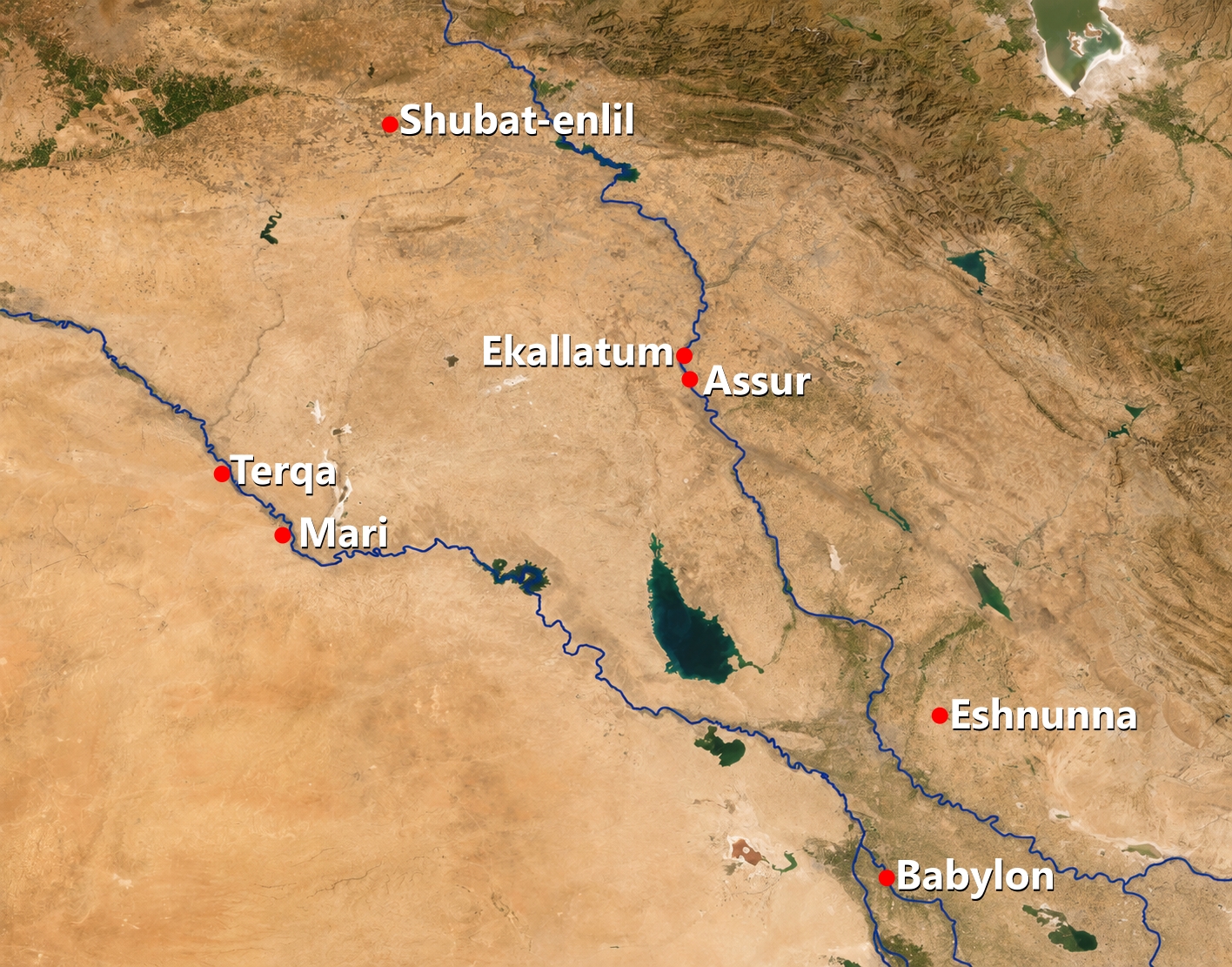 In this map, you can see that his actual capital, Shubat-enlil, is a long way from Assur. We know that Eshnunna continued to exist independently beyond Shamsi-adad’s lifetime, as did Mari and so, of course, did Babylon which soon conquered all three.
All of this means that Assur was likely near the edge of Shamsi-adad’s domains, so to call him an Assyrian king is just ridiculous. It would be like calling King George III of England (who fought against the American revolutionaries) an American king.
When Hammurabi conquered Shamsi-adad in ‑1368, he left Shamsi-adad’s son Ishme-dagan I as vassal king of Ekalattum; the capital city of Shubat-enlil itself seems to have drifted back into Mari territory, and then drops off the map altogether.
Meanwhile Ishme-dagan I was allowed to keep Assur under his control at first, but he failed to control and defend it so it soon fell back into direct Babylonian control.
The reign of Ishme-Dagan was chaotic, often being involved in military conflict with Nurrugum (location unknown). Unable to restore power to the city despite his many attempts, he was the target of nearby warlords, in particular, Zimri-lim of Mari. When the Elamites took Ekallatum in 1765, he sought refuge with his traditional ally—Hammurabi of Babylon—who helped him take back the throne. His time at Babylon may have been more in the way of captive than ally…
Subsequently, Ekallatum became a vassal city subservient to the king of Babylon Hammurabi (a year name was “Year Hammu-rabi the king subjugated the land of the region of Subartu, Ekallatum, Burunda and the land of Zamlasz from the banks of the Tigris to the Sippar canal”), who came to control all of Mesopotamia. With the death of Ishme-Dagan, his son Mut-Ashkur succeeded him. He was the last known king of Ekallatum as well as being king of Assyria. (Wiki, Ekalattum)
None of these rulers ever lived in Assur, ruled from Assur, or considered themselves Assyrians. Who then was ruling in Assur? Minor puppet kings, viceroys of the god Assur; glorified high priests, really… like Assuruballit I.
THE SHARED ANCESTRY
It was noted in passing above that Shamsi-adad of the AKL and Hammurabi in his genealogical tablet both claimed similar ancestries. I will spare you the boring details, but at least the first 11 “kings that dwelt in tents” correspond almost exactly with the first 11 ancestors of Hammurabi.
There can therefore be no question but that the genealogical traditions of the Hammurapi dynasty and those of the Assyrian King List — the first two sections of which must almost certainly be identified as the “Ahnentafel” of Šamši-Adad I — are one and the same insofar as they represent a consciousness of tribal origins. (Genealogy of the Hammurapi Dynasty, Finkelstein, henceforth GHD)
Historians generally conclude that these were memories of distant tribes of Amorites from whom the Amorites traced their ancestry; we agree, considering them to be the names of grandsons and great-grandsons of Abraham, who naturally enough “dwelt in tents” just as he did.
Historians also generally conclude they were largely fictional, and that Shamsi-adad was not related to them but simply borrowed Hammurabi’s list for his own purposes. I find this far-fetched and unnecessary.
A far easier conclusion is that Shamsi-adad and Hammurabi, who were both known to be Amorites, were distantly related; at least insofar as they came from a common group of Abrahamic tribes in the upper Euphrates area in the general region that Job and Balaam had dwelt in.
With that, we draw the conclusion that kings #1-17 were not kings at all, but the heads of tribal groups – like Reuben, Simeon, Levi, Judah, etc. David, for example, would list the same twelve tribes on his ancestry as Saul, even though they were not closely related.
That explains why the AKL goes on to list kings #18-26 as “kings who were ancestors.” First it listed the 17 Amorite tribes; then naturally enough they went on to list the specific ancestors of Shamsi-adad. On that section, the Livius note adds…
It is not clear what is meant with “ancestors” nor is it understood why the sequence of kings is reverted. Perhaps, we must read “my predecessors,” but this raises the question who is their descendant. Note the calculating error: the writer has mentioned ten kings, but one of them, Apiašal son of Ušpia, has already been mentioned among the seventeen who lived in tents.
This is a typical historian attitude. Note how casually they conclude there was a “calculating error,” rather than trying to understand their source material. Because this was no error; this is exactly what we expect.
First, Shamsi-adad lists the 17 tribes of Amorites of his nation; alone of all the list, there is no filiation here “son of, son of, etc..” Because these were tribes, more or less related as brothers/cousins.
Then in the section, “the kings my predecessors,” he uses reverse filiation, starting from the tribe from which he descended, “Apiashal of Ushpia.” Because… of course he does. Just like Saul was of the house of Israel, of the tribe of Benjamin, the son of Kish.
It should be noted that both Apiashal and Ushpia were mentioned among the list of tribes; so taking our sources seriously, this suggests that the final “tribe” was in fact a junior tribe descended from the Ushpians, not unlike Manasseh was a tribe out of Joseph.
This is not a mistake but a conscious act to connect the lineage of Shamsi-adad to the proper tribe. Which is why #19 was Ilu-kabkabu, almost certainly the father of Shamsi-adad. Then the final generation in that sequence is “Aminu, son of Ilu-kabkabu.”
Since Shamsi-adad is listed as “Šamši-Adad, son of Ila-kabkabi,” this means Aminu was almost certainly the older brother of Shamsi-adad, included in the list because he ruled first, or may still have been ruling elsewhere.
The next section of the list, kings #27-38, concludes with Erishum II, who ruled from Ekalattum and was conquered by Shamsi-adad. His ancestor Naram-sin also ruled Assur from Ekalattum. This is the only section of the early list that has proper Assyrian names like Puzur-assur; prior to this all names were purely Amorite.
One of the names in this section is Sargon, which together with Naram-sin were names from the dynasty of Akkad, suggesting a link between this lineage and the Akkadians, for whom Sargon was a mighty hero.
The only argument against this is that the first king in this section is “Sulili son of Aminu”; but as has already been noted, the filiation of the AKL is known to be wrong in many cases – it was frequently assumed that successors on the list were automatically sons, which historians have proven in several cases was not the case.
This is a well attested practice in the SKL, where dynasties believed to be successive were called “son of” in order to attempt to make a link between them, even though they in fact existed parallel. So it is consistent with how the chroniclers viewed the world.
Hence we are going to conclude that this was a clumsy attempt to stitch the ancestry of Erishum II and Shamsi-adad I together as if they were linear and not contemporary. Otherwise we would have to explain why these Sumerian and Akkadian names somehow descended from a long series of Amorites, which would make little sense.
Historians generally agree that these four sections represent at least two differing and contemporary genealogies; where they err is in placing Erishum as a king of Assyria when he is known to have ruled Assur remotely and was not even ethnically Assyrian.
In fact the AKL represents three separate and contemporary genealogies; that of Shamsi-adad I back to his Abrahamic ancestors (Kings #1-26, #39-40); that of Erishum II in Ekalattum back to Sulili (Kings #27-38); and that of Assuruballit the actual resident king of Assyria back to Assur-dugul (Kings #41 onwards).
Historians believe, of course, that king #41 immediately followed Ishmi-dagan, king #40; but then they struggle to explain why Ishmi-dagan’s sons were excluded from the list, and why there was a period of anarchy which doesn’t align with the known facts of history in that period…
AKL indicates that there was a rather troubled period after Ishme-Dagan. It omits three additional members of this ruling family who are included in a divergent king-list tradition, and it mentions a number of irregular rulers — “sons of nobodies” — one of whom ruled for six years while six others ruled for less than a year each. Out of this period a new dynastic line is seen to emerge which carries the royal line through petty kings of the early Middle Assyrian period. Wilson, in a study of the genealogies within this part of AKL, points out a number of discrepancies within the list itself and between the list and extant inscriptional evidence for the period. It would be difficult to account for these errors in AKL if the king list after Shamshi-Adad were merely a running list of kings supplemented after each reign. (ISOH)
Seen as a continuation of the dynasty of Shamsi-adad, these are grave errors for the AKL to make, true. Seen as a composite of three different lineages culminating in the reign of Ishme-dagan, who was almost certainly the architect of the document, it makes perfect sense. His lineage ended with him, because it was written by him.
Which means that the period of anarchy for kings #41-47 doesn’t represent a crisis after the death of Ishme-dagan, but rather the origins of the Assyrian state 400 years earlier. And what’s really cool is we can actually broadly synchronize this chaos with the chaos in Akkad after the fall of the Sargonid dynasty.
THE AKKADIAN ORIGINS OF ASSUR
You may recall that during the dynasty of Akkad in the SKL it said “Then who was king? Who was not the king?” and then goes on to list four kings, who ruled for one year each in ‑1755‑1752.
You will also recall the defections from the Akkadian state at that time, leading to the founding of the dynasties of Uruk IV/Ur III and the freedom of Lagash, Puzur-inshushinak of Elam, and so on. Akkad never recovered, and fell completely, probably to Puzur-inshushinak in ‑1716.
And now we find that all three lineages in the AKL trace back to roughly this period. If we assume 25 year generations for Shamsi-adad’s ancestors, the first one lived in ‑1676. If we follow the data we do have for Erishum’s ancestors and give the unknown ones 20 years of reign, we arrive in ‑1678.
And if we place Assuruballit as we already have and follow the data in the AKL, we find the first securely datable king to be Belu-bani, king #48, whom we place at ‑1668‑1658. Before him, the AKL says…
Aššur-dugul, son of a nobody, who had no title to the throne, ruled for 6 years. In the time of Aššur-dugul, son of a nobody, Aššur-apla-idi, Nasir-Sin, Sin-namir, Ipqi-Ištar, Adad-salulu, and Adasi, six sons of nobodies, ruled at the beginning of his brief reign. Belu-bani, son of Adasi, ruled for 10 years.
“Son of a nobody” is Assyrian language for a usurper who came to power in some sort of a coup. So here we see seven such kings ruling either in quick sequence or contemporarily over different regions, probably a little bit of both.
No one knows how long these other kings ruled, whether they were entirely contemporary or what; but it seems to me like it says Assur-dugul was the immediate predecessor of Belu-bani, and ruled for six years – this beginning in ‑1674.
But the AKL says Belu-bani was the son of Adasi, the 6th of these kings who ruled “at the beginning of his [Assur-dugul’s] short reign.” That might imply they were all contemporary, or that each had ruled a few years; it’s hard to say.
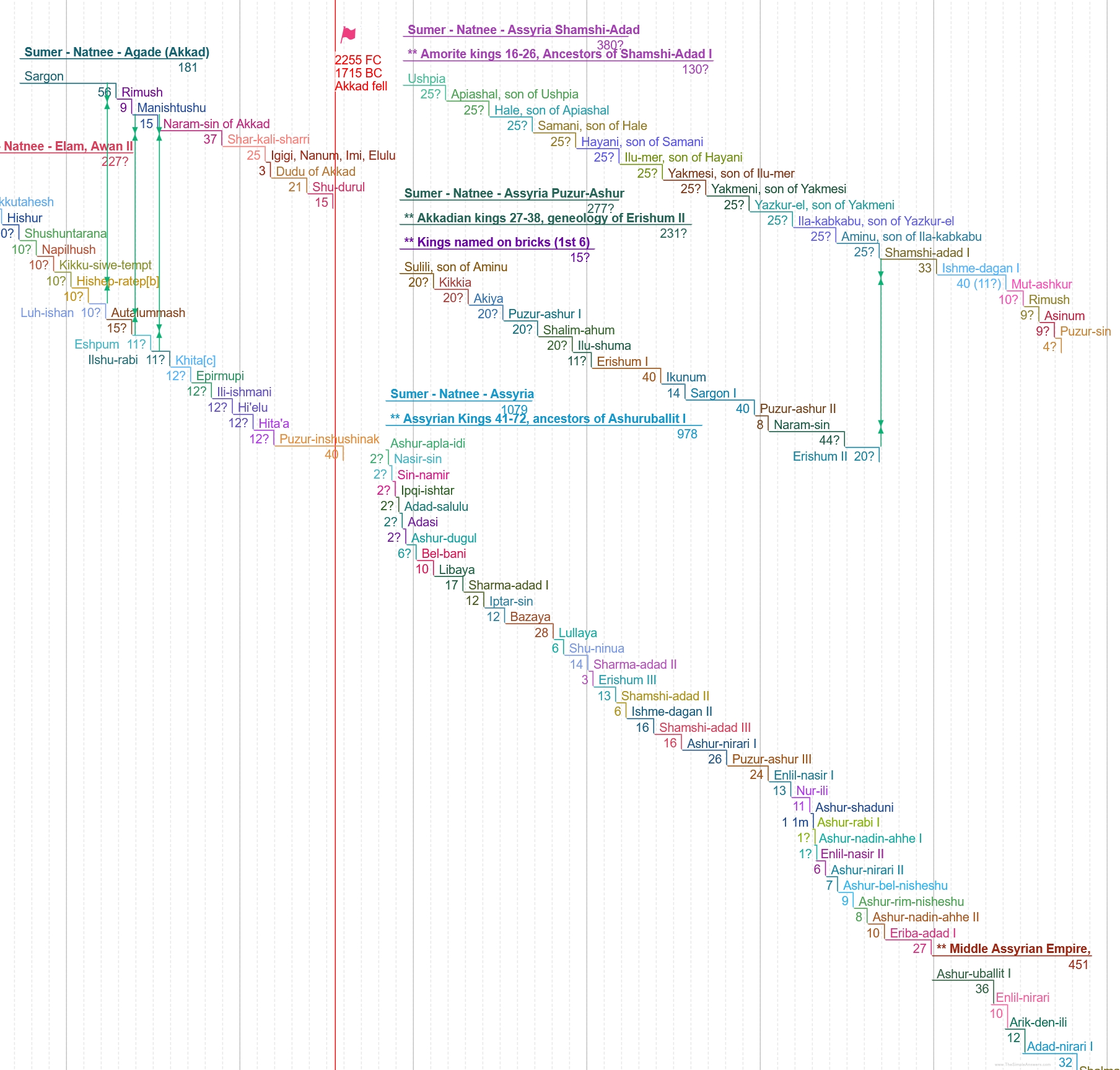
What we can say is that these events are placed very roughly in the period of ‑1700‑1675, just after the fall of Akkad led to the complete fracturing of the Akkadian world order. This created a lawless period when nations rose and fell overnight.
Akkad, which had held sway over all of Mesopotamia for generations, was no longer able to rule and everyone who held imperial ambitions fought to be king of the hill. Kings #41-48 were the contestants in that struggle, and the AKL records the victor as the founder of the Assyrian nation, Adasi.
So you decide; with these six kings “six sons of nobodies,” is the AKL attempting to describe the descent into chaos after the death of Ishmi-dagan, something which historians know did not happen?
…or is it the origin story of Assyria as a nation, in the aftermath of the collapse of Akkad, something which we are certain did happen?
Little is known about the next kings up until the time of Adad-nirari I (#76) because these kings existed contemporarily with powerful kingdoms like Babylon, Isin/Larsa and Ur III; it is the Assyrian dark age, populated only by a list of names scarcely attested by the archaeological record.
THE STORY
The story, then, is as follows; after the death of Shar-kali-sharri in ‑1755, the Akkadians were beset by the Gutians to the northeast, Elamites to the southeast, Sumerian vassals defecting to the south, and the rise of Amorites to the west.
It is to this power vacuum of the following century that many later dynasties traced their origins, because there was no history of these dynasties before these “sons of nobodies” became somebodies. For the next centuries Assur was an unpretentious and mostly stable theocratic city-state.
Meanwhile, still in the ‑1700’s, the Keturite descendants of Abraham were multiplying around Terqa, and were blessed and kept multiplying. Eventually, these “westerners,” Amorites, began pushing the boundaries of Sumer.
During these centuries we see them warring with Ur III and the Isin/Larsa kings while “dwelling in tents.” Then some of them actually wind up in power, as kings of Larsa in particular, and probably as kings of Assur as well.
Meanwhile in the early ‑1400’s, Amorite king Sumu-abum conquered Babylon. Also in the ‑1400’s, Ekalattum conquered Assur – probably both still under ethnic Akkadian rule at the time – and ruled it remotely.
His proxy was a weak local authority who did not call himself a king, but what he was: vice-regent of the god Assur; a glorified high priest. Meanwhile the ancestors of Shamsi-adad were ruling in Terqa, to the west.
Šamši-Adad I had not inherited the Assyrian throne from his father, but had instead been a conqueror. Ila-kabkabu had been an Amorite king not of Aššur (within Assyria), instead; Ila-kabkabu had been king of Terqa (within Syria) during the same time as that of the King Iagitlim of Mari (also within Syria). According to the Mari Eponyms Chronicle, Ila-kabkabu had seized Shuprum (possibly c. 1790 BC), then Šamši-Adad I had, “entered his father’s house,” (e.g.. Šamši-Adad I had succeeded Ila-kabkabu as the king of Terqa, within the following year). Šamši-Adad I had subsequently conquered a wide territory and had emerged as the king of Assyria, where he had founded an Amorite dynasty. (Wiki, Ila-kabkabu)
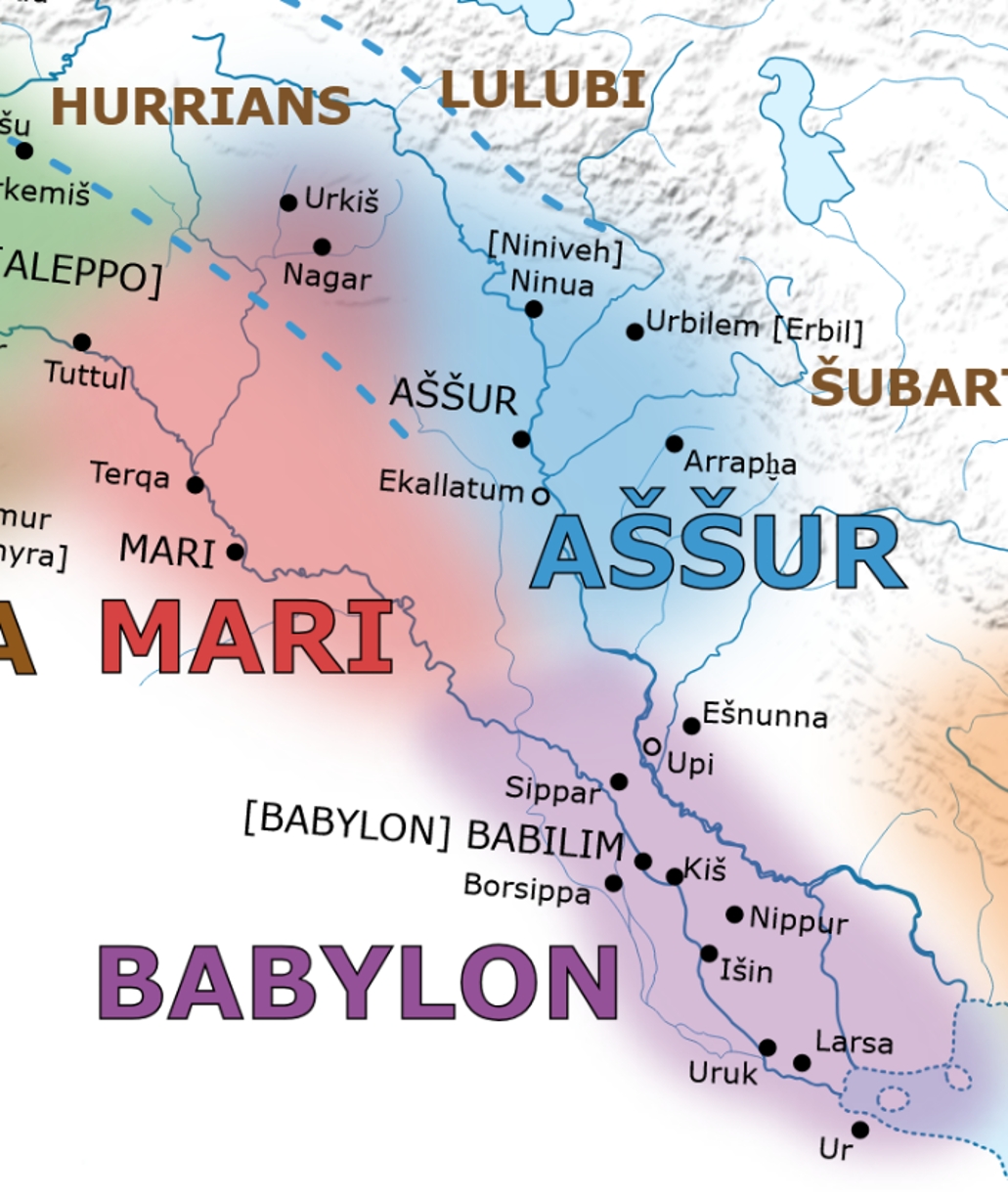 So it was from Terqa that Shamsi-adad moved east to conquer upper Mesopotamia ultimately conquering Ekalattum and inheriting its possessions, including Assur, which was a minor asset in a much larger empire stretching from Syria to Iran.
A generation later Hammurabi conquered Shamsi-adad and everyone else in sight, becoming briefly the sole ruler of Mesopotamia. His son Samsu-iluna could not hold the empire together and, facing rebellions and defections on all sides, succumbed to the Kassite newcomers.
The Kassite conquest of Babylon broke the Amorite power in Sumer, causing the Assyrian king Adad-nirari I to take back control of his region, which by all accounts he did quite successfully.
He boasted that he was the “defeater of the heroic armies of the Kassites (the ruling dynasty of their Babylonian neighbours to the south), Qutu (their eastern Gutean neighbours), Lullumu (the pre Indo-European Lullubi tribesmen of Ancient Iran immediately east of Assyria) and Shubaru (“Hurrian and Hittite northerners in Asia Minor”). Pacifier of all enemies above and below.” (Wiki, Adad-nirari I)
After this point, for several generations Assyria dominated northern Mesopotamia, while Babylon – now called Karduniash – was ruled by the Kassites through their vassals of the 1st through 9th dynasties.
KASSITE PROBLEMS… FOR THEM
Shamsi-adad’s story as told in the AKL mentions a visit to Karduniash; but that is a Kassite name for Babylon. It cannot, therefore, have been used before the Kassites conquered Babylon… something which historians tell us did not happen for around two centuries after Shamsi-adad’s time.
The traditional history struggles to explain this obvious problem, and concludes that the word is present because the entire list dates to a much later time, when the Kassites were present and that was the name for the country.
But that’s improbable, since all internal indicators suggest that the first part of the list (where the word appears) was composed by Shamsi-adad or his son. Which means the Kassites must have been present in those times.
We, of course, have no problem with that; because the Kassites would invade and subdue Babylonia in the reign of Samsu-iluna, son of Hammurabi… shortly after the lifetime of Shamsi-adad!
Ishmi-dagan reigned, according to the AKL, for 40 years. Historians universally assume this included his father’s years, because a certain eponym list only has 11 entries for him, suggesting 11 years of reign at Assur; we have no problem with his rule at Assur lasting 11 years, but believe his full reign was 40 years.
If so, his reign was ‑1368‑1328, albeit much of that was spent in exile in Babylonian or possibly ruling a small part of his former region, subject to Hammurabi. Now we date the Kassite conquest of Babylon in the 9th year of Samsu-iluna to ‑1335.
So it’s no wonder to us that Ishmi-dagan’s list mentioned Karduniash; that’s what it was called when it was made.
THE FIRST KASSITES
But the Kassites are not done giving. We have two main historical sources in the region from the 2nd millennium, the Assyrians and the Babylonians. Let’s ask each of them: “when did you first hear of the Kassites?”
Kassites were first reported in Babylonia in the 18th century BC, especially around the area of Sippar. The 9th year name of king Samsu-iluna (c. 1749–1712 BC) of Babylon, the son of Hammurabi mentions them i.e. (“Year in which Samsu-iluna the king (defeated) the totality of the strength of the army / the troops of the Kassites”). (Wiki, Kassites)
So according to the Babylonians, the first mention of Kassites was in 9th year of Samsu-iluna, which historians place as ‑1740. What about the Assyrians?
According to a fragmentary royal inscription and the Synchronistic History, Enlil-nārārī repelled the attack of Kurigalzu II at Sugaga … According to the fragmentary epic of Adad-nārārī I, his father, Arik-dēn-ili, had tense relations with the ‘king of the Kassites’ (šar māt kaššî). (Foreign Kings in the Middle Assyrian Archival documentation, Llop-Raduà)
We remind the reader to ignore the reference to Kurigalzu II, which is a partially reconstructed name on the tablet, and even if it did say Kurigalzu, it certainly did not refer to Kurigalzu II. That being said, these three kings are the first to document interactions with Kassites in the period ‑1337‑1287.
We find this very strange; a gap of well over four hundred years between the first mention of Kassite armies in Babylonian history, and the first mention of Kassite armies in Assyrian history. It’s almost as if Babylonian history has been pushed 400 years too far into the past?
We, of course, find all this information very harmonious; the 9th year of Samsu-iluna was ‑1335, and the first of the Assyrian kings to note a Kassite presence ruled in ‑1337‑1327; hence, the arrival of the Kassites was noted by the Assyrians and the Babylonians at precisely the same time.
Just as one would expect.
One last thing; in our view Shamsi-adad had died in ‑1368, and Enlil-nirari began to rule in ‑1337 – a gap of 31 years. In the traditional view, they are separated by 470 years. Why is that important? Things like this.
Bolstered by his military victories, Adad-nārārī pronounced himself šar kiššati, “king of the universe,” in imitation of his ancient predecessor Shamshi-Adad I… (Wiki, Adad-nirari I)
Is it more likely that he revived a long-dead title after half a millennium…
…or that these men were separated by a single generation? You decide.
THE RESTORATION OF THE TEMPLE OF ISHTAR
A typical example of what happens when you insert king lists end to end, as we’ve seen so many times and just saw again, is kings referencing things as if they were recent which historians believe belonged to their remote antiquity; take the following inscription:
An Inscription of Adad-nārārī I (Middle Assyrian king) … Nine stone tablets from Assur (VA 8801 and duplicates); five of the tablets were deposited in the Ištar temple when Tukultī-Ninurta I completed the reconstruction of that structure. The inscriptions are dated to the eponyms of Ša-Adad-nīnu and Aššur-dammiq.
Contents: This inscription not only records that Adad-nārārī rebuilt the temple of the Assyrian Ištar when it had become dilapidated, but also the building’s history: Sargon I restored the temple constructed Ilu-šūma and Puzur-Aššur III renovated it when it had become old. That temple, its towers, the šaḫūru-room of the courtyard, the storeroom of the courtyard called “Inn of Ištar,” and the room of the goddess Išḫara are reported to have been in ruin when Adad-nārārī became king. He claims to have reconstructed the weakened portions of that temple; strengthened the foundations with limestone; removed the old beams, supports, and lashings of the šaḫūru-room, and the beams of the storeroom of Ištar; installed new beams in these rooms; and deposited inscriptions in the temple. (From the Foundations to the Crenellations, appendix, Boda/Novotny)
So here we have a succession of kings who worked on the same temple; and there is one later one who also claimed to have worked on it, in another tablet below. Note that the following inscription references a 720-year span of time, showing that Tikulti-ninurta I certainly believed in the traditional timeline.
An Inscription of Tukultī-Ninurta I … One massive stone block (VA Ass 2296) … from the Ištar temple in Assur. … The king records here that at the beginning of his reign the temple of the Assyrian Ištar had become dilapidated; he mentions Ilu-šūma as a previous builder and that seven hundred and twenty years had passed since it had last been worked on. At the beginning of his reign, Tukultī-Ninurta had the old structure removed down to its foundation pit, rebuilt Eme (“Temple of Cultic Rubrics”), made the structure better than previously, and made it as beautiful as a heavenly dwelling. (From the Foundations to the Crenellations, appendix, Boda/Novotny)
This is certainly the same temple structure, since it mentions the work of Ilu-shuma. So here’s what we have in a nutshell, following traditional dating; Ilu-šūma (c. 1974–1935 BC) originally constructed the temple of the Assyrian Ištar.
Later, Sargon I of Assyria (c. 1920–1881 BC) restored the temple. When it had again become old, Puzur-aššur III (c. 1521–1498 BC) renovated it. Subsequently, Adad-nārārī I (c. 1307–1275 BC) rebuilt the temple after it had become dilapidated. Finally, Tukultī-ninurta I (c. 1244–1208 BC) also renewed or rebuilt the temple.
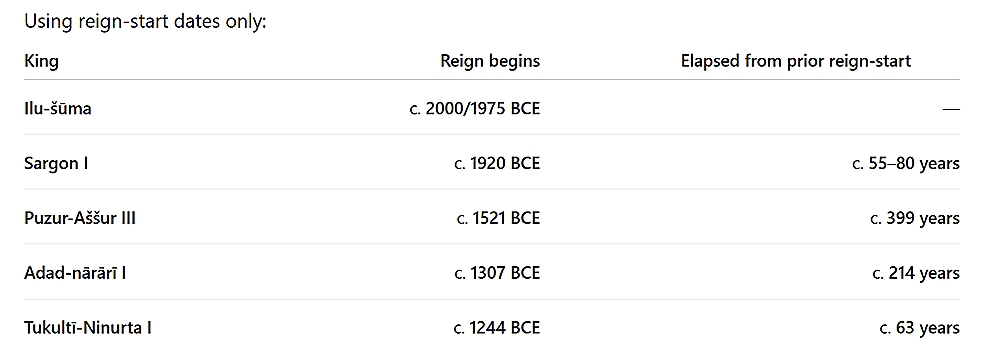
So we pose the question; why did a temple that needed repair after 70 or so years survive four hundred years without repairs. Then somehow survive again for 214 years, before needing repairs after a mere 63 years?
First, a mere 75 years is sufficient to warrant repairs to a brand new building; but then it lasts for 400 years? That is… suspicious. A mere common sense test tells us that a temple cannot possibly last 400 years without major repairs; no building can, not even today.
This makes us strongly suspect that these kings lived closer in time than we are led to believe. But we cannot argue the fact that Tukulti-ninurta, writing in the 13th century, believed the AKL to be understood linearly.
But that’s just because he was literally reading the same document we have today, and very likely didn’t understand it any better than modern historians do – just as sometimes ancient historians did the same thing with the BKL and SKL. They read it sequentially, and had no reason to doubt their conclusions.
But if we’re right, Puzur-assur III, one of the earlier restorers, lived before the creation of the list in the time of Shamsi-adad, so he would not be victim to misunderstanding the order of kings. And he seems to treat Sargon I as a contemporary, and not a distant ancestor. This is what he says in his own inscription:
Puzur-Aššur (III), vice-regent of the god Aššur, son of Aššur-nārārī (I), who was also vice-regent of the god Aššur. As for the šuḫūru-room of the temple of the Assyrian Ištar, which Ilu-šūma, a ruler who came before me, had built and which Sargon (I) [~1868–1830 BC], my ancestor, the son of Ikūnum [~1873–1869 BC], had restored, it had become dilapidated and I rebuilt it.
Puzur-assur claims his father was Assur-nirari I, this in accordance with the AKL. And he specifically calls him “vice-regent of the god Assur,” like his own title. But then he says that Ilu-shuma was another ruler – not another vice-regent – who came before.
And finally, he says that Sargon I was “my ancestor.” This is a mistranslation, as it uses the literal word “my father.” As has been noted, the word “father” is often used generically for grandfather or ancestor, but even so there’s a problem.
Even Assyriologists would say that Sargon was from a completely different dynasty, and totally unrelated to Puzur-assur. So two strange things; why would he call Sargon “ruler,” not vice-regent of Assur; and why call him “father” when there is no way he could possibly be related?
In the ancient near eastern diplomatic correspondence, leaders saw themselves as members of an extended family; equals were addressed as brothers, and vassals always addressed their masters as “my father.”
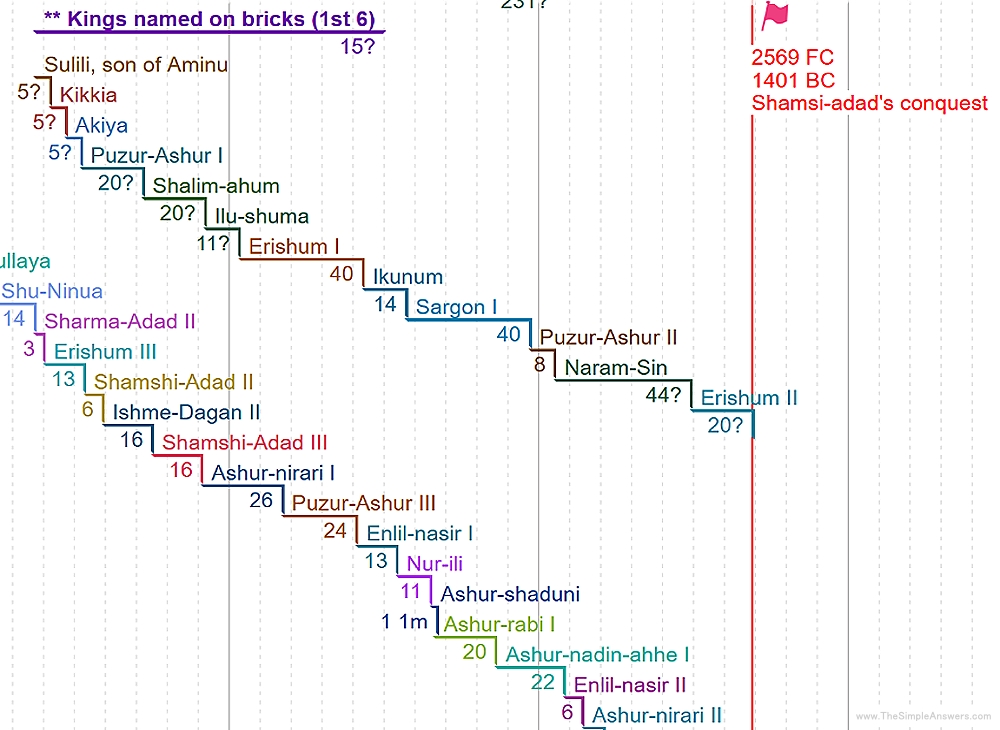 This suggests that Puzur-assur’s “father,” the “ruler” Sargon was actually a ruler, and not a vice-regent of Assur; instead, he was the master of the vice-regent of Assur, politely “my father.” Meaning he would be from a different but parallel dynasty.
Above, you will see our first attempt to putting these kings parallel; here, you see Ilu-shuma, then Sargon I above on the Ekalattum dynasty; below, but a bit too early, you see Ashur-nirari I and Puzur-assur III.
Since clearly he must postdate Sargon, we need to move him to the right; but how? Well, the AKL has some damaged sections, and fortunately we can demonstrate that one of them is just after Puzur-assur III.
There is unfortunately an additional uncertainty at this point: the year numbers of Enlil-nariri’s two predecessors Assur-nadin-ahhe I and Assur-rabi are broken in all sources of the king list. They lived in a period of instability, so one tends to assign them relatively short reigns; but there is no way of calculating them. (How Uncertain is Mesopotamian Chronology?, Hunger)
You will notice in the chart above, taken from Wikipedia they are assigned 20 and 22 years, respectively, even though their predecessor had a single month. We will give them one year each, since once guess is as good as another.
Thus we can delete 40 years from the Assyrian timeline, which moves Puzur-assur III well into the lifetime of Sargon I; however, still too early for Sargon to have built something that Puzur-assur III had to repair.
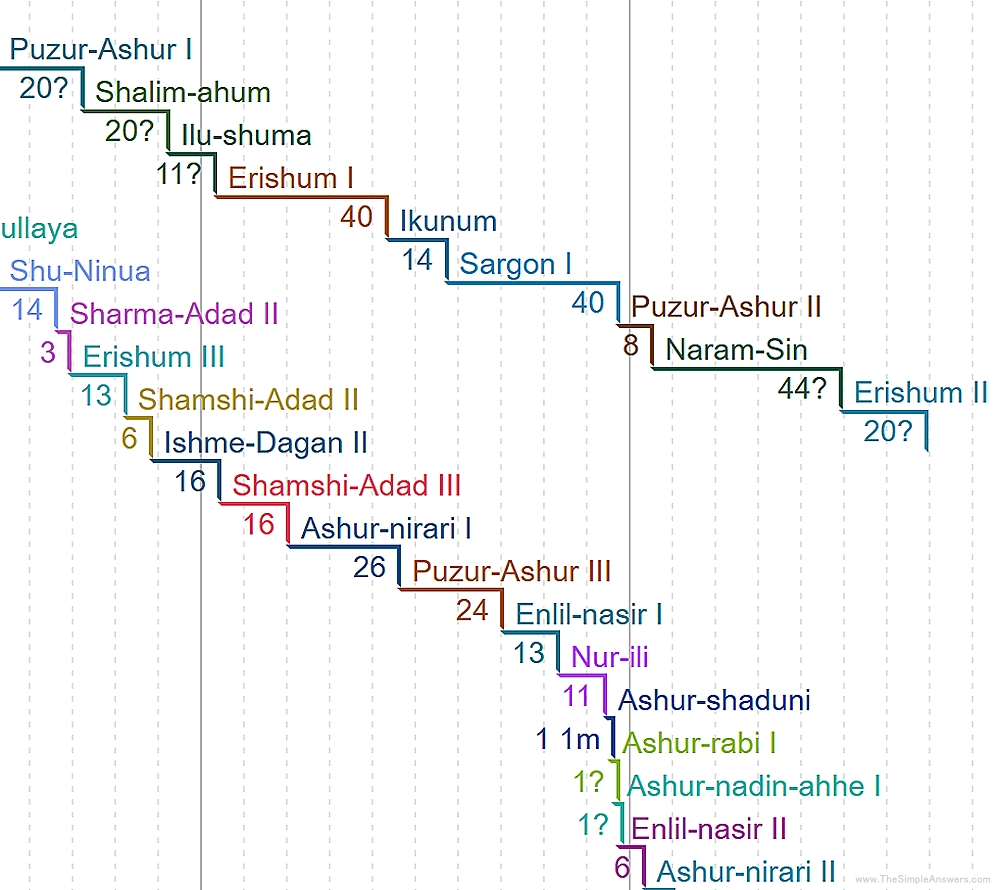 Puzur-assur addressed Sargon as “my father,” suggesting a vassal relationship with someone who lived contemporarily; yet we wonder why Sargon didn’t repair his own work? That may suggest that Sargon was recently dead and that Puzur-assur outlived him.
Thus, ideally, we would like to see Puzur-assur’s rule overlapping with the end of Sargon’s, and outliving him by a decade or two; repairing his work later in life. If Sargon had renewed the temple early in his reign, and Puzur-assur later in his reign, that would give a 60 or so year gap, reasonably consistent with the 75 years it lasted before that. To do this, our Assyrian kings would need to move to the right about another 50 years. Can we do that?
MIDDLE ASSYRIAN WEAKNESS
There are many problems in the middle Assyrian chronology; from the end of the empire in ‑612 back to the late ‑900’s, it’s well attested and fairly tight – except for some provable gaps I will explain in due time, which is why my numbers for Assyria differ from Wikipedia’s, in case you’ve checked.
Early middle Assyrian chronology is surprising tight as well, thanks to a fairly continuous sequence of limmus, year-names. But there is a knowledge gap between Eriba-adad II and Assur-dan II, dated ‑1056‑912 traditionally, ‑1097‑988 in my timeline.
In this period, there is no continuous limmu list and most kings are poorly attested. Our only real source of evidence is the AKL; and while our default is to trust ancient sources, we do not do so blindly in the face of contrary evidence.
A simple typo to change the surprisingly long reign of Assur-rabi II from 41 years to 11 or something would easily move Puzur-assur III into the right place relative to Sargon. Of course, this would be impossible to prove.
But also impossible to know if this had happened since we have no other witnesses to date this period. Ditto for Tiglath-pileser II’s 32 years – we know almost nothing of this king, how do we know he ruled that long?
Another problem which may affect the entire AKL is that, as we will prove in time, the later Assyrian kings practiced co-reigns; meaning that some kings’ reigns overlapped with their predecessors.
Now if their total years of reign were counted, and not only their sole reign, as is usual, then the length of reign in the king list will not represent an accurate chronological history. Which would also greatly shorten the Assyrian timeline, and by more years the farther back you go.
Yet despite being able to prove that later Assyrian kings practiced this, in the entire stretch of the AKL, not a single co-reign is documented. It is possible, we concede, that the Assyrians accounted for this in their history by only counting sole regnal years.
If they did, it would make them unique among the chronicling cultures; Egypt has provable co-reigns, which did not appear on the king lists, which substantially shortened the length of a the recorded years of the dynasty (the 12th being the prime example). We have proven that the Kassites did as well. And of course the Hebrews.
But the structure of the AKL would have us believe no such thing happened. That there were co-reigns is certain. That they were properly accounted for to give us a true picture of the length of the Assyrian dynasty is not.
Remember, the purpose of the king lists was not to give an accurate picture of history, as we want it today; such that, if you had a time machine and punched in ‑1541 you’d know which king would greet you.
On the contrary, it was conceived as a list of divinely sanctioned rulers, who were sometimes divine themselves, and by giving them honor to boost your own status as their successor. Giving them the maximum number of years they held royal power would be consistent with that goal; adjusting downward to deduct the years their father still lived would not.
So accurate chronology as we understand the term was not the goal of king lists, even if later generations sometimes used them as if it were. If we take the Egyptian 12th dynasty as an example, roughly contemporary in time and well documented, the average co-reign was around 5 years each.
Knowing that, if we were to posit even modest co-reigns for the middle Assyrian kings, averaging 2 years each over the course of 400 years and 30 or so kings we would reduce the timeline in this period by 60 years, which would make the temple repairs fit exceptionally well.
Interestingly, if we do the above adjustment, it places Puzur-assur just after the time of Sargon I, as we would expect; but even more interestingly, it aligns Puzur-assur III with the successor of Sargon I, whose name was… Puzur-assur II. See where I’m going with this?
Puzur-assur III settles into the exact same place in history as his counterpart in the Sulili dynasty, meaning that Puzur-assur II and III may well be the same individual. And would explain why he undertook to repair the vassal of his one-time master and predecessor!
If true, this means that after the death of Sargon I, his former vassal Puzur-assur took over the dynasty – possibly peacefully – until he was ousted by Naram-sin, a known foreign interloper!
If this could be proven conclusively, it would give us a synchronism requiring the down-shifting of Assyrian kings and effectively prove co-reigns of some sort existed.
Is it more likely that Puzur-assur III repaired a temple 400 years after its previous repair, which itself was only 75 years after its construction; or is it more likely that there are some co-reigns or otherwise incorrectly recorded reigns in the middle Assyrian empire, a fact historians already suspect?
You decide.
For my part, given the strength of this argument and the evident need to shorten the Assyrian timeline by a few decades, we have assigned an arbitrary 2 year co-reign to every middle Assyrian king with a reign longer than 5 years.
We are certainly wrong about the individual details, as they certainly were not all two years; some may have had five or ten, others none; nonetheless this change brings the reigns into a range that agrees well with all the other facts of history, and is used for the Assyrian dates on our chart and in this book.
HOW LONG CAN A TEMPLE LAST?
We got sidetracked from our discussion on the repairs to the temple of Ishtar; you recall above there were disturbing gaps of 200 and 400 years between the repairs. Can we offer something more plausible? We begin by retelling the story with our dates…
In the beginning, in Assur, Ilu-šūma (‑1578‑1567) constructed the temple of the Assyrian Ištar, let’s say early in his reign in ‑1575. Later, Sargon I of Assyria (‑1513‑1473) restored the temple early in his reign, let’s say in ‑1505.
When it had again become old, Puzur-aššur III (‑1489‑1465) renovated it near the end of his reign in ‑1465. Subsequently, Adad-nārārī I (‑1319‑1287) rebuilt the temple after it had become dilapidated, let’s again suppose early in his reign in ‑1310. Finally, Tukultī-ninurta I (‑1261‑1224) also renewed or rebuilt the temple, let’s say in ‑1240.
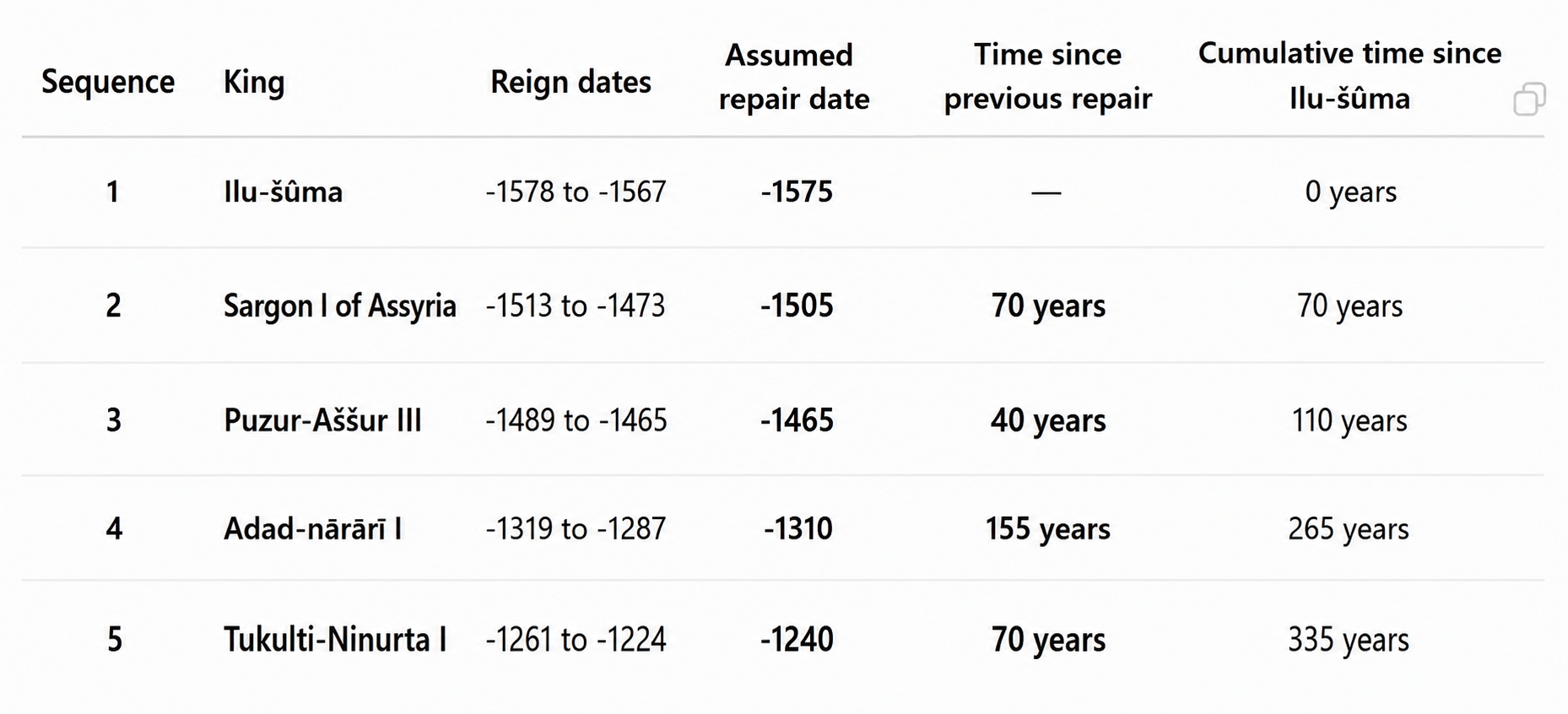
With that list in mind, read about the inscription again…
Contents: This inscription not only records that Adad-nārārī rebuilt the temple of the Assyrian Ištar when it had become dilapidated, but also the building’s history:Sargon I restored the temple constructed Ilu-šūma and Puzur-Aššur III renovated it when it had become old. That temple, its towers, the šaḫūru-room of the courtyard, the storeroom of the courtyard called “Inn of Ištar,” and the room of the goddess Išḫara are reported to have been in ruin when Adad-nārārī became king. He claims to have reconstructed the weakened portions of that temple; strengthened the foundations with limestone; removed the old beams, supports, and lashings of the šaḫūru-room, and the beams of the storeroom of Ištar; installed new beams in these rooms; and deposited inscriptions in the temple. (From the Foundations to the Crenellations, appendix, Boda/Novotny)
Note that by far the most detail is given to Adad-nirari, who found it “in ruin when Adad-nirari became king.” In our chart, we understand perfectly; after 70 years, the original structure “had become old” when Sargon repaired it.
But in the time of Adad-nirari I, 155 years had elapsed since its last repair. Naturally, it had become a ruin! Previous and later kings had given it a facelift, but no one had to give it such attention as Adad-nirari because his repair followed the longest gap in time!
But compare that to the traditional timeline…
Note that in this reconstruction, a gap of four hundred years separated Sargon and Puzur-assur, and major repairs were not noted; Sargon simply did repairs “when it had become old”; 60 years or so after it was built.
Yet identical language is used for “it had become old” after the subsequent gap of 400 years. Minor repairs only. Whereas the relatively short period of 214 years meant “it had become a ruin” before Adad-nirari gave it extensive repairs.
Repairs which needed redone again after only 63 years.
You be the judge of which one of these stories makes more sense.
THE NINEVEH TEMPLE
Interestingly, we can do the exact same thing with the repairs of the Ishtar temple of Nineveh, the other great Assyrian city.
5.11 An Inscription of Shalmaneser I (Middle Assyrian king) … clay cones … from Nineveh; the cones were discovered in the Ištar temple, the Nabû temple, and in the palace of Ashurnasirpal.
Contents: This inscription records some of the history of the Ištar temple in Nineveh prior to Shalmaneser: Aššur-uballiṭ I rebuilt the temple which Šamšī-Adad I had built; sometime later, the temple was damaged in an earthquake and was in ruin. Shalmaneser claims to have cleared away the debris in its entirety, reconstructed the weakened portions, rebuilt the damaged sections from top to bottom, returned objects inscribed with texts of Aššur-uballiṭ to their place, and deposited his own inscriptions in this building. (From the Foundations to the Crenellations, appendix, Boda/Novotny)
Here we see a sequence of three kings each of whom repaired the temple of Ishtar in Nineveh; in the traditional dates, they are Shalmaneser I (‑1274‑1245), Assuruballit I (‑1363‑1328), and Shamsi-adad I (‑1813‑1781). Shamsi-adad, referencing the same temple, tells us he repaired after an earlier king Manishtushu (‑2270‑2255)…
5.5 An Inscription of Šamšī-Adad I (Old Assyrian ruler, dynasty of Ekallātum) Sources: Nineteen stone cylinder fragments from the Ištar temple (Emašmaš) in Nineveh.
Contents: Šamšī-Adad records that he rebuilt the temple Emenue (part of Emašmaš), which the Sargonic king Man-ištūšu had built, which had become dilapidated, and which no ruler had worked on for seven generations. He claims to have constructed the ziqqurrat with more skill than previously and to have named this structure Ekituškuga (“Her Treasure House”). Šamšī-Adad also states that he erected its doorframes. (From the Foundations to the Crenellations, appendix, Boda/Novotny)
Putting this information in chart form, we have the following gaps between repairs in the traditional history…
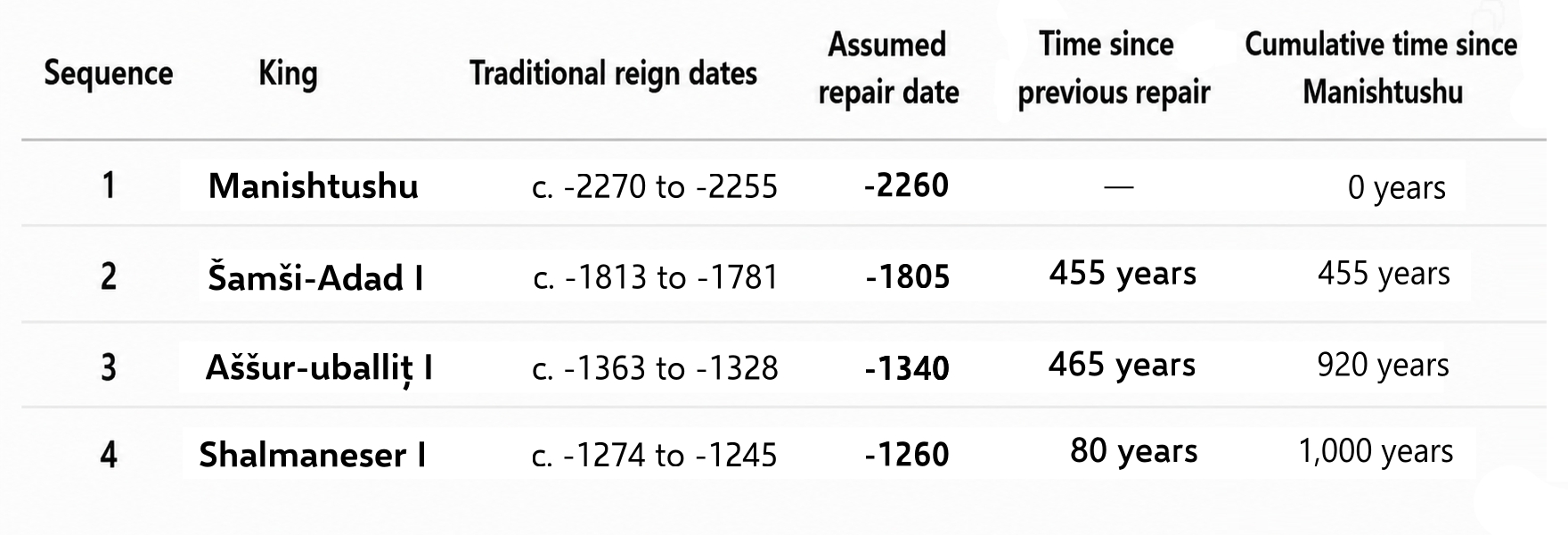
Notice the gap between repairs; in their history, two separate periods of half a millennium elapsed between repairs. How likely is that, we wonder? That the temple of the chief goddess survived so long unattended not once, but twice?
But now look at those same kings in our dates… Shalmaneser I (‑1289‑1259), Assuruballit I (‑1371‑1335), Shamsi-adad I (‑1401‑1368), and Manishtushu (‑1832‑1817) – let’s speculate that the repairs were done in ‑1270, ‑1340, and ‑1395, with the original repair in ‑1820.
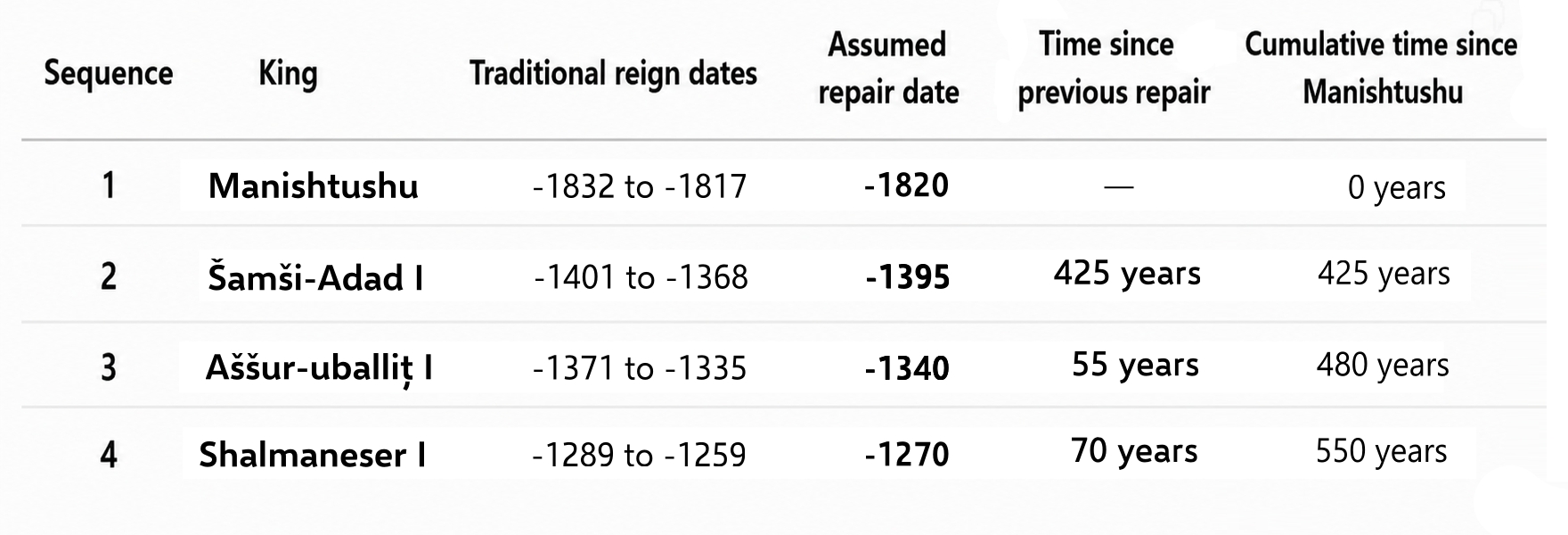
We concede that we still have one long period, but one that is explicitly called out and boasted about in the original text as being seven generations. Now the word translated as “generation” there is actually the Assyria word palu, which meant more along the line of “rotations,” “cycles”; in this context, some scholars say it’s best translated as lifetimes.
Given seven lifetimes of 70 years each, we arrive at 7×70 – 490 years – not far off of the actual elapsed time of 455 or so we have in our chart. A term like “lifetimes” is inherently approximate, so we call that close enough.
But every other repair was done regularly, routinely, on a 70-year or so basis – exactly how long we would expect an ancient building to survive without major repairs in a desert region. Inserting 400 years into this history requires immense gaps in these repairs, and common sense argues strongly that these gaps don’t exist.
ADJUSTING THE SACRED LIST
Assyriologists will object violently to messing with Assyria, but they’ve already admitted they are in the dark about that roughly two-century period, so they can hardly prove their case. And co-reigns are plausible, and they would not easily show up in history.
Besides, the only reason they object so much is that they need Assyria so badly; there is no reason to believe that the chronology before Assur-dan II is any more accurate than the SKL or the BKL, yet they treat it as if it were because without it, they have no dating system for the ancient Near East.
All of the evidence we have so far suggests that Puzur-assur III should move forward 50 years; if so, then Assuruballit would also move forward, which is nice because it distances him from the time of the Amorite kingdoms, and while he certainly was not the powerful king of the Amarna letters, his grandson credited him with some limited accomplishments:
[Adad-nirari I] son of Arik-dīn-ili, appointee of the god Enlil, vice-regent of (the god) Aššur, conqueror of the Turukkû and the land Nigimḫi to its full extent, (as well as) all of the rulers of the mountains and mountainous regions of the wide border of the (land) Qutû, conqueror of the land Katmuḫi and all of its allies, the hordes of Aḫlamû, Suteans, (and) Yaʾuri, and their lands, extender of borders and boundaries;
grandson of Enlil-nārārī, (who was) also vice-regent of (the god) Aššur, (the one) who killed the army of the Kassites and defeated all of of his enemies, extender of borders and boundaries;
(and) offspring of Aššur-uballiṭ (I), the strong king whose priesthood was outstanding in awesome Ekur and the well-being of his kingship was established as far away as the mountains, subduer of the land Muṣri, disperser of the hordes of the wide land Šubarû, extender of borders and boundaries. (Tablet of Adad-nirari I, http://oracc.org/riao/Q005738/)
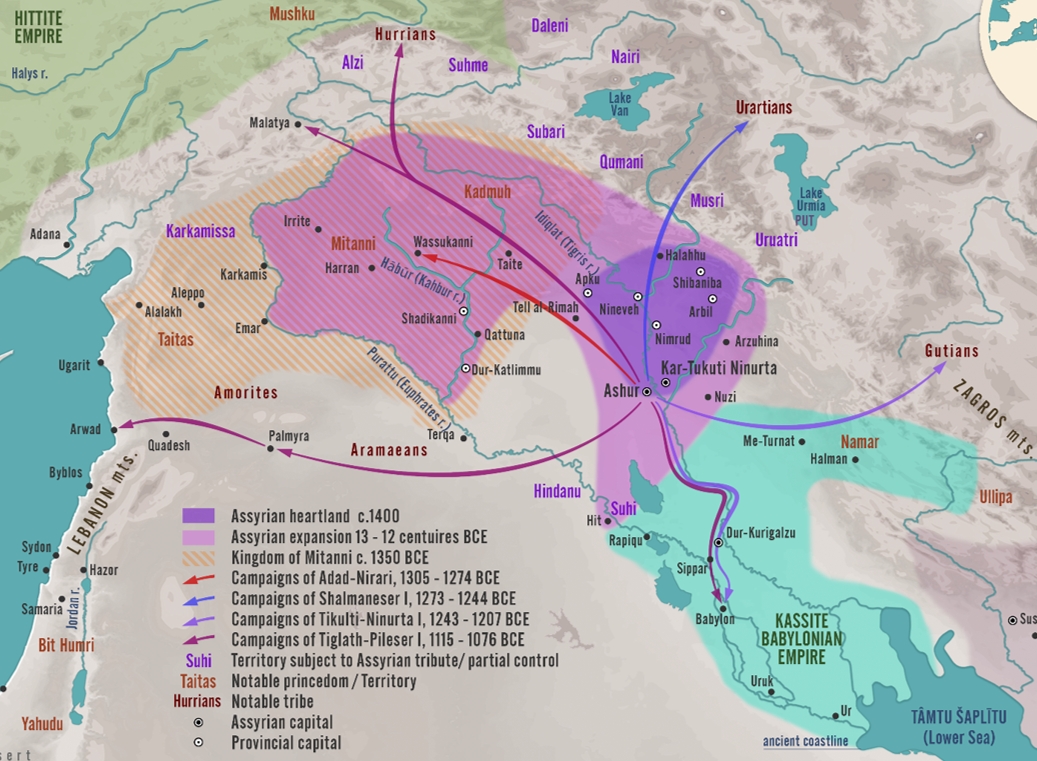
The following map from Worldhistory.org on the Middle Assyrian empire, which I have cropped to show the part we need, shows that Musri is to the northeast of Assur, not that far away from the Assyrian heartland circa ‑1400 (the purple region); and the Subaru are to the northwest.
These strictly avoid Babylonian territories and instead are occupying the lands recently abandoned after the death of Shamsi-adad. The pink area shows Assyrian expansion in the 13th-12th centuries BC, up to the time of Tikulti-ninurta I.
Note in all of this they avoid the Kassite lands to the south, in light blue – except for the supposed invasion by Tikulti-ninurta I which, as we’ve said so many times, did not happen. Tiglath-pilesar I seems to have invaded without lasting success. Which suggests this was the rise of Kassite power, not its decline.
CONCLUSION
We have repeatedly called the Assyrian “kings” of Shamsi-adad’s period high-priests of a minor city-state; Wikipedia largely agrees with us, in broad:
For most of the Old Assyrian period, Assur was a minor city-state with little political and military influence. In contrast to Assyrian kings of later periods, the kings in the Old Assyrian period were just one of the prominent leading officials in the city’s administration and normally used the style Išši’ak Aššur, which translates to “governor (on behalf) of (the god) Ashur,” rather than šar (king). The kings presided over the city’s actual administrative body, the Ālum (city assembly), which was made up of prominent and influential members among Assur’s populace. Though lacking in military and political might, Assur was an important economic center in northern Mesopotamia. (Wiki, Old Assyrian Period)
The main problem is that for certain individuals whose identities they have confused with later kings, they assign deeds that no Assyrian in this period could have done; chiefly Assuruballit I, although there are others.
They believe that Assuruballit I defied this trend because they have mis-assigned Amarna letters to him, and through them the events of Chronicle P, and through that they have assigned a large empire to him.
But once we strip those away, as we have, we are left with no reason to believe his “kingdom” was anything more than his ancestors’ kingdom had been; a minor city-state frequently subject to foreign powers.
Although they should have lived at the same time, there exists no direct link connecting Hammurabi to Assuruballit; nor would we expect one. He was not really a king but a regent of Asshur; a glorified high priest and mayor. Hardly worthy of Hammurabi’s notice, nor Shamsi-adad’s for that matter.
It is interesting, however, that coincidentally with the Kassite invasion breaking the power of Samsu-iluna in ‑1335, that the first Assyrian king who actually was powerful, Enlil-nirari I, began to reign in ‑1337.
And now we know why – Assyria was tired of being Amorite puppets, and with the coming of the Kassites, the Amorites could no longer hold sway over them, and soon lost their control over Babylonia altogether.
And Assyria’s best days were ahead of them.

This is part 28 of The History of the World Series
 Solomon and the Queen of Sheba
  Judges to Kings
  Joshua and Jericho
  Hyksos and the Amalekites
  Aftermath of the Exodus
  What Is The LOVE Of God?
  Everything You Believe About God Is WRONG!
  Make Up Your Mind!
  What Is Faith?
  How DARE you FEAR the judgment of God!
  Firstripe Figs
  The Bride Of The Father
  Exodus 40 – The Plan Of God
  The Temple Of God
  Pillars Of The Temple And The Brass Sea
  GEHENNA WITH ‘EM
  When Did God Forbid Polygamy?
  When You Shouldn’t Pray For Someone
  The Sins of the Father
  The First Paul