Hyksos and the Amalekites
This is part 32 of the The History of the World Series
; The History of the World is part 1.
Click here to read in series
From Genesis 12 until the book of Joshua, Egypt figures prominently in the Bible’s story (mentioned 268 times by name). From then until the time of David, present-tense references to Egypt or Egyptians completely disappear.
On the one hand, this is not entirely surprising; Egypt was, as has been shown, an absolute wreck. On the other hand, this is a period of over 400 years; a long time to have no reference to an Egyptian army, Egyptian trade, or so much as a single Egyptian.
Indeed, this is one reason historians reject the narrative of the Exodus and Joshua’s invasion of Canaan; for when Joshua existed, they think Egypt controlled lands as far as modern Turkey, and completely dominated Canaan.
To them, this proves these events are fictional. But for us, this proves rather the opposite; that at this point in history, not only did Egypt not have an empire stretching as far as the Euphrates… they didn’t even control their own homeland!
Which is not to say that there was no Egyptian government… nor even that the Bible didn’t mention the Egyptian government… but rather that the Bible called the Egyptian government by their proper name… the Amalekites.
Judges 3:12-14 The children of Israel again did that which was evil in the sight of Yahweh: and Yahweh strengthened Eglon the king of Moab against Israel, because they had done that which was evil in the sight of Yahweh. He gathered to him the children of Ammon and Amalek; and he went and struck Israel, and they possessed the city of palm trees. The children of Israel served Eglon the king of Moab eighteen years.
What’s interesting is that despite the fact that Amalekites were among the aggressors in almost every battle in the entire Judges period (Judges 5:14, Judges 6:3-6, Judges 10:12, etc.), not once did the Bible record a captivity to the Amalekites.
That tells us that the Amalekites were far enough away to be happy with proxy power – but close enough to send armies to assist their proxy states and allies in the near east. They were, in other words, in Egypt.
And for the exact same four centuries that Egypt disappears from the Bible’s narrative, the Amalekites appear; and at the same time that Egypt reappears in the Bible, the Amalekites disappear. Because they were the same.
THE EGYPTIAN SIDE
Now what’s interesting is we do have an independent confirmation of some of the events in the Judges period, at roughly this point in history; Salitis, first king of the 15th Dynasty whom I date to approximately ‑1331‑1312, is claimed by Manetho to have used a base in the NE delta to “strike terror into foreign tribes.”
He [Salitis] had his seat at Memphis, levying tribute from Upper and Lower Egypt, and always leaving garrisons behind in the most advantageous positions…. he found a city very favourably situated on the east of the Bubastite branch of the Nile, and called Auaris after an ancient religious tradition…. Here he would come in summer-time… to train them carefully in maneuvers and so strike terror into foreign tribes…. (Manetho, as quoted by Josephus)
This doesn’t align precisely to a particular captivity of Israel (the captivity to the Moabites in Judges 3:14 was approximately ‑1378‑1361, while that to Canaan in Judges 4:1-3 dates to ‑1298‑1278). Still, it shows that regular invasions of the land of Canaan fit into the time frame.
These “terror strikes” basically had to be targeted at Israel, since the only foreign tribes immediately east of Amalekite Egypt at that time were the Israelites! And almost every time there were dirty deeds to be done in Israel, Amalek answered the call – no matter who asked.
Judges 6:3-6 So it was, when Israel had sown, that the Midianites came up, and the Amalekites, and the children of the east; they came up against them; and they encamped against them, and destroyed the increase of the earth, until you come to Gaza, and left no sustenance in Israel, neither sheep, nor ox, nor donkey. For they came up with their livestock and their tents; they came in as locusts for multitude; both they and their camels were without number: and they came into the land to destroy it. Israel was brought very low because of Midian; and the children of Israel cried to Yahweh.
This was probably not the Midianites of Jethro, who had been friendly to Israel centuries earlier; but the “Mitanni” Midianites “and the children of the east” – other Abrahamic descendants by Keturah. These tribes had reason to hold a grudge against the children of Isaac, as did the Amalekites who were descended from Esau.
Moving on, there are a lot of references to the Amalekites harassing Israel, I won’t cite them all – but suffice it to say that they were the ever-present southern nemesis to Israel during the period of the Judges. Yet there is not one reference to Egypt until the following verse in the early 11th century… and it is very revealing!
1 Samuel 30:13 David asked him, “To whom do you belong? Where are you from?” He said, “I am a young man of Egypt, servant to an Amalekite; and my master left me, because three days ago I fell sick.”
While it is possible that a strong Egypt sold a native Egyptian slave to an Amalekite, it’s highly unlikely. Remember, the Egyptians took slaves of the Aamu; they didn’t sell slaves to them! Thus, it is far more likely that this refers to the fact that 400 years after the Exodus, the Amalekites were still in control of Egypt, taking slaves for their own use from among its citizens.
Now that number is very interesting – Israel was actually mistreated for only about a century, give or take from the time of Amenemhet III/IV to the Exodus; so God punishing the Egyptians with four centuries of slavery in return is actually in line with His own law:
Exodus 22:1 If a man steals an ox or a sheep, and kills it, or sells it; he shall pay five oxen for an ox, and four sheep for a sheep.
Israel’s firstborn was paid for by a lamb, and God specifically compares them at their Exodus to sheep being led (Psalms 78:52). This sheep had been stolen by Pharaoh and forced to work in slavery, even though they were God’s people. Thus, a payment equal to four times the crime inflicted would be fair.
Which makes it very interesting that within a few decades of the Exodus (‑1507) when the Hyksos invaded Egypt… and Saul began to reign in ‑1111, and at some point in his reign began to war against and conquer the Amalekites… more or less 400 years later.
1 Samuel 14:47-48 Now when Saul had taken the kingdom over Israel, he fought against all his enemies on every side, … and wherever he turned himself, he defeated them…. He did valiantly, and struck the Amalekites, and delivered Israel out of the hands of those who despoiled them.
Saul’s harrying of their eastern flank of the Hyksos was what weakened them enough that the Egyptians from Thebes were able to strike back and chase them out of Egypt, giving rise to the New Kingdom and the 18th Dynasty.
THE END OF THE HYKSOS
Contemporary monuments tell of the final kings of the 17th Dynasty chasing out the Hyksos as follows:
To what effect do I perceive it, my might, while a ruler is in Avaris and another in Kush, I sitting joined with an Asiatic and a Nubian, each man having his (own) portion of this Egypt, sharing the land with me. There is no passing him as far as Memphis, the water of Egypt. He has possession of Hermopolis, and no man can rest, being deprived by the levies of the Setiu. I shall engage in battle with him and I shall slit his body, for my intention is to save Egypt, striking the Asiatics. (Carnarvon tablet, as quoted in Wiki “Hyksos”)
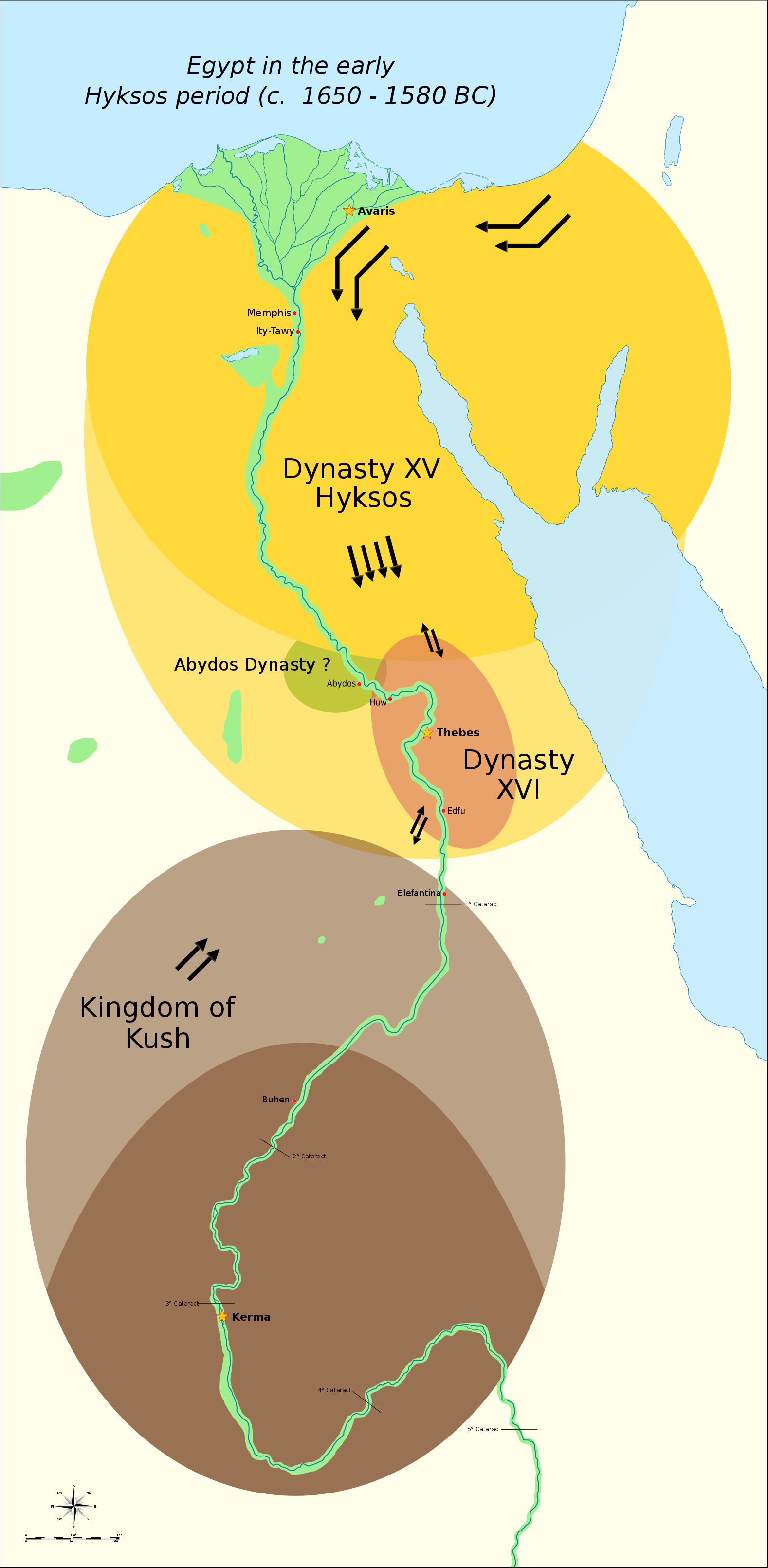 This describes a state of affairs during the reign of Kamose, last king of the 17th Dynasty. The Egyptians had ruled, as vassals, the territory around Thebes ever since the reconstruction of Egypt after the Hyksos conquest – the small orange-brown blob in the middle of following map.
Historians know this small Egyptian center as the 16th and 17th Dynasties, and towards the end of that period, coinciding with Saul’s attacks from the east, they declared themselves independent and began to, over about 40 years, chase the Hyksos out of Egypt and back to their homeland.
But while the Hyksos were occupying the delta the Nubians had taken advantage of Egypt’s weakness to appropriate much of southern Egypt, a situation that prevailed for most of the same 400 year period. And so Kamose found himself sandwiched between two stronger powers both of whom had become accustomed to owning his ancestral homeland.
His father Seqenenre Tao had tried to rebel against the Hyksos king Apophis/Apepi, and evidently failed – for his mummy shows he was executed on the battlefield (this doesn’t happen to winners). Kamose declared independence and apparently made it stick – although he was not able to expel the Hyksos from Avaris. However, he laid the groundwork for his brother, Ahmose I, first king of the 18th Dynasty, to do so.
He recounts his destruction of the city of Nefrusy as well as several other cities loyal to the Hyksos. On a second stele, Kamose claims to have captured Avaris, but returned to Thebes after capturing a messenger between Apepi and the king of Kush. Kamose appears to have died soon afterward. (Wiki, Hyksos)
This would have been a serious problem, if the Hyksos could have coordinated with the Nubians to the south; causing Kamose to return to stabilize his flank, and leaving Avaris inhabited, for the time being, by the Hyksos.
Ahmose I continued the war against the Hyksos, most likely conquering Memphis, Tjaru, and Heliopolis early in his reign, the latter two of which are mentioned in an entry of the Rhind mathematical papyrus. Knowledge of Ahmose I’s campaigns against the Hyksos mostly comes from the tomb of Ahmose, son of Ebana, who gives a first-person account claiming that Ahmose I sacked Avaris: “Then there was fighting in Egypt to the south of this town [Avaris], …Then Avaris was despoiled, and I brought spoil from there.”
Thomas Schneider places the conquest in year 18 of Ahmose’s reign. However, excavations of Tell El-Dab’a (Avaris) show no widespread destruction of the city, which instead seems to have been abandoned by the Hyksos. Manetho, as recorded in Josephus, states that the Hyksos were allowed to leave after concluding a treaty:
Thoumosis… invested the walls [of Avaris] with an army of 480,000 men, and endeavored to reduce [the Hyksos] to submission by siege. Despairing of achieving his object, he concluded a treaty, under which [the Hyksos] were all to evacuate Egypt and go whither they would unmolested. Upon these terms no fewer than two hundred and forty thousand, entire households with their possessions, left Egypt and traversed the desert to Syria. (Wiki, Hyksos)
It’s interesting how well Manetho’s account is verified by history, and yet how stubbornly historians refuse to believe it is factual when it disagrees with their theories. The expulsion of the Hyksos after the siege of Avaris was performed by Ahmose, whom we date to ‑1100‑1075.
You saw above that some historians believe the siege took place in his 18th year (‑1082); while the evidence isn’t conclusive, it’s a place to start. For comparison, this would be the 26th year of Saul’s reign in Israel – this becomes very interesting later.
Because after the Hyksos were expelled, they went east, and at this time in history they could not have invaded the lands of Israel, which were well defended. Which means they must have stayed south of Israel.
Following the capture of Avaris, Ahmose, son of Ebana, records that Ahmose I captured Sharuhen (possibly Tell el-Ajjul), which some scholars argue was a city in Canaan under Hyksos control. (Ibid.)
Sharuhen is mentioned in the Bible as one of the cities given to Simeon, in the extreme SW of the land of Canaan. At the time of the allotment of land, many tribes had not received their inheritance, nor would they for many years.
Ahmose I engaged in a retaliative three-year siege of Sharuhen, thereby launching an aggressive policy of pre-emptive warfare. The town fell soon after the siege, ending the power of the Hyksos. (Ibid.)
Despite the treaty, the Egyptians pursued the Hyksos into their next stronghold, Sharuhen, and besieged them again there – this time for good. And this gives us a chance to correct something Josephus and Manetho both misunderstood; the retreat of the Hyksos:
On these terms the Shepherds, with their possessions and households complete, no fewer than 240,000 persons, left Egypt and journeyed over the desert into Syria. There, dreading the power of the Assyrians who were at that time masters of Asia, they built in the land now called Judaea a city large enough to hold all those thousands of people, and gave it the name of Jerusalem. (Josephus, quoting Manetho)
Now this was, indeed, in the land called Judea in the time of Josephus; however, the city they retreated to was not Jerusalem, but Sharuhen. From contemporary monuments, we know that’s where the Hyksos retreated to; which means Manetho misread the name when he transcribed it – which he was only too happy to do, since he was intent on connecting the Hebrews and Hyksos.
THE DEATH OF APOPHIS
And it’s interesting that, amid all the boasting about the end of the Hyksos, the Egyptians did not mention the death of the last powerful king of the Hyksos, Apophis (in Egyptian, Apepi). That’s because they didn’t kill him. But we know who did!
According to the Turin Canon of Kings, he reigned over the northern portion of Egypt for forty years…. Although officially only in control of the Lower Kingdom, Apepi in practice dominated the majority of Egypt during the early portion of his reign. He outlived his southern rival, Kamose, but not Ahmose I. (Wiki, Apepi)
Remember that Manetho as quoted by Africanus gave him 61 years; Turin gives him at least 40 years, which means that Turin must record only his sole rule… or his rule in Avaris but not his rule in exile. Josephus has him as the 4th ruler, but Africanus placed him as the 6th and final ruler in the dynasty, as modern historians do (not counting Khamudi’s brief reign).
While Apepi exerted suzerainty over and maintained peaceful trade relations with the native Theban Seventeenth Dynasty to the south, the other kingdom eventually regained control. The Hyksos were driven out of Egypt no more than fifteen years after his death. Kamose, the last king of the Seventeenth Dynasty, refers to Apepi as a “Chieftain of Retjenu” in a stela that implies a Canaanite background for this Hyksos king. (Ibid.)
The actual time of the expulsion of the Hyksos, particularly as it relates to Apophis, is very murky. His successor, Khamudi, may only have reigned for a single year:
Based on the scarcity of material dating to Khamudi’s reign, Ryholt has proposed that his reign must have been short, amounting to no more than a year. In this situation, Khamudi would have inherited little more than the Hyksos throne, being possibly already besieged in Sharuhen, the last Hyksos stronghold in the Negev Desert. (Ibid.)
So what happened to Apophis? To establish that, we have to use the Bible. Remember, we know when this happened – during the latter part of the reign of Saul. If the expulsion of the Hyksos from Avaris took place in his 26th year, then it would probably take at least a year, perhaps several years, to break their treaty and pursue them.
The siege of the Hyksos fortress [at Avaris] appears to have been no easy matter, and was followed by another siege, lasting no less than three years, at Sharuhen, a place in the south-west of Palestine mentioned in the Book of Joshua (xix. 6). This appears to have been the limit of Amosis’s campaign in the Palestinian direction, for he had still to cope with the usurper in Nubia and with a couple of rebels who still remained on Upper Egyptian territory. (Egypt of the Pharaohs, Gardiner)
Thus, the destruction of Sharuhen would be around the 30th year of Saul. What is notable about the stories of the fall of Sharuhen and Avaris is that there is no mention of the destruction of the king of the Hyksos, who at this time was Apepi.
Why is he not mentioned, any where in the entire story? Because the Egyptians didn’t kill Apepi; Samuel did! After Saul’s failure to obey God’s commandment, Samuel killed Agag the Amakelite!
That’s not the same name, you say? Well, fun fact: you cannot spell Agag in Egyptian, because the language had no letter “g” that corresponds to the sound in “go” or “Agag.” So when the Hyksos ruled over the Egyptians, and wrote their names on monuments and such in Egyptian, they had to use Egyptian spellings.
And it is literally impossible to spell Agag in Egyptian; they would have used a different glyph to substitute for the G; And given the timeline and the stories we know, Agag must be Apepi; which is why, precisely where we know Apophis’ last stand was made, we find Agag!
1 Samuel 15:1-8 Samuel said to Saul… Thus says Yahweh of Armies, ‘I have marked that which Amalek did to Israel, how he set himself against him in the way, when he came up out of Egypt. Now go and strike Amalek, and utterly destroy all that they have, and don’t spare them; but kill both man and woman, infant and nursing baby, ox and sheep, camel and donkey.’
Saul summoned the people, and numbered them in Telaim, two hundred thousand footmen, and ten thousand men of Judah. Saul came to the city of Amalek, and laid wait in the valley…. Saul struck the Amalekites, from Havilah as you go to Shur, that is before Egypt. He took Agag the king of the Amalekites alive, and utterly destroyed all the people with the edge of the sword.
Saul smote “the city of the Amalekites.” It is not named here, but based on our Egyptian sources it must be Sharuhen. And note the size of the army – almost a quarter-million men, which agrees well with the force required to defeat the 240,000 total Amalekites who fled Avaris as we are told in Manetho.
The Bible gives no clear timeline for the events in Saul’s life, but as a direct result of Saul’s failure to kill Agag, Samuel told him “Yahweh has torn the kingdom of Israel from you this day, and has given it to a neighbour of yours who is better than you” (1 Samuel 15:28).
Therefore, the anointing of David should have taken place soon after this; we know David was 70 when he died, reigned for 40 years, and before his anointing he was old enough to take care of the sheep, and kill a bear and a lion by himself (1 Samuel 17:32-36).
Miracle or no miracle, I can’t see that happening with someone under, say 15; and older would fit better. He was, nonetheless, young enough to be mocked and belittled for his age – hence, probably not older than 25. All of this means his anointing probably took place between 15 and 25 years of age (‑1086‑1076).
Now we’ve already dated the expulsion of the Hyksos from Avaris to ‑1082 from the Egyptian side, allowing some time for the Egyptians to pursue them, besiege Sharuhen for 3 years, bringing us to ‑1079 or later.
At some point soon after, Saul came and conquered the now-battered “city of the Amalekites”; and rather than destroy it utterly, he defied God and brought back the best of the goods (1 Samuel 15:9), leaving it to Samuel to execute the last king of the Hyksos, Apophis, and promptly to anoint David.
It’s really remarkable, and a strong bit of evidence of the work we’ve done so far, that the timeline fits between Egypt and Israel at this point to the very year. Both timelines indicating the fall of Sharuhen in ‑1078 or so.
TWO AGAGS
Forty years after the Exodus, just before Joshua entered the Promised Land, Balaam was called to curse Israel, but he blessed him instead. In the process, he mentioned a powerful king named Agag in a very curious way:
Numbers 24:7 He [Jacob] shall pour the water out of his buckets, and his seed shall be in many waters, and his king shall be higher than Agag, and his kingdom shall be exalted.
Obviously, this is a reference to the Messiah, millennia later (verse 17); but a partial fulfillment is when Saul conquered, and thus was “higher” than Agag, centuries later around ‑1079, which began the exaltation of the Israelite kingdom.
Still, it would make little sense to his audience if there wasn’t also an Agag that was contemporary with Balaam’s prophecy in ‑1467. This means that there must be at least two Agags/Apepis/Apophises.
While some Egyptologists once believed that there were two separate kings who bore the name Apepi, namely Aauserre Apepi and Aaqenenre Apepi, it is now recognized that Khamudi succeeded Apepi at Avaris and that there was only one king named Apepi or Apophis. Nebkhepeshre (“Re is the Lord of Strength”) was Apepi’s first prenomen; towards the middle of his reign, this Hyksos ruler adopted a new prenomen, Aaqenenre (“The strength of Re is great”). In the final decade or so of his reign, Apepi chose Aauserre as his last prenomen. (Wiki, Apepi)
This, delivered with great confidence as Egyptologists always do, is a guess. The idea that a pharaoh changed his name mid-reign is almost impossible to prove, and it would look just the same as two pharaohs with two different names would look in history. Besides, historians well know this was a common name:
A ‘Prince Apepi,’ named on a seal (now in Berlin) is likely to have been his son. (ibid.)
This means at least three royals named Apophis/Agag are recorded – that we know of. So the idea of one existing at the time of Joshua and another one (or two) in the time of Saul is quite plausible. Remember, there was also a “prince Apepi,” likely to be the son of Apepi II.
Four colossal sphinxes of the 12th-Dynasty ruler Amenemhat III and two statues of the 13th-Dynasty ruler Smenkhera were found at Tanis, inscribed with the names of Aqenenra Apepi (another name of Aauserra Apepi). Their original dedication inscriptions to Ptah indicate that they were first set up at Memphis. It is usually assumed that they were looted by Apepi, taken to Avaris, and then removed in Ramessid times to Tanis, but all that we can be sure of is that Apepi claimed them by writing his name on them, and they may never have left Memphis at all until Ramessid times. Nevertheless, at least one royal monument of a 13th-Dynasty king was violated: the pyramidion from the top of King Merneferra Ay’s pyramid, which was probably built at Saqqara, was found at Faqus, close to Tell el-Dabea. (Wiki, Hyksos)
Note how blithely they slip in there that the looting was done by a differently named Apepi – Aqenenra, not Aauserra. It’s highly unlikely that the later Apepi who was killed by Saul, even if he reigned for 61 years as Manetho said, would have been involved in looting monuments from his own kingdom.
Remember, at that time Kamose complained that Apepi controlled Memphis. Why would he loot it, after having occupied it for centuries? It makes no sense. It’s far more likely that an earlier Aaqenenra Apepi, not properly or formally a king, not known from Manetho, removed these monuments to his own base of power while the Amalekites were still in their looting phase early on in the ‑1480’s or so.
Furthermore, note the reference to the penultimate pharaoh of the 13th Dynasty, Mernerferra ay – the last pharaoh to build a pyramid just before the Exodus. Why would Apepi steal that particular pyramidion (capstone)? Because when Apepi I invaded, it had just been built! It was literally the last pyramid built by the Middle Kingdom, and may not have even been installed.
Thus, the simplest explanation is that Aaqenenre Apepi I either invaded with the first wave, or was born in the first generation after and rose to a power worthy of comparing with the Hebrew Messiah, according to Numbers 24:7.
Then centuries later another powerful king ruled for at least 40, if not 61, years by the name of Aauserre Apepi II. He lost control of the Theban kings early in his reign, failed to regain it, and was eventually killed – either by Kamose or Ahmose at Avaris, to be succeeded by Khamoudi.
Who in turn was killed in Sharuhen by Ahmose, leaving Apepi II’s son Apepi III to rule briefly before his own death at the hands of Samuel. One reason I favor this story is the last words he heard from Samuel “As your sword has made women childless, so your mother will be childless among women!” (1 Samuel 15:33).
While this could be strictly metaphorical, it’s hard to believe that a king who had ruled for 40 if not 60 years – and was therefore probably 70 or 80 years old – still had a mother who would now become childless. Which argues that Saul’s nemesis Agag was Apepi III, much younger and with still a living mother.
THE FORGOTTEN AMALEKITES
When Israel left Egypt, they crossed into Midian and were attacked from behind by the Amalekites in an ambush; causing God to declare “Yahweh will have war with Amalek from generation to generation” (Exodus 17:16).
Deuteronomy 25:17-19 Remember what Amalek did to you by the way as you came forth out of Egypt; how he met you by the way, and struck the hindmost of you, all who were feeble behind you, when you were faint and weary; and he didn’t fear God. Therefore it shall be, when Yahweh your God has given you rest from all your enemies all around, in the land which Yahweh your God gives you for an inheritance to possess it, that you shall blot out the memory of Amalek from under the sky; you shall not forget.
Forty years later, just before Joshua entered the Promised Land, Balaam was called to curse Israel, but he blessed him instead. He mentioned the power of Agag, as we’ve already quoted, then turns to address Amalek directly…
Numbers 24:20 He looked at Amalek, and took up his parable, and said, “Amalek was the first of the nations, But his latter end shall come to destruction.”
This is very odd – and historically inaccurate as we understand it. Amalek was a tribe of desert dwellers; they left no monuments, and in fact historians cannot prove from archaeology that they even existed.
No reference to Amalek or the Amalekites has been found in surviving Egyptian and Assyrian monumental inscriptions and records, even though both groups recorded various tribes and peoples of the Levant in the relevant time period (s). Therefore, Hugo Winckler concluded that there were no Amalekites and that the Biblical stories concerning them were entirely ahistorical and mythological. Although archaeological research has improved knowledge about nomadic Arabs, no specific artifact or site has been linked to Amalek with certainty. (Wiki, Amalek)
Remember, this is exactly what God promised to do; “blot out the memory of Amalek from under heaven.” Mission accomplished! Yet while their identity is forgotten, it’s impossible that we don’t know of them, because the most powerful nation in the world at that time cannot hide from history!
These people left no monuments, no records, no mark of their existence upon the world; so calling such an insignificant people “first” among nations which included the Mitanni, Assyrians, Hittites, Egyptians, Babylonians, and so on would be laughable.
…but not if they were the Egyptian rulers of that time. Egypt, for all of is destruction, would have recovered fast – ecologically. A few good Nile floods and all would be good as new as far as the wealth of the land went.
And so if the Amalekites invaded Egypt promptly upon the departure of the Hebrews – at least within a decade or two – then by the time of Balaam’s prophecy forty years later, they had plenty of time to establish absolute control of the Egyptians.
Plenty of time to rebuild the economy and quash Egyptian rebellions, putting the Egyptians to work as slaves in their own land precisely as Ipuwer told us that “the builders of pyramids are cultivators, and those who rode the sacred boat are tied to it.”
Thus, by the time of Joshua Amalek could really be the “first of the nations,” but only if they ruled the wealthiest nation on Earth – Egypt! Known to historians as the Hyksos, but utterly unknown to historians as Amalekites.
Such a significant people as the conquerors of Egypt could not, indeed, hide from history. And, of course, they didn’t. But because the insufferably smug Egyptians couldn’t bother to learn the names of anyone’s tribe, they did not record the true names of their conquerors.
Thus the only place in the world you can learn of the existence of a people God wanted you to forget… is His own book.
THE GOD OF THE HYKSOS
The patron saint of the Hyksos, for lack of a better term, was called Seth; this was generally the bad guy in Egyptian mythology, as close as they came to a proper devil. He was the brother of Osiris who tricked and murdered him, and also the subject of an apocalyptic battle with Horus.
In the Ramesside era, Apepi is recorded as worshiping Seth in a monolatric way: “King Apophis chose for his Lord the god Seth. He didn’t worship any other deity in the whole land except Seth.” …Seth the desert god, who was worshiped exclusively, represented a manifestation of evil. (Wiki, Apepi)
Now remember, the Egyptian pharaohs considered themselves the embodiment of Horus and were destined to become one with Osiris at death; so it’s not too surprising that these foreign invaders picked the one god who was the mortal enemy of Horus and Osiris.
Of course, it also helped that he was a desert god, and they were desert dwellers – whom the Egyptians looked down at compared to their “civilized” status. Picking a powerful god from your new territory who was an Egyptian god-killer was a smart move, politically.
But I quote this as yet another piece of evidence that the Hyksos were indeed one and the same with the Amalekites. As mentioned above, Balaam was called to curse Israel but blessed him instead; among the prophecies was a reference to a future king of Israel…
Numbers 24:16 …there shall come a Star out of Jacob, and a Sceptre shall rise out of Israel, and shall smite the corners of Moab, and destroy all the children of Sheth.
No one knows who these “children of Sheth” are; the closest guess commentators have is the descendants of Seth, son of Adam. But that makes no sense; everyone is a descendant from Noah, and Noah in turn from Seth – which means literally everyone alive qualifies as “children of Seth.”To “destroy the children of Sheth” would mean “destroy all mankind.”
…but knowing that the Amalekites are the Hyksos, and knowing that by that time they were already in Egypt, already aligning themselves with the god-killing Seth, devil-like god of the desert, one can clearly see that Balaam, prophesying for God, was alluding to the Amalekite/Hyksos as the Children of the Egyptian God of chaos… Seth!
And since Seth is the Egyptian devil… one can see why the Lord “would have war with his children from generation to generation.” Something which needed to be specifically “rehearsed in the ears of Joshua” – i.e., … Jesus.
And as for the literal interpretation of the prophecy, “a scepter shall rise out of Israel,” means the creation of kingship in Israel; Saul was literally the first king, thus the first to use a scepter. And he would destroy, not smite, “all the children of Sheth.”
The only nation Saul destroyed was the Amalekites, who are therefore the children of Sheth, because they worshiped the Egyptian God Set/Seth.
Q.E.D.
THE RISE OF THE NEW KINGDOM
After chasing out the Hyksos, Ahmose returned to Egypt to secure his borders; his son Amenhotep I continued the task, attacking Libya, Nubia, and bringing native Egyptian rule to these territories for the first time in four centuries.
He ruled for, it is generally agreed, about 21 years and died quite young around 35 years of age, based on his mummy; since he would have been about 14 when he began to reign, it’s likely he had a regent for at least a few years, probably his mother Ahmose-Nefertari.
We met her earlier when we discussed the prophesies of Neferti; she is the “woman of Ta-seti,” the “most venerated woman in Egyptian history,” mother of the Egyptian messiah Ameny/Amenhotep.
The queen was revered as “Goddess of Resurrection” and was arguably the most venerated woman in Egyptian history. Ancient Nubia ruling families have been said to feature strong matriarchal inclinations, a characteristic described as indisputable in the case of the 17th Dynasty. Along with other queens of the period, it has been suggested that the matriarchal quality of Ahmose-Nefertari’s rule and line originated from Nubia.
A donation stela from Karnak records how king Ahmose purchased the office of Second Prophet of Amun and endowed the position with land, goods and administrators. The endowment was given to Ahmose-Nefertari and her descendants, though she was the most prominent God’s Wife of Amun. Separately the position of Divine adoratrix was also given to Ahmose-Nefertari. (Wiki, Ahmose-nefetari)
As shown in the previous chapter, she is generally depicted as jet black, and is known to have come from Upper Egypt, a region that is ethnically Nubian. In fact, many of the kings of the 18th-20th Dynasties are known to have significant Nubian blood:
James Harris and Fawzia Hussien (1991) conducted an X-ray survey on New Kingdom royal mummies and examined Thutmose I’s mummified remains. The study found that Thutmose I’s mummy had all the craniofacial characteristics common among Nubian populations and a “typical Nubian morphology.” (Wiki, Thutmose I)
…The analysis in general found strong similarities between the New Kingdom rulers of the 19th Dynasty and 20th Dynasty with Mesolithic Nubian samples. The authors also noted affinities with modern Mediterranean populations of Levantine origin. Harris and Wente suggested this represented admixture as the Rammessides were of northern origin. (Wiki, Rameses III)
This is not to say they were pure Nubian, but some of them would certainly have exhibited Nubian features, such as dark skin. In addition, Nubian women held an important role in leadership, something that would be a defining characteristic of the 18th Dynasty.
Given that the prophecies of Neferti certainly refer to the 400 years of Hyksos domination, that should be used as independent evidence that Amenhotep I’s mother was indeed from Ta-seti, and therefore of Nubian ancestry.
In fact, it’s quite possible that the prophecies of Neferti were written by Nefertari. She was, after all, seen as divine and known to hold the post of “God’s wife of Amun,” “second prophet of Amun,” and was immensely powerful.
She was also a strong matriarchal leader, with a vested interest in establishing her son on a fragile throne; concocting a prophecy, giving it the voice of an old kingdom prophet, then telling the history of the past 400 years and prophesying that her son, Ameny/Amenhotep would restore Egypt’s glory would have been a masterful piece of propaganda.
After her death and his, both were deified. This gave a strong starting point to the new kingdom, but he left no sons and the throne passed to Thutmose I, his chosen heir, who was legitimized by marrying into the family of Amenhotep I – probably to his sister.
Thutmose didn’t live long – his mummy is about 35 years of age at death, and Manetho gives him 13 years of rule – but he founded a dynasty that would last at least 9 generations, and include such famous figures as Hatshepsut… whom you know better as the Queen of Sheba.

This is part 32 of The History of the World Series
 Aftermath of the Exodus
  The Rising of Sothis
  Assyria and the Mitanni
  Old Assyria
  What Is The LOVE Of God?
  Everything You Believe About God Is WRONG!
  Make Up Your Mind!
  What Is Faith?
  How DARE you FEAR the judgment of God!
  Firstripe Figs
  The Bride Of The Father
  Exodus 40 – The Plan Of God
  The Temple Of God
  Pillars Of The Temple And The Brass Sea
  GEHENNA WITH ‘EM
  When Did God Forbid Polygamy?
  When You Shouldn’t Pray For Someone
  The Sins of the Father
  The First Paul