Asshuruballit, Key To Chronology

This is part 24 of the The History of the World Series
; The History of the World is part 1.
Click here to read in series
We come finally to the crux of chronology, which is effectively two massive blocks of interconnected kingdoms and dates which must be fit together somewhere around the year ‑1000. The question is, how exactly to connect them.
From Hammurabi backwards to Etana, chronology is reasonably well settled, as much as such things can be. Even after Hammurabi through the end of the 1st Sealand, few disagreements arise – over 1,000 years of history in one movable chunk.
From today back to the year ‑747, there are nearly zero disagreements; another massive block of kingdoms settled in time. These dates are secure because we are absolutely certain of Babylonian and Assyrian dates back to the beginning of the reign of Nabonassar (‑747).
This is because of a document called the Canon of Ptolemy which has a continuous list of kings starting with Nabonassar up to Byzantine times, combined with extensive neo-Babylonian and Persian astronomical diaries which confirm the information of Ptolemy. No one, not even me, argues with dates derived from that document.
The problem, for historians as well as me, is to connect those solid dates to the floating chronology of the 2nd millennium. Because between these periods is something called the “late bronze age collapse,” an historical dark age of poor records, civilizational collapse, and zombie apocalypse.
Ok, I made the last thing up. But it is indeed a historian’s worst nightmare, and in some degree affected every civilization from Egypt to Assyria to Greece and lasted from around ‑1200 to ‑800, about 400 years. While there are king lists from selected civilizations during this period, even they are fragmented and unreliable. So what are they to do?
Thus the Babylonian rulers can be securely synchronized with the Assyrian, Hittite and Egyptian kings. … Babylonian absolute chronology can only be established by Assyrian chronology, which is the “only stable and relatively fixed scheme to which it can meaningfully be related.” Hittite and Egyptian chronologies are much too fluid to help establish Babylonian absolute chronology. Only the synchronisms in the Amarna letters (Babylonian-Egyptian) and in Hittite sources can help establish a chronological framework for Babylonia in the second half of the 2nd millennium. (Mesopotamian Chronology of the 2nd Millennium BC, Pruzsinsky)
Fortunately, Egypt kept a large archive spanning roughly 40 years during the so-called Amarna period of the 18th dynasty. These kings were very diplomatically active, and kept copies of letters involving the Hittites, Kassites, Assyrians, and many others.
This would allow us to tie together the pre-collapse histories of all those civilizations, but unfortunately, Egyptian records are “far too fluid” to tell where exactly their own dynasties are in history, much less those of the kingdoms around them. So historians turned to Assyria.
Assyria boasts the longest, most stable, and presumably most accurate chronology in the ancient Near East. Thus, within a few decades at most, historians are confident of Assyrian history back to the ‑1400’s. As, in general, are we, with a few caveats of up 60 years at most.
Among the Amarna cache are two letters, EA15 and EA16, from a certain Assuruballit, king of Assyria. There was indeed an Assyrian king by that name in the 14th century BC, the only one known until the 7th century BC, and so based on this name historians established a synchronism between him and Amenhotep III.
And that single connection is how we “know” that Amenhotep III and Akhenaten of Egypt, Suppiliuma of the Hittites, Tushratta of the Mitanni, Burnaburiash II of the Kassites, and via them various Elamites and Trojans and Greek histories are all synchronized.
An excellent work. And we agree, that all of these people were contemporary. But were they contemporary with Assuruballit I in the 14th century?
The entire superstructure depends on two references to a single king in a single source; is that sufficient to base the entirety of ancient history on? Historians would say – have said for over a century – “absolutely!”
We would agree, but only if it were a perfect fit; such a vital link must be beyond any reasonable doubt; his identity should be unambiguously supported by the right genealogy, the right titulary, and conclusive proof that no other Assuruballits existed in history. Is that the case?
Well, if it were we wouldn’t be talking about it, would we?
NO DARK AGE
After the fall of the Egyptian new kingdom, supposedly in the 11th century BC, Egypt went through its own dark age, called the third intermediate period. Curiously, it lasted 406 years – almost exactly the same length as the Babylonian dark age. Odd, huh?
Come to think of it, that’s the exact amount of time our chronology is “wrong” when compared to traditional history. I wonder if that means something?
Because as it happens, when you remove approximately 400 imaginary years from Egyptian history and place the Amarna age in the late 10th century, suddenly that 400 year “dark age” that afflicted the entire Middle East disappears, and instead the history is populated by active and thriving civilizations precisely as the Bible indicates in that time.
Historians reject the Bible as an historical source in no small part because they believe that from ‑1400 to ‑1100 the Egyptians were in complete control of Palestine; hence, the book of Judges is impossible. Joshua would have been invading Egyptian land, not a Canaanite land full of Hittites.
But if we lower their chronology by 400 years, suddenly the Egyptian military actions in Palestine come in ‑1000 to ‑700, precisely when the Bible says there were Egyptians in Palestine! But of course, we’ll get to all of that in due time.
In the traditional view, the Hittites were a thriving culture with a powerful empire in the mid-2nd millennium BC, their presence on the world scene confirmed by the Amarna letters and extensive correspondence found also at the Hittite capital of Hattusa.
Then suddenly out of nowhere, they vanished around ‑1200. For four hundred years, their cities were abandoned and their population reduced to simple village life and subsistence living. Then, just as suddenly, they reappeared around ‑800, organized and powerful. No one knows why, and historians’ explanations range from weak to hilarious.
But the fact is, the Bible refers to Hittites during that time; David’s great sin was against Uriah the Hittite around ‑1060; Hittites traded chariots with Solomon around ‑1010; after hearing a loud noise, Syrian warriors feared that the Israelites had hired “the kings of the Hittites” to attack them around ‑905 (2 Kings 7:6); all this during the supposed Hittite Dark Age.
Nor is it just the Bible; Assyrians regularly engaged Hittites kings during all that time; to all indications, Hittites were very much alive and well. Historians have no satisfactory explanation for this. Because the explanation is simply that their 400 year dark age did not exist.
It was artificially created in nearly every ancient civilization by relying too heavily on their interpretation of chronology. To be more precise, they relied too heavily on this single connection – Assuruballit I = Amenhotep III.
Literally every date you’ve ever read in a textbook about the ancient Near East before ‑1000 was based on this one connection. No exaggeration – it’s that important. Every source text is made to fit this belief.
If a name does not match their expectation it will simply be rewritten. The scribes will be accused of incompetence, kings’ territorial claims rejected as boasting, whatever is necessary to preserve this idea.
I’m not being a conspiracy theorist here – I’m prepared to show my work, and you can decide for yourself if their work has been done ethically. Because every other method of dating – radiocarbon, tree rings, soil samples – it’s all built around this connection.
When any of these sources bring unexpected and unwanted results, they are recalibrated. Any novel scientific method which brings different results would be automatically abandoned as inaccurate since “we know” this is correct.
Let’s see if that confidence is justified. Because this entire structure rests on the identification of a single Assyrian king through two letters to an unnamed Egyptian king. And if this identification were incorrect… if there were another Assuruballit… it would all crumble.
ASSURUBALLIT… II?
We stipulate that there was a king named Assuruballit in the 14th century. But without the Amarna connection, we actually know very little about him for certain; a dozen or so monument markers with his name inscribed, that sort of thing.
What’s unsettling is that what little we do know from non-Amarna sources does not agree very well with what he said about himself in the Amarna letters themselves. For example, Wikipedia tells us…
Ashur-uballit refers to his second predecessor Ashur-nadin-ahhe II as his “father” or “ancestor,” rather than his actual father, Eriba-Adad I, which has led some critics of conventional Egyptian chronology, such as David Rohl, to claim that the Ashur-uballit of the Amarna letters was not the same as Ashur-uballit I. This, however, ignores the fact that monarchs in the Amarna letters frequently refer to predecessors as their “father,” even if they were not their biological sons. In this case, Ashur-uballit presumably referred to Ashur-nadin-ahhe because the latter, unlike Eriba-Adad I, had previously corresponded with the Egyptian court. (Wiki, Ashuruballit)
It is true that Semitic languages tend to not differentiate clearly between father and ancestor, or son and descendant. In fact, they used the same term to address their master in a vassalage relationship.
But we still do not expect a person to introduce himself to a foreign king in reference to his grandfather, and not his father. In a patriarchal society, this would be a grave insult to your father. So if it is true that he meant to reference his grandfather, there must have been some extraordinary purpose.
Which is why historians have concluded the purpose of mentioning the grandfather must be because he had communicated in the past with the Egyptians, therefore would be more recognizable to them.
It’s a very good answer, which would indeed make sense; except it’s flatly contradicted by his own letters. I’m honestly surprised they tried to pull this off, it’s so obvious. Read it for yourself, then decide if the opinions of scholars are always reliable:
Say to the king of Egypt: Thus Ashur-uballit, the king of Assyria. For you, your household, for your country, for your chariots and your troops, may all go well. I send my messenger to you to visit you and to visit your country. Up to now, my predecessors have not written; today I write to you. I send you a beautiful chariot, 2 horses, and 1 date-stone of genuine lapis lazuli, as your greeting-gift. Do not delay the messenger whom I send to you for a visit. He should visit and then leave for here. He should see what you are like and what your country is like, and then leave for here. (EA15, translation by Moran)
Do you see the problem? His predecessors – plural – had never written to Egypt. That certainly included his grandfather! Since the Egyptians would certainly be able to verify this, it must be true. Yet there is a line in the second letter that seems to say otherwise…
When Assur-nadin-ahhe, my ancestor, wrote to Egypt, 20 talents of gold were sent to him. When the king of Hanigalbat wrote to your father in Egypt, he sent 20 talents of gold to him. (EA 16, Moran)
Since we can presume he did not intend to contradict himself, both statements must be true. Assur-nadin-ahhe did in fact write to Egypt, yet Assur-nadin-ahhe was not one Assuruballit’s predecessors – at least, not a recent one.
Taking the words at face value, there is no other option.
And what’s interesting is that Assuruballit I would agree.
According to the AKL, the father of Assuruballit I was Eriba-adad, and his grandfather was Assur-nadin-ahe. But in his own texts, those belonging to Assuruballit I of the 14th century beyond all doubt… Assur-nadin-ahhe is not mentioned at all!
[Aššur-uballiṭ (I), vice-regent of the god Aššur, son of Erība-Adad (I); Erība-Adad (I), vice-regent of the god Aššur,(was) the son of Aššur-bēl-nišēšu; Aššur-bēl-nišēšu, vice-regent of the god Aššur, (was) the son of Aššur-nārārī (II); Aššur-nārārī (II), vice-regent of the god Aššur, (was) the son of Aššur-rabi (I); Aššur-rabi (I), vice-regent of the god Aššur, (was) the son of Enlil-nāṣir (I); (and) Enlil-nāṣir (I), vice-regent of the god Aššur, (was) the son of Puzur-Aššur (III)], (who was) also [vice-regent of the god] Aššur. (Royal Inscriptions of Assyria Online, following Grayson)
You will note that there is no “Assur-nadin-ahhe” despite going back six generations in this lineage; how on earth then would the same king have told the Egyptians “I’m Assuruballit, son of Assur-nadin-ahhe” … when he didn’t claim him as an ancestor at home??
This is a very serious problem; the person who wrote the letter to the Amarna king disagreed about his own ancestry with the person who carved this monument. The AKL may well be flawed, particularly as far back as the 14th century; but the monument certainly was not.
So if we assume that Assuruballit I knew who his own father was… there is really only one possible conclusion; Assuruballit of the Amarna letter is not the man who carved this monument.
Which means all of ancient history comes crumbling down.
IGNORANCE OF EGYPT
Everything about the letter reinforces this conclusion. If Assur-nadin-ahhe was his grandfather, and had received gold from the current Egyptian king’s father, Assuruballit would have leaned hard into the fact.
The Amarna letters are rife with that sort of guilt-shaming-begging based on past gifts from predecessors. Yet if his grandfather had asked for and received gold, Assuruballit could not possibly have written “Up to now, my predecessors have not written; today I write to you.”
This is supported by Assuraballit’s complete ignorance of Egypt in the first letter. Most notably, unlike every other single Amarna letter, the king of Egypt is not addressed by name; Assuruballit simply sent the letter to the “king of Egypt (or current resident).”
He addressed his second letter properly to the king by name; strongly arguing his ignorance of Egyptian affairs in Egypt in the first letter.
Second, Assuruballit specifically said his ambassador “should see what you are like and what your country is like, and then leave for here.” Why inquire as to what the country is like, unless he had no idea?
And finally and most importantly, his clear statement: “Up to now, my predecessors have not written; today I write to you.” Taking that statement literally, which is supported by his clear ignorance of Egypt and its rulers, neither his father nor grandfather can possibly have contacted Egypt.
Ironically, translations of this letter typically title it “Assyria enters the world stage,” yet historians go on to claim that his grandfather had written to Egypt.
It can’t be both ways, guys. Either this was their diplomatic debut, or it wasn’t.
VICE-REGENT OF ASSUR
The thing is, once you really drill down, nothing at all fits the identification with the 14th century king as the author of the Amarna letters except the name. Setting aside the ancestry issue for the moment, his titles are different.
“[Aššur-uballiṭ (I), vice-regent of the god Aššur, son of Erība-Adad (I); …appointee of the god E[nlil, vice-regent of the god Aššur…. (Royal Inscriptions of Assyria Online, following Grayson’s translation)
In primary documents that are certainly dated to Assuruballit I, he almost always calls himself “vice-regent of the god Assur,” he does not refer to himself as king in most of his inscriptions, and those few where the title “king” is used may be misattributed to him. And yet in talking to the king of Egypt, he uses completely different titles:
Say to … [ … , Great King], king of Egypt, my brother: Thus Aššur-uballiṭ, king of Assyria, Great King, your brother. For you, your household and your country may all go well. (EA16, Grayson)
The early Assyrians did not primarily consider themselves kings, but rather stewards of the true king of the city, the god Assur; not unlike Moses’ role in the wilderness, or that of the Israelite judges like Samuel (1 Samuel 12:12).
Nor do I consider that it was an accident that the Assyrians, according to the Bible descendants of Abraham through Dedan, had in their early days the same concept of kingship as the Mosaic-led descendants of Abraham had, at the exact same time – around the 15th-14th centuries.
Regardless, it would be very odd for a king who considered himself the vice-president of God who was the true king, to boast of the title of “great king” for himself; at the very least, it’s anachronistic in this period. This is not conclusive, but it’s odd.
Assyria became an independent territorial state under Ashur-uballit I c. 1363 BC, having previously been under the suzerainty of the Mitanni kingdom. Though the transition of Assyria from being merely a city-state around Assur (as it was throughout most of the preceding Old Assyrian period) had begun already in the last few decades under Mittani suzerainty, it is the independence achieved under Ashur-uballit, as well as Ashur-uballit’s conquests of nearby territories, such as the fertile region between the Tigris, the foothills of the Taurus Mountains and the Upper Zab, which modern historians use to mark the beginning of the Middle Assyrian period. (Wiki, middle Assyrian period)
This king is credited, based entirely on connections derived through the Amarna letters, with bringing Assyria out of a dark age and founding the “Middle Assyrian Empire.” Weirdly though, his successors seemed to have been fairly weak again for several generations.
Ashur-uballit’s successors Enlil-nirari (r. c. 1327–1318 BC) and Arik-den-ili (r. c. 1317–1306 BC) were less successful than Ashur-uballit in expanding and consolidating Assyrian power, and as such the new kingdom developed somewhat haltingly and remained fragile. (Wiki, Middle Assyrian Empire)
Was this a “great king” followed by several weak kings? Or was this a weak “vice-regent of Assur,” to whom the accomplishments of a much later king were incorrectly attributed? Because remember, more than half of history, just like the word “history” itself, is “story.”
There is absolutely zero contemporary evidence of inscriptions boasting of Assuruballit’s status as a great king. What few inscriptions we do have from Assuruballit himself simply show that he refurbished some temples in Assur and filled in a well and built a palace for himself.
His great-grandson credited him with conquests of nearby territories “in the land Shubaru” and “in the land Musri.” These were almost certainly close at hand. But neither he, nor his descendants, claimed any victories against the Mitanni which historians believe was their most significant achievement.
Nor did they mention exploits against Babylon which you will read about in his Wikipedia page, all of which is inferred from what they believe to have been the geopolitical situation at the time. All of which rests on the conclusion that he was the king who wrote a letter to Egypt.
But the bare facts that we are certain of provide us with nothing to make us doubt that Assuruballit was, as his ancestors had been, the ruler of a small city-state – albeit one which was on the rise.
This is precisely what we would expect, since he was contemporary, in our timeline, with Hammurabi, who controlled most of the Middle East. He couldn’t have had the empire historians ascribe to him.
THE SYNCHRONIC HISTORY
All of the exploits ascribed to Assuruballit I are derived from his identification with the Assuruballit who appears in two separate histories, called the Synchronic History and Chronicle P. But that, we shall demonstrate, was a completely different Assuruballit – although the same one who wrote from the Amarna letters.
These two primary sources both narrate the same event but they disagree on almost every point about the basic events and people involved; historians, in their scientific way, believe neither but favor the less reliable one, then write their own story.
Chronicle P (catalogued as ABC 22) was written by the Babylonians sometime in the 1st millennium BC; Wiki tells us…
It contains a number of scribal errors, but, in marked contrast to the Synchronistic History, it portrays Babylonian setbacks as matter of fact alongside their victories, which has led some modern historians to praise its impartiality, despite its apparent muddling of historical events. (Wiki, Chronicle P)
Remember the code: “scribal errors” is historian-speak for “things that don’t fit what we believe, and therefore must have been their mistakes.” In the same vein, “apparent muddling of historical events” is code for “tells a narrative which doesn’t fit what we believe.”
In between those two criticisms, historians are forced to concede that by mentioning their own losses, this record was written with much less “spin,” and therefore is more trustworthy than its Assyrian counterpart, the Synchronic history.
Chronicle P, which deals with Assyro-Babylonian-Elamite conflicts starting with the reign of Aššur-uballit I, also contains Assyro-Babylonian synchronisms. It is considered to be more reliable than the Synchronistic History, its “Assyrian counterpart.” (Mesopotamian Chronology of the 2nd Millennium BC, Pruzsinsky)
The Synchronic History (ABC 21) is believed to have been compiled by the Assyrians around ‑800 or so and it attempts to show which Babylonian and Assyrian kings ruled contemporarily with each other up to 1,000 years in the past.
Unfortunately, it has not proven itself very accurate, with many demonstrable errors; not the “scribal error” kind, but outright impossibilities. This suggests that it was compiled from imperfect records, with gaps filled in by scribes making educated guesses.
For example, it places the next-to-final king of the Sealand, Melamkurkurra, immediately before Kashtiliashu I, the third king of the Kassites, implying a transition from the 2nd to the 3rd dynasty, much as the BKL would imply (although not quite, since a few kings would be missing).
So the Assyrian scholars certainly believed that the 2nd dynasty was not contemporary with the 3rd dynasty, but successive; directly contradicting everything I’ve said… and simultaneously every modern historian.
As I’ve said, historians universally place the end of the Sealand dynasty in the reign of Ulamburiash, 150 years after the reign of Kashtiliashu I. So… if we must question the accuracy of this source, we are in the company of every other historian.
If we cannot trust it here, if it has placed dynasties end-to-end that we all agree should be parallel in this case, how on earth are we supposed to trust that it did not do the same thing with later Babylonian dynasties?
Or that other Assyrian sources, relying on this document, didn’t compound the same mistakes.
CREATION OF HISTORY
In the 8th century BC, the king lists of Babylon and of Assyria were well known, in much better condition, and available to every scribe at the time. What was already forgotten, however, was that these dynasties did not in most cases rule consecutively, but overlapped.
Therefore, a scribe writing in the 8th century, seeing the 2nd Sealand precede the 3rd Kassite dynasty on the list and not understanding Sumerian King List practices, would naturally place their kings in succession in his synchronic king list. Something no modern scholar would do with the Sealand and Kassites.
Our ancient scribe did not have at his disposal the information, or at the very least the will, to untangle the truth about the overlaps; so he simply wrote down all the kings of Assyria, with their reign lengths intact, in one column.
Then alongside that, he wrong down all the kings of Babylon, making sure to keep their reign lengths correlated with each other. Basic math, even back then, would create a document showing which king must have reigned alongside of which king.
Thus, he created an authoritative-looking document where every Assyrian dynast was confidently listed alongside every Babylonian dynast even though in some cases we are certain they belong 150 years apart!
The fact that he ignored the final king of the 1st Sealand and the first two Kassite kings gives us a clue to his process; old tablets are most often broken and illegible at the beginning and ends. He must have not been able to read the final king of Sealand and skipped straight to the first king he could read on the next tablet, Kashtiliashu I of the Kassites.
This tells us something about his commitment to accuracy in creating his list. He did the best he could with the sources he had, but he clearly prioritized a tidy-looking list over admitting to gaps in his knowledge. Which compromises this list of any value it had, if it was edited by such a scribe.
It’s not bad enough he was guessing; he glossed over the gaps in his knowledge and presented his story with confidence.
Not unlike popular history textbooks today.
SYNCHRONIZING
Creating this authoritative list was the first step; then he sought to find synchronisms between these kings using known stories and histories. Fortunately for him, the Assyrians recycled their names a lot, and the Babylonians used very similar name formulas that differed only by one word (such as Eriba-adad and Eriba-marduk; the same name, just a different deity).
And so, given that his process was inherently somewhat flexible, chronologically speaking, he could easily find two kings whose names matched known ancient contemporaries; even if they were not, in fact, the kings in the story.
Never mind that the story was actually about who we would call Tukulti-ninurta II; in his list, it was very close to Tukulti-ninurta I, so that’s the story he told. In this way, any competent scholar could find connections to “prove” the narrative he had constructed.
All he had to do was to find names that were “close enough” to be a match; and if they didn’t quite match, he need only assume that an earlier scribe had made a mistake; or simply add or subtract a few years to a reign as necessary to make things fit.
All this is strikingly like how modern historians handle history, now that I think of it.
Our Assyrian scribe took the chronological information he had available to him, told stories of their interactions where they could be made to fit, guessed to fill in the gaps where he didn’t, and voilà – the Synchronic king list, a document completely useless for chronology.
Such a scribe may even have had a chance to edit the AKL, and “knowing” that Assuruballit I had a grandfather named Assur-nadin-ahhe in the Assyrian copy of the Amarna letters, retroactively edited the AKL to insert just such a king where he “belonged.” One thing is sure: Assuruballit I himself had never heard of Assur-nadin-ahhe.
Hence, we reject utterly every connection drawn from the synchronic history, which unfortunately is about 90% of the connections historians use to pin down the history of the 2nd millennium – and which underlie nearly every “fact” in every Wikipedia article on the subject.
Historians have literally built ancient history around this document, despite the errors shown above; and the worst part is, setting apart errors of ignorance as above, they freely admit that what is there is intentionally skewed to show Assyrians as victors:
The text, which informs us about a number of boundary conflicts and has a strong pro-Assyrian bias, is preserved on three tablets from the library of king Aššurbanipal in Nineveh. (Livius.org, introduction to ABC 21)
Nothing about this history can be trusted; it would be the equivalent trying to reconstruct the history of WWII by watching old German propaganda movies 2,000 years in the future. Yes, the story is recognizably inspired by real events… but nothing useful can be drawn from it, and certainly nothing that can be trusted.
KADASHMAN-HARBE
The narrative about Assuruballit involves several conflicts between Assyria and Babylon, and the Synchronic History tells of a crushing Assyrian victory. Chronicle P tells the same story, but has the Babylonians as the winners.
Who are we to believe? The tablets “with a strong pro-Assyrian bias” or those which “portray Babylonian setbacks as matter of fact alongside their victories,” and whose “impartiality” historians praise?
I cannot fathom why historians choose to favor the former over the latter; well, that’s not actually true. They’re forced to follow it for a very simple reason; while the Synchronic History version doesn’t quite fit their narrative, it can be forced to fit if they postulate some “scribal errors.”
On the other hand, if they followed Chronicle P their entire narrative collapses, as the Assuruballit of Chronicle P is absolutely irreconcilable with the Assuruballit of the 14th century. Although he fits quite well with the one who wrote the Amarna letters…
We are countries far apart. Are our messengers to be always on the march with only such results? As to your messengers having been delayed in reaching you, Suteans had been their pursuers and they were in mortal danger. I detained them until I could write and the pursuing Suteans be taken for me. Surely my messengers are not to be delayed in reaching me. (EA16)
According to this Assuruballit, at this time the Suteans were robbing trade routes to Egypt and Canaan (you can see them as “Šutu” on the map below). Assuruballit apologizes to the king of Egypt for detaining his messengers (a grave diplomatic insult), and explained it was for their protection because he had to wait until the Suteans had been conquered.
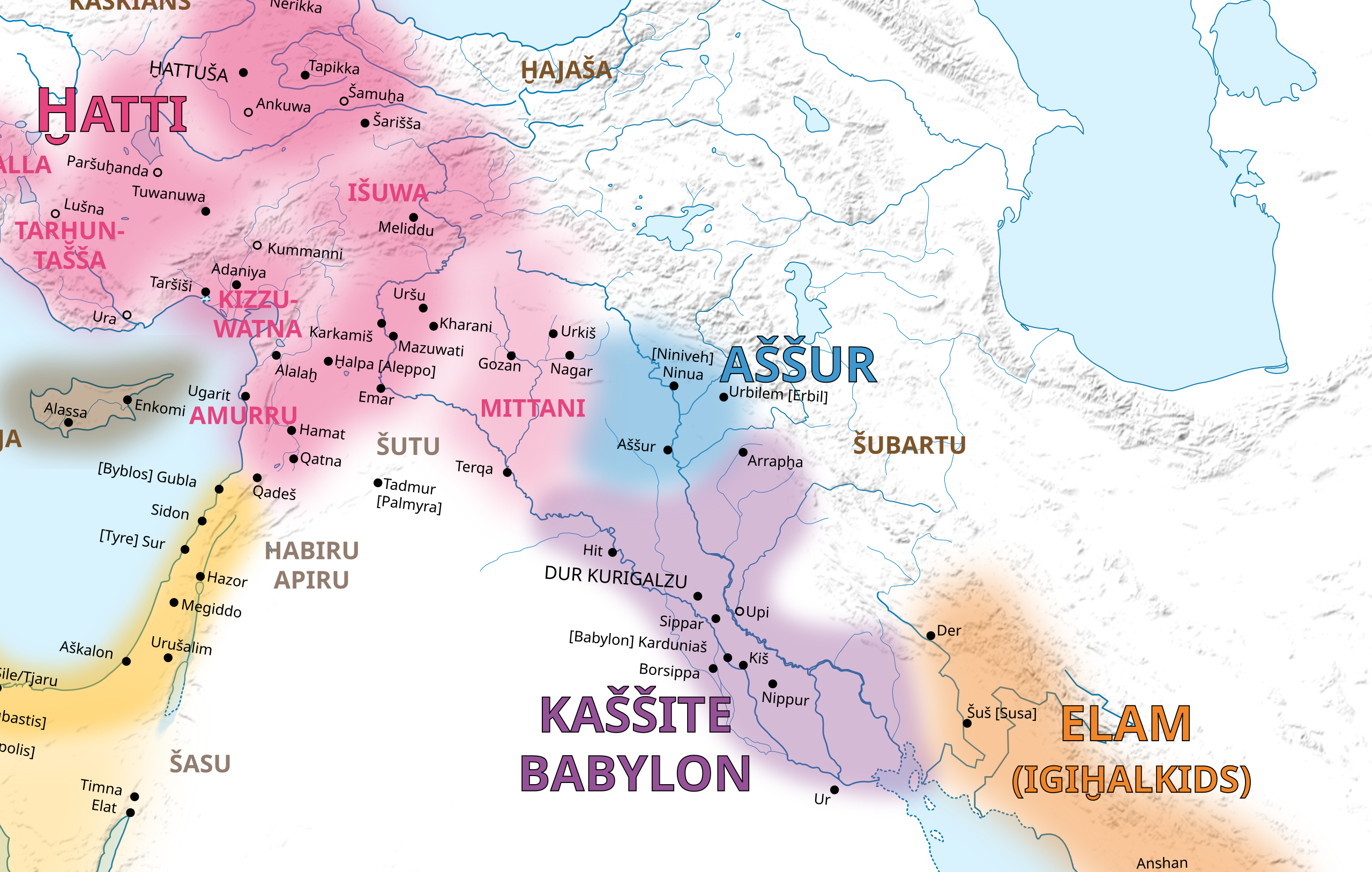
But what’s interesting is that the Assuruballit of Chronicle P tells a story of the exact same war against the Suteans. Remember how he said “I detained them until I could write and the pursuing Suteans be taken for me?” Chronicle P tells us whom he wrote!
Kadašman-harbe, son of Karaindaš, son of Muballitat-serua, the daughter of Aššur-uballit, king of Assyria, ordered the overthrow of the Suteans from the east to west, and annihilated their extensive forces. He reinforced the fortresses in Mount Šaršar.[Jebel Bišri.] He dug wells and settled people on fertile lands to strengthen the guard. (Chronicle P, ABC21, Livius.org)
So Assuruballit had to write to his grandson, Kadashman-Harbe, and ordered him to take care of the Sutean problem. It’s always great when we find both sides of a story in ancient history. It is, unfortunately, quite rare.
In Chronicle P, the Kassites, naturally, portrayed the action as having been taken by Kadashman-harbe on his own initiative; as, from their perspective, it was. They may not have even known about Assuruballit’s order to his grandson.
Anyway, the war went well and Kadashman-harbe settled friendly farmers there – a common practice, since if ethnic Kassite or Assyrian farmers were in the area, they would fight bandits and create a buffer for future problems.
Afterwards the Kassite people rebelled against him and killed him. Šuzigaš, a Kassite, the son of a nobody, they appointed as sovereign over them. Aššur-uballit, king of Assyria, marched to Karduniaš, to avenge Kadašman-harbe, his daughter’s son, and Šuzigaš, the Kassite, he killed. Aššur-iballit put Kurigalzu, son of Kadašman-harbe, on his father’s throne. (Chronicle P)
Obviously, if Assuruballit could just write a letter and have him undertake a major military operation, then Kadashman-harbe was at least an Assyrian loyalist, if not an outright vassal. After all, his father did take an Assyrian princess for a wife. And his Kassite citizens apparently hated him.
So they picked a real Kassite named Shuzigash, not some Assyrian sympathizer, as their new king. Underestimating the power and anger of Assyria, he was quickly killed by Assuruballit, and the son of Kadashman-harbe, Kurigalzu, was put on the throne in his place by his great-grandfather, the king of Assyria.
THE LINEAGE OF KURIGALZU
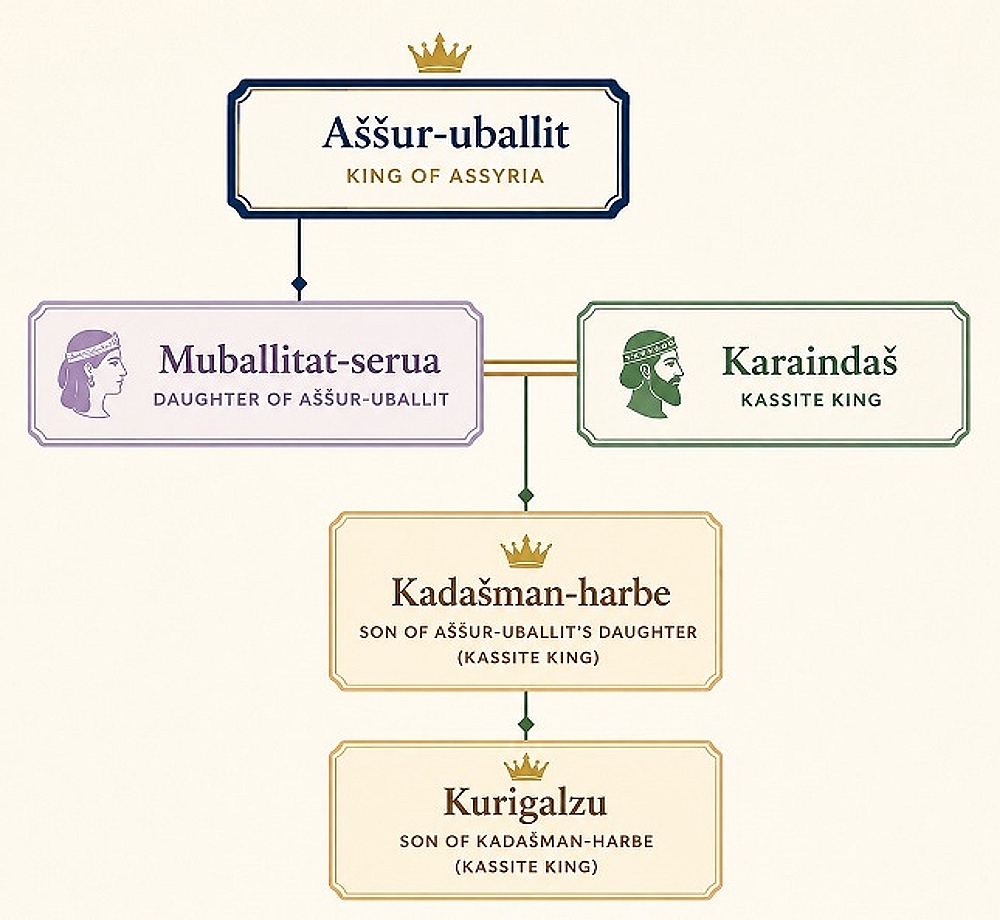 We know that Kadashman-harbe was a Kassite – his name is Kassite, for one thing – but he was also at least one quarter Assyrian royalty via the daughter of Assuruballit, Muballitat-serua, who gave birth to Kadashman-harbe by the Kassite king Karaindash.
This is a rare instance of a woman being named in such a history; the obvious reason was to show that Kadashman-harbe was descended from the king of Assyria and the king of the Kassites.
Even though it’s quite clear in the text, historians persist in claiming that it lists his father, grandmother, and great-grandfather, ignoring his grandfather whom they speculate was Burna-buriash II. Why? Because it fits the narrative, no other reason. But there’s no need to look for a missing grandfather as it clearly says Kadashman-harbe was Assurballit’s “daughter’s son.” The lineage is complete as it is.
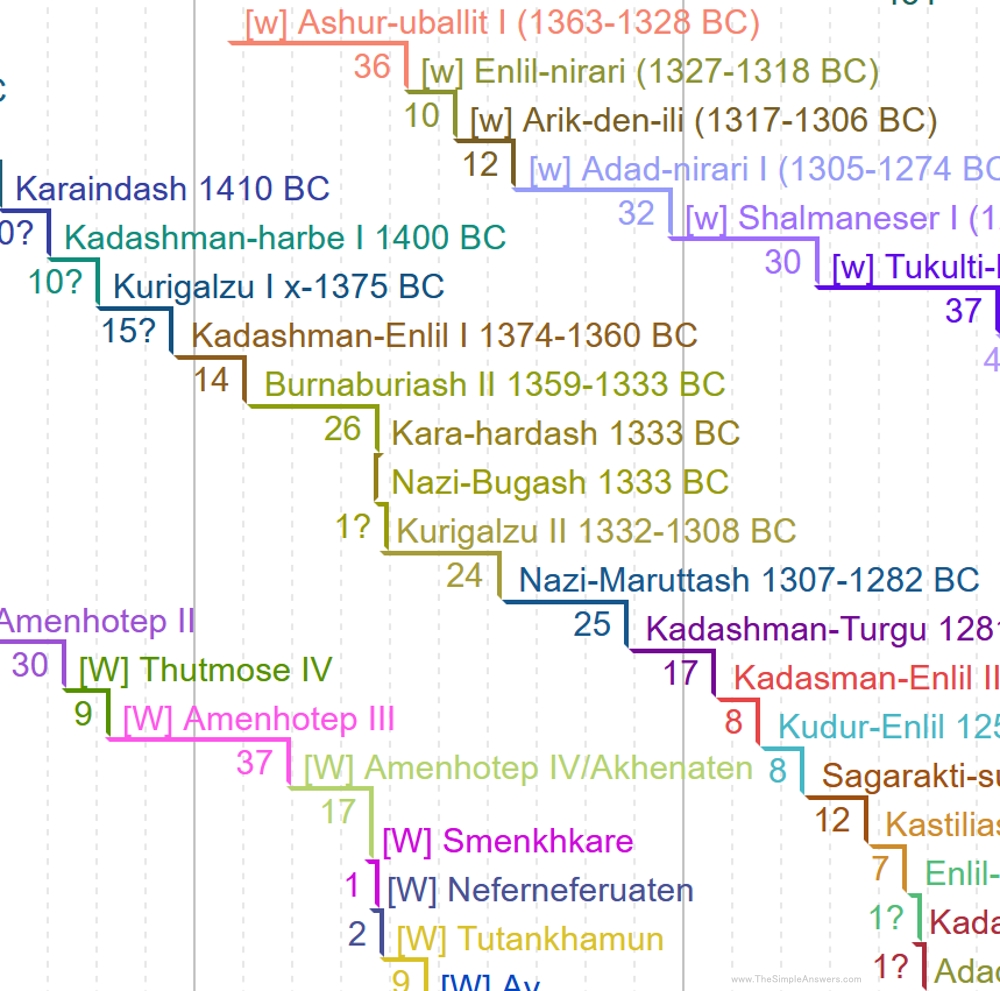 We stress this, because in this chart showing the traditional chronology for the period, Assuruballit ruled from ‑1363‑1328; since clearly his great-grandson was old enough to be placed on the throne in this story, the Kurigalzu in this story must have begun to reign near the end of his great-grandfather’s reign.
That means it must have been Kurigalzu II, who began to reign in ‑1332; so far so good. That puts Assuruballit, Burnaburiash II and Kadashman-enlil I and Kurigalzu I contemporary with Amenhotep III or Akhenaten, which the Amarna letters require. Everything fits.
Except… Chronicle P clearly says that Kurigalzu’s father was Kadashman-harbe, his grandfather was Karaindash, and his father’s murderer was Shuzigash. These are very clear facts in the story – refer to the family tree above.
Yet the ancestry of Kurigalzu II just doesn’t fit that. So what do they do? They postulate that Shuzigash must have been a typo for Nazi-bugash; that Kadashman-harbe must have been a scribal error for Kara-hardash; and that his grandfather wasn’t Karaindash at all, but must have been Burna-buriash II.
You see how they handle history? Not one fact from the story survives unchanged.
Do you want to know the right way to handle history? Look farther left on the chart, to Kurigalzu I. Do you see what his father’s name is? Kadashman-harbe! And what was his father’s name? Karaindash!
An absolutely letter-perfect fit to the facts of history; but one that is simply not possible in the traditional history, since Kurigalzu I began reigning a decade before Assuruballit! Assuruballit couldn’t possibly have placed him on the throne!
The obvious answer would be to simply slide the Kassite timeline to the right, so that they would align; but that would break other things down the line, since every date in ancient history is based on this connection.
They are stuck, they can’t move it even a few years and in this case they would have to move it by decades to fix this problem. No, it’s easier to just say that ancient scribes didn’t know their trade.
We sympathize with their position; their fundamental assumptions make it impossible to take their sources seriously. Constant adjustments must be made to every story to make it have any kind of sense. It’s easy to lose respect for ancient historians when nothing they say adds up in the accepted modern version of history.
But you know what’s even easier (and happens to be correct)? To say that they have the wrong Assuruballit, and these Kassites are 400 years from their proper place in history. And that, we are about to conclusively prove.
ASSYRIANS IN CHRONICLE P
We left Chronicle P with Kurigalzu I being placed on the throne of the Kassites by his great-grandfather, Assuruballit king of Assyria. The story that follows is broken at first, continues…
…upon them … and a shout/complaint … The enemy seized him. Together … to the sword he put all of them, and he did not leave a soul. Those who were fallen, they put in distress. They colored the midst of the rolling sea with their blood. They sent out their troops, fought zealously, and achieved victory. They subdued the enemy troops. He gathered the possessions of the vast enemy and made piles of them. Again the warriors said: “We did not know, Kurigalzu, that you had conquered all peoples. We had no rival among people. Now you (have overcome us?). We have set out, sought the place where you are and brought gifts. We have helped you conquer …” Again he … (Chronicle P)
And it trails off again. The enemy here is not named; but in the next column he attacks Elam (east) and then Assyria (north), meaning this enemy cannot be either of them; in the first column, his father had conquered the Suteans (west).
And also, “the rolling sea” was mentioned, meaning these battles took place to the south – the Sealand region. Finally, when they surrender they say “we had no rival among people.” The dominant power in the region for generations had been the Kassites themselves.
Consider what we know; they had just rebelled and killed his father for being an Assyrian puppet. Certainly Kurigalzu, installed by Assuruballit, would be loved no better. We would, then, have already expected him to face resistance to his reign.
This tale, then, must record another rebellion amongst the Kassites and Babylonians, one put down so brutally and so successfully that the remaining warriors swore allegiance to Kurigalzu as a worthy king, and said “we helped you conquer.”
Column three is badly broken, but it records a list of gifts such as a thousand horses, silver, gold, etc., and the cryptic line “On the return journey, your path. Silver, gold, precious stones … I brought. I … Babylon and Borsippa, upon me …”
Seemingly, he brought booty from, or to, Babylon, suggesting their involvement in the uprising. The story continues with the Elamites wanting to test their strength against the new Kassite king…
Hurbatila, king of Elam, wrote to Kurigalzu: “Come! At Dur-Shulgi, I and you, let us do battle together!” Kurigalzu heard … He went to conquer Elam, and Hurbatila, king of Elam, did battle against him at Dur-Shulgi. Hurbatila retreated before him, and Kurigalzu brought about their defeat. He captured the king of Elam. All of Elam … Bowing down, Hurbatila, king of Elam, said: “I know, king Kurigalzu, that this … with the kings of all lands I have brought the tribute of Elam.” (Chronicle P)
We’ll tie the Elamites into the chronology in their own chapter. Meanwhile Kurigalzu is on a roll, and he isn’t done yet; he does something surprising: attacks Assyria.
He went to conquer Adad-nirari, king of Assyria. He did battle against him at Sugaga, which is on the Tigris, and brought about his defeat. He slaughtered his soldiers and captured his officers. He put his governors in Karduniaš. (Chronicle P)
Why attack Assyria, when his great-grandfather was Assyrian, and had placed him on his own throne? Precisely because his great-grandfather was Assyrian – because that gave Kurigalzu I a legal claim to the throne of Assyria itself.
Meaning we can infer that somewhere in the last few years, his great-grandfather had finally died – he must have been old already, as great-grandfathers tend to be – and Kurigalzu I had seen an opportunity to have it all.
So he invaded, and defeated Adad-Nirari. But no mention of the taking of Assur or the death of the king is mentioned; this was a battle which resulted in an Assyrian defeat, no more.
Afterwards he “put his governors in Karduniash”; meaning that Kurigalzu did not live in Babylon himself, but governed remotely from his new city of Dur-kurigalzu, as we believe Kassites always did.
KURIGALZU I OR II
In the traditional history, they are forced to choose Kurigalzu II as the protagonist, as we have said. And across from Kurigalzu II in the traditional chronology there is an Adad Nirari – the first by that name, who ruled either ‑1305‑1274 or ‑1295‑1263 (they’re not sure exactly). And since Kurigalzu II, in their chronology, reigned ‑1332‑1308, that’s almost close enough.
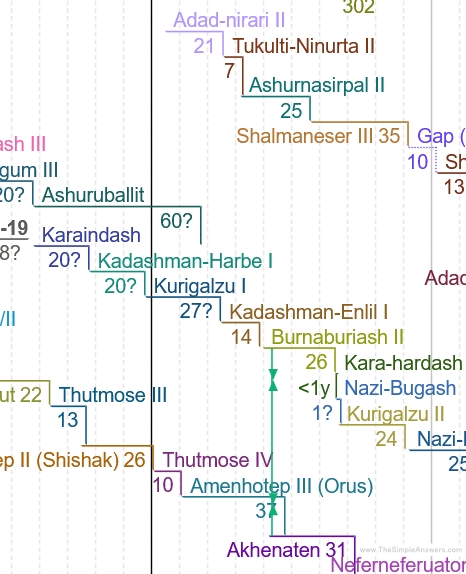
But “almost” isn’t close enough. In none of the standard chronologies do the kings overlap at all, nor do they have any wiggle room to move them. And not only that, but Kurigalzu, who supposedly defeated Adad-nirari… ruled before the king he supposedly conquered.
Surely he couldn’t conquer him if he was already dead for at least two years! Which means the standard timeline isn’t off by a few years, it must be off by decades.
 And no one talks about this problem.
We, on the other hand, are very happy to find, across from where we have placed Kurigalzu I in ‑972‑945, a king named Adad-nirari II who ruled ‑969‑948. We do not need to push and prod and make excuses for the text, nor do we need changes to the reign lengths or names to make it fit; faithfulness to the text requires us to choose Kurigalzu I based on his clearly preserved genealogy. Nor can we fiddle with his placement by more than a few decades at most; we must follow our earlier conclusions about the placement of the Kassites.
And having done all that, aren’t we fortunate to find an Adad-nirari opposite him; not the first of that name, but the second; but still an Adad-nirari as required by the literal text of Chronicle P!
But it gets better! The next column is also damaged, but begins…
… he threw iron bands and … Tukulti-Ninurta returned to Babylon and brought … near. He destroyed the wall of Babylon and put the Babylonians to the sword. He took out the property of the Esagila and Babylon among the booty. The statue of the great lord Marduk he removed from his dwelling place and sent him to Assyria.
For seven years, Tukulti-Ninurta controlled Karduniaš. After the Akkadian officers of Karduniaš had rebelled and put Adad-šuma-ušur on his father’s throne, Aššur-nasir-apli, son of that Tukulti-Ninurta who had carried criminal designs against Babylon, and the officers of Assyria rebelled against Tukulti-Ninurta, removed him from the throne, shut him up in Kar-Tukulti-Ninurta and killed him. (Chronicle P)
So we have a clear sequence then; something happened to Kurigalzu I or his successor, probably involving “iron bands,” then a king named Tukulti-ninurta appeared, conquering and looting Babylon which he then ruled for seven years.
After those seven years, in Babylon and Assur there were joint uprisings against Tukulti-ninurta and the governor he had placed in Karduniash, resulting in his son Assur-nasir-apli killing him and taking the throne of Assyria himself, while Adad-shuma-usur took power in Babylon.
Now if we apply this narrative to Adad-nirari I in the 14th century, as historians do, we find that his successors were Shalmaneser I, then Tukulti-ninurta I, then Ashur-nadin-apli. Do you see their problem?
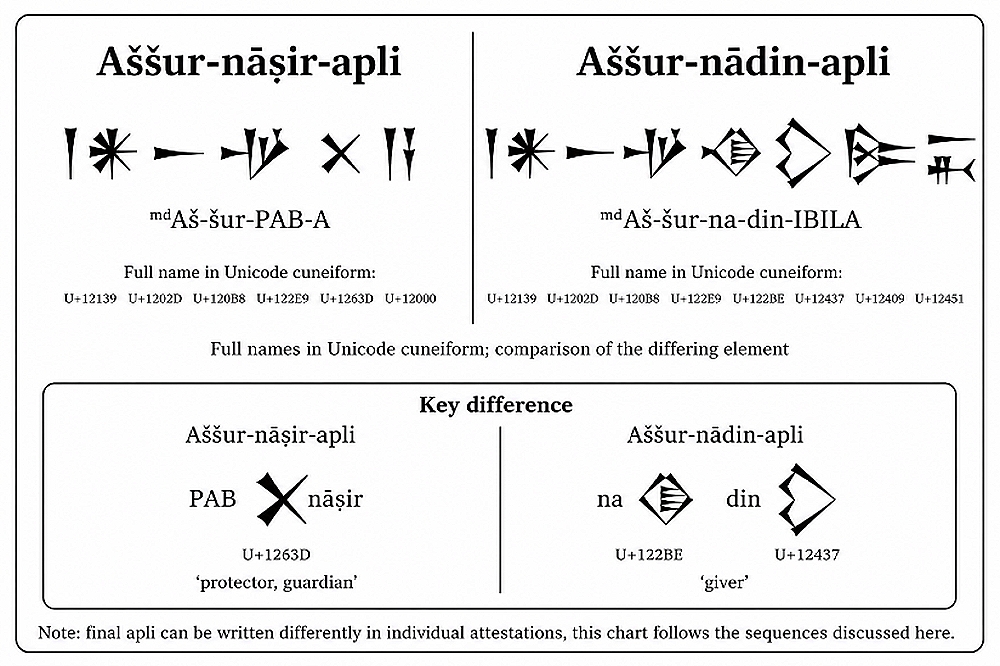 This almost fits. A king Shalmaneser is unexpectedly inserted into the sequence, which is odd but that could be explained away. Tukulti-ninurta I reigned 37 years, but maybe the scribe only meant to imply his control of Babylon lasted 7 years.
But the biggest problem is that the son of Tukulti-ninurta I is not named Ashur-nasir-apli, but Assur-nadin-apli. This looks like a small typo to us, but in cuneiform they are radically different signs that look nothing alike.
The historian’s response? “Scribal error. It’s close enough, and we have no choice, it HAS to fit.”
But it doesn’t fit, does it? When you back up and look at the big picture, hardly any names in the story are left alone; and even after all that, Kurigalzu II winds up dying before Adad-nirari I began to rule, defeating the entire purpose of the story. Nothing fits.
A HAMMER-FREE SOLUTION
We on the other hand prefer not to use a hammer for our jigsaw puzzles. Because once you start doing that, you never stop; historians must ignore the facts of four generations of Kassite kings and ignore the facts of three generations of Assyrian kings making neither fit just because the other “must” fit!
But if you put your hammer down and just take a look at the Assyrian king list in the 10th century, you will find a king named Adad-nirari II – lo and behold! His son was Tukulti-ninurta II! No awkward Shalmaneser in between.
What’s more, this Tukulti-ninurta reigned seven years, precisely as chronicle P tells us.
And the best part of all, how lucky we are to find that Tukulti-ninurta II was the father of Ashur-NASIR-apli II, who ruled from ‑942‑917. A son who has the right name, in the right sequence, precisely as Chronicle P told us.
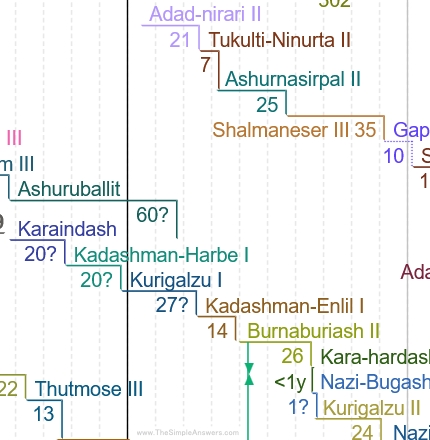 This sequence of names Adad-nirari – Tukulti-ninurta – Ashur-nasir-apli appears exactly once in the entire history of the Assyrian king list. Only one time.
The sequence of names from Karaindash, Kadashman-harbe, Kurigalzu likewise exists exactly one time in the entire Kassite king list.
Chronicle P tells us these two sets of kings were contemporary. To make this fit their assumptions, the traditional history must rewrite the story, change the name or reign length of almost every person involved… and still the dates can’t be made to match!
How bad is it when you take a hammer to a jigsaw puzzle and it still won’t fit?
But by simply listening to the texts, and moving the Kassite kings forward 400 years as we were compelled to do anyway for other reasons, these two sets of three kings happen to appear precisely opposite one another, and alongside our independently derived dates for the Amarna kings of Egypt.
As I always say, we are either immensely lucky… or we are right.
This time I’m pretty sure we’re right.
A NON-CANONICAL ASSURUBALLIT
I’m not the first to notice these problems, of course, nor the first to attempt to do something about it. Jeremy Goldberg has done considerable work in uncovering non-canonical kings – kings not mentioned in the AKL – and specifically Assuruballit. I’ll quote him now regarding what I consider one of the best proofs…
The [following] text is a prototype or copy of an inscription intended to be written on a vessel originally made by Tukultī-Ninurta I, and later repaired by Tukultī-Ninurta II. It describes the history of the object as follows:
“[The …] …-vessel to pour a libation of first-class beer, which Tukultī-[Ninurta (I)], [the son of] Shalmaneser […], had made, had become fragile. Aššur-uballiṭ had added 15 ‘KISAL’ silver, but the vessel had become brittle again. Then I, Tukultī-Ninurta (II), the one appointed by Enlil […], [added] 10 ‘KISAL’ silver.”
— KAL 3.22, lines 5–9 (A non-canonical early 11th century Assuruballit, Goldberg)
This is a shocking inscription, because it places an Assuruballit between the reigns of Tukulti-ninurta I and II. Yet the only Assuruballit in the early AKL ruled a century before Tukulti-ninurta I. You can see how this presents a grave problem to the traditional history. What, you may ask, do historians do with this inscription?
Frahm comments concerning this remarkable reference to an Aššur-uballiṭ:
“Since the name is not followed by a title and no monarch named Aššur-uballiṭ ruled over Assyria between the reigns of Tukultī-Ninurta I and Tukultī-Ninurta II, the person mentioned here cannot be a king — unless the scribes of Tukultī-Ninurta II had no longer understood an inscription on the vessel by Aššur-uballiṭ I (1363–1328 BC) and had placed it chronologically incorrectly.”
So the traditional camp (represented by Frahm) tries the usual trick; “a scribe misunderstood his job.” Goldberg argues back…
This explanation is possible, but it is not the simplest reading of the text. The object’s sequence is straightforward: Tukultī-Ninurta I made it; Aššur-uballiṭ repaired or augmented it; it deteriorated again; Tukultī-Ninurta II repaired it again. On the face of it, then, the text places an Aššur-uballiṭ between Tukultī-Ninurta I and Tukultī-Ninurta II. Since no such king appears in the canonical Assyrian king list, the passage is at least prima facie evidence for either a non-canonical Aššur-uballiṭ, or for a later scribal misunderstanding of an older vessel inscription. (A non-canonical early 11th century Assuruballit, Goldberg; henceforth Assuruballit, Goldberg)
Our point is obvious; this Assuruballit, ruling somewhere between Tukulti-ninurta I (‑1265‑1228) and II (‑948‑941), was the king who wrote the Amarna letters and meddled in Babylonian affairs. His existence cannot be denied, in the face of this evidence.
You will recall that Chronicle P places Assuruballit as great-grandfather of Kurigalzu, conqueror of Adad-nirari, father of Tukulti-ninurta – meaning Assuruballit must have lived around 100 years before Tukulti-ninurta II.
And since the vessel-repairer lived at some point between the reigns of Tukulti-ninurta I and II, thus somewhere in the 12th-11th centuries, we can say with high confidence that these are one and the same individual, and absolutely not Assuruballit I of the 14th century.
DATING ASSURUBALLIT
If our timeline is correct, then Kurigalzu I lived in ‑972‑945. Likewise for completely unrelated reasons, this is very close to where we place the three Amarna kings – ruling from ‑959‑885 – meaning Kurigalzu overlapped the first part of Amenhotep III’s 37 year reign by 14 years.
Kadashman-enlil mentioned that his sister, Kurigalzu’s daughter, was married to Amenhotep III. Since Kadashman-enlil reigned 14 years, and Burnaburiash II also communicated with Amenhotep III, this means Kurigalzu must have communicated with Amenhotep III in the earlier part of the latter’s reign, exactly as these dates place him.
Since Assuruballit also communicated with Amenhotep III, he belongs to the same timeframe. Historians would place the very beginning of his reign at the Amarna period, so that he lives long enough to install Kurigalzu II on the throne in Chronicle P, but as we have proven, that identification is impossible. Nothing fits.
Hence, Assuruballit must reign far earlier, in order to put his great-grandson Kurigalzu on the throne, who then communicates with Amenhotep III early in his reign in letters we don’t have. This means that only the very end of his reign overlaps with the Amarna period.
All of this means that Assuruballit II lived in the 10th century BC, shortly before Adad-nirari II. There simply is no other possibility. We give him the very tentative dates of ‑1012‑952, ruling contemporarily with Karaindash of the Kassites to whom he gave his daughter, and down to the Amarna period.
Historians would object, saying that his letter was found in the Amarna archive, therefore he must have been alive in ‑929 or later, since all the letters date after that point, Amenhotep III’s 30th year.
But I can find only negative evidence for this – that since they have not proven there are any earlier letters, there must not be. Several letters in the archive predate the transfer to the new capital of Akhetaten, which is from the site called el-Amarna today.
Which means at least some letters were transferred with the move to the new library; we suggest that Assuruballit’s was among them, significant for being the first communication from the region and worthy of preservation.
This is supported by Assuruballit’s ignorance of Egypt, suggesting that his was among the first letters Egypt ever received from the region; surely if Kurigalzu I gave his daughter to the Egyptians, Assuruballit would have heard about Egypt from him.
MARDUK PRAYER
We find more support for the existence of an “Assuruballit, king of the universe” from this period in another artifact mentioned by Goldberg:
A Middle Babylonian building inscription from Aššur, BM 96947, provides a tantalizing pointer to a non-canonical late Middle Assyrian king Aššur-uballiṭ. This text describes a very elaborate “house” built very near, or “in the shadow” of, a “temple of Marduk” in Aššur, for a “royal scribe” and priest of “Marduk, my lord,” Marduk-nādin-aḫḫē, who names his earthly “lord” as the “king of the universe” Aššur-uballiṭ.
…
May Marduk, my lord, inspect that house, and grant it to me for my troubles. May he allow it to endure in the future for my sons, my grandsons, my offspring, and the offspring of my offspring, so that we, I and my family, can revere Marduk, my lord, and Ṣarpanītu, my lady, forever, and maybe, by the command of Marduk, someone can set straight the kinsmen and clans of my ancestors that have embraced treachery.
May Marduk, my lord, grant to Aššur-uballiṭ, who loves me, king of the universe, my lord, long days with abundant prosperity. (Assuruballit, Goldberg)
We are informed by Chronicle P of treachery when the Babylonians murdered Kadashman-harbe, prompting Assuruballit’s invasion to set Kurigalzu on the throne. This is clearly speaking of the same events, with a non-aligned kinsman of the traitors begging forgiveness for his family.
Yet this is again, clear evidence of the existence of a 11th century or so Assuruballit, since Marduk was a strictly Babylonian deity and no scholar seriously believes that Marduk had a temple in Assur in the 14th century.
There does seem to be a systemic problem [identifying this with Assuruballit I], coming from the presence of many features in BM 96947 that anticipate evidence otherwise starting in the 13th century:
• In Assyria, ‘king of the universe’ is attested for Šamši-Adad I (not an Assyrian), and then (apart from BM 96947) not until Adad-nirari I, when it becomes banal.
• The title ‘royal scribe’ is otherwise unknown in Assyria until the 13th century.
• A ‘temple of Marduk’ in Aššur is otherwise unknown until Tukulti-Ninurta I. (Assuruballit, Goldberg)
To sum up; once again we have firm proof of the existence of a “king of the universe” Assuruballit in the right timeframe that cannot be identified with Assuruballit I. I remind the reader that historians chose Assuruballit I as the counterpart to Amenhotep III solely because he was the only king by that name on the AKL.
That is an incredibly weak basis for a decision; defensible, when supported by other facts; but extremely dangerous as the linchpin to chronology which this connection is. Because if there were any other Assuruballit to choose from, he would have been preferable.
And since he was not the only king by that name – which we have proven several different ways – then the entire case falls. All that holds it up is scholarly inertia – the reluctance to abandon ideas that have been around for centuries.
THE MISSING ASSURUBALLIT
What is strange about our Assuruballit II (not to be confused with the 7th century king by that name and number) is that he was somehow king of Assyria; why is he not on any king list?
His legitimacy cannot be argued since he was acknowledged by Tukulti-ninurta II, a king who WAS on the AKL. So how can a real, and powerful, king of Assyria not be on the list of… kings of Assyria?
I’m tempted at this point to be funny, and suggest scribal error confused Assuruballit’s name with Assur-rabi II, who is present in the king list at roughly the right time. Since turnabout is said to be fair play, I would be fully within my rights to do so. But since I’m actually after the truth, it’s not how I do history.
I’m further tempted to be funny and suggest that the AKL is a literary device meant to insult the king Assuruballit retroactively by removing his name and replacing it with someone else’s. But again, I’m not that petty.
Petty enough to think it, but not petty enough to do it.
I could always cast doubt on the authenticity of their texts. There is certainly plenty of reason to doubt them – they do, themselves:
The [Assyrian] king-lists mostly accord well with Hittite, Babylonian and ancient Egyptian king lists and with the archaeological record, and are generally considered reliable for the age. It is however clear that parts of the list are fictional, as some known kings are not found on the list and other listed kings are not independently verified.
…
One problem that arises with the Assyrian King List is that the creation of the list may have been more motivated by political interest than actual chronological and historical accuracy. In times of civil strife and confusion, the list still adheres to a single royal line of descent, probably ignoring rival claimants to the throne. Additionally, there are some known inconsistencies between the list and actual inscriptions by Assyrian kings, often regarding dynastic relationships. For instance, Ashur-nirari II is stated by the list to be the son of his predecessor Enlil-Nasir II, but from inscriptions it is known that he was actually the son of Ashur-rabi I and brother of Enlil-Nasir. (Wiki, list of Assyrian kings)
Such a document could easily lose a king. Still, we can do better. Because we can prove, as an absolute fact, that Assyria was at times ruled by multiple kings, only one of which made it onto the AKL.
Aššur-nirari III. He was the recipient of an extremely offensive letter from Adad-šuma-uṣur, which he addressed to “the Assyrian kings,” putting Aššur-nirari on an equal footing with his subordinate for added insult, a fragment of which has fortuitously survived: (Wiki, Adad-shuma-usur)
The relevant text says…
Speak to Aššur-nīrārī III and Ilī-padâ […], kings of Assyria:
Thus says Adad-šuma-uṣur, strong king, [king of the world], king of Karduniaš:
Aššur has made you, Aššur-nīrārī III and Ilī-padâ, completely insane through forgetfulness, constant drunkenness, and the inability to make decisions. […] There is nobody among you with mind or counsel. … (Letter to Assur-nirari, http://oracc.org/tcma/nineveh/P393862)
Let’s unpack this for a moment. Adad-shuma-usur addressed a letter to the Assyrian KINGS. Plural. According to traditional historians, there was no such thing at any point in history, except for a few periods of civil war which this obviously wasn’t.
2 Chronicles 28:16 At that time did king Ahaz send unto the kings of Assyria to help him.
Interestingly, the Bible also records the plurality of Assyrian kings, in direct contradiction to traditional histories. Historians, as always, spin the letter which is addressed plainly to “the kings of Assyria… Assur-nirari and Ili-pada,” and say this was a clever form of scorn, “putting Aššur-nirari on an equal footing with his subordinate for added insult.”
But their assumption remains that Ili-pada was not actually an Assyrian king. That he could not possibly have been part of another, separate line of Assyrian kings who ruled at the same time in a different part of the Assyrian world.
The weird thing is… historians actually do know that there was at least one set of duplicate Assyrian kings. I really don’t know why that doesn’t influence their conclusions here.
Ilī-padâ … was a member of a side-branch of the Assyrian royal family who served as grand vizier, or sukkallu rabi’u, of Assyria, and also as king, or šar, of the dependent state of Ḫanigalbat around 1200 BC. He was a contemporary of the Assyrian king Aššur-nīrāri III, c. 1203–1198 BC. (Wiki, Ili-pada)
Note that first one historian mocks the use of the title “king of Assyria,” then another admits that yes, he was a king “of the dependent state of Hanigalbat,” a region north and west of Assyria which we will discuss at length in its proper place.
The point is, suddenly two kings of Assyria makes completely valid sense. And if Ili-padi could be a king of Assyria while Assur-nirari was…
Then Assuruballit could be king while Tiglath-Pilesar II and Assur-dan II were king! And despite themselves, historians concede the premise:
Though they are often ignored in historiography, it is possible that the line of kings in Hanigalbat constituted a junior line of Assyrian co-rulers, with authority and prestige beyond simply being viceroys. A Middle Assyrian-age letter from the Babylonian king Adad-shuma-usur is addressed to the “kings of Assyria” rather than the “king of Assyria,” a possible reference to there being two simultaneous kings. Another Babylonian letter, this one to Ibašši-ilī, explicitly referred to him as the “king of Assyria.” (Wiki, king of Hanigalbat)
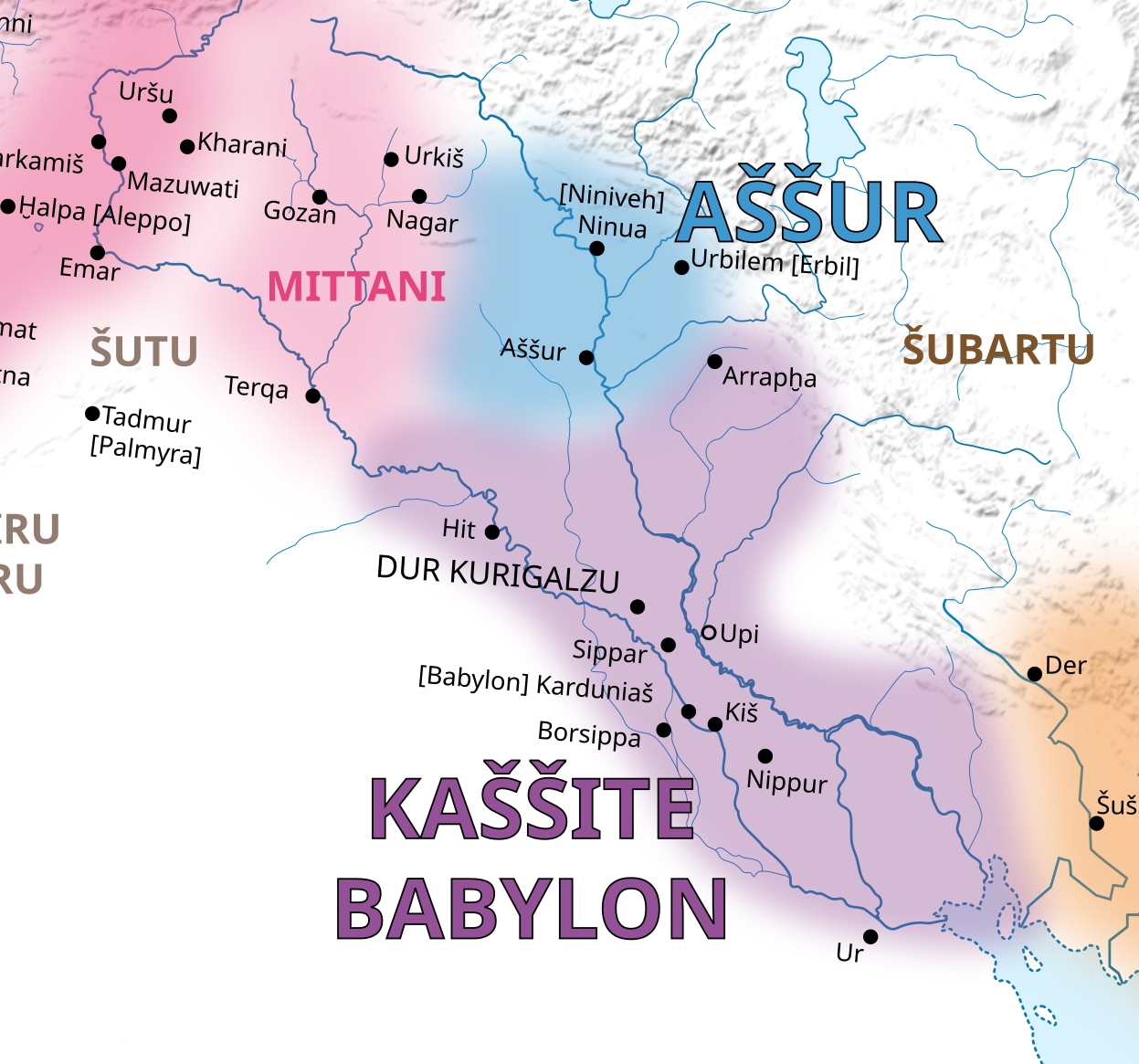 Ili-pada and his heirs are believed to have ruled from a town between Terqa and Gozan on this map in the 13th-12th centuries. And at that time, it was quite a powerful office.
The king of Hanigalbat … was an Assyrian vassal ruler, essentially a viceroy, in the territory of the Kingdom of Mitanni, also known as Hanigalbat, following its conquest by the Middle Assyrian king Shalmaneser I. The kings of Hanigalbat were members of the Assyrian royal family and also held the title of grand vizier (sukallu rabi’u). Though vassals under their relatives in Assyria, they held sway over virtually the entire western Assyrian Empire. (Wiki, king of Hanigalbat)
Our point is that the possibility of kings of Assyria who are not in the AKL is a well attested fact. Whether they ruled jointly in Assur, ruled separate cities or regions, or one was a usurper and one was legitimate, the fact is that there is more than enough room to have Assuruballit be a king of Assyria in the 11th century.
THE REAL ASSURUBALLIT
A picture begins to emerge starting at the time of Assur-dan II (‑992‑969), the first king to begin to spread Assyrian influence after the Assyrian empire went through a very weak century or two – more on that later.
As they began a vast empire which would one day stretch from Egypt to Iran, parts of the empire were placed under the administration of co-kings of Assyria, probably related to Assur-dan II, the king in Assur.
One of these must have been Assuruballit, likely a close relative of Assur-dan II who, we speculate, ruled lands farther west – somewhere opposite the Suteans from Egypt who impeded his messengers.
And with that, all of the problems in the first half of this paper make sense; of course Assuruballit’s ancestry as given in the Amarna letters doesn’t match Assuruballit I of the 14th century; they’re not the same person! They ruled a different part of Assyria… 400 years apart!
The Assuruballit who ruled western Assyria no doubt did have a distant ancestor, but not predecessor in this office, whose name was Assur-nadin-ahhe and who had contacted Assyria during the reign of, say, Thutmose II or Hatshepsut.
Up to now, my predecessors have not written to visit your country. Today I write to you. I send you, as your greeting-gift, a beautiful chariot, two horses, and one date-stone of genuine lapis lazuli. Do not delay the messenger whom I send to you for a visit. He should visit and then leave for here. He should see what you are like and what your country is like, and then leave for here. (EA 15)
And as ruler of a westerly province, it also explains Assyria’s paltry gift to Egypt; a small chunk of lapis, two horses, and a chariot? This is perhaps 1/100th the value of the gifts of the other “great kings” in the Amarna letters. This is the gift of a relatively poor king, who couldn’t afford better.
Considering how much history they have to tweak and twist to fit their theories, and the immense weight of ancient history resting on this one connection, the burden of proof is on historians to establish, beyond all reasonable doubt, that Assuruballit I wrote the Amarna letters in the 14th century.
It is my considered opinion that they have failed to do so.
You must make up your own mind, of course.

This is part 24 of The History of the World Series
 Akhenaten the Heretic
  The Richest Man in History
  Thutmose III and Shishak
  Solomon and the Queen of Sheba
  Judges to Kings
  What Is The LOVE Of God?
  Everything You Believe About God Is WRONG!
  Make Up Your Mind!
  What Is Faith?
  How DARE you FEAR the judgment of God!
  Firstripe Figs
  The Bride Of The Father
  Exodus 40 – The Plan Of God
  The Temple Of God
  Pillars Of The Temple And The Brass Sea
  GEHENNA WITH ‘EM
  When Did God Forbid Polygamy?
  When You Shouldn’t Pray For Someone
  The Sins of the Father
  The First Paul