Part 5: THE DIASPORA

Genesis 10:22-25 The children of Shem... Arphaxad… And Arphaxad begat Salah; and Salah begat Eber. And unto Eber were born two sons: the name of one was Peleg; for in his days was the earth divided; and his brother’s name was Joktan.
In the days of Peleg, the Earth was divided; which is why he was called Peleg, Hebrew for division. Peleg was the 4th generation after the flood, and the Bible tells us the age his father was when he was born; as it does for his father, and his, allowing us to add up 110 years from the flood to the birth of Peleg in ‑2204 (Genesis 11:10-16).
The division being spoken of can only refer to the division of languages and the resultant spread of humanity to their appointed lands, dividing the Earth as if it was an inheritance divided among heirs – as, in God’s eyes, it was.
Deuteronomy 32:8 When the Most High gave to the nations their inheritance, when he separated the children of men, he set the bounds of the peoples according to the number of the children of Israel.
That last part seems odd until you realize that there were 70 descendants of Jacob in Egypt when they moved there during the famine (Exodus 1:5). So Moses is pointing out that the number of nations divided from Noah’s sons corresponded to this number, 70 nations mentioned in Genesis 10. Paul refers to this in…
Acts 17:26 And He has made from one blood every nation of men to dwell on all the face of the earth, and has determined their preappointed times and the boundaries of their dwellings,
This “setting the bounds of the peoples” can only refer to the destinations they were guided to after Babel; hence, the naming of Peleg gives us a firm window for the aftermath of Babel. However, it doesn’t say he was born in the year of the division of language, only that it happened “in his days.”
It doesn’t say at what point during his days the division happened. Thus, the date ‑2204 sets an upper window making Babel necessarily after that. Presumably, since he was the last generation mentioned among the 70 nations in Genesis 10, he wasn’t that old, but presumably not yet old enough to name.
In many cultures, naming was an event that didn’t happen until a child was a man – something which might happen at 13, 20, your first kill, a vision quest – it varied depending on the culture. Then again, the Bible has a tendency to rename people even when they are already old – Abraham got his name at 99, Israel got his probably when he was 91. So Peleg might have been named “Ralph” until Babel happened.
So while our upper window is firm, our lower window is softer. Regardless, Babel probably happened relatively early in his life. Thus, let’s say the window is ‑2204-2174, probably towards the end of that window. That’s about 140 years after the flood – sufficient time for the population to multiply for 75 years, migrate to Mesopotamia, live in relative harmony in Kish for 60 years, and then begin to build Babel. The SKL will support this, and modify it slightly, when we get to that part of the story.
WHO WAS AT BABEL
It’s important to note that all of humanity was in Mesopotamia, probably excepting Noah and possibly a few people who stayed with him. Because humanity is very specifically said to have spread from Babel: “Yahweh scattered them abroad FROM THERE on the surface of all the earth…” (Genesis 11:6-8).
The Canaanites, for instance, are agreed by everyone to have settled in the east coast of the Mediterranean in the famous “land of Canaan.” And since that’s a lot closer to the starting point, Gobekli Tepe, than it is to Babel, it’s tempting to assume they might have already broken off and settled before arriving in Sumer; but the Bible specifically says the Canaanites were “spread abroad” afterward.
Genesis 10:18 …Afterward the families of the Canaanites were spread abroad.
Now it doesn’t say after what; but in context, it can only be after the events of Babel referenced in verse 10, which tells us that the Canaanites were at Babel. Furthermore, remember the evidence suggests that Gobekli Tepe was abandoned for some time and then resettled? This would be why it was resettled.
To be fair, it is possible the Bible is using hyperbole (it has been known to use “everyone” when it could not have literally meant that; Matthew 3:9 for instance). Still, there is no reason to believe that everyone else mentioned in Genesis 10-11 wasn’t there as well. Because remember the whole reason of going to Sumer:
Genesis 11:4 They said, “Come, let’s build ourselves a city, and a tower whose top reaches to the sky, and let’s make ourselves a name, lest we be scattered abroad on the surface of the whole earth.”
If some of them had already scattered, it would be too late for that. Plus, remember that at the time of Babel, everyone in the whole Earth spoke one language (Genesis 11:1). It was because of the events of Babel that everyone was cursed with different languages, right?
So wouldn’t it be odd if, say, Canaan or Japheth was cursed with a different language when he wasn’t even here, or involved in the building of Babel? Also, how can the Bible claim that “the whole Earth” was traveling east together to Shinar, if Canaan wasn’t there?
Ergo… humanity, including all the seventy mentioned in Genesis 10 and their descendants, were in Mesopotamia at the time of Babel, and involved in the events there to some degree, and scattered to the four winds from there.
The only exceptions are Mr. and Mrs. Noah, and possibly the lineage of Abraham; Shem, Arphaxad, Eber, etc., who may have been spared the effects of the language change and might have preserved the original language of Eden. Maybe.
THREE GROUPS OF MANKIND
The first test of the Bible’s veracity is simply common sense; looking at AfroEurAsia, it is obviously broken up into three broad categories; by land mass, by language, skin color, facial features, culture and religion, we can easily divide the world into the peoples of Europe, the peoples of Asia, and the peoples of Africa.
Genesis 9:18 The sons of Noah who went out from the ship were Shem, Ham, and Japheth. Ham is the father of Canaan. These three were the sons of Noah, and from these, the whole earth was populated.
You cannot get more different, ethnically, than a Kenyan, a Japanese, and an Englishman. This suggests, on the basis of mere common sense, that the stories of Shem, Ham, and Japheth can be used to explain the diversity of humanity that we see – the division of humanity into three broad categories.
Nor is this something that the authors of the Bible might have invented as an attempt to explain their world; as in the traditional history it is certain that their world did not include contact with the Far East. So how did they just guess that there are three broad genetic types and three major language groups?
The Bible repeatedly calls Egypt “the Land of Ham,” and we can trace the sons of Ham to regional groups who inhabited Africa since the most ancient of times. Ham is recorded having four sons; Cush, Misraim, Phut, and Canaan.
These are the easiest ethnic groups to track, because to this day, the Egyptians call their country Misr, as the Bible consistently calls Egypt. Cush has been known throughout the ages to be the lands south of Egypt.
Farther north, the Canaanites are easily located since Moses invaded Canaan; but Canaan had many tribes mentioned in the Bible, and they occupied a territory extending from southern Turkey through Syria and almost to Egypt.
Several sons of Canaan are quite recognizable, such as Sidon – the ancestor of the Phoenicians, and much later, of the Carthaginians. Another son, Heth was ancestor of the Hittites who historians believed didn’t exist at all… until they discovered about 100 years ago that the Bible was right, they had once been a massive empire.
Still another son was the father of the Amorites and is well known in ancient Egyptian texts under the name Amurru and – spoiler alert – about 800 years after the flood these people would conquer Babylon and found the first Babylonian dynasty, best known for producing Hammurabi and his famous code of laws.
The last son of Ham, Phut, is generally considered to be the father of the Libyans, known to ancient authors as “Phute.”
Phut also was the founder of Libya, and called the inhabitants Phutites (Phoutes), from himself: there is also a river in the country of Moors which bears that name; whence it is that we may see the greatest part of the Grecian historiographers mention that river and the adjoining country by the appellation of Phut (Phoute): but the name it has now has been by change given it from one of the sons of Mezraim, who was called Lybyos.” Pliny the Elder and Ptolemy both place the river Phuth on the west side of Mauretania. Ptolemy also mentions a city Putea in Libya. (Josephus)
The Libyan tribe of pỉdw shows up in Egyptian records by the 22nd dynasty, while a Ptolemaic text from Edfu refers to… “the land of the Pitu.” The word was later written in Demotic as Pỉt, and as Phaiat in Coptic, a name for Libya Aegypti, northwestern Egypt. Ancient Egyptian sources also refer to an ethnic group to their west, associated with the Libyans, called Put; (Wiki, Phut)
And so you see, with no effort at all – and honestly very little room for argument, we have completely identified the first homelands of all the sons of Ham!
THE SONS OF SHEM
Shem is almost as easy; for his sons were Arphaxad, Elam, Lud, Aram, and Asshur. And one of the great things about taking the Bible as your primary source is that if you just look for these names on an ancient map, you’ll know exactly where these tribes first settled;
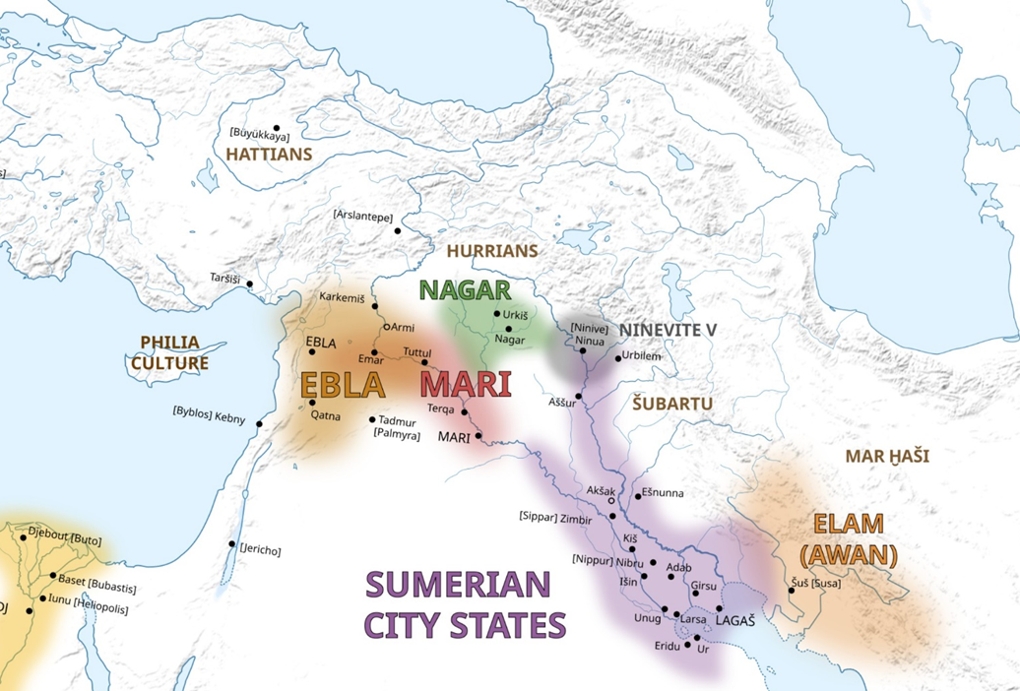
Looking at this map, you immediately recognize a son of Shem east of Sumer, in Elam, which dates back to the earliest part of the Sumerian history. Northwest of Elam, you find the city of Asshur, the son of Shem who built Nineveh.
Genesis 10:11 (KJV) Out of that land went forth Asshur, and builded Nineveh, and the city Rehoboth, and Calah,
It should be noted that some versions translate this passage differently, suggesting these cities were built by Nimrod; this derives from the confusion of “Asshur,” unarguably a name of an ancient city, and the son of Shem by that name.
However, I’m confident this is the correct reading, that Asshur the person built Asshur the city. Besides the obvious logic (why would Nimrod name a city after his cousin?), we can establish it using the archeological knowledge of the Uruk expansion.
We know that the kingdom of Uruk was culturally dominant across the whole Mesopotamian basin, but Nineveh was far beyond the field of direct control. So it’s far more likely that Asshur, son of Shem, went north to get away from Nimrod and start his own kingdom to the north; building Nineveh as well as a city named after his no-doubt humble self.
For our concern, all that really matters is that the Bible correctly identifies another ancient culture in the correct location, once again showing intimate knowledge of the earliest days in Mesopotamia. And, of course, it identifies the ancestor of this tribal group later known as Akkadians or Assyrians as descended from Asshur, grandson of Noah.
Still further to the NW, we find the civilization of Aram; this is mentioned in the Bible in the time of Abraham, approximately ‑1950, as having been located between the two rivers in the upper reaches of Mesopotamia, in what is now Syria – or between Ebla, Mari, and Nagar on the map.
Now what’s interesting is that Genesis 24:10 records Abraham’s servant returning to Haran, saying “he made his way to Aram-naharaim, to the city of Nahor.” This literally means “Aram between-the-rivers.”
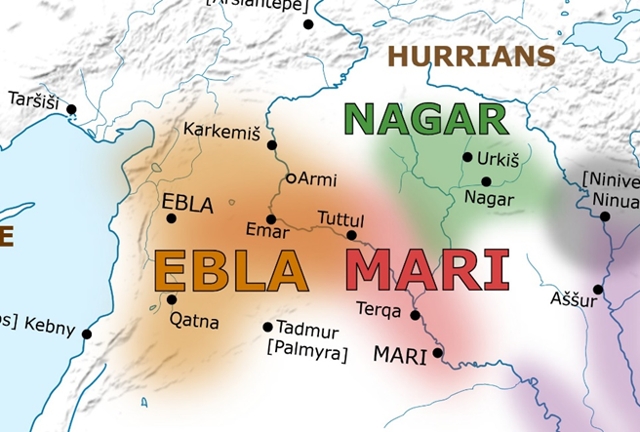 Now if you zoom in on that map above, you’ll find a suspiciously large number of commonalities between archeology and the Bible. First, in precisely the place the Bible says it should be, there is a city named “armi” – Aram. And the city and culture known as “Nagar” is very plausibly connected to “Nahor,” Abraham’s ancestor.
Despite this, historians will tell you confidently that there was no civilization known as Arameans at this point in history;
The Arameans, or Aramaeans… were a tribal Semitic people in the ancient Near East, first documented in historical sources from the late 12th century BC. Their homeland, often referred to as the land of Aram, originally covered central regions of what is now Syria. (Wiki, Arameans)
Yet that very same article contradicts this conclusion:
The toponym A-ra-mu appears in an inscription at the East Semitic-speaking kingdom of Ebla listing geographical names, and the term Armi, the Eblaite term for nearby Idlib, occurs frequently in the Ebla tablets (c. 2300 BC). One of the annals of Naram-Sin of Akkad (c. 2250 BC) mentions that he captured “Dubul, the ensí of A-ra-me” (Arame is seemingly a genitive form), in the course of a campaign against Simurrum in the northern mountains. Other early references to a place or people of “Aram” have appeared at the archives of Mari (c. 1900 BC) and at Ugarit (c. 1300 BC)… The earliest undisputed historical attestation of Arameans as a people appears much later, in the inscriptions of Tiglath Pileser I (c. 1100 BC). (Ibid.)
So the name, as a place name, is found frequently in precisely the place and time we would expect it to be based on the Bible. It is not difficult to believe that the king of “A-ra-me” would call his subjects “A-ra-me-ans.” And the Bible tells us those people were descended from Aram, son of Shem.
That being said, the people later known as Arameans in the time of Tiglath-pilesar I may have been an entirely different ethnic group; indeed, Abraham’s own brothers and father seemed to have made a huge mark on the place with names based on Nahor, Haran, and Terah all found in the region, and they were Hebrews descended from Arphaxad, not Aram.
But the region’s earliest inhabitant, from whom it took its name, was certainly Aram, which is what the Bible continued to call it.
The next son of Shem is Lud, whom classical writers believed was connected to Lydians, in the far western part of Turkey. This is not impossible, however the Lydians don’t appear on the written historical record by that name until quite late in history – around the 7th century BC. That’s why I favor an earlier Anatolian ethnic group, the Luwians. Either way, they most likely landed in Anatolia, only to be later displaced into Europe or absorbed by the Hittites, sons of Canaan.
The final son of Shem, Arphaxad, is nowhere to be found in history; most theories link him to Syrians migrating into southern Sumer and becoming the Chaldeans of Nebuchadnezzar’s time, but these theories are believed in only because there is nothing better.
We will provide a much better alternative in a chapter soon, but for now we leave him unidentified. It’s worth the wait.
A WORD TO THE CRITIC
Before we address the final son of Noah, Japheth, let’s pause to note how easily we identified the first nine grandsons of Noah; all but a few snapped in place so easily, the Bible must have had inside knowledge of the workings of these ancient ethnic groups.
A critic would say “sure, the Jews wrote fictional origin stories and folk etymologies, a thousand years after the fact to explain the origins of these nations.” Let’s take a moment to consider how that might have gone; let’s try to imagine how these supposed Hebrew or Jewish authors would have fabricated origin stories for the world’s civilizations, which stretched from Morocco to Iran, Ethiopia to Armenia.
And then I ask the critics… how did they do such a good job?
Remember, to the critic these stories were written by some Yahweh-obsessed priests in a petty bronze age city state – to more critical critics, even later during the Babylonian captivity in the 6th century BC. And the goal of these stories, the critic believes, was to try to make their sad lot in life better by preaching the preeminence of their own cult of Yahweh.
And if that were true… how did these men do such a great job of proving it? The typical cultural horizon in the bronze age was a few hundred miles; beyond that dwelt dragons and myth. Only the most powerful civilizations – Egypt, Babylon, etc. – bothered to communicate across such immense distances – and even then only for a few centuries at a time before the next social upheaval.
To the critic, the Israelites were never a kingdom, never a powerful civilization, just a minor tribal group with delusions of grandeur. How did they even know there were such a people as the Libyans or Elamites?
And why did they spend so much time describing civilizations which had not been significant for centuries, even millennia – Elam and the Hittites, Akkad and Uruk? And other cities and civilizations that, to this day, no one knows if they even existed – like Calneh?
Try to put yourself in the scenarios historians believe to have been true; you’re a Jewish priest in 6th century BC Babylon or 12th century BC Palestine, either trying to explain your captivity to the Babylonians or trying to justify your colonization and genocide of the Canaanites.
If that were your purpose, you would look at a map of the known world, and identify every single political entity on that, and make origin stories for all of them, with yours, obviously, the oldest and most noble.
Yet the Genesis 10-11 list doesn’t match the world in the ‑6th century; it ignores the Urartians, for example, and the Persians, Chaldeans, Greeks, Cretans, and so on. The Egyptians had long since stopped calling themselves Mizraim, preferring instead “the people of Kemet,” the black land; so why identify them with the wrong name for that time? If we’re really inventing stuff, invent a son of Noah named Kemet!
Nor does it match the world of the ‑12th century (nor the ‑15th, for that matter); it ignores the Mitanni, the Kassites, the Myceneans and Minoans. And the Arameans aren’t where they should be. If your goal was to explain your current neighbors… why do such a bad job?
Because the fact is, no average person reading Genesis 10 in the ‑6th century would have recognized more than one or two nations by name. So it was a colossal failure as a backstory for their nations.
Nor is it just the omissions that are a problem; if you were creating a fictional origin story for nations, why mention so many people who do not correspond with any known nation? To our knowledge, there has never been a nation named Arphaxad, or Togarmah, or Joktan, for example. So why include nations which did not exist?
In fact, the vast majority of the names on the list cannot be convincingly tied to any nation, then or ever. What good was it, then, as propaganda? It is difficult to believe that a people setting out to describe the origins of their neighbors in a given bronze age/iron age context ignored so many important neighbors and invented so many others!
Thus the critics should criticize themselves; the inaccuracies mean it cannot have been meant as a contemporary commentary on any group of civilizations at any point in history. It can only be what it pretends to be: actual history.
WHAT ARE THE ODDS?
Simultaneously, it is difficult to believe anyone in a bronze age context could have been so accurate about the details of the earliest civilizations like Uruk, the Hittites, the Amurru, Akkad, and so on.
Together, these prove convincingly that the information in the Bible is rooted in an accurate record dating to the times they purport to describe. In other words – eyewitnesses to Babel and the resulting dispersal passed down records to their children, culminating in the works of Moses.
Because otherwise, how do we explain how the Hebrews provided such concrete origins for the exact names of the earliest civilizations of mankind? Not of their own contemporary civilizations – but of the oldest ones.
How could they possibly have known some of the things they clearly knew; for example, that Nimrod/Enmerkar the hunter built Uruk, millennia before? How could their records be a late forgery, and still be in such close agreement with the SKL, which they surely could neither read in the original cuneiform nor likely even access.
How could any Hebrew writer, however late, have known that Kish was built before Babel, or that Babel had been built before Uruk? Or how could he have known that ethnically, the Elamites, Arameans, and Assyrians are so closely related when most likely, any possible author of Genesis had never even seen these people?
How could such a people have provided accurate origin stories of the earliest and most ancient Sumerian kingdoms placing them in precisely the location, priority, and ethnic arrangement we know them to have been?
And what possible reason would they have had to try to provide an origin story for an obscure country like Ethiopia or Elam or Libya with no diplomatic ties to Israel… ever?
In a world with no accurate maps – indeed, with few maps at all – in a world where people often lived and died in a 10 mile radius, how could anyone at that time possibly have possessed such a vast knowledge of geography, ethnology, and linguistics as to chart a plausible origin story for every civilization on Earth at that time?
This inclines one to believe the Bible was written by people who knew what they were talking about – people who had been there, or at least knew people who had. People who had accurately preserved written or oral histories from the very earliest times of man.
JAPHETH
As I said, the ease with which we locate Ham and Shem argues strongly for the accuracy of the Bible on this subject. Which makes us all the more confused when we find an almost total absence of Japhethite names in our map!
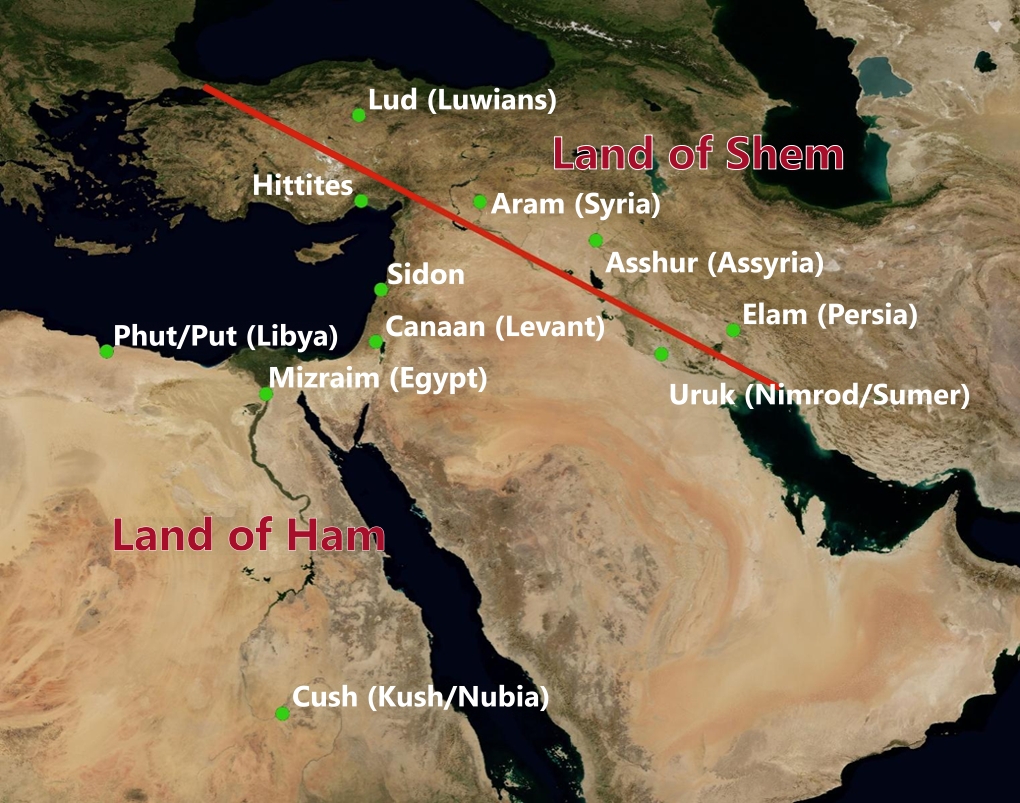 We have a map which has populated all of northern and eastern Africa (Ham), and all of the eastern coast of the Mediterranean and much of Turkey (also Ham). Sumer, since it was ruled over by Etana from Kish/Cush, and then by Nimrod, son of Cush, was almost certainly also a Hamitic group. Which means we can draw a rough line across the world, more or less parallel to the Euphrates and say “southwest of this line is Ham.”
Northeast of that line – generally speaking, of course – everyone was a son of Shem. God divided the people at Babel into broad family groups, saying for instance “These are the sons of Shem, after their families, after their languages, in their lands, after their nations” (Genesis 10:31). Paul referenced this much later, saying…
Acts 17:26 (Rotherham) From one man he has made every nation of humanity to live all over the earth. He has given them the seasons of the year and the boundaries within which to live.
So we can infer from this that after Babel, for whatever practical or divine reasons, Shem went north and east and Ham went south and west. But if we have populated all of eastern/northern Africa, the eastern Mediterranean, and Anatolia with Ham, and the rest of the Middle East with Shem, we are left wondering, what happened to Japheth?
In this story there is no room for Japheth; which is odd, because his very name means “expansion” (Genesis 9:27). He must be someplace with plenty of room for him to expand; his descendants, today, must number in the billions – more than his Shemite or Hamite cousins – and yet everything within a thousand miles in any direction was owned by his brothers.
Most historians and Bible students would say that Japheth went to Europe, and settled in the Greek islands and spread to the western Mediterranean, and became the ancestor of the ancestor of the Europeans. This is based largely on the works of Josephus, Jewish historian from the 1st century.
But this fails the test of “expansion”; there are fewer Europeans than Hamites. And there’s another problem with this theory, and a much more existential one. If Ham is the African peoples, and Shem is the Middle-Eastern peoples from Iran to Turkey, both things everyone agrees upon… and if Japheth is the Europeans…
Then who is the ancestor of all the Asians?? A few straggling Shemite tribes? Why, then, do Asians appear so different in every way, genetically, linguistically, culturally, and religiously, from the Middle Eastern peoples?
We can forgive Josephus for not worrying about this question since he didn’t know of their existence! But we should be less charitable with modern Christians who could do with mixing their beliefs with a dash of reality now and then.
Josephus was simply using common sense; he looked at the world, his known world and he knew where the Shemites had been; knew where the Hamites had been. He had no idea where the Japhethites had been so he looked at the biggest dark spot on HIS ethnic map, which was Europe, and decided they must be… there.
He did his best to match cities and rivers and so on to names; but far less convincingly than he did with Ham and Shem. He introduces very little fact to back up these assertions, compared to the obvious connection between, say, Aram=Arameans, Elam=Elamites. A typical example:
For Gomer founded those whom the Greeks now call Galatians, [Galls,] but were then called Gomerites. Magog founded those that from him were named Magogites, but who are by the Greeks called Scythians… Thobel founded the Thobelites, who are now called Iberes; and the Mosocheni were founded by Mosoch; now they are Cappadocians. There is also a mark of their ancient denomination still to be shown; for there is even now among them a city called Mazaca, which may inform those that are able to understand, that so was the entire nation once called. (Josephus)
This is what we in the business call “reaching.” But we have a much better grasp of the world than he did; so our common sense should yield better results than his did. And using the same process, we would see that the ethnic blank spot on our map that needs filling is Asia.
JAPHETH AFAR OFF
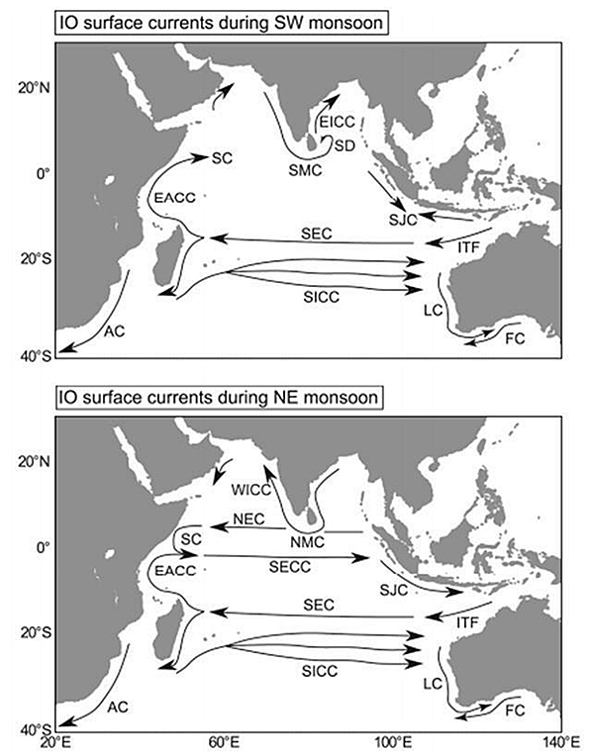 (Tracking the stranded area of marine debris in Indonesian coasts…; Rizal and Gautama, et al)No matter where Japheth went from Sumer, he would have had to leapfrog his brothers; Elam, Assur, Aram, and Lud formed a solid ring north and east; and Canaan, Mizraim, and Cush formed a solid ring south and west. Where else was he to go? Where would YOU have gone? Where people almost always go – the path of least resistance.
Imagine yourself caught between your two brothers and their endless squabbles, every bit of land for a thousand miles in any direction claimed by your brothers. You find yourself on the shores of a mighty river that flows into the sea… Where would you go?
You’d build boats – it is, after all, your family’s business, with 120 years of boat building experience before the flood – and load up all your family and belongings, and float out to sea and see where the current takes you. And where, exactly, would that be? It depends on the time of year!
If you leave in March/April – the time of the Biblical feast of Passover and Unleavened Bread, it should be noted – you would, by these currents, find yourself promptly carried to Africa and down the coast. Stop in some nice place – as Ham’s descendants must have done – and you need never return.
On the other hand, if you wait six months and leave in September/October – the time of the Biblical Feast of Tabernacles, it should be noted – you will float right around the coast of India, and find yourself in the vast complex of islands and isthmuses and peninsulas of southeast Asia.
Isaiah 66:19 And I will set a sign among them, and I will send those that escape of them unto the nations, to Tarshish, Pul, and Lud, that draw the bow, to Tubal, and Javan, to the isles afar off, that have not heard my fame, neither have seen my glory; and they shall declare my glory among the Gentiles.
This passage, listing some of Japheth’s descendants 1,500 years after the flood, says they are in “the isles afar off, that have not heard my fame.” Now this could, possibly, describe the Greek islands – that’s what Josephus and most people believe; but those islands are not really that far off.
The Mediterranean was a pretty small place by Isaiah’s time, and you could catch a commercial boat to Greece and be there in a matter of weeks. I mean, Jonah was more or less contemporary with Isaiah, and he caught a boat to Tarshish, probably in Spain. So it’s highly unlikely that the Greeks had never heard of the fame of Yahweh.
But if you go in the exact opposite direction, out the mouth of the Euphrates and into the vast archipelago, you will find an island that had been called Java as far back as anyone can remember. Islands truly “afar off,” so far away that they certainly never heard of the fame of the Hebrew God… and where the son of Japheth named “Javan” may have settled.
Islands where there has never been competition with Shemite or Hamite peoples which was, after all, precisely why Japheth left in the first place! There was no room for the son of Noah blessed with “expansion” to expand!
But the Far East is indeed a vast, rich land suitable for the expansion of the most populous peoples on Earth, where over half of Earth’s population dwells! And to this day, Christianity is poorly known in those countries – and remember, Isaiah was an end-time prophecy!
A COMMON LANGUAGE
One of the primary effects of Babel was the diffusion of languages among the various peoples of the world, based largely on tribal lines; this is why Japanese has almost nothing in common with Italian or Zulu, while Hebrew and Assyrian have quite a bit in common.
And science confirms that something like this must have happened; for it is well known that languages most likely evolved from a common origin; European languages have been traced back to a common hypothetical ancestor called the Proto-Indo-European group, which contains languages as different as Sanskrit, Persian, English, Greek, Russian, and so on.
All of these languages, to some extent, share common words or expressions, and are theorized to have evolved from a common origin. We don’t disagree with that at all – it’s just that instead of evolving over, say, 20,000 years, they did so in a much shorter time, fast enough to make the finishing of Babel impossible.
But that, in and of itself, is strange. Why would they stop building the city due to inability to communicate… only to go out and build another city, Uruk, under the same leader? One obvious answer suggests itself; that the Urukians were all related!
The languages were not broken up randomly, nor were all languages equally different from one another. After listing 70 nations, broken up broadly into the families of Shem, Ham, and Japheth, God says…
Genesis 10:31-32 …These are the sons of Shem, after their families, after their languages, in their lands, after their nations. These are the families of the sons of Noah, after their generations, in their nations. Of these were the nations divided in the earth after the flood.
Note that families and lands were a criterion for the division of language; thus, people who were more closely related and/or who were destined to dwell near each other by God would be more likely to share more words in common.
So after Babel, Nimrod and his closer relatives who could still communicate with him moved downstream and built their own cities. Meanwhile, Asshur and his relatives who could still communicate with him moved upstream, and built Nineveh, Rehoboth Calah, Resen and Assur – almost certainly Asshur, the later capital of Assyria.
Remember, God’s stated goal was to force the people to separate specifically by confusing the languages. This encouraged Shemites to move together as a group, and they went towards Assur, and away from Kish; just as it caused Hamites to move the other direction, to Uruk.
If anyone is inclined to mock this story, I would advise evolutionists not to throw rocks in this particular glass house of theirs, because the origin of language is one of the most embarrassing points in evolution theory.
I suggest you read the hypotheses listed on the Wikipedia “Origin of language” page. And once you’ve read it, I dare you to tell me with a straight face that the tower of Babel is harder to believe than some of the theories proposed there.
There are literally dozens of theories proposed on that page. So many that no one can agree because they all have huge deficiencies. Because no one can imagine how something so complex as language came to exist.
The greatest problem for evolutionary linguists is that as we go back in time, all languages get more complex, not less. It was much harder, grammatically, to speak Latin than it is Italian. Vastly harder to speak ancient Sanskrit than it is modern Hindi. The English of Shakespeare is vastly more complex, grammatically, than modern English, and Chaucer is even worse. And so on.
Thus we see, consistently, a pattern of ever-decreasing linguistic complexity, of gradually removing grammar rules to make it easier to speak; every time a new population change happens – immigration, emigration, intermarriage, conquest, etc. – the language is simplified by the new speakers to make it easier to learn.
This points to a time in the past when there was a ridiculously complex but awesomely precise language, which has been devolving into grunts and emojis ever since. So how, then, did that language become so complex if it started with an ape saying “ow” when he hit his thumb?
Evolutionists have no good answer for this. But the Bible does.
Languages are made of words, words are made of breath, and breath is made of air – or, archaically, “spirit.” So when God created Adam, He breathed into him the breath of life and gave him the gift of language, or in NT terms “the gift of tongues.”
And that language began to decay rapidly at Babel – where everyone suddenly developed a speech impediment, which rapidly evolved into different languages; which have been devolving into ever more simplistic languages ever since.
So really, rather than language evolving from apes… our language is evolving into a series of grunts like the apes!
BY THEIR LANDS
All things being equal, after Babel Eber’s sons Joktan and Peleg would have found it much easier to communicate with each other than either would have been able to communicate with, say, Cush. But all things are not quite equal.
Because the language of Akkadian (Asshur’s descendants in northern Mesopotamia), and Aramaic, the language of their cousin Aram (and incidentally, the language Jesus probably spoke in Judea) are quite closely connected – as is Hebrew, named for the ancestor of the Hebrews, Eber.
However, these languages are also fairly similar to Hittite, Canaanite, and Egyptian – all of them Hamite nations. By the theory of family alone this should not be; however, Genesis went on to say “after their lands” was a criterion for their division; and for reasons of His own, He wanted Assyrians to be able to communicate with Egypt with relative ease.
Given their proximity, it is also likely that these tribes intermarried significantly, explaining why they resemble each other physically as well as linguistically, as a blend or average of some the genetic traits of some of their Hamite and Shemite cousins.
We can prove this happened in the time of the patriarchs, when Esau (ultimately, an Arphaxadite) married Hittite women (Genesis 27:4), and even Abraham had a child by an Egyptian woman; even these few fusions, early on in a linguistic line, will serve to blend languages and cultures.
Plus, bear in mind that God did not divide the languages of Noah’s sons into Italian and French; these languages have evolved into separate languages in the last 1,600 years alone, without God’s help. Before that, they both spoke Latin. 2,000 years before that, Latin and Greek may well have been one language.
So the changes at Babel may have been relatively subtle; sufficient to prevent easy communication, especially between different family branches, but not so much to make communication impossible; yet set on a trajectory that would inevitably make interacting more difficult over time.
This is probably why Abraham, descendant of Eber, an Arphaxadite, is not recorded as having had any trouble communicating or needing an interpreter as he traveled from Ur to Haran which was at that time an Aramaic land, down to Canaan where he interacted with Amorites and Hittites, then to Egypt.
All of these languages would, at that time, likely have been roughly as similar as Spanish is to Italian; not mutually intelligible, but having enough cognates that it would take relatively little effort to communicate at least roughly; helped by the fact that travel between lands was, necessarily, slow, it would allow time to learn the local dialects as you entered new lands.
THE THIRD FAMILY
So back to the identity of Japheth; we have accounted for the African language groups and dark skinned tribes; we know that the languages of Europe and western Asia as far as India all share a common ancestor, strongly arguing that their peoples do as well.
We know, both from their ancient art and the features of modern inhabitants, roughly what the ancient Assyrians looked like; likewise the Arameans and Elamites. And comparing those pictures to say, a Japanese or Ugandan, there is a great and obvious difference.
However, comparing the Assyrians to a random European, they are quite similar. They may have darker skin or slightly different noses, but it cannot be argued that, if forced to choose between the native populations of each of the old world continents, the Shemites of the plains of Mesopotamia most closely resemble Europeans, identifying the population of Europe as genetically Shemites, and not Japhethites.
In every conceivable way, the Iranians are far closer to the Greeks than either are to the Japanese. This argues strongly that the Japhanese (yes, I said it) are descended from Japheth. Which, based on his departure point from the shores of the Euphrates, is the easiest place for him to have gone.
Which, again, is just plain common sense. In the broadest possible sense, there are three great ethnicities, languages, and cultures in the world; Asia, Africa, and Europe. This argues that, at an extremely early time, mankind was divided into thirds by the sons of Noah.
Even the very shape of our planet argues that there were meant to be three broad divisions among these three sons (plus the western hemisphere, which God had later plans for). And of those three continents… the “expansionist” tribe got the biggest chunk!
Nor is it an accident that his holy city happens to be at the crossroads of these continents. Because the law was meant to go forth to all nations from that city, and so God conveniently located it between them!
Micah 4:2 Many nations will go and say, “Come, and let us go up to the mountain of Yahweh, and to the house of the God of Jacob; and he will teach us of his ways, and we will walk in his paths.” For out of Zion will go forth the law, and the word of Yahweh from Jerusalem.