Hammurabi and the Dynasties of Babylon
This is part 22 of the The History of the World Series
; The History of the World is part 1.
Click here to read in series
We left Babylon in the capable hands of Hammurabi, of the 1st dynasty of Babylon. He was, as has been mentioned, an Amorite and therefore likely a descendant of Abraham through one of the children of Keturah.
Wikipedia summarizes Hammurabi’s rapid rise – and his son’s equally rapid fall – as follows:
When Hammurabi rose to power in the city of Babylon, he controlled a small region directly around that city, and was surrounded by vastly more powerful opponents on all sides. By the time he died, he had conquered Sumer, Eshnunna, and Mari, and vassalised Assyria, making himself master of Mesopotamia. He had also significantly weakened and humiliated Elam and the Gutians.
While defeated, however, these states were not destroyed; if Hammurabi had a plan for welding them to Babylon he did not live long enough to see it through. Within a few years after his death, Elam and Assyria had left from Babylon’s orbit and revolutions had started in all the conquered territories. The task of dealing with these troubles—and others—fell to Samsu-iluna. Though he campaigned tirelessly and seems to have won frequently, the king proved unable to stop the empire’s unwinding. Through it all, however, he did manage to keep the core of his kingdom intact, and this allowed the city of Babylon to cement its position in history. (Wikipedia, Samsu-Iluna)
Samsu-iluna faced revolts from most of the territories his father had conquered, such as from Rim-sin II of Larsa. He may have been Rim-sin I’s nephew, installed as puppet by Hammurabi when he conquered Larsa; regardless, we place him as the final king of Larsa after Rim-sin I, ruling until the 13th year of Samsu-iluna.
The rebellion began in the 8th regnal year of Samsu-iluna. Rim-Sîn II controlled the cities of Nippur and Ur for a time. Documents at Nippur were dated to Samsu-iluna until his year 8, then to Rim-Sin II, returning to being dated to Samsu-iluna in his year 11. There were Kassite troops included in his forces. The rebellion ended for Rim-Sîn II about 18 months later with his death and the fall of Larsa to Samsu-iluna. (Wikipedia, Rim-Sin II)
Note the presence of Kassite troops fighting on behalf of Larsa in the 8th-13th years of Samsu-iluna (‑1335‑1331); this is significant since it is their first mention in history as a nation, but they would, within a century, conquer all of Mesopotamia.
A few years later, a pretender calling himself Ilum-ma-ili, and claiming descent from the last king of Isin, raised another pan-Sumerian revolt. Samsu-iluna marched an army to Sumer, and the two met in a battle which proved indecisive; a second battle sometime later went Ilum-ma-ili’s way, and in its aftermath, he founded the First Dynasty of Sea-Land, which would remain in control of Sumer for the next 300 years. (Wikipedia, Samsu-iluna)
The dynasty Ilum-ma-ili founded, called the 1st Sealand dynasty, explicitly considered themselves the legitimate continuation of the Isin dynasty with ethnic Sumerians/Akkadians in opposition to the foreign Amorites who ruled Babylon.
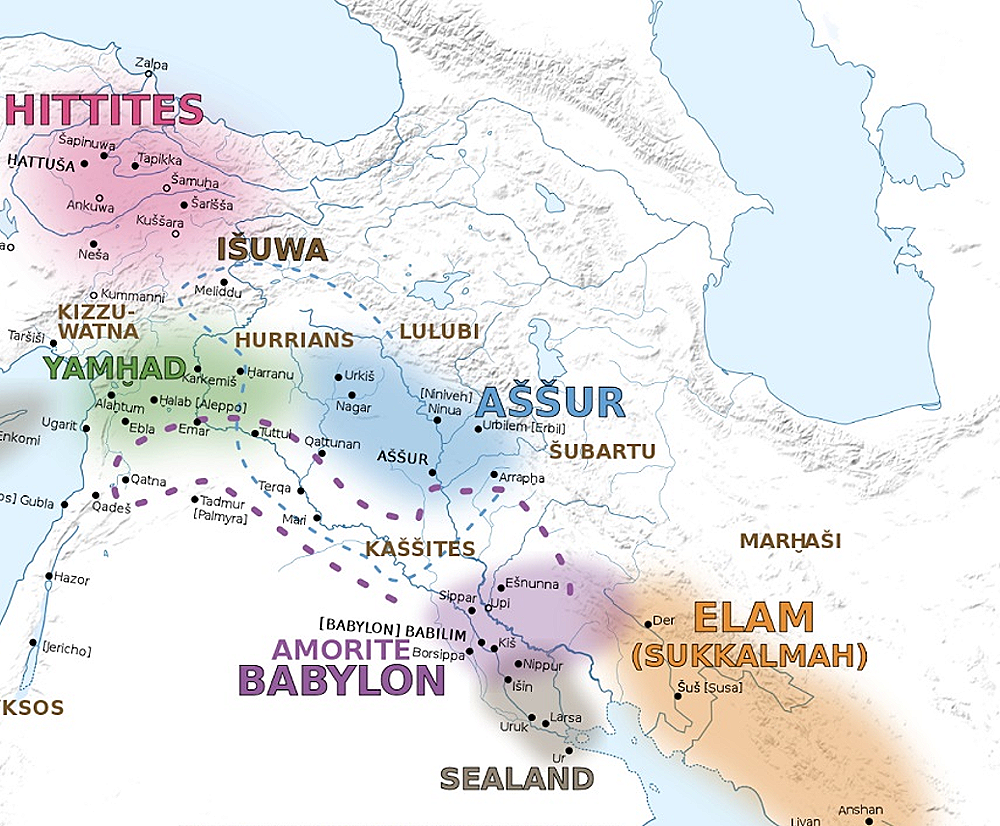
Sealand refers to the far south, including such ancient and venerable cities as Isin, Larsa, Uruk and Ur. Babylonia, on the other hand, was farther north, with the Kassites northern still – and also far to the east, even though that’s not shown in this map.
So with the fall of the 1st dynasty of Babylon, and their subsequent domination by the Kassites, the southern Sumerians felt a need to re-establish a dynasty of actual Sumerians, who literally wanted to Make Sumer Great Again.
The restoration of Sumerian kingship based on the legitimacy of Isin-Larsa strongly suggests the Sealand dynasty begins shortly after the fall of Isin to Larsa, or at least the fall of Larsa to Babylon. And we can prove that this is, indeed, the case.
Ilum-ma-ilī, … the founder of the dynasty, is known from the account of his exploits in the Chronicle of Early Kings which describes his conflicts with his Amorite Babylonian contemporaries Samsu-iluna and Abi-ešuḫ. It records that he “attacked and brought about the defeat of (Samsu-iluna’s) army.” He is thought to have conquered Nippur late in Samsu-iluna’s reign as there are legal documents from Nippur, from month 3 of Samsu-iluna year 29, dated to his reign. Abi-eshuh, the Amorite king of Babylon, and Samsu-iluna’s son and successor, “set out to conquer Ilum-ma-ilī,” by damming the Tigris, to flush him out of his swampy refuge, an endeavor which was apparently confounded by Ilum-ma-ilī’s superior use of the terrain. (Wikipedia, First Sealand Dynasty)
This gives us a link to our existing timeline, meaning the first king of the Sealand must have ruled contemporarily with these two kings of the Amorite dynasty. Another link comes later, from a year name of Abi-eshuh’s successor, whose reign must have been during or sometime after his enemy Damiq-ilishu:
…year name 37 records the destruction of an important Sealand fortress in 1648: “Year in which (Ammi‐ditana) destroyed the city wall of Udinim built by the army of Damiq‐ilishu.” (A history of Babylon, Beaulieu)
Notice it doesn’t mention Damiq-ilishu himself, just the wall he had built. That could have been done a long time earlier, and he could already be dead at this time.
And one final link exists; in the Epic of Gulkishar, a king of Sealand, he is portrayed warring against Samsu-ditana, and winning; however, it is known that he did not destroy Babylon, since the Hittites would do that a few years later.
Nathan Wasserman and Ygal Bloch also assume that it [the Epic of Gulkishar] portrays historical events, and argue that the confrontation between the two rulers occurred near the end of Samsu-Ditana’s reign, and that it weakened Babylon and directly made the sack of the city by the Hittites possible. …
In has been proposed that Gulkišar might have also controlled Babylon, though Odette Boivin considers this unlikely. However, Elyze Zomer argues that the inclusion of the Sealand dynasty in later lists of kings of Babylon might have been the result of one of its members temporarily controlling the city. This conclusion is also supported by Stephanie Dalley. (Wikipedia, Gulkishar)
The point of all of this is to establish synchronisms proving, beyond all doubt, that the Sealand dynasty was contemporary with the Amorite dynasty starting during the reign of Samsu-iluna, with Gulkishar’s long reign overlapping the end of the dynasty.
Unfortunately, the way the reigns overlap can only allow us to get within a decade or two of a precise synchronism; when exactly during Gulkishar’s 55 year reign Samsu-ditana was conquered is unknown; making it an open question when the 2nd (Sealand) dynasty actually ended.
And of course, all this assumes that these reign lengths are recorded and transmitted correctly; but there are several small conflicts with the known facts which make it hard to make everything fit, even for historians.
The reigns given, for example, do not add up to the total given in the BKL of 368; to make it fit, we would have to give some of the kings ridiculously long reigns. Even with some implausibly long reigns, like that of Peshgaldaramesh, it still only adds up to 306 – 62 years short.
So something is wrong, but we don’t know what. Historians believe the reign of Peshgaldaramesh in particular is highly suspect, and give him only 29 years. We follow that in the chart below:
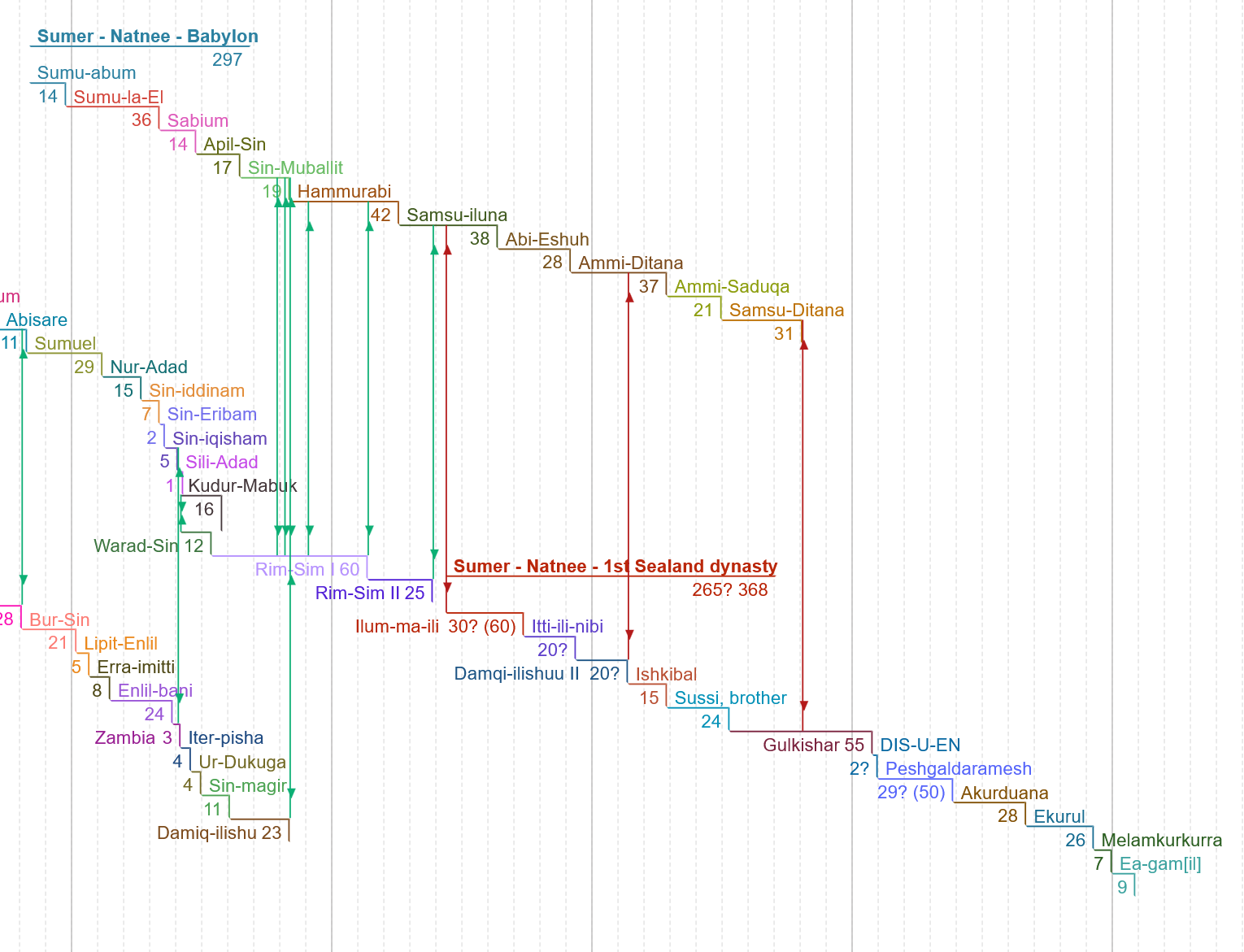
Given the lack of sources for this period, we don’t want to be dogmatic about the dates here, or even the order of the kings. This is an extremely gray area of history, where a decade or three either way cannot confidently be disputed by anyone.
Historians date the last year of the final king, Ea-gamil, to ‑1065 (adjusted dates, relative to the end of Samsu-ditana’s reign). If we accept their consensus we see that the 1st Sealand dynasty, which claimed to be the successor to Isin, actually fits in roughly the right place, chronologically, just after Isin itself.
Thus, the dynasty began very roughly 50 years after the death of Damiq-ilushu I, which makes Ilum-ma-ili’s claimed descent from him very plausible. But let’s imagine, for a moment, we had insisted on an end-to-end approach for 1st and 2nd dynasties…
In that case, Ilum-ma-ili would seem to have lived centuries after Damiq-ilushu, making us gravely doubt his claim. But when you have the dynasties arranged correctly, as historians do in this case, his claims are quite reasonable. Hold that thought.
THE FALL OF BABYLON
The exact details of the fall of Babylon and the end of the Amorite 1st dynasty are unclear. It’s generally agreed that it took place in the 31st year of Samsu-ditana, which we date to ‑1189; in that year the Hittites invaded Mesopotamia and destroyed Babylon, although no one is quite sure why, since they didn’t stick around afterwards.
After their raid on Babylon the Hittites withdrew without laying territorial claims to the region. What happened then is unclear. The prologue of a kudurru probably dating to the reign of Marduk‐shapik‐zeri (1077–1065) [traditional dates] describes in retrospect the turmoil of that period:
When the fighting of the Amorites, the insurrection of the Haneans and the army of the Kassites upset the boundaries of Sumer and Akkad during the reign of Samsu‐ditana and the ground plans could not be recognized and the borders were not designed.
The prologue does not allude to any specific event, but it suggests that the Kassites profited from the prevailing chaos, while their contribution to the fall of Samsu‐ditana may in fact have been minimal. Be that as it may, after a period of uncertainty they captured Babylon and made it the seat of their power. (A History of Babylon, Beaulieu, henceforth AHOB)
Samsu-ditana’s last attested year name is his 27th. This suggests that his last four years were tumultuous, or possibly even spent in exile. The Sealand may have conquered Babylon at that time only to have their prize destroyed by the Hittites.
According to the kudurru above, the Amorites were involved in the destruction; odd, since Samsu-ditana was himself an Amorite. In addition, the Hittites whom we know were involved are conspicuously absent from the list of enemies.
But remember to the Sumerians “Amorite” just meant “someone from the west” – thus, Hittites would be included. And the Hittites themselves claimed to have conquered and destroyed Babylon:
Further details are preserved in the Telepinu Proclamation, a Hittite historical text dating to the later part of the sixteenth century. The Proclamation states that the assault on Babylon took place during the reign of the Hittite king Mursili I …
And then he (Mursili I) marched to Aleppo, and he destroyed Aleppo and brought captives and possessions of Aleppo to Hattusha. Then, however, he marched to Babylon, and he destroyed Babylon, and he defeated the Hurrian troops, and he brought captives and possessions of Babylon to Hattusha. (AHOB)
We will return to this episode in the chapter on the Hittites. For now, it’s enough to show that, like in the time of Chedorlaomer, the Hittites were not interested in expanding their territory; they came to raid and returned home leaving Babylon in shambles.
The raid on Babylon could not have been intended to exercise sovereignty over the region; it was simply too far from Anatolia and the Hittites’ center of power. It is thought, however, that the raid on Babylon brought an end to the Amorite dynasty of Hammurabi and allowed the Kassites to take power, and so might have arisen from an alliance with the Kassites or an attempt to curry favor with them. (Wikipedia, Mursilis I)
Most of what you read about this period are educated guesses, some less educated than others; the only fact we know for sure is that the Hittites were involved in the fall of Babylon, and the Kassites were in some sense connected. Everything else is circumstantial.
Following the Hittites’ withdrawal from Babylon, the region was plunged into further political turmoil. During this period, the Kassites, who were a relatively unknown group of people in Babylonia, emerged as the preeminent authority. The precise events that led to the Kassites coming to power are uncertain, with contemporary scholars labelling this period as a dark-age given the lack of primary evidence. (Wikipedia, Middle Babylonian Period)
Pro tip: when you see the term “dark age,” you can be certain that historians are wrong about something. But this is as far forward as we can securely date for now; the end of the Sealand is estimated around ‑1065, but it’s impossible to be sure. So it’s time to try a different approach.
THE DYNASTIES OF BABYLON
According to traditional history, after the rise of Hammurabi of the 1st dynasty around ‑1792 (their dating throughout this section), an ethnic group from the Zagros mountains called the Kassites began to filter into Sumer and develop a civilization in parallel to the Amorite dynasty of Babylon and the Sealand dynasty for around a century or more.
After the Hittites sacked Babylon in ‑1595, within a few decades the Kassites were actively in charge of Babylon, and are commonly known as the 3rd dynasty of Babylon – despite the fact they do not ever seem to have actually inhabited the city itself.
In the traditional history, the Kassites were in turn conquered by Elamites around ‑1155, after which the 4th through 9th dynasties of Babylon ruled for around five centuries; it was a fragmented period of mostly weak, poor kings who left behind little record of their accomplishments – thus called a dark age by historians.
For much of the time these kings were vassals of Assyria, and Babylon was not a significant player on the world scene until the late 7th century BC saw the rise of the 10th dynasty, the neo-Babylonian empire of Nabopolassar and his son Nebuchadnezzar.
This is the traditional viewpoint; and it conflicts rather badly with our story. We have committed ourselves, with good reason, to starting the history of Sumer after the flood, with the creation of kingship somewhere around ‑2200.
Working forward from that premise, but using the same information as historians have, and in general following their conclusions, we have arrived at the date of ‑1386 for the beginning of Hammurabi’s reign, as opposed to ‑1792; so clearly, we are off by 406 years.
Or are we?
We mostly owe our knowledge of Babylonian kings to a document creatively named the Babylonian King List (BKL). I’ve summarized the dynasties as presented in Wikipedia in this chart; it is quite intimidating to our theory.
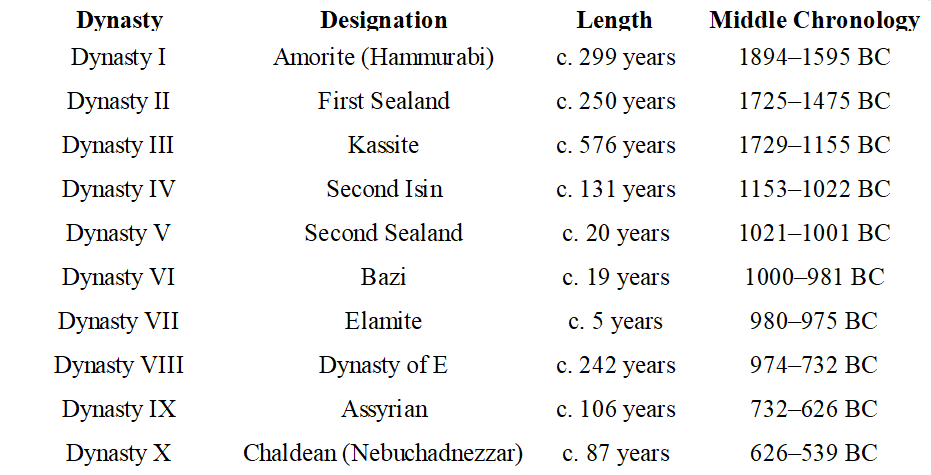
Now obviously, if this is correct our chronology is all wrong. But notice that comment at the top right? “Middle Chronology?” That is meant to tell us that this list is based on the middle chronology, one of four competing chronological schemes which differ by around 150 years.
So perhaps there is room for argument with these dates after all. These dates are presented with confidence, but when you dig into the subject a bit you realize just how much guesswork goes into these dates.
The BKL does not preserve reign lengths for many kings, and where it does, historians routinely ignore it. For example, the 3rd dynasty Kassites are given 576 years of rule, but historians say that the Kassites actually only ruled Babylon around 376 years; the first 200 years, if they are relevant at all, must apply to their ancestors who dwelt elsewhere. They say.
And they may be right; but they’re guessing. More importantly, they are not taking the king list literally, they are adjusting and rearranging it as necessary to make it fit their preconceived notions. So they really have no room to quarrel if we do the same.
Remember, this is a Babylonian king list, written in the finest Sumerian tradition; and since we know the SKL listed many dynasties sequentially even though they existed simultaneously… why should we assume that the BKL did not do the same thing?
The irony is, historians already know that 1st, 2nd, and 3rd dynasties overlapped significantly; but they assume that every dynasty after that was entirely sequential. Logically, that does not follow.
We point that out because if they weren’t consecutive, if one of them – the 3rd Kassite dynasty – was taken out of the sequence, and run parallel to 4th through 9th dynasties – then suddenly our timeline makes perfect sense.
And that would solve a lot of problems for historians at the same time.
BABYLONIAN DARK AGE
According to the traditional story, after 300-400 years or so of rule over Babylon the powerful Kassites were conquered and replaced by a series of weak, divided kings who left few evidences of their existence; until suddenly, a powerful dynasty replaced them.
But if true, there’s something very odd. There are an immense amount of documentation, records, and monuments by the Kassite 3rd dynasty. By comparison, there are almost none for the 4th through 9th dynasties. This is highly unusual in history. In almost every case, newer dynasties leave behind more material than older ones.
The post-Kassite period is literally called “the dark age between the time of Nebuchadnezzar I and the Chaldean kings,” which lasted roughly 400 years. There’s that number again. Just how dark was it, do you wonder?
In an earlier work I dealt at length with the political history of Babylonia between the fall of the Kassite dynasty (middle of the twelfth century B.C.) and the death of Shalmaneser V (722 B.C.). Because there were few written sources available for reconstructing the history of those four centuries, the materials could be gathered and discussed in relatively comprehensive fashion within a few hundred pages.
The period of the Kassite dynasty, though it covers a comparable span of time, presents different problems. Most formidable is the bulk of contemporary native documentation, which is seventy-five times larger than that for the succeeding period. Less than 10 percent of this enormous corpus has been published, and publications in various stages of preparation will not alter this figure appreciably.
…In round numbers, the Kassite period offers more than 12,000 known primary documents from Babylonia, as opposed to approximately 160 for the Post-Kassite era… (Materials and Studies for Kassite History, Brinkman; henceforth MSKH)
Let that sink in for a moment. There were, at the time of this publication in 1976, seventy-five times more material from the 400 year Kassite period than the following period which likewise lasted roughly 400 years. How is that possible?
Generally speaking, newer civilizations build on top of older ones, and almost always leave behind vastly more relics; how then is the older one vastly more present in the archeological record than the newer one?
Easy; because both sets of artifacts came from the same 400 years; part of which was assigned to an earlier period, and part of which was assigned to a later period to make it seem like it fills 800 years. But taken together, there is the usual amount of information one would expect to find.
The supposedly later kings were not later at all, but contemporary vassals; they made few records because they made few independent decisions; they were not in charge of the bureaucracy, the Kassites were.
They left few monuments because their money went to the coffers of the Kassites. Things were more rarely dated to the years of the king of Babylon because that was the prerogative of the Kassites.
But if you insist on separating these two parallel civilizations by four hundred years, and stack them end-to-end instead… well, this is how one creates a dark age. A darkness, however, which is only in the minds of the historians.
KASSITE OVERLORDS
Our theory is simple – that the Kassites ruled contemporarily for the entirety of the 2nd through 9th dynasties, and that for much of that time they were in charge of Babylonia, though not always in charge of all of it.
Full disclosure, this part of the theory is not my own; I learned it from Jim Rielly of www.displaceddynasties.com, to whom I am indebted for many breakthroughs, particularly in later Egyptian history, without which this work wouldn’t be possible. Still, I have made it my own, and refined his dating significantly. I will let him sum up the theory:
In our understanding, none of the 36 Kassite kings ever actually governed the day-by-day operations of Babylonia, which throughout its history functioned as a semi-autonomous nation, suffering invasions and periodic replacements of kings, and the shifting of the political centers of power common to the region of “Sumer and Akkad” of older times. This situation prevailed for the duration of Kassite “overlordship” of Babylonia, while the Kassite kings continued to function independently, centered in their traditional homeland in the Zagros Mountain region. Even after the 17th Kassite king Kurigalzu I constructed a namesake city Dur-Kurigalzu north and slightly east of Babylon, around the middle of the 10th century B.C. (using revised history dates), we believe the Kassites rulers spent most of their time elsewhere.
Summing up, we have absolutely no reason at this time to doubt that the 36 Kassite kings, whose combined reign lengths totaled 576 years as listed on the Babylonian King List A, were the legitimate rulers of the country for the whole of that time, all the while the land was governed by kings centered in Babylon or elsewhere in Babylonia. (DD)
His belief is that Samsu-iluna in fact lost that battle to the early Kassites, and thereafter functioned as a puppet for the duration of his reign, and the balance of the 1st dynasty. Historians would say “Absolutely not, the Amorites were independent.”
And yet… they place the beginning of the 576 Kassite period roughly contemporary with Samsu-iluna, beginning with Gandash, first king of the Kassites. Historians say he was a minor chieftain in a distant land; what would he say, if we could ask him?
The bright whirlwind, the bull of the gods, the Lord of Lords
Gaddaš, the king of the four quarters of the world, the king of the land of Sumer
And Akkad, the king of Babylon, am I.
At that time, the Ekur of Enlil [at Nippur], which in the conquest
Had been destroyed (remainder gone) — (Inscription of Gandaš, as quoted in Wikipedia, Gandash)
Historians reject this out of hand as a late copy, pure fancy. But it fits. We know Samsu-iluna fought the Kassites shortly before this, and we have reason to believe it did not go well. In fact, after this, the titles of the Amorite kings are recorded differently:
The use of royal titles in this chronicle is desultory. For example, while Hammurapi and Samsu-iluna are specifically called king, Abi-ešuh and Samsu-ditana are not. (MSKH)
Brinkman notes this fact because it’s downright strange. Why the sudden change in titulary? Because they were no longer kings – not really. It makes perfect sense, when you know that the Kassites conquered Samsu-iluna.
As the Babylonian empire weakened in the following years the Kassites became a part of the landscape, even at times supplying troops for Babylon. (Wikipedia, Kassites)
This also explains why we find the Kassites in the armies of Babylon. Certainly no country has ever been comfortable hiring soldiers from their enemy; and since we know the Kassites attacked Babylon in the time of Samsu-iluna, it’s very odd that their soldiers are in the Babylonian army a generation later.
One interpretation, the one generally accepted, is that the mighty Amorites hired Kassite mercenaries; the other is that the weak Amorites submitted to the Kassites, who then fought alongside them. We have explicit evidence for this relationship:
“Thus speaks Ammi‐saduqa. The translator who came from the encampment of the Kassites informed me that numerous Samharite troops have already crossed over into the heart of the country in order to attack the herds, flocks and troops.” (AHB)
This is the behavior of close allies, or of a master-vassal relationship.
SEALAND AND THE 2ND ISIN DYNASTY
Farther to the south, in opposition to the Kassites, and often warring with their Babylonian puppets, the Sealand kings remained free. Abi-eshuh, no doubt at the behest of his Kassite masters, tried to catch Ilum-ma-ili but failed – the south was an immense marshland, nearly impossible to invade, even up into modern times.
What’s strange is why the Sealand was included in a list of “kings of Babylon” when historians doubt they ever actually ruled it; if they did, it was only for a few years before the Hittites destroyed the city.
That, in turn, casts doubt on the understood purpose of the Babylonian King List itself; if the Sealand was never actually ruling in Babylon, maybe the king list itself isn’t meant to portray kings of Babylon, but of somewhere within Babylonia.
Thus, a king of Babylon might rule alongside a king of the Sealand far to the south; there may also be room for a king to rule Isin alongside both; and some, or all, of these kings may be subject to a Kassite king whose armies project power throughout Babylonia.
With this interpretation, the supposed “dark age” that followed the sack of Babylon didn’t exist; for if we take historians’ dates for the start of the 4th dynasty (-1153), the so-called 2nd Isin dynasty, but use our dates for the fall of Babylon (-1189)… they line up pretty close.
Since we don’t believe the kings of Isin actually ruled in Babylon at all, but from Isin – hence the name – then the easiest story to tell is that, promptly after the sack of Babylon by the Hittites, the Kassites installed a new leadership in the nearby city of Isin to keep the hostile 1st Sealand dynasty at bay.
That would explain a lot of things.
In his inscriptions Nebuchadnezzar revives epithets of the First Dynasty, particularly those of Hammu‐rabi such as “king of justice” (shar mesharim), “true shepherd” (re’u kinu), and “sun‐god of his land” (Shamash matishu). In spite of the rhetoric projecting the image of a strong, centralized kingship, Nebuchadnezzar had to share his authority with local officials, especially Kassite tribal leaders. Shitti‐Marduk, the head of the Kassite clan of Bit‐Karziabku, obtained the reinstatement of his district’s autonomy with increased tax exemptions, and the prologue of his kudurru, while acknowledging the preeminence of Nebuchadnezzar, celebrates his own exploits in an epic style normally the prerogative of the king. The Hinke kudurru records a grant to the mayor of Nippur; while cursorily acknowledging Nebuchadnezzar, it portrays a Kassite official named Baba‐shuma‐iddina of the Hunna clan (Bit‐Hunna) as the actual granting authority. The same Baba‐shuma‐iddina is later attested as governor of Babylon in the Shitti‐Marduk kudurru. (AHOB)
Historians believe that approximately 600 years after Hammurabi, for no apparent reason, Nebuchadnezzar I of the 4th dynasty “revived” epithets he used. This would be a lot more likely if the 1st dynasty had literally just ended a few decades earlier.
Historians also believe that the first ruler of the 4th dynasty took over after the Elamites conquered the Kassites in ‑1155, yet somehow within literally 30 years the king of the 4th dynasty found himself “sharing his authority with local officials, especially Kassite tribal leaders.”
So somehow they had enough power to take over for the Kassites… but still had to share power even though the Elamites had already defeated them? And they chose as their model for kingship a dynasty of foreign Amorite kings from half a millennium earlier?
Really?
SHARING WITH KASSITES?
Although they teach the party line in all the textbooks, privately they doubt the reconstruction of the 4th dynasty kings as powerful; they even explicitly suggest they might be vassals, although they guess wrong about who the masters really were:
Another fragmentary text of Shilhak-Inshushinak’s records the plundering of cattle at Hussi, a city located near Upi/Opis in northern Babylonia, and it also mentions the Tigris, the Euphrates and Nippur, suggesting that the conquests extended both west and south of the northeastern frontier belt just described. In view of conquests such as these, one must query the status of the early kings of the Second Dynasty of Isin who ‘ruled’ at this time. Some scholars have gone so far as to suggest that they were in fact Elamite vassals. While not implausible, there is no evidence that such was the case. (Archeology of Elam, Potts)
While there is no evidence of Elamite vassalage, you just saw above that there is evidence that the kings of Isin had to share power with Kassites. We find more evidence on a Kudurru of Nebuchadnezzar I…
When Nebuchadnezzar, the exalted and noble prince, the offspring of Babylon, the ruler of kings, the valiant patesi, the governor of Eridu, the Sun of his land, who makes his people prosper, who protects boundary-stones, who holds fast the boundaries, the king of justice, who pronounces a righteous judgment, the strong hero, whose might is devoted to waging war, who bears a terrible bow, who fears not the battle, who overthrew the mighty Lullubi with the sword, the conqueror of the Amorites, the despoiler of the Kassites, the appointer of kings, the prince beloved of Marduk — when the king of the gods, Marduk, sent him forth, he raised his weapons to avenge Akkad. (Babylonian boundary-stones… in the British museum, King)
Notice the need to avenge his people. From whom? Evidently, Kassites and Amorites (and from other monuments, Elamites as well). Amorites had been the former occupants of Babylon five centuries before, in the traditional timeline.
After the fall of Hammurabi and several other Amorite dynasties, they were gone. By the 12th century, they were not a notable force in Sumer. So why, then, does Nebuchadnezzar claim to be a “conqueror of the Amorites?” Even as he borrows the titles from the Amorite 1st dynasty of Babylon?
After half a millennium, this makes no sense at all. But if the Amorites (Hittites) had been in the area just 30 or so years before sacking Babylon, that makes perfect sense. Especially if he, as a young man, had been in the armies helping to repel them.
You’ll also note he was a “despoiler of the Kassites.” At first, this would seem to contradict the idea that he was a Kassite vassal; but remember, he explicitly shared power with Kassites. They fought in his armies. And then there’s this:
The Babylonians divided those into kingdom resident Kassites (referred to as such) and Kassites from peripheral areas termed Samḫarû and Bimatü. (Wikipedia, Kassites)
Just a century or so earlier Babylonians distinguished between “kingdom” Kassites – i.e., those of the line of Kassite kings of the 3rd dynasty – and their enemies of other tribes who were also ethnically Kassite.
So there is no contradiction between Nebuchadnezzar “despoiling” Kassites, and also serving them; between him killing Amorites and also claiming legitimacy by imitating earlier Amorite kings.
Historians on the other hand struggle to explain why he was a “despoiler of the Kassites,” since their story goes that he lived 30 years after the last Kassite king fell to the Elamites. There should have been nothing Kassite left to “despoil.”
It’s a great fit for us, of course, since in our timeline, the Kassites were still reeling from their loss of Babylon.
THE RETURN OF MARDUK
We will devote an entire chapter to this later, but when the Hittites sacked Babylon in ‑1189 they took back with them a statue of the god Marduk, the city’s chief god. This was vital to several religious ceremonies, and so its return was a significant event.
A later document recalls the event from the perspective of the god and claims that he spent 24 years there before being returned from the Hittites, although he doesn’t name the king who recovered him.
However, if we pair that fact with the inscription of Agum-kakrime, the 8th Kassite king, he mentions recovering a statue of Marduk from that region and takes credit for it.
I sent a message to the distant land, to the land of Haneans. They seized the hand (i.e., led in procession) of Marduk and Zarpanitu and I indeed returned them – Marduk and Zarpanitu, those who love my reign – to Esagila and Babylon. (Inscription of Agum-kagrime, The Marduk prophecy, Darabi)
This doesn’t explicitly mention the Hittites, but Hana is in the far northwest, roughly half-way to the Hittite land from Babylon. It makes a plausible exchange point. And Agum-kakrime lived at roughly the right time frame, although the part of the tablet that recorded the reign lengths of the early Kassite kings is badly damaged so we don’t know for sure.
However we now pair that with another fact; that Nebuchadnezzar I is known to have recovered a statue of Marduk; historians universally believe this to have come from Elam, however this story is reconstructed from several different narratives woven together, and we will take it apart at length in the appropriate chapter.
For now, if we accept that Nebuchadnezzar I and Agum-kakrime both existed at roughly the same point in history – in our reconstruction, ‑1164‑1143 and ‑1184‑1154, then it’s interesting that separate traditions connect both of them to the return of a statue of Marduk which would only happen if they were master and vassal, working hand-in-glove and both receiving credit.
Bearing in mind that all of these dates are approximations within a few years at best, even for historians, then their reigns both fall very near our 24 year window after the fall of Babylon in ‑1189. Very convenient.
Another possible synchronism is…
A kudurru dated to the first year of his son and successor Marduk‐shapik‐zeri records a grant of land to the prefect of the palace gate, one Shiriqti‐Shuqamuna, son of Nazi‐Marduk. The document specifies that the land had been confiscated from the previous holder of that office, a certain Uzib‐Shiparru, son of Abirattash. (AHOB)
Marduk-shapik-zeri ruled ‑1120‑1108, so his first year was ‑1120. In that year, a land grant was given to Shiriqti-shuqamanu, prefect of the palace gate. The land he was given had been taken away from the previous holder of that office.
Now it’s impossible to know how long Shiriqti had held the office after his predecessor, but let’s speculate 10 years. Uzib-shiparru was presumably an adult, and let’s say he retired at the age of 60. Rank speculation I know, but we have to have something. That means he would have been born in ‑1190.
His father was named Abi-rattash, which happens to be the same as the name of a Kassite king who ruled very roughly from ‑1244‑1124. This doesn’t quite fit, but it’s close enough to make us wonder if these are the same king.
The name is quite rare, almost unattested outside of these two instances, and the dating of the early Kassite kings must be regarded as extremely rough; an error of 20-40 years would not raise any eyebrows. It cannot be proven, but it makes one wonder.
THE END OF SEALAND AND 2ND ISIN
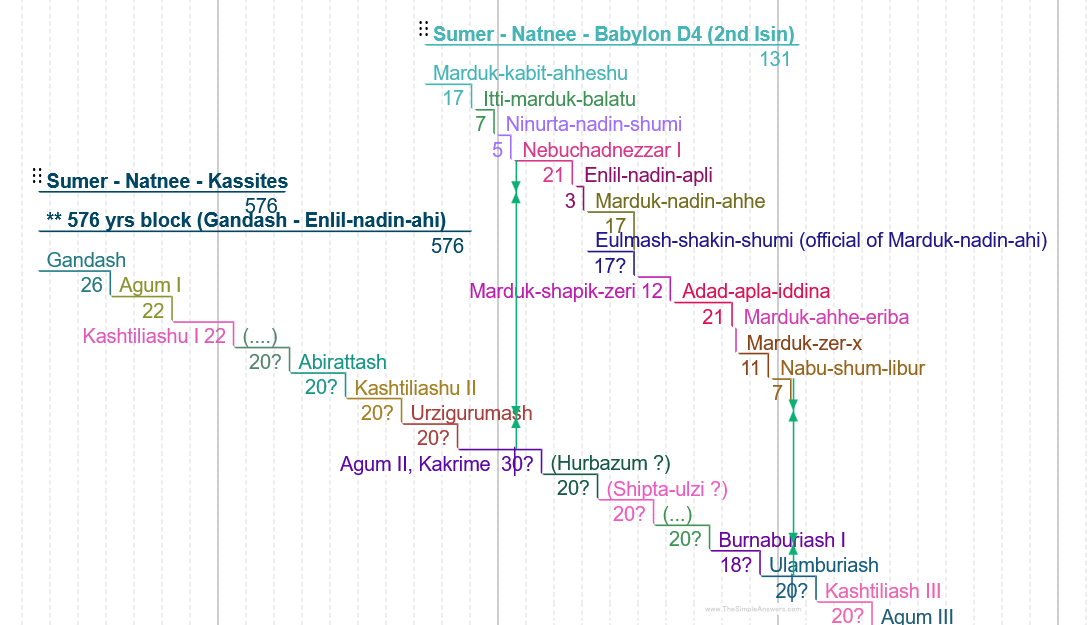
It so happens that in our reconstruction 2nd Isin and 1st Sealand ended at roughly the same time; since they almost certainly ended at the exact same time in reality, we will align the end of 1st Sealand with the end of 2nd Isin to reflect a single Kassite campaign to conquer southern Mesopotamia once and for all in ‑1065.
The Kassites ended the Sealand’s occupation of the captured territories and during the reign of King Ulamburiash I, they consolidated their authority … by subjugating the First Sealand dynasty, who now only occupied the southern coastal and swampland regions of Mesopotamia. By conquering the Sealand’s territories, the Kassites were able to reestablish the previously disrupted lucrative trade routes in the area. After the subjugation of the Sealand dynasty, the Kassites had successfully unified the whole of southern Babylonia into a centralised political entity and established the Kingdom of Babylonia (known in international correspondence as māt Karduniaš). Prior to this point in Near Eastern history, southern Babylonia had not been controlled by one ruling entity. (Wikipedia, Middle Babylonian period)
Despite their significant accomplishments, this period of history provides little details about the Kassites, their very names are lost in some cases. Kings #4-11 are particularly obscure. Perhaps their obscurity reflects their absence from the Mesopotamian scene after the loss of Babylon, leaving the Isin and Sealand dynasties to carry the Sumerian banner.
After Ulamburiash conquers 2nd Isin and the Sealand, suddenly the Kassites are much better documented and clearly are more powerful. Because they’re finally back in Babylonia.
SECOND SEALAND
Historians don’t think any of the 1st Sealand kings actually ruled Babylon, and are naturally confused as to why they were included in the list; we are not, because this list is the heir of the SKL. We would expect different locations to have different kings ruling at the same time.
This is one of the key “common sense” things we do. The SKL had always been arranged as “1st dynasty of Ur,” “1st dynasty of Uruk,” and then later “2nd dynasty of Ur,” “2nd dynasty of Uruk,” etc.
And in most cases, the 2nd dynasty followed chronologically after the end of the 1st, even though they might be separated by a dozen other dynasties in the list. That’s just how Babylonians thought about king lists.
This means that in the SKL there was an Isin dynasty, then in the BKL there was a 2nd Isin dynasty; the BKL has a 1st Sealand dynasty, then a 2nd Sealand dynasty. These are location-specific dynasties, and in the tradition of the SKL they overlapped in time, but not in location.
So far, we’ve relied on historians to rearrange the 1st through 3rd dynasties in parallel, which we agree with. Then we’ve added the 4th dynasty to follow the fall of Babylon, deleting the 400 years or so which separated them in the traditional history.
But now it’s time to do the same with the 5th dynasty, which we place immediately following the 2nd dynasty because they had the same name. Logically, then, it should follow the 1st Sealand dynasty. Right?
But this is a problem for historians; because in the traditional history, the 2nd Sealand dynasty was separated from the first by nearly 500 years. That’s a long time for a dynasty to be dead before revival; I would argue that it’s unprecedented. But in our timeline, it naturally follows immediately after the first.
And this is not just speculation, we have two strong reasons to believe we are right. First, because the first ruler of the 2nd Sealand is Simbar-shipak, the first ruler of a Babylonian dynasty to have a Kassite name (outside of the 3rd dynasty itself).
All three rulers of Sealand II appear to have had some Kassite background. The name Simbar‐Shipak is purely Kassite. (AHOB)
In the traditional history, the Kassites had been conquered for 130 years; why, suddenly, does a Kassite appear on the throne? Yet this is exactly what we would expect, because we believe the Kassites conquered all of Babylonia for the first time in ‑1065, and promptly set up an ethnic Kassite king to keep the peace in their new possessions.
This king, though loyal to the Kassites, immediately set about establishing his Babylonian bona fides, giving us our second strong reason to believe we are right and historians are wrong; the 2nd Sealand dynasty considered itself the legitimate heir of the 1st Sealand dynasty;
The [first] Sealand Dynasty seems to have considered itself the inheritor of the neo-Sumerian beacon and the 3rd king, Damqi-ilišu, even took his name [from the final king of 1st Isin]. The founder of the 2nd Sealand Dynasty, Simbar-Šipak [-1065-1048], was described as “soldier of the dynasty of Damiq-ilišu,” in a historical chronicle. (Wikipedia, Dynasty of Isin)
So note the consistent thread running from Damiq-ilisu I, final king of Isin, to the 1st Sealand dynasty whose third king took his name, straight through to the 2nd Sealand dynasty who expressly identified himself as “a soldier of the dynasty of Damiq-Ilishu.”
According to the Dynastic Chronicle … “Simbar‐Shipak, a soldier resident of the Sealand, descendant of Eriba‐Sîn, a soldier who died in combat during the reign of Damiq‐ilishu, reigned seventeen years; he was buried in Sargon’s palace.” This Damiq‐ilishu must probably be identified as the third ruler of the First Dynasty of the Sealand and the entry must reflect an attempt to connect the new royal house of the Sealand with the first one. (AHOB)
For us, this makes perfect sense; Isin predates the 1st Sealand by not more than 50 years, probably less. 2nd Sealand immediately follows the 1st Sealand, ruling the same territory, albeit under Kassite control.
For historians, this is a grave problem, bordering on the absurd. Because between 1st and 2nd Sealand, they insert 435 years of the Kassites and 131 years of the 2nd Isin dynasty. Which means, in their version of history, Simbar-shipak was trying to ideologically resurrect a kingdom which hadn’t existed for half a millennium. Foolishness!
It’s as if I was to claim myself the heir to a kingdom from the 1500’s; first, how could I hope to prove it; and second, why reach back so far? Was that the last person in my ancestry to do anything important? Beyond a century or two at most, such ancestor-derived legitimacy fades rapidly.
So we understand why historians are so dubious about his claim to fame; there is no way that Simbar-shipak could possibly know if he was related to Damiq-ilishu, who lived roughly 600 years earlier. I might as well claim to be a direct descendant of Christopher Columbus, and his rightful heir.
Naturally, in our chronology, it makes a lot more sense. We place Simbar-shipak ruling from ‑1065‑1048, and Damqi-ilishu II ruled ‑1280‑1260; that’s less than 200 years, making it much more plausible that a king might know his ancestors that far back.
Even today, many people trace their ancestry to Abraham Lincoln, a few even to George Washington. How many can trace it back to Henry V (1387-1422)?
How many would care if they could?
Think about that.

This is part 22 of The History of the World Series
 After Amarna
  Akhenaten the Heretic
  The Richest Man in History
  Thutmose III and Shishak
  Solomon and the Queen of Sheba
  What Is The LOVE Of God?
  Everything You Believe About God Is WRONG!
  Make Up Your Mind!
  What Is Faith?
  How DARE you FEAR the judgment of God!
  Firstripe Figs
  The Bride Of The Father
  Exodus 40 – The Plan Of God
  The Temple Of God
  Pillars Of The Temple And The Brass Sea
  GEHENNA WITH ‘EM
  When Did God Forbid Polygamy?
  When You Shouldn’t Pray For Someone
  The Sins of the Father
  The First Paul